Lee Burkhill: Award Winning Designer & BBC 1's Garden Rescue Presenters Official Blog
Intermediate level
Designing a child friendly garden that is both fit for children and adults can feel overwhelming. However, with careful planning and some selective zoning, it can be achieved. Even a beginner gardener can help transform their garden space into one thats kid friendly. This article details everything you need to know to design a fabulous child (and inner child) friendly garden.
When it comes to garden design for children, you may have seen gardens turned into playgrounds with wood chips everywhere or worse, fake grass and the obligatory swing set. However, there are many better ways to subtly design a garden that makes it exciting for children without completely removing the attraction for grown-ups!
Usually, people start by buying a massive set of play equipment and then try to shoehorn it into the garden, making it the focal point and looking out of place with the rest of the garden design. However, there are many better ways to create a garden that your children will love without sacrificing their own enjoyment, which I’m going to show you in my guide. After all, I’ve been designing award-winning gardens for decades and have drawn up many for the BBC’s Garden Rescue!
Quick Answer
The key to a child-friendly garden is zoning: dividing your space into dedicated areas for play, planting, and adult relaxation. Use soft natural surfaces like bark chip and real turf rather than artificial grass, choose resilient plants like Alchemilla, Hydrangeas, and hardy Geraniums, and integrate play features such as mud kitchens and sunken trampolines that blend into the design rather than dominating it. Avoid open water features with young children present, and always consider how the garden will evolve as your children grow.
This page contains affiliate links for products I use and love. If you take action (i.e. subscribe, make a purchase) after clicking a link, I may earn some gardening commission, which helps me keep the Garden Ninja Blog free for all.
What is a child-friendly garden?
A child-friendly garden is a space that accommodates and encourages children to get outside and explore the space. Often child-friendly gardens feature play, sensory elements and planting to stimulate younger family members to get out into the garden. A child-friendly garden is not just a lawn or a play set stuffed into the corner of the garden!
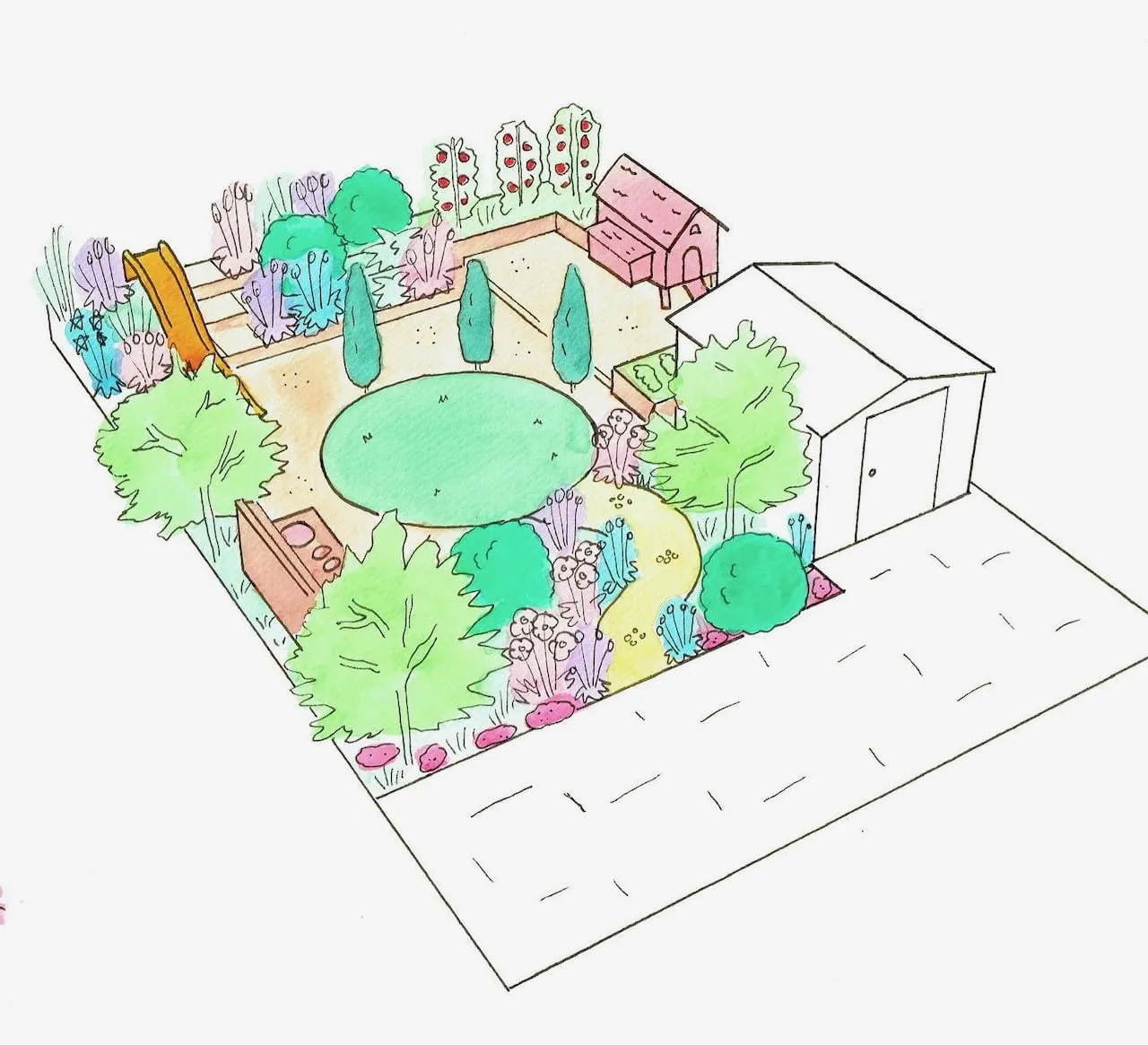
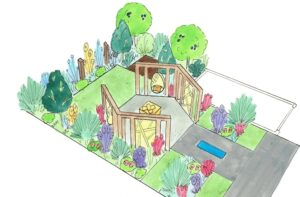
A child-friendly garden is a well-thought-out and multifunctional space which all ages can enjoy. If this type of garden is designed well, it shouldn’t scream ‘playground’ and will look beautiful and be functional for the entire family. The example above shows how a carefully planted and designed garden can accommodate children’s play as a seamless part of the overall design.
Can you spot the slide, mud kitchen and chicken coop above?
Designing from a Child’s Eye View: The Perspective That Changes Everything
One of the biggest mistakes I see when reviewing family garden designs is that they’ve been conceived entirely from adult height and adult priorities. Before you sketch a single zone or order a load of topsoil, get down on your knees and look at your garden from your child’s perspective. That beautiful Miscanthus grass you’ve been eyeing up? From a toddler’s viewpoint, it’s a towering forest of rustling giants. That gap under the rhododendron that looks scruffy to you? That’s a palace, a den, a secret headquarters to a five year old.
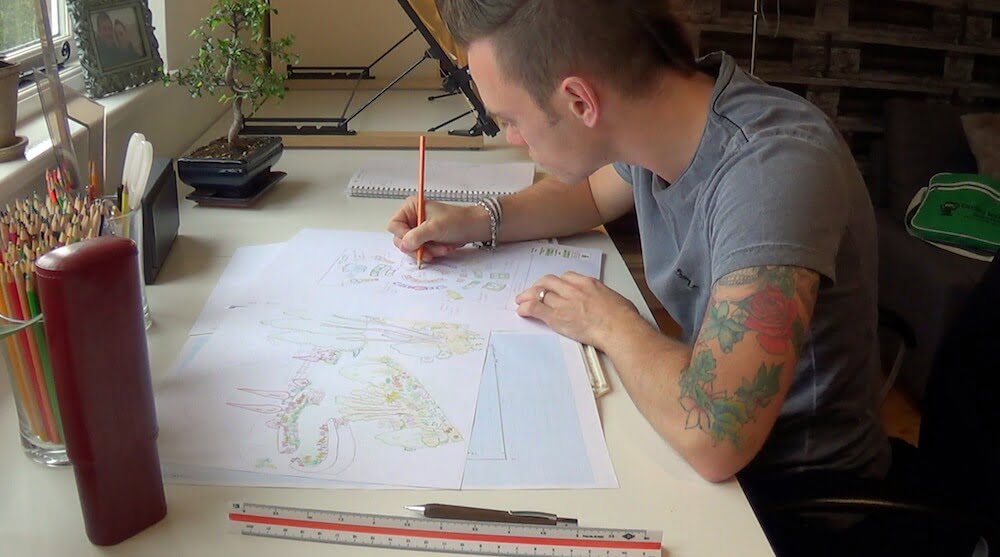
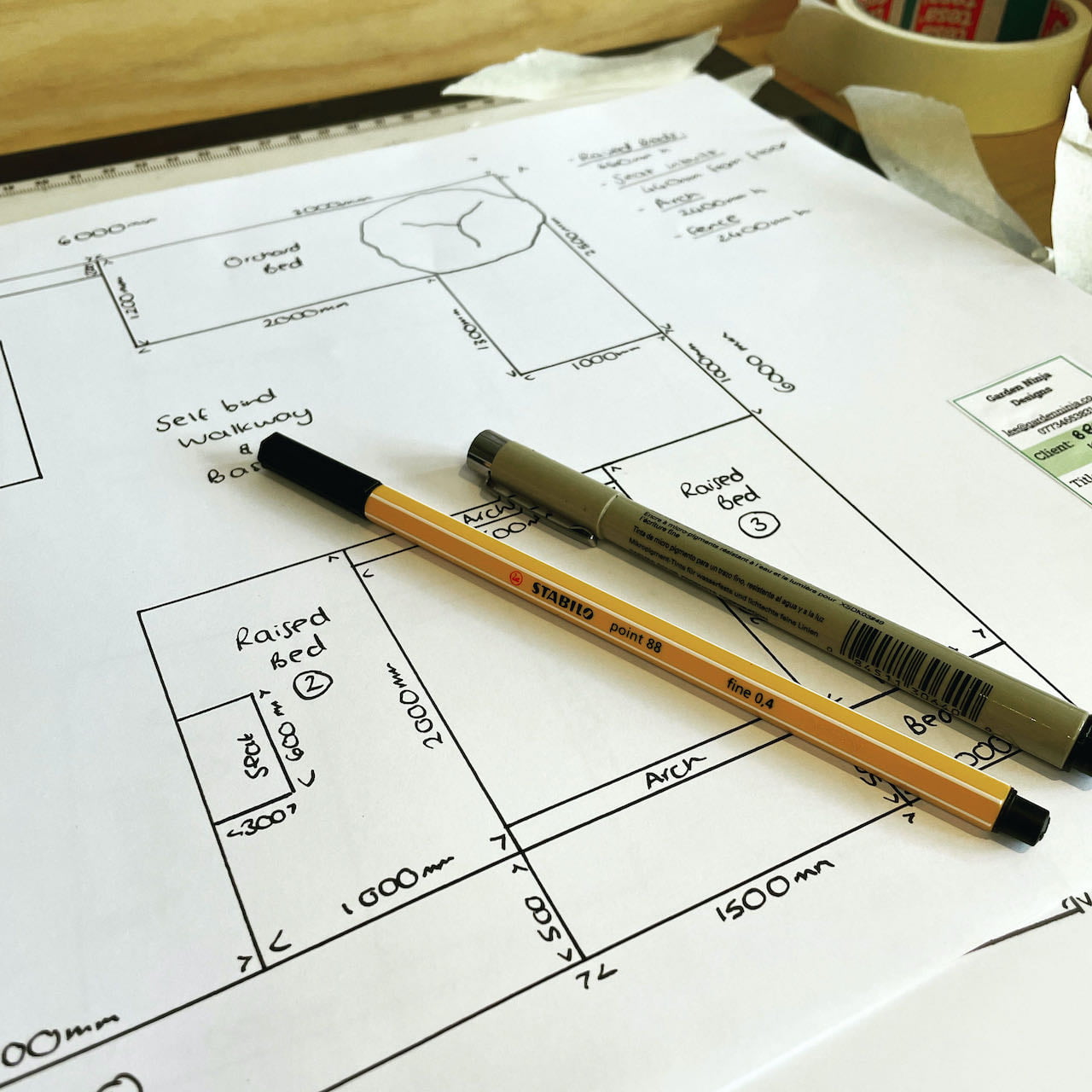
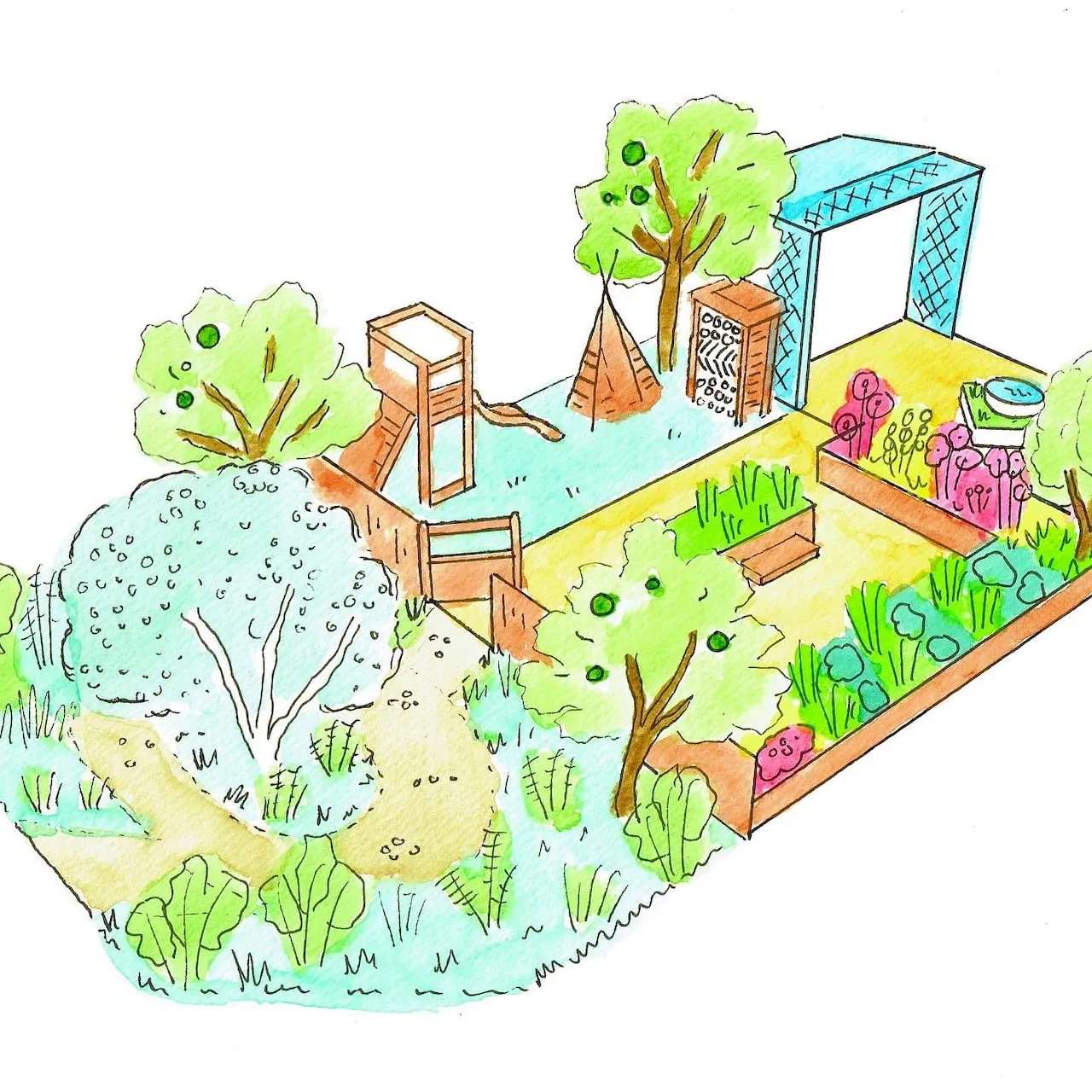
Garden Ninja Hand Drawing
When I’m designing family gardens, I literally get down on the ground and photograph the space from about 60cm high. The view from down there is completely different. You notice the underside of shrub canopies, the way light filters through foliage at different angles, and the sheer scale of what seems ordinary to adults. A standard raised bed wall at two sleepers high creates a proper fortress wall for younger children. That magnolia tree you planted five years ago? The lower branches become monkey bars, and the canopy overhead creates a natural roof for imaginative play.
This perspective shift extends beyond the physical. Children don’t see “dead space” the way adults do. That slightly muddy patch where grass won’t grow? They see a dig zone, a place to make potions, somewhere to examine worms and beetles up close. The challenging damp corner of your garden isn’t a problem to solve but an opportunity to create something mysterious and exciting.
Think about how meadow planting works from child height as well. What might come up to your knees creates an entire landscape for smaller children to navigate through, with tall stems becoming pathways through a miniature wilderness. The same planting that provides seasonal interest and pollinator value also offers your children an ever-changing adventure course. I used this exact approach in a Bristol garden where the clients were worried about losing lawn space. We created flowing drifts of prairie-style planting at varying heights, and their children spent more time exploring those borders than they ever did on the previous lawn.
Your design should accommodate different ages as well. While a toddler needs visible hiding spots where you can still see them, but they feel concealed, teenagers need genuine privacy. A seating area tucked behind a pleached hornbeam screen or within a pergola draped with climbing roses gives older children somewhere to retreat that feels separate from the main adult zones.
How to design a child friendly garden
Now, before you go appointing a landscaper and ordering all your play equipment, it’s time to step back and survey your current garden, then develop a considered design from that survey. Let me walk you through the steps I use for every child-friendly garden I design at Garden Ninja HQ.
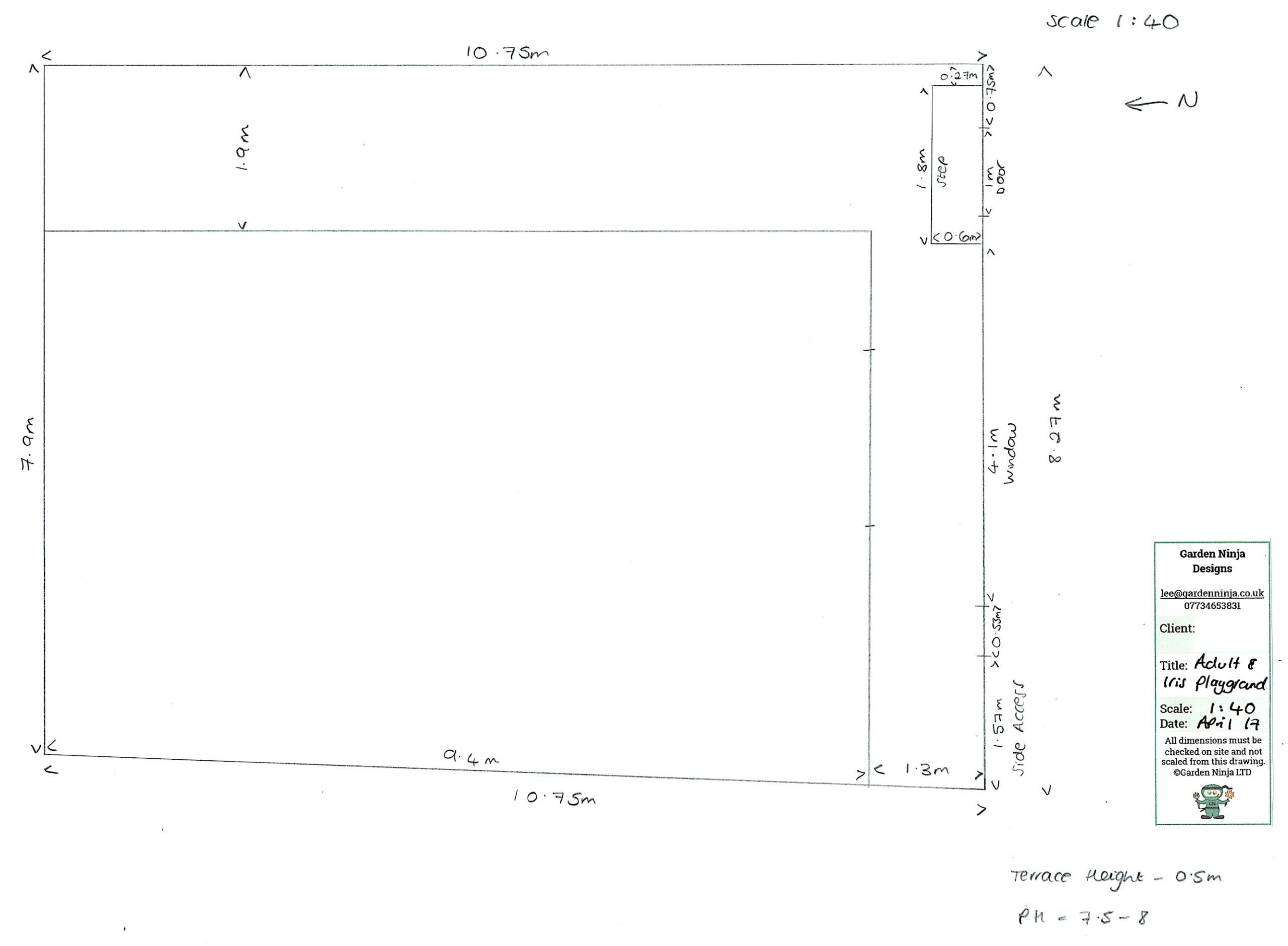
Step 1: Draw up a garden survey
The first thing I do before starting any garden is to draw up a scaled plan or survey of the garden area. This can be as simple as measuring the perimeter and a few measurements across the midpoint of the garden to get an idea of size.
This then enables you to work out what will fit where and plan the layout of the garden.
Step 2: Work out how many areas or zones you need
Garden zoning is a really good way to work out which parts of the garden are dedicated to which family members. Through zoning, you can work out which part of the garden gets the most sun for an adult sitting area and which part may be more shaded, perfect for a children’s play area. You can read more on zones in a garden below.
Shaded areas are often better for children as it prevents them from becoming overexposed to the sun and these areas lend themselves better to blending in play equipment. It also adds that feeling of mystery for children, which can really help with active play.
Step 3: Sketch up your plan to scale
The next step is where most people stop, as it involves some drawing. However, this is the most important part of child friendly garden design. By sketching out the zones, areas, and buildings (such as playhouses or sheds), you can start to work out how the different zones work together. You may even find that you have to reduce the zones at this stage as you have too many.
This is the ideal time to spot these design issues rather than when a builder turns up to start landscaping. That’s why this step is so important. It helps prevent mistakes and work out precisely what you and your children need in the garden.
Step 4: Ensure that you have height and transition spaces within the garden
An excellent way to help connect the zones and bring some privacy is to use heights such as small garden trees or screens to provide different areas in the garden. By using these, you can make the garden feel much bigger and private whilst still keeping an eye on your children as they play, meaning both children and adults feel like they have their own space and privacy.
Step 5: Incorporate suitable play equipment and wild play areas
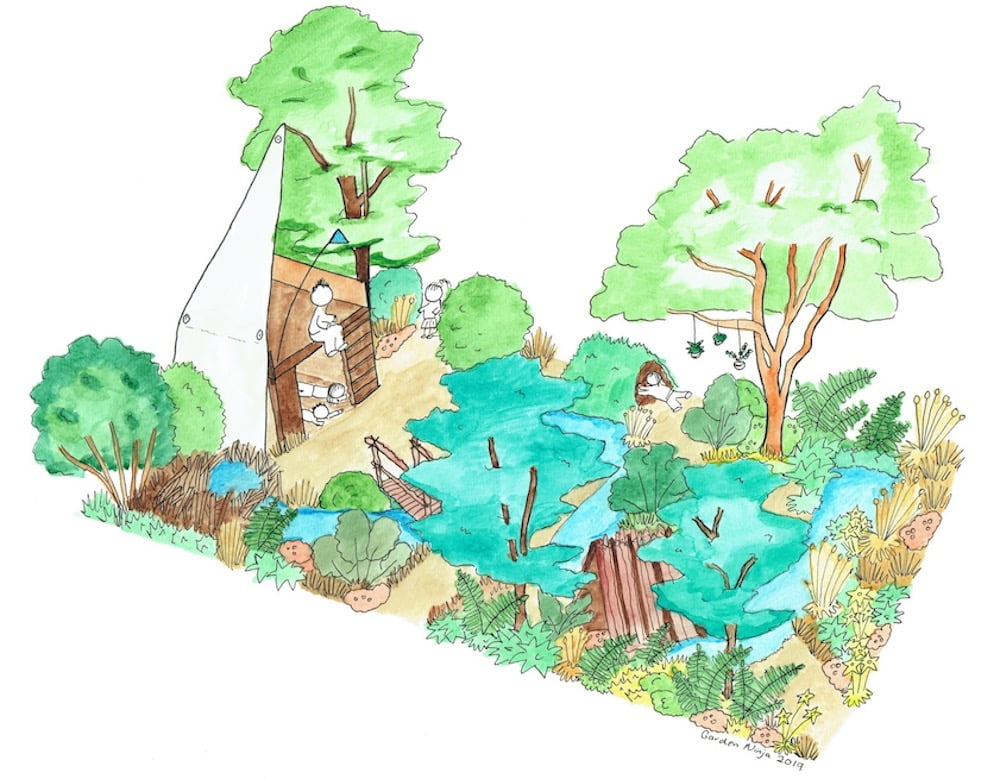
Now it’s time for the fun bit, adding the play areas to the garden! If you’ve got a specific play zone, it may be that you fill this area with various play obstacles, interactive items, swings or even a den. You could also interweave the play activities throughout the zones meaning the children can explore more. It really is up to you. See below how a teepee, climbing frame, and woodland path are all used for play while complementing the overall design.
One of the best ways of encouraging children to use a garden is to use wild play. Natural materials such as logs, rope swings, and stepping stone paths encourage them to explore and make their own stories and integrate these within the garden design.
Step 6: Choose child friendly plants, trees and shrubs
No garden is complete without a lush planting plan that really brings the area to life. Don’t just think about lawns but use deep herbaceous borders to add interest, scent and interest for wildlife. Trees can bring height and attract birds, shrubs give winter structure and can help screen off play areas, and a rich herbaceous series of borders helps soften the transition between the zones.
Step 8: Incorporate growing your own plants from seed
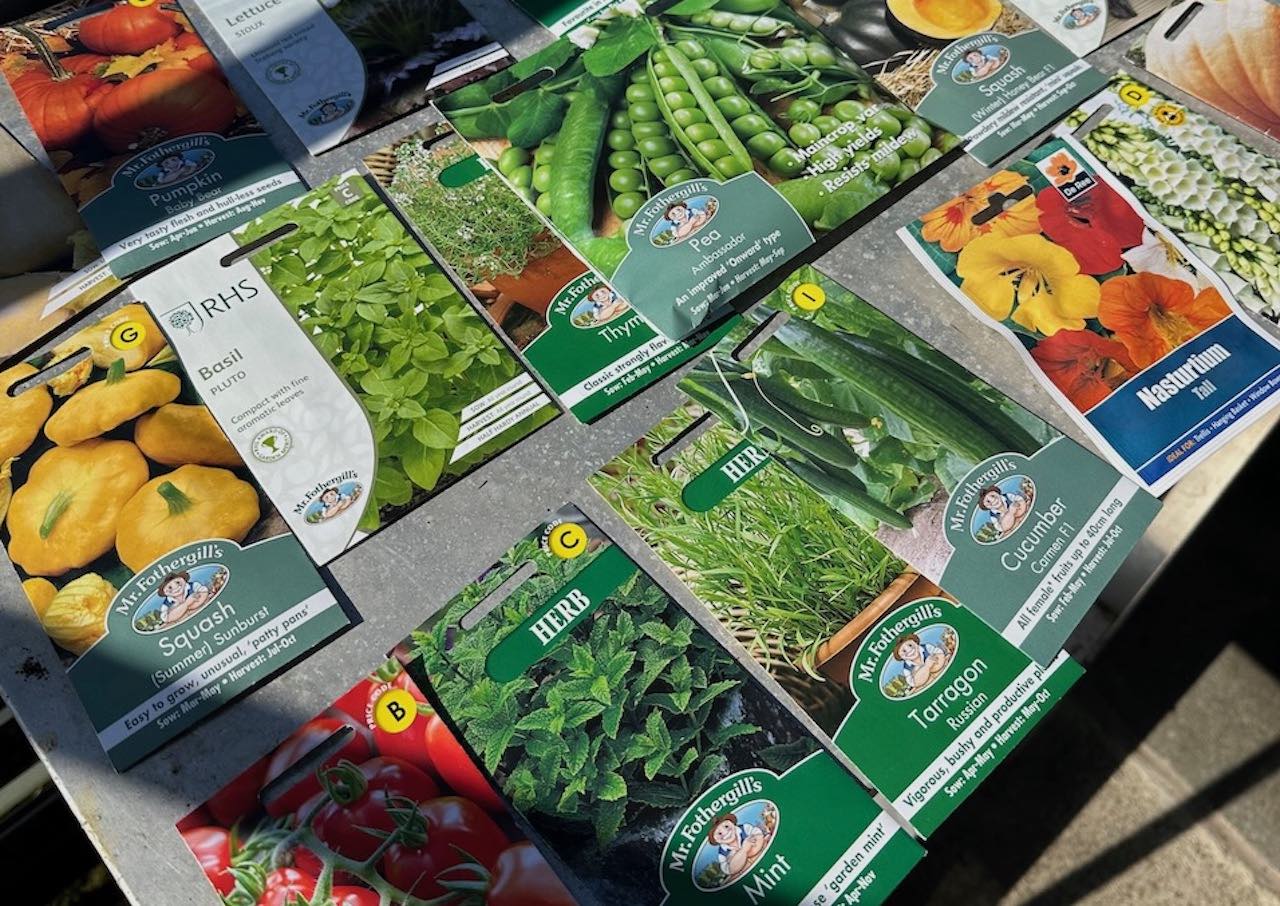
If there is one thing that children love to do in the garden, it is to grow plants from seed. Taking a few packets of seeds, whether vegetables or flowers and growing them with your children is a fantastic activity to help teach your children about the life cycle of plants and where their food comes from.
When it comes to design, why not factor in a cold frame, greenhouse or even just a simple potting table area where you and your children can grow your own plants? I guarantee you will both be hooked once you start!
If you’ve seen my other work on family-friendly garden design you will know how I love to zone off gardens. Zoning helps give a purpose to each space, whether it’s the children’s play area, the grow-your-own section or the relaxed adult chill-out area.
Garden zoning will help you easily design a space that has separate needs without it turning into a mishmash of flying footballs, prize flowers getting damaged or having to relax in the middle of a play area!
Examples of garden design zones
Seating areas for adults and children
Play areas
Planting beds
Grow your own zone
The separation between the zones (walls, borders, hedges)
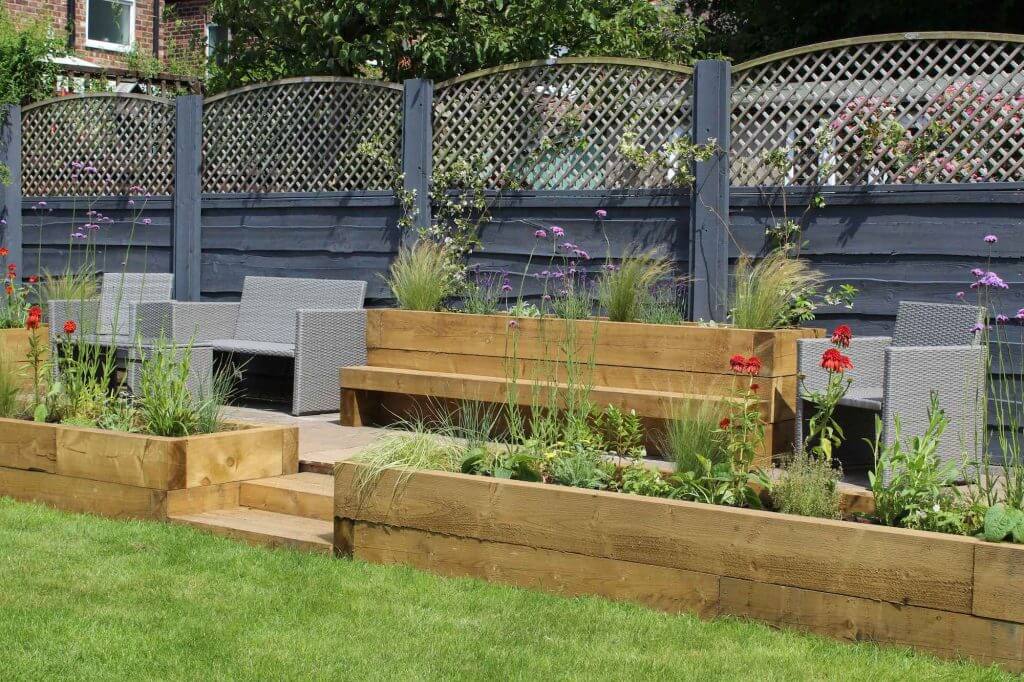
See how a small timber wall above separates the adult area from the main play lawn? Creating a clear marker between the two whilst allowing parents and children to interact. It also means that plants are protected from toys, and the adults sit in an elevated position where they can keep an eye on younger children.
Child Friendly Materials in Garden Design
The first thing I like to do is to plan exactly what type of materials I will use in a child-friendly garden to separate the zones and provide structure. Below is a list of materials often used and those to be avoided.
Materials for a child-friendly garden:
Wood, sleepers and cladding (softer to the touch)
Natural stone paving (porous for rainfall)
Gravel
Woodchip and play bark
Play bark is one of the most practical surfaces for children’s play zones. It cushions falls, drains freely, and is far kinder on knees than any hard surface. A depth of at least 150mm is recommended under play equipment to provide adequate protection. It will need topping up every year or two as it breaks down, but it composts beautifully and feeds the soil beneath.
Plastic foam or 3G crumb (non-recyclable and carcinogenic links)
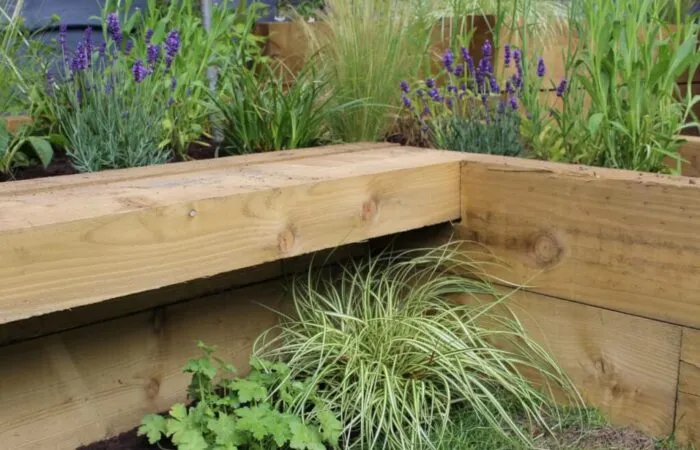
I find that timber sleepers are both multifunctional, safe enough and soft enough to blend a number of areas. When stacked two sleepers high, their height is tall enough for a toddler to be protected from the border but tall enough for a seat or perch for growing children and adults.
Walls are also suitable, but harder materials such as stone can provide a risk for children running into them or sharp edges.
Paving materials can be tricky. Often, parents worry that stone will provide a harsh surface for children to play on. Gravel is a much softer surface for any trips and falls but also leads to uneven areas for seating. Also, very young children have a habit of trying to eat small pieces of gravel! In my experience, paving for paths and seating areas is the best option and turf or woodchip is used in play areas where falls and bumps are more likely.
Garden fencing and boundary security
One aspect of child-friendly garden design that rarely gets enough attention is how to keep children safely within the garden itself, particularly in front gardens or properties near roads. A low picket fence at around 900mm high is usually sufficient to contain younger children, but once they can climb, the calculus changes. For front gardens near busy roads I always specify at least 1.2m, combined with a self-closing gate latch positioned high enough that small hands cannot reach it.
For rear gardens, internal boundaries between the adult seating area and the children’s play zone are just as important as the perimeter. A single course of sleepers, a low clipped hedge, or even a line of dense ornamental grasses can create a meaningful visual and physical marker without making the garden feel like a series of separate rooms. The goal is gentle separation, not fortress-grade containment. I find that children actually respond well to clearly defined zones and are more likely to stay within them when the transitions feel designed rather than imposed.
💡 Top Tip
Tool storage is also a genuine safety consideration in child-friendly gardens. Garden chemicals, sharp tools, and power equipment should always be stored in a locked shed or cabinet rather than left accessible. Childproof locks are available for shed doors and are worth every penny. The RHS recommends treating all garden chemicals as you would household medicines: locked away, out of sight, and completely inaccessible to children.
Why artificial turf is a nightmare
Artificial turf or plastic grass is often listed as an ideal child friendly garden material. However, I have a real aversion to artificial turf as it’s probably the least child friendly and wildlife-suitable garden groundcover.
If you have pets, their faeces will stick to it and not biodegrade like lawn
It’s slippery when wet
It causes severe friction burns if children skid on it
Artificial turf is not as low-maintenance as it may seem. With artificial turf, you still need to brush it and treat it a bit like an outdoor carpet. It will need sand brushing in at least once a year. It also has a habit of floating up during heavy rain or floods.
Lastly, I find it really unsuitable for children. Falling on turf may leave a grass stain on your knee, but falling on artificial turf leaves one heck of a friction burn at times. Rather than artificial turf, I would always advocate either real turf (it’s barely more maintenance in reality), gravel or wood chip.
Water Safety in Family Gardens
This is the section most garden design guides skim over, and I think that is a mistake. Water and young children are one of the most serious safety considerations in any family garden, and it is something I discuss explicitly with every client who has children under five. The statistics are stark: around six children drown in garden ponds and water features every year in the UK, and the majority of incidents involve under-fives in gardens they were visiting rather than their own homes. The risk does not disappear the moment you reach your own back gate.
⚠️ Safety Warning
A child can drown in as little as 5cm of water. Even a water butt, a paddling pool left partially filled, or a shallow ornamental dish can pose a genuine risk to toddlers. The RHS recommends that all open water in gardens with young children either be fenced off, covered securely, or removed entirely until children are old enough to understand the hazard. No safety device is a substitute for direct adult supervision.
Ponds: the honest answer
My honest advice to clients with children under five is to delay the pond. I know that is not what people who love garden wildlife want to hear, but a pond that gets properly installed once children are older is far better than one that creates years of anxiety or, worse, a tragedy. The good news is that most ponds can be retrofitted relatively easily once the children are school-age and able to understand basic water safety. In the meantime, a pond-shaped bed planted with moisture-loving plants like Hostas, Astilbes, and ornamental grasses creates exactly the same aesthetic contribution without any of the risk.
If you have an existing pond and young children in the household, there are practical steps you can take. A steel mesh grid installed flush with the pond surface, properly secured at the edges, can support the weight of a child and prevent submersion. Pond safety nets are also available. However, neither of these should be treated as permanent solutions or as a reason to relax supervision.
Child-safe water features that still bring sound and movement
The reason people want ponds in the first place is usually about sound, movement, and wildlife, and you can achieve all three without open water. A bubble fountain is my go-to recommendation for families with young children. The principle is simple: a small underground reservoir covered securely with a rigid steel mesh, topped with decorative stones or a millstone, with a pump that drives water up through the centre and back down over the surface. The water is always recirculating, the reservoir is completely inaccessible, and the sound of water over stone is genuinely lovely. Wildlife will still use it for drinking and bathing.
Alternatively, a wall-mounted water feature with a shallow trough collector is another completely child-safe option. The water drops from a spout into a shallow trough that drains immediately back into a sealed reservoir. There is no pool of standing water at any point. These can be installed on a fence, a rendered garden wall, or a purpose-built timber frame and look striking year-round.
Water butts should always have a secure, locked, or childproof lid when young children are in the garden. The standard push-fit lid that comes with most water butts is not childproof and can be lifted off easily. A strap or clip that locks the lid is inexpensive and worth fitting as standard. I always recommend clients position water butts in an inaccessible corner of the garden, behind a shed or in a service area, rather than in the main garden space.
Paddling pools are worth a brief mention because they represent a seasonal but significant hazard. A paddling pool left partially filled overnight, even at 15 to 20cm depth, poses a real drowning risk. The rule in our house and the advice I give every client is simple: empty the paddling pool every evening without exception. It takes two minutes and eliminates the risk entirely. Storage-wise, a large garden toy storage box keeps paddling pools, inflatables, and water toys in one place and makes the empty-and-store routine far easier to maintain.
💡 Top Tip
When children are ready for a proper pond, usually from around age seven or eight with appropriate supervision, involving them in the design and planting is one of the most powerful ways to build a lasting relationship with the garden. Watching tadpoles develop, counting pond skaters, and identifying dragonfly larvae are genuinely formative experiences. The pond they helped design will be treasured for decades.
Create areas of interest for Children
Most people are used to seeing a swing set or a massive jungle gym in a garden as the only way to keep children entertained. However, a better way to create entertainment is through more subtle approaches.
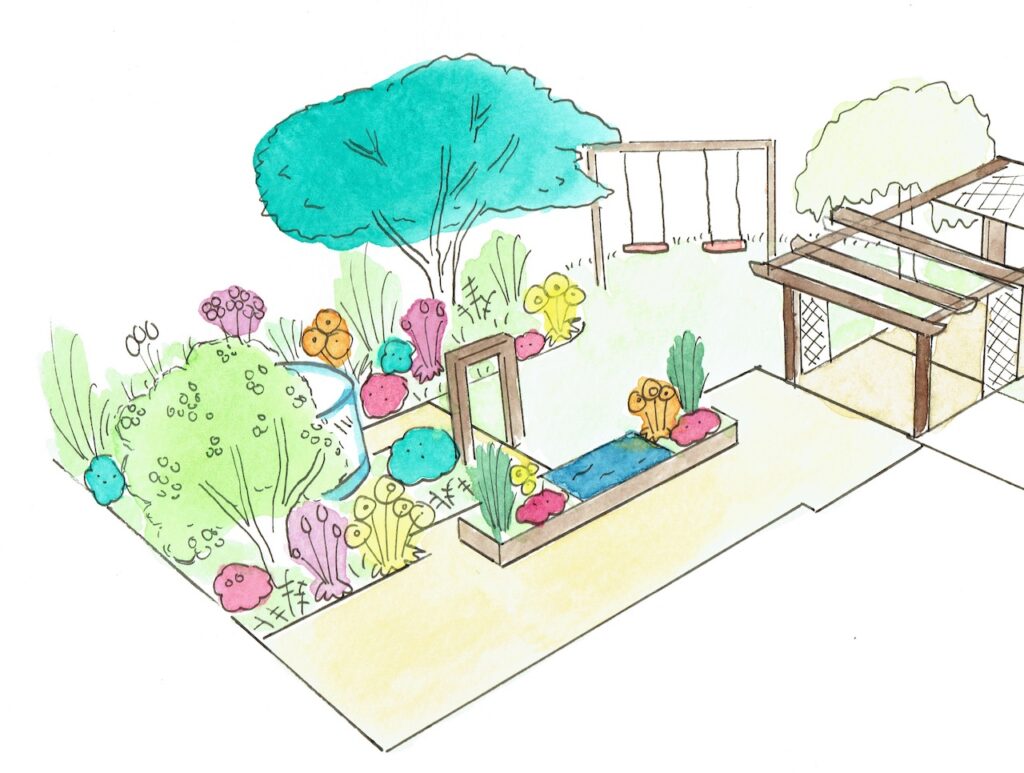
Why not create a path of cross-sections of logs like in the design below? These logs run through the borders, allowing children to use all garden areas. This way, children can hop and adventure through the garden borders. This doubles up as a route for playing a game of tick or musical statues.
The lawn below is edged so that there’s a mini path around the lawn, so if it’s wet, the children can avoid soggy grass. There are loads of tricks used in this garden to provide children with all sorts of play activities. Even the pergola walkway doubles up as monkey bars for older children!
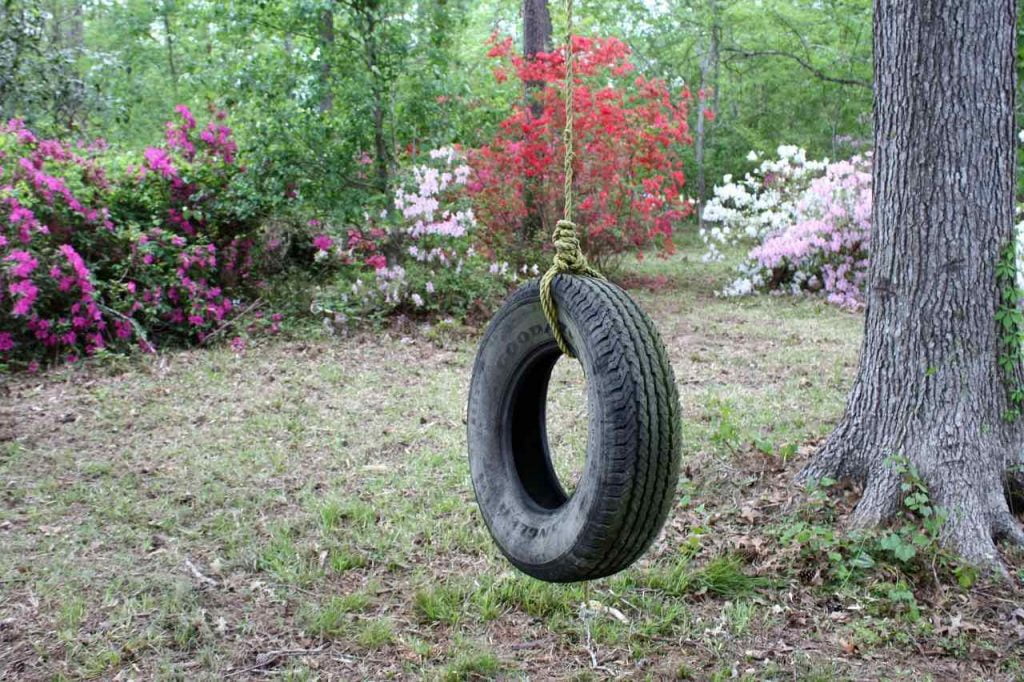
Rather than having a huge swing set, why not hang a rope from an existing tree with a tyre on it or use a rope swing? Then it’s a swing, a seat and a secret spy window all in one!
Instead of a sandpit, why not have a grow-your-own box where children can plant vegetables and nurture their own plants?
Best play equipment for children
Now that we have discussed the design, layout and zoning of a child-friendly garden, it is time for the fun part. The play equipment! The majority of shop-bought play items are sadly made of plastic, most of which can’t be recycled at the end of their life. I prefer to try to use more natural materials, such as wood or recycled items.
When it comes to outdoor play equipment, children are not bothered by the most expensive shiny toys but by the play items that offer the widest range of fun! If you already have a very obvious play set that sticks out too much, why not use some of the ideas below to help it blend in? Camo nets and climbing plants can help soften large play structures and make them fit into your design far better.
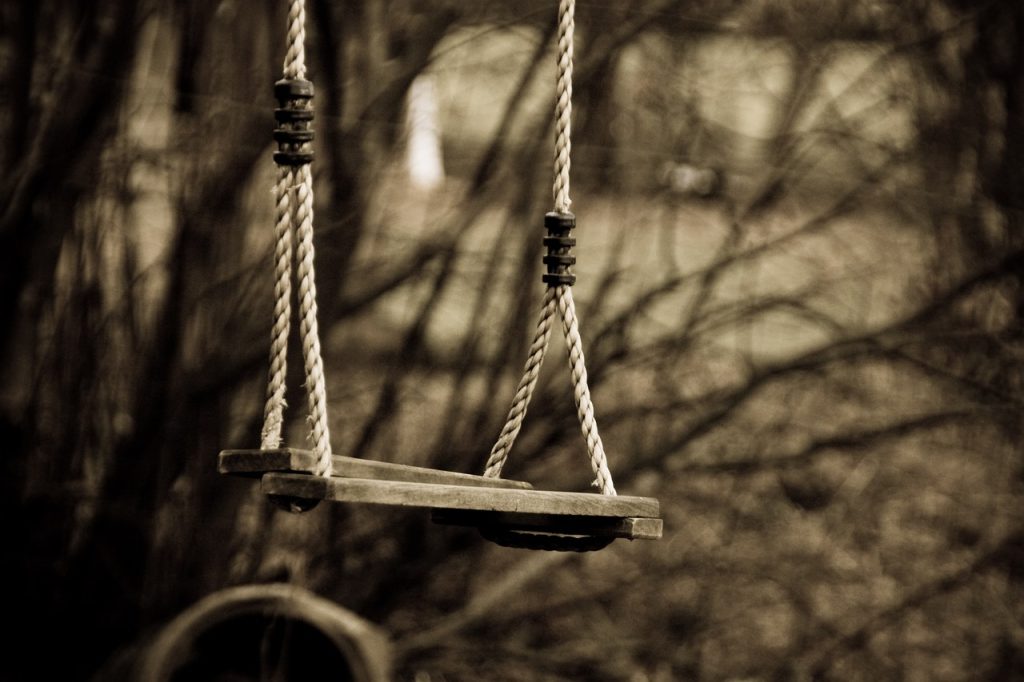
i) Rope Swings
These wooden adjustable swings can be attached to existing established trees or to the side of sturdy garden arches or frameworks. Always check the suitability of frameworks or tree branches that they are secure.
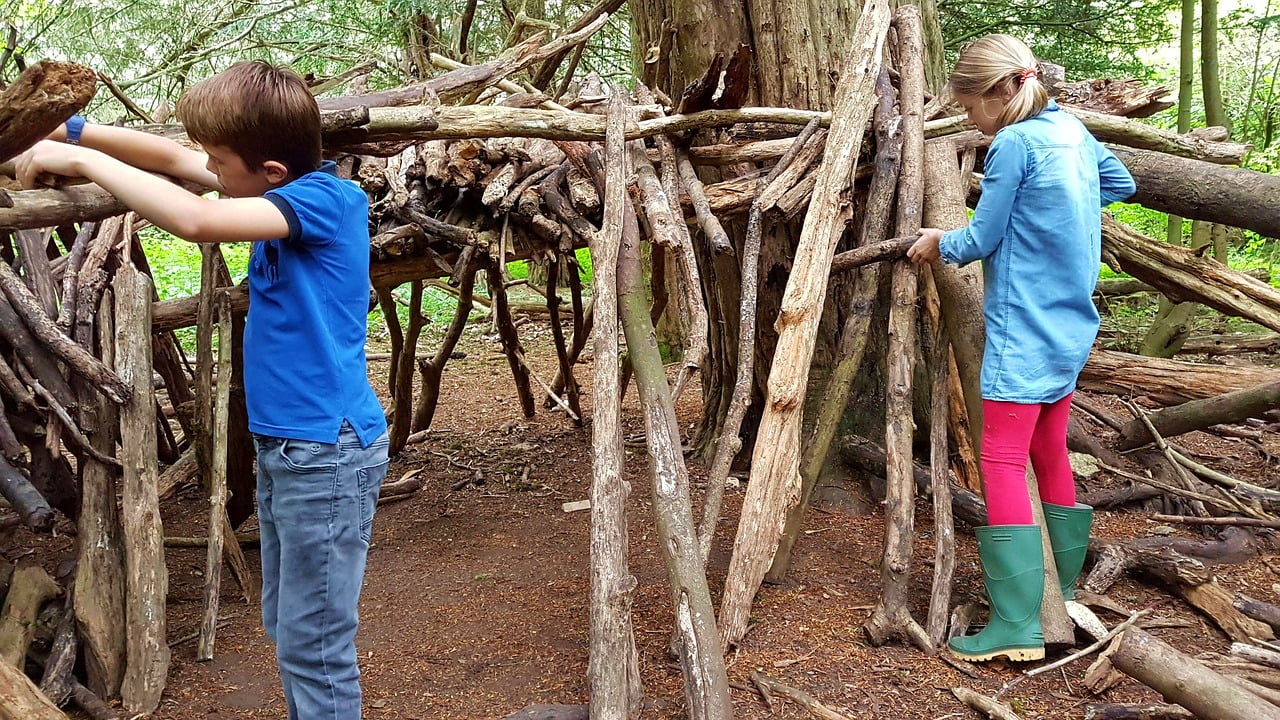
ii) Build a garden Den
Dens are fantastic for children’s wild play and relaxation. A den is a hideaway for children where they can play, read stories or relax away from their parents. All you need to do is create a box or frame that children can sit under or crawl into. You may even already have large trees with low branches that can act as the framework. Always make sure the framework is structurally sound and well-connected as a builder if unsure.
Children love crawling through tunnels in gardens, whether a shop-bought fabric pop-up tunnel or one made from timber. I’ve used them in countless child garden designs. The beauty of a square timber tunnel is the top of it can be used as a makeshift table, and you can plant around it to make it blend in. Win-win!
Can you spot the tunnel in the flower bed above and the bridge over the raised bed before the greenhouse? Well hidden, aren’t they?
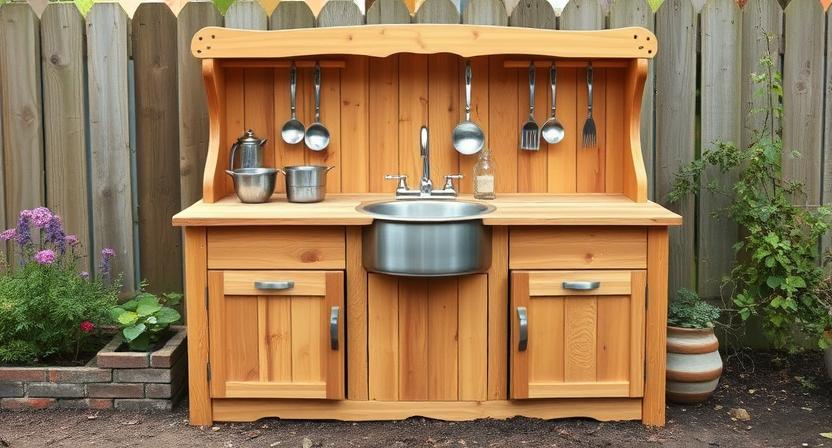
If there’s one feature that transforms how children use a garden, it’s a proper mud kitchen. I’m not talking about a token bucket and spade; I’m talking about a legitimate outdoor kitchen setup where getting absolutely filthy is not just permitted but actively encouraged. This is quite possibly the best return on investment you’ll make in any child-friendly garden.
The beauty of a mud kitchen is that it gives messy play a dedicated zone, which paradoxically makes parents more relaxed about the mess because it’s contained and expected. Children engage in incredibly sophisticated imaginative play when they’ve got pots, pans, utensils, water and access to soil. They’re making potions, cooking mud pies, running restaurants, conducting science experiments and developing fine motor skills whilst having an absolute whale of a time.
Location is critical. You want it close enough to a water source that refilling watering cans isn’t a marathon, but not so close to the house that muddy footprints march straight onto your kitchen floor. Partial shade is ideal because children will spend hours there on hot days. I often position mud kitchens near vegetable plots or herb gardens so children can “harvest” ingredients for their mud cuisine.
For construction, you can go down several routes depending on budget and ambition. The simplest approach is to repurpose an old wooden pallet, stand it vertically and add some hooks for utensils and a shelf for pots and pans. Charity shops and car boot sales are goldmines for cheap pots, wooden spoons, whisks and colanders. Add a metal washing-up bowl mortared into a gap between pallets for a “sink”, and you’ve got a functional mud kitchen for under thirty quid.
If you’re more ambitious, build a proper structure from timber. I typically use untreated scaffold boards or timber sleepers to create an L-shaped counter at about 60cm high for younger children, with a proper sink unit cut out to hold a bowl. Include shelving above and below for storage. If you really want to go all out, install a water butt nearby with a tap at child height so they can fill their own containers.
Stock your mud kitchen thoughtfully. Include measuring jugs and cups for “recipes”, funnels and sieves for experimenting with water flow, potato mashers and rolling pins for processing mud mixtures, and multiple containers in different sizes. Natural items like pine cones, pebbles, sticks, leaves and seedheads become ingredients. A small blackboard for writing menus completes the setup.
The Sunken Trampoline: Making the Unmissable Invisible
Right, let’s address the elephant in the garden. Trampolines. Children absolutely adore them, they’re fantastic for burning energy and developing coordination, and they’re also enormous visual blights that dominate any garden they’re plonked into. The standard above-ground trampoline on its frame sits there like a giant eyesore, catching wind, creating maintenance headaches and generally announcing “THIS IS A CHILDREN’S GARDEN” to anyone within viewing distance.
The solution? Sink the trampoline.
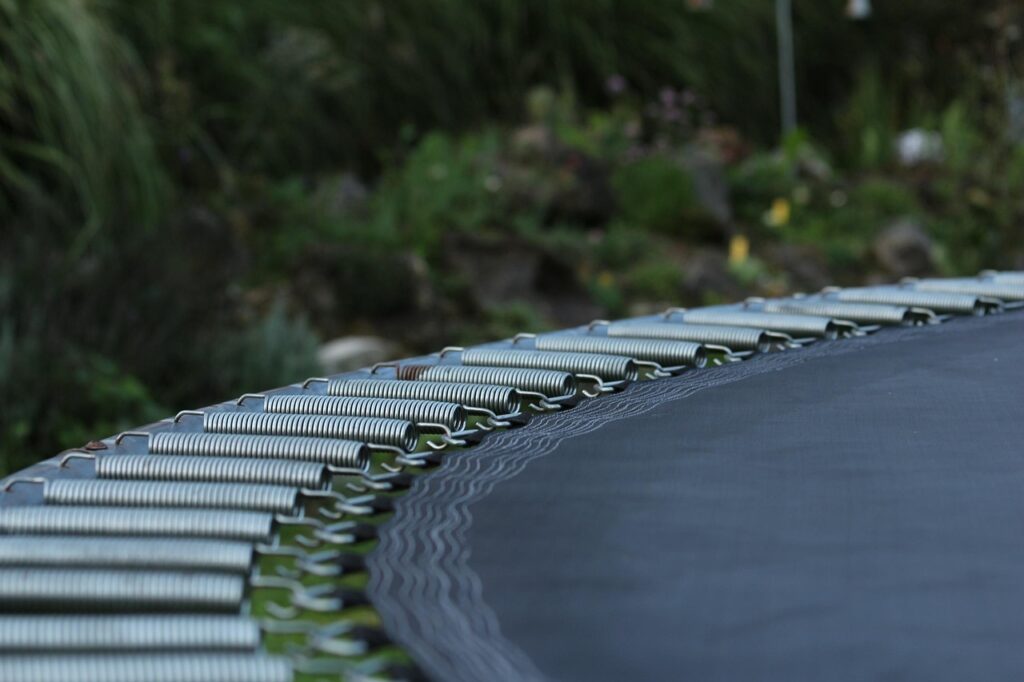
A sunken or in-ground trampoline solves multiple problems at once. Visually, it becomes part of the garden floor rather than a feature that screams for attention. From a safety perspective, children can’t fall off it because there’s no height to fall from, and you don’t need that ghastly safety net surround that makes them look like backyard prison yards. The jumping mat sits roughly flush with the ground level, surrounded by planting, and suddenly your trampoline has become an integrated feature rather than an intrusion.
Spot the sunken trampoline in the image above, it’s to the left behind the multistem birch and herbaceous planting scheme! Clever eh!
Installation does require more groundwork than simply assembling a frame on the lawn. You’ll need to excavate a pit roughly one metre deep and slightly larger than your trampoline’s diameter. Proper drainage is absolutely critical because you’re essentially creating an underground chamber that could fill with water. I typically specify a drainage system with a soakaway or connection to the main drainage, lined with a geotextile membrane and filled with free-draining aggregate. You’ll also need ventilation gaps around the trampoline edge because the bounce action needs air movement underneath.
There are now specialist in-ground trampoline kits available that make installation significantly easier than it was a few years ago. Companies like BERG and EXIT Toys produce trampolines specifically designed for ground installation with better drainage and ventilation systems. You can either tackle this as a DIY project if you’re reasonably competent with excavation and drainage, or bring in a landscaper. Budget-wise, you’re looking at roughly £800 to £1,500 including the trampoline and installation, depending on size and site conditions.
The planting around a sunken trampoline becomes part of its concealment strategy. I use tall, soft, resilient species that can cope with the occasional ball or child landing in them. Hydrangeas work brilliantly because they’re tough as old boots, provide excellent height and volume, and their soft foliage cushions any impact. I’m also a fan of ornamental grasses like Calamagrostis x acutiflora ‘Karl Foerster’, which rustle beautifully in the wind, create natural screening, and bounce back if flattened. Avoid anything spiky or with hard, woody stems close to the trampoline edge.
One of my favourite installations was in a Manchester garden where we created a circular sunken trampoline surrounded by a meadow-style planting. From the house, you could barely tell it was there. The children could bounce to their hearts’ content, and when they were done, it simply looked like a slightly recessed circular garden feature. The clients were thrilled because their garden still looked sophisticated enough to entertain in, whilst giving their two boys exactly what they wanted.
Designing by Age: From Toddler to Teenager
One of the most common mistakes I see in family garden designs is treating children as a single homogeneous group. A two year old and a twelve year old have almost nothing in common when it comes to what they need from a garden. The most successful family gardens I have designed are the ones where the clients thought ahead and planned for how the space would evolve, rather than designing purely for the children’s current ages and then ripping everything out three years later.
Toddlers and under-fives
At this stage, containment and supervision are the two overriding design priorities. Young children need to be visible from the house, which means keeping the primary play area within a direct sightline from the kitchen or main living room. Avoid anything that creates blind spots or obscures the view: dense tall planting or solid structures positioned between the house and the play zone are problematic at this age.
Surfaces matter enormously. Grass is ideal but will wear to mud patches quickly under heavy use. A bark chip play zone takes the pressure off the lawn and is forgiving on inevitable tumbles. Keep everything at ground level, avoid raised platforms or climbing structures with significant fall heights, and position the play area well away from any boundary fencing or walls that could be scaled.
Water features of any kind should be either absent or completely secured as described in the water safety section above. Even a decorative pot filled with water poses a risk at this age. Sandpits are a popular option and work well for under-fives, though they do need a cover when not in use to prevent them becoming a cat toilet.
💡 Top Tip
Design the toddler play zone so it naturally transitions into something else as children grow. A bark chip play area can become a planted border later. A sandpit can be repurposed as a raised vegetable bed. Thinking ahead at the design stage saves both money and disruption when priorities shift.
Ages five to ten
This is the golden age of garden play, and the stage where a well-designed outdoor space pays back its investment most visibly. Children in this age group need space to run, something to climb, somewhere to hide, and ideally a dedicated area for messy or creative play. The mud kitchen, den, and crawl tunnel sections of this guide are all primarily aimed at this age group.
From around age five, involving children in the growing-your-own side of the garden starts to pay genuine dividends. A raised bed or even a series of large containers positioned at child height, where they have complete ownership of what gets planted and harvested, builds engagement with the garden that lasts well beyond this age. Quick-growing crops are essential for maintaining interest: radishes ready in three weeks, salad leaves in four, and sunflowers that will visibly gain height every single day are all reliable hooks.
Water features can be reintroduced at this stage, with appropriate supervision. A bubble fountain or wall-mounted feature is still the safer choice, but a properly installed and maintained pond with gently sloping shallow edges becomes feasible for confident swimmers who have had water safety conversations with their parents.
Pre-teens and teenagers
By this stage, the design priorities shift almost entirely towards privacy, independence, and social space. Teenagers want somewhere to sit with friends that feels separate from the adult zone, preferably with some degree of enclosure. A seating area tucked behind a pergola, a corner with screening plants on two or three sides, or a simple bench positioned within a more enclosed planting scheme all work well.
The play equipment can often come down at this point, which is actually a good opportunity to reassess and replant. Many of my clients have turned former swing set areas into wildflower patches, vegetable gardens, or cutting flower borders once the play equipment was no longer needed. These transitions are genuinely exciting from a design perspective because there is often a good clear area of reasonably well-composted ground to work with.
Lighting becomes more important for teenagers who use the garden after dark. Simple solar path lighting, a string of outdoor festoon lights around a seating area, or low-level ground lights along a path make the garden usable in the evening and give older children a reason to be outside during the longer autumn and winter evenings. It is also worth noting that a teenager who takes an interest in gardening at this stage, perhaps through the grow-your-own zone established when they were younger, is genuinely one of the most rewarding outcomes a family garden can produce.
Child-Friendly Planting Ideas
Now, this really is a bone of contention in the gardening world. Some people argue that you should never have any toxic plants in your garden, which makes sense at first. However, when you realise that most plants have some form of toxin or side effect if eaten or ingested, it makes you think again about plant selection. Unless you’re going to fill your garden with lettuce, you need to take a more balanced view of plant selection.
Now it goes without saying that super-toxic plants like Monk’s Hood, Lily of the Valley and Euphorbia (the sap is highly irritating to the skin) should probably be avoided if children are around. However, even Hydrangeas (granny’s garden favourites) contain cyanide and, if enough is eaten, are highly toxic.
The same is true with Foxgloves and other seemingly safe plants. Even Daffodil bulbs can be toxic if eaten. It’s about being sensible and measured, teaching children about plants, not eating them unless you know they are edible, and treating them with respect. Even the humble Daffodil can be toxic if the bulb is eaten.
My argument here for child-friendly garden design is simple. If your children are likely to eat plants or be left unsupervised in the garden, you need to consider what plants you’re putting in. In my experience, you supervise your children most of the time. Besides, children are more interested in climbing, hiding or collecting leaves than eating plants.
If you provide enough interest in the garden with play areas and activities, it should stop your children from resorting to eating plants and bulbs.
Resilient Planting: Beautiful Borders That Survive Childhood
One of the most common complaints I hear from parents is that their planting looks gorgeous for about three weeks until a football inevitably launches through it or a game of chase tramples half the border. The solution isn’t to give up on planting or resign yourself to indestructible but boring laurel hedges. It’s about selecting species that can take a battering and bounce back, literally.
Bombproof Shrubs
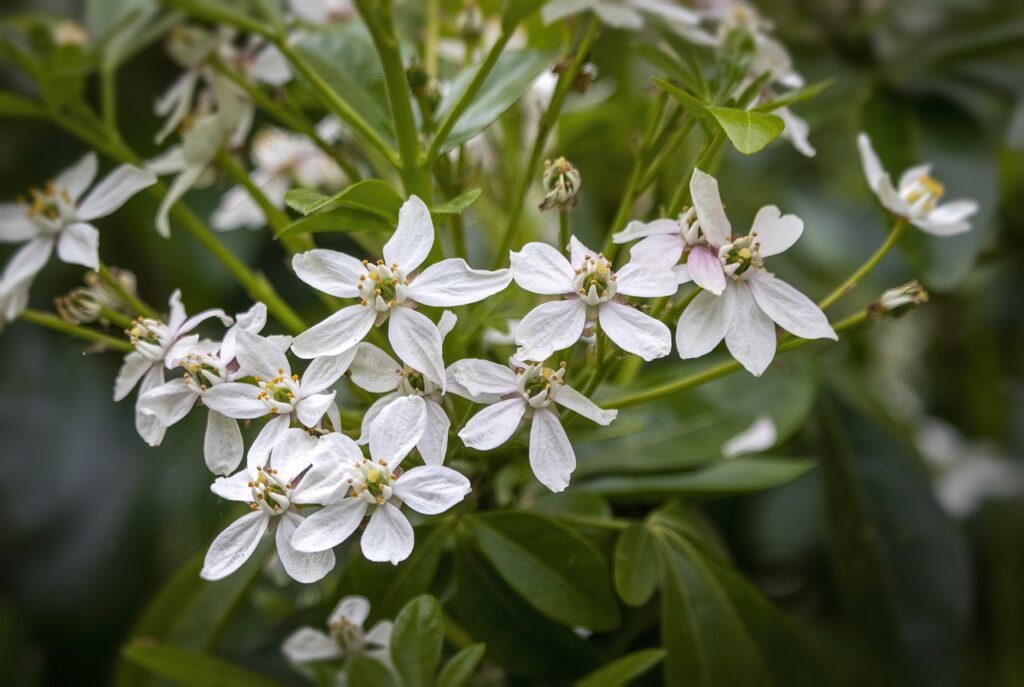
Certain shrubs have evolved to cope with being grazed, bent, and generally mistreated by animals. These same qualities make them perfect for family gardens. Choisya ternata (Mexican orange blossom) is almost indestructible. You can kick it, crash a bike into it, launch balls through it, and it will simply reorganise its branches and carry on. It’s evergreen, has gorgeous scented white flowers, and deer and rabbits won’t touch it, which tells you how robust it is.
Hydrangeas are famously resilient, particularly the mophead and lacecap varieties. They’re deciduous, so children can’t damage them much in winter, and their soft woody stems bend rather than snap. Even if a branch does break, they respond brilliantly to pruning. Hydrangea paniculata varieties like ‘Limelight’ and ‘Vanilla Fraise’ are particularly robust and produce massive flower heads that children find fascinating.
Buddleja davidii (butterfly bush) is borderline indestructible. It copes with poor soil, requires minimal maintenance, and even if you accidentally demolish half of it, you just prune it hard in spring, and it comes back stronger. The bonus is that it attracts butterflies in profusion, giving children something to watch and chase.
For evergreen structure that can take punishment, Viburnum tinus is your friend. It has year-round interest with white flowers in winter, is completely hardy, and shrugs off most abuse. Mahonia x media varieties like ‘Winter Sun’ have an architectural form and fragrant yellow flowers in winter. While their leaves are spiky (which actually protects them from rough play), they’re not as dangerously spiky as holly.
Flexible Perennials
Herbaceous perennials that are naturally floppy and flexible survive better than rigid, brittle species. Alchemilla mollis (lady’s mantle) is the classic bulletproof perennial. Its soft foliage cushions falls, it self-seeds generously, so even if part of it is destroyed, there’s always more, and it looks charming, frothing around path edges.
Hardy geraniums in varieties like ‘Rozanne’ or ‘Patricia’ spread generously, flower for months, and if they get flattened, they just pop back up. They’re soft landing zones disguised as pretty plants.
Grasses deserve their own category because they’re naturally designed to bend and flex. Deschampsia cespitosa forms elegant tussocks that children can’t really damage. Miscanthus sinensis varieties provide height and movement, and whilst their stems are fairly rigid when mature, they’re positioned at the back of borders where they’re less likely to be in the firing line. For front-of-border work, Stipa tenuissima and Carex testacea are both gorgeous and resilient.
Rudbeckias and Echinaceas get repeatedly recommended for family gardens because they’re tough as old boots, they flower for months, they seed around creating spontaneous drifts, and even if you flatten them, they’ll recover. Their daisy-like flowers also appeal to children visually.
Strategic Planting Design
Beyond species selection, your planting design structure can build in resilience. Create deep borders rather than narrow ones; this gives plants space to sprawl and means there’s depth to absorb impacts. Use graduated heights so that if taller plants at the back get knocked, they lean into mid-height plants in front rather than flopping onto the lawn.
Plant in drifts and masses rather than single specimens. If you’ve planted twenty Geranium ‘Rozanne’, losing three to a rogue football isn’t a disaster. If you’ve got one treasured specimen Eryngium, one wayward ball, and it’s gone. Repetition of tough species creates visual impact and built-in redundancy.
Consider using sacrificial planting in high-risk zones. Right next to play areas, use things that you genuinely don’t mind losing. Annuals sown from seed are perfect for this. If they get destroyed, you’ve lost a packet of seeds worth £2 rather than a £15 perennial. Hardy annuals like Calendula, Nigella and cornflowers self-seed so enthusiastically that they effectively become permanent features, but losing a few individual plants doesn’t matter.
List of Plants Toxic to Children if Eaten
Here’s a list of plants that you might want to avoid in the garden if you are concerned. In particular, Monk’s Hood is the real nasty one in the group.
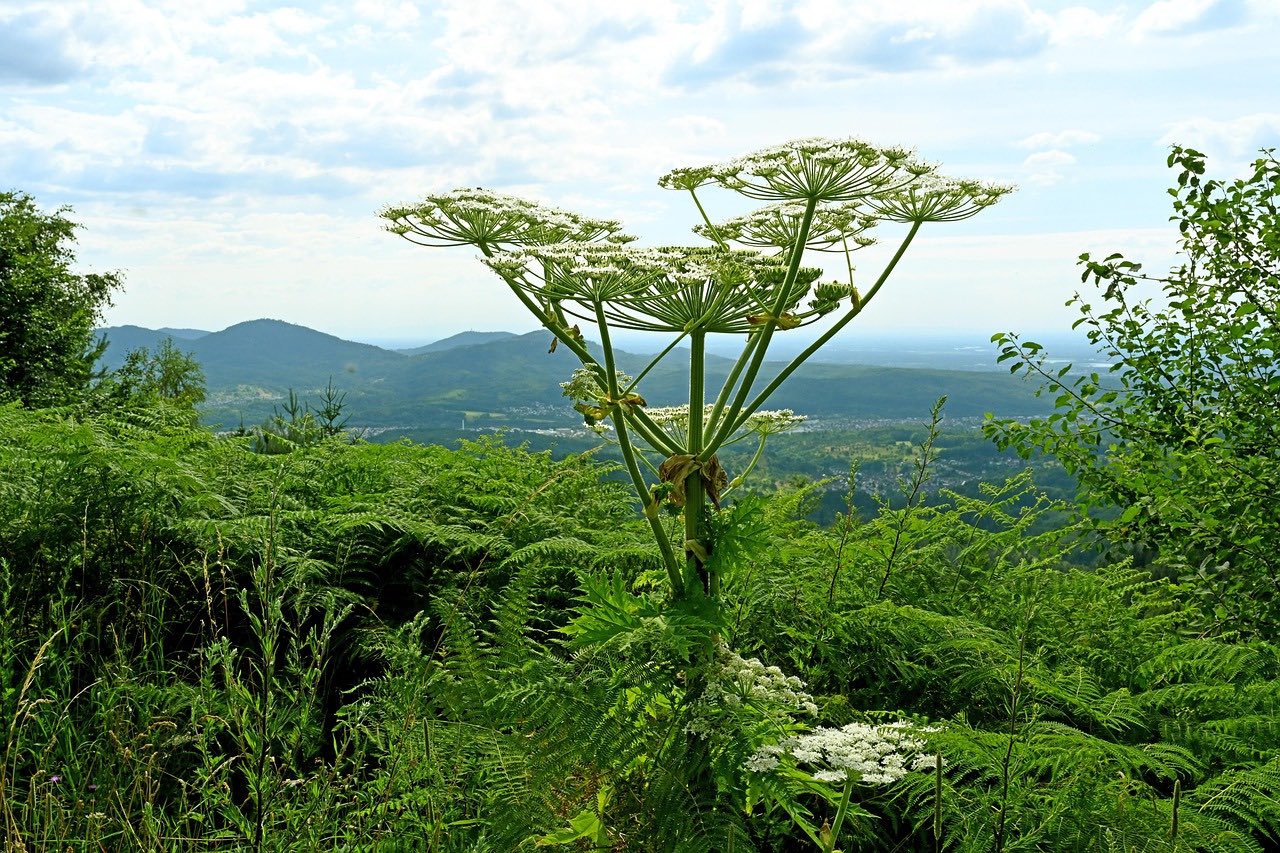
Also, whilst out in the woodland, make sure that you teach your children to avoid Giant Hogweed, often found in verges. An image of it is shown below. It is enormous, at least 7ft, if not taller. Its sap strips melatonin from the skin, causing blistering and years of damage because the skin can’t protect itself from the sun. If you see it, report it to your council for removal.
⚠️ Toxic Plant Warning
The plants listed below are all toxic to children if eaten or, in some cases, touched. Many are common garden plants and their toxicity does not necessarily mean they must be removed, but they do require awareness, particularly with young children who are unsupervised. Teach children never to eat anything from the garden unless you tell them it is safe. If you suspect a child has ingested any plant material, contact the NHS 111 service or your local poison control centre immediately.
Aconitum (Monk’s Hood): one of the most toxic plants in UK gardens
Creating a sensory-rich environment in your garden does far more than look pretty. When children can touch, smell, hear, taste and see a diverse range of plants, they’re developing their understanding of the natural world in a way that no amount of screen time can replicate. I’m going to give you specific plant recommendations that I’ve tested in family gardens. These aren’t just theories; they’re plants that children genuinely interact with and remember.
Sight: Beyond Basic Colour
Yes, sunflowers are brilliant, and marigolds are reliably cheerful, but let’s be more adventurous. Swiss chard ‘Bright Lights’ gives you stems in hot pink, orange, yellow and red that children find absolutely mesmerising. They’re also edible, which ticks the taste box as well. Heuchera cultivars come in almost absurd colours, from deep purple ‘Obsidian’ to lime green ‘Lime Marmalade’, and they stay looking good at ground level where children notice them.
For architectural drama, nothing beats Gunnera manicata if you’ve got space and moisture. The leaves grow to over a metre across, creating natural umbrellas that children instinctively want to shelter under. Alternatively, Rodgersia pinnata ‘Superba’ gives you that same primordial jungle feeling in a more manageable package, with huge textured leaves and frothy pink flowers. If you haven’t already read my guide on the colour wheel, please do so, and you can then apply colour theory to your garden!
Touch: Texture Is Everything
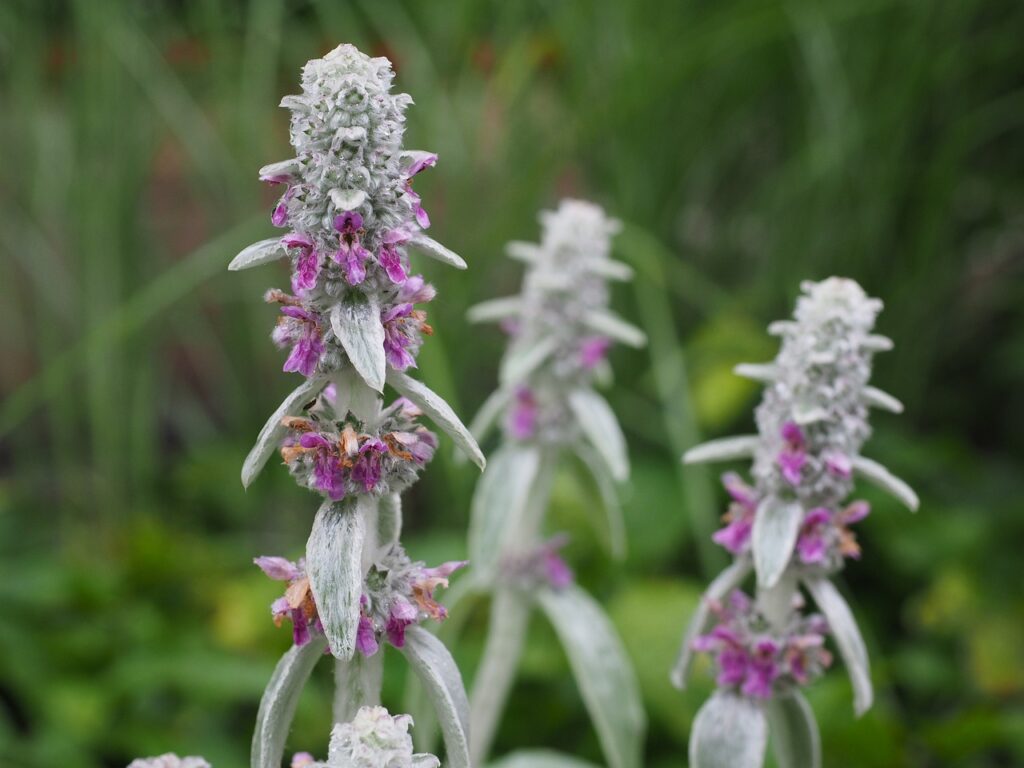
Lamb’s ear (Stachys byzantina) is the gateway drug to sensory gardening. Every child who encounters it wants to stroke the impossibly soft, furry leaves. I’ve never met a child who could walk past it without touching it. Similarly, the downy foliage of Salvia argentea feels like stroking a rabbit.
For contrast, include plants with different textures. The rough, almost sandpapery leaves of Pulmonaria contrast beautifully with the smooth, succulent foliage of Sedum. Grasses like Pennisetum alopecuroides produce soft, fluffy seedheads that children find irresistible. I deliberately plant these where children will brush past them on pathways.
Smell: The Instant Memory Maker
Scent is incredibly powerful for creating garden memories. Chocolate cosmos (Cosmos atrosanguineus) genuinely smells of chocolate and makes children absolutely convinced you’re growing sweets in the garden. The curry plant (Helichrysum italicum) divides opinion but creates brilliant discussions about why something can smell like curry without being edible.
For herbs, you can’t beat the classics. Mint is bombproof and comes in multiple varieties; chocolate mint, apple mint and Moroccan mint all smell distinctly different. Lemon verbena (Aloysia citrodora) releases its scent when touched, creating an interactive element. Rosemary, thyme and lavender should all be positioned where little hands will brush against them regularly.
Sound: The Forgotten Sense
Ornamental grasses create the most beautiful rustling soundtrack to a garden. Stipa tenuissima moves in the slightest breeze, creating a whispering effect that children find quite magical. The seedheads of plants like Lunaria annua (honesty) and Nigella damascena (love-in-a-mist) rattle when shaken, giving children something to listen for and collect.
Taste: The Edible Experience
This deserves its own section really, but within the sensory garden, include plants that children can safely taste. Nasturtiums have edible flowers with a peppery kick that surprises children. Alpine strawberries fruit continuously through summer and are small enough that children can help themselves without decimating your crop. Cherry tomatoes like ‘Sungold’ are so sweet they’re basically fruit, and children who claim to hate tomatoes will often eat them straight from the plant.
Create a dedicated snacking border where everything is edible and children have permission to graze. Include pea plants, which give them the satisfaction of podding, sugar snap peas that can be eaten whole, and dwarf beans that hang at perfect picking height. Throw in some chives (edible flowers), calendula (edible petals for salads) and borage (flowers taste of cucumber).
I designed a sensory garden in Liverpool for a family with three children under eight. We created a circular path through raised beds planted with every texture, scent and edible we could fit in. Two years later, the mother told me it was still the most-used part of the garden, and her youngest could identify plants by smell with his eyes closed. That’s the power of engaging multiple senses simultaneously.
How Much Does a Child-Friendly Garden Cost?
One of the most common questions I get from clients at the start of a family garden project is what a realistic budget looks like. The honest answer is that a child-friendly garden can be delivered at almost any price point, from a few hundred pounds of DIY improvements through to a full professional redesign. What follows is a realistic breakdown of the main cost components based on projects I have worked on across the UK.
Play surfaces
Play bark is the most cost-effective safe surface for a children’s play zone. A tonne bag of certified play bark costs around £80 to £120 delivered, and a 20 square metre play area laid to 150mm depth requires approximately two to three tonne bags. That puts the material cost at £160 to £360 for a decent-sized play zone, plus a few hours of your own labour to spread it. It needs topping up every one to two years as it breaks down, but at those prices it is hard to argue against.
Play equipment
A simple rope swing attached to an existing tree costs next to nothing: a length of rope and a wooden seat or tyre. A purpose-built timber climbing frame with slide for primary school age children typically runs from £300 to £800 depending on complexity. A quality mud kitchen, bought rather than built, costs £80 to £250. Built from reclaimed timber it costs almost nothing beyond time. A DIY den with pallets and waterproof fabric is around £30 to £50 in materials.
A sunken trampoline is the most significant single play equipment investment, at £800 to £1,500 including excavation and the trampoline itself, as covered earlier in this guide. For families who know their children will get years of use from a trampoline, the in-ground version is the better long-term investment given it does not dominate the garden visually and eliminates the fall-from-height risk associated with above-ground models.
Hard landscaping
Raised beds built from railway sleepers are one of the best value hard landscaping investments in a family garden. A single sleeper bed measuring 2.4m x 1.2m costs around £80 to £150 in materials and can be built in a weekend. They serve multiple purposes: boundary marker between zones, growing space, seating edge, and visual structure. A full terrace or patio using natural stone will cost from £1,500 upwards professionally laid, or considerably less if you have the skills to do it yourself.
Planting
Planting a family garden does not require expensive specimens. The resilient species recommended earlier in this guide, Alchemilla, hardy Geraniums, Hydrangeas, and ornamental grasses, are all widely available at garden centres in the £5 to £15 per plant range. Buying smaller pot sizes and allowing them to establish over a season is always more economical than buying large specimens, and for the robust species suited to family gardens the wait is rarely more than one growing season. Budget approximately £15 to £25 per square metre of planted border for a decent initial planting scheme.
Professional design
A full garden design consultation with a professional designer like myself typically costs from £500 for a basic planting plan up to £2,500 or more for a full measured survey, CAD design, and planting specification for a medium-sized garden. That fee is separate from any landscaping or construction costs. For many families, an hour-long online consultation at £150 to £200 is the most useful starting point: it gives you a framework and direction without committing to a full design fee.
💰 Child-Friendly Garden Budget Guide
Feature
DIY Cost
Professionally Installed
Play bark zone (20m²)
£160 to £360
£400 to £700
Mud kitchen
£30 to £80
£150 to £400
Rope swing
£20 to £50
£100 to £200
Climbing frame (timber)
£300 to £600
£600 to £1,200
Sunken trampoline
£500 to £900
£800 to £1,500
Raised bed (sleeper, 2.4×1.2m)
£80 to £150
£200 to £400
Bubble fountain (child-safe)
£80 to £200
£250 to £600
Planting (per m² of border)
£15 to £25
£40 to £80 inc. labour
Case Study: Child-Friendly Design Example
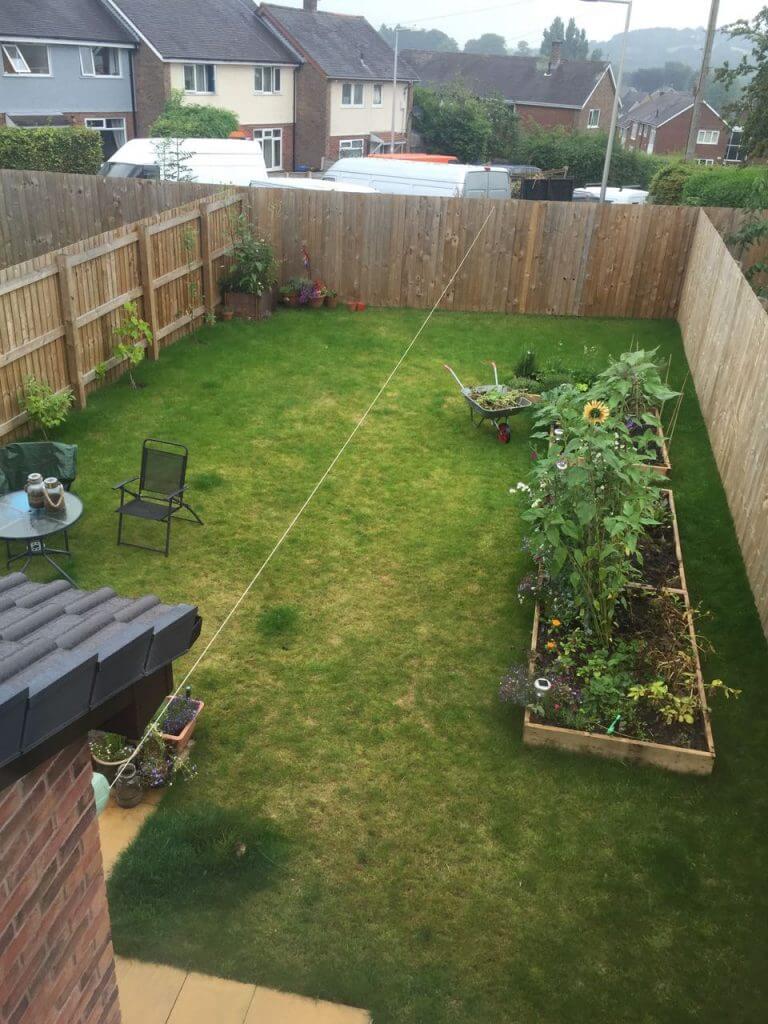
I have written extensively about the issues with new build gardens. Whether it be random grids, oddly shaped boundaries, wasted pockets of space or the fact you can’t dig down further than an inch before hitting rubble, this garden was no exception. It was not a child-friendly garden at all.
The couple wanted to create a child-friendly garden that was also suitable for entertaining adults in. Space where children would be safe, but adults could feel relaxed with some privacy from neighbours. The garden’s soil quality was terrible; they were overlooked and wanted a separate area away from the main garden to produce their own vegetables. I also had a challenge with a horribly damp corner, which I promised I would make into a feature for the children. Me and my big mouth!
The garden before the redesign was overlooked and awkward
Solution
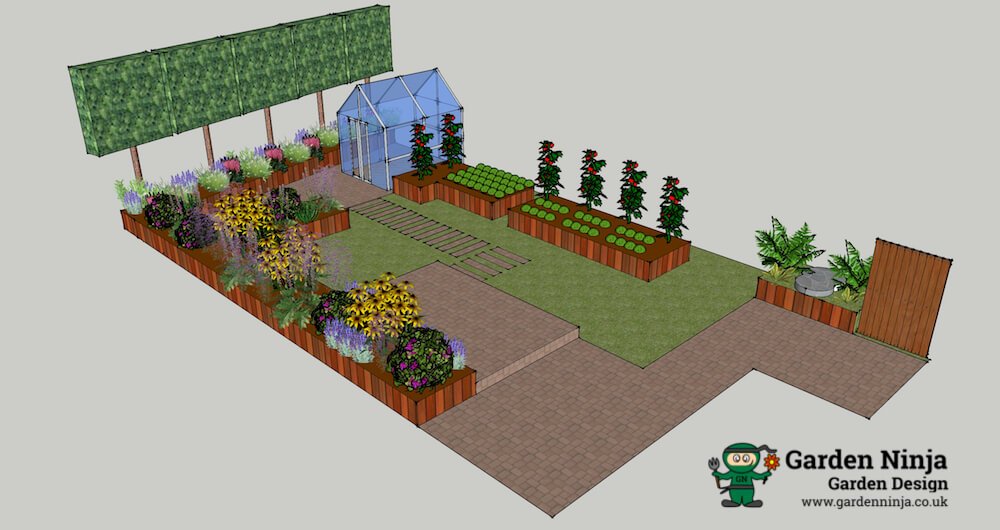
The first part of the design was to take the long garden and divide it into zones. Starting at the back of the garden, where the sun hits first, was perfect for the adult good life zone of the garden. The couple wanted a greenhouse, so I incorporated this into the plans in the adult zone.
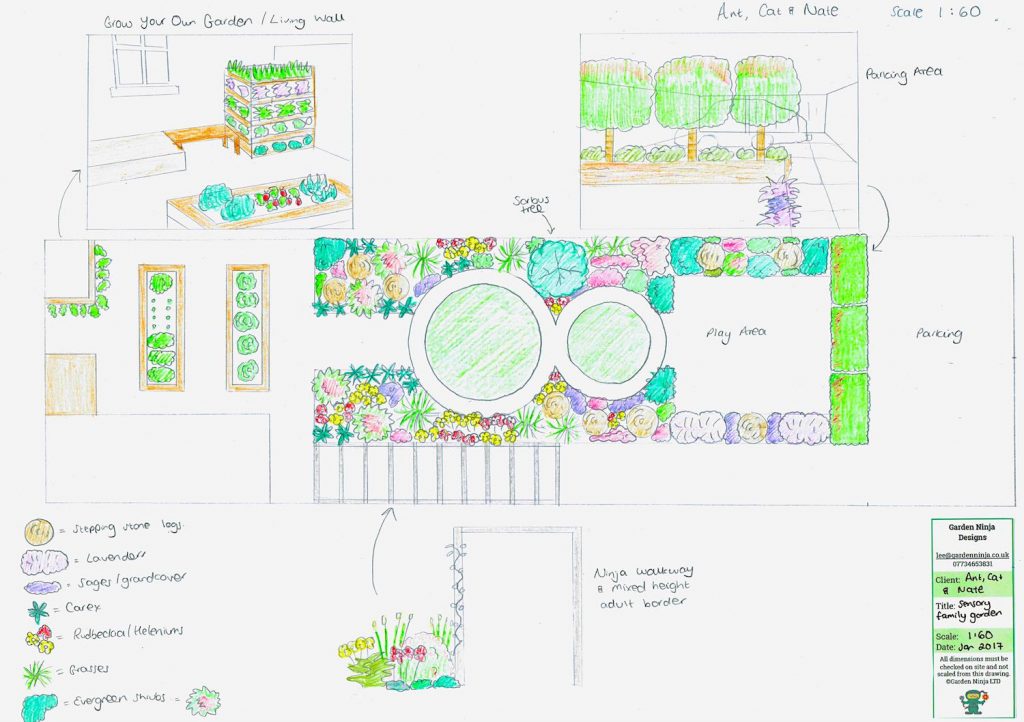
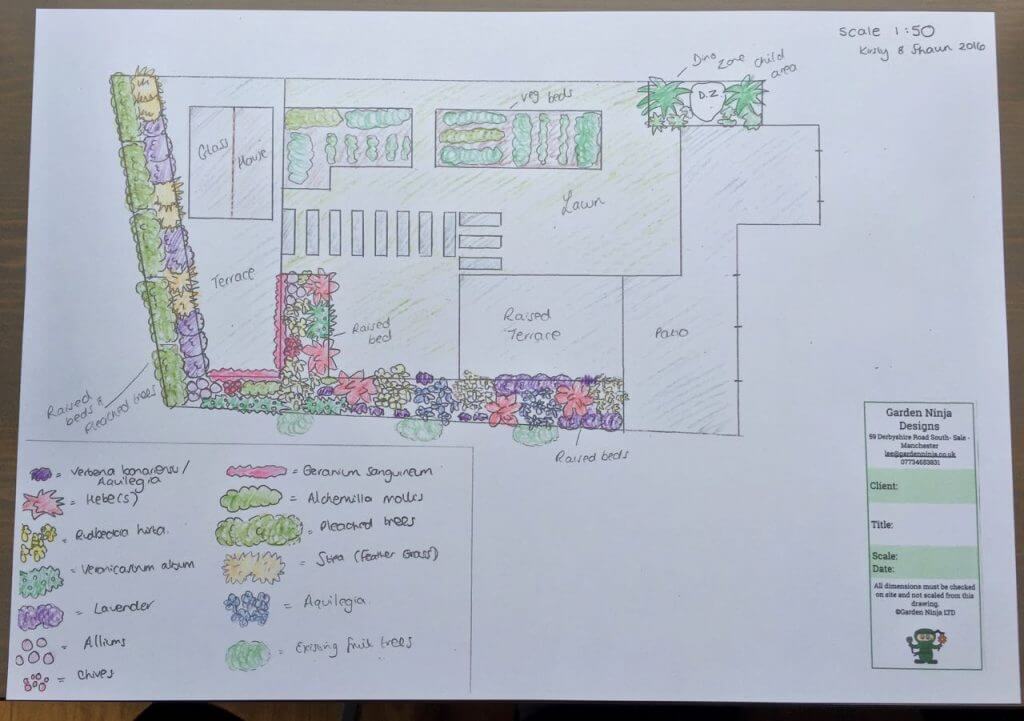
The finished hand-drawn plan
i) Adult Zone
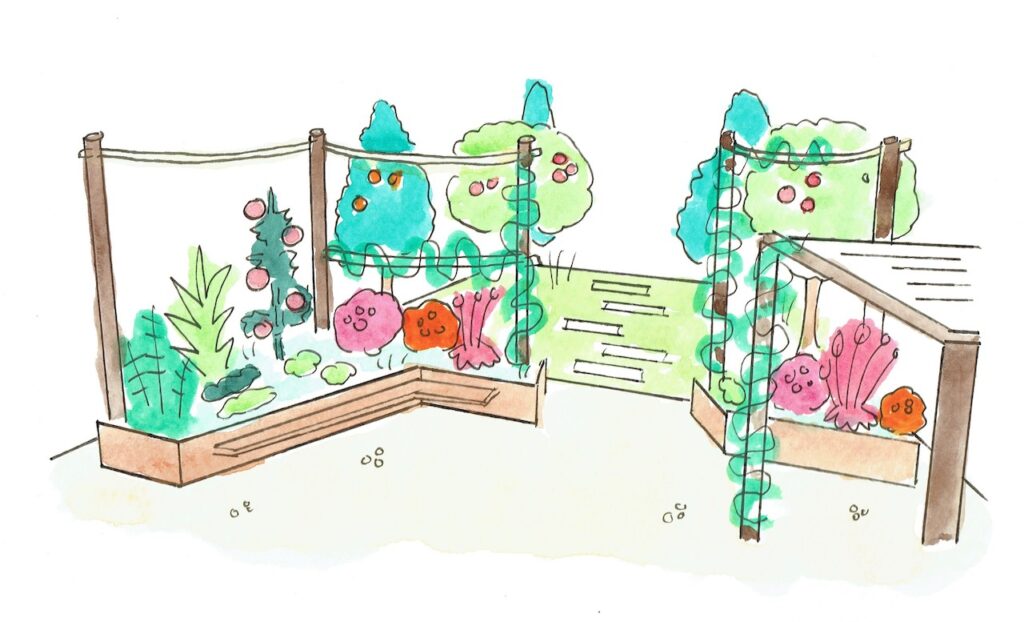
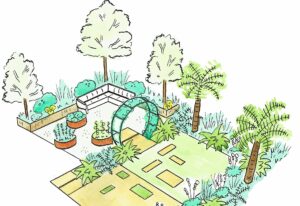
Using raised beds meant we could avoid mass excavation of the awful soil and bring in far better organic matter for the beds. The raised beds also help to screen off the zone from the rest of the garden. The clever use of pleached trees gives a contemporary screen to the back fence and some much-needed height to the child-friendly garden. They also wanted somewhere to sit in the garden.
ii) Children’s Zone
The majority of the main garden was designed with child-friendly and edible plants. The raised beds gave a clear line between the borders so they could play safely. I kept this part relatively simple so children could kick a ball about it or put a slide there if they wished. When designing, it’s important not to over-stylise a garden when children use it, as you risk making it too exclusive for adults. I chose the planting scheme full of tough and colourful child-friendly plants that could take the odd flying dinosaur or Barbie doll strop!
CAD plan of the child-friendly garden
iii) Entertaining Raised Terrace
This area extended the current terrace, lifting it up a step that could be home to an outdoor dining space. Mirroring the width of the patio doors helped connect this area to the house and keep it scaled. I connected this to the adult zone via some stylised paving slabs that gave a contemporary stepping-stone look to the garden.
iv) Dino-zone
In the bottom right was a shady border that was quite damp; the design extended the path around the house to remove the now-dead turf. I also added another raised bed filled with ferns and shade-loving plants. It featured a giant flat rock that can be used as a children’s play area to play with their toys.
Given that the couple’s young child loved dinosaurs, I themed this as the Dino-zone! Even as the children grow up, this area will look good in its own right, with lush shade-loving plants full of texture and interest, but it makes for a really fun play feature too.
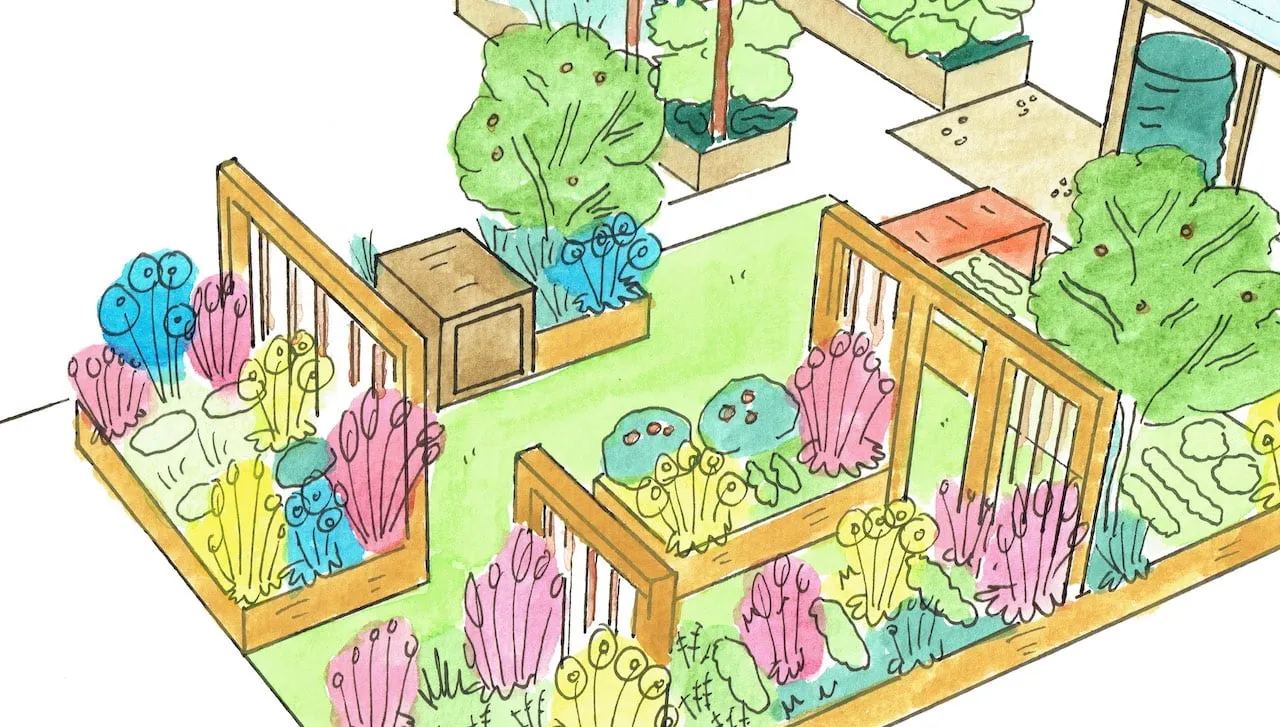
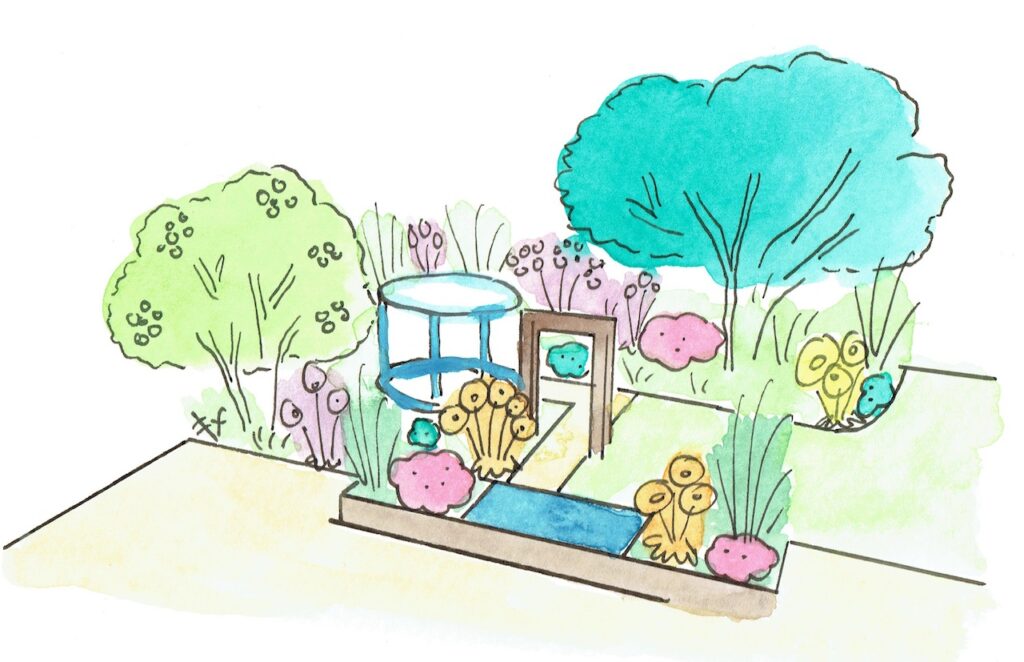
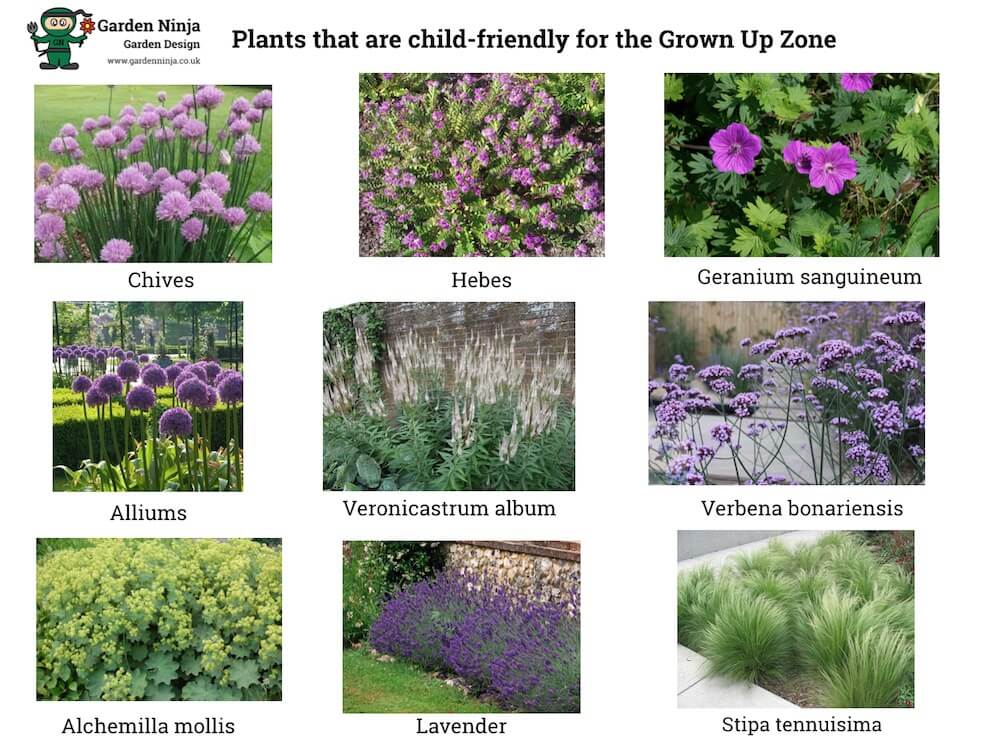
Example plant groups suggested to the couple.
This design was a pleasure to work on. It was a real challenge given the limited space, the poor soil quality and the family’s requirements, so it worked for adults and children. By using straight lines and zones and splitting the garden sensitively, I think the design really works for the couple. Even as the children grow up, the garden is ‘adult’ enough to morph into the next stage of their life.
Frequently Asked Questions About Child-Friendly Gardens
What age is a child-friendly garden suitable for?
A child-friendly garden can be designed to suit any age from toddler upwards, but the design priorities change significantly as children grow. Toddlers need maximum supervision, contained spaces, soft surfaces, and no open water. Primary school-age children thrive with climbing features, mud kitchens, dens, and growing spaces. Teenagers benefit most from private seating areas, independence, and a garden that does not feel childish. The best family gardens are designed with progression in mind so they evolve naturally rather than needing a full redesign every few years.
How do I make my garden safe for a toddler?
The three priorities for toddler safety are water, falls, and access to chemicals or sharp tools. Remove or securely cover all open water including ponds, water butts, and even large plant saucers. Keep all play equipment at ground level or with minimal fall heights. Store tools, chemicals, and garden equipment in a locked shed or cabinet. Use soft surfaces like bark chip in play zones rather than hard paving. Fit a self-closing, high latch gate on any boundary that opens onto a road. Finally, remove or fence off any plants known to be highly toxic, particularly Aconitum (Monk’s Hood), Laburnum, and Nightshade.
What are the best surfaces for a child-friendly garden?
Real turf is the ideal primary surface for a family garden. It is soft, natural, and handles falls well, though it will wear in high-traffic areas. Bark chip at a depth of 150mm or more is the best surface beneath play equipment and in dedicated play zones, cushioning falls effectively. Natural stone paving is excellent for paths, seating areas, and terraces. Gravel works well in quieter zones but is not suitable directly in play areas for young children who may mouth it. Artificial turf should be avoided in child-friendly gardens: it overheats in summer, causes friction burns, smothers wildlife, and cannot be recycled.
Should I avoid ponds if I have children?
For children under five, my strong recommendation is to delay a pond or remove an existing one temporarily. The drowning risk in shallow water is real and significant for this age group. For older children, a properly installed pond with gently sloping edges, good visibility from the house, and consistent safety conversations with children is manageable. As an alternative for families who love water in the garden, a bubble fountain with a covered underground reservoir gives you the sound and movement of water with no open water surface whatsoever.
What plants are safe to grow in a child-friendly garden?
The most child-safe planting approach is to focus on edibles (which children are encouraged to taste) and robustly non-toxic ornamentals. Safe edibles for a family garden include strawberries, tomatoes, peas, beans, courgettes, and most herbs. Among ornamentals, hardy Geraniums, Alchemilla mollis, ornamental grasses, Rudbeckia, Echinacea, Hydrangea (avoid ingestion), and Buddleja are all resilient and low-risk choices. Avoid Aconitum, Laburnum, Nightshade, Lily of the Valley, and Foxgloves if you have very young children who cannot yet understand the difference between edible and toxic plants.
How do I stop play equipment looking out of place in the garden?
The most effective approach is to position play equipment within a clearly defined zone that is separated from the main garden by planting, raised sleeper edges, or a change in surface material. Surround larger structures with planting to soften their visual impact. Climbing plants trained over wooden play equipment, camo netting, and ornamental grasses at the edges of a play zone all help blur the boundary between functional play space and designed garden. For trampolines, sinking them into the ground is the single most transformative thing you can do: an in-ground trampoline is almost invisible from the house.
How much does a child-friendly garden cost in the UK?
A basic child-friendly garden with a bark chip play zone, simple mud kitchen, and resilient planting can be achieved for £500 to £1,000 on a DIY basis. A mid-range project with a professional design, raised beds, paving, and quality play equipment typically runs from £3,000 to £8,000 installed. A full landscaping project including a sunken trampoline, terraced seating area, custom planting design, and professional installation can reach £15,000 to £25,000 or more for a medium-sized garden. The biggest single cost variable is usually hard landscaping; planting and play equipment are relatively affordable even on tighter budgets.
Design the Garden You’ve Always Wanted
Ready to stop guessing and start designing with confidence? My Garden Design for Beginners online course takes you from blank canvas to brilliant layout, step by step.
I’m Lee Burkhill, award-winning garden designer and BBC1’s Garden Rescue presenter, and I’ve built this course around the same principles I use for every client garden, practical, honest, and designed to actually work in the real world.
In 20 hours of flexible online study you’ll cover:
Design principles that make any garden work
How to select and arrange plants like a professional
Styles and layouts to suit every size and shape of space
Video lessons, real-world case studies, quizzes, and a certificate on completion, all for just £199.
Enrol today and start designing your dream garden.
29
Garden Design Examples for Small Gardens: 30 Design Templates & Planting Plans
Garden Design Examples for Small Gardens: 30 Design Templates & Planting Plans: In this online gardening course, I’ll walk you through 30 fantastic garden designs, explaining the logic behind the layout, the plant choices, and take-home tips for applying them in your own garden.
Weekend Garden Makeover: A Crash Course in Design for Beginners
Learn how to transform and design your own garden with Lee Burkhills crash course in garden design. Over 5 hours Lee will teach you how to design your own dream garden. Featuring practical design examples, planting ideas and video guides. Learn how to design your garden in one weekend!
Garden Design for Beginners: Create Your Dream Garden in Just 4 Weeks
Garden Design for Beginners Online Course: If you want to make the career jump to becoming a garden designer or to learn how to design your own garden, this is the beginner course for you. Join me, Lee Burkhill, an award-winning garden designer, as I train you in the art of beautiful garden design.
Designing a child-friendly garden that works for the whole family comes down to three things: thoughtful zoning, resilient planting, and designing with the future in mind. Use real turf and play bark over artificial surfaces, choose Hydrangeas, hardy Geraniums, and ornamental grasses over brittle or spiky plants, and integrate play features like mud kitchens and sunken trampolines so they enhance the garden rather than dominate it.
Address water safety explicitly before any other design decision if you have children under five, keep tool storage locked away, and think about how each zone will evolve as your children grow through the stages covered in this guide. A garden designed well for a family today will still be a beautiful, functional space long after the children have grown up and moved on.
If you have found this guide useful, make sure you visit my YouTube channel for more garden guides, and do share your child-friendly garden stories on Facebook or Instagram. Happy Gardening!
Your subscription could not be saved. Please try again.
Your subscription has been successful.
Lee Burkhill
Lee Burkhill, known as the Garden Ninja, is an award-winning garden designer and horticulturist with over 30 years of gardening experience and 15 years as a professional garden designer. A qualified RHS (Royal Horticultural Society) professional, Lee specialises in sustainable garden design and practical horticultural advice. He designs and presents on BBC1’s Garden Rescue and in leading gardening publications. Lee combines three decades of hands-on gardening knowledge with professional design qualifications to help gardeners create beautiful, functional outdoor spaces.
Thanks for sharing, I really enjoyed your post here. We also have a new built and are looking to design our garden suitable for us and our little 16 month toddler. Do you have a picture of the finalised garden? I would love to see it.
Hi Peter, Unfortunately I don’t have any after pics of this garden. The owners wanted to build it themselves in stages. Have a look at my Family Garden redesign though for a similar style.



























Hello Ninja!
Thanks for sharing, I really enjoyed your post here. We also have a new built and are looking to design our garden suitable for us and our little 16 month toddler. Do you have a picture of the finalised garden? I would love to see it.
Cheers
Peter
Hi Peter, Unfortunately I don’t have any after pics of this garden. The owners wanted to build it themselves in stages. Have a look at my Family Garden redesign though for a similar style.
Thanks Lee!