Lee Burkhill: Award Winning Designer & BBC 1's Garden Rescue Presenters Official Blog
Intermediate level
Wildflower meadows are making a come back and for good reason. These wildlife-rich flower beds offer a haven for and bees. Even in the smallest garden, you can create a mini wildflower meadow. So come join me as I show you the easiest way to create that wildflower meadow garden!
When you think of meadows, you may think of acres of rolling hillside, Julie Andrews, and lazy summer days. However, the wildflower meadow is under threat from the overdevelopment of green spaces. So now, a number of gardeners are looking to recreate smaller versions of these in their own gardens, helping to create a refuge for nature and increase the beauty of their gardens in fighting back the tide of concrete.
This guide will show you how any size garden can benefit from either a mini meadow or at least incorporating some fuss-free, wildlife-friendly plants. Both to bring wildlife and a sense of relaxation to your garden no matter what size.
This page contains affiliate links for products I use and love. If you take action (i.e. subscribe, make a purchase) after clicking a link, I may earn some gardening commission, which helps me keep the Garden Ninja Blog free for all.
Types of Wildflower Meadow Explained
There are two main types of wildflower meadow which you have to choose from. One is the fast annual meadow that needs to be reseed each year, and the second is the perennial meadow that takes longer to get going but is less temperamental to weather or seasonal changes. Whichever you choose has its benefits and drawbacks, which I’ll explain in this article.
Annual wildflower meadow
Perennial wildflower meadow
1. Annual Wildflower Meadow Tips
An annual wildflower meadow is based on a mix of annual (single-season) plants that are grown, flower, set seed, and then die each year. These annual meadows often feature more showy and varied flower colours.
Contrary to many people’s belief, they are hard to establish and maintain without significant input each year. You’re either going to be sowing seeds or laying wildflower turf to start your meadow.
If you’ve been led to believe all you need to do is scatter a wildflower seed mix down on the lawn or some open ground, then sit back with the Chablis, you’re sadly wrong. Your chances of success and germination deteriorate severely without significant preparation and removal of weeds or existing plants.
Annual Meadow Seed Mix Example
Below is an example of some of the annual wildflower seed species you may find. Sometimes, these are pre-mixed in packets with a number of other native and non-native species. They are used mainly for first-year colour with some establishment each year after.
The drawbacks of an annual meadow are the amount of initial preparation to get the seed mix to germinate and establish. These annual meadows require really poor soil to germinate and will not usually succeed if grasses or other weeds are present. This means you have to strip any turf or weeds from the area before sowing. If you have very fertile ground, these seeds will struggle to take.
Annual wildflower mixes are freely available but need poor, weed and grass-free soil to have a solid chance of success.
More often than not, I hear from people who have tried to sow annual meadows, but either failed to prepare the site properly or too high a soil quality scuppers their efforts!
You’re also totally reliant on self-seeding each year. So you must leave your meadow to flower, set seed, then distribute it naturally. This is why, in year two, a number of species may disappear, as they don’t manage to set viable seeds or are outcompeted by more competitive species.
2. Perennial Wildflower Meadow Plant Mix
Whilst I love annual meadows, I’m also a fan of saving both time and effort in the garden. Especially with new gardeners where failure can often put them off continuing! I also have a niggle with creating picture-perfect meadow mixes that, in reality, would never thrive each year without huge amounts of interference. So, I always prefer to use native perennial wildflower species when planting meadow mixes.
You may not get every colour under the sun, but you can create a far more sympathetic and longer-lasting effect that benefits both wildlife, with continued pollen/food sources, and you, the gardener, from not having to reseed every year!
In my experience, they can compete with grasses, especially if some Toadflax is added to the mix. I also find it gets back to the true essence of what a meadow is, without it being too fiddled with for Instagram-worthy beauty alone.
I use the following mix here in the UK for my meadow planting. Proven as either tough UK natives or real ‘doers’ in the garden, these species can quite happily tolerate a bit of competition and come back year after year. You’re not going to lose sleep on your well-earned summer holiday in Spain, that they may not get pollinated before Autumn comes!
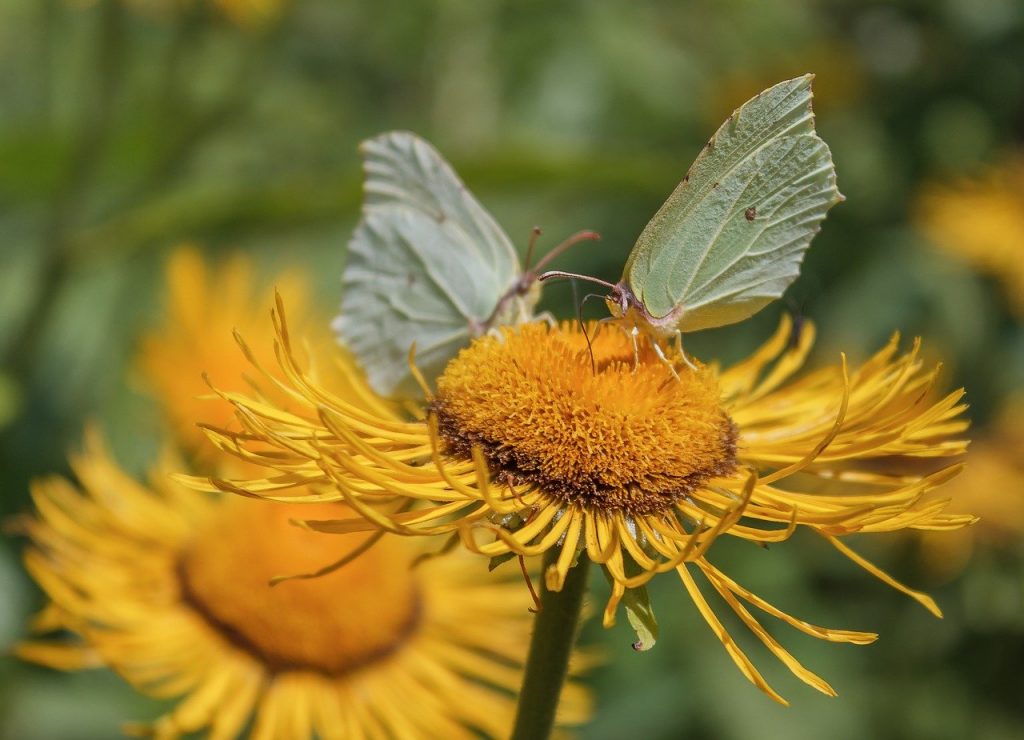
1. Inula helenium (Elecampane)
Elecampane is tall and an all-you-can-eat buffet for wildlife.
Height 120–150cm (4–5ft)Spread 90–100cm (3ft)Flowers Yellow, July–AugustHardiness H6 (fully hardy to −20°C)Wildlife Value Bees, hoverflies, beetles
Lee’s Expert Tip: Elecampane is a bold architectural plant that earns its place at the back of any meadow. In my experience it performs best in slightly moist, rich soil but once established it is remarkably self-sufficient. The large basal leaves are spectacular even when the plant is not in flower — a quality I always look for when recommending meadow plants to clients on my BBC Garden Rescue designs.
Elecampane is one of the most striking tall perennials you can introduce to a wildflower meadow, and it is criminally underused in UK gardens. Its large, sunflower-like yellow blooms appear from July into August on stout stems that can reach well over a metre, giving genuine structural height to what might otherwise be a flat planting.
As a former medicinal herb used since ancient Roman times, it carries history as well as beauty, and its nectar-rich flowers are absolutely mobbed by bees and hoverflies during summer. The sheer size of the plant means it works wonderfully as a backdrop to shorter species like Oxeye Daisy and Mallow, creating the natural layering you would see in a traditional hay meadow. Fully hardy throughout the UK, Elecampane is a plant that asks very little once it has settled in, returning year after year with increasing vigour.
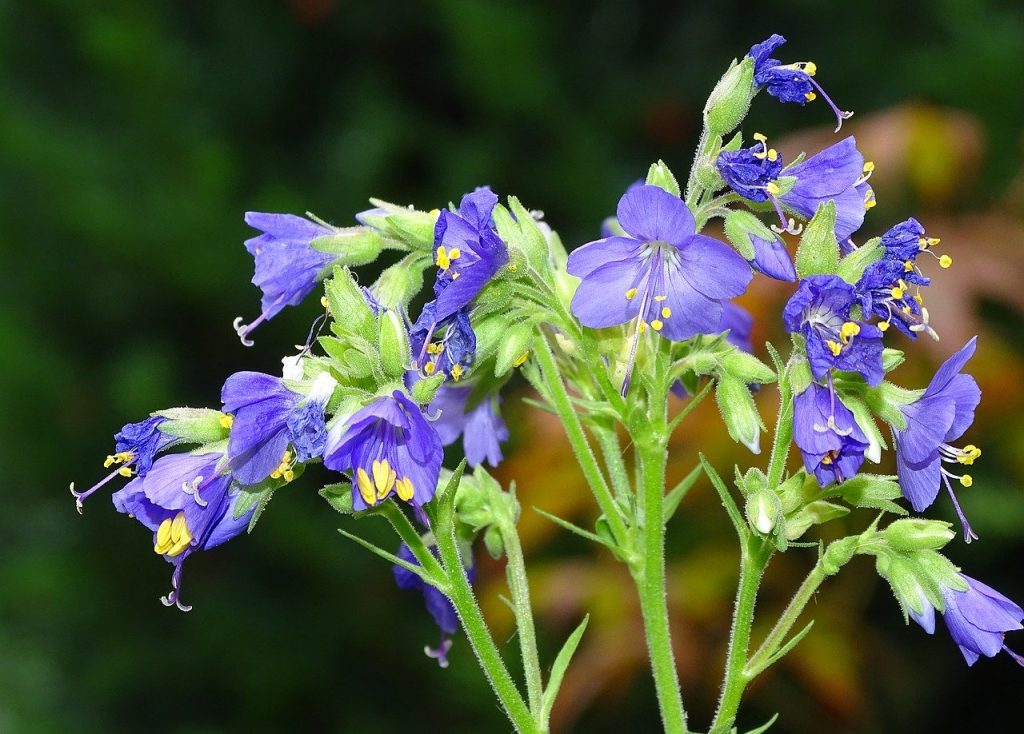
2. Polemonium caeruleum (Jacobs Ladder)
Jacobs Ladder — a rarely seen herb which is a UK native.
Height 60–90cm (2–3ft)Spread 30–45cm (12–18in)Flowers Blue-violet, May–JulyHardiness H7 (fully hardy to −20°C and below)Wildlife Value Bumblebees, solitary bees, hoverflies
Lee’s Expert Tip: Jacob’s Ladder is one of Britain’s genuinely rare native wildflowers and grows wild in only a handful of northern limestone habitats. I grow it from seed every time I am creating a perennial meadow — its ferny, ladder-like foliage is ornamental all season long, and the blue flowers appear at a time when many other meadow plants are still getting going in spring.
Polemonium caeruleum, or Jacob’s Ladder, is a UK native wildflower so scarce in the wild that finding it in cultivation feels like a proper privilege. In the garden it performs outstandingly well, producing elegant pinnate leaves that look almost fern-like throughout the season, then throwing up tall spikes of vivid blue-violet flowers from May onwards.
It is a superb early-season food source for bumblebees at a time when the meadow is still waking up, bridging the gap before later-flowering species like Yarrow and Chicory take over. Its moderate height means it sits comfortably in the middle layer of a perennial meadow planting, filling the visual space between ground-hugging species and the taller architectural plants behind. Completely hardy across the entire UK, it will self-seed gently, gradually spreading to form attractive drifts over time.
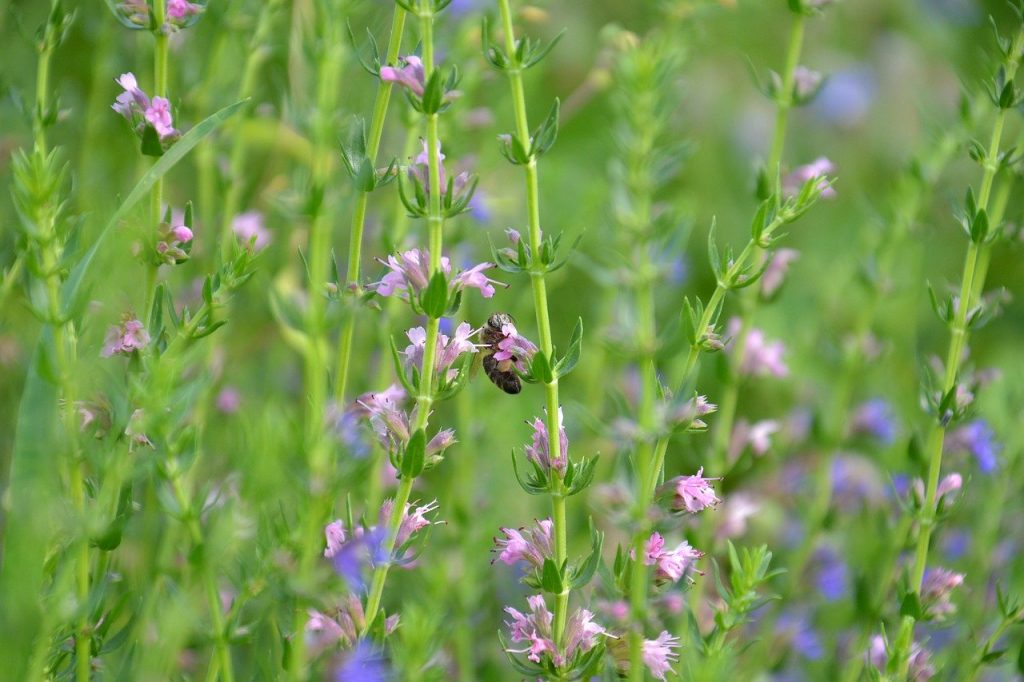
Height 40–60cm (16–24in)Spread 30–45cm (12–18in)Flowers Blue-violet, July–SeptemberHardiness H5 (fully hardy to −15°C)Wildlife Value Bees, butterflies, moths
Lee’s Expert Tip: Blue Hyssop is semi-evergreen, which means it provides year-round structure to the meadow edge even in winter — a quality I value enormously on designed gardens where the client wants interest all year. Cut it back hard in early spring to keep it compact and bushy rather than becoming straggly.
Hyssop is one of those plants that punches well above its weight in a wildflower meadow. As a semi-evergreen sub-shrub it provides year-round presence at the front or middle of a planting, and from July through to September its dense spikes of blue-violet flowers are a magnet for every bee and butterfly visiting the garden.
It has ancient credentials as a medicinal herb and it has been cultivated in Britain since at least the sixteenth century. Hyssop carries a pleasant aromatic scent that adds a sensory dimension to the meadow experience. Being a Mediterranean native, it thrives in free-draining, relatively poor soils, which makes it perfectly adapted to the nutrient-lean conditions that wildflower meadows require. In my professional practice I often use Hyssop at the edges of meadow plantings to create a neat, structured transition between a mown lawn and the wilder planting beyond.
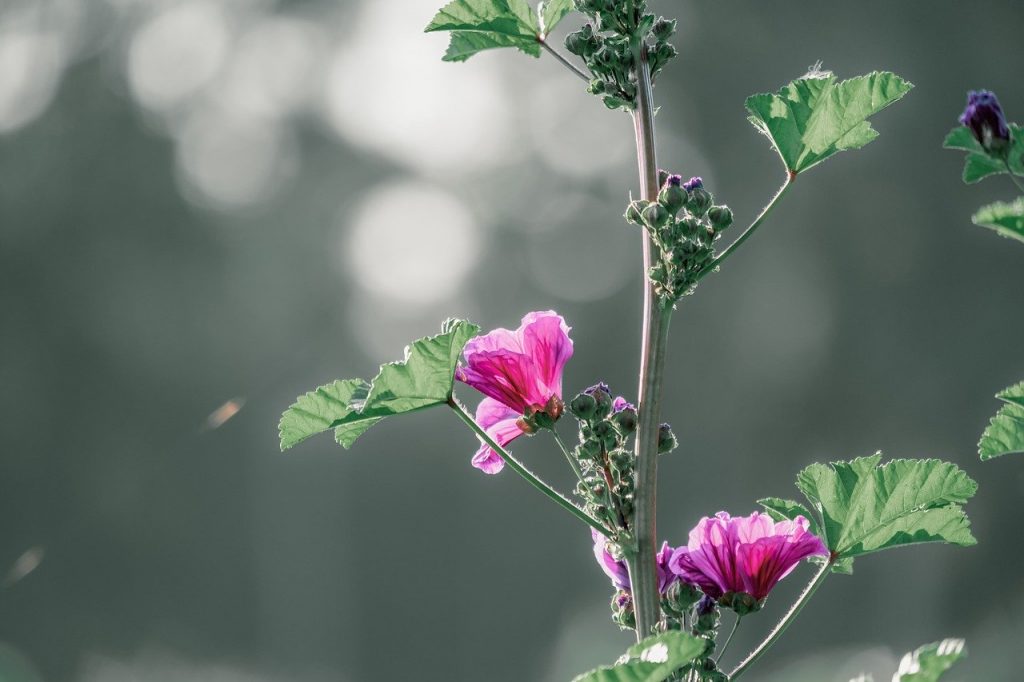
Height 45–90cm (18in–3ft)Spread 30–60cm (12–24in)Flowers Pink-purple, June–OctoberHardiness H5 (fully hardy to −15°C)Wildlife Value Bees, butterflies, moth larvae (larval food plant)
Lee’s Expert Tip: Common Mallow has one of the longest flowering seasons of any native wildflower, blooming from June right through to the first frosts in October. That extended season makes it one of the most ecologically valuable plants you can include for late-season pollinators when other sources are dwindling. It is also an important larval food plant for several moth species.
Common Mallow is a plant that I have used repeatedly on BBC Garden Rescue when clients want a wildflower area that looks spectacular without demanding constant attention. Its tall, branching stems carry an endless succession of those beautiful cerise-pink flowers streaked with darker veining, and it will bloom from June right the way through to October — a genuinely exceptional season.
It is one of Britain’s most ancient native plants, referenced in texts dating back to the Saxons, and it establishes readily in most soils as long as the site is reasonably sunny. In a meadow context it works particularly well interspersed with white Oxeye Daisies and yellow Yarrow, the contrast in colour being extremely effective from a distance. It is fully hardy across the UK and tends to self-seed enthusiastically, so expect it to gradually colonise any available ground.
5. Achillea millefolium (Yarrow)
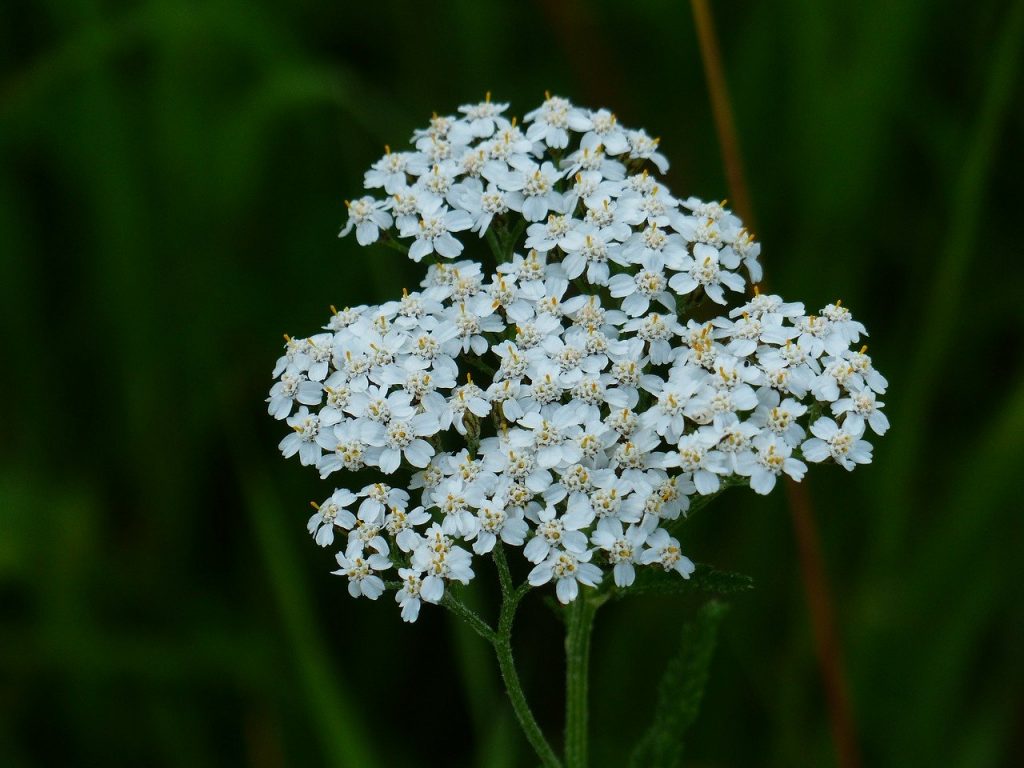
Yarrow — A favourite roadside plant that can take over if left unchecked. Great for a large space.
Height 60–100cm (2–3ft)Spread 60cm (24in)Flowers White or pale pink, June–AugustHardiness H7 (fully hardy to −20°C and below)Wildlife Value Over 100 insect species; RHS Plants for Pollinators
Lee’s Expert Tip: Yarrow is the ultimate meadow workhouse — completely bombproof in terms of hardiness, drought tolerance, and competitive ability. Be aware that in a small meadow it can become dominant over time. If this happens, thin it out in early spring to give space to more delicate species alongside it.
Of all ten plants on this list, Achillea millefolium — Common Yarrow — is arguably the most ecologically important. The RHS has confirmed that Yarrow supports over 100 different insect species, making it one of the single most valuable garden plants in the UK for invertebrates.
Its flat-topped flower heads in white or blush pink provide a landing platform that smaller insects including hoverflies, parasitic wasps and beetles find irresistible, and its feathery, aromatic foliage is attractive even when not in flower. In a meadow setting, Yarrow has an important practical role as a spreader and gap-filler.
It has rhizomatous roots that gradually knit together the planting, creating a more robust and competitive sward that is better able to resist grass invasion. It is as tough as old boots in terms of hardiness, coping with the most exposed and unforgiving sites across the UK, and its drought tolerance is exceptional once established.
6. Leucanthemum vulgare (Oxeye Daisy)
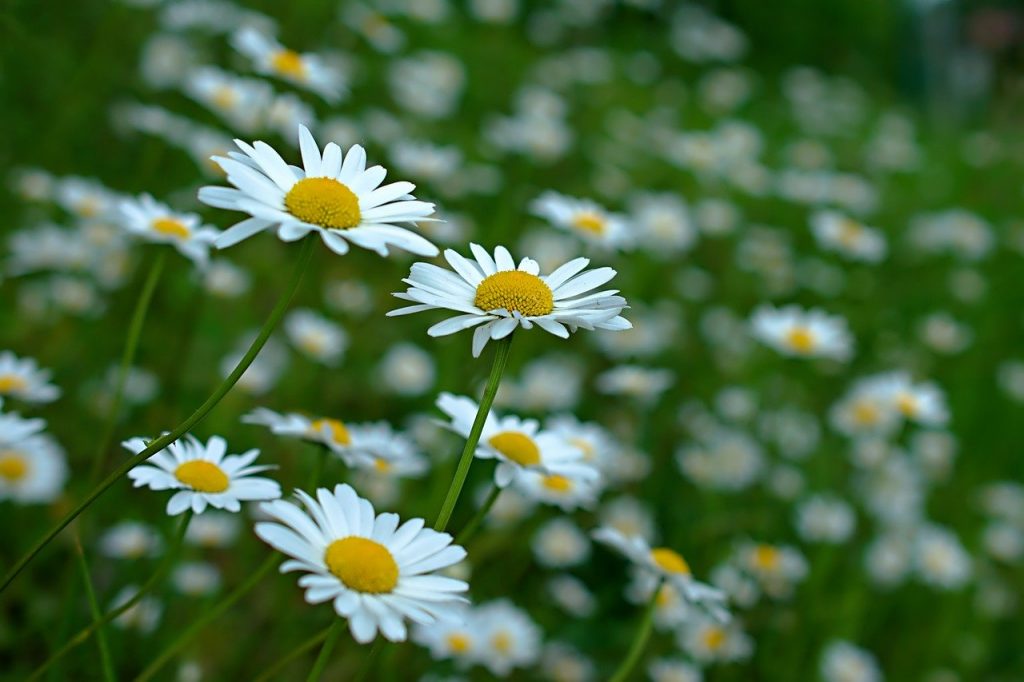
Oxeye daisies will tolerate abuse and neglect — great for time-poor or new gardeners!
Height 30–80cm (1–2.5ft)Spread 30–60cm (12–24in)Flowers White with yellow centre, May–SeptemberHardiness H7 (fully hardy to −20°C and below)Wildlife Value Beetles, flies, butterflies, birds (seed heads)
Lee’s Expert Tip: Oxeye Daisy is the first plant I recommend to anyone who tells me they have killed everything they have ever grown. It truly is indestructible. It will colonise bare soil rapidly, stabilising the new meadow in its first two seasons while slower perennials establish around it — which makes it invaluable as a structural pioneer.
Leucanthemum vulgare, the Oxeye Daisy, is the quintessential British wildflower meadow plant and for very good reason as it is practically indestructible.
Native to the British Isles, it is found in meadows, roadside verges and disturbed ground across the country, and it brings that classic white-and-yellow daisy charm that most people picture when they think of a wildflower meadow. From a design perspective I value it enormously as an early establisher: it germinates readily, grows quickly, and begins flowering in its first summer, giving a new meadow planting the visual impact it needs whilst slower species settle in.
Its long flowering season runs from May right through to September, and the spent seed heads are eaten by finches and sparrows in autumn, providing year-round ecological value that goes well beyond the flower season.
7. Linaria vulgaris (Toadflax – parasitic plant)
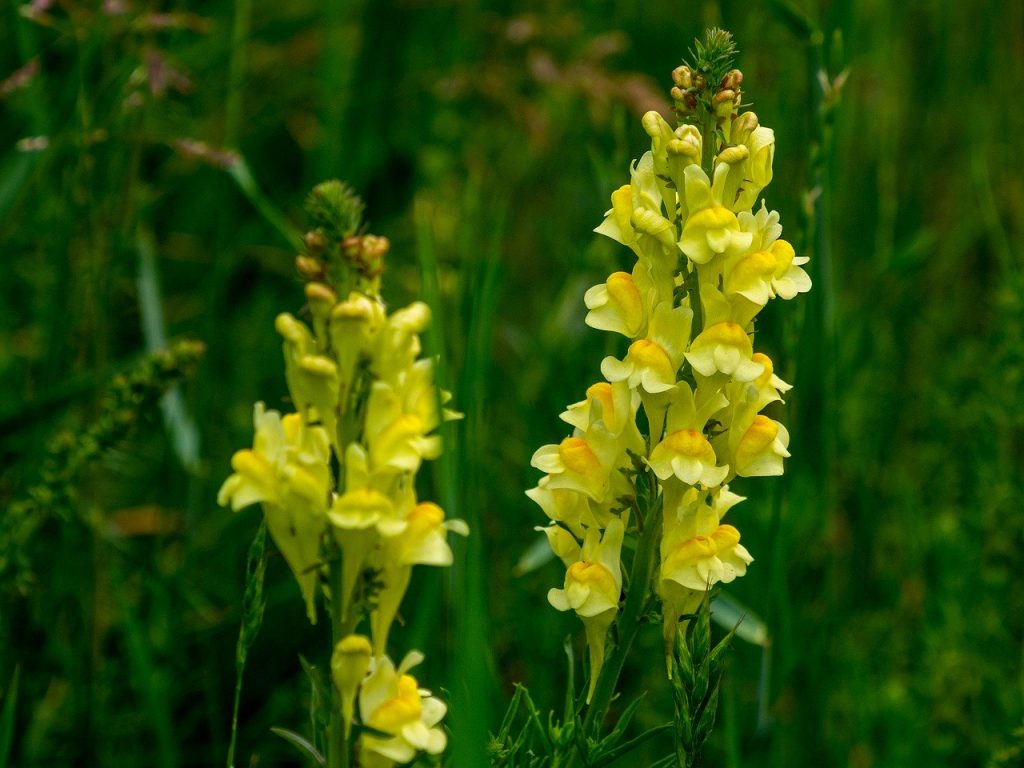
Toadflax — don’t fear its competitive nature. It will help slow down competing grasses. It won’t eat your children or ruin your life!
Height 30–80cm (1–2.5ft)Spread 30–45cm (12–18in)Flowers Pale yellow with orange flash, June–OctoberHardiness H7 (fully hardy to −20°C and below)Wildlife Value Bumblebees (specialist relationship); moth larvae
Lee’s Expert Tip: Toadflax is unusual in that it is semi-parasitic on grasses — exactly like Yellow Rattle, but without the dramatic grass-suppressing effect. Think of it as a gentler ally in the ongoing battle against aggressive grass competition. I always include it alongside Yellow Rattle for belt-and-braces grass control in perennial meadows.
Linaria vulgaris, Common Toadflax, is a fascinating plant that most people walk past without a second glance, yet it plays a quietly vital role in a wildflower meadow. Those pale yellow, snapdragon-like flowers with their characteristic orange flash are specifically structured to be pollinated by long-tongued bumblebees.
The flower is physically too heavy for most smaller insects to open. This specialised relationship makes it particularly valuable for supporting bumblebee populations. Its semi-parasitic nature, attaching to grass roots and drawing some of their nutrients, makes it an ally in the competition between meadow flowers and vigorous grasses. It spreads by both seed and rhizome, so in a large meadow it can be quite assertive. Which is no bad thing when you need something to compete with rampant rye grasses.
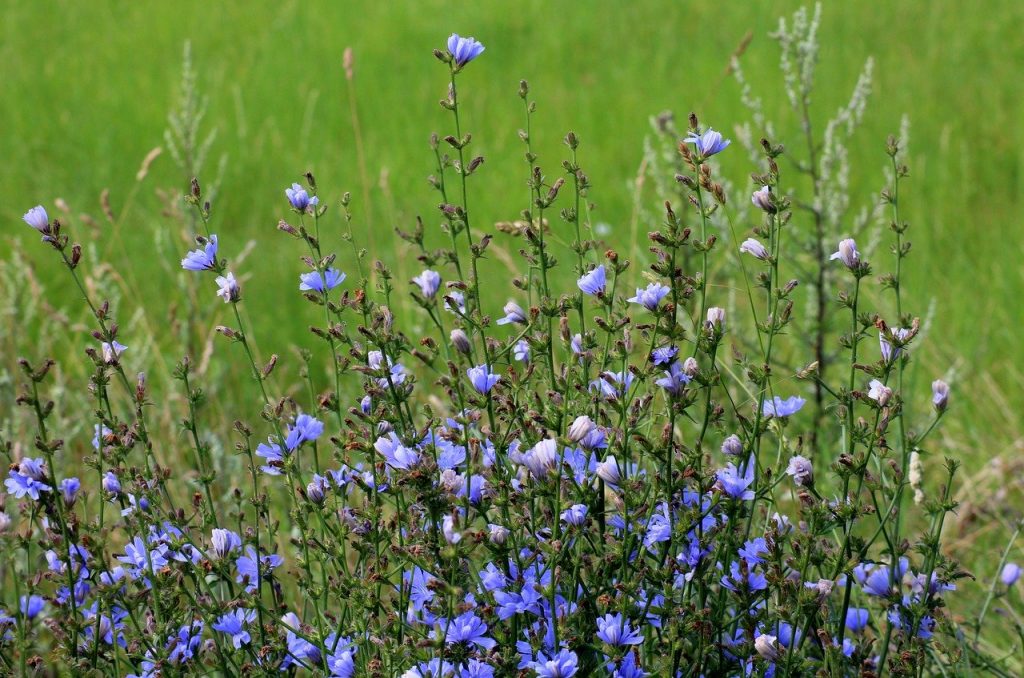
8. Cichorium intybus (Chicory)
Chicory has a light, airy habit and provides baby blue flowers.
Height 50–120cm (20in–4ft)Spread 30–45cm (12–18in)Flowers Sky blue, July–OctoberHardiness H6 (fully hardy to −20°C)Wildlife Value Bees, butterflies, hoverflies, beetles
Lee’s Expert Tip: Chicory is one of very few native wildflowers that provides that pure, clear sky-blue colour — a genuine rarity in the meadow palette. Worth knowing: the flowers close by early afternoon on sunny days, so position your meadow where you can enjoy it in the morning for maximum visual impact from this species.
Chicory is one of those plants that stops garden visitors in their tracks when it is in full bloom. Those intense, sky-blue daisy flowers on their tall, branching stems are quite unlike anything else in the wildflower palette. It is a native British plant, found historically on chalk downland and roadsides across southern England, and it thrives in exactly the poor, well-drained soils that a wildflower meadow provides.
From a design perspective, its tall, airy structure adds a lovely lightness to a planting — it does not create a solid visual mass like Mallow or Yarrow, but rather floats through the other plants, providing flashes of brilliant blue at eye level from July right through to October. As a food source it is popular with a wide range of pollinators, and the young leaves are actually edible. It is the same plant family that produces witloof chicory and endive in the vegetable garden.
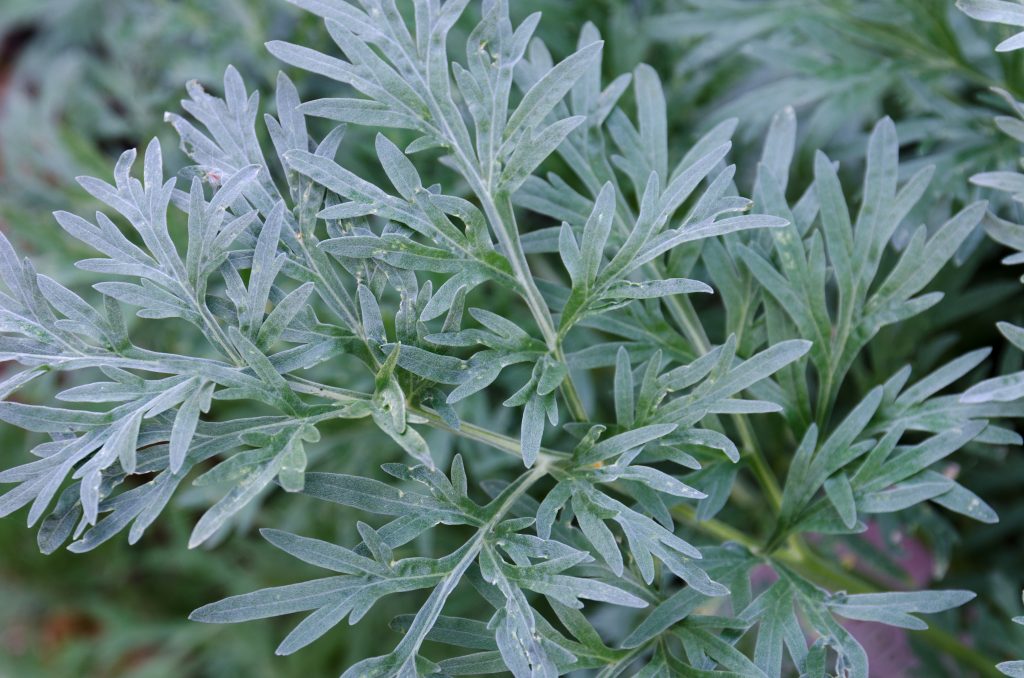
9. Artemisia absinthium (Wormwood)
Wormwood is technically a deciduous shrub but has yellow flowers. Good to add some mid-height structure to a meadow.
Height 60–120cm (2–4ft)Spread 60–90cm (24–36in)Flowers Tiny yellow-green, July–AugustHardiness H7 (fully hardy to −20°C and below)Wildlife Value Moth larvae; aromatic foliage acts as natural insect deterrent
Lee’s Expert Tip: Wormwood is grown principally for its spectacular silver-grey foliage rather than its flowers. In a meadow dominated by greens and bright flower colours, that silver presence is genuinely striking and adds a professional garden-designer touch. It is the same plant from which absinthe is distilled — a fascinating horticultural fact that always goes down well with visitors.
Artemisia absinthium, Wormwood, is the most structurally distinct plant on this list, and that is precisely why I include it. In a meadow planting rich in green foliage and colourful flowers, the intensely silver-grey, deeply divided leaves of Wormwood provide a visual contrast that makes every plant around it look better. It is a deciduous sub-shrub rather than a true herbaceous perennial, developing a slightly woody base over time, and its small, unremarkable yellow-green flowers are of less visual interest than most of the other species here.
What it contributes is structural mid-height presence throughout the growing season, and the finely divided, aromatic foliage has a natural insect-deterrent quality that makes it a useful plant to position near the meadow boundary. A plant steeped in history and known to herbalists for centuries, and the key botanical ingredient in absinthe, along with witchcraft pratcices it adds a certain cultural intrigue for any gardener who likes to know the stories behind the plants they grow.
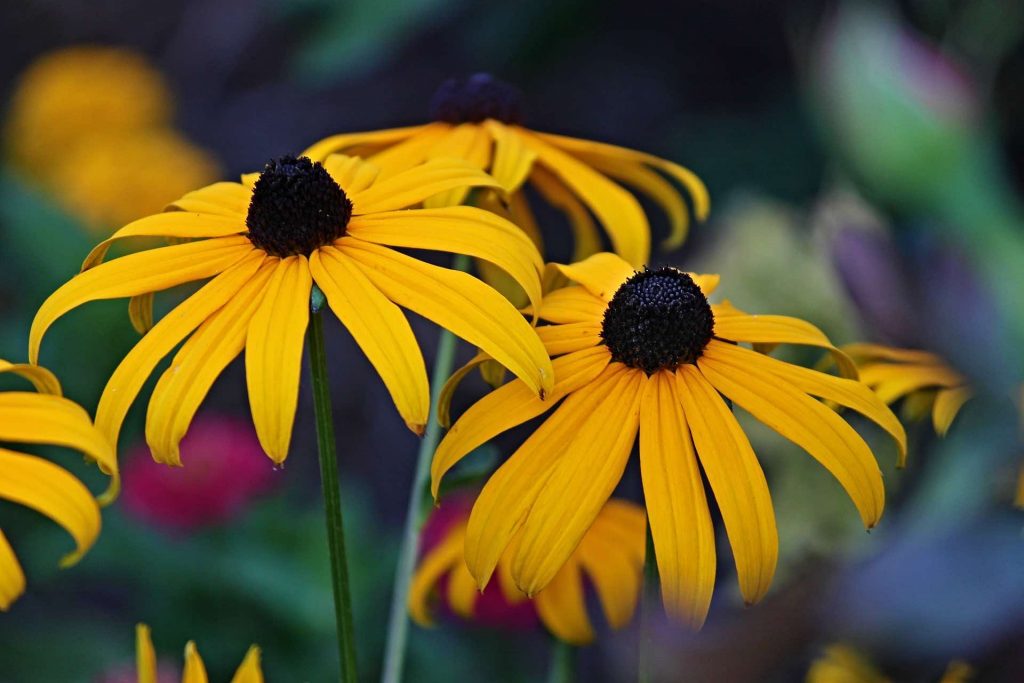
10. Rudbeckia hirta (Black-Eyed Susan)
Rudbeckia is one of my favourite plant genera. These beauties, whilst not native, will transport you to the American prairie lands!
Height 45–75cm (18–30in)Spread 30–45cm (12–18in)Flowers Golden yellow with dark centre, July–OctoberHardiness H3–H4 (not reliably hardy; treat as annual or short-lived perennial)Wildlife Value Bees, butterflies, hoverflies; seed heads feed finches all winter
Lee’s Expert Tip: A note on hardiness: Rudbeckia hirta is technically a short-lived perennial that may not survive harsh UK winters reliably. I grow it as an annual from seed each year, starting indoors in March at around 20°C, which guarantees a reliable display. The seed is inexpensive and the germination rate is excellent — no drama.
Rudbeckia hirta, the Black-Eyed Susan, originates in the North American prairies rather than the British countryside, and I make no apology for including it. Those rich golden-yellow daisy flowers with their dramatically dark, domed centres are simply spectacular, and they bloom prolifically from July right the way through to October. Filling the meadow with warm colour at a time when many earlier flowering species are beginning to fade.
In terms of wildlife value, the tall seed heads that persist well into winter are an important food source for goldfinches and other seed-eating birds, extending the ecological season long after the last flower has dropped. It is worth being candid about its hardiness: in milder parts of the UK it will often self-seed and return reliably, but in colder regions it is best treated as an annual. Raising fresh plants from seed each year is easy and economical, and ensures that vivid golden display season after season.
If there is one plant I would insist you include in any perennial wildflower meadow, it is Yellow Rattle — Rhinanthus minor. Known as the “meadow maker” by conservationists and wildflower enthusiasts alike, this modest-looking annual with its small yellow flowers and papery seed pods is quite literally the secret weapon of successful meadow-making in the UK. It is the plant I mention on almost every BBC Garden Rescue meadow project, and for very good reason.
The reason Yellow Rattle is so important comes down to its semi-parasitic nature. Its roots penetrate and attach to the roots of nearby grasses, drawing water and nutrients from them and significantly reducing their vigour. In practice, this means the aggressive rye grasses and meadow grasses that would otherwise smother your carefully established wildflowers simply cannot outcompete them with the same ferocity.
Without Yellow Rattle, vigorous grasses will dominate and your wildflowers will eventually disappear. With it, you create the conditions for a genuinely species-rich meadow where your Mallow, Yarrow, Chicory and Oxeye Daisies can thrive year after year.
I have a dedicated full guide on how to grow Yellow Rattle on the site, but here are the essential points you need to know before you begin.
How to Sow Yellow Rattle Successfully
Yellow Rattle seed must be sown in autumn, no later than November. This is non-negotiable. The seed requires a prolonged cold period — a process known as vernalisation — before it will germinate in spring. Seed sown in spring will simply fail to germinate, full stop.
The seed is also very short-lived, so always use the freshest seed possible from the current year’s harvest, and buy from a reputable UK native seed supplier. The germination rate drops dramatically for seeds stored for even one season.
Before sowing, cut your grass or existing meadow area as short as possible and remove all clippings. You are aiming to expose around 50% bare soil to give the tiny seeds a fighting chance of making contact with the ground and germinating. Broadcast the seed at roughly 0.5 grams per square metre and firm in gently. Then leave it alone through winter and wait for those first seedlings to appear in March or April the following spring.
Do not be disheartened if only a modest number of plants establish in year one. Yellow Rattle builds its colony over two to three seasons, self-seeding prolifically once it is established. By year three a good colony is a genuinely transformative presence in a meadow, and you will see your wildflowers respond noticeably as the grass competition diminishes around them. It is one of the most rewarding long-term investments you can make in your meadow, and from a designer’s perspective I consider it as essential as any of the top-ten plants listed above.
Ok, so let’s get down to business with my guide. Planting out a perennial wildflower meadow is far easier to do and more cost-effective than laying annual meadow turf or having to spend weeks removing turf to then reseed. This is because you’re only paying for the seed, some compost and then your own time in sowing them on a window sill or greenhouse.
My method is to grow all of your own perennial wildflowers from seed which is both super cost-effective and far more fun than the drop-and-run approach of annual seeds. You’ll also get to really know your meadow plants and get a real sense of achievement as you watch them germinate. I have grown all of the above plants time and time again with no drama. So this is a real foolproof way of creating a wildflower meadow.
Growing a perennial wildflower meadow from seed is easier and more cost-effective.
Lastly, this method allows you to scale the meadow up and down by growing plants according to the size of the plot. Whether it is a metre-wide strip at the end of a lawn or 4 acres of a grassy paddock!
Step-by-Step Perennial Meadow Planting Guide
Step 1: Choose a mix of herbaceous perennials and wild flower candidates. The list above is not exhaustive but gives a nice mix of pink, blue, white and yellow wildflowers. Most of which are either native or have herbal properties (always triple-check plant idents before eating or using them!).
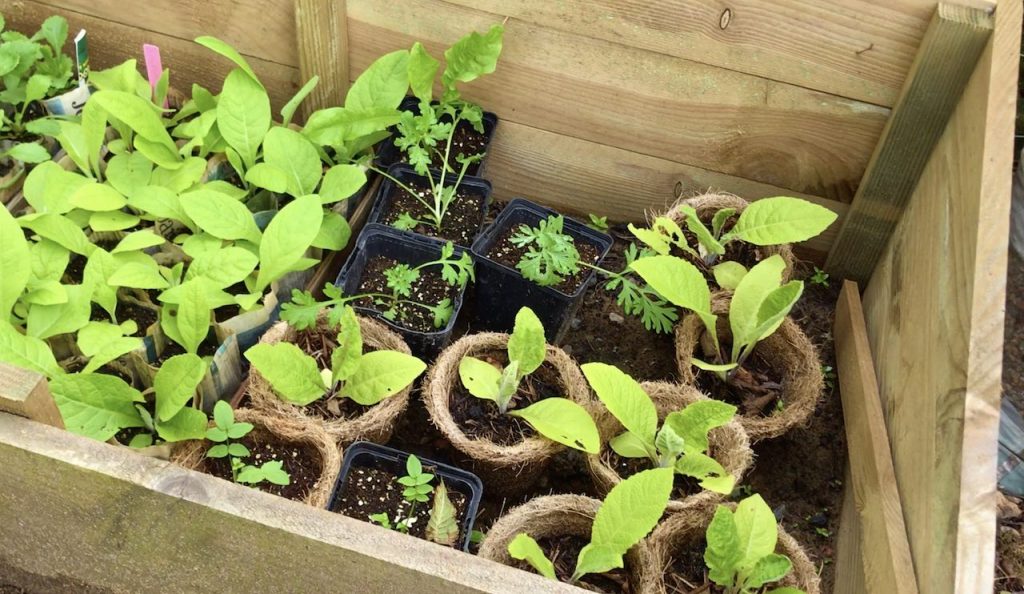
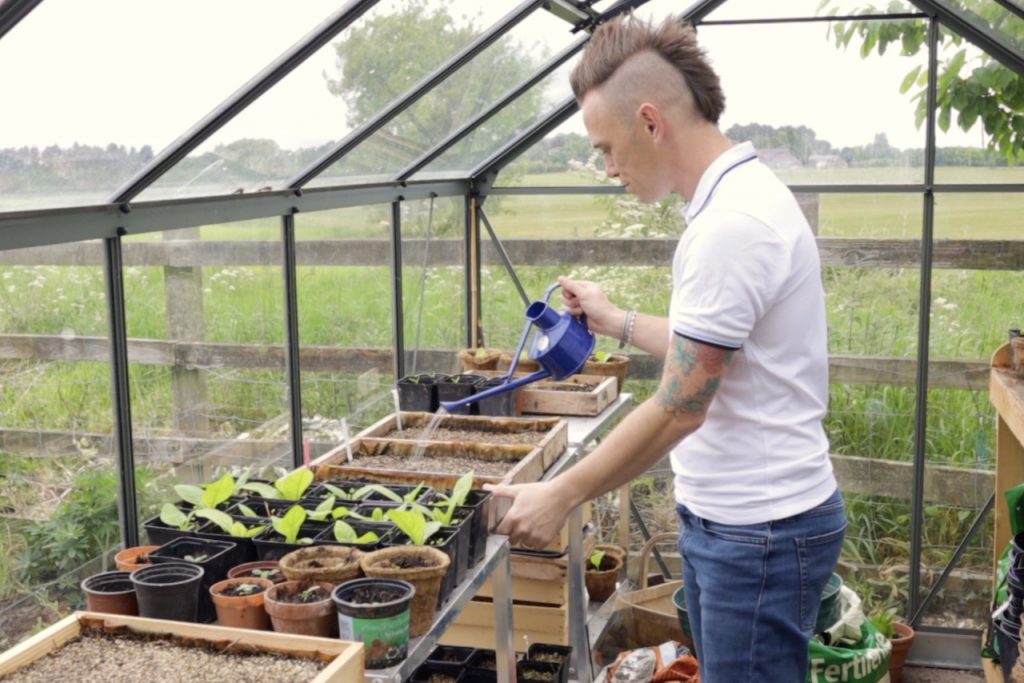
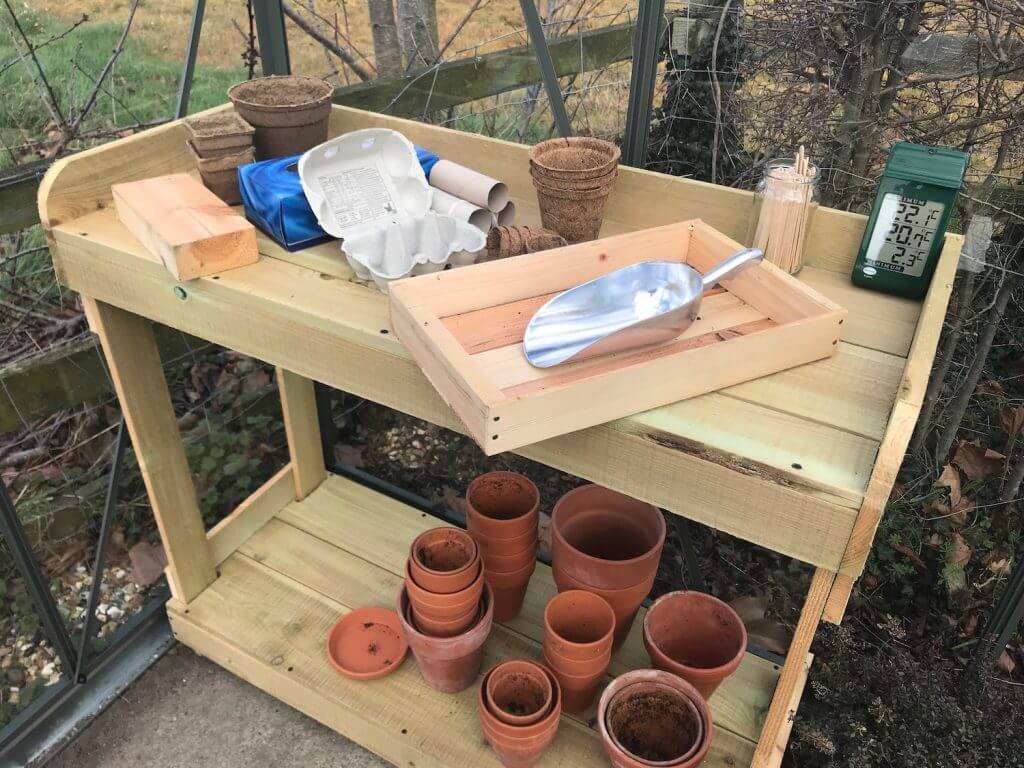
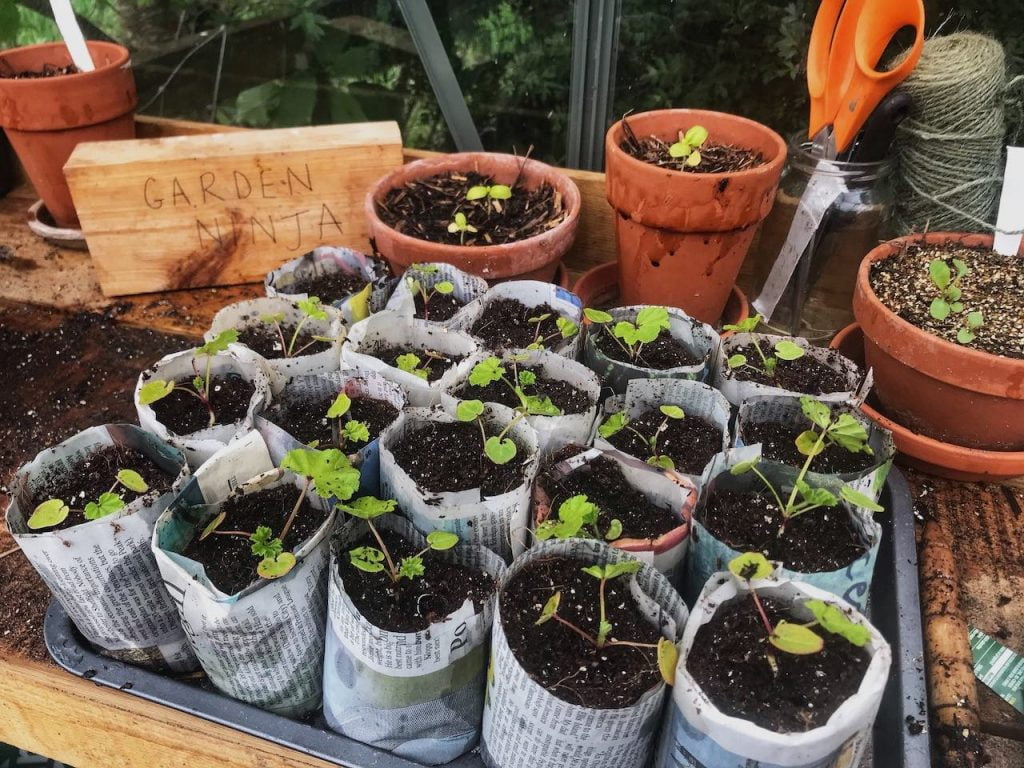
Growing your own perennial plants is easy whether it’s in a greenhouse or on a window ledge
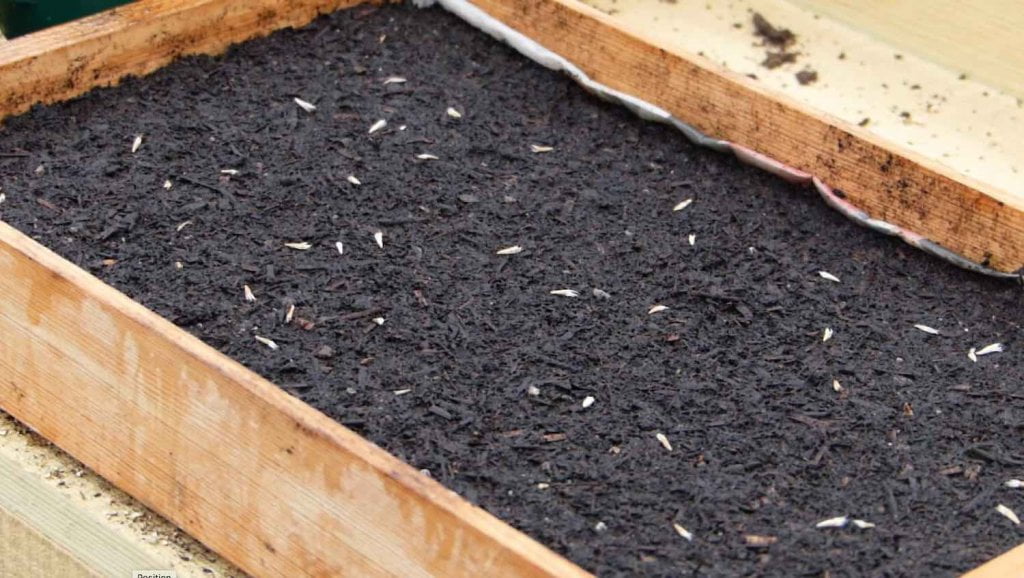
Step 2: As soon as spring arrives, i.e. March in the UK, start to sow your wildflower seeds under glass or on a window ledge. (There’s more detail on sowing seeds here and below). Remembering to sow them thinly and get ready to have many more plants than you initially expected. Good news for your friends and family!
Step 3: Once your seeds have germinated and put on some growth, pot them on and then harden them off a few weeks after.
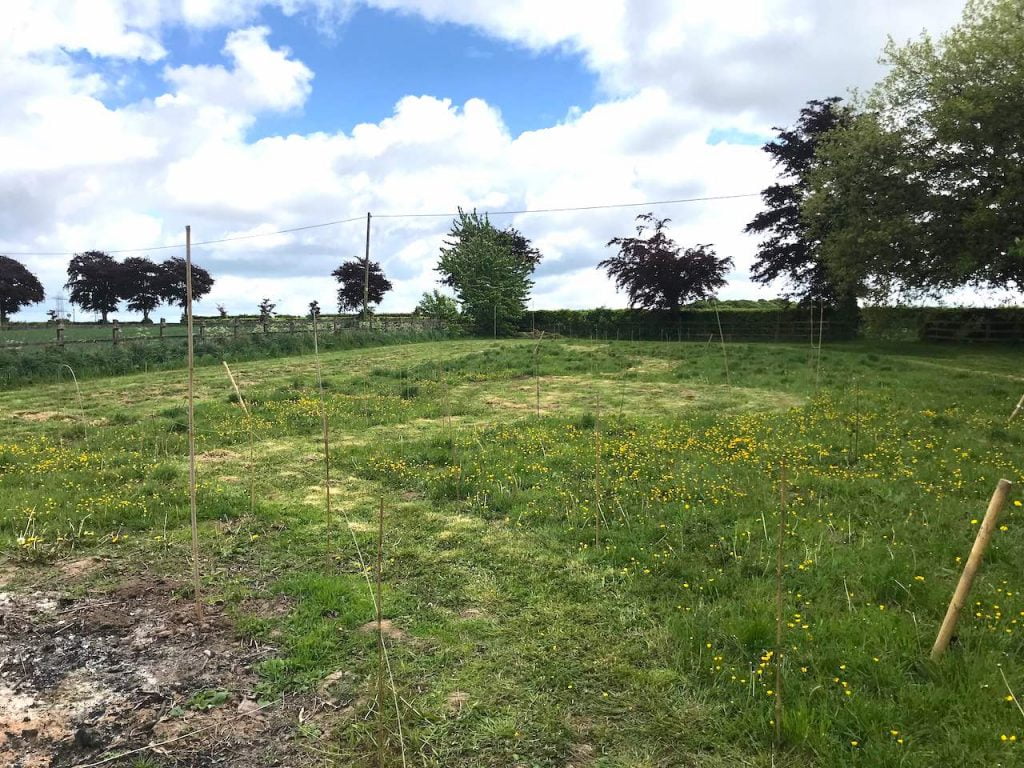
Step 4: Choose a suitable area for your wildlife meadow. It may be at the bottom of a lawn or an unloved border that’s a bit lacklustre. Ideally, you want to remove as many perennial weeds as possible. Though with this method, you don’t need to totally cultivate the ground if it’s in okay condition.
Whether it is a large or small space, work out the area. All wildflowers need a sunny site where possible.
Step 5: Work out how many plants you need for this area, or use the amount you have to dictate the space you’ll be giving over to the mini meadow! Ideally, space your plants about 60cm apart. Always check the ultimate height and growth. Planting closer than this can lead to them competing with each other. A 1m x 4m strip of the lawn may only need 5–10 plants, depending on the species.
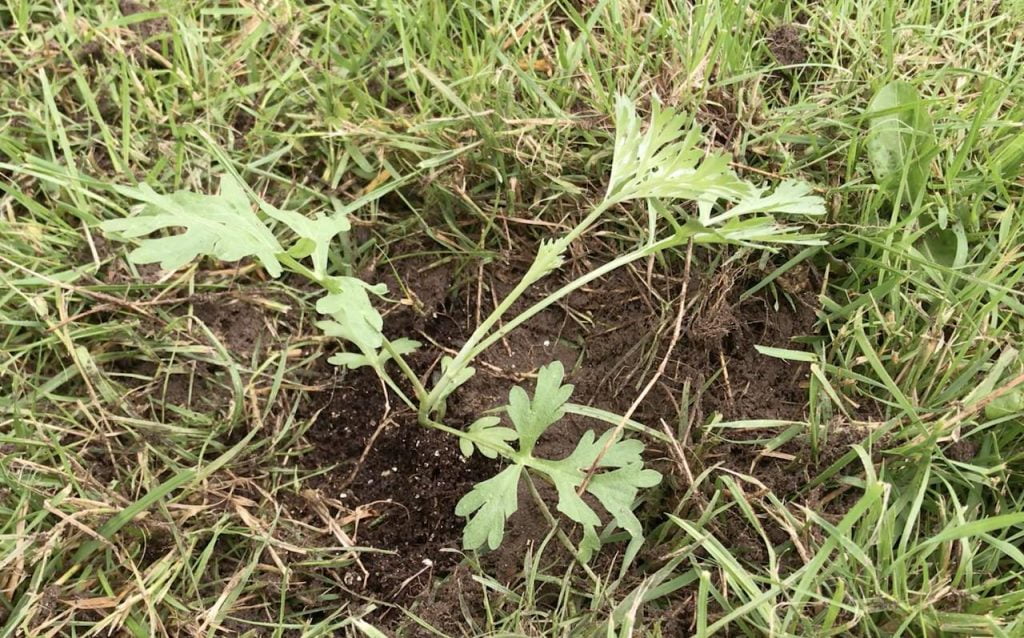
Step 6: If planting in a lawn, dig out a circle of turf that’s 30cm in diameter around the small plant. Remove the turf and then plant in your wildflower plant. This gives it a better chance of survival. I also keep the grass around these plants cut short, so they get the best access to light and water whilst they establish. I try and plant in drifts of different plants for a more natural look rather than a formal pattern.
Step 7: Keep your new plants watered and free from weeds and grasses immediately around them for the first year. This enables them to get established. In the first year, they probably won’t flower but will establish their roots.
Comedy watering cans are an option but more fun
Step 8: Now for the brutal part. In October, when the season is over, mow over or scythe back the entire meadow area. Remember that these herbaceous perennials and grasses will come back. This is essential. If not, you will end up with a crispy brown mess come spring. I then mow again in early March the following spring and then leave the meadow all season until October again. It really is mega-low fuss once it’s established!
Choose the mower to suit the size of your meadow — you could even use a strimmer if it is small.
The final thing to note is that we are not trying to completely remove weeds or grasses from growing. A true meadow mix has an abundance of weedy plants and grasses mixed in. This is what makes it so rich and diverse for wildlife. What we are aiming to do is add a few more flowering specimens to stop the area just turning weedy and monotone with its plants.
Growing Wildflowers from Seed
Growing all wildflowers from seed under glass or on a window ledge couldn’t be simpler. Most of these species require nutrient-poor soil to germinate, so always use seed compost where possible. I’ve also used ‘spent’ compost sometimes, i.e. compost from a tub of annuals that have finished the year before.
How Long Will a Wildflower Meadow Take to Bloom?
There’s no quick way to establish a wildflower meadow. Any new meadow will take at least 2 years to flower.
Whether you’re sowing annual seeds or growing herbaceous perennials, as I’ve chosen, it’s year 2 when you see results. With the perennial method, you’ve got a greater chance of success as the plants are already growing when you plant them. However, you will get far brighter colours with an annual mix if you prepare the ground and make the effort to get it going.
Once you’ve got your wildflower meadow going, though, it’s relatively easy to maintain. There is no real need to water or weed. Just cut back in early spring and again in October when the season’s finished. If you want to watch my series on wildlife garden design for more hints and tips, please check out the playlist below and make sure you follow me on Social Media.
Maintenance of a Meadow vs an Ornamental Lawn
Maintaining a wildflower meadow versus an ornamental lawn involves different considerations due to their distinct characteristics and purposes. Whilst a meadow is more hands-off for the summer, there is more maintenance in spring and autumn, whereas cutting a regular utility or ornamental lawn is a lot more of a slow drip in weekly mowing.
For a meadow, maintenance typically involves less frequent mowing, allowing the wildflowers and grasses to grow naturally and bloom. Mowing twice a year, typically in late summer and then in early spring, helps prevent the area from becoming overly dense and allows wildflowers to reseed. Removing excess thatch and debris after mowing can also promote healthy growth. Removing thatch is the real time burden and requires a lot of effort.
In contrast, an ornamental lawn requires more frequent mowing, often weekly during the growing season, to maintain a uniform and manicured appearance. Additionally, ornamental lawns may require regular fertilisation, weed control, and irrigation to sustain their lush green appearance. You can usually mulch a lawn to reduce the time required.
Furthermore, meadows tend to be more tolerant of varying soil types and moisture levels, making them suitable for areas where traditional lawns may struggle, such as slopes or poorly drained soil. However, it’s essential to select native or adapted wildflower species suited to the local climate and growing conditions to ensure success.
Overall, while meadows may require less intensive maintenance compared to ornamental lawns, they still benefit from occasional management practices to encourage biodiversity and preserve their natural beauty. Don’t be fooled that a meadow is maintenance free — they are not!
Wildflower Meadow Troubleshooting
Over my thirty years of gardening and fifteen years as a professional garden designer — including many wildflower projects featured on BBC Garden Rescue — I have seen virtually every meadow problem there is. Here are the most common issues and exactly how to fix them.
My meadow is all grass with very few flowers
This is by far the most common problem and it almost always comes down to one of three causes: the soil is too fertile, Yellow Rattle has not been established, or the meadow was planted into existing grass without sufficient ground preparation. Rich soil overwhelmingly favours grass over wildflowers, because grasses are greedy feeders that outcompete more delicate species when nutrients are plentiful. The long-term solution is to stop adding anything to the soil, cut and remove all clippings every single time (never mulch or leave them), and introduce Yellow Rattle in the coming autumn. In the short term, you can introduce plug plants of your chosen wildflowers directly into the existing grass, removing a 30cm circle of turf around each one to give them a fighting start.
My wildflower seeds failed to germinate
Annual seeds sown directly into existing lawn or grass will almost always fail because the established root competition is simply too intense for tiny seedlings to overcome. Annual seeds also need bare, weed-free soil with good seed-to-soil contact. If you scattered seed onto an existing lawn and nothing happened, that is unfortunately the expected result. Start again on a properly prepared area of bare soil, or switch to the plug plant method I use for my perennial meadows — it bypasses the germination problem entirely and gives you much faster results. Perennial seeds, meanwhile, are famously slow and may take many months to show themselves. Some species can take an entire winter to germinate. Patience is genuinely the most important virtue in wildflower meadow making.
Nettles, docks and thistles are taking over
These three plants are the nemesis of the wildflower meadow and indicate soil that is too nutrient-rich and possibly previously disturbed. Docks and nettles in particular have deep tap roots and spread aggressively in fertile ground. The only reliable control is hand-pulling before they set seed, done repeatedly over several seasons until the soil seed bank is exhausted. Never let docks or thistles flower and set seed in your meadow or you will be fighting them indefinitely. Cutting the meadow twice in the first year — once in May and again in August — significantly weakens persistent weeds by repeatedly removing their growing tips. Do not be tempted to use herbicides, as these will also damage or kill your wildflowers and further enrich the soil as the dead vegetation breaks down.
Some plants have disappeared after the first year
This is entirely normal and nothing to panic about. Annual wildflowers in a perennial meadow mix, such as Cornflower or Corncockle, will not return unless they successfully self-seed — and self-seeding depends on having bare soil for germination, which a well-established perennial meadow may not provide in abundance. Some perennial species are simply slow to establish and may not flower until year two or even year three. Rather than reseeding wholesale, I recommend introducing a few additional plug plants of any species that seems to have vanished, placing them in areas with a little less competition. The meadow will evolve and change its character over time — and that is part of the beauty of it.
The meadow looks untidy and my neighbours are unhappy
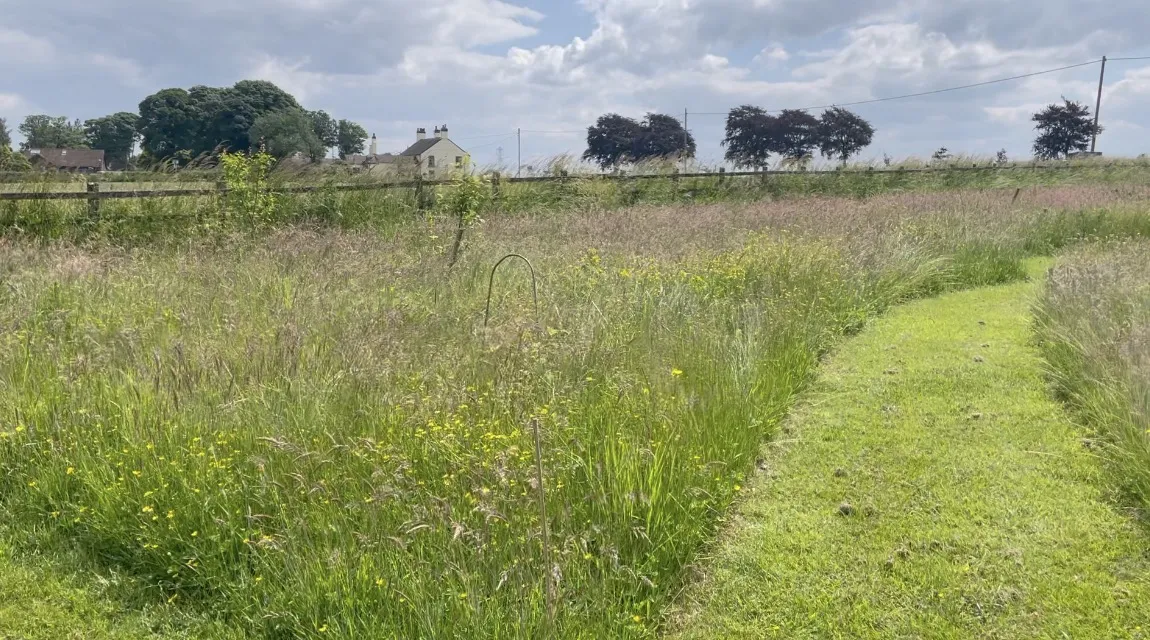
This is a genuinely underestimated challenge, and something I address with clients regularly. A wildflower meadow in its growing season can look wild and unkempt to eyes accustomed to manicured lawns. The simplest design solution is to mow a neat path around the perimeter of the meadow area, and perhaps a meandering path through the middle of it. This immediately signals intentionality — it shows that you are managing the space deliberately rather than simply ignoring it. A clearly defined edge between the meadow and the rest of the garden is the single most effective way of making the planting look designed and professional rather than neglected. A low picket or post-and-rail fence around the meadow boundary can also help frame it as a deliberate feature rather than an oversight.
Wildflower Meadow FAQs
Can I create a wildflower meadow in a small garden?
Absolutely, and this is one of the questions I get asked most frequently on social media and through the Garden Ninja forum. A wildflower meadow does not need to be large to be effective — even a one-metre-wide strip along a fence or at the bottom of a lawn can provide meaningful habitat for pollinators and bring real visual beauty to a small outdoor space. A container or raised bed can also be planted with smaller wildflower species if your garden is very compact. The key is to approach it as a designed feature from the outset, framing it with neat edges and mown surrounds so that it looks intentional rather than abandoned, regardless of its size.
When is the best time to plant a wildflower meadow in the UK?
For annual wildflower seed, the best sowing windows are mid-spring (March to April) or early autumn (September), when the soil is warm and moist enough for reliable germination. For perennial wildflower plug plants grown using the method I recommend in this guide — raising them yourself from seed sown in March under glass — the ideal planting-out time is late spring to early summer, once the risk of hard frost has passed. Yellow Rattle seed is a special case: it must go in during autumn no later than November, as it requires a cold winter to trigger germination the following spring.
Do wildflower meadows need watering?
Established wildflower meadows are remarkably drought-tolerant and generally require no supplemental watering in a typical UK summer. The species selected for traditional British meadows have evolved over thousands of years to cope with the natural rainfall patterns of these islands. In the first season after planting, however, it is worth watering new plug plants during any prolonged dry spells, as the root systems are not yet deep enough to access moisture from lower in the soil profile. Once established — usually by the end of the second season — your meadow should be entirely self-sufficient in terms of water.
How do I stop grass taking over my wildflower meadow?
Grass competition is the single greatest enemy of the wildflower meadow. The most effective long-term strategy combines three things: sowing Yellow Rattle in autumn (its semi-parasitic roots suppress grass vigour from within the sward), removing all mowings from the site every single time you cut (leaving clippings adds nutrients that favour grass over flowers), and cutting the meadow twice yearly in early spring and again in late autumn, which prevents any one grass species becoming dominant. Avoid fertilising the meadow area under any circumstances — a wildflower meadow deliberately requires poor, low-fertility soil to thrive.
How many times should I mow a wildflower meadow each year?
For an established perennial wildflower meadow, I recommend two cuts per year. The first cut should happen in early March, before the new season’s growth begins properly — this clears away the old dead stems from the previous year and lets light reach the emerging wildflower crowns. The second cut happens in October once the growing season is complete and most plants have set seed. Both times, it is essential to remove all the cut material from the site rather than leaving it to compost in place. In the establishment years (one and two), a third cut in June or July can help manage any annual weeds that are establishing themselves before your wildflowers have built sufficient competitive strength.
How much wildflower seed do I need per square metre?
The standard recommended sowing rate for a wildflower and grass meadow seed mix is 3 to 5 grams per square metre. For pure wildflower mixes without grass, a slightly lower rate of 2 to 3 grams per square metre is sufficient. When sowing, it helps enormously to mix the seed with dry horticultural sand at a ratio of about one part seed to four parts sand — this bulks out the mixture and makes it much easier to broadcast evenly across the prepared area. Yellow Rattle specifically should be sown at 0.5 grams per square metre, separately from the main mix in autumn.
Will a wildflower meadow attract bees and butterflies?
A well-planted wildflower meadow is one of the single most effective ways to support bees, butterflies and other pollinators in the garden — more effective, in my professional view, than almost any other planting type. The diversity of flower species means that different nectar and pollen sources are available across a very long season, from spring through to late autumn, providing a consistent and varied food supply for pollinators at every stage of their life cycle. Beyond bees and butterflies, a meadow supports moths, hoverflies, beetles, grasshoppers and a wide range of other invertebrates, which in turn attract birds including sparrows, finches and thrushes.
Can I have a wildflower meadow in a shady garden?
The vast majority of wildflower meadow plants need full sun to perform well — most traditional British meadow species evolved in open, unshaded conditions and will produce poor, sparse flowering in shade. If you have a shady garden, I would not recommend attempting a conventional wildflower meadow, as the results are likely to be disappointing. However, there are woodland-edge wildflowers — such as Foxglove (Digitalis purpurea), Red Campion (Silene dioica) and Bluebell (Hyacinthoides non-scripta) — that will thrive in partial shade and create a beautiful naturalistic planting in their own right. Treat this as a woodland wildflower area rather than a meadow and your chances of success increase enormously.
How long will a wildflower meadow last?
A well-managed perennial wildflower meadow can last indefinitely — traditional hay meadows in the UK have been continuously managed for over a thousand years and remain species-rich habitats today. The key word there is managed. A perennial wildflower meadow is not a plant-and-forget proposition; it requires two cuts per year with removal of arisings, the ongoing suppression of invasive weeds, and the occasional introduction of new species to maintain diversity as the plant community evolves. Done properly, the investment of perhaps two or three hours of work twice a year will sustain a beautiful, wildlife-rich meadow that genuinely improves in character with every passing season.
Unlock Your Garden Potential with Garden Ninja’s Expert Online Training
Ready to transform your gardening skills beyond just choosing plants? Garden Ninja’s expertly crafted online courses will fast-track your development from keen amateur to skilled garden designer in months rather than years. Starting at just £29, you’ll gain access to professional garden design expertise from BBC Garden Rescue’s Lee Burkhill, delivered at a fraction of traditional horticultural education costs.
29
Garden Design Examples for Small Gardens: 30 Design Templates & Planting Plans
Garden Design Examples for Small Gardens: 30 Design Templates & Planting Plans: In this online gardening course, I’ll walk you through 30 fantastic garden designs, explaining the logic behind the layout, the plant choices, and take-home tips for applying them in your own garden.
Weekend Garden Makeover: A Crash Course in Design for Beginners
Learn how to transform and design your own garden with Lee Burkhills crash course in garden design. Over 5 hours Lee will teach you how to design your own dream garden. Featuring practical design examples, planting ideas and video guides. Learn how to design your garden in one weekend!
Garden Design for Beginners: Create Your Dream Garden in Just 4 Weeks
Garden Design for Beginners Online Course: If you want to make the career jump to becoming a garden designer or to learn how to design your own garden, this is the beginner course for you. Join me, Lee Burkhill, an award-winning garden designer, as I train you in the art of beautiful garden design.
Creating a wildflower meadow offers numerous benefits, both for the environment and for personal enjoyment. Firstly, it provides vital habitats for pollinators like bees, butterflies, and other beneficial insects, supporting biodiversity and helping to sustain ecosystems. Wildflower meadows also contribute to soil health by preventing erosion, improving water retention, and promoting microbial activity.
Additionally, they offer aesthetic beauty with their diverse array of colourful blooms throughout the growing season, providing a serene and natural landscape for relaxation and enjoyment. Moreover, maintaining a wildflower meadow requires less intensive care compared to traditional lawns, reducing the need for mowing, fertilizers, and pesticides, thus conserving resources and promoting sustainability. Creating a wildflower meadow brings ecological, aesthetic, and practical benefits to both the gardener and the wider environment. So what’s stopping you, Ninjas?
I’d love to hear from you on Social media, either by Tweeting, Facebook or Instagram, about how your gardens are doing. If you need gardening advice, why not check out my Youtube Gardening guides and subscribe if you haven’t already?
Make sure you come back soon to see the results of my meadow as it progresses.
Your subscription could not be saved. Please try again.
Your subscription has been successful.
Lee Burkhill
Lee Burkhill, known as the Garden Ninja, is an award-winning garden designer and horticulturist with over 30 years of gardening experience and 15 years as a professional garden designer. A qualified RHS (Royal Horticultural Society) professional, Lee specialises in sustainable garden design and practical horticultural advice. He designs and presents on BBC1’s Garden Rescue and in leading gardening publications. Lee combines three decades of hands-on gardening knowledge with professional design qualifications to help gardeners create beautiful, functional outdoor spaces.
Where did you buy the seeds of these 10 plants, please? Thanks!
Ideally, I prefer to buy the (plug or potted) plant versions of these 10 but where from?
There are no wildflower plugs/plants in local London garden centres nor nearby Essex/Chigwell and people are shocked we intend to plant weeds as base (daisies).
Hi Eliska, yes you can sow these seeds directly in the ground. Just make sure you remove all turf and prepare the soil like you would for turf. There’s a guide here on my how to lay a lawn post. https://www.gardenninja.co.uk/how-to-lay-turf/ It will show you how to prepare the ground. Sow the seed in autumn for the next year. Hope that helps. Lee
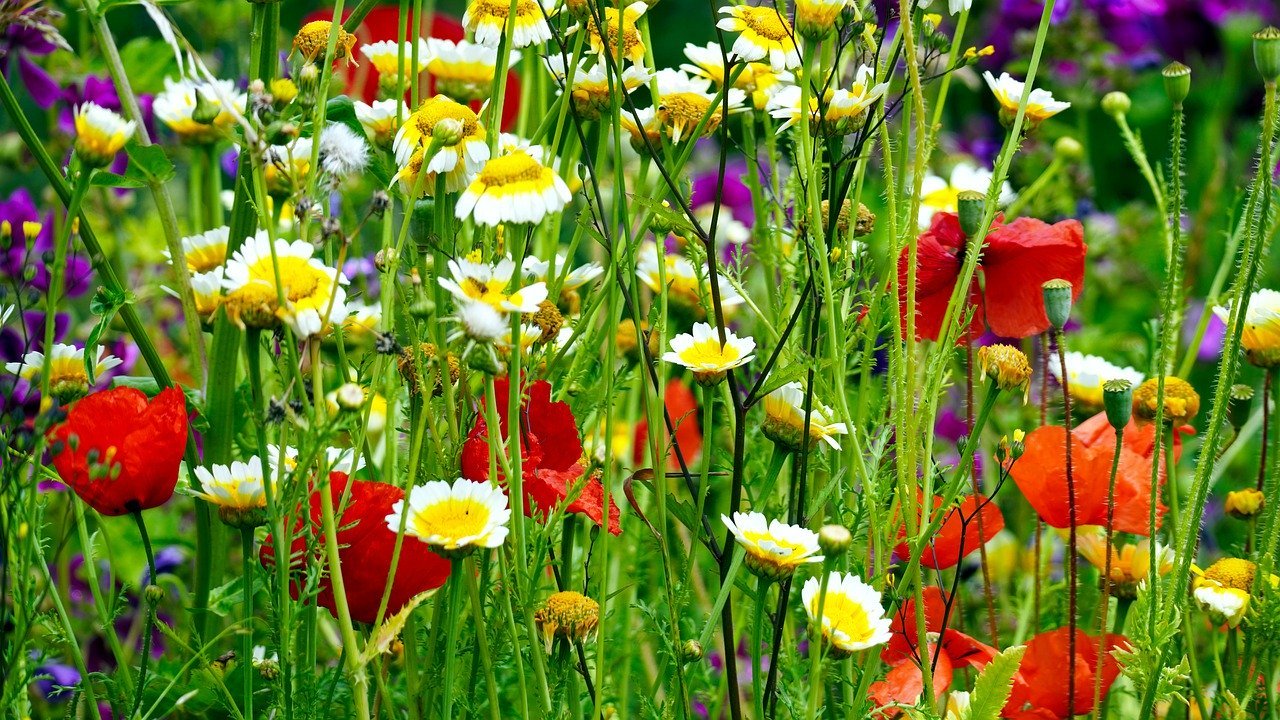

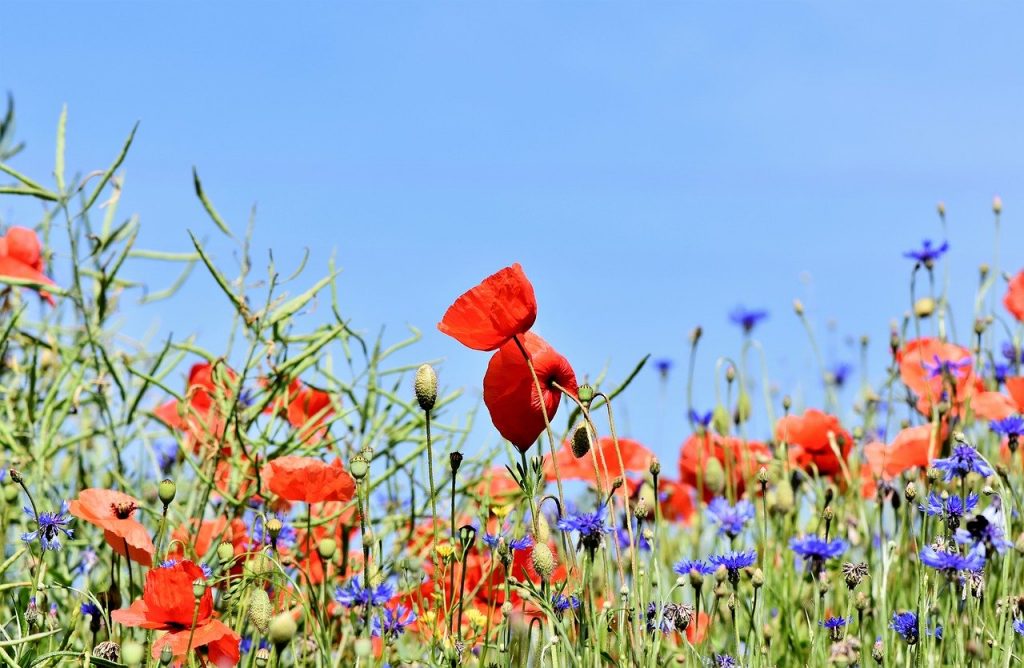
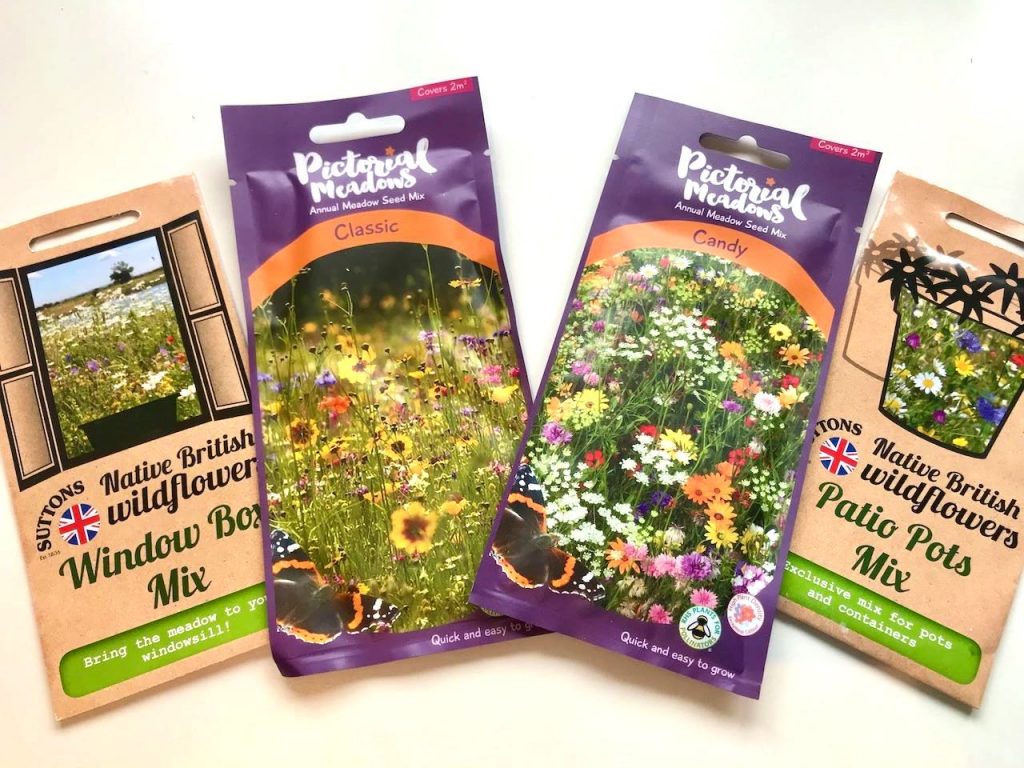

















I adore wildflower fields. My next home will have more acreage and I fully intend to have a wildflower field out my backdoor.
Love to do this but struggling to get the seed separately where would you suggest online to get them please
Thanks sam
Hi Sam, Jekkas is a good site for wild flower and herb seeds. Try there if you’re struggling. Happy Gardening! Lee
Where did you buy the seeds of these 10 plants, please? Thanks!
Ideally, I prefer to buy the (plug or potted) plant versions of these 10 but where from?
There are no wildflower plugs/plants in local London garden centres nor nearby Essex/Chigwell and people are shocked we intend to plant weeds as base (daisies).
Hi Mac, I bought the seeds from a number of online sources here in the UK. Jekkas is really good along with Chiltern seeds. Both excellent! Good luck!
I plan to make a wildflower meadow that’s approximately 20m². I can’t sow all the seeds for this indoors.
Can I just sow directly into the ground?
And what will it look like in the autumn/winter – will it just be all dead?
Thanks!
Hi Eliska, yes you can sow these seeds directly in the ground. Just make sure you remove all turf and prepare the soil like you would for turf. There’s a guide here on my how to lay a lawn post. https://www.gardenninja.co.uk/how-to-lay-turf/ It will show you how to prepare the ground. Sow the seed in autumn for the next year. Hope that helps. Lee