For the garden you’ve already got, not the one you’re starting from scratch. Seven checklists and video lessons from BBC Garden Rescue’s Lee Burkhill, built to help you work out what’s worth keeping before you spend a penny.
69


Quick Answer
A Christmas cactus needs bright, indirect light, watering only once the top 2 to 3cm of compost has dried out, and a half-strength liquid feed once flowering has finished. For autumn flowers, give it six to eight weeks of cooler, darker nights from late September, then keep it settled once buds form.
A Christmas cactus is a forest plant from the humid, shaded mountains of Brazil, and that origin explains almost every care decision you will make with it. Treat it like a desert cactus, and it sulks. Give it dappled light, regular moisture, and some humidity, and it will last for decades.
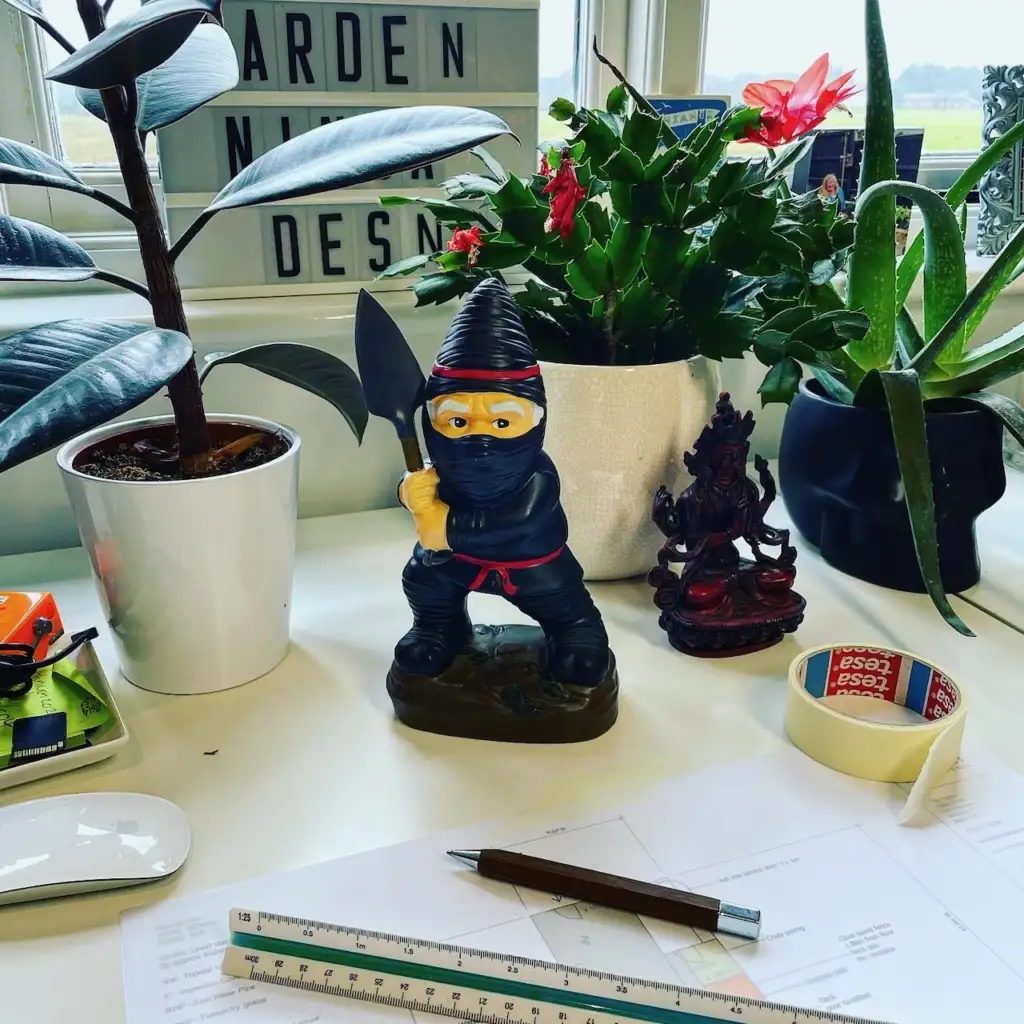
I have had my own Christmas cactus for 15 years now, and other than dividing it and repotting it, it barely needs any attention. I water it when the compost dries out and otherwise leave it alone.
The feed matters. For flowering, with the right liquid feed, I can get mine to flower three to four times a year, compared with the single winter display most plants give.
In this guide, I’ll share what I have learned from keeping mine for the long haul: the light and watering it likes, the feed that keeps it flowering, why it drops its buds when you move it, and how to divide and propagate it into new plants.
If you only buy one thing for a Christmas cactus, make it a balanced liquid houseplant feed such as Baby Bio Original Houseplant Food (an affiliate link, so I earn a small commission on qualifying purchases at no extra cost to you), since this plant grows in leaf litter rather than sand and needs more nutrition than a true cactus.
The plants sold in the UK every November as Christmas cacti are almost always Schlumbergera truncata or its hybrids, although the name is used loosely to cover the whole Schlumbergera genus.
In the wild, these plants are epiphytes and lithophytes from the coastal mountains of south-eastern Brazil. They grow in pockets of leaf litter wedged into tree branches and rock crevices, in dappled rainforest shade with no sand or full sun anywhere near them. That single fact explains most of the mistakes people make with them.
A true desert cactus stores water in a thick body and can sit through weeks of drought in blazing light. A Schlumbergera has none of those adaptations. Its flattened, leaf-like stem segments, properly called phylloclades, photosynthesise in place of true leaves, and the plant is built for humid, sheltered, indirectly lit conditions with moisture and organic matter around its roots.
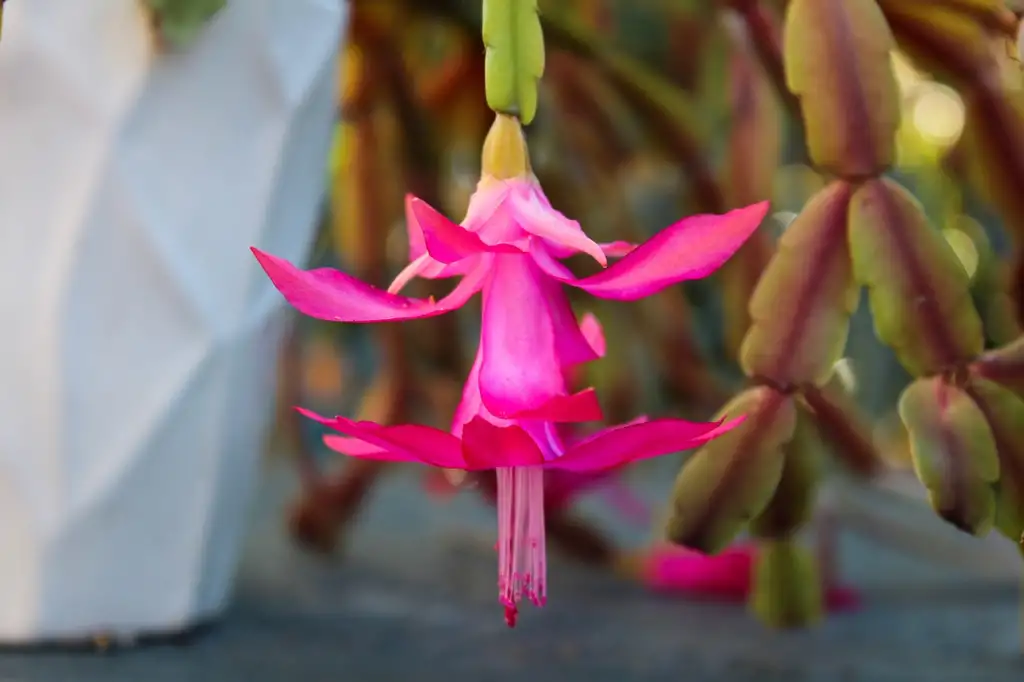
Three different plants are sold under the Christmas cactus banner, and telling them apart helps you understand how they flower. Thanksgiving cactus (Schlumbergera truncata) has pointed, claw-like teeth along the segment edges and is the type sold most often in the UK from October onwards, even when the label says Christmas cactus.
True Christmas cactus (Schlumbergera x buckleyi) has softer, more rounded segment edges and tends to flower slightly later, closer to the festive period itself. Easter cactus (Hatiora gaertneri, sometimes still sold as Rhipsalidopsis) is a different genus, with scalloped segment margins carrying tiny bristles at the notches, and it flowers in spring.
All three want essentially the same care, so I treat them as one group in this guide.
| Detail | At a Glance |
|---|---|
| Botanical Name | Schlumbergera truncata / Schlumbergera x buckleyi |
| Plant Type | Epiphytic forest cactus, grown as a houseplant |
| RHS Hardiness | H1B (tender, minimum 10°C, indoors year round in the UK) |
| Height and Spread | Up to 30 to 40cm, trailing habit, stays compact for years |
| Flowering Period | Late November to January, occasionally repeating into February |
| Best Conditions | Bright indirect light, humidity, cooler autumn nights to set buds |
| Key Feature | Flattened segmented stems and tubular flowers; long lived for decades |
Bright but indirect light suits a Christmas cactus best. An east- or north-facing windowsill is close to ideal, providing gentle morning light or soft all-day brightness without the intensity of a south- or west-facing pane in summer.
If a south-facing sill is your only option, keep the plant back from the glass or behind a net curtain. Strong direct sun through window glass in July and August can bleach or scorch the segments, leaving pale, papery patches that never fully recover.
Segments sometimes blush red or purple at the edges. A little of this is a normal response to bright light or a cool spell. If it spreads across the whole plant, move it somewhere gentler.
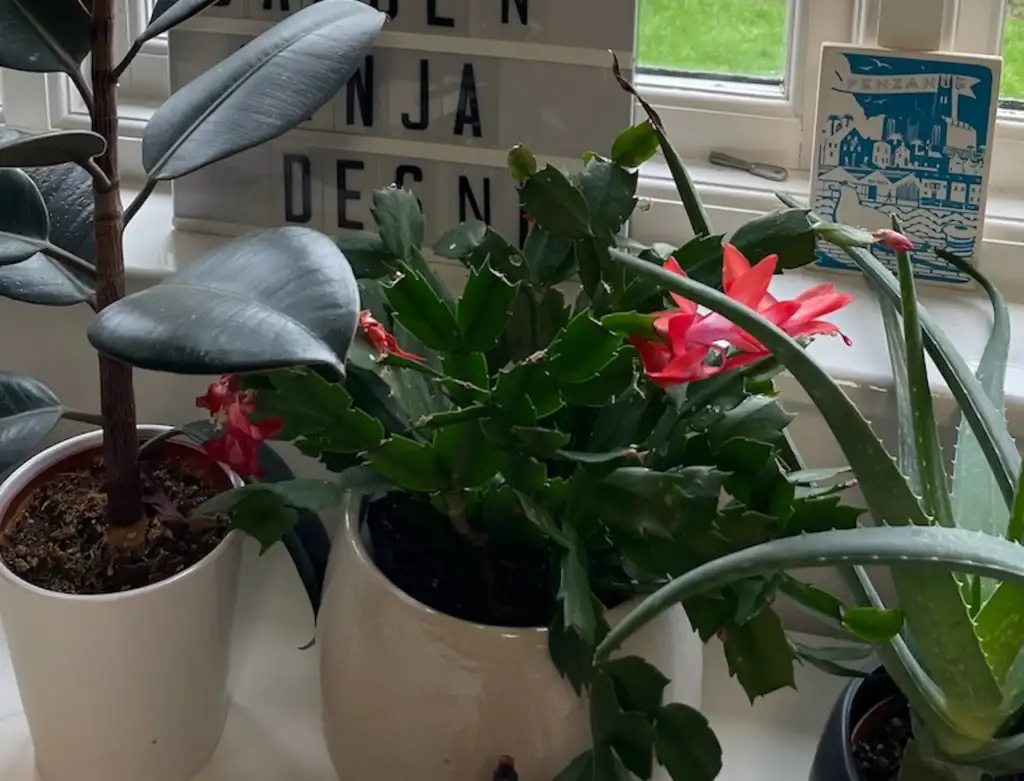
Too little light causes its own problems. A Christmas cactus kept in a dim corner all year produces weak, floppy growth and flowers poorly, even with the right temperature cues in autumn. Aim for bright, filtered daylight for most of the day.
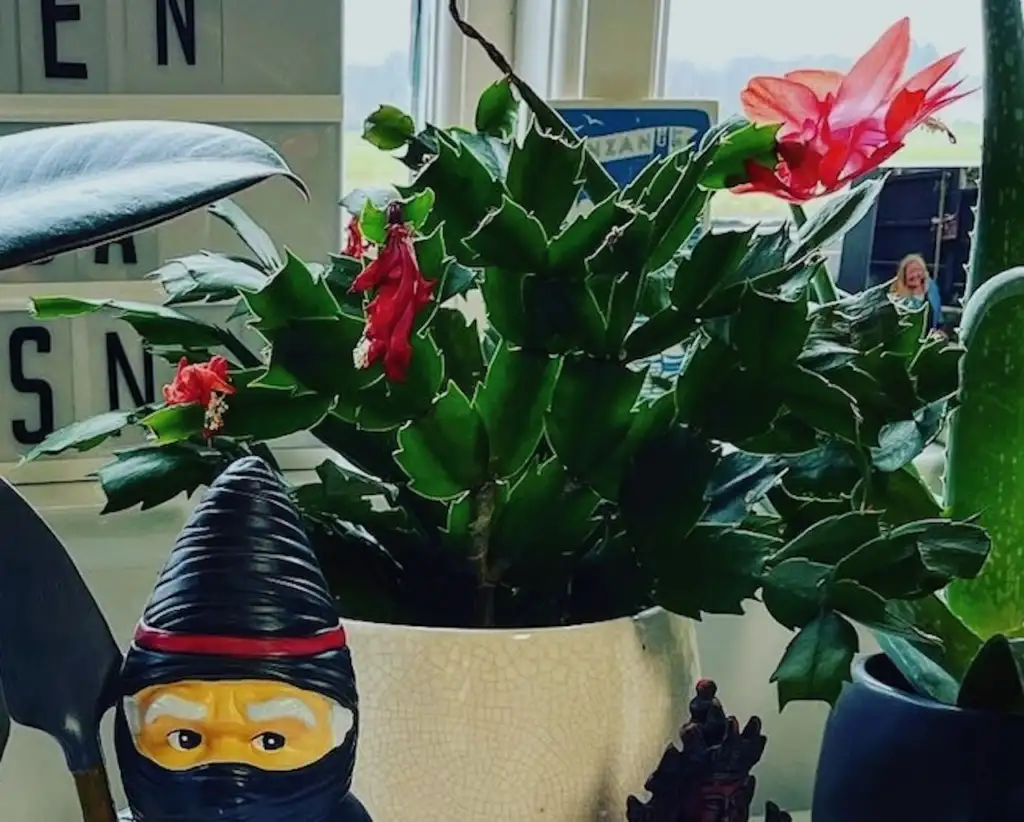
Mine has been with me for 15 years and has needed very little fuss, which comes down to finding a spot it likes and leaving it there. Once you find yours, resist the urge to keep moving it, especially once flower buds appear, which I’ll cover shortly.
Normal room temperature, somewhere between 18°C and 24°C, suits a Christmas cactus for most of the year. The exception is autumn, when the plant needs a cool spell to set its flower buds. That detail solves nine out of ten “why won’t it flower” questions I get asked on the forum, and I cover how to arrange it in the flowering section below.
For the rest of the year, consistency matters most. Sudden temperature swings from a draughty hallway, a window left open on a frosty night, or a spot right beside a radiator or working fireplace stress the plant and often cause buds to drop before they open.
Keep it away from heat sources and cold draughts alike. If you need to move it to a noticeably different temperature, do it gradually rather than overnight, wherever you can.
Water thoroughly whenever the top two to three centimetres of compost has dried out, then let the pot drain fully. Never leave it standing in a saucer of water.
In a normally heated home, this works out to roughly once a week through spring and summer, easing to every ten days or two weeks once the plant enters its cooler, darker autumn rest. This is where the desert cactus comparison misleads people. A Christmas cactus comes from humid forests and cannot store water the way a true cactus does, so letting it dry out completely for weeks can cause real damage.
The segments are a useful guide. A well-watered plant has plump, glossy, slightly firm segments. If they look wrinkled, thin or limp, the plant needs a drink, and a thorough soak usually plumps everything back up within a day or two.
A base that feels soft or mushy, with segments dropping off in clumps, points to overwatering and root rot rather than thirst. Check that the compost is properly dry before assuming wrinkled segments mean the plant needs water.
A moisture meter takes the guesswork out of this if you tend to fuss over your plants or forget them for a fortnight at a time. It is one of the few tools I would recommend for houseplant care beyond a decent watering can.
This routine is why mine barely needs attention. It gets a drink when the top of the compost is dry, then I leave it alone.
Feeding is where I get the most from my plant. With the right liquid feed, mine flowers three to four times a year, and it does that as a 15-year-old plant that otherwise gets almost no attention. Timing is key: I only feed it after it finishes flowering, never while it is in bud or bloom. I reach for
Baby Bio Original Houseplant Food diluted to half strength for my own plant, and a single small bottle lasts a typical Christmas cactus most of a year, given how sparingly it needs feeding.
🛒 Buy Baby Bio Original Houseplant Food from Amazon UK
Use a balanced liquid houseplant feed at half the strength recommended on the bottle, starting once a flush of flowers has finished and carrying on while the plant puts on new growth.
Only feed after flowering has finished. Feeding a budding or flowering plant tends to encourage leafy growth at the expense of blooms, and it can push soft, sappy new growth that is more prone to bud drop.
Avoid dedicated cactus and succulent feeds if you can. Those are formulated for the low-nutrient needs of desert species and don’t give a forest-dwelling Schlumbergera what it needs.
I’m asked this question more than any other about this plant, and the answer almost always comes down to one thing. A Christmas cactus needs a trigger to set flower buds, and keeping it warm and well watered all year is not enough on its own.
Schlumbergera is photoperiodic, like a Poinsettia, meaning it reads day length and temperature as a cue to flower. In its native Brazil, that cue arrives with the short days of the southern hemisphere’s winter. In a centrally heated UK living room with the lights on every evening, the cue never arrives unless you create it.
From late September, give the plant cooler nights of around 12°C to 15°C alongside twelve to fourteen hours of uninterrupted darkness each night for six to eight weeks. A cool spare room, a porch, or an unheated conservatory works well, as long as it stays frost-free.
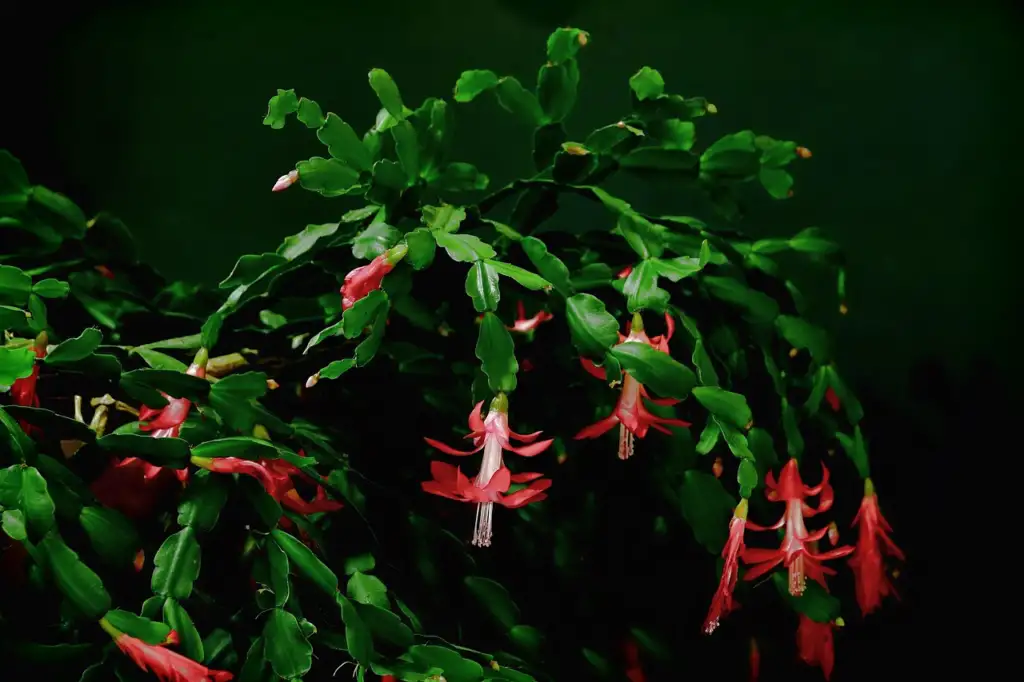
The darkness matters as much as the cold. Streetlight through a bare window, a landing light left on, or switching on a lamp to check the plant partway through the night can interrupt the cue and delay or prevent budding. If your only spot is a room you use in the evenings, a cupboard, or a box over the plant overnight works as well as a dark room.
Once you can see buds forming at the segment tips, bring the plant back to its normal spot and resume warmer daytime temperatures. Avoid any further moves from that point, which brings me to bud drop.
Once you have been through a single autumn cycle, reblooming becomes routine rather than a mystery. The same six-to-eight-week cool, dark spell each autumn reliably sets the main winter display, and the plant repeats the pattern from then on.
Mine gives me more than that single winter flush. At 15 years old, it still flowers three to four times a year with the right liquid feed, given only after each flush finishes. The only other work I do is divide it and pot it up.
A few habits keep the display generous. After flowering finishes, usually in January, give the plant a short rest with reduced watering for four to six weeks before returning to the normal spring and summer routine.
In early spring, pinch or gently twist off a segment or two from the tips of the longest stems. This encourages bushier, more branched growth, which gives more flowering points the following winter and provides cutting material.
Avoid moving the plant once buds have formed . Commonly, light changes cause buds to drop; even turning it to face a different direction can cause buds to drop before they open. If you do need to move it, do so before buds appear or after they have fully opened, never in between.
Christmas cacti flower better when slightly pot-bound, so resist repotting every year as you would with faster-growing houseplants. Every two to three years is plenty.
Dividing the plant and potting afterwards is the only real maintenance mine has needed in 15 years.
Thnotg, once flowering has finished and the short winter rest is over, rather than anywhere near the flowering season. Move up only one pot size at a time. A pot that is too generous holds excess moisture around the roots for far longer than the plant wants, which is a direct route to root rot.
Use a free-draining, peat-free potting mix rather than a dedicated cactus and succulent compost, which is usually too gritty and too low in organic matter for a forest species. A standard peat-free multipurpose compost, loosened with a quarter to a third extra perlite or horticultural grit by volume, provides a good balance of moisture retention and drainage.
Always choose a pot with drainage holes. A pot slightly wider than it is deep suits the plant’s shallow, spreading root system better than a tall, narrow one.
This is one of the easiest houseplants to propagate, and it is how a single plant turns into several. All you need is a healthy plant and a bit of patience.
You can also root a segment in a small glass of water on a windowsill if you would rather watch the roots develop, moving it into compost once they reach a centimetre or two long. I find compost propagation more reliable and less fiddly for this plant.
Dividing an established plant is the other route, and it is the one I use. Lift it from its pot, split the root ball into two or three clumps that each carry healthy segments, and pot them up separately in fresh compost.
Propagating little and often from the pinchings you take each spring, as covered in the reblooming section, is the easiest way to build up a small collection without buying another plant.
Wrinkled or limp segments almost always mean the plant needs water, provided the compost has dried out properly. Give it a thorough soak and the segments should plump back up within a day or two. If the compost is still damp and the segments are wrinkled, check the roots for rot, since a rotted root system cannot take up the water sitting right next to it.
Bud drop usually happens after buds form due to a sudden change, such as moving to a different spot, a draught, a knock, or an inconsistent watering routine. Keep conditions as stable as possible from the moment you see buds forming until they open fully.
A soft, mushy base with segments dropping off in clumps points to root rot from overwatering or a pot without adequate drainage. Ease off watering immediately. If it is severe, take healthy cuttings from higher up the plant as insurance before you lose the whole thing, then start fresh in a well-draining pot.
Segments turning red or purple at the edges usually respond to bright light, cold, or natural seasonal colouring as temperatures drop in autumn. A small amount is nothing to worry about. If the whole plant colours up, move it to a gentler, more sheltered spot.
Mealybugs are the pest I see most often on Christmas cacti, showing up as small cottony white clusters tucked into the joints between segments. Dab them off with a cotton bud dipped in diluted isopropyl alcohol and check back every few days, since they often need two or three rounds of treatment.
Spider mites occasionally appear in very dry, centrally heated air, showing as fine speckling and faint webbing. Improving humidity and giving the segments an occasional lukewarm shower usually knocks them off.
Yes, and that is one of the plant’s better qualities for anyone sharing a home with cats or dogs. The ASPCA lists Schlumbergera as non-toxic to both cats and dogs.
That puts it among a small group of popular festive houseplants without a warning label. Poinsettia, Amaryllis, Mistletoe, and Holly all carry varying degrees of toxicity risk, so a Christmas cactus is one of the safer festive options for homes with curious pets.

No plant material is meant to be eaten in large quantities, and a pet that chews enough of any houseplant can end up with a mild stomach upset. Keep plants out of easy reach as a precaution rather than relying on the label alone.
With reasonable care, a Christmas cactus is long-lived and can easily last twenty, thirty, or more years. Specimens passed down through three generations of one family, still flowering every winter on someone’s windowsill, are not unusual.
Mine is 15 years old now and still going strong. In that time it has needed little beyond dividing and potting on, and with the right liquid feed it flowers three to four times a year. It asks for very little, tolerates slight neglect, and keeps going longer than almost anything else you could put on a windowsill.
Part of its reputation for longevity comes from its slow, steady growth habit, which makes Schlumbergera seem unremarkable day to day. It doesn’t chase rapid growth like a Monstera or a Pothos, so it doesn’t exhaust itself or outgrow its space. A stable spot, a sensible watering routine and a deliberate cool, dark spell each autumn suit a plant that will still be flowering for whoever inherits it.
Thanksgiving cactus (Schlumbergera truncata) has pointed, claw-like teeth along the segment edges and is what most UK garden centres sell as a Christmas cactus. True Christmas cactus (Schlumbergera x buckleyi) has softer, rounded segment edges and flowers slightly later. Easter cactus (Hatiora gaertneri) is a different genus with scalloped, bristled segment margins and flowers in spring. All three share the same care needs.
The most common cause is a missed autumn trigger. From late September, the plant needs six to eight weeks of cooler nights (around 12°C to 15°C) and twelve to fourteen hours of uninterrupted darkness overnight. Without both cold and dark, buds often fail to set, no matter how healthy the plant looks.
Yes. Most plants give one main display in winter, but mine flowers three to four times a year with the right liquid feed, given only after each flush of flowers has finished. It is a 15-year-old plant that needs very little attention beyond dividing and potting.
This is almost always underwatering. Check that the compost is properly dry, then give the plant a thorough soak and let it drain fully. The segments typically plump back up within a day or two. If the compost is still damp when the segments are wrinkled, check the roots for rot instead.
Yes, a sheltered, shady spot outdoors through the warmer months works well. Bring it back in well before the first frost, and before the dark autumn cool spell that triggers flowering. Avoid full sun outdoors, since it scorches the segments just as readily as a south-facing window does.
Bud drop almost always follows a sudden change once buds have formed, such as moving the plant, a cold draught, inconsistent watering or a knock. Keep the plant settled in one spot with a steady watering routine from the moment buds appear until they open.
Yes, a healthy segment that has dropped off, or one you remove deliberately, will root readily. Let the base callus for a day or two, then follow the same propagation steps as with a deliberate cutting, either straight into free-draining compost or first rooted in a glass of water.
No. The ASPCA lists Schlumbergera as non-toxic to cats and dogs, making it one of the safer festive houseplants for pet-owning households. Keep any houseplant out of easy chewing range as a sensible precaution.

Join over 100,000 gardeners on YouTube
Free gardening videos from the Garden Ninja, with 8 million views and counting.
Subscribe on YouTube, it’s free🌿 More Houseplant Guides
Once you have got the hang of a Christmas cactus, these are my other complete UK houseplant care and rescue guides.
What works for a windowsill plant applies outdoors on a bigger scale. My online courses take you through the same practical, experience-led approach to planning and planting a whole garden, whether you are starting from a blank patch or trying to make sense of a garden you have inherited.
With courses starting from just £29, you get the knowledge I use on professional client projects and on BBC Garden Rescue, broken down into a format you can work through at your own pace.
For the garden you’ve already got, not the one you’re starting from scratch. Seven checklists and video lessons from BBC Garden Rescue’s Lee Burkhill, built to help you work out what’s worth keeping before you spend a penny.
Garden Design Examples for Small Gardens: 30 Design Templates & Planting Plans: In this online gardening course, I’ll walk you through 30 fantastic garden designs, explaining the logic behind the layout, the plant choices, and take-home tips for applying them in your own garden.
Learn how to transform and design your own garden with Lee Burkhills crash course in garden design. Over 5 hours Lee will teach you how to design your own dream garden. Featuring practical design examples, planting ideas and video guides. Learn how to design your garden in one weekend!
Garden Design for Beginners Online Course: If you want to make the career jump to becoming a garden designer or to learn how to design your own garden, this is the beginner course for you. Join me, Lee Burkhill, an award-winning garden designer, as I train you in the art of beautiful garden design.
A Christmas cactus asks for little once you treat it as a forest plant. Give it bright, indirect light; water when the top of the compost has dried out; feed it once flowering has finished; and arrange one cool, dark spell each autumn for the main winter display.
Mine is 15 years old, flowers three to four times a year with the right liquid feed, and needs nothing more than the occasional dividing and potting on. Look after yours the same way, and it could still be flowering on a windowsill in thirty or forty years, quite possibly propagated into pots you have long since forgotten to give away.
Happy gardening, and here’s to your own Christmas cactus still flowering on a windowsill decades from now, with a few propagated offspring dotted around the homes of people you love.


Lee Burkhill, known as the Garden Ninja, is an award-winning garden designer and horticulturist with over 30 years of gardening experience and 15 years as a professional garden designer. A qualified RHS (Royal Horticultural Society) professional, Lee specialises in sustainable garden design and practical horticultural advice. He designs and presents on BBC1’s Garden Rescue and in leading gardening publications. Lee combines three decades of hands-on gardening knowledge with professional design qualifications to help gardeners create beautiful, functional outdoor spaces.
View all posts by Lee Burkhill








JOIN THE NINJAS

Be the first in line for new Guides, Discount codes and Offers