For the garden you’ve already got, not the one you’re starting from scratch. Seven checklists and video lessons from BBC Garden Rescue’s Lee Burkhill, built to help you work out what’s worth keeping before you spend a penny.
69


Quick Answer
Heucheras grow best in partial shade in free-draining soil, planted with the crown level with the surface. Plant in spring or early autumn, mulch without burying the crown, and divide every three to four years in spring. Revive woody, lifting plants by replanting them deeper, and check pot-grown plants for vine weevil grubs.
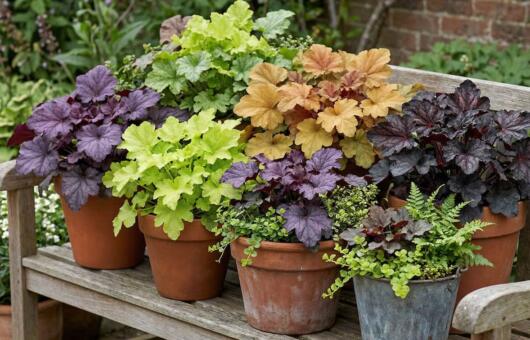
Heucheras are the plant I reach for more than any other when a client shows me a shady corner, a gloomy side return or a row of empty pots by the back door and asks what on earth will give them colour there all year. Also known as Coral Bells, they are grown for their leaves rather than their flowers, and those leaves come in almost every colour you can imagine, from near-black and plum through to caramel, amber, lime and silver. They hold that colour through most of the year, fit in the smallest garden and cope with the kind of shade that defeats most flowering perennials.
The catch is that Heucheras have a reputation for fading away after a few years, and the questions I get on the forum and in my YouTube comments are nearly always the same ones. Why has my Heuchera gone woody? Why is it lifting out of the ground? Why did it collapse overnight? Every one of those problems has a clear cause and a straightforward fix, and once you understand how a Heuchera grows, keeping them going for years becomes simple.
In this guide I’ll walk you through where to plant them, how to grow them in pots, how to divide and propagate them for free, how to rescue a tired or dying plant, and which varieties I rate for UK gardens. I have also included the companion plants I use most often with them in the shade borders I design, so you can put together a scheme that works from the first season.
Jump To
This guide contains Amazon affiliate links, which help keep Garden Ninja free to read, and if you’d like to start experimenting with leaf colour straight away, these Heuchera plants on Amazon UK are an easy way to begin.
Before getting into the detail, here are the key facts for the genus as a whole. Individual varieties vary a little in height and in how much sun they will take, which I cover in the varieties section further down.
Heucheras are clump-forming perennials from the woodlands, rocky slopes and mountain ledges of North America, and they belong to the Saxifrage family, Saxifragaceae. Their common names are Coral Bells, after the tiny bell-shaped flowers of the wild red-flowered Heuchera sanguinea, and Alumroot, after the astringent roots that were used medicinally. There are around 35 wild species, but almost every Heuchera you will find in a garden centre today is a hybrid bred from a handful of them, principally Heuchera americana, Heuchera micrantha, Heuchera villosa and Heuchera sanguinea.
Understanding where they come from explains almost everything about how to grow them. In the wild they grow on well-drained woodland floors and in pockets of gritty soil between rocks, where the roots stay cool and moist but never sit in water. That is why the two things that kill more Heucheras than anything else in UK gardens are wet, heavy soil in winter and too much hot afternoon sun in summer.
The other thing worth knowing is how the plant is built. A Heuchera grows from a woody central crown made up of short, thick stems. Each year new leaves appear at the tips of those stems, and the old lower leaves die off. Over time the stems get longer and woodier, and the whole crown slowly pushes itself up and out of the soil. This is completely normal behaviour, and it is the reason Heucheras need dividing or replanting every few years to stay compact and healthy. I’ll show you exactly how to do that later on.
You will also see two close relatives on sale alongside them. Tiarella, or Foamflower, is a woodland perennial with frothy white spring flowers, and Heucherella is a cross between Heuchera and Tiarella that combines the leaf colour of one with the spreading habit and flowers of the other. Both are grown in exactly the same way, and I treat them as part of the same family of shade plants when I’m designing a border.
This is the question I’m asked most often about Heucheras, and the answer depends on the leaf colour of the variety you’re growing. As a rule, Heucheras perform best in partial or dappled shade, ideally with a few hours of morning sun and shelter from the hot afternoon sun. An east facing border, the dappled light under a deciduous tree or the shaded side of a fence are all ideal spots. I cover this sort of aspect in more detail in my guide to plants for east facing gardens.
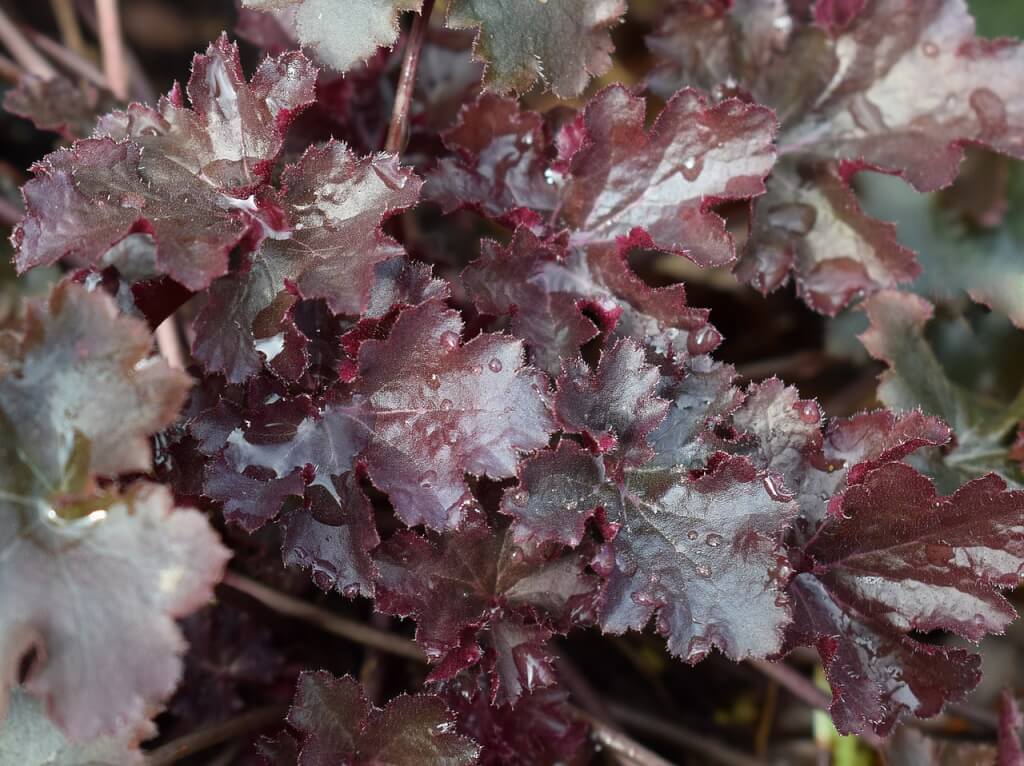
Within that, the colour of the leaf tells you how much sun a variety will take. The dark purple, plum and near-black varieties have plenty of pigment to protect their leaves, and they cope with the widest range of light, from quite deep shade through to a fair amount of sun if the soil stays moist. Silver-leaved varieties are similarly adaptable. The lime, yellow, amber, peach and caramel varieties are the ones that scorch, and in a sunny south facing spot you will see their leaves bleach to a washed-out cream with crispy brown edges by midsummer. Give those the lightest shade in your garden and they will glow.
Varieties bred from Heuchera villosa, such as ‘Caramel’ and ‘Autumn Bride’, have larger, softly hairy leaves and are the most tolerant of heat and sun, so they are a good choice if your only space gets a few hours of direct sun in the afternoon. At the other extreme, very deep shade under evergreens or in a dark basement well will leave most Heucheras thin, leggy and dull in colour. They need some light to colour up well, so if you’re planting a truly dark corner, have a look at my list of shade loving plants for difficult borders for tougher options.
Heucheras want soil that holds some moisture in summer but drains freely in winter. A fertile, loamy border soil with plenty of organic matter is perfect. Light, sandy soils are fine too, as long as you add well-rotted compost when planting and mulch each spring to help them hold water through dry spells.
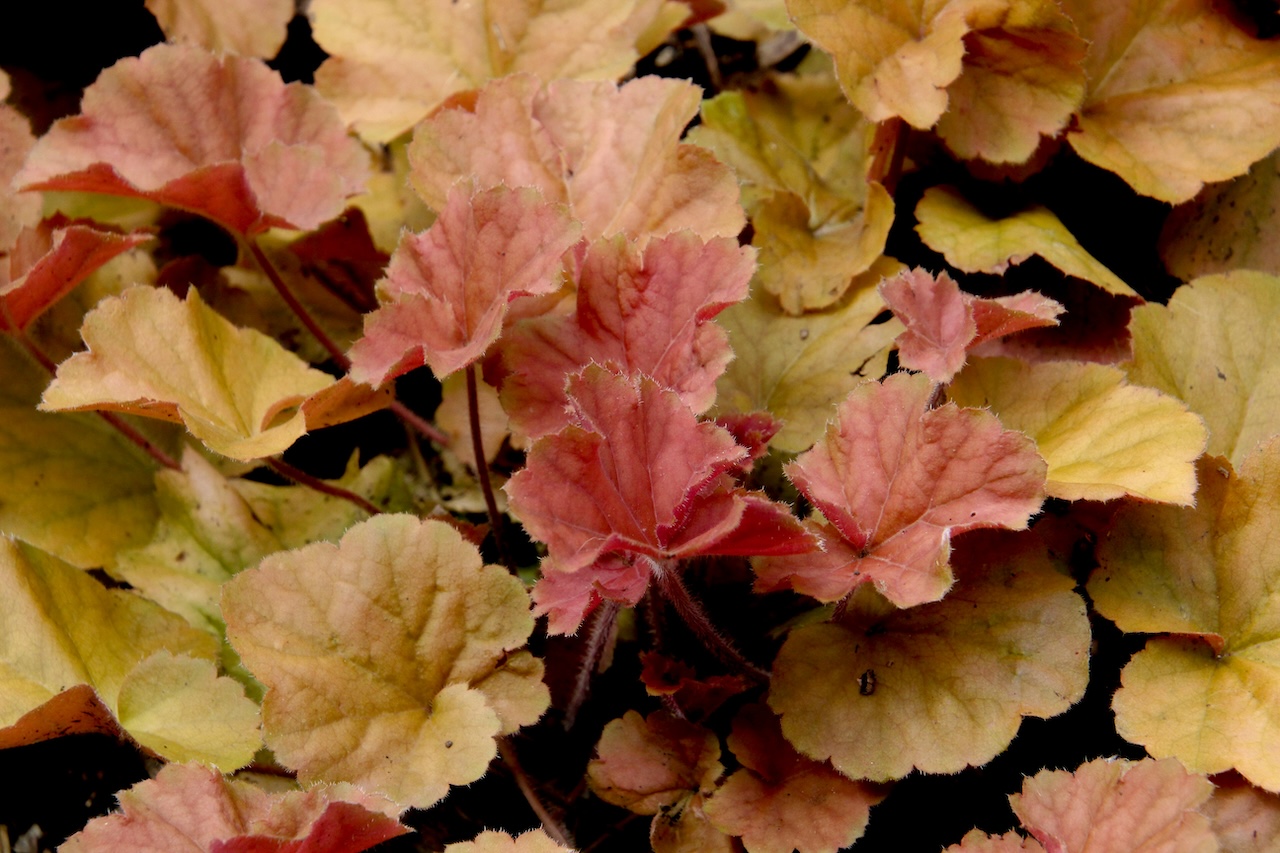
Heavy clay is where they struggle. The fibrous roots sit close to the surface, and in a cold, wet winter clay soil stays waterlogged around the crown, which leads to crown rot. You can still grow them on clay, and I often do, but I plant them slightly raised on a low mound and dig in plenty of compost and horticultural grit across the whole planting area rather than just in the hole, so the water has somewhere to go. On slopes and at the front of raised beds they do particularly well because the drainage takes care of itself. My guide to the best plants for heavy clay soil in shade has more on preparing clay for shade planting.
Heucheras are not fussy about pH and grow happily in acid, neutral or alkaline soil. If your garden is on very heavy clay that sits wet from November to March, I would grow them in pots or raised beds instead, which also makes them far easier to check for vine weevil.
The best times to plant Heucheras in the UK are spring, from March to May, and early autumn, from late August to the end of September. The soil is warm and moist at both times, so the roots establish quickly without needing constant watering. Pot-grown plants can go in at any time of year when the ground isn’t frozen or waterlogged, but summer planting means a lot of watering and winter planting on heavy soil risks the roots sitting wet before they have grown out into the surrounding ground.
Water the plant in its pot an hour or so before planting so the rootball is fully moist. Dig a hole a little wider than the pot and the same depth, and mix a couple of handfuls of garden compost or peat-free compost into the soil you have removed. Before you plant, tip the Heuchera out and look at the rootball. You want to see plenty of healthy white roots. If the compost falls away and you find fat, cream, C-shaped grubs, that is vine weevil, and the plant needs treating before it goes anywhere near your border.
Set the plant so that the crown, where the leaf stems join the roots, sits level with the surrounding soil or a centimetre above it on heavy ground. Never bury the crown, because soil and wet mulch sitting against those woody stems is the quickest way to rot a Heuchera. Backfill, firm gently with your hands rather than your boot, and water well.
Space plants 30 to 40cm apart for the average variety, or 45cm for the larger Heuchera villosa types. For impact I always plant in groups of three, five or seven of the same variety, which gives a solid block of colour that reads from across the garden. Planted at these spacings they knit together within two seasons into a dense mound that shades out weeds, which is why I use them so often as ground cover in shade.
Heucheras are one of the best plants you can grow in a container. They look good twelve months of the year, their shallow roots don’t need a deep pot, and a single plant fills the space of three or four bedding plants. In winter containers they are the backbone of almost every scheme I put together, with Violas, Cyclamen and Ivy around them.
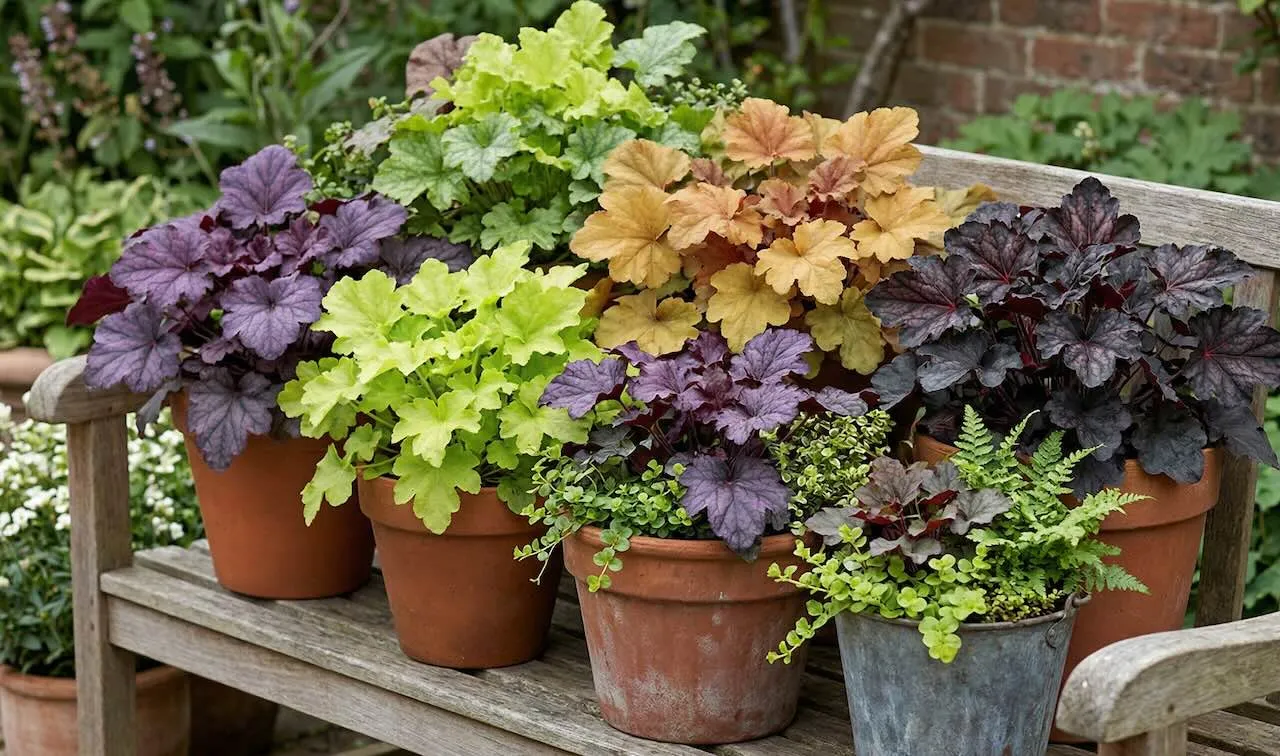
Use a pot at least 25 to 30cm across for a single plant and make sure it has drainage holes, because a Heuchera in a waterlogged pot will rot at the crown within a winter. I use a peat-free multipurpose compost mixed with roughly a quarter by volume of horticultural grit, which gives the drainage they need without drying out too quickly in summer. Raise the pot onto feet or bricks through the winter so excess water can drain away freely, as I explain in my guide on whether pots need drainage holes.
Finish the pot with a layer of gravel or grit over the compost surface. This keeps the crown dry, stops compost splashing onto the leaves, and makes it harder for adult vine weevils to reach the compost to lay their eggs. That last point matters, because pot-grown Heucheras are far more likely to be killed by vine weevil than plants in the ground. The warm, soft compost in a container is exactly where the adults like to lay, and the grubs can strip every root out of a pot over a single winter without you seeing a thing.
Water pots whenever the top couple of centimetres of compost feel dry, which in summer can mean every day or two, and much less in winter. From spring to late summer, feed pot-grown plants with a balanced liquid feed every three to four weeks. Plants in containers use up the nutrients in fresh compost within a couple of months, and a hungry Heuchera loses leaf colour quickly. Repot or top dress with fresh compost each spring, and every two to three years lift the plant, divide it and start again in fresh compost. My beginner’s guide to container gardening covers pot choice and compost in more depth.
Once established in the ground, Heucheras are low-maintenance plants that need very little from you. Water newly planted ones regularly through their first summer, then only in prolonged dry spells. They will tolerate some dryness once settled, particularly in shade, but plants that dry out badly in full sun will scorch.
Border plants don’t need regular feeding. A mulch of garden compost or leaf mould each spring provides everything they need. Heavy feeding with high-nitrogen fertiliser makes them produce soft, floppy leaves and does nothing for their colour, so I avoid it. The exception is pot-grown plants, which I feed from spring to late summer as described above.
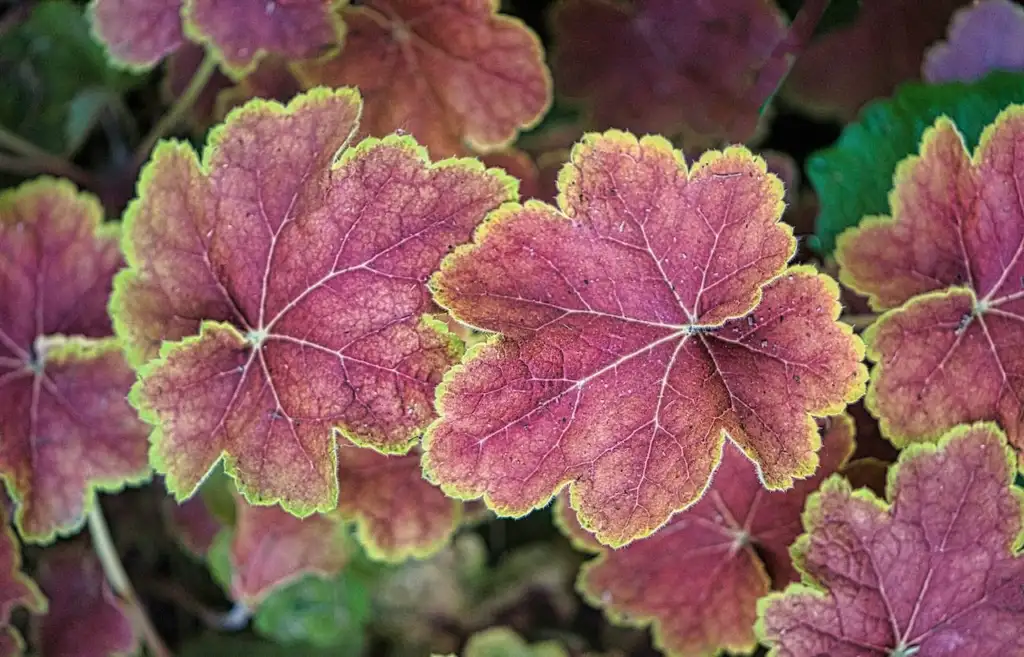
Mulching each spring is the single most useful job you can do for a border Heuchera. A 5cm layer of compost, leaf mould or fine bark around the plant keeps the roots cool and moist and, importantly, tucks soil back in around the base of the stems as the crown rises. Keep the mulch a couple of centimetres away from the centre of the crown itself so it doesn’t hold wet against the stems.
In March or early April, before the new leaves unfurl, spend ten minutes on each plant. Cut off any old, brown, tatty or frost-damaged leaves right down at the base with clean secateurs or scissors, and remove any leaves showing rust spots. Don’t cut the whole plant back to the ground like a herbaceous perennial, because the healthy evergreen leaves are feeding the plant and new ones grow from the stem tips, not from below ground. This is also the moment to check whether the crown has lifted, which I cover in the revival section below.
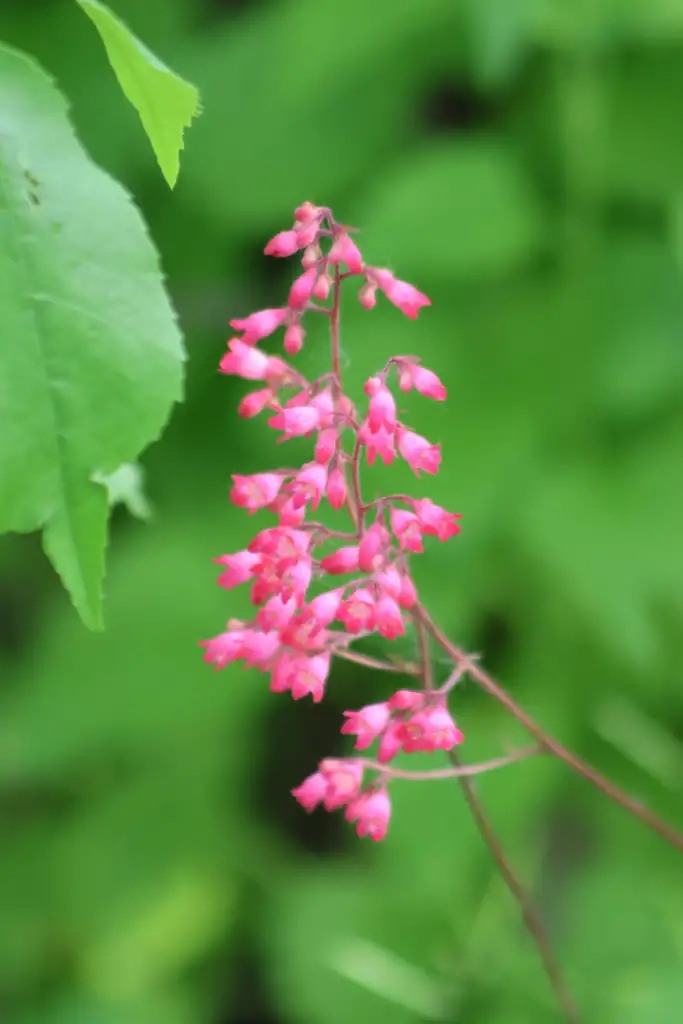
That is up to you. The airy flower spikes are loved by bees and are a bonus on varieties bred for flowers, such as ‘Paris’ and the red-flowered Heuchera sanguinea types. On many foliage varieties the flowers are small and cream or greenish, and some people prefer to remove them to keep the plant looking neat. Removing the spikes once they’ve faded tidies the plant and on the flowering varieties encourages a second flush, so I cut them off at the base when they go over.
Most Heucheras are evergreen or semi-evergreen in the UK. In a mild winter, or in the south and west and in towns, most varieties hold their leaves right through to spring. In a hard winter or a cold northern garden, some of the older leaves will brown or collapse, particularly on the lime and amber varieties, but the plant is not dead. Leave the damaged foliage in place over winter to protect the crown, then trim it off in spring when new leaves start to appear.
They are fully hardy, rated H6 by the RHS for most varieties, so cold alone rarely kills them. What does the damage in winter is wet. Plants sitting in waterlogged soil or pots rot at the crown, and on heavy soil a cycle of freezing and thawing can push the whole plant up and out of the ground, which is known as frost heave. Heucheras are particularly prone to this because their roots are so shallow.
Check your plants after any hard frost, and in late winter walk round and press any lifted plants gently back into the soil with your fingers. If the roots have been exposed, cover them with a handful of compost or soil. In pots, move containers against a house wall where they’re sheltered from the worst of the rain, raise them onto feet, and for very exposed gardens wrap the pot rather than the plant. My guide on protecting container plants from winter frost walks through this step by step.
Dividing is the key to keeping Heucheras going for years rather than watching them fade after three or four seasons. It rejuvenates old, woody plants, resets a crown that has lifted out of the soil, and gives you several new plants for free from every clump. I divide mine every three to four years, and I’d rather do it a year early while the plant still looks healthy than wait until the centre has gone bare.
The best time to divide Heucheras is in spring, from late March to May, as the new leaves start to grow. Early autumn, in September, also works well while the soil is still warm, but avoid dividing in summer heat or in late autumn on heavy soil, when small divisions can sit wet and rot before they root. The general technique is the same one I use for most perennials in my guide on how to divide herbaceous perennials, with a couple of Heuchera-specific tweaks.
Give the plant a good soak the day before you lift it. Moist roots hold together better and the plant suffers less stress.
Dig around the plant about 15cm out from the leaves with a border fork or spade and lift it out. Heuchera roots are shallow, so this doesn’t take much effort. Shake or gently wash off the loose soil so you can see how the crown is made up.
Before you go any further, look through the roots and the soil you’ve shaken off. If you find cream, C-shaped grubs with brown heads, pick them all out, wash the roots clean and only replant into fresh soil or compost.
Looking down on the plant, you’ll see it’s made of several separate rosettes of leaves, each on its own woody stem. Pull or cut the clump apart with a clean, sharp knife so that each piece has at least one healthy rosette of leaves, a section of stem and its own roots. Pieces with two or three rosettes establish fastest. A mature clump usually gives three to six good divisions.
The oldest, woodiest part of the crown in the middle, with long bare stems and few leaves, won’t regrow well. Put it on the compost heap and keep the younger, vigorous pieces from around the outside.
Cut off any damaged or tatty leaves. Replant each division in soil refreshed with compost, setting it so that any bare woody stem is buried and the base of the leaves sits at soil level. Firm in gently, water well and keep the divisions moist for the next few weeks while they root.
Divisions replanted in spring will usually have filled out into good plants by the end of the summer. Autumn divisions are best potted up and kept in a sheltered spot or a cold frame over winter, then planted out in spring, particularly if your soil is heavy.
If you only want one or two new plants, or you want to rescue the healthy tips from a plant with a rotten or grub-damaged crown, you can take cuttings instead of dividing. This is the method I use when a Heuchera has become very leggy, with long bare stems and a rosette of leaves at the top of each one.
In spring or late summer, cut off a rosette with 3 to 5cm of stem attached, just below where the leaves join. Remove all but the three or four youngest leaves, and trim any large ones in half to reduce water loss. Push the stem into a small pot of gritty compost so the base of the rosette sits on the surface, water it in and keep it in a bright spot out of direct sun. Roots form along the buried stem in four to six weeks, and the new plants can be planted out once they have filled the pot.
Heucheras can be grown from seed, and Heuchera sanguinea seed is sold widely, but the named foliage varieties don’t come true from seed. Most of the colourful modern varieties are also protected by plant breeders’ rights, so propagating them to sell isn’t allowed, although dividing them for your own garden is fine.
When a Heuchera starts to look sad, the cause is usually one of a small number of things, and you can normally tell which from the symptoms. This table covers the problems I see most often, both in client gardens and in the photos that get posted on the Garden Ninja forum.
| Symptom | Likely cause | What to do |
|---|---|---|
| Plant sitting on top of the soil on bare woody stems, leaves only at the tips | Normal ageing and frost heave pushing the crown upwards | Lift and replant deeper, or divide, in spring |
| Sudden wilting or collapse, plant pulls out of the ground with no roots | Vine weevil grubs eating the roots | Check roots, remove grubs, save healthy rosettes as cuttings, apply nematodes |
| Notches cut into the leaf edges | Adult vine weevils feeding at night | Check pots and soil for grubs; treat in late summer |
| Leaves bleached, pale or brown and crispy at the edges | Too much sun or drying out, often on lime and amber varieties | Move to lighter shade in autumn or spring, water and mulch |
| Soft, brown, mushy crown with an unpleasant smell | Crown rot from waterlogged soil or buried crown | Cut away rot, take cuttings from healthy tips, improve drainage |
| Orange-brown raised spots on the underside of the leaves | Heuchera rust | Remove affected leaves, improve airflow, water at the base |
| Thin, floppy growth with dull colour | Too much shade or too much nitrogen | Give more light, stop feeding border plants |
This is by far the most common Heuchera problem, and the one I get asked about more than any other. After three or four years the plant looks like a small cluster of palm trees, with bare, brown woody stems a few centimetres long and a tuft of leaves at the top of each. It’s tempting to think the plant is on its way out, but it’s usually perfectly healthy. It has simply grown upwards out of its own planting hole.
The fix is to replant it deeper. In spring, lift the plant, divide it if it has several stems, and replant each piece so that the woody stem is buried right up to the base of the leaves. Heuchera stems produce new roots wherever they are in contact with moist soil, so within a few weeks the buried stem will have rooted and the plant will be sitting firmly back at ground level. If you don’t want to lift it, mounding a few centimetres of gritty compost around the bare stems up to the leaves achieves much the same thing, as long as you keep the very centre of the rosettes clear.

If a plant has collapsed, give it a gentle tug. If it comes away in your hand with a stump of stem and almost no roots, vine weevil grubs are nearly always to blame, and you’ll usually find them in the soil underneath. If the crown is soft, brown and smells of rot, the cause is waterlogging. In either case, look for any rosettes that are still firm and green, cut them off with a short length of clean stem and pot them up as cuttings using the method above. You can often save a favourite variety this way even when the parent plant is beyond help.
Heucheras are healthy plants with very few problems, but the one pest you do need to know about is vine weevil. It’s the reason most Heucheras that die in a UK garden die, and it’s the reason I check the rootball of every Heuchera I buy before planting it.
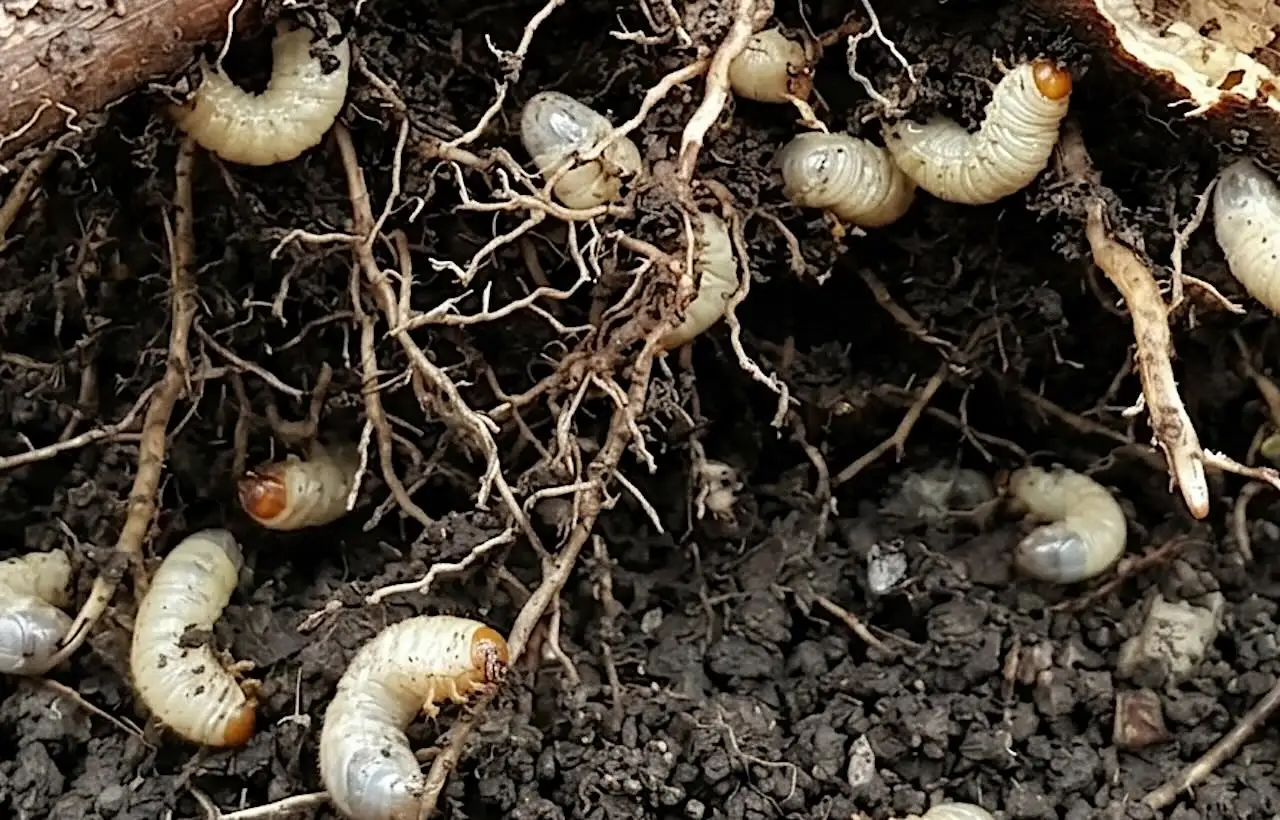
Adult vine weevils are small, matt black, flightless beetles about 9mm long that feed at night and cut distinctive U-shaped notches from the edges of leaves. That damage is only cosmetic. The real problem is their larvae, the cream, C-shaped grubs with a brown head that hatch from eggs laid in the soil or compost in summer and then spend autumn, winter and spring eating the roots. Heucheras in pots are especially vulnerable, and many plants arrive from nurseries already carrying grubs.
The most effective and wildlife-friendly control is biological. Vine weevil nematodes are microscopic worms, Steinernema kraussei, which you water onto moist soil or compost where they seek out and kill the grubs. Apply them when the soil temperature is 5°C or above, typically from late March to May and again from mid-August to October when the new generation of grubs is small. A gravel mulch on pots, sticky barriers around the rim and night-time torchlit checks for adults in spring and summer all help too. I cover the life cycle and every treatment option in detail in my complete UK guide to getting rid of vine weevils.
Very rarely. Heuchera leaves are slightly rough, often hairy and contain bitter compounds that slugs and snails don’t like, which is why they feature in my list of slug-proof plants for UK gardens. You may see the odd nibble on soft new spring growth in a very wet year, but established plants are left alone. If you’re finding neat notches around the leaf edges rather than ragged holes in the middle of the leaf, that’s adult vine weevil, not slugs, and it’s worth checking the roots.
Heuchera rust, caused by the fungus Puccinia heucherae, shows as small raised orange-brown or tan pustules on the undersides of the leaves, with pale or yellow spots above. It’s worst in damp, still conditions and on crowded plants. Remove and bin affected leaves as soon as you see them rather than composting them, water at the base of the plant rather than over the foliage, and space plants so air can move between them. Dividing congested clumps also helps, since the fresh growth that follows is usually clean.
There are hundreds of named Heucheras, and new ones arrive in the garden centres every spring. Some of the older introductions were bred for colour at the expense of vigour and fade within a couple of years, so I stick to proven varieties that I know hold their colour and come back reliably in UK conditions. Here are the ones I use most, grouped by the job they do in a border.
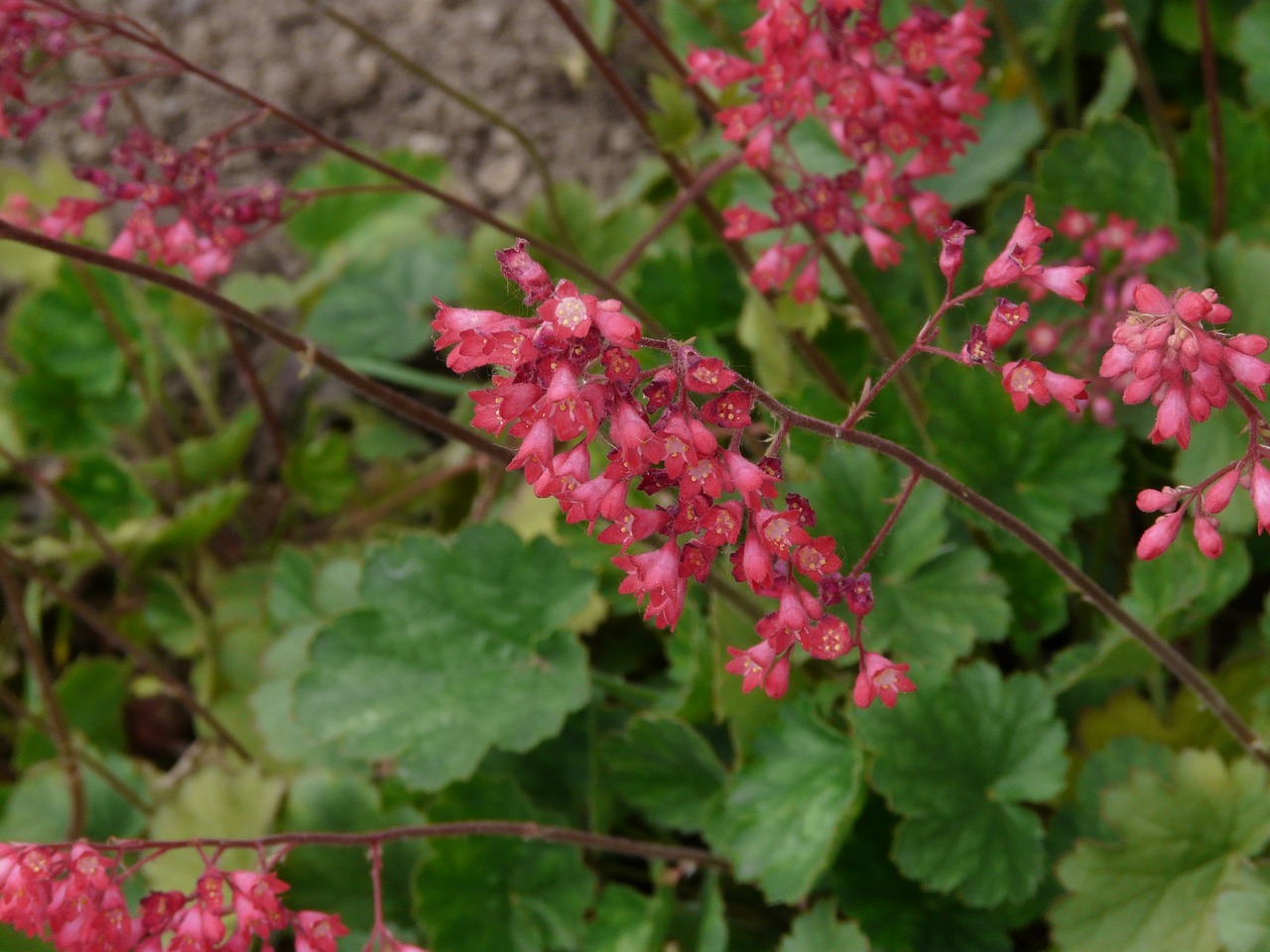
| Variety | Leaf colour | Best light | Foliage height | Why I grow it |
|---|---|---|---|---|
| Heuchera villosa ‘Palace Purple’ | Bronze-purple, maple-shaped | Sun to partial shade | 30 to 45cm | RHS AGM classic, tough and reliable, cream flowers |
| Heuchera ‘Obsidian’ | Glossy near-black | Sun to partial shade | 25 to 30cm | The darkest colour, superb against silver or lime |
| Heuchera ‘Plum Pudding’ | Plum-purple with a silver sheen | Partial shade | 25 to 30cm | Holds its colour well through winter |
| Heuchera ‘Lime Marmalade’ | Ruffled bright lime | Partial to full shade | 25cm | RHS AGM, lights up the darkest corners |
| Heuchera ‘Marmalade’ | Amber and orange with burgundy undersides | Partial shade | 25 to 30cm | Warm colour for autumn and winter pots |
| Heuchera ‘Caramel’ | Apricot to caramel | Sun to partial shade | 30 to 40cm | Heuchera villosa hybrid, copes with more sun and heat |
| Heuchera villosa ‘Autumn Bride’ | Large, soft green | Sun to shade | 30 to 45cm | White flower spikes from late summer into autumn |
| Heuchera ‘Silver Scrolls’ | Silver with dark veins | Partial shade | 20 to 25cm | Brightens shade and cools down hot colours |
| Heuchera ‘Green Spice’ | Green with silver and purple veining | Partial shade | 25 to 30cm | Turns orange and pink in autumn |
| Heuchera ‘Paris’ | Silvery green | Partial shade | 20cm | Grown for its rose-pink flowers, repeat flowers all summer |
| x Heucherella ‘Tapestry’ | Green with dark purple centre | Partial to full shade | 20 to 25cm | Spreads gently, pink flowers in spring |
If you only grow one Heuchera, make it a dark one. Heuchera villosa ‘Palace Purple’, which you’ll also see sold as Heuchera micrantha var. diversifolia ‘Palace Purple’, has been around since the 1980s and is still one of the toughest and most forgiving varieties you can buy. ‘Obsidian’ is the one to choose for sheer drama, with leaves so dark they read as black in shade, and ‘Plum Pudding’ sits between the two with a silvery sheen over the purple that catches the light. These three cope with the widest range of positions, and I use them in almost every shade scheme I design. They also give a strong contrast against silver and white planting, which I explore further in my guide to purple and black plants for garden design.
Lime, amber and orange varieties bring light into dark spaces in a way few other shade plants can. ‘Lime Marmalade’ is the one I rate most highly, with ruffled leaves that glow under trees and against dark fences, and it holds an RHS Award of Garden Merit. ‘Marmalade’ and ‘Caramel’ give warm amber and apricot tones that work well in autumn with Japanese Maples and ornamental grasses. Of these, ‘Caramel’ is the best choice for a spot that gets some afternoon sun, since its Heuchera villosa parentage makes it far more tolerant of heat. The others need proper shade to avoid scorching.
Silver-leaved varieties such as ‘Silver Scrolls’, and patterned ones such as ‘Green Spice’, are the peacemakers of a planting scheme. They sit comfortably between strong colours and stop a border of dark and lime varieties from looking too busy. ‘Green Spice’ also puts on an autumn show as its leaves warm up to orange and pink.
Most modern Heucheras are grown for their leaves, but a few are worth growing for their flowers. ‘Paris’ produces rose-pink flower spikes from late spring right through the summer and is loved by bees, and Heuchera villosa ‘Autumn Bride’ is one of the few perennials for shade that flowers in September and October. For a spreading effect under shrubs, x Heucherella ‘Tapestry’ gives you the leaf colour of a Heuchera with the running habit of Tiarella.
🛒 Buy Heuchera plants from Amazon UK
Heucheras are team players. On their own they can look a little like dots of colour, but planted with the right partners they become the glue that holds a shady border together. When I’m designing a shade scheme, I think about contrast of leaf shape and texture first, and colour second. Heuchera leaves are rounded and mounded, so they look best next to plants with strappy, feathery or very large leaves.
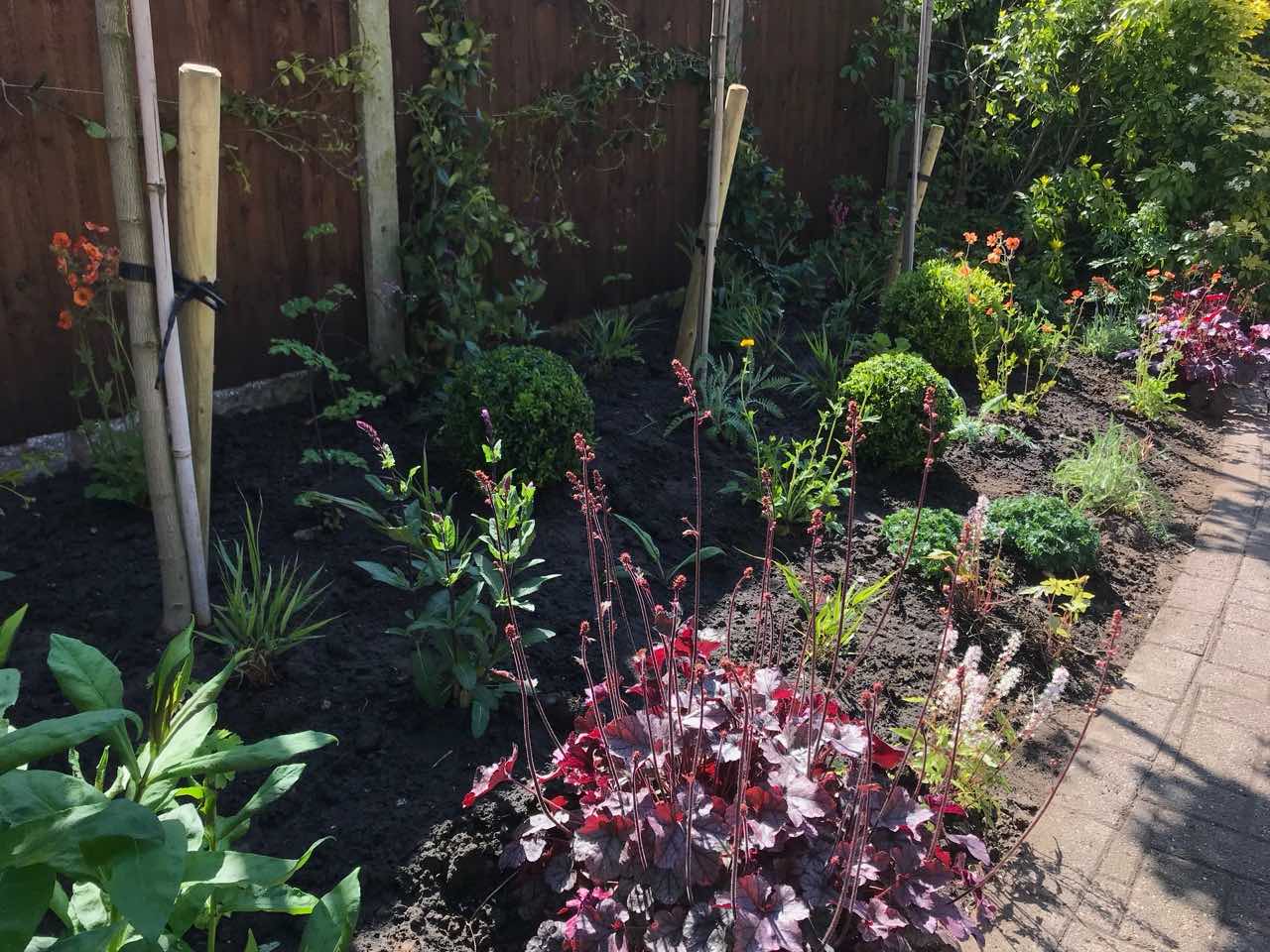
These are the companions I use most often:
Ferns give the fine, feathery texture that makes Heuchera leaves stand out. A Japanese Painted Fern with its silver and burgundy fronds pairs naturally with dark and silver Heucheras.
Hostas provide the big, bold leaves that anchor a shady scheme. Blue-leaved Hostas next to ‘Lime Marmalade’ is one of my favourite simple combinations, and my guide on how to grow Hostas covers keeping them looking good. Hostas are a favourite of slugs, so plant them where you can keep an eye on them.
Grasses and sedges bring movement and a strappy leaf shape. Carex ‘Evergold’ is evergreen like the Heucheras, so the pairing works all year, and Hakonechloa macra does the same job for summer and autumn.
Spring flowering shade plants such as Brunnera macrophylla, Epimediums and Hellebores flower when the Heucheras are just waking up, so the border has interest from February onwards.
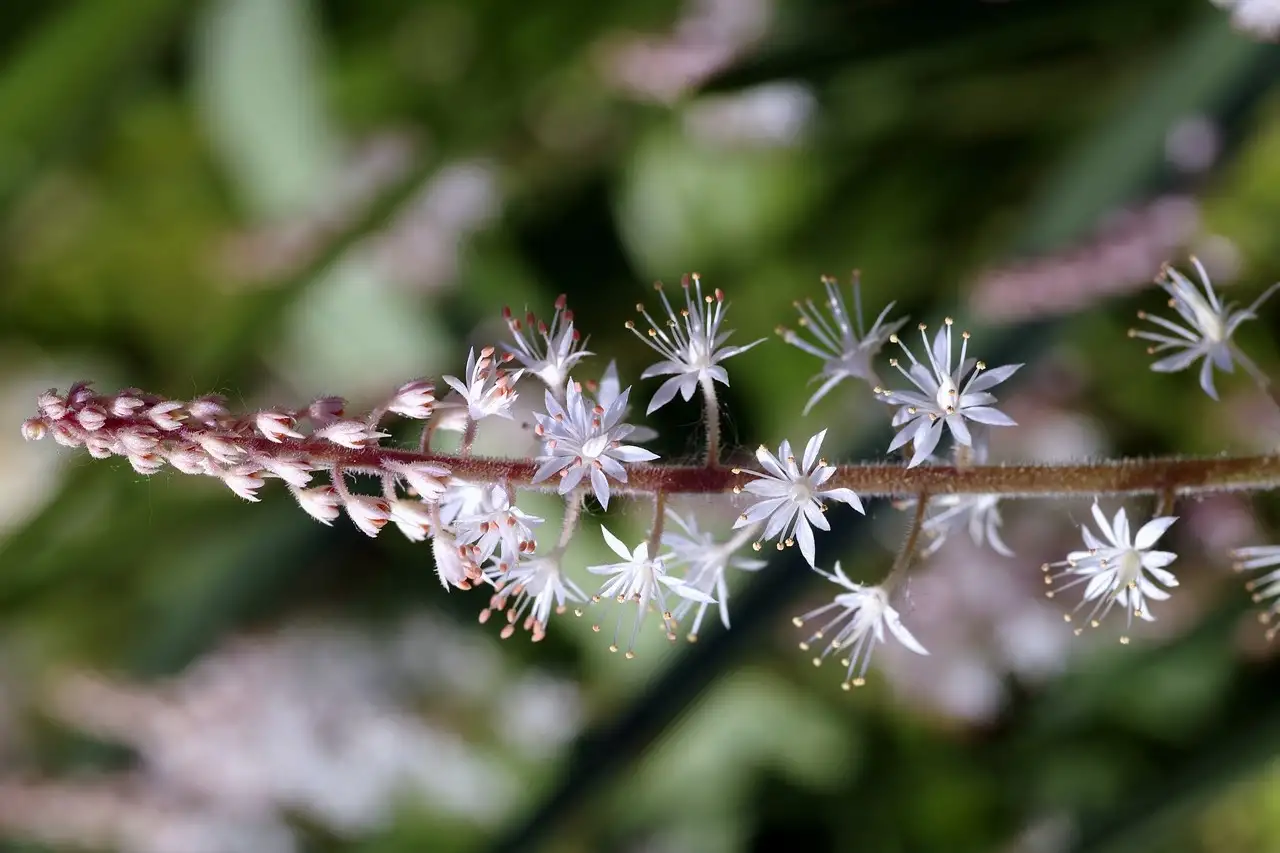
Tiarella, or Foamflower, is the Heuchera’s closest relative and a natural partner. Its frothy white flowers in April and May lift a planting of dark Heucheras, and Tiarella cordifolia will spread gently to fill the gaps between them.
In pots, I combine Heucheras with Skimmia, trailing Ivy, Violas and hardy Cyclamen for autumn and winter, then swap the Violas for Begonias or Fuchsias in summer. For more ideas on building a shady border from scratch, have a look at my guide to plants for north facing gardens.
Heucheras grow best in partial or dappled shade with some morning sun. Dark purple, near-black and silver varieties cope with more sun if the soil stays moist. Lime, amber and caramel varieties scorch in hot afternoon sun and need lighter shade. Very deep shade makes all varieties thin and dull.
Yes. Heucheras are hardy perennials, rated H6 by the RHS for most varieties, and they keep their leaves through most UK winters. Plants that seem to fade after a few years have usually become woody and lifted out of the soil, and dividing or replanting them deeper in spring restores them.
Leave the foliage in place over winter to protect the crown, make sure the plants aren’t sitting in waterlogged soil, and raise pots onto feet. After hard frosts, press any plants that have lifted back into the soil. In spring, trim off damaged leaves at the base and mulch around the plant.
Heucheras grow best in fertile, moist but free-draining soil in partial shade, such as an east facing border, under deciduous trees or in pots in a shaded spot. They dislike heavy, waterlogged clay in winter, so raise them on a mound, add grit or grow them in containers on heavy soil.
Divide Heucheras every three to four years in spring, from late March to May, as new growth begins. Early autumn also works while the soil is warm. Lift the clump, split it into rosettes with their own roots, discard the woody centre and replant the pieces slightly deeper.
The most common causes are vine weevil grubs eating the roots, crown rot from waterlogged soil or a buried crown, and sun scorch on lime and amber varieties. A plant that collapses and pulls out with no roots has vine weevil. Healthy rosettes can often be saved as cuttings.
Heucheras are not listed as toxic to dogs or cats by the ASPCA, which makes them a useful choice for a pet-friendly garden. As with any plant, dogs that chew large amounts of leaves may get a mild upset stomach, so discourage chewing.
Slugs and snails rarely eat Heucheras, because the leaves are rough, often hairy and bitter. You may see the odd nibble on soft new growth in a wet spring. Neat notches cut into the leaf edges are usually adult vine weevil damage rather than slugs.
Don’t cut Heucheras back to the ground. In early spring, remove only the old, brown or damaged leaves at the base, and cut off faded flower stems in summer. The healthy evergreen leaves keep feeding the plant, and new growth comes from the tips of the woody stems.
Most Heucheras form a mound of leaves 20 to 45cm tall and 30 to 60cm wide, with flower stems reaching up to 60cm. Heuchera villosa varieties such as ‘Caramel’ and ‘Autumn Bride’ are the largest, and compact varieties such as ‘Paris’ stay around 20cm.

Join over 100,000 gardeners on YouTube
Free gardening videos from the Garden Ninja, with 8 million views and counting.
Subscribe on YouTube, it’s freeHeucheras are one of the building blocks I use in almost every shady garden I design, but the real skill lies in knowing how to layer them with shrubs, grasses and flowering perennials so the whole border works together through every season. That’s exactly what I teach in my online garden design courses, drawing on the same process I use for clients and on television.
The courses start from just £29, so you can learn to plan planting schemes like a designer at your own pace.
For the garden you’ve already got, not the one you’re starting from scratch. Seven checklists and video lessons from BBC Garden Rescue’s Lee Burkhill, built to help you work out what’s worth keeping before you spend a penny.
Garden Design Examples for Small Gardens: 30 Design Templates & Planting Plans: In this online gardening course, I’ll walk you through 30 fantastic garden designs, explaining the logic behind the layout, the plant choices, and take-home tips for applying them in your own garden.
Learn how to transform and design your own garden with Lee Burkhills crash course in garden design. Over 5 hours Lee will teach you how to design your own dream garden. Featuring practical design examples, planting ideas and video guides. Learn how to design your garden in one weekend!
Garden Design for Beginners Online Course: If you want to make the career jump to becoming a garden designer or to learn how to design your own garden, this is the beginner course for you. Join me, Lee Burkhill, an award-winning garden designer, as I train you in the art of beautiful garden design.
Heucheras give you year-round leaf colour in shade with very little work, as long as you give them the conditions they evolved for. Plant them in partial shade in free-draining soil with the crown level with the surface, match the leaf colour to the light, mulch each spring without burying the crown, and keep a close eye on pot-grown plants for vine weevil. Choose dark and silver varieties for tougher spots, and save the lime and amber ones for gentle shade.
Most Heuchera problems come down to age, wet or vine weevil. Divide your plants every three to four years in spring, replant woody, lifting plants deeper, and take cuttings from any healthy rosettes if a plant collapses. Do that, and a single Heuchera will keep you in free plants for the rest of your gardening life. If you have a Heuchera that isn’t looking right, post a photo on the Garden Ninja forum and I’ll help you work out what’s going on.
Happy gardening!


Lee Burkhill, known as the Garden Ninja, is an award-winning garden designer and horticulturist with over 30 years of gardening experience and 15 years as a professional garden designer. A qualified RHS (Royal Horticultural Society) professional, Lee specialises in sustainable garden design and practical horticultural advice. He designs and presents on BBC1’s Garden Rescue and in leading gardening publications. Lee combines three decades of hands-on gardening knowledge with professional design qualifications to help gardeners create beautiful, functional outdoor spaces.
View all posts by Lee Burkhill







JOIN THE NINJAS

Be the first in line for new Guides, Discount codes and Offers