For the garden you’ve already got, not the one you’re starting from scratch. Seven checklists and video lessons from BBC Garden Rescue’s Lee Burkhill, built to help you work out what’s worth keeping before you spend a penny.
69


Designing a garden that works for excitable children who want to launch footballs through your borders and exhausted parents who want five minutes of peace with a coffee is genuinely challenging. Most families end up with one of two disasters: a garden completely surrendered to plastic play equipment and bald mud, or a pristine adult space where children are constantly told, “Don’t touch that.” Neither makes anyone happy.
You absolutely can create a garden that provides an ideal play space for energetic children while offering adults a genuinely relaxing escape. It is not about having a massive budget or acres of space. It is about thoughtful zoning and strategic design decisions that I am going to walk you through in this guide, drawing on more than 20 years of designing family gardens for clients across the UK and transforming some genuinely unloved spaces into places families actually want to be in.
Quick Answer
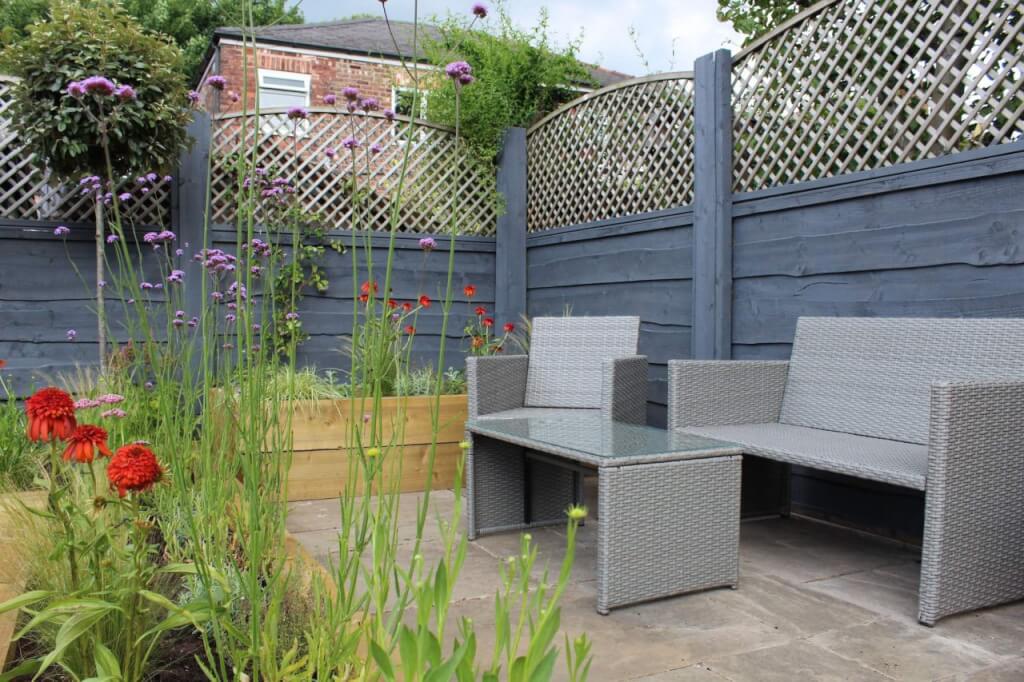
The key to a successful family friendly garden is zoning: splitting the space into clearly defined areas for play, growing, adult relaxation, and storage. Use physical cues like paths, raised beds, and planting to separate each zone without hard fencing. Design play features with their eventual removal in mind, choose tough but beautiful plants that can survive a football, and phase the work over two to three years rather than trying to do everything at once.
Jump To
Let me be honest about something most garden designers tiptoe around. Creating a family-friendly garden can cost an absolute fortune if you are not strategic. Walk into any garden centre in spring and you will find play equipment ranging from £200 for a basic swing set to £3,000-plus for elaborate climbing frames. Add professional landscaping, quality paving, raised beds, and planting, and a complete garden transformation can easily reach £10,000 to £40,000.
For most young families juggling mortgages and childcare, that is simply not realistic. The good news is that with some creativity and strategic phasing, you can create a brilliant family garden for a fraction of that cost. I have designed gardens at every budget level and some of the most successful family gardens I have ever created have been the ones where money was tightest and creativity was highest.
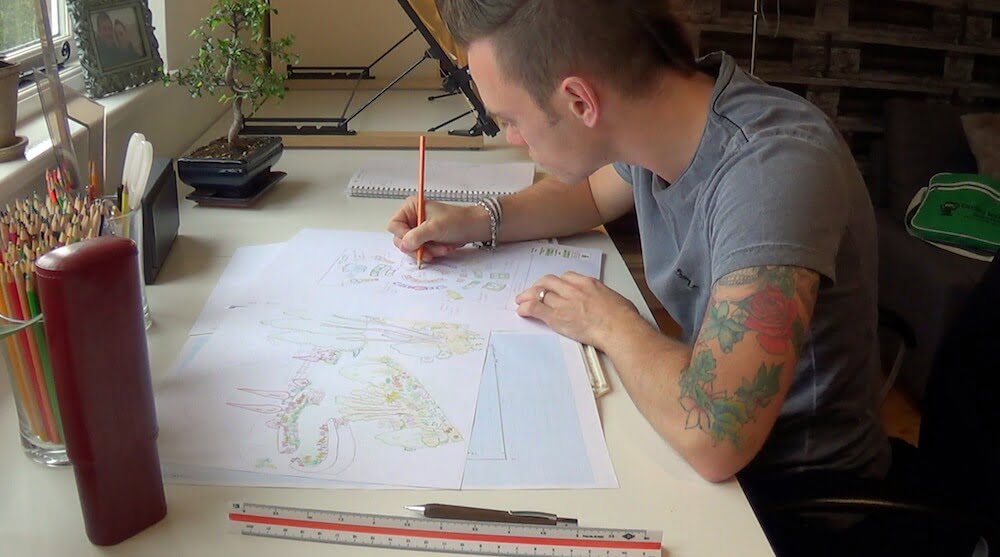
The single biggest money-saving strategy is phasing your development over two to three years rather than trying to do everything at once. In the Manchester garden I show later in this guide, we did not install everything simultaneously. Year one focused on getting the hard landscaping bones right: the patio, paths, and raised bed structures. These permanent features require skill and are worth investing in properly because they last for decades.
Year two tackled planting and lawn installation. Year three added finishing touches: lighting, seating, and play features. This phasing approach allowed the clients to afford quality materials throughout, rather than compromising everything to do it all at once. Start with the elements that provide structure and usability, then add planting, and finally the bells and whistles when budget allows.
This is where you can save significant amounts of money if you are remotely handy with tools. That £2,500 climbing frame? You can build something just as functional for £200 to £400 in materials. I have worked with families who created incredible play features using reclaimed scaffold poles, recycled timber, and basic DIY skills.
A simple swing set can be built from two sturdy posts, a crossbeam, and proper swing seat fixings. Use timber at least 100mm x 100mm for the posts, set in concrete to a depth of 600mm for stability, and use treated softwood or naturally durable hardwood. Sand all edges smooth. Budget: roughly £80 to £150 depending on timber choice.
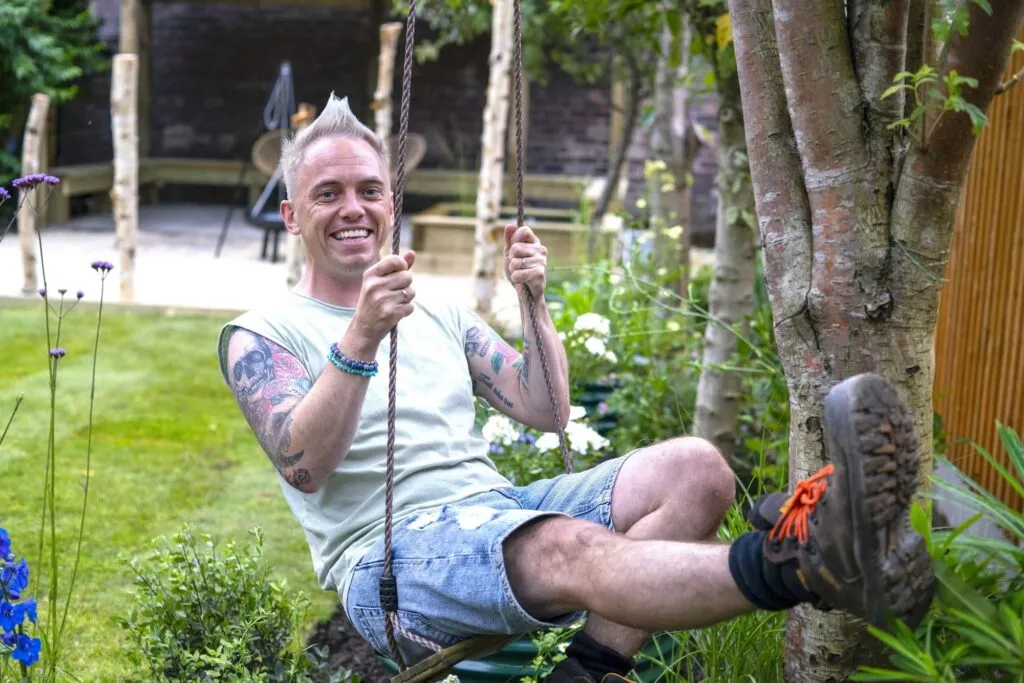
For a climbing frame, old scaffold poles are genuinely brilliant. They are incredibly strong, weather-resistant, and you can pick them up second-hand from scaffold hire companies for a fraction of new prices. Bolt them together to create climbing structures, monkey bars, or frames for rope ladders and cargo nets. Add a platform deck at one end and a slide at the other, and you have a proper adventure playground for under £300.
For den-building on a shoestring, heat-treated pallets (marked HT, never chemically-treated MB ones) are often free from builders merchants and industrial estates. Stack and secure them properly, remove all protruding nails, sand rough edges, and children will have hours of creative play for essentially nothing but your time.
💡 Top Tip
The RoSPA guidance is to allow a 2-metre safety zone around all play equipment. Plan this into your zone layout from the start rather than trying to squeeze equipment in afterwards. Rubber bark chip at 300mm depth is the most cost-effective certified impact-absorbing surface for under equipment, costing around £5 to £8 per square metre.
Planting is where families panic about costs, seeing £15 perennials and £40 shrubs and calculating that filling borders will cost thousands. It absolutely does not have to. In one family garden I designed, the planting list would have cost £800 in mature specimens. The clients spent about £250 by growing from seed, taking cuttings, buying small plug plants, and being strategic about what they purchased at full size.
Hardy annuals grown from seed give instant impact for pennies. A packet of Californian poppy seeds costs £2 and will fill a square metre with vibrant orange flowers. Cornflowers, nigella, calendula, cosmos, and sunflowers are all trivially easy from direct-sown seed. For under £20, you can have entire borders filled with colour in their first summer whilst your slower-growing perennials establish.
Cuttings are free plants from friends, neighbours, or your own garden. Penstemons, salvias, lavender, rosemary, and sedums are all easy to propagate from softwood cuttings. Take them in late summer from the same year’s growth, put them in gritty compost, and you will have rooted plants by spring ready to go into borders. Also buy small and be patient. A 9cm pot perennial at £3 versus £12 for a 2-litre pot means you can buy four times as many plants. In two years you will not see the difference.
The reclamation yard and Facebook Marketplace are your best friends when creating family gardens on a budget. I have sourced natural stone paving for £8 per square metre compared to £40-plus for new. Railway sleepers, old bricks for edging, reclaimed timber for decking and structures are all available at fractions of new prices if you are willing to hunt.
People are constantly giving away or selling for very little: paving slabs, gravel, topsoil, plants, pots, and garden furniture. Unwanted play equipment from families whose children have outgrown it regularly appears at giveaway prices. Skip salvage with permission from site managers can yield perfectly usable timber, sleepers, and interesting stone. Always verify reclaimed timber for old treatment chemicals before using in a food-growing or children’s play area.
Before touching paving or ordering plants, spend time answering these questions honestly as a family. This is not about a party once a year. This is about the 95% of everyday garden use, so be realistic.
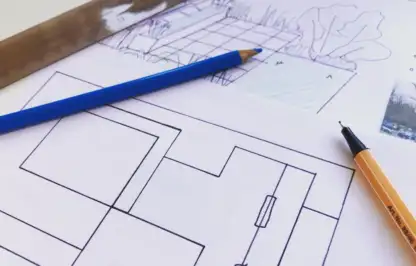
Once you have answered these, sketch out a rough plan of your garden and mark on existing trees, buildings, and hard landscaping. Mark where sun falls at different times of day. This sketch does not need to be professional but having it on paper stops you making costly assumptions once work starts.
Zoning is the single most powerful tool in family garden design. It means deliberately breaking the space into distinct areas, each with a clear purpose, rather than letting everything blur together into one multipurpose muddle. Done well, the zones feel natural and connected. Done badly, the garden feels like a series of disconnected rooms with no flow.
In a typical family garden I might identify four zones: a children’s play zone (usually closest to the house for supervision), an adult relaxation zone (in the sunniest position), a growing zone for vegetables or herbs, and a storage and utility zone. These do not need hard boundaries between them. Raised beds, a change in surface material, or a path can signal a transition from one zone to another without putting up a fence.
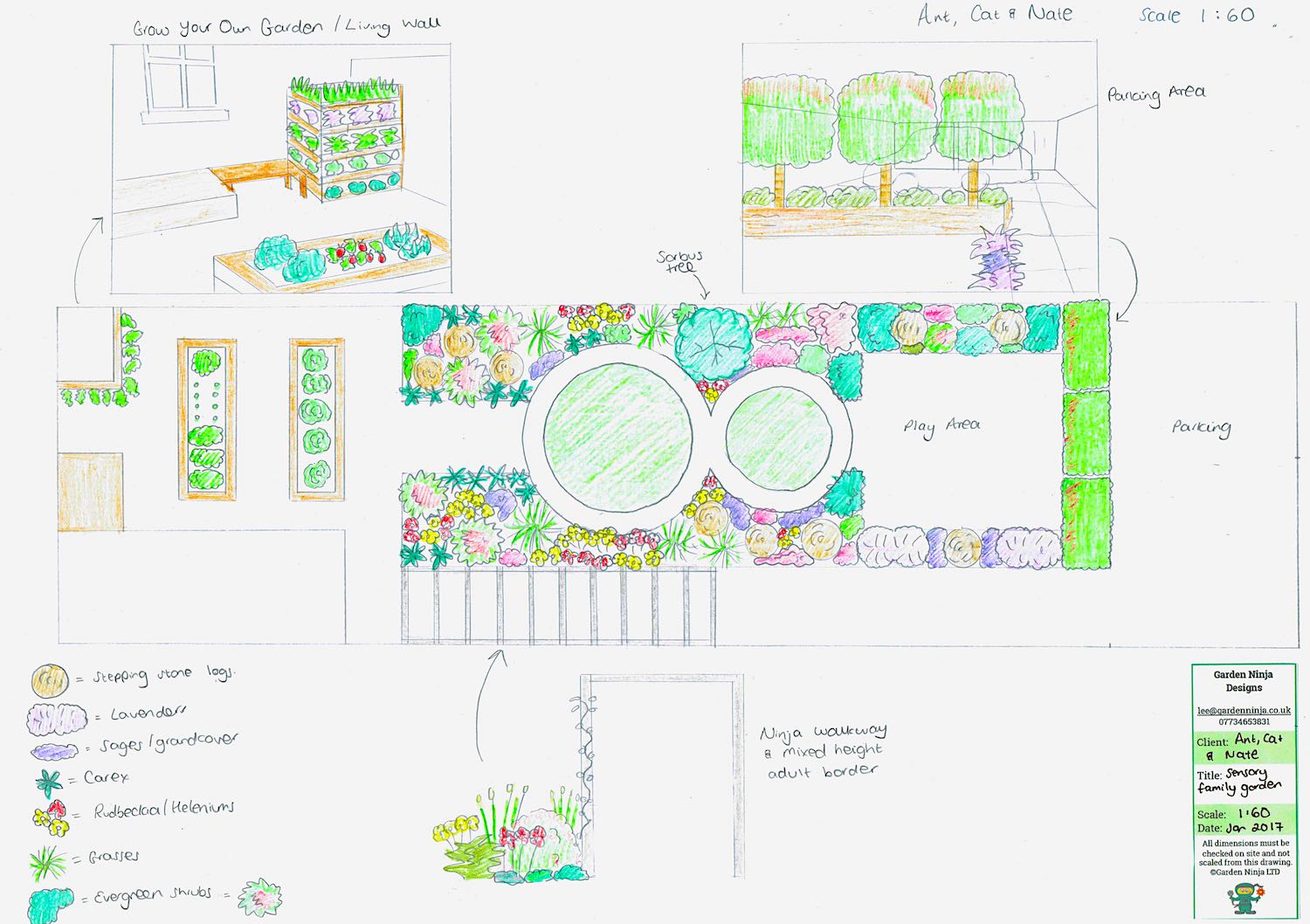
The children’s zone should have the most robust, unfussy planting because it will take the most punishment. The adult zone can be more considered, with better furniture and more delicate planting. The growing zone keeps food production separate from play so footballs are not flattening your courgettes. Storage should be accessible but screened from view.
Safety planning is not about bubble-wrapping the garden. It is about removing genuinely hazardous situations while allowing children the freedom to explore, climb, and take the kind of manageable risks that develop confidence and coordination. In my experience of designing hundreds of family gardens, the most dangerous feature is almost always poor lighting on steps or level changes, not play equipment.
What goes under and around play equipment matters significantly for both safety and maintenance. Here is an honest comparison of the main options available to UK families.
For most family gardens, certified bark chip at 300mm depth strikes the right balance between cost, effectiveness, and appearance. It can be topped up easily and removed when the play area eventually transitions to something else.
Open water is a genuine hazard for young children. A child can drown in very shallow water, so any pond or water feature needs careful consideration. My usual approach for families with children under six is to either install a dry rill (a decorative drainage channel with no standing water), a covered reservoir with a millstone or pebble fountain where the pump reservoir is completely concealed under a grate, or to plan the pond for later installation once children are older. A beautifully planted bog garden can occupy the same space as a future pond and is completely safe. If you do want a pond, a steel mesh cover just below the water surface gives children who fall in something to grab and buy time for an adult to respond.
There is a huge market for expensive jungle gyms. You need to consider how active your children actually are, whether they will use a given piece of equipment, and critically, for how many years. In my experience as a designer, slide usage peaks between ages three and six then drops off sharply. Swings have better longevity, remaining popular from toddlerhood through to early teens. Climbing frames have perhaps four to six years of peak usage.
This is why I advocate strongly for play features that have a secondary purpose or can be removed without leaving a mess. A pergola designed to support rope swings or climbing nets remains a beautiful garden structure even after the play equipment is removed. Timber posts set for swings can later support shade sails or climbing plants. Structures that bolt together can be dismantled when no longer wanted.
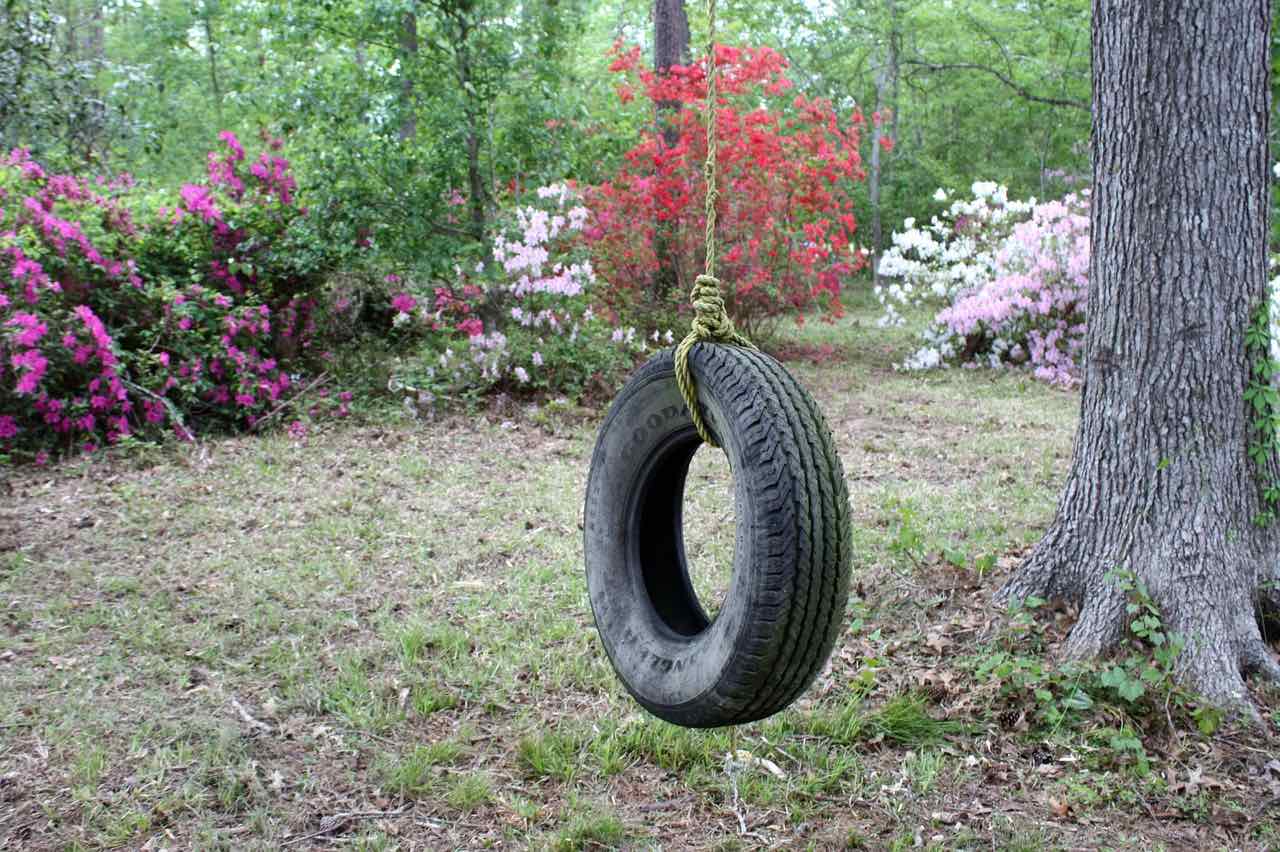
Sandpits are beloved by toddlers and ignored by anyone over eight. Design sandpits with their eventual transformation in mind. A timber-framed sandpit becomes a raised vegetable bed by simply emptying the sand and filling with compost. Trampolines are perhaps the highest-use play investment for families with children aged five to twelve. An in-ground trampoline, set flush with the lawn, is far less visually intrusive than a frame model and removes the fall hazard of the frame height.
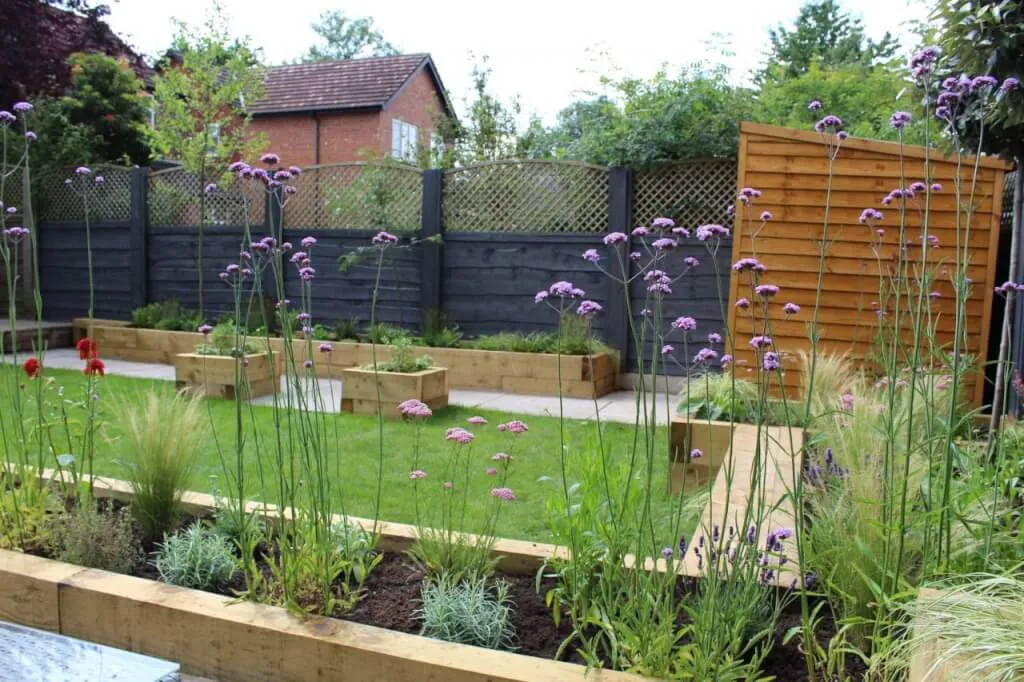
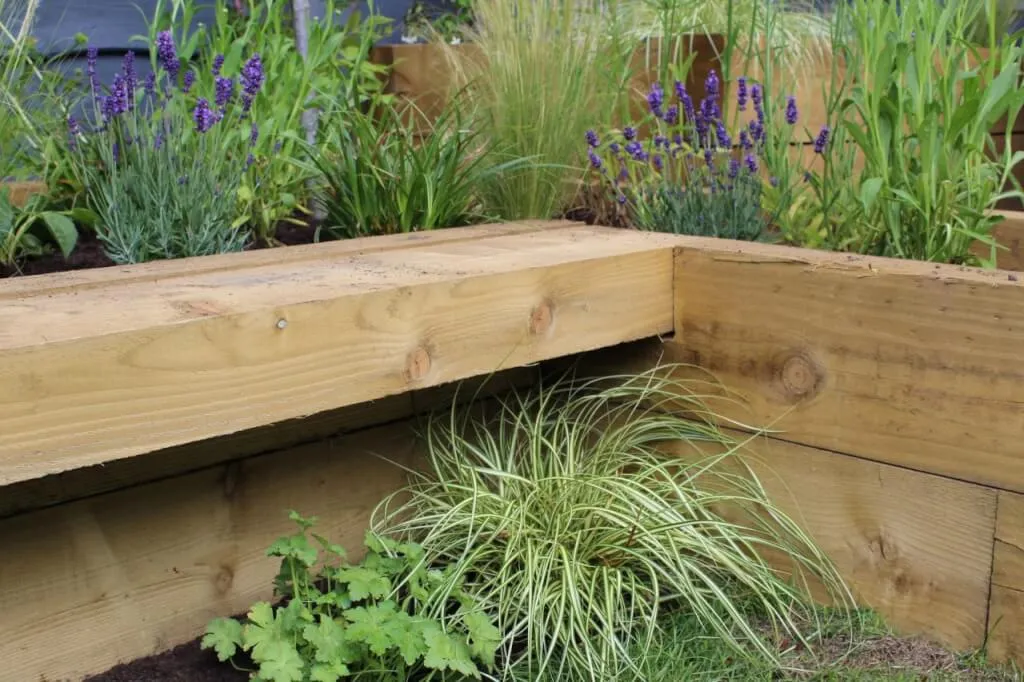
Raised beds are extraordinarily useful in a family garden for reasons beyond growing. They act as natural zone dividers, creating the psychological and physical separation between the children’s lawn and the adult terrace without the need for a fence. At 40cm height they double as occasional seating for adults watching children play. They bring planting up to a level where it can be appreciated rather than trampled. And they give children their own growing space where they can plant sunflowers, strawberries, or radishes and feel genuine ownership over part of the garden.
💡 Top Tip
Give children their own dedicated raised bed for growing. Fast-maturing crops like radishes, salad leaves, and cherry tomatoes reward impatient young growers with results in weeks rather than months. Sunflowers sown in April will be taller than most children by July. The sense of pride that comes from eating something you grew yourself is genuinely one of the most powerful ways to build a lasting relationship between children and outdoor spaces.
Paving and paths do more than just provide a surface to walk on. In a family garden, they are one of the primary tools for creating the feeling of distinct zones and giving the garden visual structure. A path running off the main lawn signals to children (and adults) that there is something interesting in another part of the garden. It also doubles practically as a bike track, a road for toy cars, and a surface that remains usable in wet weather when the lawn has turned to mud.
Stepping stones through a border or across a section of lawn are endlessly engaging for children. They become part of games, dare challenges, and imaginary worlds. They also protect borders from trampling by giving children a legitimate path through the planting. My guide to DIY paths covers materials and installation in detail.

For the main patio, choose a surface that handles heavy use, is easy to clean, and remains safe when wet. Textured porcelain paving is excellent for family gardens: it is virtually maintenance-free, non-slip when wet, and holds up to garden furniture, bikes, and muddy boots for decades. Natural stone is beautiful but requires sealing and more careful maintenance. Decking can be slippery when wet and I generally do not recommend it as a primary surface in a family garden with young children unless it has an anti-slip coating and is maintained rigorously.
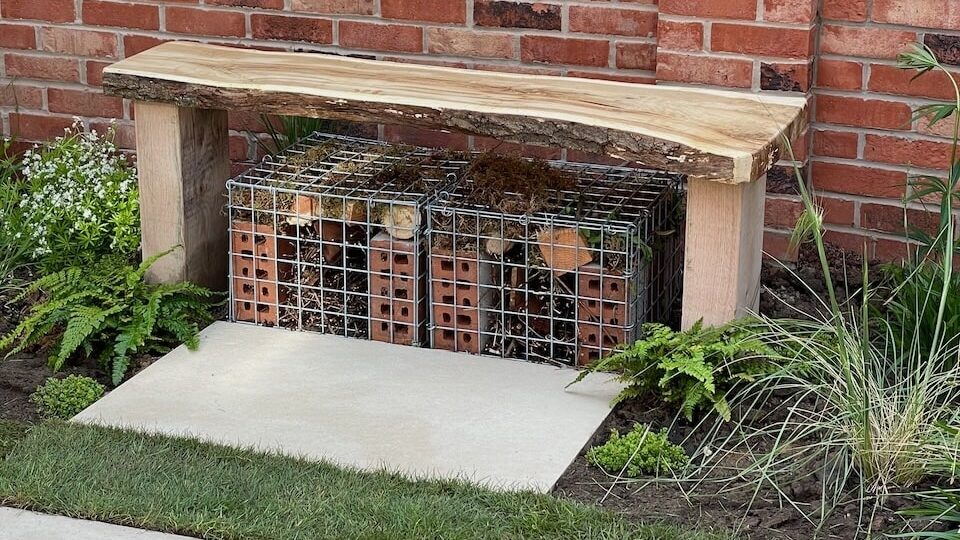
Garden furniture takes up a lot of room and needs winter storage. In a family garden where space is always at a premium, integrated timber seating built into the garden structure is far more useful than a table and chairs set that spends half the year in a bag. In the Manchester garden shown later in this guide, I incorporated built-in benches along the edges of the raised beds, providing seating for six to eight people at the kind of impromptu garden parties that family life generates, whilst blending seamlessly into the planting around them.
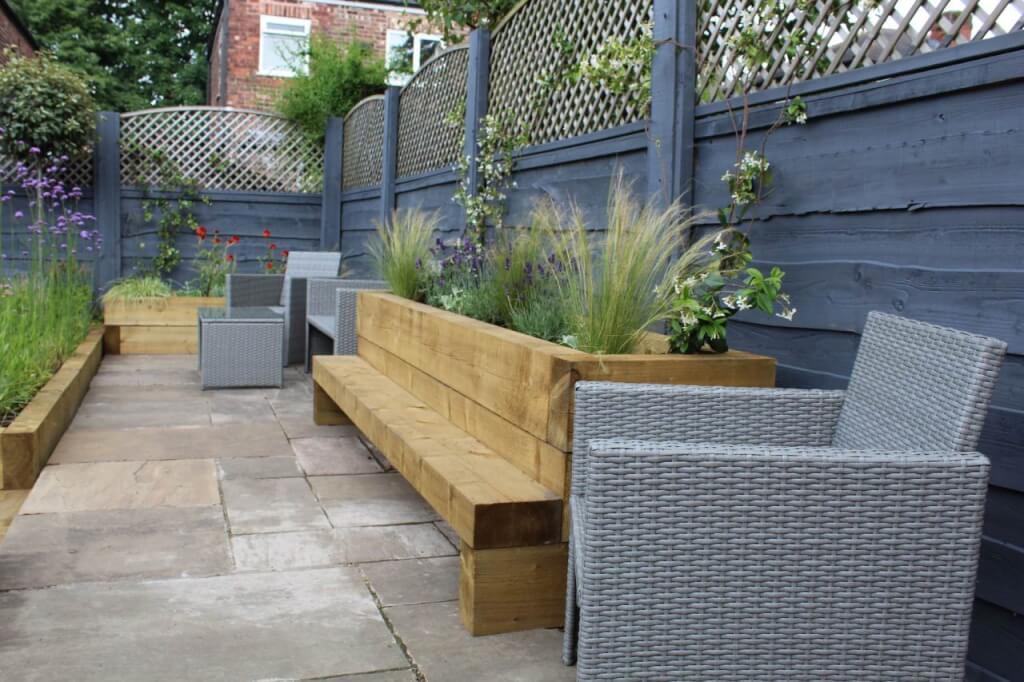
Planting beneath and around seating, particularly low aromatic plants like thyme and chamomile along the front of benches, creates a sensory experience when you sit down and brush against them. It also means the seating area feels like it is embedded in the garden rather than plopped on top of it, which is a significant difference in how the whole space feels to spend time in.
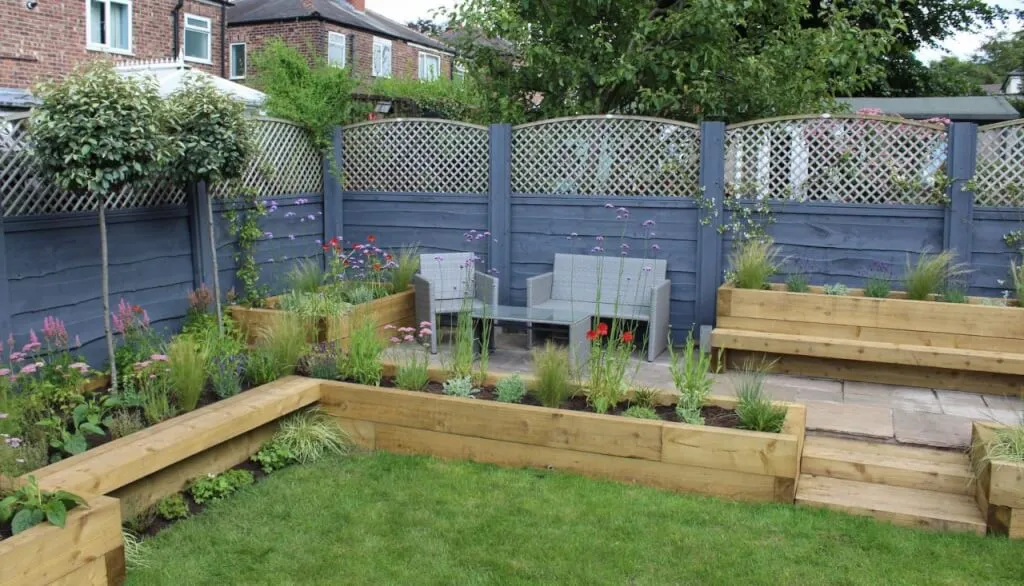
This north-facing, overlooked garden in Manchester is a project I am particularly proud of because the brief was exactly the challenge this guide is about. Two young children needed space to play safely. Two exhausted parents needed somewhere to actually sit down. The builders had left the garden as a compacted mess with a random overgrown tree, an uninspired square of struggling lawn, and those odd out-of-control shrubs that seem to appear in every unloved suburban garden.
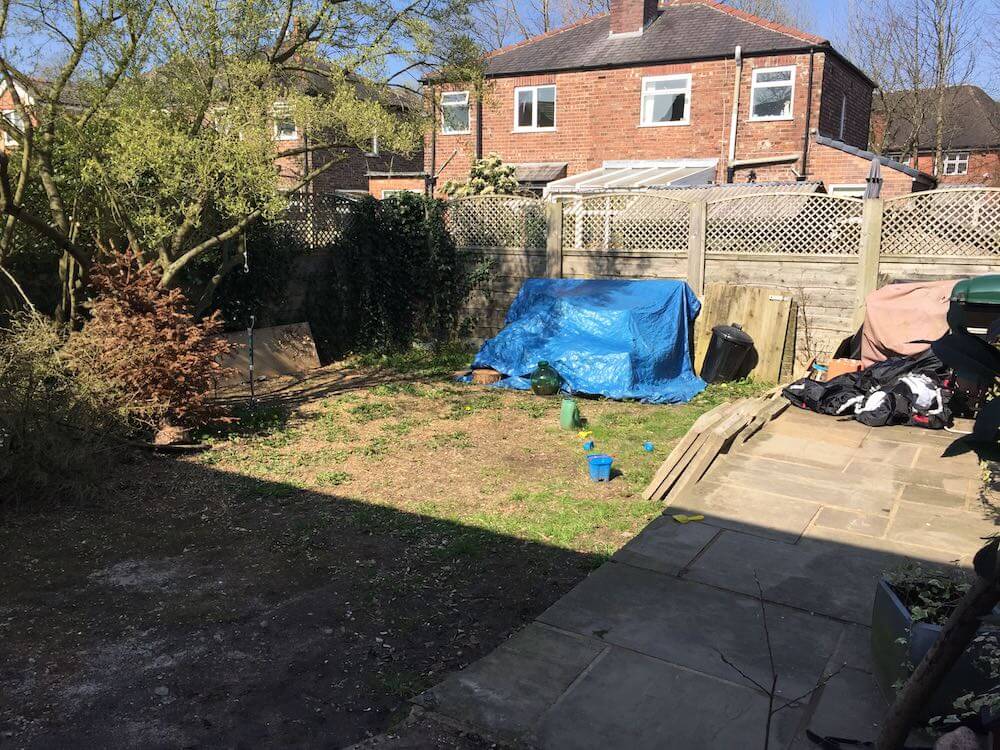
The clients wanted a substantial lawned area for the children that could evolve over time as they grew up. They wanted privacy from neighbours. They needed storage for bikes. They wanted colour and wildlife-friendly planting. And they had a budget that required careful prioritisation.
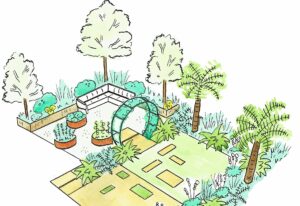
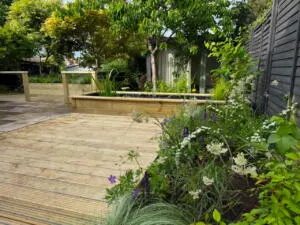
The solution was a clear zone layout: a raised terrace adult zone screened by planters and raised borders, connected to a generous children’s lawn below via cut-through paths that maintained flow without making the garden feel divided. The raised beds contained the scaffold pole climbing structure (which now functions as an arbour walkway with climbing plants now the children are older) and tough herbaceous planting that could take the occasional stray football.
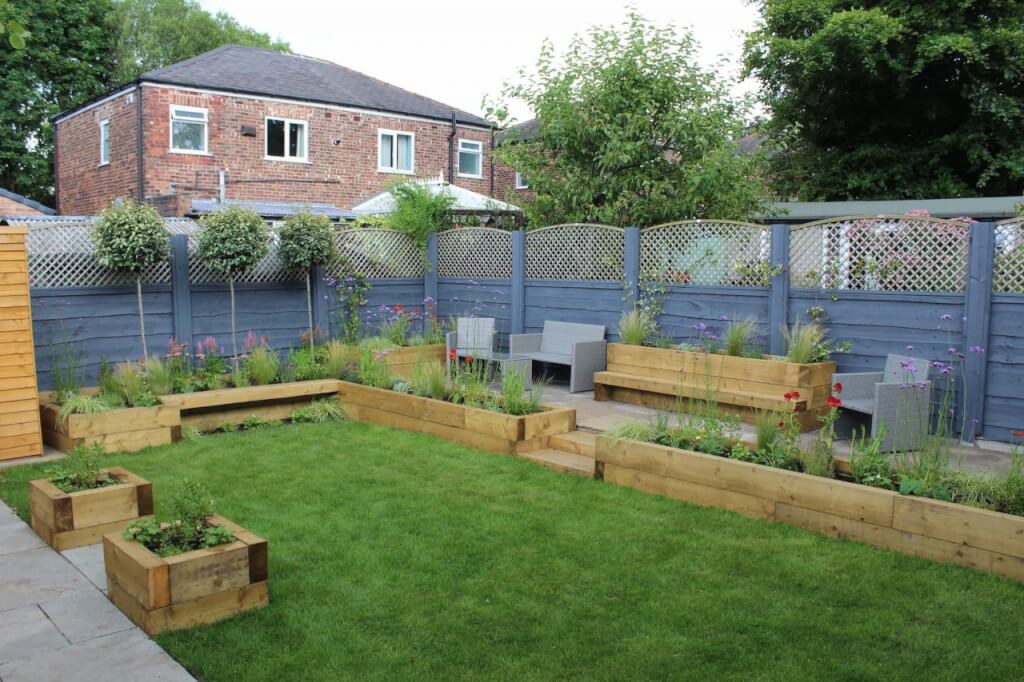
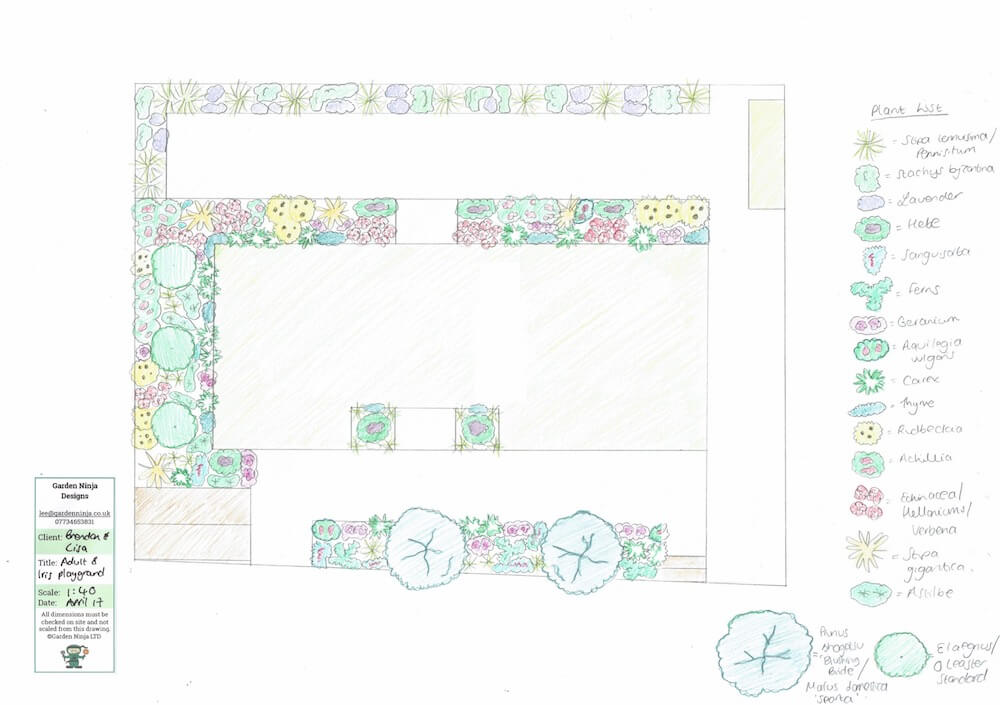
The far shaded border used shade-tolerant plants including Sanguisorba and ferns that thrive in the dappled conditions created by the neighbouring trees, brightening an area that could easily have been left as a dead corner. Two small trees, Malus ‘Sparta’ and Sorbus ‘Joseph Rock’, added height and further privacy on the north boundary without casting excessive shade.
Planting choices in a family garden need to balance beauty, resilience, wildlife value, and safety. The good news is that these goals are far more compatible than most people think. The vast majority of common garden plants are perfectly safe. Yes, many contain mild toxins. But actual serious poisoning from garden plants is remarkably rare because most plant parts taste disgusting and children spit them out immediately.
There are a small number of plants I actively exclude from family gardens. Aconitum (Monkshood) contains alkaloids that are seriously toxic and it looks deceptively innocuous. Euphorbia species have irritant latex sap that causes severe skin reactions, particularly in sunlight. Laburnum seeds are seriously toxic to children. Ricinus communis (castor oil plant) contains ricin. And Giant Hogweed causes severe photodermatitis. Beyond these five, I take a balanced approach and focus on teaching children not to eat plants, wash hands after gardening, and to ask before touching unfamiliar plants.
⚠ Plants to Avoid
Aconitum (Monkshood), Euphorbia species, Laburnum, Ricinus communis, and Giant Hogweed (Heracleum mantegazzianum) should be avoided in gardens where young children play. All other plants carry manageable risk when combined with basic safety education.
For the children’s zone, choose robust plants that recover quickly from damage and provide colour, scent, and wildlife value. For the adult zone, you can be more adventurous. The planting I used in the Manchester garden brought colour across the whole season through tough, beautiful pollinators.

When children are young, planting needs to survive footballs, trampling, and general chaos. Robust, unfussy plants that recover quickly are the right choice. As children mature and garden respect improves (usually around ages eight to ten), you can transition towards more sophisticated schemes. That border filled with bombproof Geraniums and Alchemilla can gradually incorporate more delicate species. Plan this transition from the start. Deep borders with tough plants at the front protect more delicate specimens towards the back during the chaos years, and as respect improves, those plants can take centre stage.
Families generate garden clutter at astonishing rates. Bikes, scooters, balls, outdoor toys, sports equipment, garden tools, and all the miscellaneous paraphernalia of family life need somewhere to live. Without adequate storage, it migrates across the garden, making the space feel smaller and more chaotic than it actually is. Good storage is not glamorous but it is genuinely transformative for how a garden feels to use every day.
If you have space for a proper shed, it is probably your single best storage investment. Go for at least 2.4m x 1.8m because smaller ones fill up immediately and become unusable. Specify 12mm or ideally 16mm tongue-and-groove cladding, proper pressure-treated timber, and an apex roof for longevity. Budget options with thin cladding last five to seven years before falling apart, which makes them false economy.
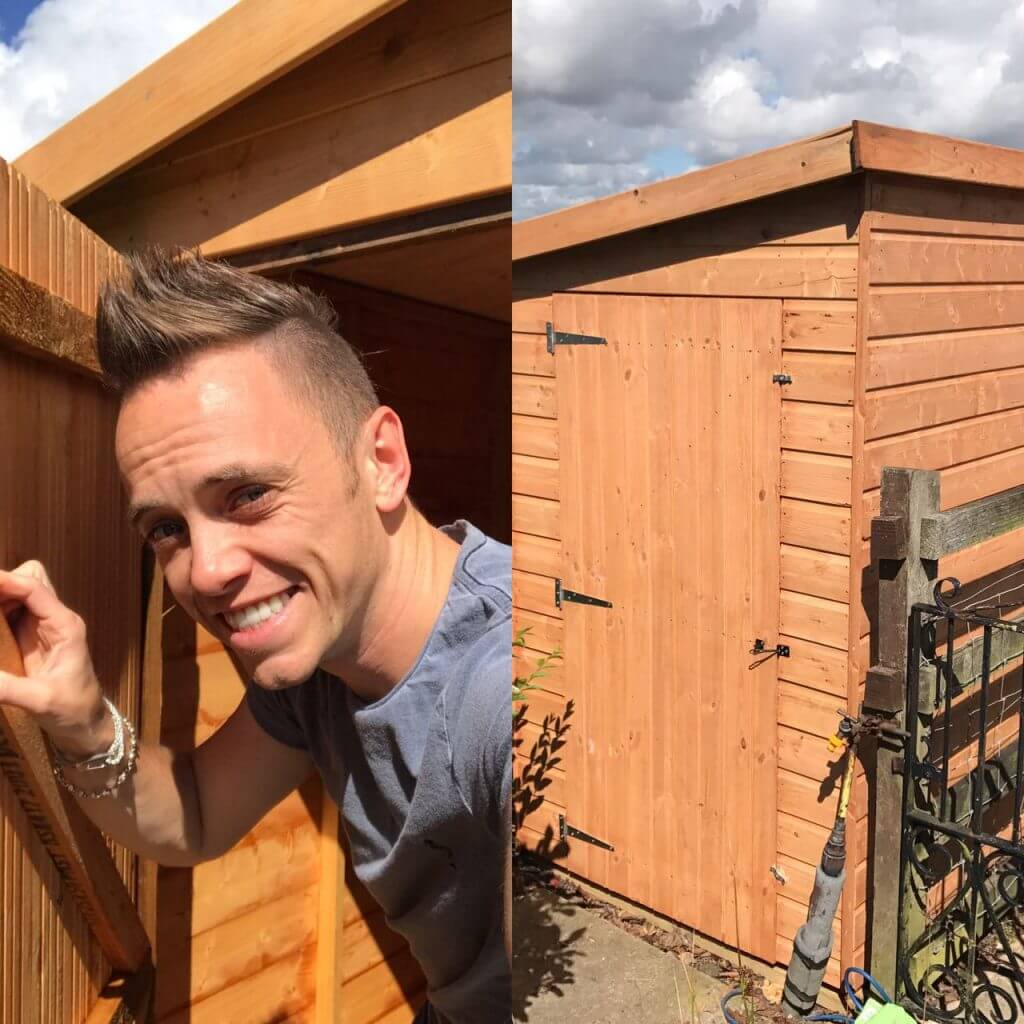
Position sheds strategically. Paint them in dark heritage colours (charcoal, black, forest green) so they recede visually rather than catching the eye. A sedum green roof adds roughly £200 to shed costs but creates a living roof that manages rainwater, benefits wildlife, and integrates the shed visually into the garden rather than fighting with it. If you are overlooked, neighbours see a green roof rather than a shed roof.
When constructing decking, design access hatches into the surface. Even 600mm x 600mm hatches provide useful storage for cushions, toys, or gardening equipment. Larger hatches can swallow bikes or scooters. Make them from the same decking boards so they disappear visually when closed. Gas struts or soft-close hinges keep them safe for children and functional for adults.
Integrated seating with storage underneath is another high-value option. Build benches around patio edges with hinged seat tops revealing storage compartments. Make them at least 450mm deep for comfortable seating and line the storage area with breathable membrane rather than making it completely sealed, which traps moisture.
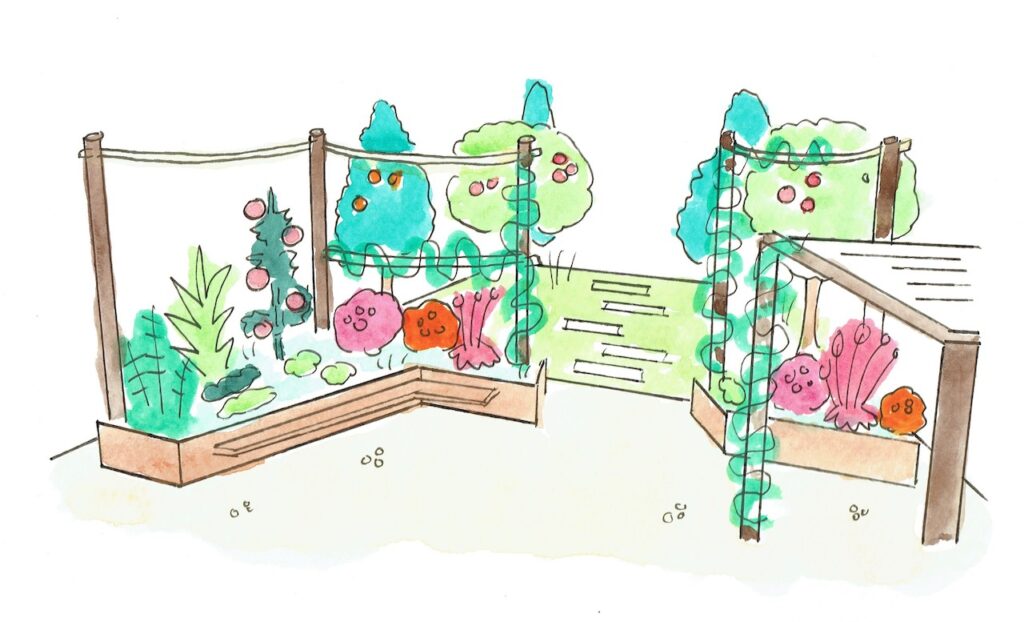
One of the biggest mistakes in family garden design is creating spaces perfectly suited to children aged three to seven and discovering they are completely wrong for everyone four years later. Children change rapidly and gardens need to evolve with them without requiring complete redesigns every few years.
Most family garden design focuses intensely on young children and largely ignores teenagers, which is a missed opportunity. By the time children hit twelve or thirteen they are not playing on swings, but they might actually want to be in the garden if you give them reasons. Teenagers want privacy from parents, space to be with friends, and the same creature comforts as adults. A covered seating area with decent furniture (and yes, a power socket for phone charging) creates somewhere they will actually use. Hammocks are surprisingly popular with teenagers. Fire pits and chimineas become evening gathering spots. Give teenagers a proper growing project if they show interest: a greenhouse section, substantial vegetable beds, or a cut flower patch for pocket money can engage teenage interest in ways that children’s play features never will.
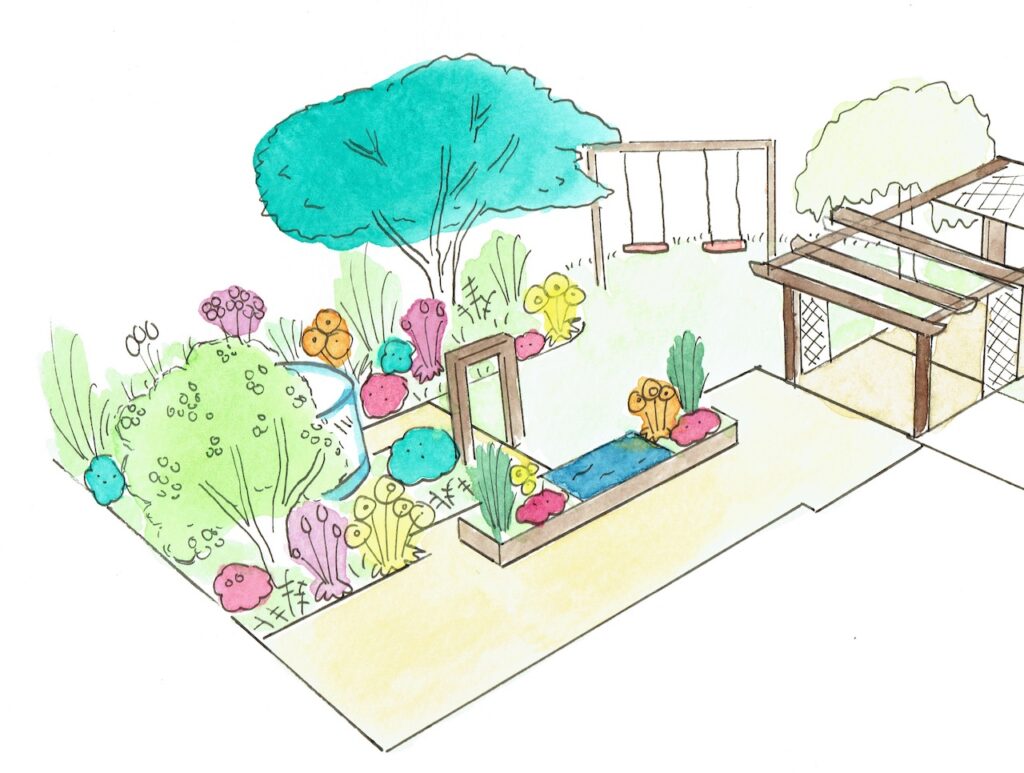
The most effective approach is dedicated storage that is easy for children to use themselves. A lidded outdoor box or bench with storage near the play zone means toys have a home and children can tidy up without adult supervision. Agree a rule that toys not put away go in the bin. Harsh, perhaps, but effective. Beyond storage, reducing the volume of garden toys to those that actually get used rather than accumulating every item that appears at birthdays is genuinely transformative.
For a hard-wearing family lawn, use a seed mix containing at least 60 to 70 percent perennial ryegrass. Ryegrass is tough, fast-recovering, and handles heavy foot traffic far better than fine fescue and bent mixes, which are beautiful but not suited to children’s use. RTF (rhizomatous tall fescue) blends are an excellent option if you can find them: they spread underground via rhizomes to self-repair worn areas, which is enormously useful in a high-traffic family garden. Avoid wildflower mixes and fine ornamental blends for the main play area.
In my experience, a minimum of 5 metres x 5 metres gives enough space for most children’s play including ball games, without being so large that it dominates the garden. In a typical suburban garden of 10 metres x 8 metres, allocating roughly half to lawn and half to paving, planting, and raised beds works well. If space is tight, prioritise the lawn over any other element because children need open space more than they need specific equipment.
I have strong feelings about this, and I will be direct. I do not recommend artificial grass for family gardens except in very specific circumstances, such as a tiny courtyard or a north-facing passage where natural grass simply cannot establish. Artificial grass heats up significantly in summer sun (it can reach 60 to 70 degrees Celsius on a hot day, which is potentially dangerous for young children), it harbours bacteria in ways that natural grass does not, it contributes microplastics to the environment, and it has zero wildlife value. A properly seeded natural lawn with an appropriate wear-tolerant mix will serve a family far better. If bare patches are a problem, overseed in autumn each year, and the lawn will recover.
Most families find that by age ten to twelve, the garden can start a meaningful transition towards a more adult-oriented design. The play zone lawn remains valuable for sport and general use through the teenage years, but the heavy play equipment can start to come out from around age eight to ten, depending on the child. Plan for this by choosing play structures that can be removed cleanly rather than ones concreted permanently into the ground.
Give them ownership. Their own raised bed, their own tools scaled to their size, and their choice of what to grow. Fast-results crops are crucial: radishes are ready in three weeks, salad leaves in four, and cherry tomatoes by midsummer if started indoors in April. Sunflowers never fail to captivate children and give them something to measure themselves against. Avoid asking them to weed or do maintenance tasks they did not choose. Let them engage on their own terms and the interest will develop naturally.
Enjoyed this family garden design guide? My Garden Design for Beginners course will help you design the whole space with confidence. Step-by-step video lessons, real-world case studies, and a design certificate at the end, all taught by me, Lee Burkhill, award-winning designer and BBC1’s Garden Rescue presenter.
For the garden you’ve already got, not the one you’re starting from scratch. Seven checklists and video lessons from BBC Garden Rescue’s Lee Burkhill, built to help you work out what’s worth keeping before you spend a penny.
Garden Design Examples for Small Gardens: 30 Design Templates & Planting Plans: In this online gardening course, I’ll walk you through 30 fantastic garden designs, explaining the logic behind the layout, the plant choices, and take-home tips for applying them in your own garden.
Learn how to transform and design your own garden with Lee Burkhills crash course in garden design. Over 5 hours Lee will teach you how to design your own dream garden. Featuring practical design examples, planting ideas and video guides. Learn how to design your garden in one weekend!
Garden Design for Beginners Online Course: If you want to make the career jump to becoming a garden designer or to learn how to design your own garden, this is the beginner course for you. Join me, Lee Burkhill, an award-winning garden designer, as I train you in the art of beautiful garden design.
A great family garden does not require a huge budget or a large space. It requires clear zoning, honest thinking about how your family actually uses the space, and design decisions that plan for the future as well as the present. Phase your spending, choose tough but beautiful plants, invest in play features that can transition into something else, and give children genuine ownership through their own growing space. The garden that works for a three-year-old and a thirteen-year-old and a set of tired parents is absolutely achievable. It just takes a little thought at the design stage.
Do you have a family garden that needs a transformation? Why not get in touch about a garden design consultation, or explore the Garden Ninja forum where I answer garden questions regularly.
Happy Gardening!



Lee Burkhill, known as the Garden Ninja, is an award-winning garden designer and horticulturist with over 30 years of gardening experience and 15 years as a professional garden designer. A qualified RHS (Royal Horticultural Society) professional, Lee specialises in sustainable garden design and practical horticultural advice. He designs and presents on BBC1’s Garden Rescue and in leading gardening publications. Lee combines three decades of hands-on gardening knowledge with professional design qualifications to help gardeners create beautiful, functional outdoor spaces.
View all posts by Lee Burkhill








JOIN THE NINJAS

Be the first in line for new Guides, Discount codes and Offers