STIHL Cordless Strimmer Review: FSA 45, 56 and 60 R
Lee Burkhill: Award Winning Designer & BBC 1's Garden Rescue Presenters Official Blog
Intermediate level
With spring in the air, many of us gardeners will be turning our attention to our gardens. In particular our lawns. As they come back to life the lawn mowers will be out and weekends will be a buzz with the noise of mowers. Part of that care is lawn edging. Notoriously painstaking and sometimes back breaking. So I was excited when STIHL sent me a lawn strimmer to review for them.
Quick Answer
STIHL cordless strimmers are among the best-built grass trimmers available for UK gardens. The FSA 45 suits small gardens with its integrated battery and blade system, the FSA 56 steps up for medium gardens with replaceable 36V batteries, and the FSA 60 R handles larger plots with a 350mm cutting width and up to 30 minutes runtime. All offer the build quality and quietness STIHL is famous for.
Lawn edging is one of those tasks that separates a well-kept garden from a truly polished one. I’ve spent years designing and planting gardens for clients, and I can tell you that even the most beautifully planted border looks sloppy if the lawn edges are ragged. Yet edging and strimming is also one of the most physically unrewarding jobs in the garden, which is exactly why a good cordless strimmer can transform your Sunday morning maintenance routine.
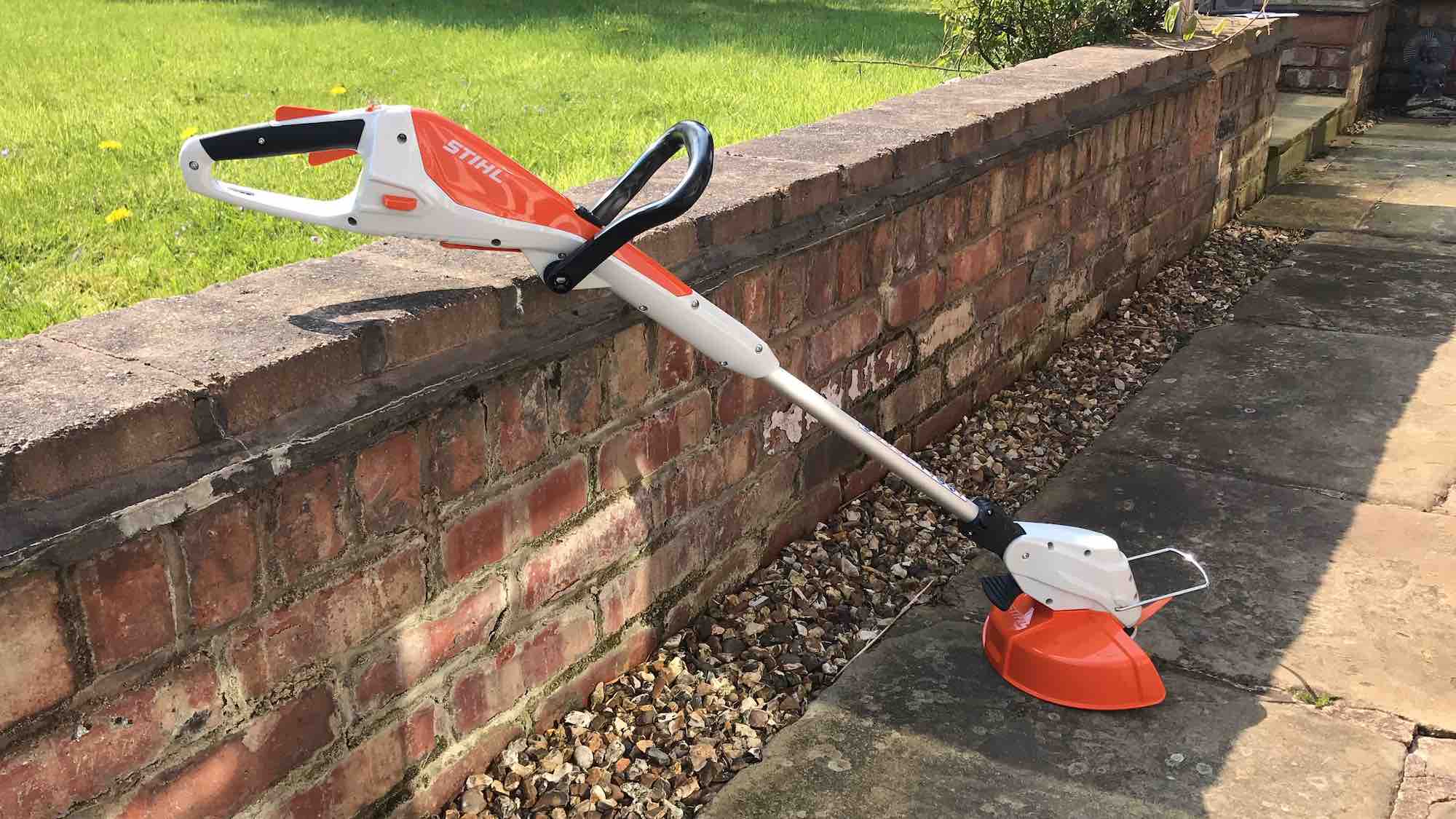
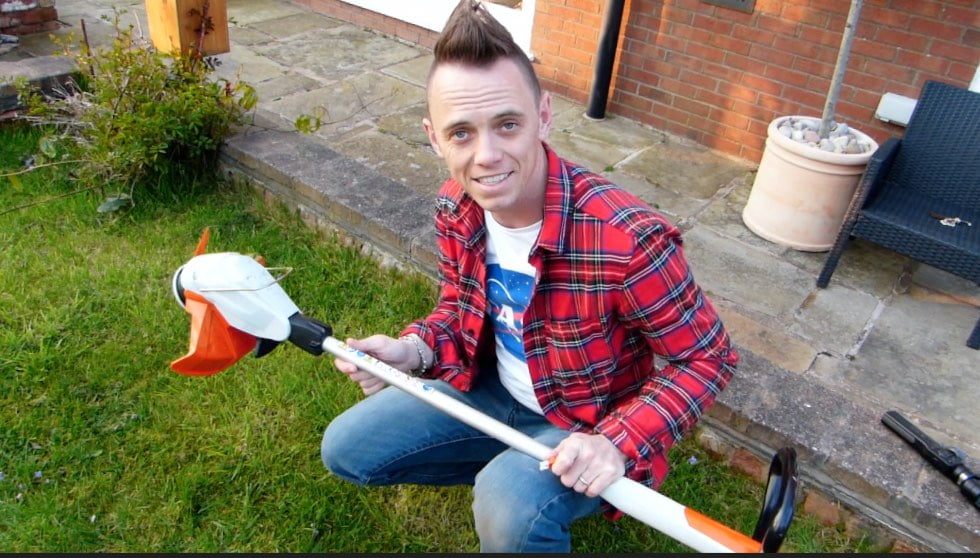
Testing the STIHL FSA 45 in my own garden. Here’s how it actually performed.
I first reviewed the STIHL FSA 45 when STIHL kindly gifted me the model to test. Since then I’ve used various STIHL models professionally and in my own garden, and the brand has continued to evolve its cordless range significantly. So in this updated review I want to revisit the FSA 45 with fresh eyes, put it in context of the full STIHL cordless strimmer lineup, and give you the honest professional opinion you need to choose the right tool for your garden. I wasn’t paid by STIHL for this review and never have been. Everything here is based on genuine hands-on experience.
This page contains affiliate links for products I use and love. If you take action (i.e. subscribe, make a purchase) after clicking a link, I may earn some gardening commission, which helps me keep the Garden Ninja Blog free for all.
STIHL FSA 45 Review: The Entry-Level Cordless Strimmer
The STIHL FSA 45 was my introduction to the brand’s cordless strimmer range, and it made an immediate impression. At just 2.3kg it’s genuinely lightweight, which matters more than most people realise when you’re working around borders for 20 minutes or more. Heavy strimmers cause arm fatigue quickly, and you end up rushing the job just to put the thing down. The FSA 45 never felt like a burden.
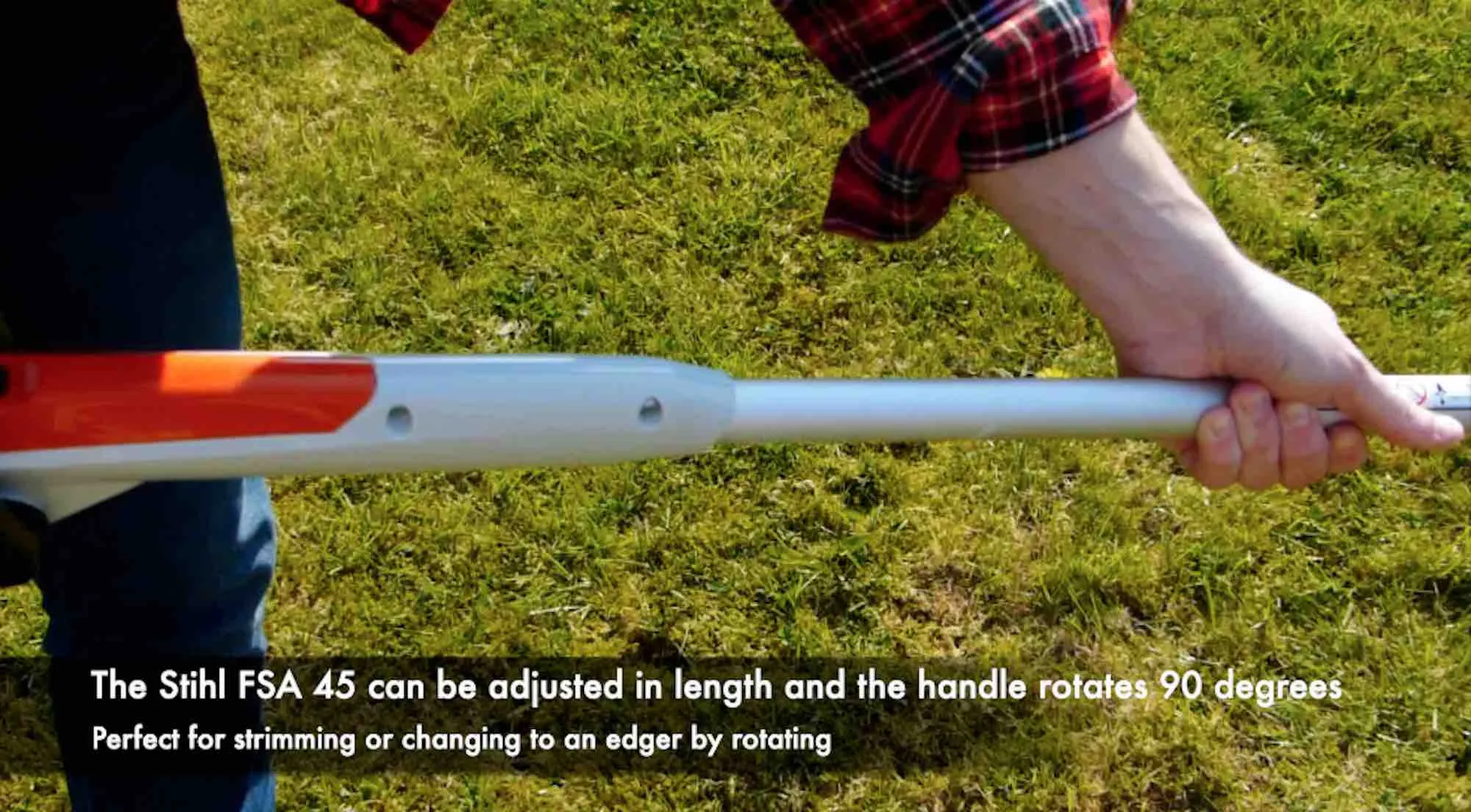
The first thing I noticed was how adjustable it is. The shaft extends from 1,100mm to 1,300mm, the main handle pivots to suit different angles, and the cutting head rotates 90 degrees for vertical edge cutting. As someone who is particular about adjustability in garden tools, this flexibility is genuinely useful rather than a marketing tick-box. Whether you’re trimming under a fence at an awkward angle or running a crisp vertical edge along a path, the FSA 45 adapts.
The adjustable shaft and handle pivot makes the FSA 45 genuinely versatile for different heights and tasks.
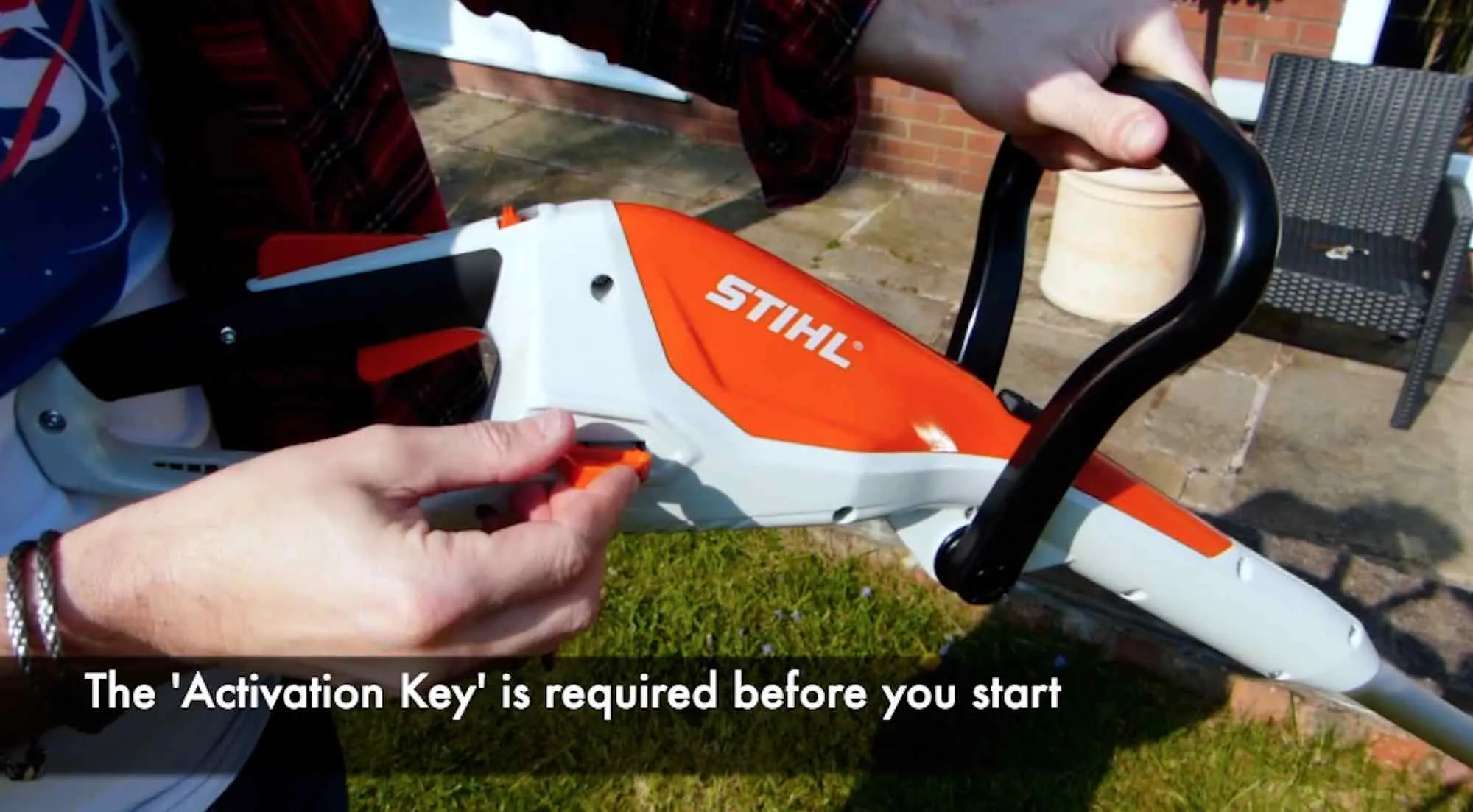
The safety ignition key is an interesting design choice. It slots into the side of the machine and the strimmer simply won’t start without it. I appreciate the thinking behind it, especially for households with children, though in practice most gardeners will leave it permanently in place. If you lose it you have a very quiet, very expensive garden ornament, so I’d recommend keeping a note of where to source replacements when you buy. A small lanyard or clip attachment would be an improvement STIHL could make here.
The safety ignition key is a sensible feature. Just don’t lose it.
Performance in the Garden
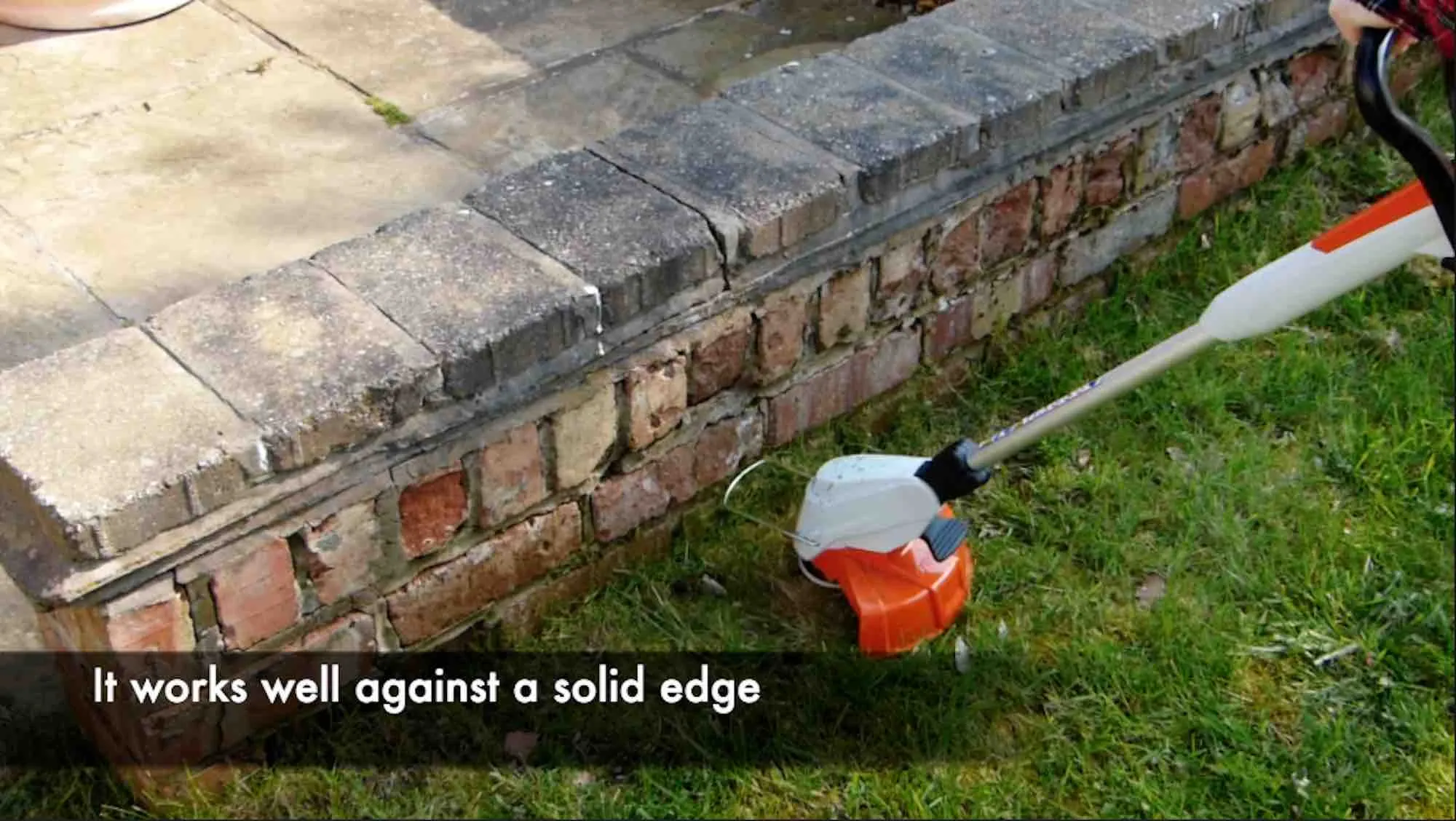
The FSA 45 uses STIHL’s PolyCut blades rather than traditional strimmer line, and this is where it distinguishes itself from many budget competitors. I tested it on a brick-edged lawn, which is notoriously hard on conventional line strimmers because the line shatters on contact with masonry. The FSA 45’s bump guard keeps the head just far enough from the brickwork to prevent blade destruction, and the result was a much cleaner edge than I expected from an entry-level model.
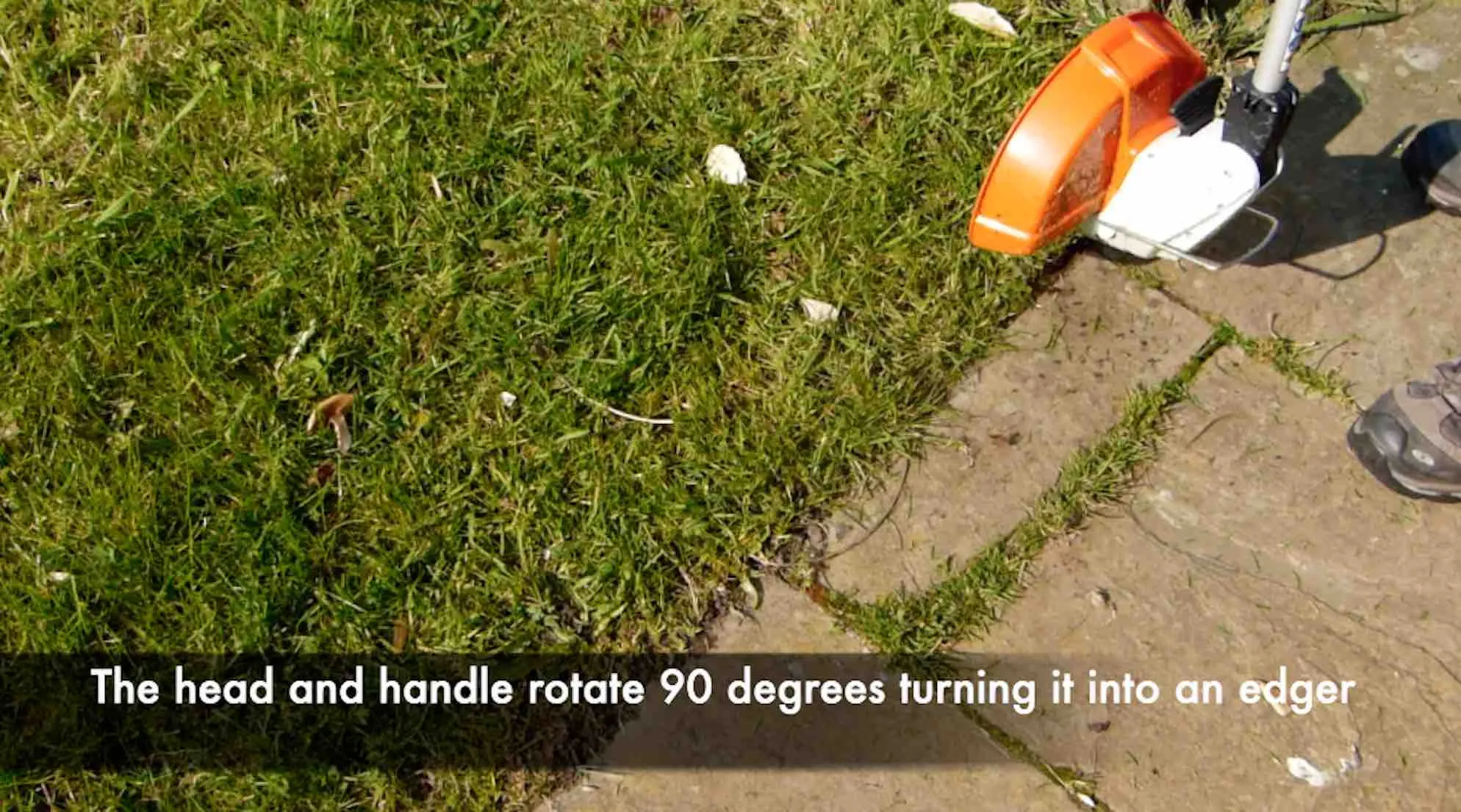
Where the FSA 45 genuinely surprised me was in vertical edge cutting. Flip the head 90 degrees, do the same with the handle, and you have an effective lawn edger that produces a sharp, defined grass line along paths and borders. In this configuration it actually outperforms its role as a conventional strimmer in my view. The blades produce a cleaner vertical cut than line does on most comparable machines.
Testing the FSA 45 for lawn edge cutting. The vertical configuration is particularly effective.
The 20-minute runtime from the integrated battery is, however, where the FSA 45’s main limitation shows itself. In a compact courtyard or small front garden this is adequate. For anything approaching a third of an acre, you’ll be going back and forth to the charger. The integrated battery design means you cannot swap in a fresh battery mid-job the way you can with STIHL’s AK-series models. This is a design decision STIHL has clearly made to keep costs down, and it means the FSA 45 is very deliberately a small-garden tool.
💡 Top Tip
Charge the FSA 45 the evening before you need it. The integrated battery charges like a phone so it’s easy to build into a routine. Don’t let it sit fully discharged for extended periods. Lithium-ion batteries prefer partial cycling to full drain-down.
The noise level is genuinely one of the FSA 45’s best features. At below 80dB it’s quiet enough for early morning use without disturbing neighbours, which is a real consideration in modern urban and suburban gardens. Petrol strimmers are a completely different story, and even many corded electric models produce more racket. STIHL’s cordless range consistently performs well on noise.
The Full STIHL Cordless Strimmer Range: Which Model Does What?
Since I first tested the FSA 45, STIHL has developed its cordless lineup into a genuinely comprehensive family of tools, from lightweight introductory models right through to machines that rival petrol strimmers in cutting power. Here is an honest breakdown of the current range and who each model suits.
STIHL FSA 30: The Ultra-Lightweight Option
The FSA 30 is STIHL’s lightest and most beginner-friendly strimmer. It uses the PolyCut 3-2 mowing head, runs on an integrated battery, and weighs in at under 2kg. For someone who finds garden tools physically demanding, a retirement gardener maintaining a small lawn, or a flat/apartment dweller with a balcony and a tiny patch of grass, the FSA 30 is hard to beat for sheer ease of use. It won’t tackle tough weeds or long grass with any conviction, but for regular maintenance of a small, well-kept lawn it does the job quietly and without fuss.
As reviewed in detail above. The best choice for a garden up to around 150 square metres, where you need more capability than the FSA 30 offers, but don’t want the complexity of a separate battery system. The blade-based cutting head is a genuine differentiator, making vertical edge cutting particularly effective. The 20-minute runtime is the main limitation, and it is a real one. Be honest with yourself about your garden’s size before committing.
STIHL FSA 56: The Step-Up Cordless Model
The FSA 56 is where STIHL’s range becomes genuinely compelling for a wider range of gardeners. It runs on the brand’s 36V AK battery system, which means you can buy additional batteries to swap mid-job, and the same batteries power other tools in STIHL’s AK lineup including hedge trimmers and leaf blowers. This interchangeability is a significant advantage if you’re building a cordless tool collection.
The FSA 56 weighs 3.2kg including battery and has a 280mm trimming circle. At around £200 with battery and charger included, it represents excellent value for what is genuinely a premium machine. It’s quiet enough for suburban use, handles most garden grass and light weeds without complaint, and the 20-minute runtime from the AK10 battery extends considerably if you upgrade to the higher-capacity AK20 or AK30. For most UK gardens between 150 and 400 square metres, the FSA 56 is the model I’d reach for first.
The FSA 60 R represents STIHL’s AK-series strimmer for gardeners with more ground to cover. It uses the same 36V battery system as the FSA 56 but with a larger 350mm cutting diameter, giving you a meaningfully wider swathe per pass. With the AK20 battery it delivers up to 30 minutes runtime, enough to comfortably maintain up to around 1,250 metres of lawn edge per charge according to STIHL’s own figures.
The FSA 60 R suits gardens between 300 and 600 square metres well, and with a spare AK20 battery you can cover considerably more before needing to wait for a charge. The loop handle design, aluminium shaft, and nylon line head (rather than blades) make it a more conventional strimmer experience than the FSA 45, but the cutting performance is noticeably stronger. For anyone who has been frustrated by the limitations of lighter consumer strimmers on thicker grass or weeds along borders, the FSA 60 R is a significant step up.
The FSA 80 R is where the STIHL cordless range crosses into genuinely professional territory. With a 380mm cutting width, 36V AK30 battery compatibility, and the ability to accept blade attachments for tackling brambles, woody weeds, and rough grass, it’s a machine that can handle conditions where other cordless strimmers struggle. Independent testers have found it capable of slicing through overgrown areas that would stop a standard consumer strimmer in its tracks.
For most domestic gardeners this is more machine than they need, and the price reflects that. But if you have a large plot with rough edges, an orchard, or areas that have been left unmanaged for a season, the FSA 80 R is the cordless tool that can genuinely replace a petrol strimmer. It runs at 75dB in Eco mode, which is remarkable for something with this level of cutting power.
This is one of the most common questions I get asked when people are buying a cordless strimmer, and it’s worth addressing properly because the answer affects which STIHL model makes sense for you. I’ve used both systems extensively and they each have genuine advantages.
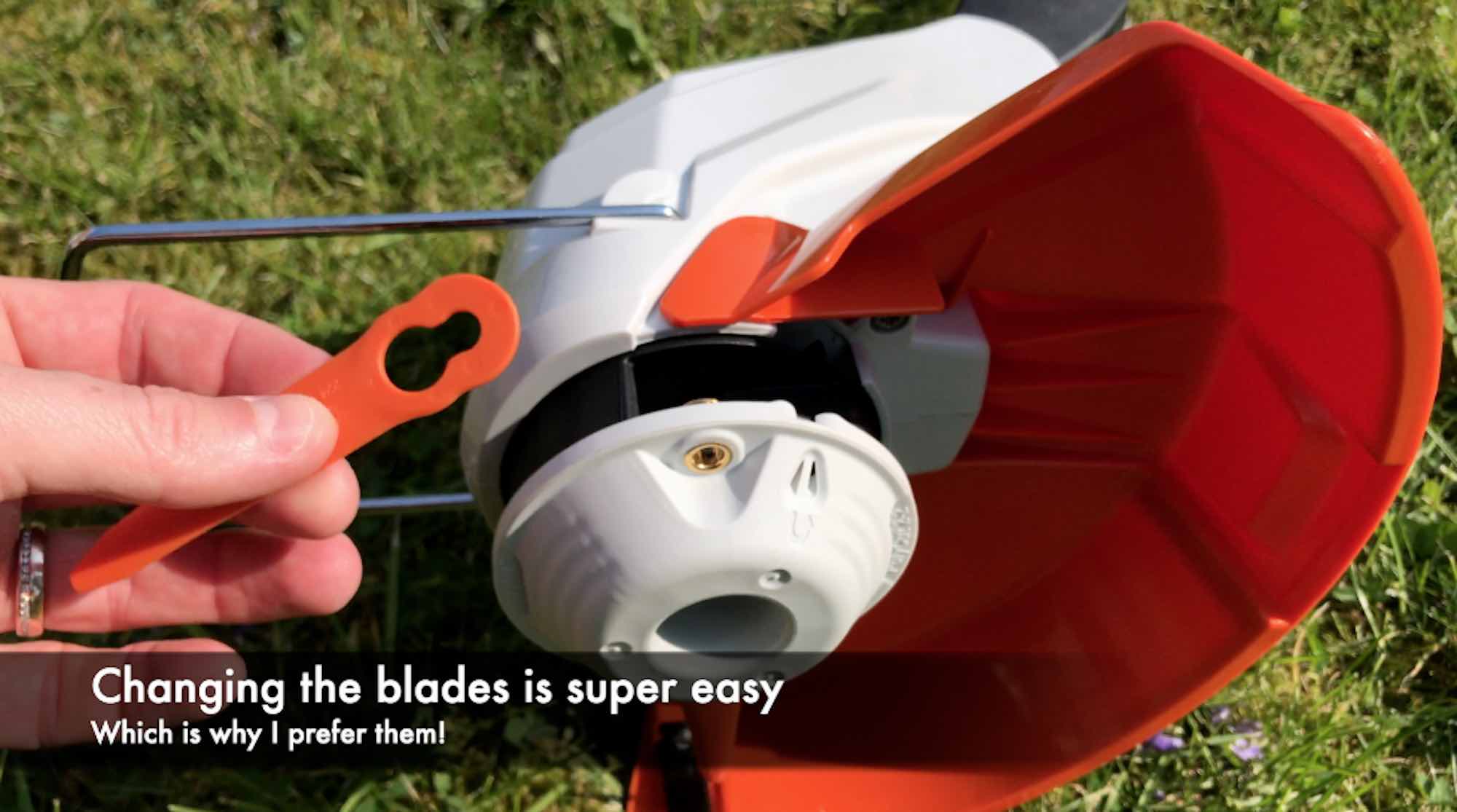
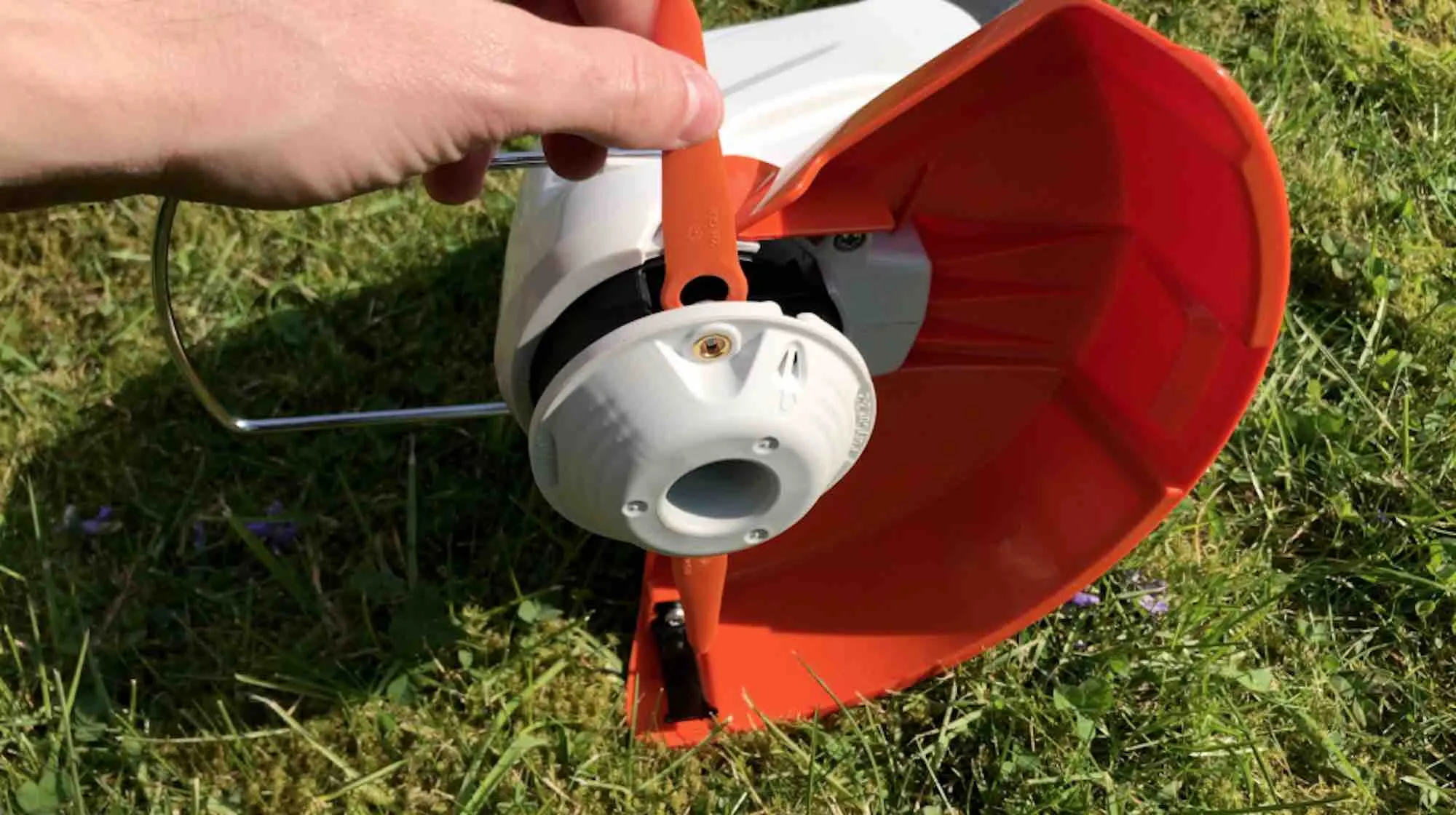
Changing PolyCut blades on the STIHL FSA 45. The tool-free system is quick and straightforward.
Strimmer line is the traditional choice and the one most gardeners are familiar with. Line works well on soft grass, feathers gently around obstacles, and is particularly effective on slopes or uneven ground where you need the head to follow the contours naturally. The main frustrations are the inevitable line breaks at inconvenient moments, the fiddly process of reloading the spool, and the tendency of line to shatter against hard surfaces. Good strimmer line wears faster than you expect and quality line is worth paying for.
Blades, as used on the FSA 45 and FSA 30, are more durable against hard surfaces and produce a cleaner cut for vertical edging work. The PolyCut system on STIHL’s entry-level models uses plastic blades that pop on and off without tools, and replacement blades are widely available. I genuinely prefer blades for edging work specifically because they maintain a more consistent cutting height along a path or bed edge. On the other hand, blades struggle more with thick, stemmy weeds and coarse grass than line does, and they don’t flex around obstacles in the same way.
My honest recommendation: if your primary use is lawn edge maintenance along paths, patios, and borders, consider the blade-based FSA 45. If you have more varied work including rough corners, longer grass, or weed patches around structures, the line-based FSA 56 or FSA 60 R will serve you better over the long term.
The PolyCut blades are stored neatly underneath the handle. Replacement blades are available from STIHL dealers and online.
One of the strongest reasons to invest in a STIHL strimmer rather than a cheaper alternative is the AK battery ecosystem that underpins the FSA 56, FSA 60 R, and FSA 80 R. The 36V lithium-ion batteries in the AK range are compatible across a significant number of STIHL cordless tools, which means a battery purchased for your strimmer can also power the STIHL cordless hedge trimmer, leaf blower, or even some models in the Compact Cordless lawn mower range.
This matters practically because it changes the economics of tool ownership over time. Rather than buying a complete kit with battery and charger for each new tool, you buy the tool as a bare unit and run it from batteries you already own. STIHL offers three battery capacities in the AK system: the AK10 (entry, lightest), the AK20 (mid-range, most versatile for domestic use), and the AK30 (highest capacity, longest runtime). For most gardens the AK20 hits the right balance between weight and runtime. The AK30 is worth considering if you have a large garden where stopping to swap batteries mid-job is frustrating.
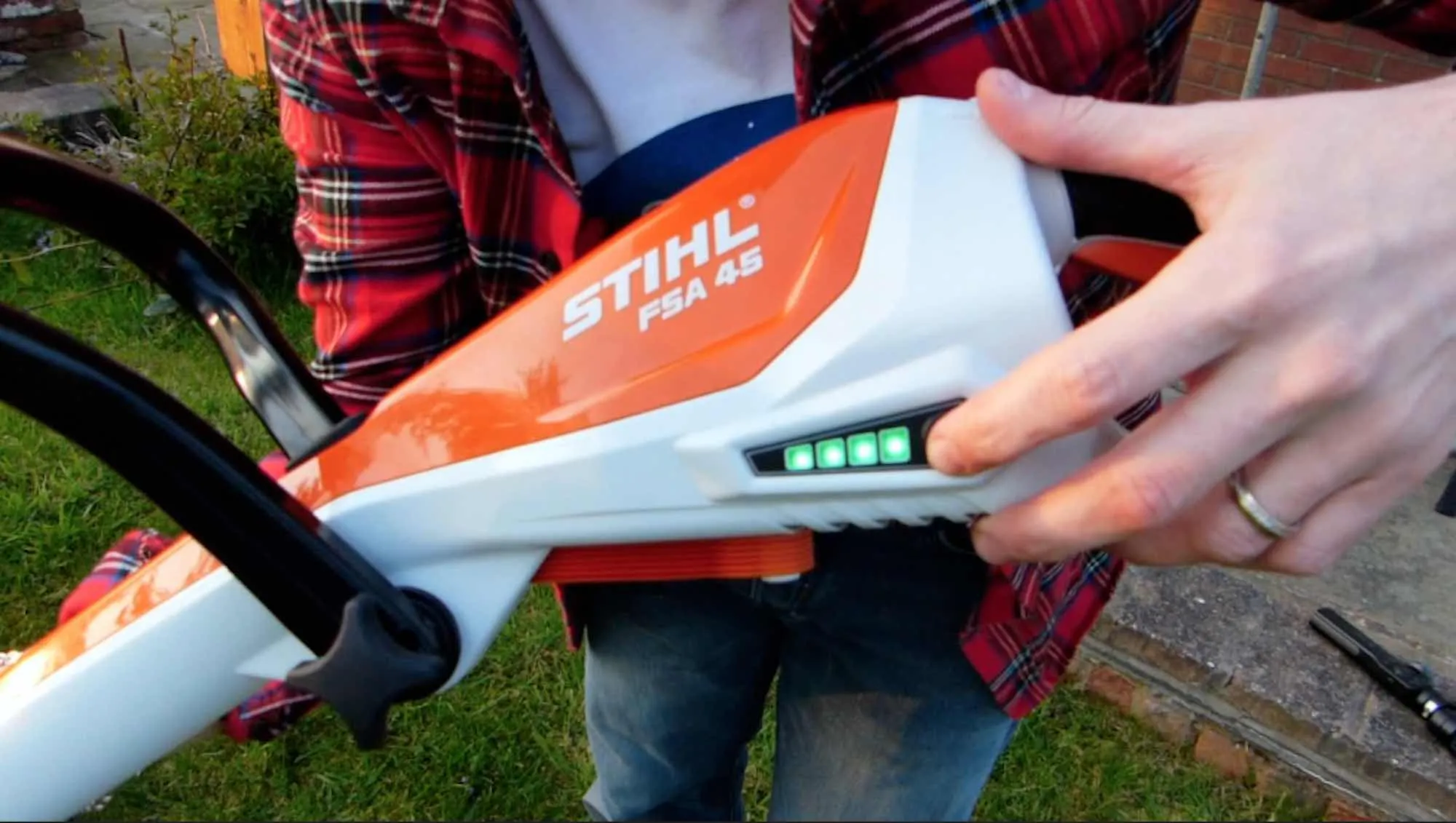
The LED charge indicator on the integrated battery models shows remaining power at a glance.
💡 Top Tip
If you’re considering multiple STIHL cordless tools, buying the FSA 56 or FSA 60 R as your first AK-system tool is a sensible entry point. You get a complete kit with battery and charger, and every subsequent STIHL AK tool you buy as a bare unit will run from your existing battery. The savings over time are substantial.
Choosing the right strimmer for your garden size is the most important decision in this whole process. An underpowered strimmer for a large garden is a recipe for frustration, and an oversized, heavy machine for a small courtyard is money wasted. Having designed gardens professionally for over 20 years, here is my honest guide based on typical UK garden sizes.
Small Gardens (Under 150m²)
This covers most terraced house rear gardens, courtyard gardens, and small front gardens. The STIHL FSA 45 is the model I’d recommend here without hesitation. The 20-minute integrated battery runtime is more than adequate, the blade system handles edge work brilliantly, and the overall package is lightweight enough to grab and use without any preparation. At this garden size the integrated battery is a feature rather than a limitation because you’ll finish the job before the charge runs out.
Medium Gardens (150–400m²)
This is the most common garden size in the UK, covering the average semi-detached property with a back lawn of reasonable size. The FSA 56 is the natural choice. You’ll appreciate the swappable AK battery because longer border runs or more complex lawn shapes will push against 20 minutes, and the slightly wider 280mm cutting diameter means fewer passes along longer edges. For gardens at the upper end of this range, buying a second AK battery gives you uninterrupted working time.
Large Gardens (400m² and Above)
For larger plots, rural gardens, or properties with significant lawn area, the FSA 60 R or FSA 80 R are the models to consider. The wider cutting head means you cover more ground per pass, the longer AK30-powered runtime means fewer interruptions, and the build quality on both models handles the kind of sustained use a large garden demands. If your garden also includes rough grass, wild margins, or areas with brambles and coarse weeds, the FSA 80 R with blade attachments is genuinely in a different class to anything else in the cordless market.
Getting the Best from Your STIHL Strimmer: Edging Technique
A good strimmer in untrained hands will still produce a ragged result, so it’s worth understanding the basic technique that gets the most out of whichever STIHL model you choose. This is something I’ve demonstrated on BBC Garden Rescue and in my own client gardens many times, and the principles are consistent regardless of which machine you’re using.
The vertical edging position. Rotate the head 90 degrees for clean, defined lawn edges along paths.
For horizontal trimming along fence lines and under borders, keep the head tilted at a slight angle rather than perfectly flat. This avoids scalping the grass immediately adjacent to the fence and produces a gradient rather than a hard line, which looks more natural. Walk steadily and don’t rush. A consistent walking pace produces a far neater result than stop-start movement.
For vertical edge cutting along paths, patios, and driveways, rotate the head 90 degrees as mentioned above and walk with the edge of the cutting circle just inside the lawn surface. Let the bottom of the rotation do the work rather than pressing the tool into the ground. This takes a little practice to get right but once you have the feel for it the results are genuinely impressive. Done well, a strimmer edge rivals the sharpness of a half-moon edging iron.
⚠️ Safety Warning
Always wear eye protection when strimming. Blades and line both throw debris at speed, and even plastic PolyCut blades can project small stones or soil fragments. Safety glasses should be treated as non-negotiable, not optional. Steel-toecap footwear is also recommended when using more powerful models.
Before starting any strimming session, clear the area of stones, gravel, children’s toys, and any other objects that could be picked up and propelled by the cutting head. This is particularly important for blade-based models because blades project objects more forcefully than line does. Walk the area first and remove anything that shouldn’t be there.
STIHL vs the Alternatives: Is the Premium Worth It?
STIHL sits at the premium end of the cordless strimmer market, and it’s a fair question whether that premium is justified when there are cheaper alternatives from Bosch, Ryobi, Worx, and others. Having used tools from all of these brands professionally and personally, here is my honest assessment.
The quality difference between STIHL and budget alternatives is most apparent in build longevity and cutting consistency. A £40 budget strimmer will cut grass, but after two seasons of regular use the cutting head develops play, the adjustment mechanisms loosen, and the line or blade system becomes unreliable. STIHL tools are built to be repaired by authorised dealers rather than discarded when something wears, which changes the true cost of ownership calculation significantly if you plan to use the tool for more than a few years.
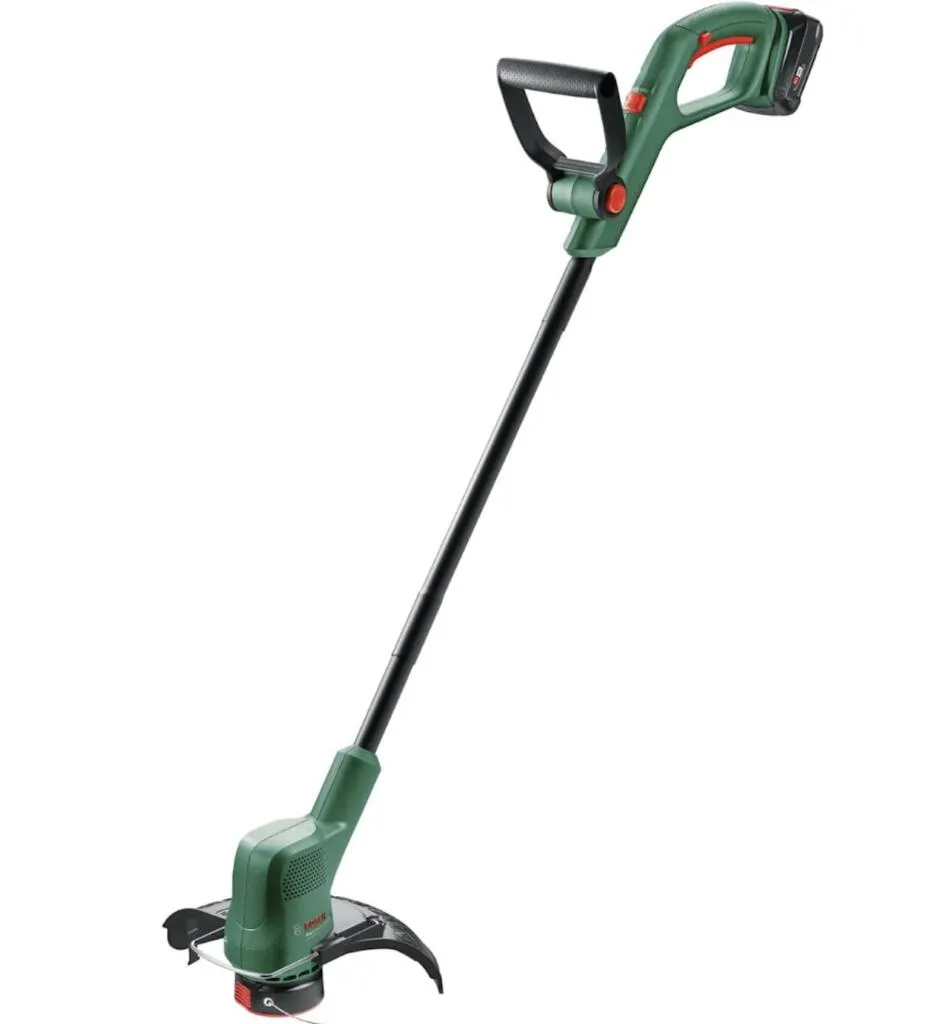
Bosch is the strongest mid-market alternative. The UniversalGrassCut range is genuinely good at its price point, especially for small gardens, and the EasyGrassCut series is very capable for light use. Ryobi’s ONE+ system offers excellent battery interchangeability across a wide tool range at lower cost than STIHL’s AK system. If budget is the primary constraint and you’re happy to replace a cheaper strimmer every three to five years, the Ryobi or Bosch options are perfectly adequate.
But for gardeners who want a tool that will still perform exactly the same in ten years as it does today, that can be taken to a local STIHL dealer for a blade sharpening, line head service, or battery health check, and that holds its value far better than budget alternatives, STIHL is worth the investment. The FSA 56 in particular is a machine that most domestic gardeners will likely never need to replace if they look after it properly.
A good cordless strimmer will serve you well for many years with minimal maintenance, but a little care at the right times makes a real difference to long-term performance. These are the habits worth building in from day one.
After every use, knock the cutting head against the ground to clear grass clippings from around the blades or line head, then wipe down the guard and shaft with a damp cloth. Grass juice is surprisingly corrosive on plastic components over time, and cleaning it off after each session is genuinely worth the 30 seconds it takes. For blade-based models, remove the blades periodically and check for cracks or chips. Cracked blades should be replaced immediately.
For line-based models, keep a spare pre-wound spool in your shed. Running out of line mid-job and having to hand-wind a replacement is one of gardening’s more tedious interruptions. Most STIHL dealers stock pre-wound spools that drop straight in, and STIHL’s AutoCut heads make line replacement a much more straightforward task than older designs.
Battery care is particularly important for lithium-ion models. Don’t store batteries fully discharged for extended periods, especially over winter. A 40–60% charge level is the ideal storage state for lithium-ion batteries. Store them at room temperature rather than in a cold garage or shed because extreme cold degrades capacity faster. If you’re not using the strimmer for a month or more, bring the battery inside.
The FSA 45 is still available through STIHL dealers and online retailers, though some sources list it as a model that may be phased out as the FSA 56 becomes the primary entry point for the AK-system range. If you’re looking at the FSA 45, check availability from your local STIHL dealer. The FSA 56 is the more future-proof choice if you’re buying new today.
How long does the STIHL battery last before needing replacing?
STIHL’s lithium-ion batteries are rated for approximately 500 full charge cycles before significant capacity degradation. With typical domestic use of once a week during the growing season, that represents a working life of many years. Battery health is also more dependent on storage conditions than on use frequency. Keeping batteries at room temperature and avoiding both full discharge and overheating will extend their useful life considerably.
Can you use STIHL AK batteries with other brands?
No. STIHL’s AK battery system is proprietary to STIHL tools. The 36V AK batteries are not cross-compatible with Bosch, Ryobi, or other brands’ battery systems. This is both a strength (consistently optimised for STIHL tools’ performance) and a limitation (you’re committing to the STIHL ecosystem). If you already have a large collection of Ryobi ONE+ or Bosch 18V batteries, it may be worth considering whether staying within that ecosystem makes better financial sense.
What is the difference between a strimmer and a brushcutter?
A strimmer (or grass trimmer) uses nylon line or plastic blades to cut soft grass and light weeds. A brushcutter uses metal blades or heavy-duty line to cut thick weeds, brambles, and woody growth. STIHL’s FSA 45 and FSA 56 are primarily strimmers, while the FSA 80 R with blade attachments crosses into brushcutter territory. For most domestic UK gardens a strimmer is all you need. Brushcutter power is necessary for rough vegetation management or heavy-duty clearing.
Is a cordless strimmer as powerful as a petrol strimmer?
For domestic garden use, yes. STIHL’s FSA 60 R and FSA 80 R deliver cutting performance that rivals most entry-level petrol strimmers, without the engine noise, exhaust fumes, fuel mixing, and warm-up time. Professional groundsmen working all day in demanding conditions will still reach for petrol, but for a domestic gardener maintaining a UK garden the cordless models are genuinely comparable and significantly more pleasant to use.
Where can I buy STIHL strimmers in the UK?
STIHL tools are sold through authorised STIHL dealers rather than large DIY chains like B&Q or Wickes. This is a deliberate brand policy and is part of why STIHL quality remains consistently high. You can find your nearest dealer through the STIHL UK website. Many STIHL models are also available through Amazon UK and specialist garden machinery retailers online.
Transform Your Garden Knowledge with Garden Ninja’s Expert Resources
Ready to elevate your gardening beyond basic tasks? My comprehensive online courses provide the expertise to transform you from enthusiastic beginner to confident garden creator.
With courses starting from just £29, you gain access to award-winning design knowledge.
29
Garden Design Examples for Small Gardens: 30 Design Templates & Planting Plans
Garden Design Examples for Small Gardens: 30 Design Templates & Planting Plans: In this online gardening course, I’ll walk you through 30 fantastic garden designs, explaining the logic behind the layout, the plant choices, and take-home tips for applying them in your own garden.
Weekend Garden Makeover: A Crash Course in Design for Beginners
Learn how to transform and design your own garden with Lee Burkhills crash course in garden design. Over 5 hours Lee will teach you how to design your own dream garden. Featuring practical design examples, planting ideas and video guides. Learn how to design your garden in one weekend!
Garden Design for Beginners: Create Your Dream Garden in Just 4 Weeks
Garden Design for Beginners Online Course: If you want to make the career jump to becoming a garden designer or to learn how to design your own garden, this is the beginner course for you. Join me, Lee Burkhill, an award-winning garden designer, as I train you in the art of beautiful garden design.
The STIHL FSA 45 remains a genuinely excellent small-garden strimmer with particular strengths for vertical edge cutting, quiet operation, and lightweight handling. Its integrated battery is a limitation for larger plots but a non-issue for the garden sizes it’s designed for.
For most UK gardeners buying new today, the FSA 56 with its swappable AK battery and ecosystem compatibility is the model I’d recommend as the best all-round starting point. Step up to the FSA 60 R for larger gardens, and consider the FSA 80 R only if you have serious clearing work to tackle alongside regular trimming.
Whichever model you choose, STIHL’s build quality means you’re making an investment that should outlast several cheaper alternatives over the same period.
Your subscription could not be saved. Please try again.
Your subscription has been successful.
Lee Burkhill
Lee Burkhill, known as the Garden Ninja, is an award-winning garden designer and horticulturist with over 30 years of gardening experience and 15 years as a professional garden designer. A qualified RHS (Royal Horticultural Society) professional, Lee specialises in sustainable garden design and practical horticultural advice. He designs and presents on BBC1’s Garden Rescue and in leading gardening publications. Lee combines three decades of hands-on gardening knowledge with professional design qualifications to help gardeners create beautiful, functional outdoor spaces.