For the garden you’ve already got, not the one you’re starting from scratch. Seven checklists and video lessons from BBC Garden Rescue’s Lee Burkhill, designed to help you decide what’s worth keeping before you spend a penny.
69
Quick answer: A modern garden comes down to restraint. Use clean, straight lines that take their scale from the house, one or two hard landscaping materials such as porcelain or sawn stone, and plants repeated in blocks rather than dotted about. Add rendered walls or Corten steel for structure, light it well and keep the number of features small.
Modern garden design is one of the styles I get asked about most, and it suits the way a lot of us live now. If you like clean lines, a calm palette and planting that makes an impact without a lot of fuss, a modern garden can turn even a small, overlooked plot into a space that feels like another room of the house.
From designing gardens for clients and on Garden Rescue, the modern schemes that work best are rarely the most expensive. They’re the ones where every choice has a reason behind it. In this guide I’ll take you through the ideas I use myself, from layout and materials to planting, lighting and privacy, along with the mistakes that make a garden look dated or cheap. There’s a real before and after from one of my own projects further down too.
Jump To
This page contains affiliate links. If you’re after one quick upgrade that instantly reads as modern, a Corten steel water bowl is the feature I come back to again and again, and if you buy through my links I may earn a small commission, which helps keep the Garden Ninja blog free.
A modern garden is defined more by what you leave out than what you put in. Where a cottage garden takes you on a journey through dozens of plants and textures, a modern scheme strips everything back to a few strong elements and repeats them. That restraint is harder than it sounds, because every material and plant has to earn its place.
In practice, nearly every successful modern garden I’ve designed shares the same five ingredients:
People often use modern and contemporary as if they mean the same thing. Strictly speaking, modernist design comes from the early twentieth century and the Bauhaus idea that form follows function, while contemporary simply means current. In a garden the two overlap so much that I treat them together, and the ideas below work for both.
“Clean lines” has become a bit of a buzzword in garden design, so I want to clear up what it actually means. It refers to definite lines, and those can be straight or curved. A perfect circle of paving or a bold, sweeping arc is just as modern as a rectangle. What isn’t modern is the weak, wavy edge that appears when someone decides to soften a lawn with a half-moon edger and ends up with wobbly curves all over the garden.
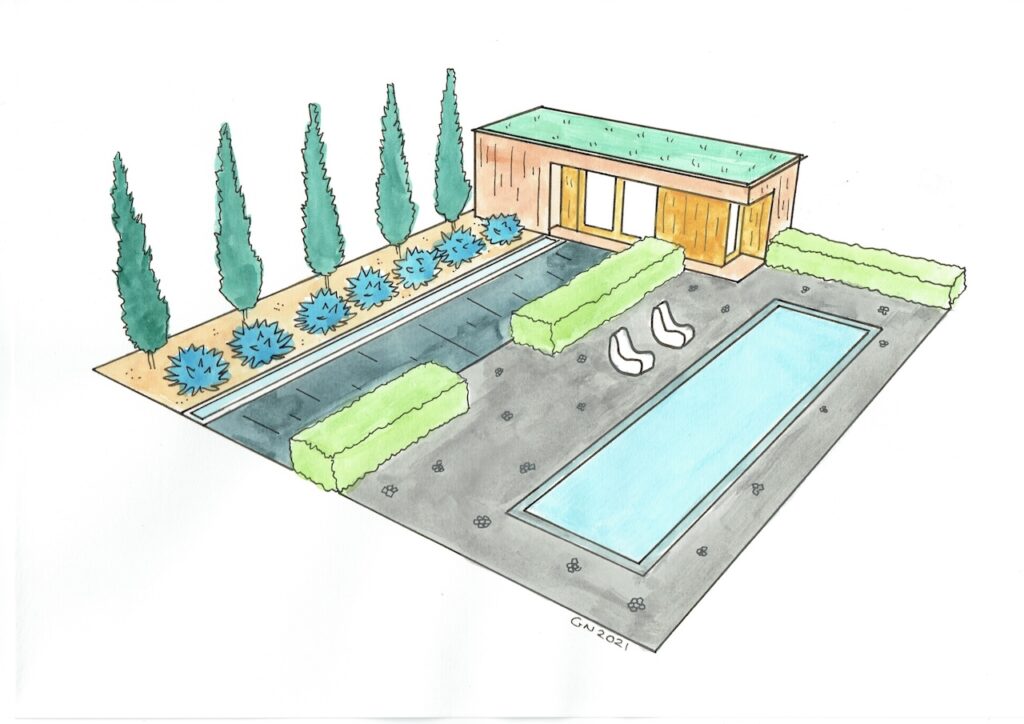
The easiest way to get the geometry right is to take your measurements from the house. I use the width of the patio doors, the line of a window or the corner of an extension to set the size of the terrace and the position of paths. Lines that start at the house make the garden feel designed for that building, which is the difference between a modern garden and a collection of modern products. On smaller plots this is especially useful, because the house dominates the view and the garden needs to sit comfortably with it.
Keep the layout simple. One or two well-proportioned spaces, such as a terrace and a lawn or a gravel garden, will always look more modern than five small zones squeezed into the same area. If you’re working with a blank plot, my guide to designing a small garden walks through measuring up and planning the layout step by step.
Paving does more to set the style of a modern garden than anything else, simply because there’s so much of it. Large-format slabs laid in a straight stack or a long running bond give that crisp look straight away, and porcelain, sawn sandstone and granite are the materials I specify most for modern schemes. Avoid riven finishes, random patterns and anything with a lot of colour variation, as these pull the look back towards a traditional garden.
Here’s how the main modern paving options compare, using the same typical supply prices I quote in my new build garden guide:
| Material | Modern Look | Typical Cost per m² | Maintenance | Best For |
|---|---|---|---|---|
| Porcelain | Very crisp, uniform colour | £40 to £90 | Very low, wipes clean | Terraces next to the house |
| Sawn sandstone | Smooth, natural, slight variation | £35 to £80 | Low, occasional sealing | A softer modern look |
| Concrete slabs | Clean if you choose smooth, plain units | £12 to £35 | Medium, can stain and grow algae | Tight budgets and paths |
| Composite decking | Linear and warm | £40 to £130 | Low, an annual clean | Raised areas and level changes |
| Gravel | Textured and calm | £5 to £20 | Low with a membrane and edging | Gravel gardens and paths |
Whatever you choose, use it consistently. On one of my new build projects the same grey porcelain runs from the terrace through every path, and that single decision does more to make the garden feel joined up than any feature in it. If you want contrast, use one accent material in a small dose, such as a band of gravel or a strip of black slate, rather than mixing three or four types of slab.
Edging matters too. A crisp metal edge between lawn and border or gravel and planting keeps lines sharp for years, where a cut turf edge slowly creeps out of shape.
🛒 Find Corten steel lawn edging on Amazon UK
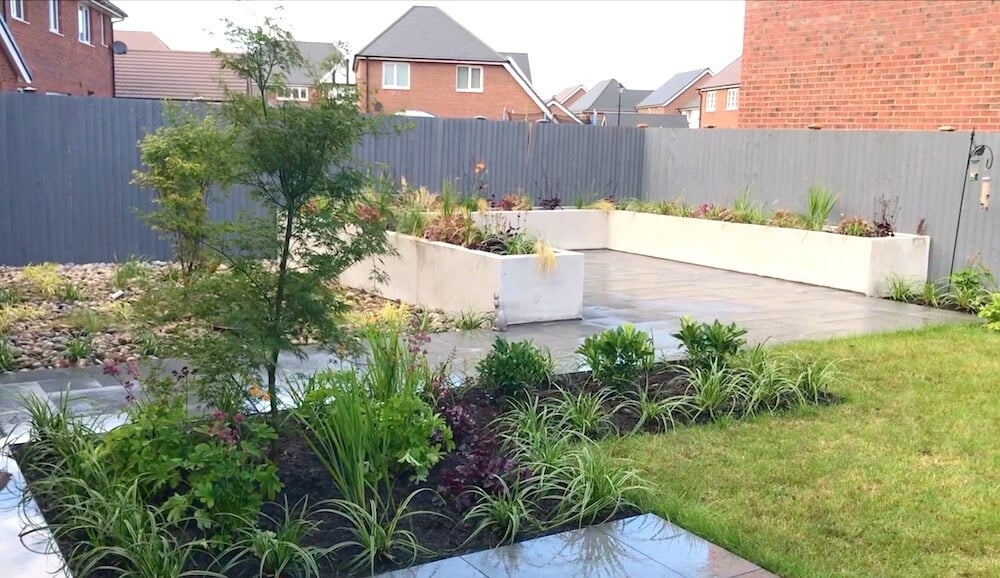
Built structure gives a modern garden its bones. Rendered block walls and raised beds are one of my favourite tools, because they create height, hide awkward boundaries and give you somewhere to perch, all in one clean shape. Painted in a soft white, grey or charcoal to pick up on the house, they look sharp all year and frame the planting beautifully.
Raised beds also solve practical problems. They lift planting closer to eye level in a small garden, give you better soil where the ground is poor or full of builder’s rubble, and make maintenance far easier on the back. Built at around 45cm high with a wide coping, they double as seating for when friends come round.
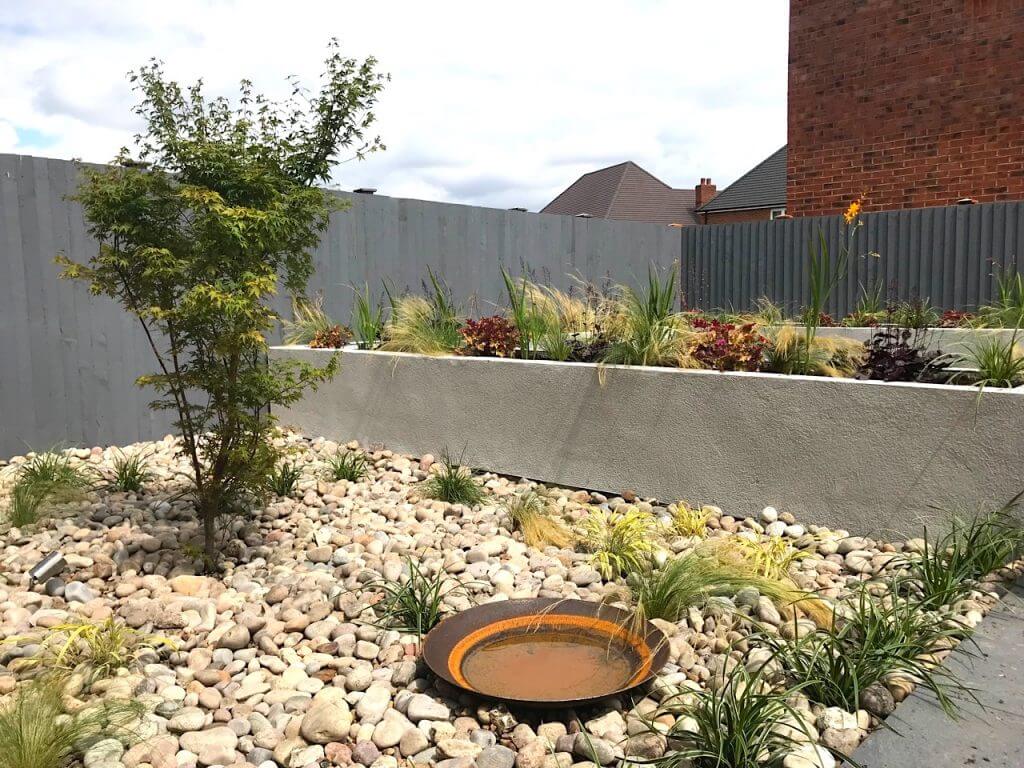
Corten steel is the other material I reach for. It weathers to a warm rust colour that sits brilliantly against grey paving and green planting, and it works as edging, planters, screens and water bowls. A single Corten bowl in a bed of cobbles is one of the simplest ways to add a focal point, and it doubles as a drinking spot for birds.
🛒 Buy a Corten steel water bowl from Amazon UK
Modern planting is about impact through repetition. Instead of one of everything, choose a handful of plants and plant each in generous groups, then repeat those groups across the garden. I usually pick plants for three jobs: one or two for height, a couple for texture and one or two for colour. That might be a multi-stemmed tree, a tall grass, a low evergreen and a single flowering perennial, and that’s enough for a whole garden.
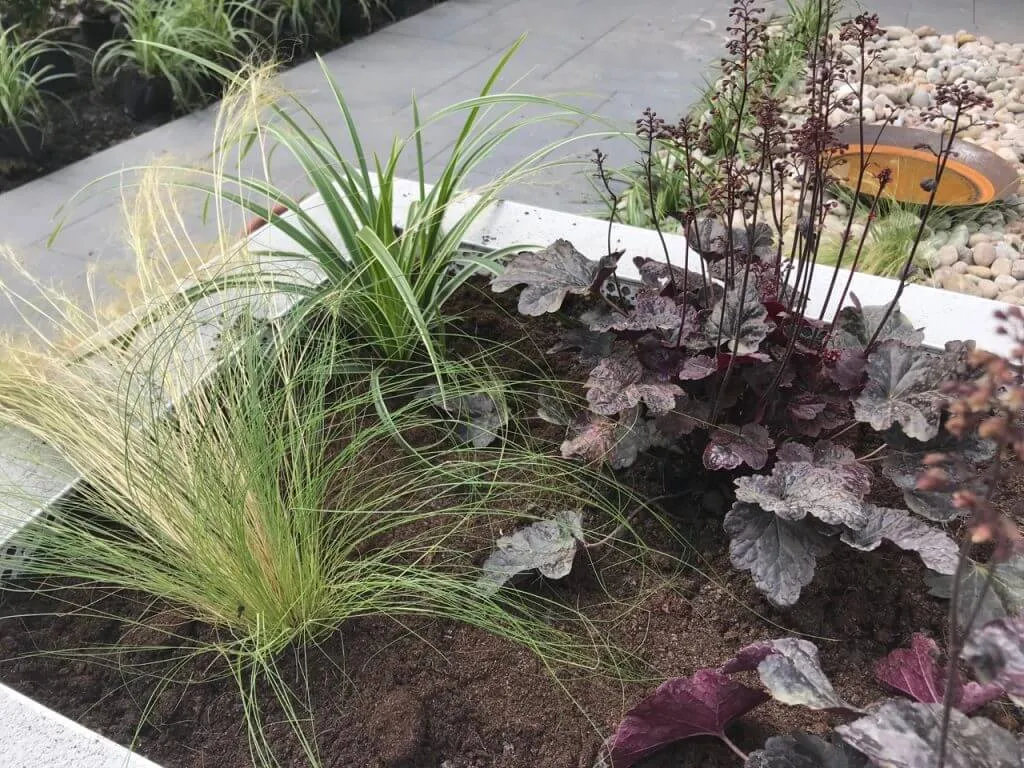
Block planting is also easier to look after. When a group of the same plant flowers and fades together, the next block takes over, and the border keeps its shape, so you’re not deadheading individual plants all summer. Ornamental grasses are perfect for this, as they hold their form through winter and move beautifully in the wind. My guide to ornamental grasses has the ones I use most.
Colour-wise, keep it restrained. Greens with silver, white or one strong accent such as purple or burnt orange will always look more modern than a mixed rainbow. Evergreens give you structure through the winter months, so make sure at least a third of the planting holds its leaves, and my list of essential evergreen shrubs is a good place to start.
These are the plants I use most in modern gardens. Every one has a strong shape or texture that holds up when planted in repeated groups, and the hardiness ratings are taken from the RHS, where H4 is hardy through an average UK winter and H7 is very hardy.
| Plant | Type | RHS Hardiness | Typical Height | Why It Works | Where to Buy |
|---|---|---|---|---|---|
 Betula utilis var. jacquemontii (Himalayan Birch) Betula utilis var. jacquemontii (Himalayan Birch) | Tree | H7 | 8 to 12m, smaller if multi-stemmed | Bright white bark, lovely as a multi-stemmed specimen | Buy from Crocus |
 Acer palmatum (Japanese Maple) Acer palmatum (Japanese Maple) | Small tree or shrub | H6 | Varies by cultivar, often 1 to 4m in gardens | Sculptural shape and autumn colour | Buy from Crocus |
 Ilex crenata (Japanese Holly) Ilex crenata (Japanese Holly) | Evergreen shrub | H6 | Clip to any size | Box alternative for balls, cubes and low hedges | Buy from Crocus |
 Pittosporum tenuifolium ‘Golf Ball’ Pittosporum tenuifolium ‘Golf Ball’ | Evergreen shrub | H4 | 0.5 to 1m | Naturally neat domes with no clipping | Buy from Crocus |
 Calamagrostis × acutiflora ‘Karl Foerster’ Calamagrostis × acutiflora ‘Karl Foerster’ | Ornamental grass | H6 | 1.5 to 2m | Upright and architectural through winter | Buy from Crocus |
 Stipa tenuissima (Mexican Feather Grass) Stipa tenuissima (Mexican Feather Grass) | Ornamental grass | H4 | 0.5 to 0.6m | Soft movement against hard materials | Buy from Crocus |
 Hakonechloa macra (Japanese Forest Grass) Hakonechloa macra (Japanese Forest Grass) | Ornamental grass | H7 | 0.3 to 0.5m | Flowing mounds for shade and edges | Buy from Crocus |
 Ophiopogon planiscapus ‘Nigrescens’ (Black Mondo Grass) Ophiopogon planiscapus ‘Nigrescens’ (Black Mondo Grass) | Evergreen perennial | H5 | Up to 0.2m | Near-black foliage, superb against pale paving | Buy from Crocus |
 Lavandula angustifolia ‘Hidcote’ (Lavender) Lavandula angustifolia ‘Hidcote’ (Lavender) | Evergreen shrub | H5 | Up to 0.5m | Neat rows, scent and pollinators | Buy from Crocus |
 Trachelospermum jasminoides (Star Jasmine) Trachelospermum jasminoides (Star Jasmine) | Evergreen climber | H4 | Several metres on a wall or wires | Glossy green screen with scented summer flowers | Buy from Crocus |
Box has fallen out of favour because of box blight and box tree caterpillar, which is why I now use Ilex crenata for clipped shapes in almost every modern garden. For more ideas that look after themselves, my low-maintenance garden plants guide covers a wider range.
Most modern gardens, particularly on new builds and in towns, are overlooked, and the instinct is to put up the tallest fence allowed. In my experience that makes a small garden feel boxed in and darker. A better approach is to screen at the height that matters, usually just above head height where the neighbours’ windows are, and keep the lower boundary lighter.
Pleached trees are my first choice for this. They give you a clipped green screen on clear stems, block the view without blocking all the light and look smart in every season. My pleached trees guide covers planting and support in detail. Horizontal slatted fencing in timber or composite also suits a modern garden well, especially when it’s stained a dark colour so the planting stands out against it.

Inside the garden, a rendered wall, a slatted screen or a row of tall grasses can create a hidden seating area that feels private even when it isn’t fully enclosed. On one of my projects the seating terrace sits behind a raised rendered bed in the back corner, and it’s the one spot in the garden where nobody can see in.
Lighting is what turns a modern garden into an evening room, and it’s one of the features clients thank me for most once the garden is finished. The aim is to light objects rather than flood the space: uplight a multi-stemmed tree, wash light across a rendered wall, or set small lights into the face of steps and raised beds. A few well-placed fittings will look far more modern than a string of lights along every edge.
For anything wired, a low-voltage system is the easiest to install and adjust, and it’s worth running the cable before the paving goes down so the fittings can sit neatly within the design. Recessed lights in the paving around a terrace look especially sharp. Solar lights are fine for marking a path, but they rarely give enough light to pick out a feature.
🛒 Shop low-voltage garden spotlights on Amazon UK
Water fits naturally into a modern garden as long as the shape is simple. A still Corten or stone bowl, a rectangular rill or a formal raised pool all suit the style, and reflective water brings light into a shady corner. Moving water from a simple spout adds sound that helps mask traffic and neighbours.
Even a shallow bowl brings wildlife into the garden, which is one of the reasons I include water in almost every scheme. If you’d like to build something bigger, my pond and water feature guide takes you through it from digging to planting.
Small gardens suit the modern style better than almost any other, because restraint and repetition stop a small space from feeling cluttered. The rules tighten up a little, though. Stick to one paving material, keep the planting palette to five or six plants, and use built-in seating on raised bed walls rather than freestanding furniture that eats into the floor space.
Go vertical where you can. A climber such as Star Jasmine trained on horizontal wires turns a bare fence into a green wall, and a single multi-stemmed tree gives height without casting heavy shade. Large-format paving also helps, as fewer joints make a small area look bigger. For terraced and town plots, my townhouse garden design guide goes into layouts in more depth.
A modern look doesn’t need premium materials. Plain, smooth concrete slabs laid in a tight grid can look surprisingly sharp, gravel with a crisp steel or timber edge is one of the cheapest ways to cover ground, and painting existing fences a dark charcoal instantly makes planting pop. Railway sleepers laid flat or stacked make simple raised beds at a fraction of the cost of render.
The biggest saving comes from planning. Draw the layout first, then build it in phases, starting with the hard landscaping and adding the trees, lighting and water as budget allows. Buying plants in smaller pot sizes and planting in autumn also saves a great deal, as I explain in my guide to designing a garden on a budget.
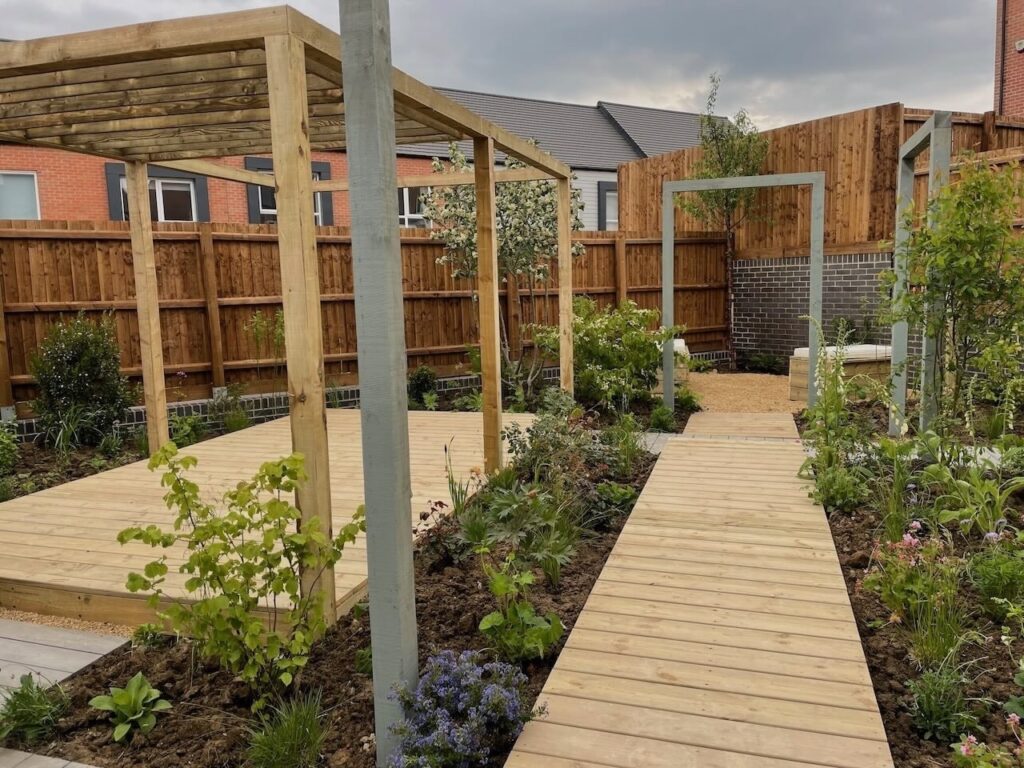
Some people avoid modern design because they picture cold grey paving and little else. Warmer materials work just as well. Pale timber decking and boardwalks, a simple timber pergola and soft planting give a Scandi feel that still follows the same rules of clean lines and repetition.
Japanese and Chinese gardens share a lot with modern design too, with their focus on simplicity, raked gravel, water and carefully placed plants. If that appeals, have a look at my Japanese garden design tips and my Chinese garden design guide.
A modern garden is one of the easiest styles to keep looking good, which is why it suits so many busy clients. Hard landscaping does a lot of the work, block planting hides the odd tired plant, and evergreen structure means the garden never looks bare. Most of my modern schemes need little more than a cut back of the grasses in late winter, a trim of the clipped shrubs once or twice a year and a sweep of the paving.
To keep the workload down, mulch the borders with bark or gravel after planting to suppress weeds, choose plants that suit your soil and aspect so they don’t struggle, and swap a small, awkward lawn for paving or gravel if mowing it is a chore. Plan an automatic drip line into raised beds and pots at the build stage, because raised beds dry out faster than borders in summer. Avoid artificial grass, though. It gets hot, does nothing for wildlife and rarely looks as crisp after a few years as people expect.
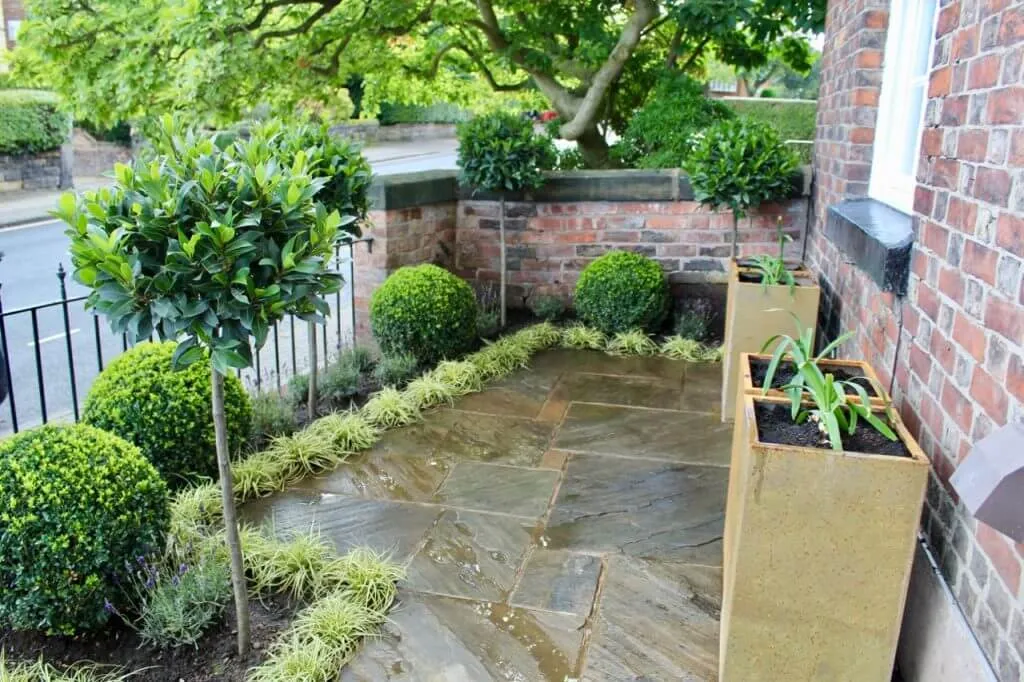
The same principles work at the front of the house, where the garden has to cope with bins, parking and deliveries as well as look good from the street. Large-format paving or a permeable gravel drive with a crisp metal edge sets the tone, and a pair of clipped Ilex crenata balls or a single multi-stemmed tree either side of the path gives instant symmetry. Repeat one grass, such as Stipa or Carex, along the edge of the path and you have a front garden that looks designed with very few plants.
Keep bins out of sight with a slatted timber store in the same finish as your fence or front door, and light the path and door with a couple of low fittings rather than one bright security light. If you’re paving a front garden, check whether you need planning permission. In England, permeable surfaces or areas that drain onto a border usually don’t, which is another reason gravel and permeable block suit a modern front garden so well. My formal front garden guide has more layouts if you’d like a stricter, more symmetrical look.
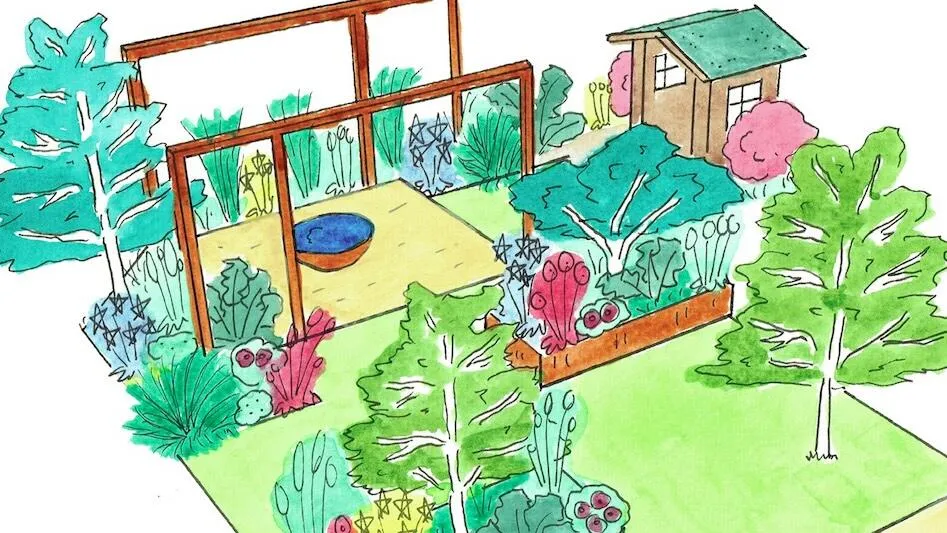
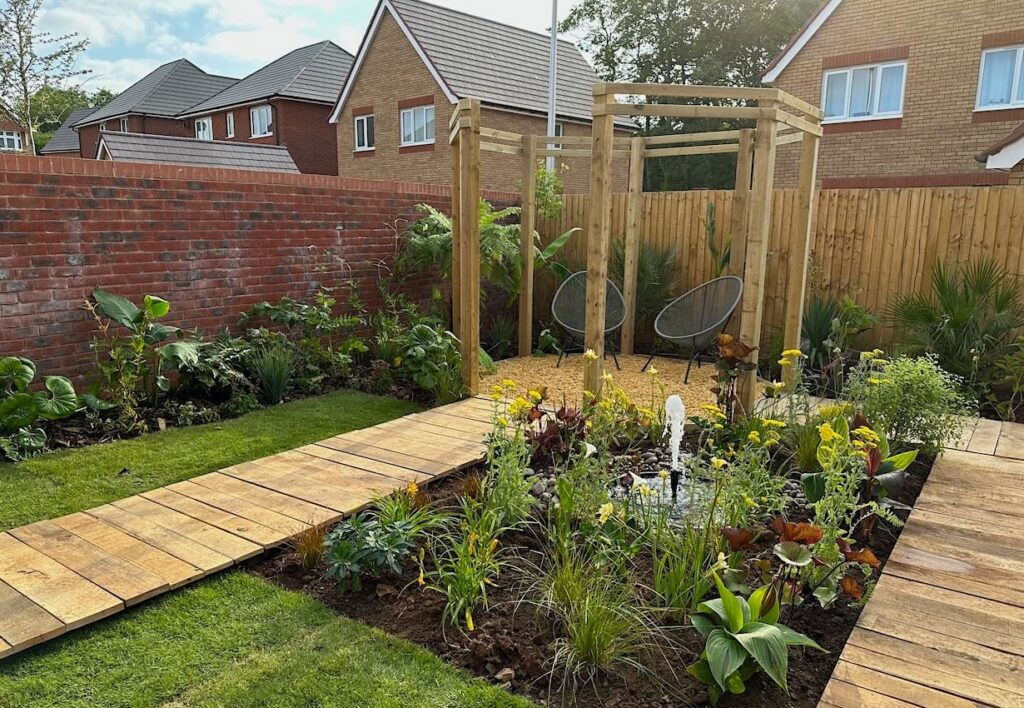
Here’s how these ideas come together in one of my own projects. The client had just moved into a new build executive home that was contemporary and stylish inside, but the garden was a box of low-grade turf with inspection covers dotted across the lawn. It was overlooked, partly shaded and gave her no reason to step outside.
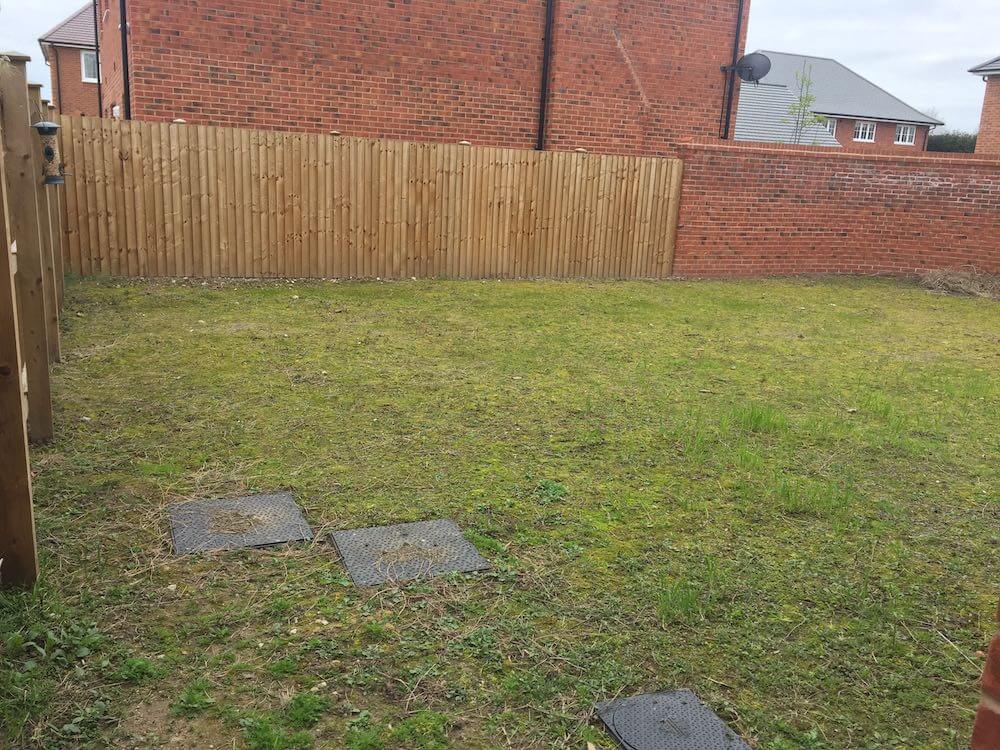
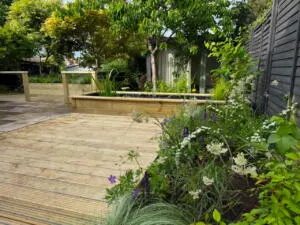
She wanted a garden that felt like a high-end boutique hotel, with Asian-inspired colours, very little maintenance and plenty for the birds. I took the scale from the patio doors, split the space into four zones and used just two main materials: grey porcelain throughout and white render for the raised beds. A hidden seating terrace sits behind a raised bed in the back corner, a cobble bed with an Acer and Corten water bowls forms the wildlife area, and the planting is grouped in repeated blocks of grasses, Heuchera and Carex, with a shade border of Thalictrum, Erythronium ‘Pagoda’ and evergreen Skimmia along the darker wall.
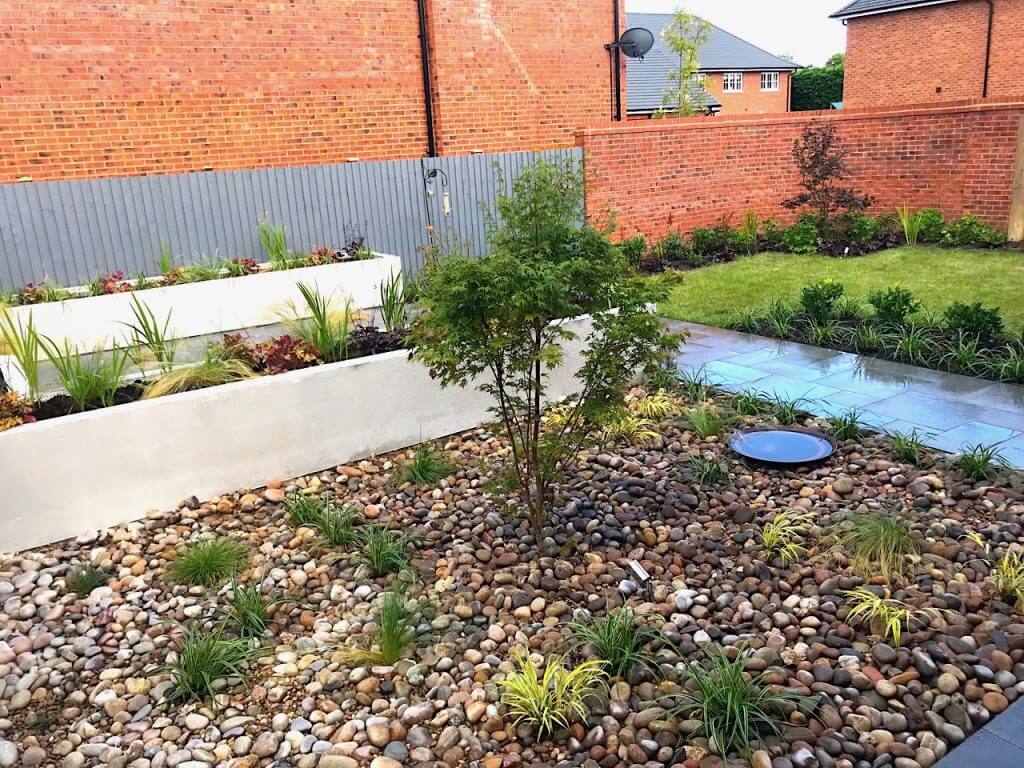
I’ve written the full project up as a case study, including the plan and the reasoning behind each zone, in my new build garden design guide.
Most modern gardens that disappoint fall down on the same handful of things, and they’re easy to avoid once you know them:
If you’d like a second pair of eyes before you commit to materials, an online garden design consultation with me is a quick way to check a plan, and you can see how much a garden designer costs for a full design.
Simplify it. Use straight lines or bold curves that take their scale from the house, choose one or two hard landscaping materials such as porcelain or sawn stone, and plant a small number of plants in repeated blocks. Add structure with raised beds, rendered walls or clipped evergreens, and light a few key features for the evening.
Too many materials, plants dotted about one at a time, small paving slabs, weak lawn and border edges and a lack of evergreen structure in winter. Choosing a limited palette and repeating it across the garden makes even inexpensive materials look considered.
Modernist design comes from the early twentieth century and the idea that form follows function, with strong geometry and minimal ornament. Contemporary simply means current. In practice the two overlap heavily in gardens, and both rely on clean lines, a limited palette and bold planting.
Yes. Porcelain gives a crisp, uniform finish that suits modern design, needs very little maintenance and resists staining. It typically costs £40 to £90 per square metre to supply, and large-format slabs laid in a straight stack or running bond give the most modern look.
Plants with a strong shape or texture that look good in repeated groups. Multi-stemmed Birch or Acer for height, Calamagrostis and Stipa grasses for movement, Ilex crenata or Pittosporum for evergreen structure, and Black Mondo Grass or Lavender for edging all work well.
Yes. A water bowl, grasses left standing over winter for their seed heads, flowering perennials such as Lavender and a climber on the fence all bring in birds and pollinators without breaking the clean, modern look.

Join over 100,000 gardeners on YouTube
Free gardening videos from the Garden Ninja, with 8 million views and counting.
Subscribe on YouTube, it’s freeIf you’d like to design a modern garden yourself, my online courses teach the same process I use with clients, from measuring up and setting the geometry to choosing a planting palette that repeats properly.
Courses start from £29, so you can get the layout and materials right on paper before you spend anything on paving.
For the garden you’ve already got, not the one you’re starting from scratch. Seven checklists and video lessons from BBC Garden Rescue’s Lee Burkhill, designed to help you decide what’s worth keeping before you spend a penny.
Garden Design Examples for Small Gardens: 30 Design Templates & Planting Plans: In this online gardening course, I’ll walk you through 30 fantastic garden designs, explaining the logic behind the layout and plant choices, plus take-home tips for applying them in your own garden.
Learn how to transform and design your garden with Lee Burkhill’s crash course in garden design. In over 5 hours, Lee will teach you how to design your dream garden. Featuring practical design examples, planting ideas and video guides. Learn how to design your garden in one weekend!
Garden Design for Beginners Online Course: Want to become a garden designer or design your own garden? This beginner course is for you. Join me, Lee Burkhill, an award-winning garden designer, as I train you in the art of beautiful garden design. Enjoy 20 hours of online study and video lessons, along with quizzes and a completion certificate.
A modern garden works when every element has a reason to be there. Take your lines from the house, keep to one or two materials, plant in repeated blocks with plenty of evergreen structure, and add a few well-chosen features such as Corten steel, water and lighting. Done well, it gives you a garden that feels like an extra room, looks good all year and takes far less looking after than a traditional mixed border.
If you’re starting from a blank new build plot, my new build garden design guide takes you through the soil, survey and layout stages first.
Happy Gardening!


Lee Burkhill, known as the Garden Ninja, is an award-winning garden designer and horticulturist with over 30 years of gardening experience and 15 years as a professional garden designer. A qualified RHS (Royal Horticultural Society) professional, Lee specialises in sustainable garden design and practical horticultural advice. He designs and presents on BBC1’s Garden Rescue and in leading gardening publications. Lee combines three decades of hands-on gardening knowledge with professional design qualifications to help gardeners create beautiful, functional outdoor spaces.
View all posts by Lee Burkhill




JOIN THE NINJAS

Be the first in line for new Guides, Discount codes and Offers