How to design a front garden: plants, layouts & ideas guide
Lee Burkhill: Award Winning Designer & BBC 1's Garden Rescue Presenters Official Blog
Intermediate level
Front gardens are often the most overlooked type of garden design. Most home owners throw a few annual bedding plants into pots near the front door, may put up the odd summer hanging basket or even go so far as to add a token rose into an other wise barren from garden border. But why should the front garden be any less deserving than the back? This guide will show you how to cause a commotion in your streets with a fabulous front garden. You'll be the talk of the town!
🌿 Quick Answer
To design a front garden, start by surveying your space for sunlight, soil type, and size. Define whether you need parking, privacy, or planting as your priority. Choose a style — cottage, formal, or low maintenance — then sketch a layout balancing hard landscaping with at least one third planting. Select layered plants for year-round interest: trees, shrubs, perennials, and ground cover.
A well-designed front garden can transform the look of your home, boost kerb appeal, and provide a welcoming space for visitors. But designing a front garden isn’t just about gorgeous aesthetics — it’s about functionality, planting schemes, encouraging wildlife in our housing estates, and making the best use of space. After all, the front garden is usually the entrance to the home, so it has a slightly different function from a back garden.
Whether you have a small urban courtyard or a sprawling driveway, this guide will take you through everything you need to know to design the perfect front garden. I have spent over 20 years professionally designing front gardens, and I present garden makeovers on BBC1’s Garden Rescue, so I have seen just about every front-garden challenge you can imagine. Let me share what actually works.
Front gardens are usually a missed opportunity to garden and help green up our otherwise grey housing estates, roads, and cities. I’m a big believer that we, as ethical gardeners, should maximise our green space to give wildlife a fighting chance. Not only that, but wildlife is already struggling, given urban sprawl, the increasing mass of hard landscaping covering cities and the fact that new build housing estates are squeezing more buildings into each space by reducing gardens, green spaces and soft landscaping.
It’s tough out there for Mother Nature and wildlife, leaving sterile postcodes with nothing but concrete, paving, and composite windows. The RHS estimates that nearly a quarter of all UK front gardens are now completely paved over. That’s a staggering loss of habitat, and it happens one driveway at a time.
By committing to designing your front garden, you will not only increase the green space available to wildlife such as insects, birds, and bees but also help soften the visual impact of houses, hard landscaping, and grey spaces.
Think of a beautiful front garden as a ‘moment of rest’ as you return home. Research from the University of Sheffield found that adding plants to an otherwise bare front garden reduced residents’ stress hormones by measurable amounts. The garden will look gorgeous, help slow rainwater, keep your home cooler in summer, and connect you with wildlife. Here are the tangible benefits worth bearing in mind as you design.
🧠 Mental Health
Being around greenery promotes relaxation, reducing anxiety and depression. Even a short walk past your own planting each morning makes a difference.
🌬️ Air Quality
Plants absorb pollutants and produce oxygen, reducing harmful gases such as carbon dioxide and nitrogen oxides from nearby roads.
🦋 Biodiversity
Flowers, shrubs, and trees attract bees, butterflies, and birds, creating vital urban wildlife habitats and wildlife corridors between gardens.
💧 Flood Prevention
Green spaces absorb and slow rainwater, reducing surface runoff that overwhelms Victorian drains and contributes to urban flooding.
🏠 Property Value
Homes with well-designed front gardens are more desirable and often fetch higher market prices. Kerb appeal is one of the cheapest ways to add value.
🔊 Noise Reduction
Hedges and trees act as natural sound barriers, muffling urban noise from traffic and neighbours. A dense hedge can reduce road noise noticeably.
Step 1: Understanding your front garden space
Before you start sketching out ideas, assessing your space is essential. Front gardens vary in size enormously, and unless you’re one of the lucky people to have a sizable plot, the likelihood is that your front garden will be far smaller than the back garden and also have several competing needs, such as paths, driveways, and access for wheelie bins.
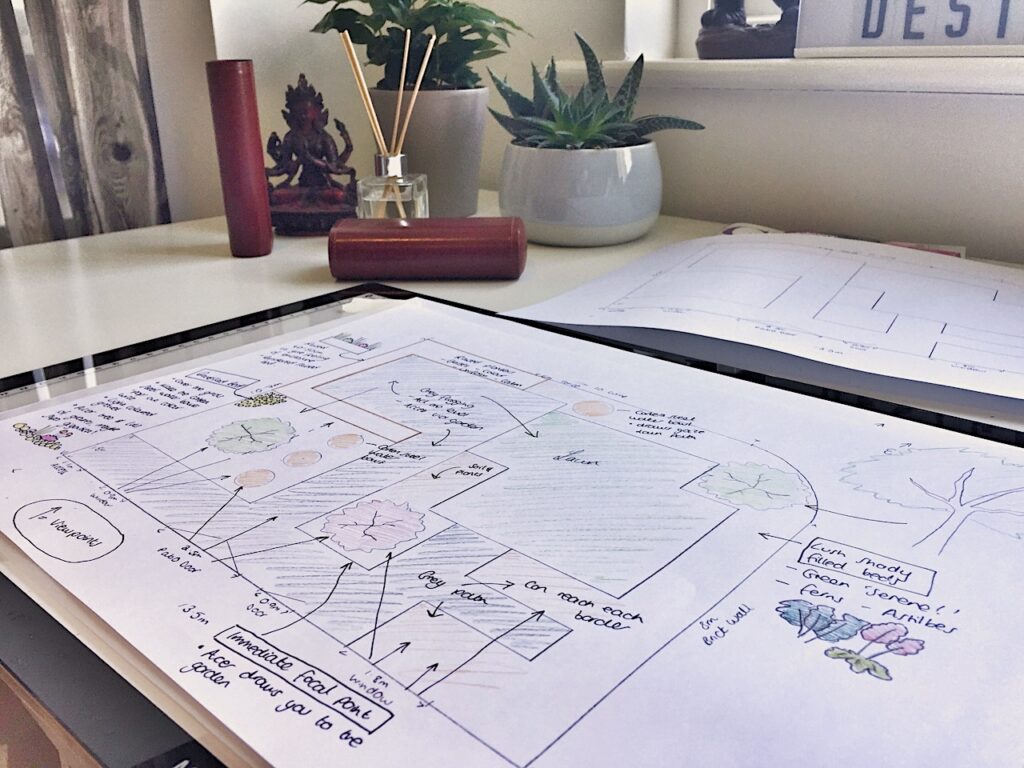
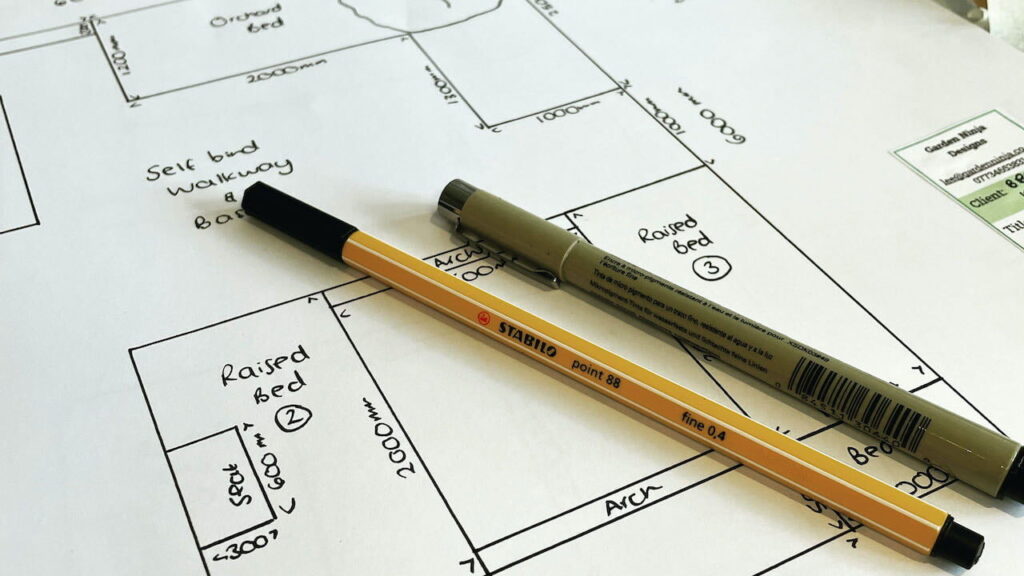
For a successful design, we need to create a baseline survey or blueprint to which we can then apply our ideas, wishes, and desires. It helps keep our projects on scale and enables us to make mistakes on paper rather than incurring costly errors when landscapers are paid to install the wrong-sized paths or when too many plants are ordered.
Before you jump in with design ideas, the first step is to identify and record these four characteristics of your front garden.
A) Sunlight and shade
Observe how much sun your front garden receives throughout the day. This will influence your plant choices and help you understand where there may be shade. A south-facing front garden is an absolute gift: full sun, warm walls, and the option to grow Mediterranean plants, wisteria, and sun-loving perennials. A north-facing frontage is a different challenge entirely, but by no means a disaster. See my section on north-facing planting further down for specific recommendations.
B) Soil type
Check your soil’s pH and composition — sandy, loamy, or clay. This determines which plants will thrive in your garden. Usually, taking a spadeful of soil and giving it a good squish will tell you whether it’s gritty and sandy or fudgy like clay. Make a note of this: certain plants will only grow in specific soil types — choosing the wrong plants for your soil is one of the most common and costly front garden mistakes I see.
C) Climate and microclimate
Your local climate affects plant choices. Additionally, walls, fences, or buildings can create microclimates that affect growth conditions. Make a note of where frost pockets may be, whether there are constantly damp or boggy areas, or very parched patches of soil. A south-facing wall, for example, can be 5°C warmer than open ground just a metre away, which opens up a whole range of more tender plants.
D) Size and layout
Measure your space and note existing features such as paths, trees, and driveways. Make a note of the windows and doors so you can double-check the garden proportions as well. This will help with accurate planning. Make sure you note the scale of your drawing, i.e., 1:100 or 1:50. Getting this right from the start saves enormous frustration later.
Step 2: Defining the purpose of your front garden
Now that we have a blueprint of the front garden’s current state, we can assess its function or purpose. Unlike back gardens, most front gardens have one primary purpose: to get you to the house, garage, or back garden. But this is where, as considerate gardeners, we can box clever and make this journey as beautiful as possible.
By creating beautiful green front gardens, we slow the journey to the house and give our homes that extra boost to help relieve stress and calm us down, both when we leave and when we return home. Think of a beautiful front garden as a decompression chamber between the outside world and your home.
With all that in mind, you must consider a few requirements when designing your front garden. Not every garden needs all of these, so make a list of any that apply to your specific situation. Understanding the purpose of your garden will guide your design choices and prevent you from adding things you don’t need, which can use valuable space and make the garden look bitty. Less is more with front gardens, and doing a few things well rather than lots of bits here and there will be far more effective and easy to maintain.
🏡 Kerb Appeal
What style, theme, or colour do you want the garden to have?
🛡️ Privacy
If you need privacy, consider hedging or planting to create seclusion from the street.
🛠️ Maintenance Level
Do you want lower maintenance or a garden you can get busy in each week?
🐝 Wildlife-Friendly
What can you plant to encourage pollinators and biodiversity?
🚗 Parking and Access
Functional layouts with driveways, pathways, bin access and turning circles.
Paths at least 1.2m wide for wheelchair, pushchair, and wheelbarrow access.
⚡ EV Charging
If you have or plan an electric vehicle, think about charger positioning and cable routing now.
Step 3: Formal or informal front garden design?
The next consideration is which garden design style works best for you. This usually falls into two broad categories: formal and informal. Understanding the difference matters because it affects not just aesthetics but also how much time you will spend maintaining the garden every year.
Formal garden design is all about structure, symmetry, and control. Think crisp lines, geometric layouts, and perfectly clipped hedges that create a sense of order and elegance. These gardens often have strong focal points, such as statues, topiary, or symmetrical pathways, that guide the eye in a carefully planned way.
Inspired by classic European designs, such as French parterre gardens and Italian Renaissance styles, formal gardens convey a grand, sophisticated feel. Maintenance is key here — regular pruning, mowing, and shaping keep everything looking pristine and intentional.
Informal garden design embraces asymmetry, looser planting, and nature’s wild side. Curved pathways, flowing plant arrangements, and a relaxed, organic feel define this style. Plants are often mixed in a way that mimics natural landscapes, with soft edges and layered planting that create a more relaxed, inviting atmosphere. Cottage gardens, woodland-style planting, and wildlife-friendly spaces fall into this category.
Step 4: Creating a layout and structure
A well-thought-out layout is key to a functional and attractive front garden. As we’re usually not planning seating, entertaining, or relaxing areas, the three main layout functions are: pathways, parking, and planting and flower beds. Getting the balance between these three right is the central challenge of front garden design.
Pathways and access
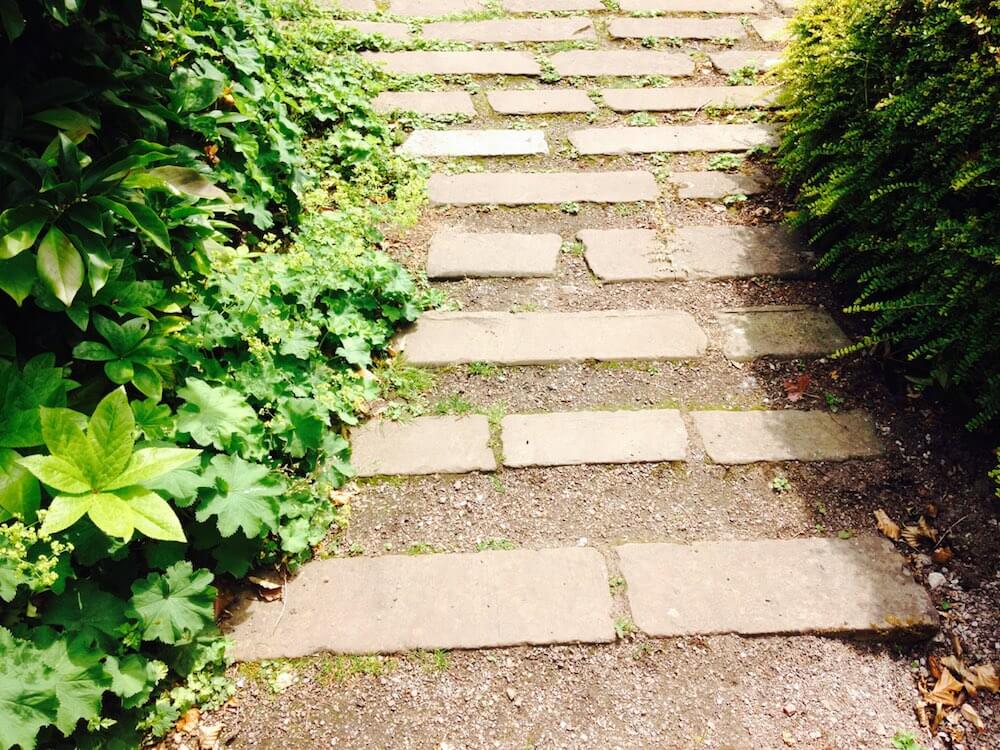
It’s usually good design practice to have an obvious route, whether a path or walkway, that signals you to follow it. Having to guess how to reach the door is a design fail — and funnily enough, many gardens struggle to get this right. Gravel, pavers, cobbles, stepping stones, chipped bark, or concrete are all good, solid choices for access routes, with some being more expensive than others.
Consider the maintenance and whether the material is cohesive with your property. Chipped bark may look lovely as a path to a thatched cottage, but not so much as an entrance to a contemporary townhouse.
As a rule of thumb, the minimum width of a path should be 90cm, which is wide enough for bins, but 1.2m is ideal for wheelchairs, wheelbarrows, and access for two people to pass. It doesn’t have to be the quickest route; you may want to lead the visitor past a specimen plant, but it must be obvious.
💡 Top Tip: Path Materials
Gravel is a brilliant front garden path material. It’s affordable, permeable (allowing water through), looks great with almost any house style, and has the added bonus of being audible underfoot, which helps with security. 🛒 Buy decorative garden gravel from Amazon UK
Parking considerations
Is parking the real difficulty with front gardens? As house prices have skyrocketed, space has become a premium. Mixed in with that, people are now more mobile than ever, with a car a necessity for most, whether for commuting or social needs. There are simply more cars than most properties were designed for. In the 1970s, one car per household was rare, but now most adults in a household probably have their own means of transport.
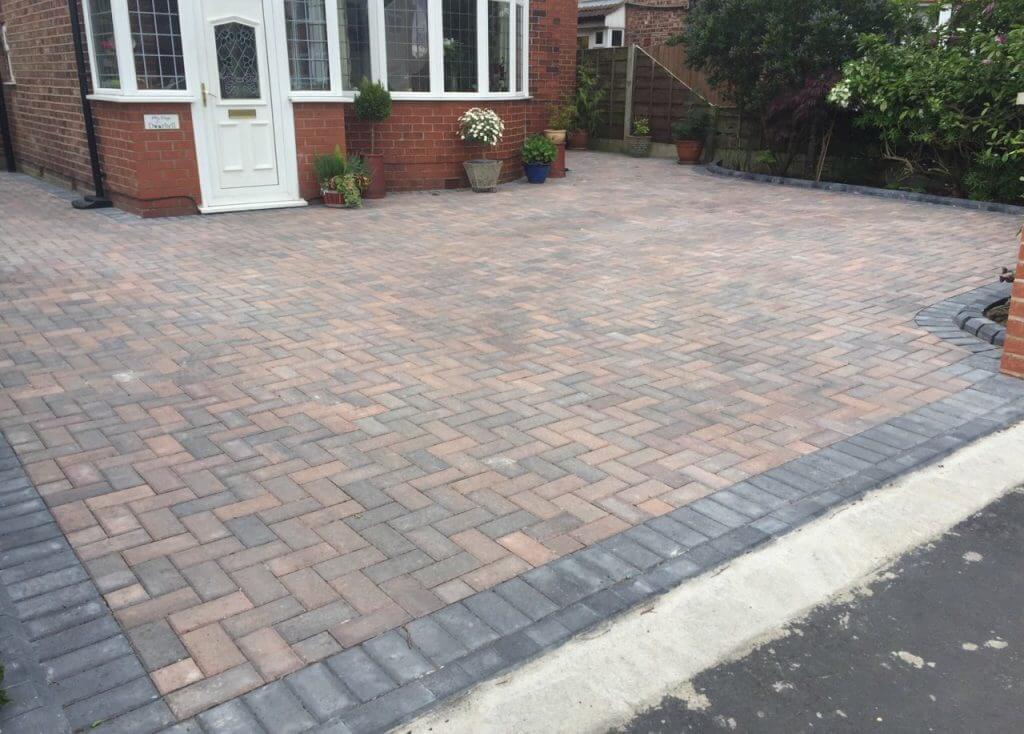
What people have tended to do in the last 20 years is see their front garden as a car park. Block paving, tegula paving bricks, flags, and the dreaded sea of tarmac have now consumed huge swaths of our front gardens. More often than not, the entire front garden is paved, even when sections of it are useless for parking and become dead areas. It’s something the RHS has been campaigning about as part of its ‘Greening Grey Britain’ campaign.
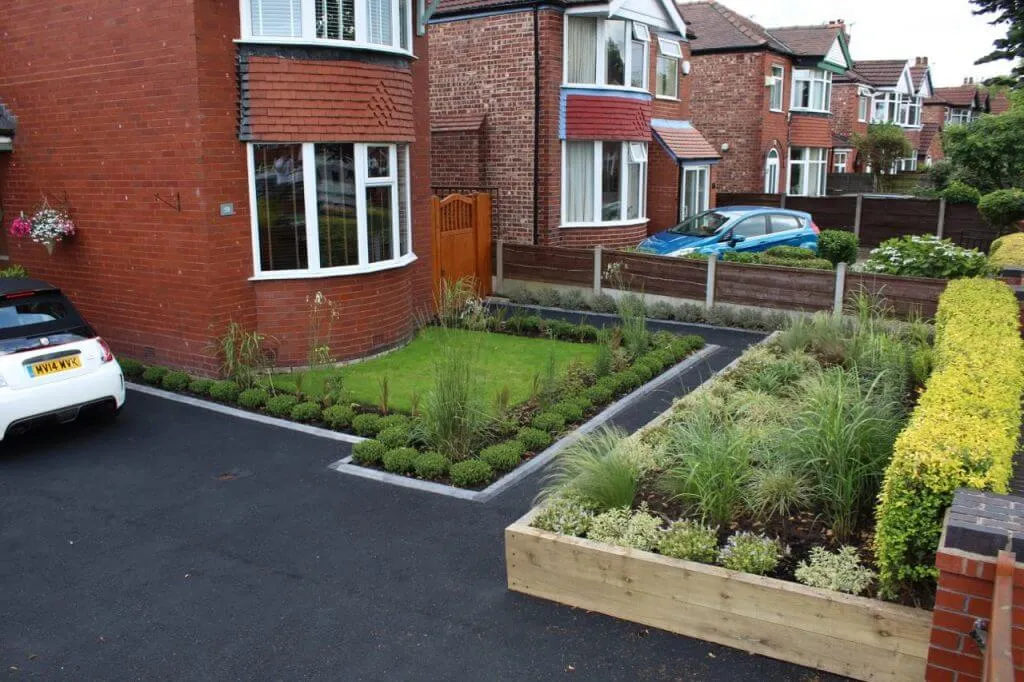
With good garden design, you can still have off-street parking even in the smallest of gardens. What we designers implore you to consider is keeping hard landscaping in front gardens to a minimum and using porous materials that allow water to pass through and support wildlife. Map out the exact size of the space and turning circle needed for your car. Then, plan how you can green the rest of the space.
If you need a driveway, opt for materials that allow water drainage. Permeable paving, gravel, and reinforced grass grids are all excellent options. 🛒 Buy reinforced grass grids from Amazon UK — these are a fantastic green alternative to solid tarmac and still cope comfortably with vehicle weight. Add edging and planting around parking areas to soften the look, and opt for deep flower beds lining pathways. They will slow your journey and help reduce flooding.
Do you need planning permission to pave a front garden?
⚠️ Important: Planning Rules
In England, you need planning permission if you want to lay more than 5 square metres of impermeable paving in your front garden. Permeable paving, gravel, and other porous surfaces are exempt from this rule. Always check with your local planning authority before starting work, especially in conservation areas or listed buildings.
This rule was introduced after the 2007 floods, when paved-over front gardens were identified as a significant contributor to surface water runoff and urban flooding. The good news is that permeable paving, gravel on a permeable membrane, and reinforced grass grids are all fully exempt, giving you plenty of options. 🛒 Browse permeable paving options on Amazon UK
Planting and flower beds
One question I ask all front-garden design clients is: Do you need a lawn? This is usually met with a gasp of horror, but as I dig deeper, I am often told that most people don’t actually need a front lawn. Sometimes, larger, more substantial flower beds with beautiful shrubs, herbaceous perennials, and suitable small garden trees look much more inviting and require less maintenance. You spend less time mowing and more time watching your front garden work its magic through the seasons. Make your flower beds at least 1m deep, if possible, so they look more impactful than tiny, skinny borders.
How to hide wheelie bins in a front garden
Wheelie bins are the bane of many a front garden design, and I understand the frustration. The key is to plan for them from the start rather than trying to squeeze them in as an afterthought. A timber bin store is the most popular solution, and modern designs are genuinely attractive, with slatted sides, planting troughs on top, and even green roofs planted with sedums. Hedging is another brilliant option: a tight bay of Griselinia or privet clipped around three sides of the bin area keeps everything tidy without any construction work. Pyracantha trained against a fence or wall beside the bins is a particularly good double-duty solution, providing attractive berries and effective security.
Step 5: Sketch out and plan your front garden planting design
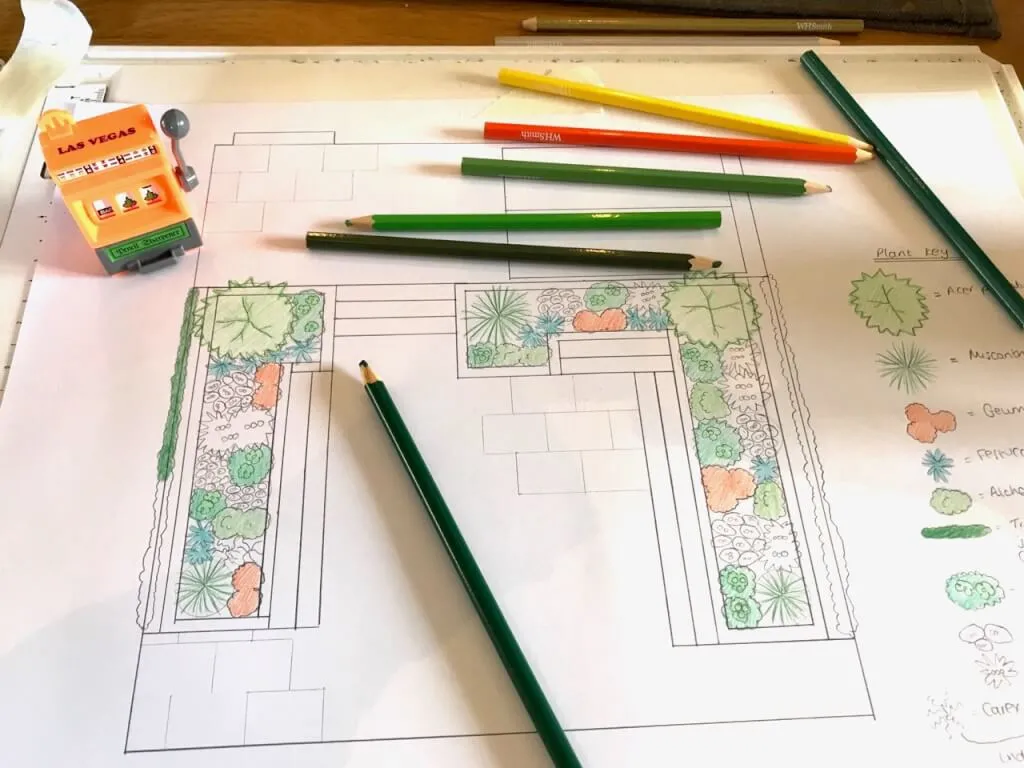
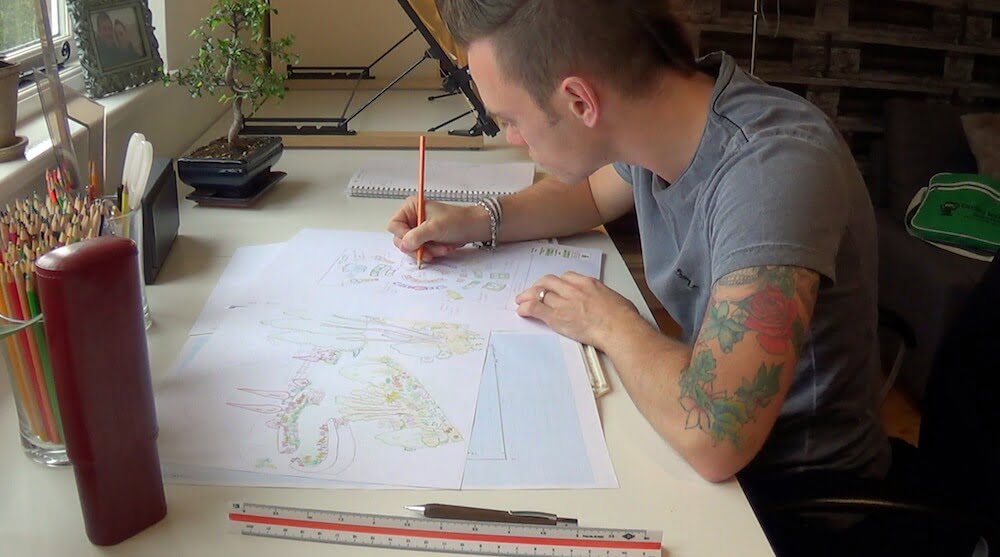
Now, for the fun part: sketch your front garden design to scale. Using the list of the above characteristics, start to work out where the paths need to be: the front, side, or back door. Work out if there is enough room to step out of the car onto some paving, not flower beds. Then it’s up to you how to lay out the front garden. Will you go for super deep informal flower beds? Will you ditch the lawn for ground cover plants that are far better for wildlife? Maybe you’ve chosen a super formal scheme with clipped topiary and lavender plants lining neat pathways? The choice is entirely yours.
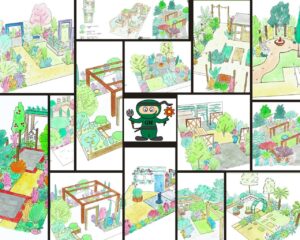
If you’re scratching your head at this point, why not sign up for my 30 Garden Design Templates online course, which includes a set of unique garden design templates and planting plans for all aspects of gardening, soil types, and styles? It’s a great, affordable way to get loads of inspiration for your own front garden design layouts.
29
Garden Design Examples for Small Gardens: 30 Design Templates & Planting Plans
Garden Design Examples for Small Gardens: 30 Design Templates & Planting Plans: In this online gardening course, I’ll walk you through 30 fantastic garden designs, explaining the logic behind the layout, the plant choices, and take-home tips for applying them in your own garden.
Weekend Garden Makeover: A Crash Course in Design for Beginners
Learn how to transform and design your own garden with Lee Burkhills crash course in garden design. Over 5 hours Lee will teach you how to design your own dream garden. Featuring practical design examples, planting ideas and video guides. Learn how to design your garden in one weekend!
Garden Design for Beginners: Create Your Dream Garden in Just 4 Weeks
Garden Design for Beginners Online Course: If you want to make the career jump to becoming a garden designer or to learn how to design your own garden, this is the beginner course for you. Join me, Lee Burkhill, an award-winning garden designer, as I train you in the art of beautiful garden design.
Choosing the right plants will define the character of your front garden and should be selected based on the sunlight levels and soil type you identified in your survey. The key to a successful front garden design is to use repetition in your planting palettes.
The biggest mistake you can make is having one of these and one of those in a small front garden, as it makes the garden feel even smaller and looks scattered and inconsistent. Apart from trees and shrubs, all other plants look better in multiples and are planted repeatedly for consistency. Ensure that, when listing suitable plants, you opt for multiples of 3, 5, or 7 to give a more balanced look.
The best way to design interesting flower beds is to use layers to create depth, height, and structure. Think of it like a theatre set: tall elements at the back (or centre if the bed is viewed from all sides), mid-height performers in the middle, and low-growing plants at the front edge. Here is the layered framework I use for every front garden design.
🌲 Layer 1: Trees
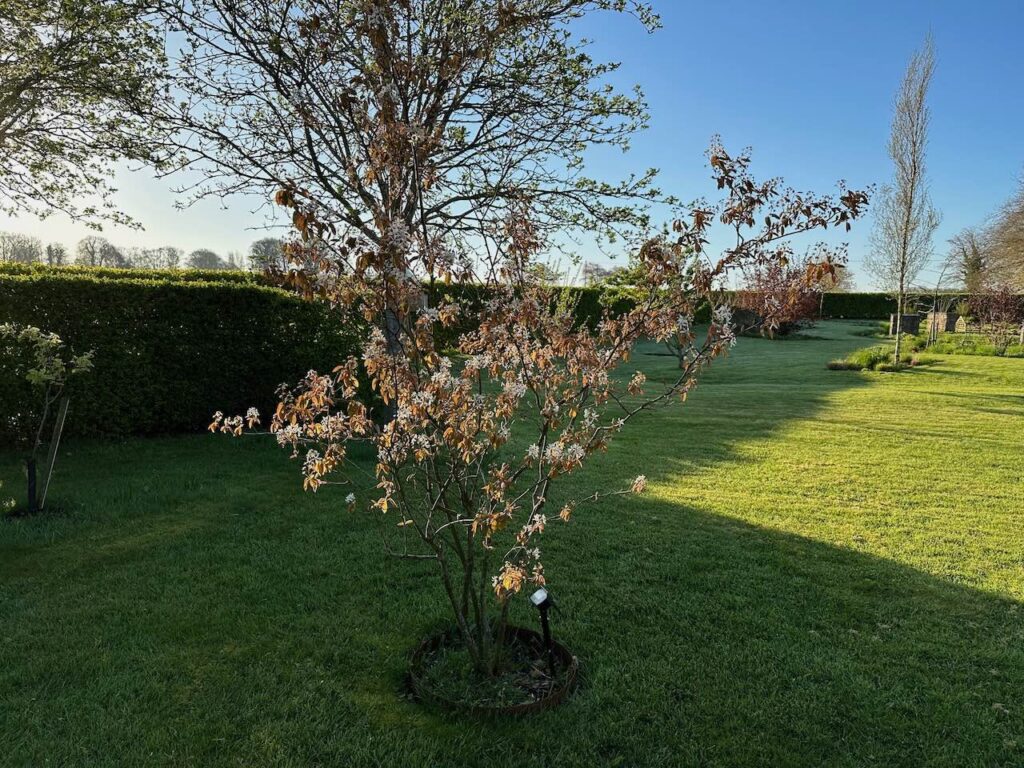
Provide height and structure. Choose small trees such as Japanese maples, Amelanchier, or Pyrus ‘Chanticleer’ for smaller gardens. Avoid large-growing species near foundations.
🌿 Layer 2: Shrubs
Offer year-round interest and wildlife value. Consider evergreens like Choisya, Viburnum, or Photinia for structure, or flowering shrubs like Hydrangea for seasonal impact.
🌷 Layer 3: Perennials
Add seasonal colour and pollen for insects. Use plants like lavender, salvias, hardy geraniums, catmint (Nepeta), and Erigeron for months of flowers.
🍃 Layer 4: Ground Cover
Low-growing plants that fill gaps, suppress weeds, and reduce maintenance. Try creeping thyme, sedum, Ajuga, or Alchemilla mollis at bed edges.
Best trees for front gardens
Tree choice is arguably the single most important decision in front garden design. Get it right, and you have decades of seasonal interest, wildlife value, and structural beauty. Get it wrong, and you have cracked paths, clogged gutters, and a tree-removal bill. My golden rule: always check the eventual height and spread before you buy, and avoid anything with invasive roots near the house.
🌿 At A Glance: Amelanchier lamarckii (Snowy Mespilus)
Botanical Name
Amelanchier lamarckii
Plant Type
Deciduous small tree / large shrub, RHS AGM
UK Hardiness
H6 (hardy to -20°C)
Height / Spread
6 to 8m / 4 to 6m
Flowering Period
April (white star flowers), followed by red autumn berries and spectacular autumn colour
Best Conditions
Full sun to partial shade, moist but well-drained soil, any aspect
Amelanchier lamarckii is one of my absolute favourite front garden trees. It earns its place in the garden three times over: clouds of white spring blossom emerge with bronzy young foliage in April, red berries feed the birds in summer, and the Autumn colour is breathtaking. It’s a genuinely beautiful tree that never outgrows a normal-sized front garden.
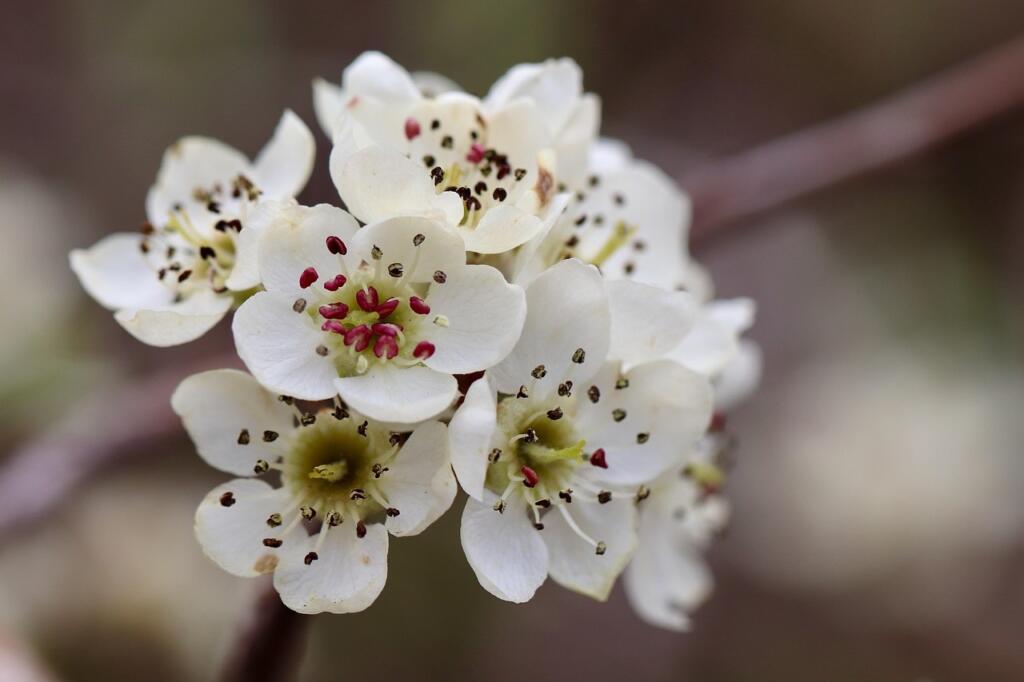
🌿 At A Glance: Pyrus calleryana ‘Chanticleer’ (Ornamental Pear)
Botanical Name
Pyrus calleryana ‘Chanticleer’
Plant Type
Deciduous tree, RHS AGM
UK Hardiness
H6 (hardy to -20°C)
Height / Spread
8 to 15m / 4 to 6m (narrow, upright crown)
Flowering Period
March to April (white blossom), spectacular orange-red autumn colour
Best Conditions
Full sun, any moist but well-drained soil including heavy clay, tolerates pollution
Pyrus calleryana ‘Chanticleer’ is the ideal street-facing front garden tree for UK plots. Its narrow, upright habit means it will not overwhelm a small plot or block light to the house, and it is exceptionally tolerant of pollution from nearby roads. Spring blossom, glossy summer foliage, and fiery Autumn colour make it genuinely three-season.
Always plant trees at a distance from the house equal to their eventual spread. For most small garden trees, that means at least 3 to 4 metres from the wall. If your soil is clay, increase this to 5 metres. Installing a root barrier when planting near paving or foundations is good practice. 🛒 Buy root barriers from Amazon UK
Evergreen shrubs for front garden structure
Evergreen shrubs are the backbone of any successful front garden planting scheme. Aim for 60 to 80 per cent of your planting to be evergreen as it ensures the garden looks presentable every single month of the year, not just in summer. The following are my top recommendations for year-round structure and interest.
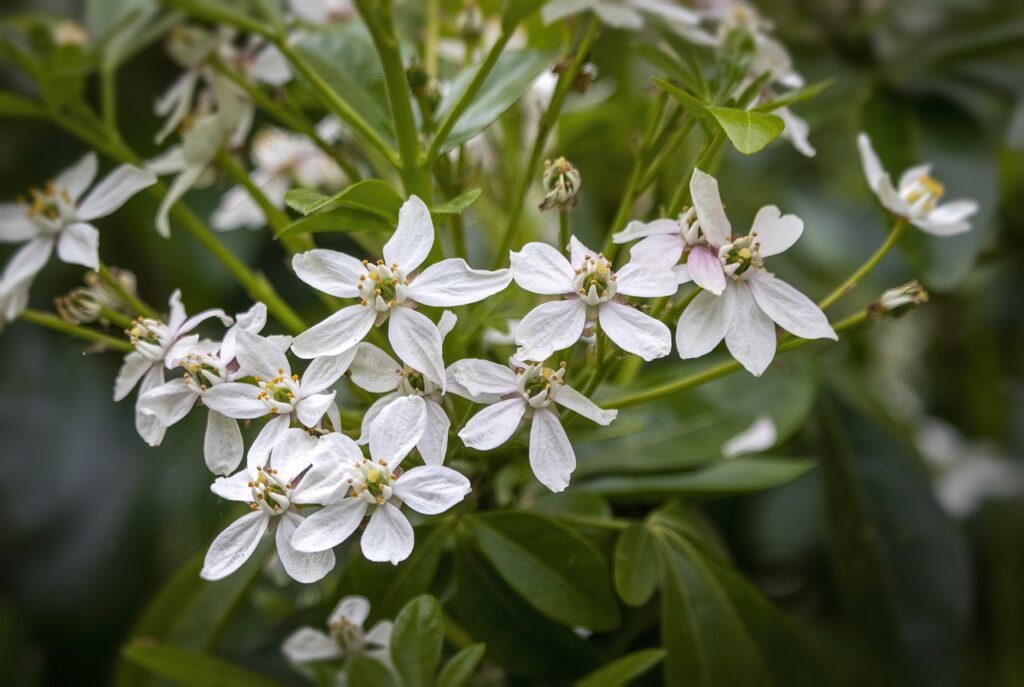
🌿 At A Glance: Choisya ternata (Mexican Orange Blossom)
Botanical Name
Choisya ternata
Plant Type
Evergreen shrub, RHS AGM
UK Hardiness
H4 (hardy to -10°C)
Height / Spread
1.5 to 2.5m / 1.5 to 2.5m
Flowering Period
Late spring (main flush) and again in autumn. Fragrant white star flowers
Best Conditions
Full sun to partial shade, well-drained soil, sheltered from cold north and east winds
Choisya ternata is one of the RHS’s top five front garden shrubs, and I completely agree with that assessment. Glossy, aromatic evergreen foliage looks smart all year, and the fragrant white flowers appear twice — once in late spring and again in Autumn, which is a real bonus. The golden cultivar ‘Sundance’ and the slender-leaved ‘Aztec Pearl’ are both outstanding alternatives.
April to May (white flower clusters); brilliant red new growth spring and autumn
Best Conditions
Full sun to partial shade, any moist but well-drained soil, tolerates urban pollution
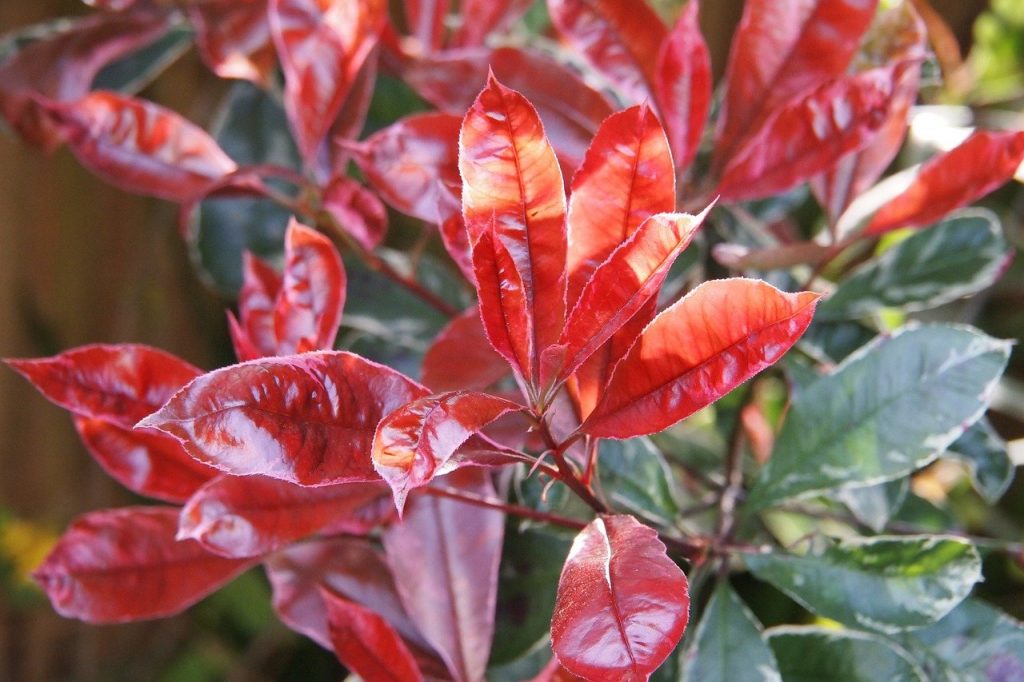
Photinia ‘Red Robin’ is a front garden stalwart for very good reasons. Those vivid scarlet new shoots that emerge in spring and again in Autumn give the effect of a flowering shrub without a single flower. It responds well to clipping, can be trained as a hedge or standard, and is one of the most pollution-tolerant shrubs available. Euonymus, Viburnum tinus, and Cotoneaster are other rock-solid evergreen choices for urban front gardens.
Climbers and wall shrubs for the front garden impact
Climbers are the most underused plants in front gardens, yet they can transform a bare wall into something truly spectacular. A south or west-facing front wall is a premium planting opportunity that most people leave completely blank.
Even a north-facing wall can support some superb climbers. The key practical point is that most climbers need a support structure: either trellis panels fixed to the wall, or a system of horizontal wires held by vine eyes.
🛒 Buy trellis panels from Amazon UK — fix these to your wall before planting, and your climbers will have instant support to get started.
🌿 At A Glance: Wisteria sinensis (Chinese Wisteria)
Botanical Name
Wisteria sinensis
Plant Type
Deciduous climber, RHS AGM
UK Hardiness
H6 (hardy to -20°C)
Height / Spread
9m+ / 9m+ (vigorous, needs strong support)
Flowering Period
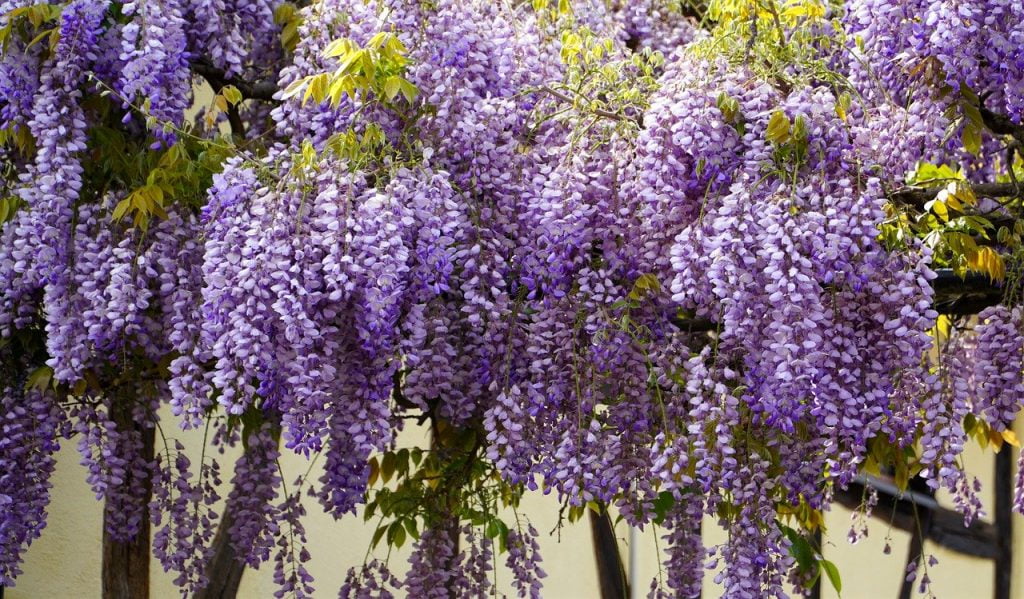
May to June, cascading fragrant lilac-blue racemes
Best Conditions
Full sun (south or west-facing wall essential), fertile moist well-drained soil
Few plants make a more dramatic front garden statement than a wisteria cascading across a house front in May. It requires a sturdy support structure and twice-yearly pruning — July to six leaves and February to two or three buds — but rewards with decades of breathtaking displays. Plant a grafted specimen from a reputable nursery rather than a seedling, as seedlings can take ten years or more to flower.
🌿 At A Glance: Trachelospermum jasminoides (Star Jasmine)
Botanical Name
Trachelospermum jasminoides
Plant Type
Evergreen climber, RHS AGM
UK Hardiness
H4 (to -10°C, needs shelter)
Height / Spread
4 to 9m / 2 to 3m wall-trained
Flowering Period
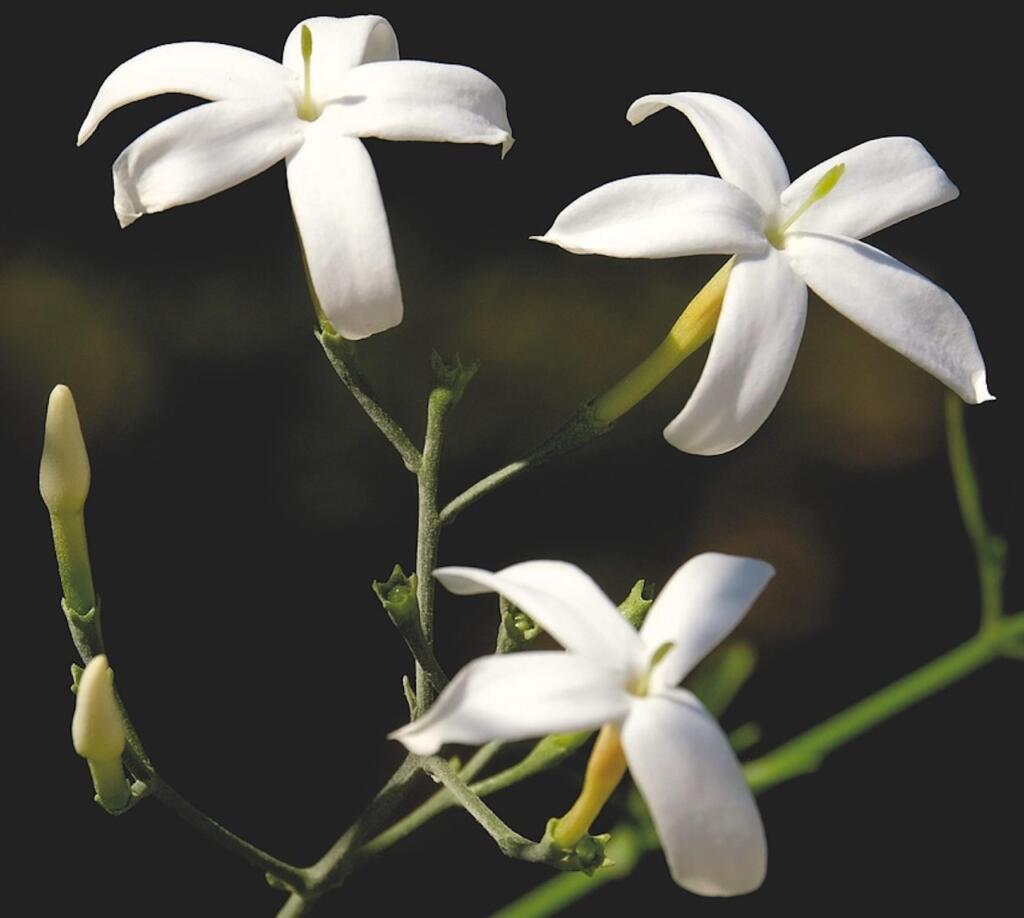
July to August. Intensely fragrant white star flowers
Best Conditions
Full sun to partial shade, warm sheltered south or west-facing wall, fertile well-drained soil
Star Jasmine is evergreen, self-twining, and produces the most intoxicatingly fragrant flowers of any climber I know. Position it beside the front door or along the path where visitors will walk past it on summer evenings. The glossy, dark leaves may flush bronze in cold winters, adding to their year-round appeal.
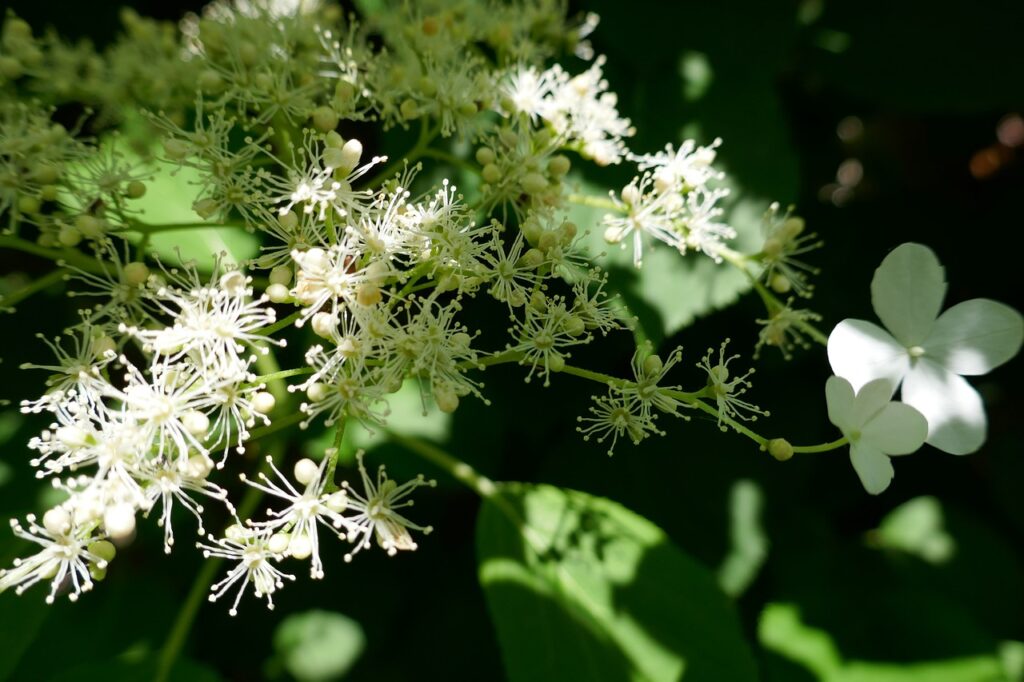
For a shadier north or east-facing wall, climbing hydrangea (Hydrangea anomala subsp. petiolaris, RHS AGM, H6) is the answer. It is self-clinging once established, so it needs no trellis and produces beautiful white lacecap flowers in June. It is slow to start.
The first two to three years can feel frustratingly static, but once it settles in, it grows strongly and will eventually cover a large wall. Clematis and honeysuckle (Lonicera periclymenum, native, RHS AGM, H7) are two other versatile climbers that work across almost any aspect.
A north-facing front garden is not the gardening sentence it might appear. Yes, it rules out sun-lovers like lavender, wisteria, and agapanthus. But it opens up a whole world of beautiful shade-tolerant plants that many sunny front gardens cannot grow. The key is to work with the aspect rather than against it, choosing plants that genuinely thrive in shade rather than simply tolerating it.
Top plants for north-facing front gardens
Sarcococca confusa (Sweet Box)
Evergreen, RHS AGM. H5. Incredibly powerful winter fragrance from tiny white flowers December to March. Perfect beside a shaded front door. 🛒 Buy from Amazon UK
Mahonia x media ‘Charity’
Evergreen, RHS AGM. H5. Bold architectural foliage, honey-scented yellow flowers November to February. Outstanding for dark corners. 🛒 Buy from Amazon UK
Hydrangea petiolaris (Climbing Hydrangea)
Deciduous climber, RHS AGM. H6. One of the only climbers for full shade. Self-clinging. White lacecap flowers in June. 🛒 Buy from Amazon UK
Camellia x williamsii ‘Donation’
Evergreen shrub, RHS AGM. H5. Glossy leaves, spectacular pink flowers February to April. Needs acid soil or ericaceous compost in a pot. 🛒 Buy from Amazon UK
Hakonechloa macra ‘Aureola’ (Golden Forest Grass)
Deciduous grass, RHS AGM. H5. Graceful arching golden foliage that brightens dark corners. Turns amber in autumn. 🛒 Buy from Amazon UK
Heuchera (Coral Bells)
Evergreen perennial, RHS AGM. H7. Extraordinary year-round foliage in purple, amber, lime, and silver. Outstanding in pots and shaded borders. 🛒 Buy from Amazon UK
Scented plants to welcome you home
One of the most underrated qualities in front garden planting is scent. After a long day, walking up your garden path through a cloud of fragrance is genuinely restorative. The best approach is to plan for scent year-round, not just in summer. Plant Sarcococca beside the front door for winter fragrance, Choisya for spring, lavender and star Jasmine for summer, and a late-flowering honeysuckle or Mahonia for Autumn. Position scented plants where people will actually walk past them — along the path, beside the gate, or flanking the front door.
Year-round scent planner for front gardens
Season
Plant
Scent Character
Winter
Sarcococca confusa
Intensely sweet, honey-vanilla, carries in cold air
Late Winter
Mahonia x media
Sweet honey scent on mild days
Spring
Choisya ternata
Fresh orange blossom, clean and uplifting
Spring
Wisteria sinensis
Rich, grape-like, intoxicating at close range
Summer
Lavandula angustifolia
Classic, aromatic lavender — needs no introduction
Summer
Trachelospermum jasminoides
Rich jasmine, strongest in the evening
Summer
Lonicera periclymenum
Warm, honeyed, strongest at dusk — attracts moths
Use plants to stop pollution.
Believe it or not, some plants are incredibly pollution-tolerant and can absorb particulates from nearby roads and pavements. If you have a paved-over space, this debris gets blown directly to your front door instead. The following are good, solid choices for highly polluted inner cities — plants that can handle pollution from cars and buses, are easy to grow, and are super low-maintenance.
Front garden container planting: pots, window boxes, and hanging baskets
Containers are a brilliant solution for any front garden, particularly where planting space is limited or where you want to change the display with the seasons. A pair of well-planted pots flanking the front door is one of the highest-impact, lowest-cost improvements you can make.
For permanent container planting, use John Innes No. 2 compost rather than multi-purpose compost, as it retains its structure and nutrients for much longer. 🛒 Buy John Innes No.2 from Amazon UK
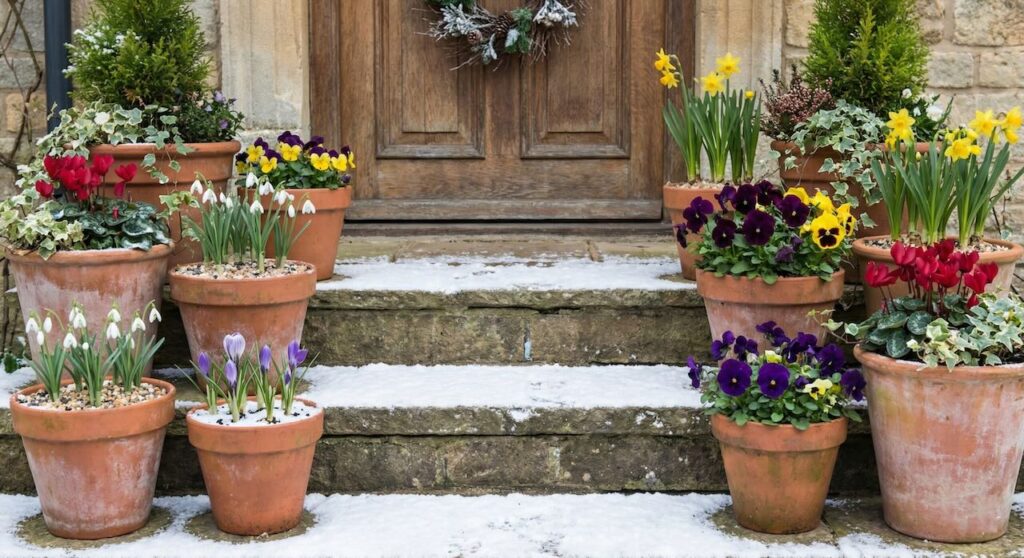
For maximum seasonal impact, try the layered bulb approach in Autumn: plant a layer of tulips at 15cm depth, narcissus at 10cm depth, and crocus at 5cm depth in the same pot. Come spring, the crocus flowers first, then the narcissus, then the tulips — giving weeks of succession from one container. 🛒 Buy large terracotta garden pots from Amazon UK
Window boxes with brightly coloured summer bedding instantly change the entire look of a house’s front. Pelargoniums (zonal geraniums) in terracotta pots flanking the front door are a timeless British look. For winter interest, try ornamental cabbages, heuchera, ivy, and miniature cyclamen — they will look beautiful from November right through to April. 🛒 Buy window boxes from Amazon UK
Front garden lighting: welcoming and wildlife-friendly
Good lighting transforms a front garden after dark, improving both safety and kerb appeal. Solar-powered path lights are the easiest starting point — no wiring, no electrician, and they work well in any garden that gets reasonable daylight. Place them along the path edge rather than pointing directly at the house, which creates a more welcoming, soft effect. A wall-mounted light beside the front door improves security and makes a genuine difference to how welcoming the entrance feels on winter evenings.
Avoid leaving garden lights on all night. Artificial lighting disrupts moth navigation, affects bat foraging behaviour, and disorients migrating birds. Use motion-activated lights where possible, or lights on a timer that switch off by 11pm. Warm white light (2700K) is less harmful to wildlife than cool blue-white LEDs. 🛒 Browse outdoor wall lights on Amazon UK
Front garden security through plants and design
Your front garden design can do a lot of heavy lifting when it comes to home security without resorting to ugly measures. Gravel on paths and driveways is one of the simplest and most effective security features available: it is audible underfoot, meaning any approach to the house is clearly announced. Thorny boundary plants are another brilliant deterrent. A dense planting of Pyracantha, Berberis, or Rosa rugosa along a boundary is more effective than most security systems and considerably more attractive.
Roses, particularly the rugosa types with their fierce thorns and dense growth habit, make outstanding security hedges. They also produce gorgeous, fragrant flowers and large, wildlife-valuable hips. Holly (Ilex aquifolium) is another option: spiny, dense, and almost impenetrable when mature. From a design perspective, keeping planting below window-sill height at the front of the house maintains natural surveillance from inside — the ‘eyes on the street’ principle. Motion-activated lighting removes the cover of darkness.
Maintenance is one thing to keep in mind when designing any garden space. As enthusiastic gardeners, we can often get swept away by fanciful garden plans and high-maintenance plants without considering the weekly or monthly effort required to keep them looking their best.
Keeping your front garden looking sharp starts with regular cleaning and tidying, sweeping paths and driveways clear of leaves, dirt, and debris to prevent them from piling up and creating a messy, slippery surface. A quick sweep every few days keeps things fresh and prevents build-up that can be harder to shift later. Hard surfaces like patios, decking, fences, and walls can quickly become grimy, especially in damp weather when moss and algae thrive.
Weeds love to creep into pathways, driveways, and borders, making the space look untidy and stealing nutrients from your plants. Regular weeding stops them from taking over and keeps everything looking well-maintained. For a longer-lasting fix, consider mulch to slow down regrowth.
🛒 Buy bark chipping mulch from Amazon UK — applied 5 to 7cm deep around plants, it suppresses weeds, retains moisture, and improves soil as it breaks down. A weed-suppressing membrane beneath gravel areas significantly reduces ongoing maintenance. 🛒 Buy weed membrane from Amazon UK
Lastly, always keep an eye out for litter or pet waste. A well-maintained front garden sets the tone for the rest of your home, and a quick daily check to clear any rubbish or surprises left by passing pets helps keep it clean and inviting. Small efforts like these make a huge difference in keeping your front garden looking its best all year round and encouraging your neighbours to look after theirs.
What happens when you pave over your front garden?
The biggest problem with paving over your front garden is water runoff and urban flooding during heavy downpours, as there is very little green space left to absorb it. Open soil, turf, flower beds, and organic matter all help retain moisture while allowing it to drain slowly. There is no better man-made alternative to slowing down the release of water than soil, plant roots, leaf span, and the like.
In the example above, there’s a full-length drive to the left that can fit three cars, and another three on the front. This type of paving is completely overkill and unnecessary. Not only does it cost more, but it is harsh to look at, and it significantly affects runoff and wildlife. During the awful floods of 2015, research confirmed that the removal of trees and vegetation from landscapes increased water runoff, making flooding much more severe than it would otherwise have been.
Paving over also annihilates the chances of wildlife surviving in your front garden. Flags and tarmac have no organic value at all and offer nothing for insects, birds, and wildlife to survive on. A good rule of thumb is that the most hard landscaping you should have in any garden space is two-thirds, with one-third as soft landscaping — either plants, lawns, or shrubs. Soft landscaping helps blend the garden with harder materials, gives wildlife habitat, and keeps the front of your house clean.
Hedging: the front garden essential
Hedging such as Ligustrum ovalifolium (Privet), Buxus sempervirens (clipped Box), Prunus spinosa (Blackthorn), or Carpinus betulus (Hornbeam) makes excellent hedges for front gardens. Informal hedges only need clipping once a year, while more formal varieties, such as Box, require multiple clippings during the season. They also prevent litter and debris from being blown onto your drive or front step.
Hedges are a fantastic addition to any front garden, offering practical and aesthetic benefits in equal measure. One key advantage is that they act as a natural barrier, helping to keep your front door and entrance area clean. By filtering dust, dirt, and debris the wind carries, hedges prevent grime from accumulating near your home, reducing the need for frequent cleaning. They also act as a buffer against road spray from passing vehicles, which is especially useful in urban areas.
Beyond their functional role, hedges bring a softer, more natural feel to a front garden. Unlike hard fencing or walls, hedging creates a gentle, organic transition between spaces, helping the garden blend seamlessly into its surroundings. The varied textures, shapes, and shades of green provide visual interest throughout the year, and with the right plant choices, seasonal flowers, berries, and even fragrant foliage can further enhance their charm.
Perhaps one of the greatest benefits of hedges is their support for local wildlife. They provide shelter and nesting sites for birds, offering a haven away from predators. Many hedge plants also produce flowers and berries that attract pollinators such as bees and butterflies, while their dense foliage provides cover for small mammals like hedgehogs. A front garden hedge, connecting to a neighbour’s hedge, becomes part of a wildlife corridor that stretches right through your neighbourhood.
As a reminder, it may be helpful to work through the list below as you design your new front garden. Think of it as a recipe for a successful garden design — miss one ingredient and the dish is never quite right.
✅ Front Garden Design Checklist
Front garden ideas and style examples
i) Cottage garden theme
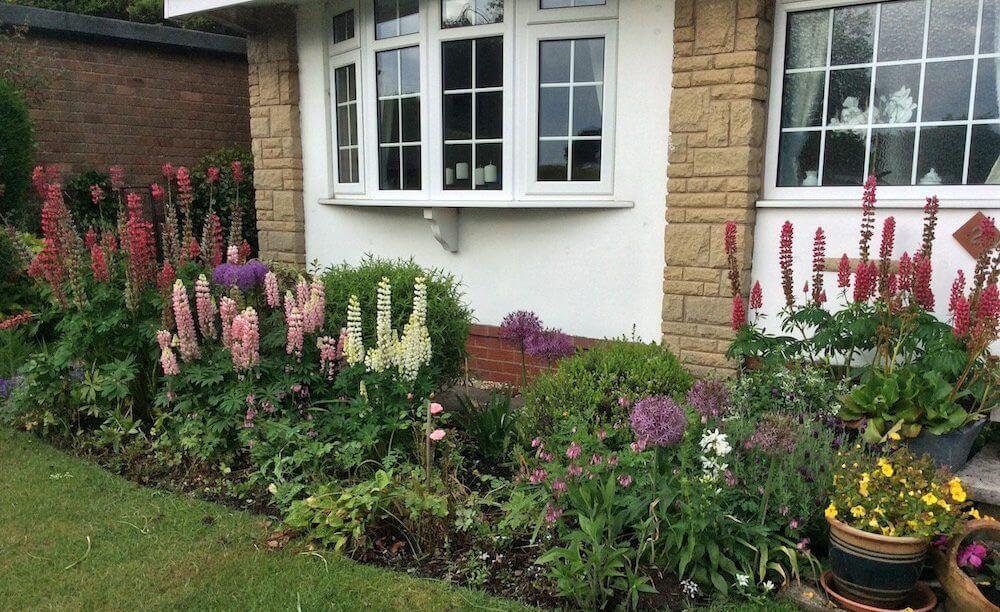
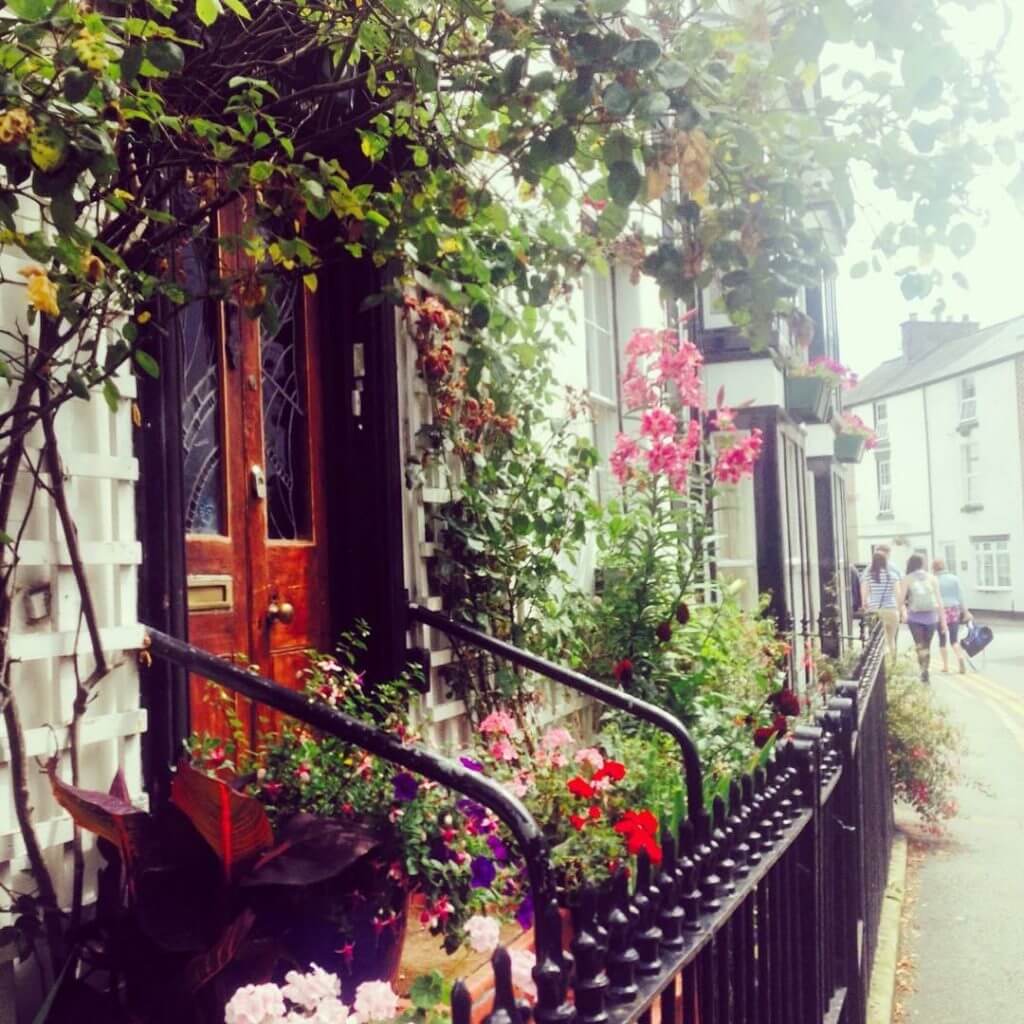
Looking at the photo below, you can see how someone has turned a front garden border into a lovely, lush cottage garden. In summer, this garden is in full colour with bee-friendly plants such as Lupins and Alliums for purple pops. Shrubs provide year-round colour and soften the front of the house. This would be a relatively high-maintenance garden, as seen by some of the spaces around the plants that have died back and have not yet been replaced. A cottage front garden works best on properties with traditional architecture — Victorian terraces, Edwardian semis, and country cottages all suit the relaxed, abundant planting style beautifully.
Below is an example of a terraced garden and how you can pack in an array of cottage planting to give that relaxed yet exciting front garden look. Climbers and even a tropical Canna give texture and drama. This is the style where mixing in Nepeta, hardy geraniums, Alchemilla mollis, and Erigeron karvinskianus at the front of borders works particularly well, creating a soft, billowing edge that spills gently over the path.
ii) Formal modern front garden
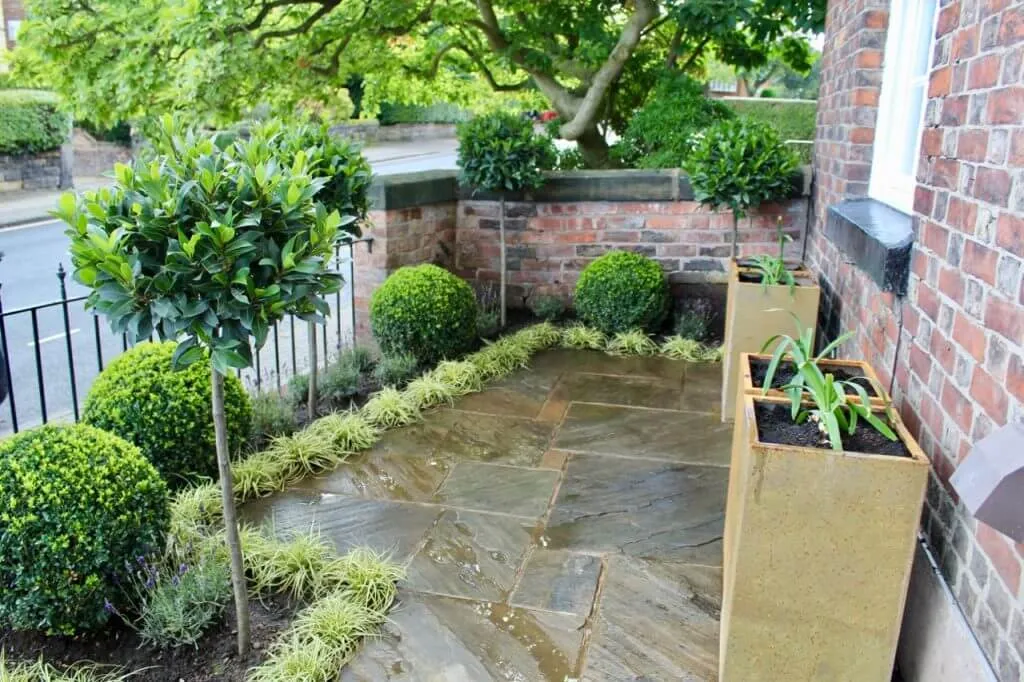
This example features about two-thirds hard landscaping, which gives plenty of room for two cars and a garden area. The use of evergreens and topiary gives a sleek, modern look. Yellow flag Iris provides a pop of colour throughout the scheme. Low hedges screen off the front door, and the Phormium tenax gives some height to the access route. For a truly contemporary front garden, consider using large-format natural stone paving, clean metal edging, and restricting the planting palette to just two or three species repeated throughout. Less is emphatically more in the formal modern style.
iii) Low-maintenance front garden
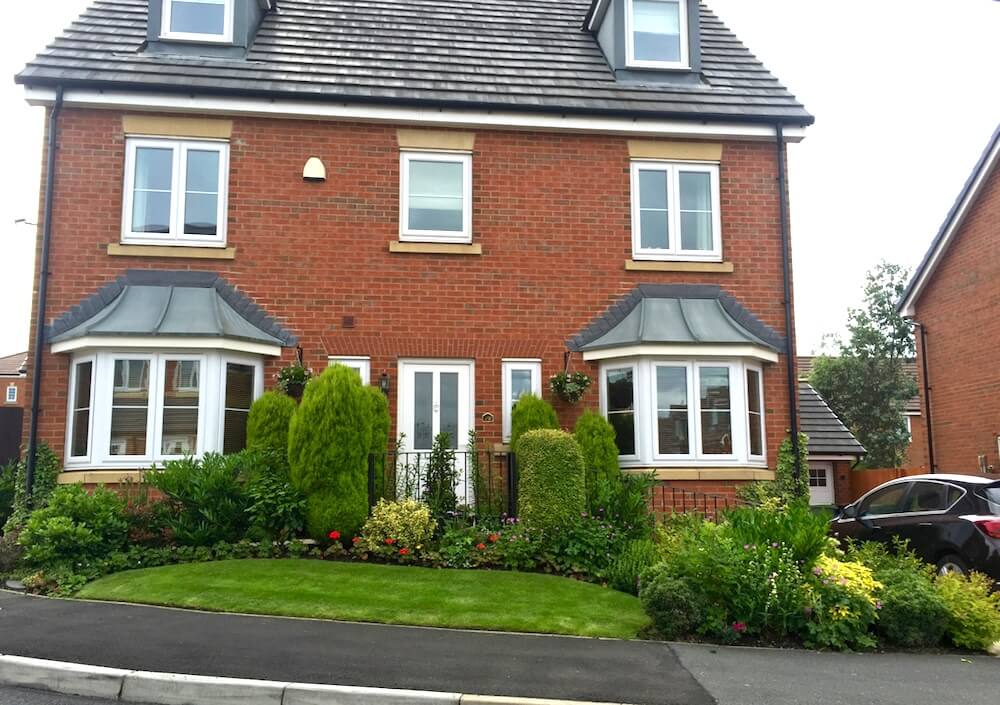
This garden may look very detailed, but the plants chosen make it low-maintenance. The use of Conifers, Viburnum, and herbaceous perennials gives a real, lush look with minimal effort on the gardener’s part. The lawn is present but small enough to mow quickly. Again, access is laid out by the metal fence leading to the front door, with planting that screens and softens the house’s brickwork.
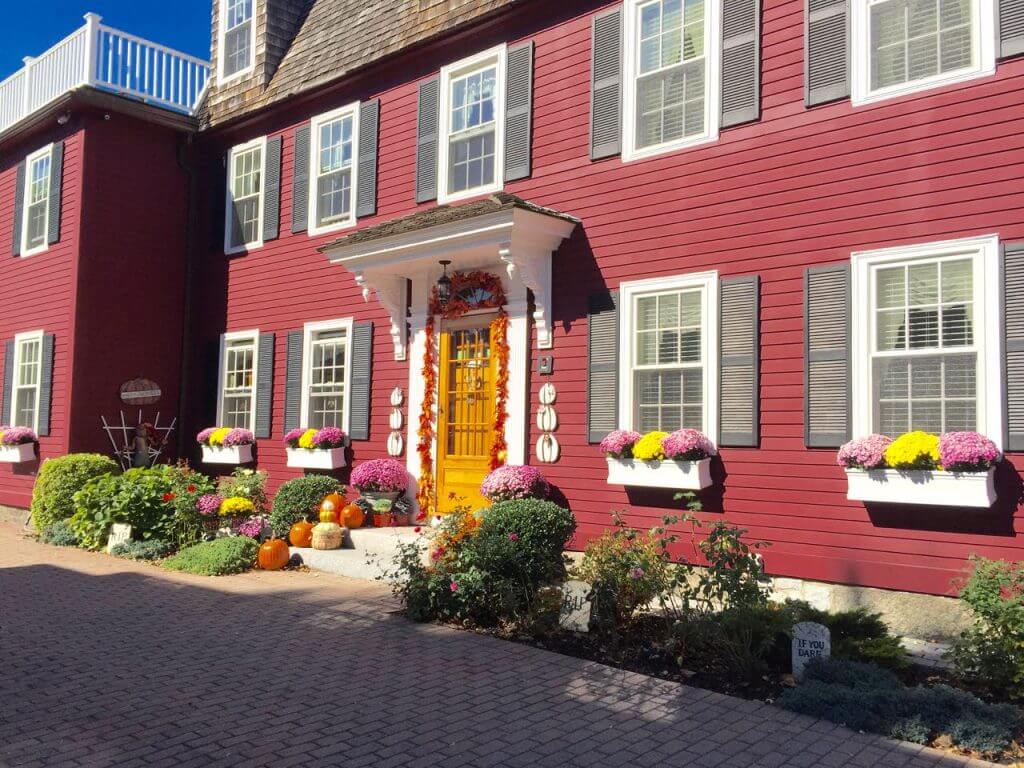
The above is another low-maintenance but high-impact garden. Using evergreen shrubbery for year-round structure, but window boxes with brightly coloured Chrysanthemums allow you to change the colour each season. This is a practical and very effective approach for busy households: the permanent planting does the structural work, and the containers provide the seasonal colour without requiring any bed maintenance.
Frequently asked questions about front garden design
Do I need planning permission to pave my front garden?
In England, you need planning permission if you want to lay more than 5 square metres of impermeable paving in your front garden. Permeable paving, gravel, and other porous surfaces are exempt from this rule. This was introduced following the 2007 floods, when paved-over front gardens were identified as a significant contributor to surface water runoff. Always check with your local planning authority before starting work.
What are the best low maintenance plants for a front garden?
The best low maintenance front garden plants are tough evergreen shrubs that look good all year without constant attention. Choisya ternata (Mexican orange blossom), Viburnum tinus, Pittosporum tenuifolium, Sarcococca confusa, and Photinia ‘Red Robin’ all provide structure, flowers, or fragrance with minimal pruning. Add hardy geraniums, Nepeta (catmint), and Erigeron karvinskianus as perennial fillers that return every year without replanting.
What can I do with a small front garden UK?
Small front gardens benefit from simplicity and clever use of vertical space. Choose one focal point such as a small tree (Amelanchier or Pyrus ‘Chanticleer’) and underplant with no more than five or six plant varieties. Grow climbers up walls and fences to add height without taking up ground space. Use large pots rather than narrow beds, and keep the colour palette restrained. The 3, 5, 7 rule for plant quantities prevents the garden looking scattered and fussy.
What should I plant in a front garden for year-round colour?
Aim for 60 to 80 per cent evergreen plants as your foundation. Sarcococca confusa flowers in winter, Camellia blooms in early spring, Choisya ternata in late spring, lavender and Nepeta in summer, and Pyracantha berries carry through autumn and into winter. Add spring bulbs (crocus and daffodils) beneath deciduous shrubs, and Erysimum ‘Bowles’s Mauve’ for near-continuous flowering from February to midsummer.
How can I make my front garden look nice on a budget?
Focus on the highest impact changes first. Weed, edge borders, and sweep paths for an instant lift at zero cost. Paint the front door a bold colour. Buy reduced-price plants from garden centre sales in autumn. Grow lavender, hardy geraniums, and Erigeron karvinskianus from seed or cuttings — near free. Use gravel instead of expensive paving. A £20 bag of crocus bulbs planted in autumn delivers a spectacular spring display the following year.
What is the best hedge for a front garden?
The best front garden hedge depends on your priorities. For year-round green, choose privet (Ligustrum ovalifolium) or Portuguese laurel (Prunus lusitanica). For pollution filtering near busy roads, privet and Photinia ‘Red Robin’ are proven performers. For wildlife value, native mixed hedging of hawthorn, blackthorn, and hornbeam supports the most species. For low clipped formality, yew (Taxus baccata) or Phillyrea are reliable alternatives to box that resist blight.
How do I design a front garden with parking?
The key is to avoid covering the entire area in hard surface. Use twin-track paving (two strips for car wheels with planting between) or permeable materials like gravel over stabilisation grids, reinforced grass, or permeable block paving. Edge the parking area with planting beds at least 30cm deep. Even a narrow border of lavender or catmint along a driveway transforms the space. Remember that more than 5 square metres of impermeable paving requires planning permission in England.
Need front garden design help?
My online garden consultations are designed to give you expert, tailored advice to transform your outdoor space — no matter where you are. Whether you’re struggling with layout issues, unsure about plant choices, or just need a fresh perspective from an award-winning Chelsea garden designer and BBC Garden Rescue presenter, I’ll help you create a front garden that’s both practical and beautiful.
✅ Personalised design solutions — I will assess your space and provide bespoke recommendations that suit your style, budget, and needs.
✅ Planting advice — Expert guidance on the best plants for your soil type, climate, and maintenance preferences.
✅ Problem-solving support — From awkward spaces to drainage issues, I will help you tackle any garden challenge with confidence.
✅ Save time and money — With a clear plan, you will avoid costly mistakes and get the most out of your garden from the start.
✅ Sustainable and wildlife-friendly ideas — I love creating gardens that support nature while being easy to maintain.
Front garden design summary
Designing a front garden is a rewarding process that enhances your home and creates a welcoming outdoor space. Whether you prioritise aesthetics, functionality, or sustainability, careful planning and thoughtful plant selection will ensure a stunning and practical result. Take your time, experiment with layouts, and — most importantly — enjoy the process of creating your perfect front garden. If you need extra help, why not get in touch with me for a garden design consultation? It can help you save hours of frustration in getting the right design layouts, planting options, and material choices.
By following these Garden Ninja principles, you’ll have a front garden that not only looks fantastic but is also easy to maintain and genuinely beneficial for wildlife.
Lee Burkhill, known as the Garden Ninja, is an award-winning garden designer and horticulturalist with over 20 years of professional garden design experience and a Chelsea Flower Show award to his name. A qualified RHS professional, Lee specialises in sustainable garden design and practical horticultural advice. He designs and presents on BBC1’s Garden Rescue and in leading gardening publications. Lee combines decades of hands-on gardening knowledge with professional design qualifications to help gardeners create beautiful, functional outdoor spaces.