Best Cordless Garden Tools UK 2026: A Garden Designer’s Complete Guide
Lee Burkhill: Award Winning Designer & BBC 1's Garden Rescue Presenters Official Blog
Beginner level
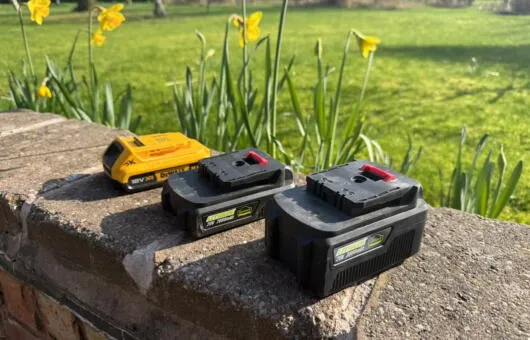
Thinking of making the switch to battery powered cordless garden tools? Well you've come to the right place. I've been using battery powered tools since they were first released over 12 years ago and have tried them all! This guide will explain the differences between the brands, the battery sizes and capacities. It will also show you how to keep them running longer and stronger with some of my top battery tips!
The shift from petrol-powered to cordless battery-powered garden tools has been one of the most significant changes in UK domestic gardening over the last decade. When I started in garden design, petrol was the professional standard and battery tools were the weak compromise you gave to someone who did not know better. That is completely reversed now, which makes gardening with tools far easier and safer, in my expert opinion!
The cordless tools on the market in 2026 are genuinely capable of handling everything a typical UK domestic garden demands. In many cases, they are better, lighter, quieter, and lower-maintenance, without the faff of petrol and two-stroke oil.
The question I get asked most often is not “which hedge trimmer should I buy” but rather “which platform should I buy into. Because once you commit to a battery system, switching is expensive. In this guide, I will walk you through that decision properly, then give you my honest recommendations across the tool categories that matter most for UK gardens.
Affiliate disclosure: This guide contains affiliate links. If you purchase through these links, Garden Ninja earns a small commission at no extra cost to you. I only ever recommend products I have personally used or would confidently recommend to my clients.
For most UK domestic gardens, yes — and in some respects better. I would not tell a professional landscape contractor with half an acre of formal hedging to ditch their petrol hedger tomorrow. But for a typical UK back garden, even a reasonably large one with established hedges and mixed borders, modern 18V to 40V battery tools will handle the work with ease. Especially if you choose one tool brand and buy multiple interchangeable batteries!
The practical advantages of cordless tools for UK domestic gardeners are significant. No fuel to store or mix, no pull-start frustration on cold mornings, no servicing of carburettors and air filters. They start first time, every time.
They are considerably quieter, too. Which is relevant if you are in a terraced street where starting a petrol leaf blower at 8 am would make you unpopular. And the weight reduction on tools like hedge trimmers makes a real difference over a long session and helps stop your arms from giving up as quickly!
Where petrol still has the edge is continuous runtime on very large properties, and raw cutting power for the most demanding commercial tasks. For anything below that level, the battery version of the same tools does the job. Modern batteries from premium platforms hold a charge long enough for a typical garden maintenance session without needing a mid-session recharge. Still, multiple compatible, interchangeable batteries completely remove this issue!
🌿 Lee’s Professional View
On Garden Rescue we use a mix of tools depending on the job. But for my own clients’ maintenance visits and the work I do in my own garden, I have used cordless tools almost exclusively for the last four years. The convenience factor alone is worth it — and the tools genuinely perform. The key is investing in a quality platform rather than buying a mixed bag of budget brands that share nothing.
Battery Platforms Compared: Which Ecosystem to Choose
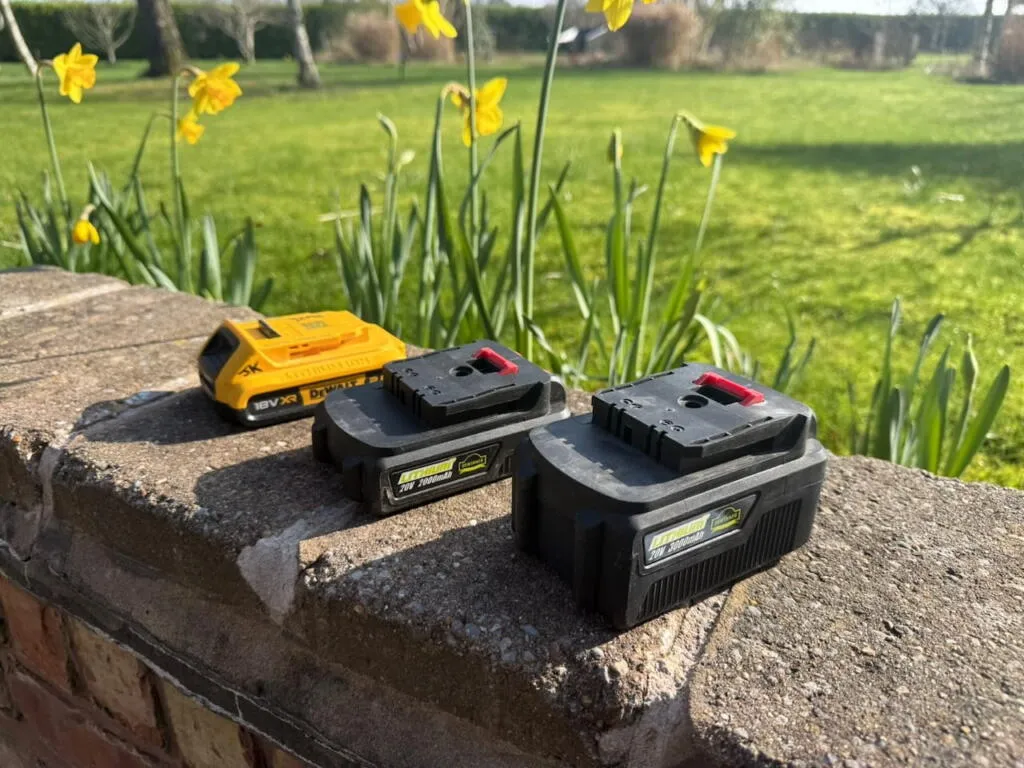
This is the most important decision in this whole guide. Each manufacturer uses a proprietary battery system, and batteries from different brands are not compatible. If you buy a Ryobi hedge trimmer and later want a Ryobi leaf blower, you can share batteries between them. But you cannot use that Ryobi battery in a Bosch trimmer, or vice versa. Choose your platform first, then choose your tools — not the other way around.
Ryobi ONE+ (18V) is the best-value platform in the UK, with over 200 compatible tools available at B&Q, Argos, and Amazon. A 25-year cross-compatibility guarantee means batteries you buy today will still work in tools a decade from now, which is a genuinely meaningful commitment. EGO Power+ (56V) is the premium alternative — genuinely petrol-equivalent power, a five-year tool warranty, and a ten-year battery warranty. The entry cost is higher, but for larger, more demanding gardens, it is the cordless choice I would make.
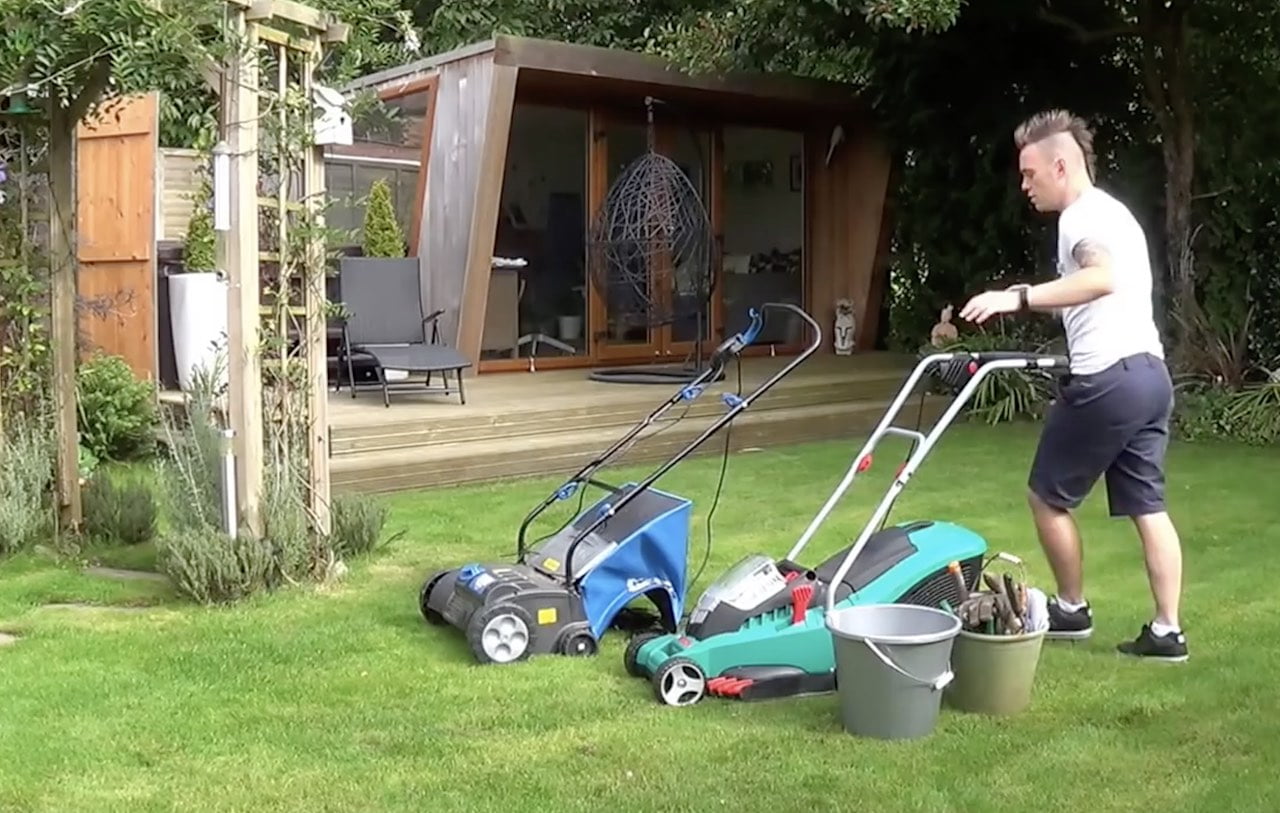
Bosch Power For All (18V) is unique in being a cross-brand alliance — the same battery works in Bosch, Flymo, and Gardena tools, making it the logical choice for anyone already in the Bosch DIY ecosystem. In fact, I’ve got a 12-year-old electric battery Bosch lawn mower that is still going strong!
Stihl AK/AP (36V)carries serious professional credibility and a 10-year battery life claim, but is only available through the dealer network rather than on Amazon or B&Q — worth considering if you want professional-grade tools and have a local dealer.
Makita LXT (18V/36V)bridges the garden and trade tool markets and is the most durable platform, with a vast range of compatible tools. This is the brand used by most landscapers I have worked with, given the interoperability of the batteries.
Greenworks (24V to 48V) is a good-value alternative to EGO for medium-sized gardens, with eco-focused positioning and a growing UK range. Also hard to miss as their products are lime green, not to be confused with Ryobi’s green! Burt, it does mean you’re more likely to find either of these in a dark shed or garage.
For most UK gardeners starting fresh, Ryobi ONE+ is the sensible first platform. If you have a larger, more demanding garden and budget is not the primary concern, EGO Power+ is where I would go. If you already own Bosch DIY tools, staying in the Power For All ecosystem makes obvious sense.
What Voltage and Battery Capacity Actually Mean
Battery specifications can feel confusing. Here is what actually matters for garden tools.
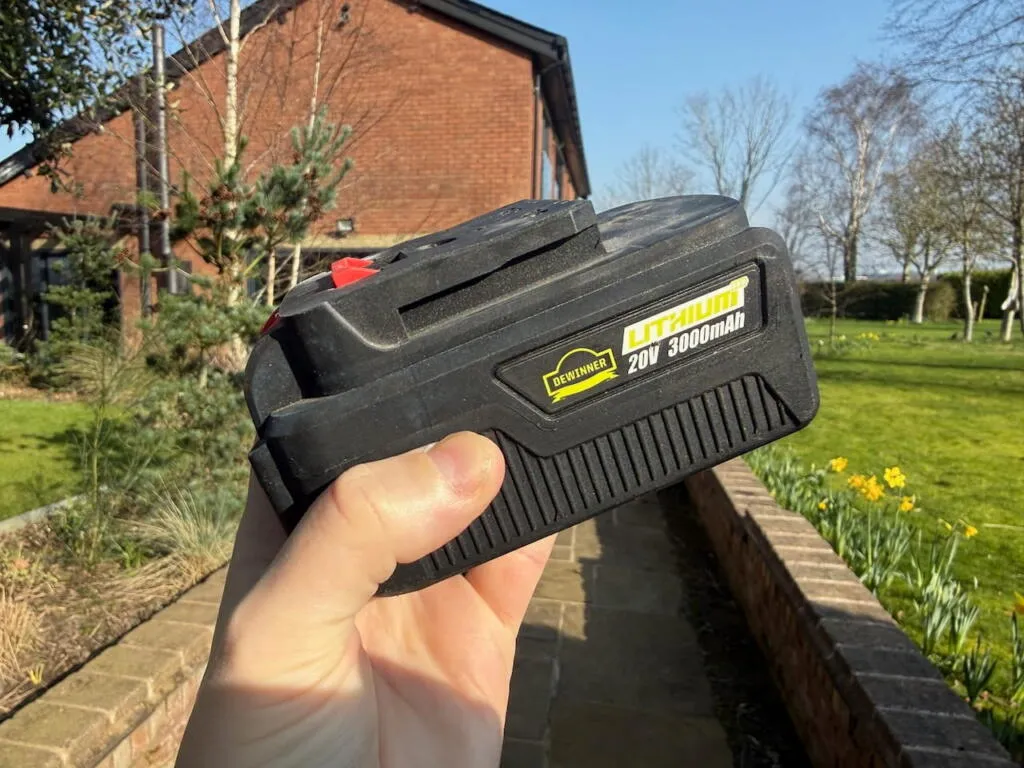
Voltage (V) determines power — a 40V tool will cut through thicker material and maintain speed under load better than an 18V equivalent.
Ampere-hours (Ah) determines runtime — a 4.0Ah battery in the same tool will last roughly twice as long as a 2.0Ah battery.
The sweet spot for most garden tools is an 18V to 40V platform with a 4.0Ah battery.
Many manufacturers offer twin-battery systems in which two 18V batteries are connected in series to deliver 36V power — Ryobi and Makita both use this approach. It is a cost-effective way of stepping up to higher voltage without committing to an entirely separate battery type. The 4.0Ah battery is the consensus recommendation across professional reviews — heavier than a 2.0Ah, but the runtime difference more than justifies the weight for garden work.
Best Cordless Hedge Trimmers
The hedge trimmer is the tool most UK gardeners need first. Domestic hedges — privet, laurel, box, yew, beech — need cutting at least once and often twice a year, and doing it by hand with long-handled shears is hard work for anything more than a small boundary. A quality cordless hedge trimmer transforms a sweaty afternoon into a manageable hour.
🏆 Best Overall
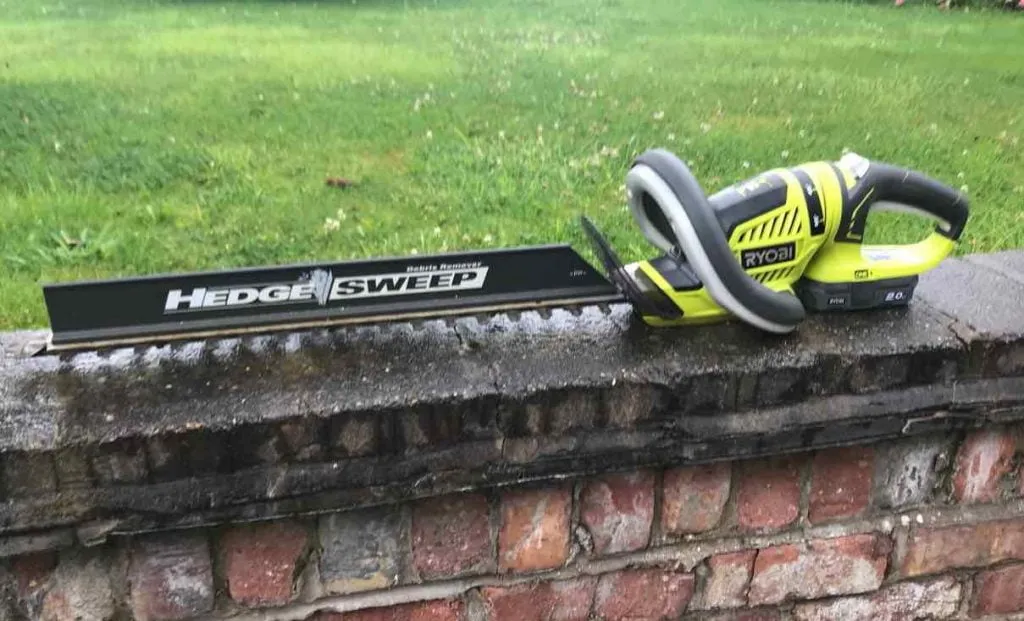
Ryobi ONE+ OHT1845 18V Hedge Trimmer
Around £85 to £101 (bare tool) · £100 to £130 with battery
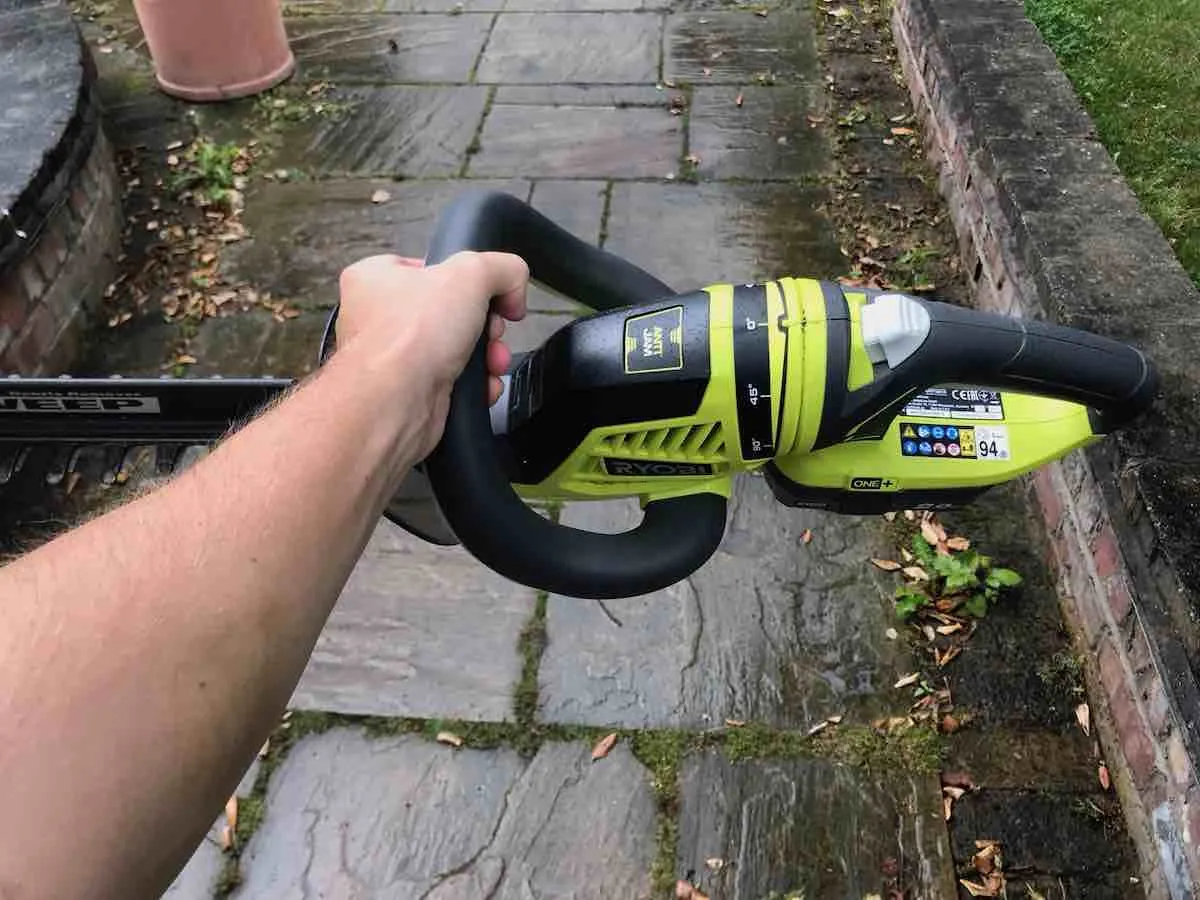
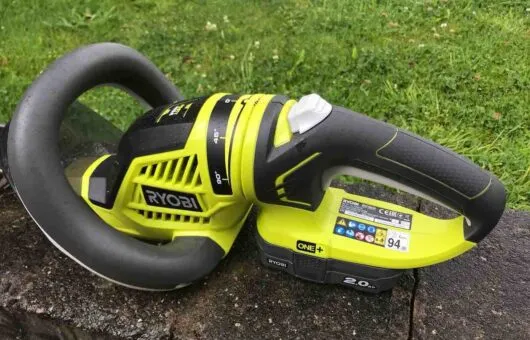
This is my first recommendation for most UK domestic gardeners. The Ryobi ONE+ hedge trimmer handles typical domestic hedges — privet, laurel, box, beech — with ease. The 45cm blade length suits hedges up to about 1 metre deep. It is lightweight at around 2.6kg, which matters enormously when you are holding it above your head trimming the top of a garden boundary. The rotating rear handle allows you to cut at angles without repositioning yourself, which is a genuinely useful feature rather than a marketing gimmick. Being ONE+ compatible means any Ryobi battery from your existing collection will work.
Best for: Domestic gardens with established hedges, Ryobi platform users, anyone wanting a light, capable trimmer at a sensible price.
If budget is your primary consideration, the VonHaus G-Series consistently earns its position as the best-value cordless hedge trimmer in the UK market. BBC Gardeners’ World awarded it Best Buy in the budget category, and for light to medium domestic use — trimming a small privet or box hedge, tidying shrub borders — it performs well beyond its price point. For a first hedge trimmer for a small garden, or as a spare tool, it represents excellent value. The limitation is battery capacity — expect around 20 to 25 minutes of cutting before you need to recharge, which is enough for most small gardens.
Best for: Small gardens, light hedging work, budget-conscious buyers, first hedge trimmers.
The Bosch UniversalHedgeCut 18-55 steps up in both blade length (55cm) and cutting capacity, handling stems up to 22mm thick. Bosch build quality is consistently excellent — these tools feel solid in a way that budget alternatives do not. The Power For All battery compatibility means if you already own any Bosch 18V DIY tool, your existing batteries work immediately. The telescoping version (AdvancedHedgeCut 36-75T) extends to reach taller hedges without a ladder — well worth considering if you have a tall formal hedge.
Best for: Medium to large gardens, Bosch platform users, gardeners with taller or thicker hedges.
I will be honest: I was late to appreciate a good leaf blower. For years, I considered them slightly lazy, preferring to use a much quieter rake, but after using a quality cordless blower to clear a large garden of Autumn leaves in twenty minutes that would have taken two hours with a rake, I am completely converted. They are also excellent for clearing paths, blowing debris out of gravel areas, and clearing out gutters with the right attachment.
🏆 Top Pick
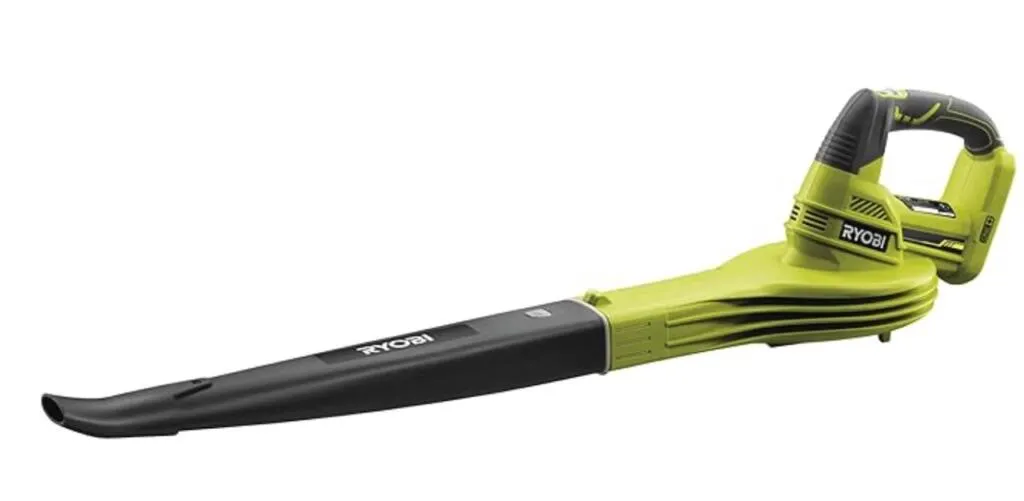
Ryobi ONE+ PCL510B 18V Leaf Blower
Around £50 to £65 bare tool
The Ryobi PCL510B is the leaf blower I would recommend to most ONE+ platform users as a first purchase. Compact, genuinely lightweight, and capable enough for typical garden leaf clearance. The turbine-style blower nozzle focuses the airflow effectively. It will not win any top speed tests against premium tools but it clears a typical back garden patio and lawn area without drama. As a bare tool it is excellent value if you already have ONE+ batteries.
Best for: Ryobi ONE+ users, typical domestic leaf clearance, light to medium garden tasks.
For gardeners who want to do more than blow leaves around, a 3-in-1 blower, vacuum, and mulcher is genuinely useful. The Swift 40V converts between modes easily and the mulching function shreds collected leaves to roughly a tenth of their volume — making them immediately usable as mulch rather than needing bagging and disposal. For a garden with large deciduous trees, the mulching function alone justifies the additional cost. Autumn leaf clearance in UK gardens is one of the most labour-intensive recurring tasks, and this tool addresses it comprehensively.
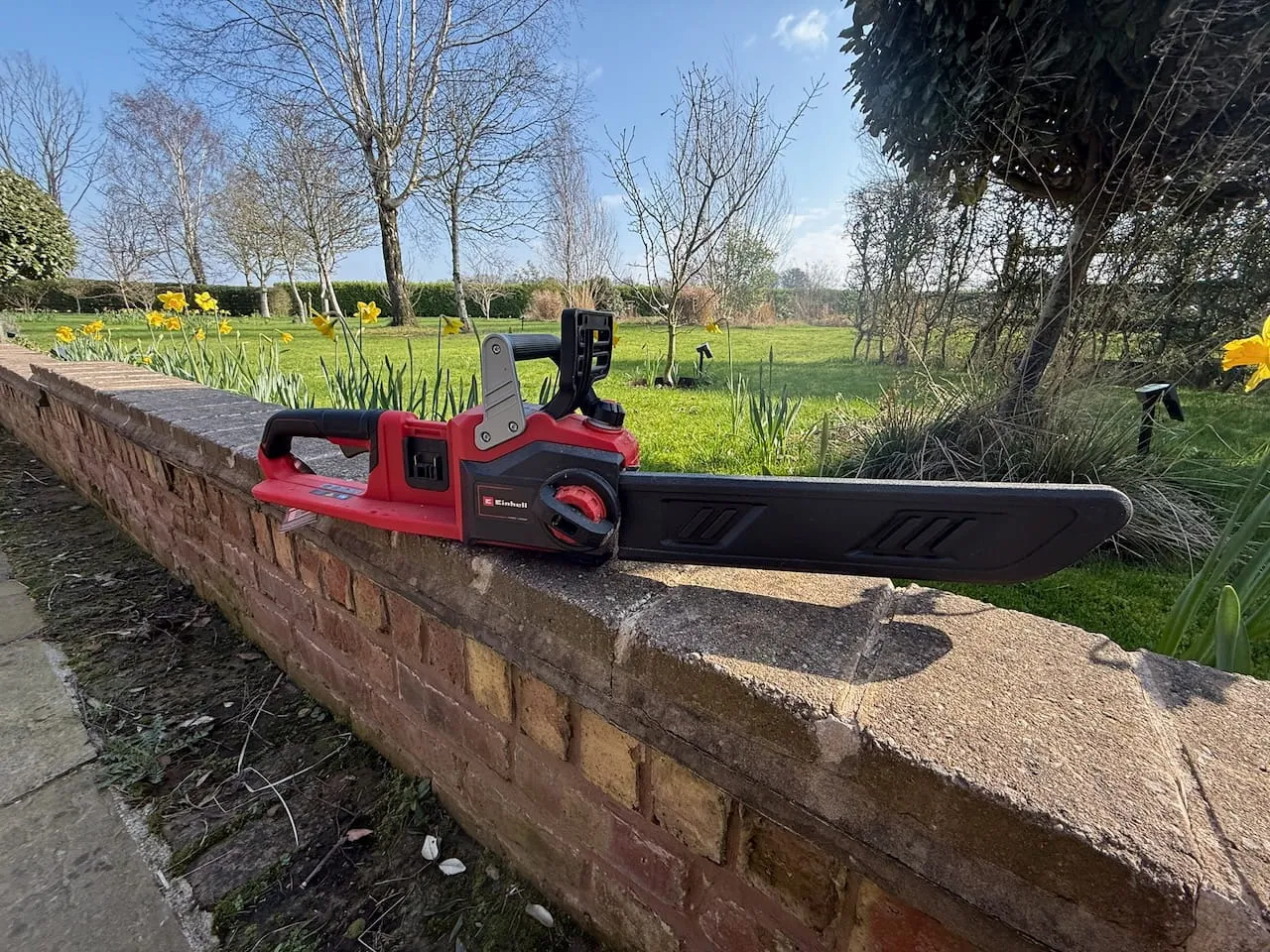
The cordless pruning saw category has exploded in the last three years. Mini chainsaws have become affordable enough that many domestic gardeners now own one, and they are genuinely transformative for tasks like cutting back overgrown shrubs, sectioning fallen branches, and managing small trees. The key distinction to understand is between a dedicated cordless pruning saw — essentially a compact, handheld chainsaw — and the many budget mini chainsaws that have flooded the market. The budget mini chainsaws look appealing at £25 to £50, but the safety design and build quality of unbranded versions are genuinely concerning. I would always steer people towards a named platform tool for this category.
🏆 Best Cordless Pruning Saw
Ryobi RY18PSA 18V ONE+ Cordless Pruning Saw
Around £100 bare tool · £130 to £150 with battery
The Ryobi RY18PSA is a 150mm bar pruning saw — compact enough to use one-handed for overhead work and powerful enough to handle branches up to about 150mm diameter, which covers the vast majority of domestic pruning tasks. It uses Ryobi ONE+ batteries, so existing platform users can pick this up as a bare tool at a very reasonable price. The chain is tool-free tensionable, which I appreciate enormously — getting the tension right without needing to find a screwdriver is a small thing that makes a real practical difference.
Best for: Ryobi ONE+ users, branch management, cutting back established shrubs, occasional small tree work.
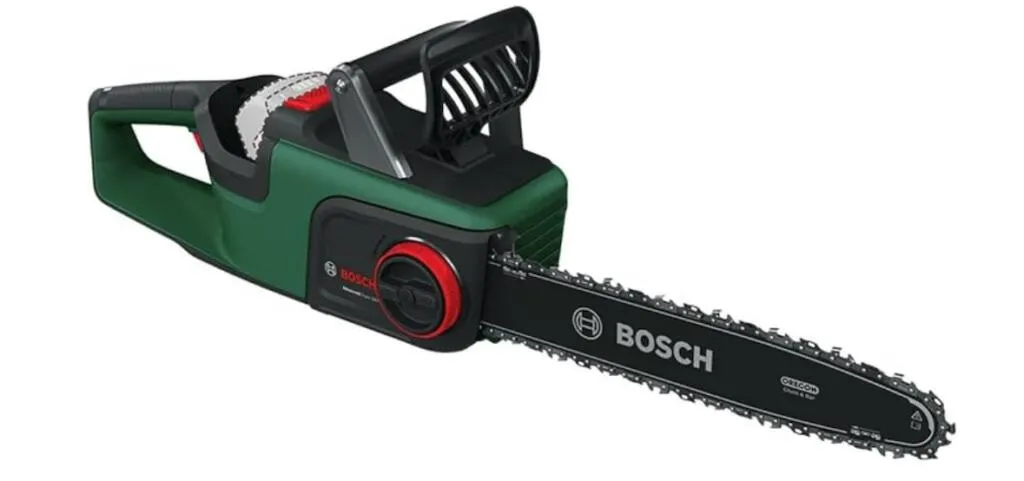
The Bosch EasyChain is a step up from the Ryobi pruning saw — a 200mm bar giving more cutting capacity for larger branches and occasional small tree work. Bosch safety design on this tool is excellent, with a chain brake and low kickback chain as standard — important features that cheaper alternatives often omit. Power For All battery compatible. For gardeners managing mature garden trees or doing annual renovation pruning of established shrubs, this is the tool I would reach for.
Best for: Larger branch work, Bosch Power For All platform users, mature garden management.
Battery secateurs are a category I have watched develop with interest over the last few years. They are particularly valuable for anyone managing a large volume of pruning — fruit tree orchards, Rose gardens, and continuous deadheading through a long summer season. The motor does the cutting work, dramatically reducing repetitive strain on hand and wrist joints. They are not yet a replacement for quality hand secateurs, such as Felco, in my experience, but for volume work or for gardeners with significant joint limitations, they deserve serious consideration.
Best Battery Secateurs
Stihl ASA 20 Battery Secateurs
Around £180 to £220
Stihl’s battery secateurs represent the most professional-grade option currently widely available in the UK. A 15mm cutting capacity, consistent cutting speed regardless of stem hardness, and Stihl’s typically excellent build quality. The battery is a compact inline unit that adds minimal weight and bulk compared to some older designs. These are not a casual purchase — at this price they are for gardeners who prune seriously and regularly. But for that audience, the reduction in hand fatigue over a long pruning season is genuinely significant.
Best for: Serious pruning volumes, rose gardens, fruit tree orchards, gardeners with significant joint limitations.
Fifteen years of visiting UK gardens as a professional designer means I have walked into a lot of sheds, opened a lot of tool cupboards, and had a lot of conversations that start with “I bought this last year, and I am already disappointed with it.” The frustration is almost always avoidable, and it almost always comes back to one of the same handful of mistakes. If you are about to invest in a cordless tool platform, these are worth knowing before you spend a penny.
Buying tools from different brands without checking battery compatibility. This is the most common and most expensive mistake I see. Someone buys a Ryobi hedge trimmer because it was on offer, then a Bosch leaf blower because a neighbour recommended it, then a VonHaus pruning saw because the price was right. They end up with three tools, three incompatible batteries, three chargers taking up shelf space, and no cost savings from building within a single platform. The whole point of a battery ecosystem is that one battery powers everything. Buy into a platform first and let that decision guide every tool purchase that follows.
Choosing the cheapest battery in the range. Every major platform offers batteries at multiple capacities, and the entry-level 2.0Ah battery is always the most affordable. It is also the wrong choice for most garden tasks. A 2.0Ah battery in a cordless hedge trimmer gives you between 15 and 25 minutes of cutting, depending on conditions.
For a small garden with a modest hedge that may be enough, but for anything more demanding, you will find yourself stopping to recharge at exactly the wrong moment. The 4.0Ah battery is the right choice for the vast majority of garden tasks,s and the price difference between a 2.0Ah and 4.0Ah battery is rarely more than fifteen or twenty pounds. That is a small premium for genuinely doubled runtime.
Buying an underpowered trimmer for a demanding hedge. Laurel, leylandii and privet are the three plants most likely to expose the limitations of an underpowered hedge trimmer. All three produce thick, fast-growing stems that require real cutting capacity. I regularly see gardeners with budget 18V trimmers struggling through mature laurel, forcing the blades, stalling the motor, and blaming the tool for what is really a mismatch between the tool and the task. If you have a large or well-established laurel hedge, a 36V tool or a premium 18V model with a wide cutting gap is not an extravagance. It is the right specification for the job.
Storing tools and batteries in a damp or unheated outbuilding. As covered in the battery care section above, the British garden shed is not a good environment for lithium-ion technology over winter. But beyond the batteries, tools left in damp conditions with grass clippings and sap on the blades will develop corrosion and rust, significantly shortening their working life. A few minutes of cleaning after each use and proper dry storage over wintermakes an enormous difference to how long a set of tools lasts. Wipe blades down, clear debris from vents and guards, and store tools with the battery removed.
Overlooking the bare tool option once you are on a platform. I see this less often, but it is worth mentioning because it represents real money left on the table. Once you own two or three batteries from a platform, every additional tool in that range can be purchased as a bare tool, typically saving 30 to 50 pounds compared to the battery-and-charger bundle. New platform users must purchase the starter bundle. Established platform users who are adding a pruning saw or a second hedge trimmer to their collection should always look for the bare tool version first.
🌿 Lee’s Professional View
The platform decision is genuinely the most important thing I would ask anyone to think carefully about before buying their first cordless tool. Get that right and every subsequent purchase becomes easier and cheaper. Get it wrong and you end up with an incompatible collection of tools that never quite does what you need. Spend an hour researching which platform suits your garden and your likely future tool needs before you buy anything. It is the best hour you will invest in your garden toolkit.
How to Make Your Batteries Last: What Every Cordless Tool Owner Needs to Know
The battery is the most expensive single component in any cordless tool system, and it is the one part most people treat as an afterthought. I have seen gardeners spend £400 on a platform of electric garden tools like Ryobi, only to destroy the battery runtime in 18 months through entirely avoidable habits and neglect. A premium lithium-ion battery from Ryobi, EGO, or STIHL should give you five to ten years of reliable service. Whether it actually does depends almost entirely on how you treat it between uses.
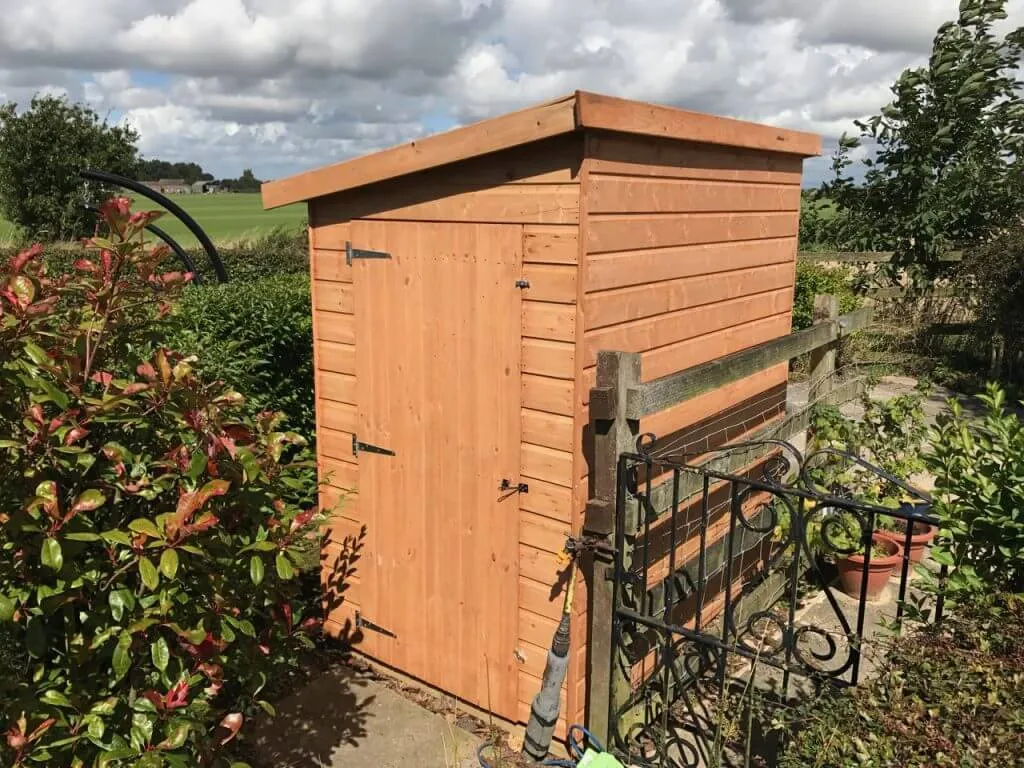
The single most damaging thing you can do to a lithium-ion battery in a UK garden context is store it in an unheated shed or garage over winter. This is what most people do, and it is where batteries quietly die. Lithium-ion cells are sensitive to temperature extremes, and a British winter in an uninsulated outbuilding is genuinely harmful. When cells are exposed to sustained cold, their internal chemistry slows, capacity drops, and if the battery is also sitting flat or close to empty, the degradation can become permanent.
The battery will not fail immediately. It will simply hold less and less charge each spring until one day it barely powers twenty minutes of hedge trimming that used to take forty. Bring batteries indoors for winter storage. Under the stairs, in a utility room, or in a cool corner of the kitchen are all fine. It takes thirty seconds, and it can add years to the life of a battery that costs you fifty or eighty pounds to replace.
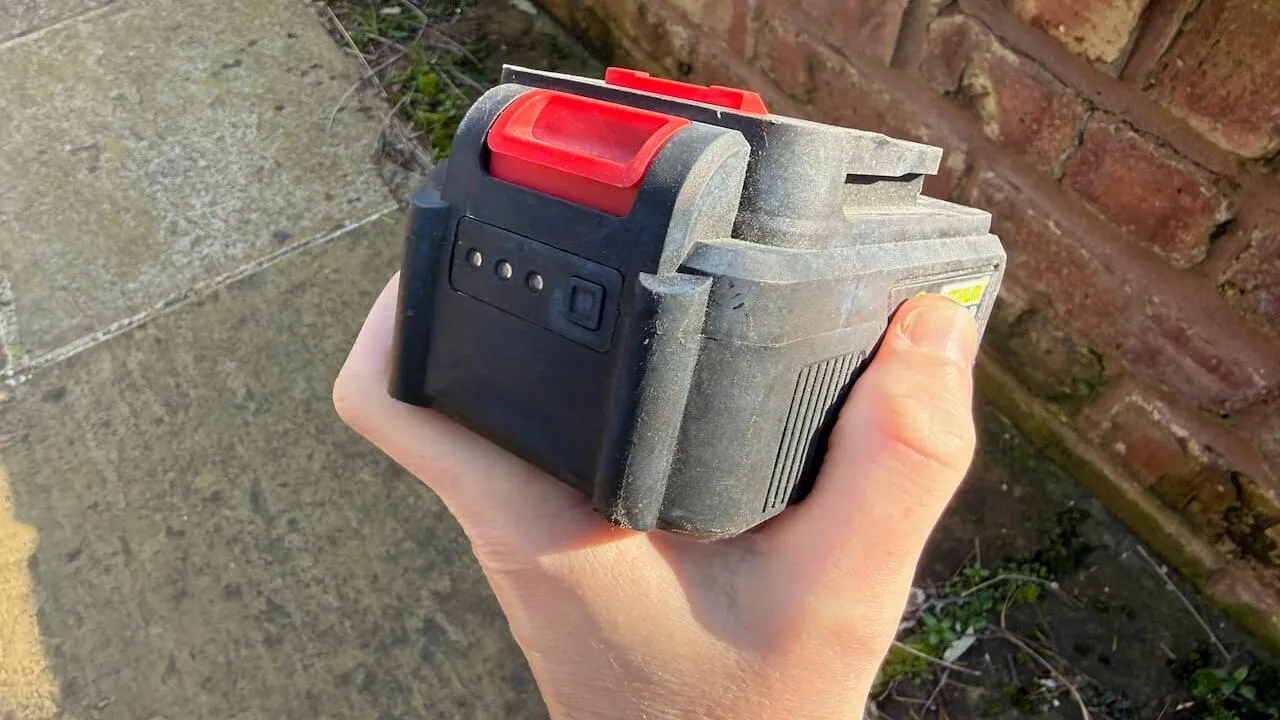
The correct storage charge level is one that all major manufacturers agree on: 40 to 60 per cent. Most batteries with an LED indicator will show this as two of four lights out. Never store a battery fully charged or completely flat for extended periods, as both states put stress on the cells.
If you are putting tools away at the end of October, run the battery down to around half charge before storage, then bring it indoors. Check it once in January or February and give it a brief top-up charge if the indicator has dropped. That is genuinely all the winter care a quality battery needs.
Charging habits matter throughout the year, too. The temptation to leave a battery on the charger overnight or permanently plugged in between uses is one I would strongly discourage. Modern chargers from reputable brands have built-in overcharge protection, but consistently leaving batteries on charge for hours beyond what is needed still generates heat in the cells, and heat is another great enemy of battery longevity, alongside cold.
Charge the battery, remove it when done, and store it separately from the tool. It is also worth knowing that charging a very cold battery is actively harmful rather than merely unhelpful. If you have brought a battery in from a cold shed on a January morning, let it reach room temperature before charging it. Charging below around 5 degrees Celsius can cause internal lithium plating that permanently reduces capacity.
Finally, always buy the genuine manufacturer’s battery rather than a cheap third-party alternative. I understand the appeal of a £15 replacement that claims full compatibility. Still, the battery management electronics in a high-quality lithium-ion pack do a great deal of careful work to protect both the battery and the tool. Cheap alternatives frequently lack these protections, which can damage the tool itself as well as failing quickly. A genuine Ryobi or Bosch battery costs more upfront and represents genuine value over five years. The cheap alternative often costs more in the end.
🌿 Lee’s Professional View
I keep all my cordless tool batteries in the house from November through to March. It sounds like an odd habit but it has genuinely made a difference to battery longevity across my tool collection. My oldest Ryobi ONE+ batteries are now six years old and still hold a very usable charge. The tools live in the shed. The batteries come inside. That one change is probably worth more than any other battery care advice I could give you.
Common Questions Answered
How long do cordless garden tool batteries last?
Premium brand batteries (Ryobi, Bosch, EGO, Stihl) typically offer 5 to 10 years of service life with normal use. The key is storage — batteries kept in a cold, damp garage over winter will degrade faster. Store at room temperature in a cool, dry location, and they will last well. Never store batteries fully flat — keeping them at 40 to 60% charge for long-term storage preserves cell health.
Can I use cordless tools in the rain?
Most cordless garden tools have an IPX4 water-resistance rating, which means they can handle light rain and splashing but are not designed for sustained exposure to heavy rain. I would not use power tools of any kind in heavy rainfall — both for the tool’s sake and your own safety. Drizzle and working immediately after a shower is generally fine with quality tools.
Are cordless hedge trimmers powerful enough for thick laurel?
Yes, with the right tool. Laurel is a demanding plant — thick, fast-growing stems with dense growth. A quality 18V trimmer with a good cutting gap (at least 19mm) will handle established laurel. For very thick, mature laurel, I would use a 36V tool or a platformthat offersg greater power delivery. Do not attempt to cut stems thicker than the tool’s rated maximum — you will strain the motor and make a poor cut.
What is the difference between a leaf blower and a leaf vacuum?
A leaf blower moves leaves from one place to another. A leaf vacuum sucks them up and collects them in a bag, usually mulching them in the process. A 3-in-1 tool does both, plus mulching. For most UK gardens, I recommend a 3-in-1 blower-vacuum-mulcher — the mulched leaves are immediately useful as border mulch, and the tool earns its keep in multiple ways.
What Next?
If you really want to amp up your gardening skills and make your garden beautiful, why not take one of my online garden design courses? Whether you want to take a crash course in a weekend or spend more time becoming a fully-fledged garden designer, I have courses for all abilities. That way, you can put all of your knowledge of full sun herbaceous perennials into practice in your own garden. The best thing is they are affordable, and you don’t need to go back to university — study at your own time and refer back to the course materials at any time for as long as you want. So what’s stopping you from creating the garden of your dreams?
Study Online Anywhere
Video Lessons
Quizzes
5 Sample New Build Garden Designs
Beginners guide to Planting
Certificate upon Completion
29
Garden Design Examples for Small Gardens: 30 Design Templates & Planting Plans
Garden Design Examples for Small Gardens: 30 Design Templates & Planting Plans: In this online gardening course, I’ll walk you through 30 fantastic garden designs, explaining the logic behind the layout, the plant choices, and take-home tips for applying them in your own garden.
Weekend Garden Makeover: A Crash Course in Design for Beginners
Learn how to transform and design your own garden with Lee Burkhills crash course in garden design. Over 5 hours Lee will teach you how to design your own dream garden. Featuring practical design examples, planting ideas and video guides. Learn how to design your garden in one weekend!
Garden Design for Beginners: Create Your Dream Garden in Just 4 Weeks
Garden Design for Beginners Online Course: If you want to make the career jump to becoming a garden designer or to learn how to design your own garden, this is the beginner course for you. Join me, Lee Burkhill, an award-winning garden designer, as I train you in the art of beautiful garden design.
Cordless garden tools have genuinely caught up with petrol for everything a typical UK domestic garden demands. The technology argument is settled. What matters now is making the right decisions before you spend any money.
Choose your platform before you choose your tools. Ryobi ONE+ is the smart starting point for most gardeners. EGO 56V is where to go if you have a large garden and want petrol-equivalent performance. If you already own Bosch power tools, stay in the Power For All ecosystem and save yourself money on batteries you already own.
Buy the 4.0Ah battery, not the 2.0Ah. The extra runtime is worth every penny of the small price difference, and you will not regret it mid-way through a hedge in August.
Bring your batteries indoors over winter. It takes thirty seconds, and it can add years to the life of something that costs fifty to eighty pounds to replace.
Get those three things right, and the rest largely takes care of itself. A well-chosen cordless platform, properly maintained, will reliably serve a UK domestic garden for a decade or more. That is genuinely good value, and considerably less faff than anything with a pull-start and a fuel tank.
Your subscription could not be saved. Please try again.
Your subscription has been successful.
Lee Burkhill
Lee Burkhill, known as the Garden Ninja, is an award-winning garden designer and horticulturist with over 30 years of gardening experience and 15 years as a professional garden designer. A qualified RHS (Royal Horticultural Society) professional, Lee specialises in sustainable garden design and practical horticultural advice. He designs and presents on BBC1’s Garden Rescue and in leading gardening publications. Lee combines three decades of hands-on gardening knowledge with professional design qualifications to help gardeners create beautiful, functional outdoor spaces.