For the garden you’ve already got, not the one you’re starting from scratch. Seven checklists and video lessons from BBC Garden Rescue’s Lee Burkhill, built to help you work out what’s worth keeping before you spend a penny.
69


Quick Answer
A potted Christmas tree goes brown mostly from drying out, either from being left neglected outdoors over summer or from too long indoors in warm, dry central heating. Once a conifer’s needles have died they will not turn green again, so the priority is stopping further browning through regular watering, good drainage and only bringing the tree in for the festive fortnight, rather than trying to revive growth that has already gone.
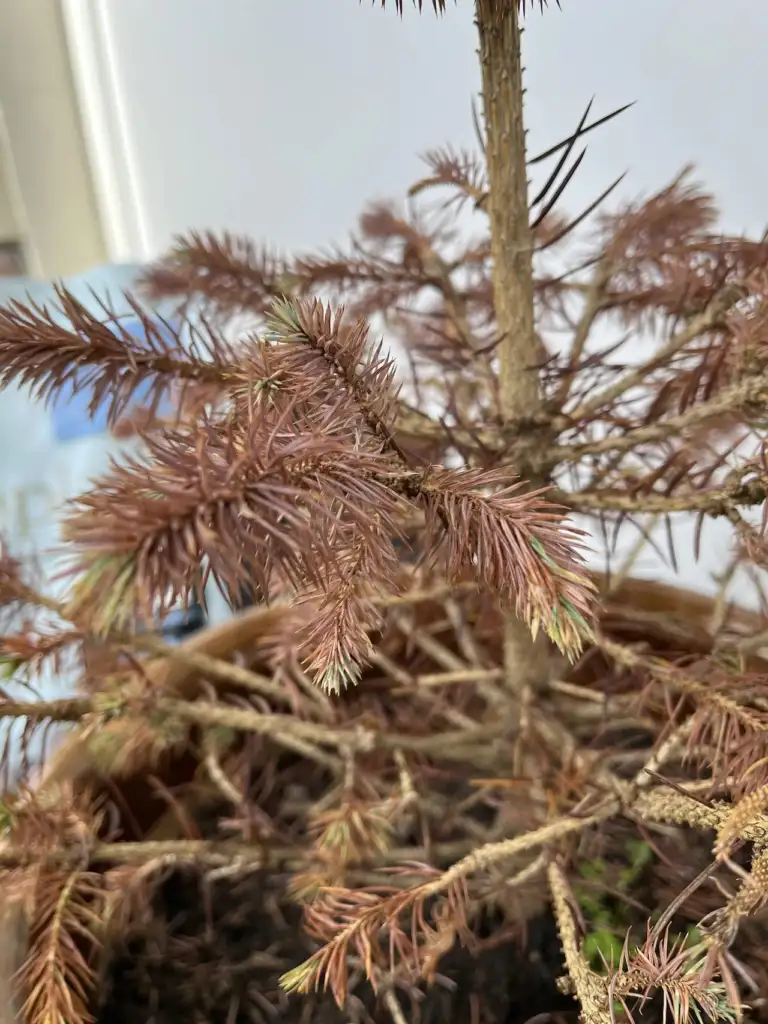
The honest answer sits somewhere between disappointing and manageable for most gardeners. A potted Christmas tree is not a houseplant, and it is not a garden shrub either; it is an outdoor conifer being asked to survive in a container for years on end! Which is a harder situation for the roots than being planted straight into the ground. You’re basically forcing a mature tree to stay small and healthy in the most restrictive container.
Most of the browning I see reported comes down to one of a small handful of causes, and in this guide I want to work through each of them properly: why it happens, what you can realistically do about a tree that has already started to brown, and how to change your routine for next year so you are not back here again in twelve months with the same rusty dry coloured branches.
Jump To
1. Why Potted Christmas Trees Go Brown 2. The Most Common Cause: Drying Out 3. Can Brown Needles Turn Green Again? 4. Root Bound and Pot Size Problems 5. Bringing It Indoors Without Killing It 6. Watering Routine All Year Round 7. Feeding a Potted Christmas Tree 8. Repotting: When and How 9. Drainage and Pot Feet 10. Where to Keep It the Rest of the Year 11. Is My Tree Beyond Saving? 12. Preventing It Next Year 13. Frequently Asked QuestionsContainer-grown conifers are one of the more demanding plants you can keep in a pot long term. These Christmas trees and conifers are simply not meant to survive long term without being able to grow to their potential full size.
A tree that would happily send roots two metres down into open ground to find moisture and nutrients is instead confined to however many litres of compost the container holds, which means it is entirely dependent on you for water and feed rather than being able to find its own. This is why so many of them brown or worse, die. As the gardener struggles to keep them hydrated, fed, and root-pruned.
Add in that most potted Christmas trees are evergreen conifer species that lose water through their needles all year round rather than shutting down for winter the way a deciduous tree does, and you have a plant that is working harder for fewer resources than almost anything else you might grow in a container! (Bet you’re feeling guilty already, right? Don’t panic, I have some hacks incoming!)
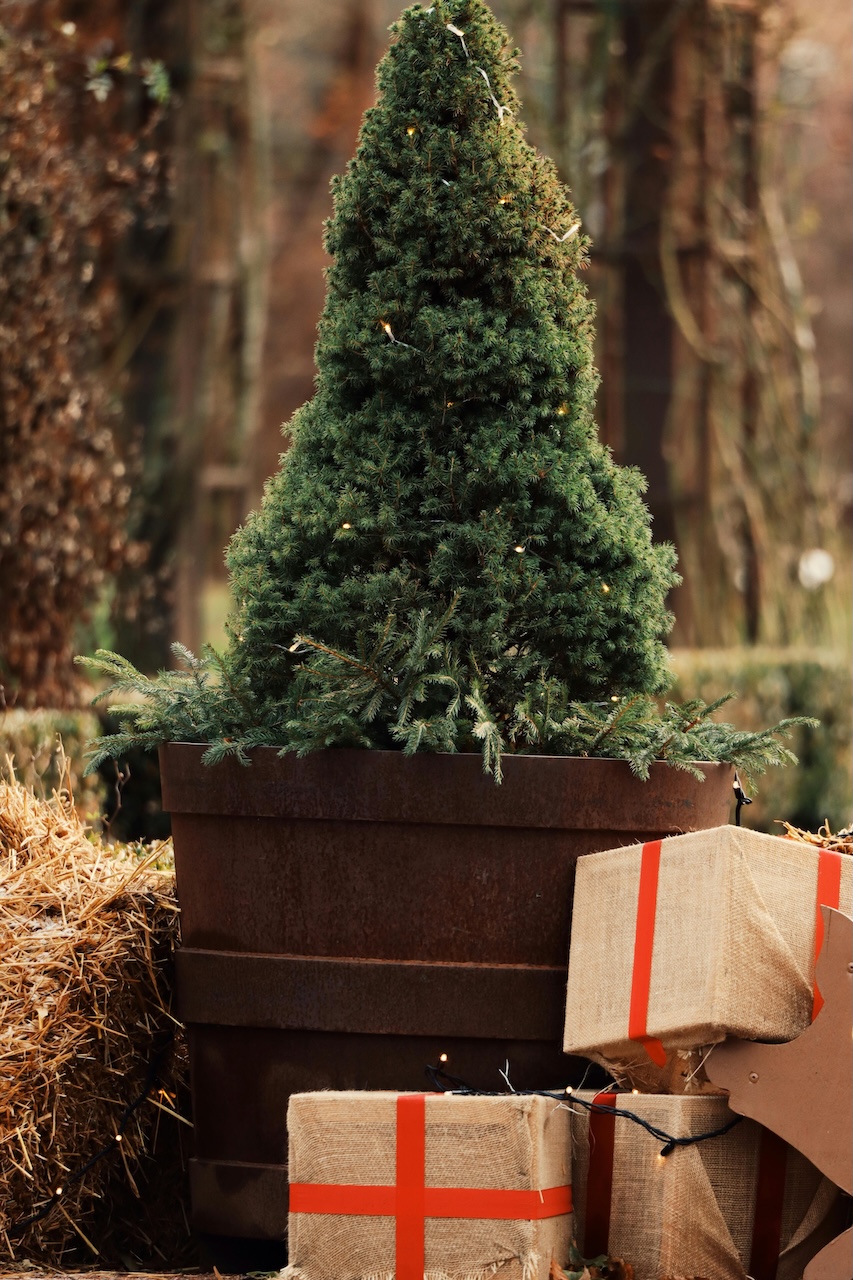
From what I see on the forum, browning tends to trace back to one of four things, roughly in order of how often I am asked about them. The compost dries out completely at some point, usually over summer when nobody is thinking about a tree bought in December. The tree gets brought indoors and kept there for too long, where central heating strips moisture from the air far faster than the roots can replace it.
The tree becomes root bound in a pot it has now outgrown, so there simply is not enough compost left to hold any water. Less commonly, a genuine pest or disease problem such as cypress aphid causes a similar rusty browning but for a completely different reason. I will work through each of these properly, but if you only read one section, make it the next one, because drying out accounts for the overwhelming majority of the cases I see.

If your tree is heading indoors for the festive period on a stand, a stable, water-holding Christmas tree stand with a built-in water reservoir makes the single biggest difference to how much watering you actually keep up with over the two weeks it is in the house.
If your tree has come back out of storage this December with brown patches that were not there last year, the single most likely explanation is that it went too dry for too long at some point in the past twelve months. This usually happens in one of two windows.
The first is over summer, when a tree that lived indoors for Christmas gets moved out to a patio or side return and is then, understandably, forgotten about once the decorations come down and the garden itself takes priority. A pot that size can dry out completely within a week or two during a warm spell, and conifers do not wilt visibly the way a thirsty perennial does, so there is often no obvious warning sign before the needles start to brown from the inside of the plant outward.
The second window is indoors over the festive period itself, which feels counterintuitive because the tree has just come from a garden centre or your own patio looking perfectly healthy. Centrally heated rooms typically sit at a relative humidity that would be considered arid outdoors, and a real conifer standing next to a radiator or above underfloor heating is losing moisture through its needles far faster than most people account for when they top the tree stand up.
A week or so of this on its own rarely does lasting damage, but a tree kept indoors for three or four weeks, which I know some households do to get full value out of it over the whole of December, is a different proposition for the roots.
Both scenarios cause the same underlying problem. Once the compost in the pot dries out fully, water becomes very difficult to get back into it evenly. Dry peat based or peat free compost can develop what gardeners call hydrophobic behaviour, where water poured onto the surface simply runs down the inside edge of the pot and out of the drainage holes rather than soaking into the root ball, so the tree can look as though it is being watered generously while the actual root zone stays bone dry underneath.

If you suspect this has happened, the fix is to stand the whole pot in a few centimetres of water for twenty minutes to half an hour, allowing the compost to rehydrate from the bottom up through capillary action, rather than continuing to pour water on top and assuming the job is done.
This is the question I get asked more than any other, and I would rather give you the honest answer now than let you spend weeks nursing a section of the tree that was never going to come back. Once a conifer’s needles have died and turned brown, they stay brown. There is no recovery.
Unlike many broadleaf shrubs, which can push new growth from old wood even after a hard prune or a stressful year, conifers generally cannot regenerate from bare, dead branches. The green growth you see is doing all of the tree’s photosynthesis, and once it is gone from a particular branch, that branch will not recover on its own.
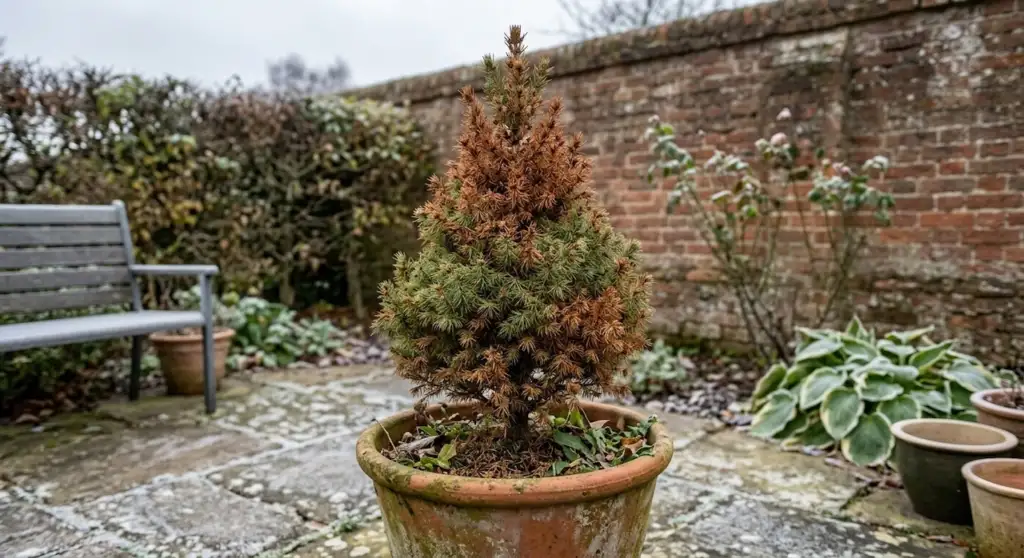
What matters now is establishing how much of the tree is actually affected. A light dusting of brown on the innermost, oldest growth close to the trunk is often just normal needle drop, which every conifer does as older foliage ages and is shed to make way for new growth further out, and is nothing to worry about.
Browning concentrated on one side of the tree, particularly the side that faces a radiator or gets the most sun through a window, points to localised drying and is a sign to change how you are watering and positioning the tree rather than a reason to give up on it. Widespread browning across most of the canopy, especially combined with needles that come away easily when you run a hand along a branch, is a more serious sign and moves you into the territory covered later in the section on whether a tree is beyond saving.
If your tree is coming up to its third or fourth Christmas in the same pot, root binding is worth ruling out before you assume drying out is the only cause. A container-grown conifer’s roots will eventually fill whatever space they are given, circling round the inside edge of the pot once they run out of room to grow outward.
Beyond that point, the ratio of root mass to available compost tips heavily in favour of root, which means there is proportionally less compost left to hold water and nutrients between each watering, and the tree can appear to dry out far faster than it used to, even though your watering routine has not actually changed.
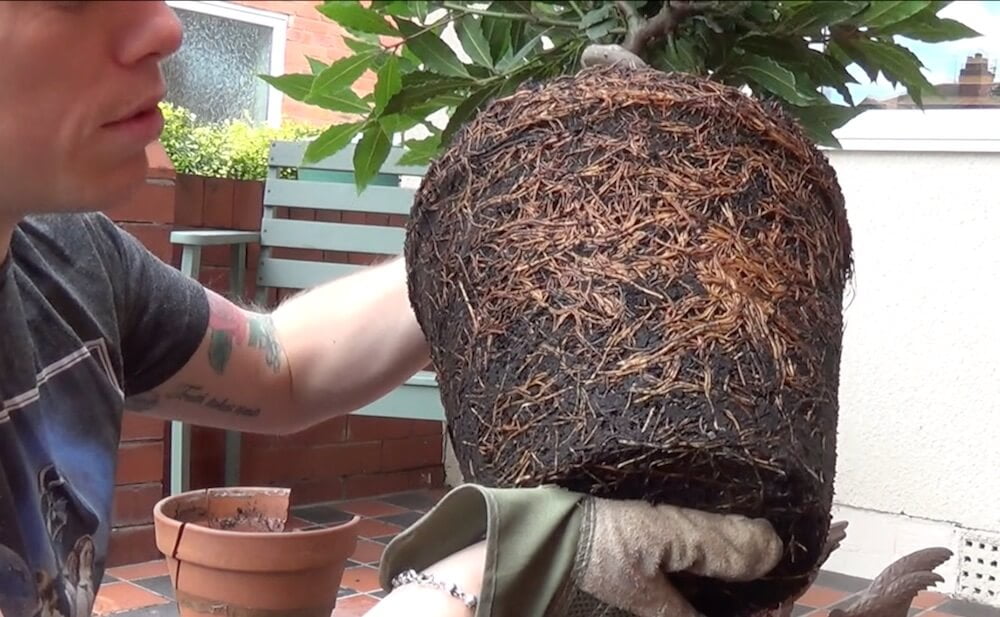
You can check this without fully repotting the tree. Tip it gently onto its side, supporting the trunk, and slide the root ball out far enough to look at the sides and base. If you see a dense mat of roots circling the pot with very little visible compost between them, the tree has outgrown its container and needs to go up a size, which I cover in the repotting section below.
If the roots are still loosely spread with plenty of compost visible around them, the pot is not the issue, and the browning is more likely due to watering or positioning issues covered elsewhere in this guide.
A potted Christmas tree can absolutely come indoors and look wonderful for the festive period, but treating it as an outdoor plant on a short, well-managed visit rather than a permanent houseplant is what keeps it healthy year on year.
My own rule of thumb, and one I would encourage anyone with a real potted tree to adopt, is a maximum of ten to fourteen days indoors. Bring it in a few days before Christmas rather than at the start of December, and take it back outside shortly after New Year rather than leaving it up through the whole of January because it still looks presentable.
Position matters just as much as duration. Keep the tree away from radiators, wood burners, open fires and the direct blast of any heating vent, since this is the single fastest way to dry out both the needles and the compost.
A cooler spot in the room, ideally one that still gets reasonable daylight, will keep the tree far more comfortable than a warm corner even if it is slightly less convenient for where you wanted to put it. If you use a tree stand with a water reservoir, check and top it up every one to two days rather than once at the start, since a tree indoors in heating can draw down a reservoir faster than people expect.
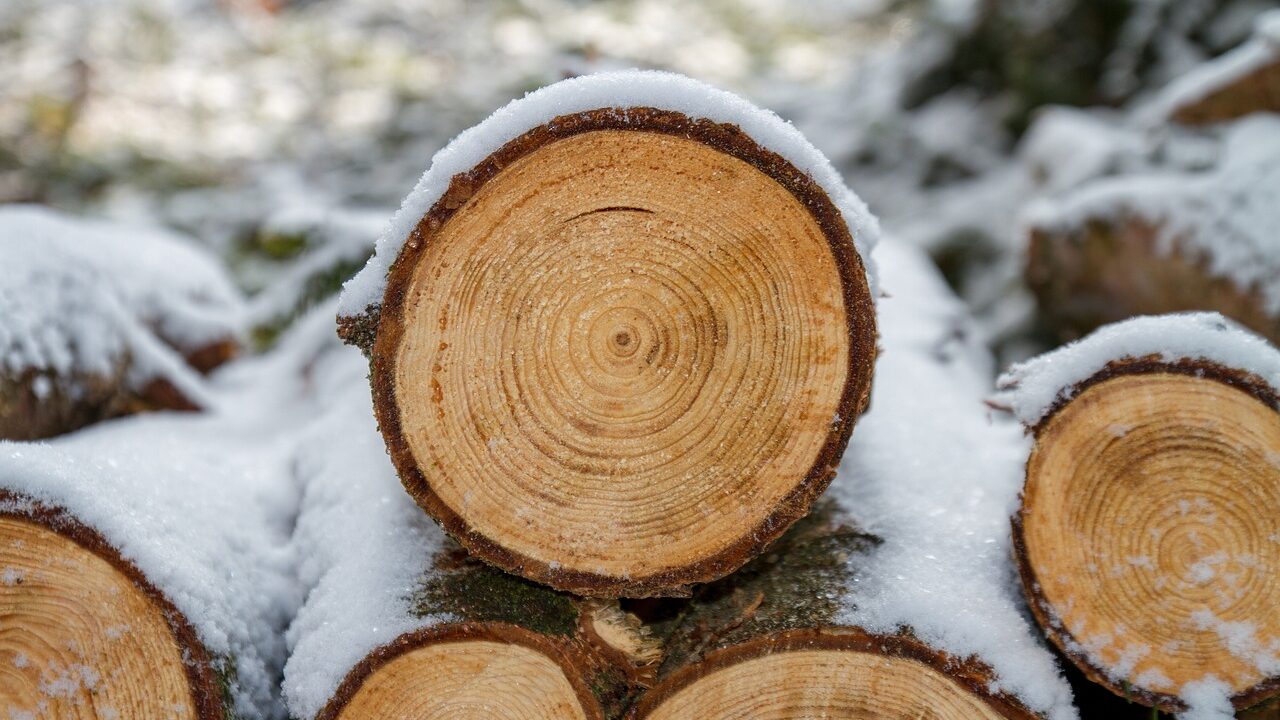
One habit worth breaking, if you picked it up from cutting Christmas trees, is trimming a fresh slice off the base of the trunk before bringing a potted tree indoors.
That technique is used to open the water-carrying tissue of a cut tree that has no roots left to draw water through, and it has no purpose on a living, rooted tree in a pot, where the roots are still doing that job. Cutting into the trunk of a potted tree only creates an unnecessary wound and should be left for cut trees alone.
Getting the watering routine right for the other fifty weeks of the year is what actually prevents the browning you notice at Christmas! By the time the tree is back indoors, any damage from a dry summer has usually already happened, hence the browning Christmas tree leaves. Through spring and autumn, check the compost once a week by pushing a finger a few centimetres in, and water thoroughly whenever the top few centimetres have dried out, rather than watering on a fixed schedule regardless of conditions.
A good soak that runs through and out of the drainage holes is far more useful to the roots than a light sprinkle, little and often, since the latter tends to wet only the top layer of compost and encourages roots to stay shallow rather than develop further down in the pot. Or consider adding a saucer under the pot to help retain some moisture; a good liquid feed three times a year is also a good idea!
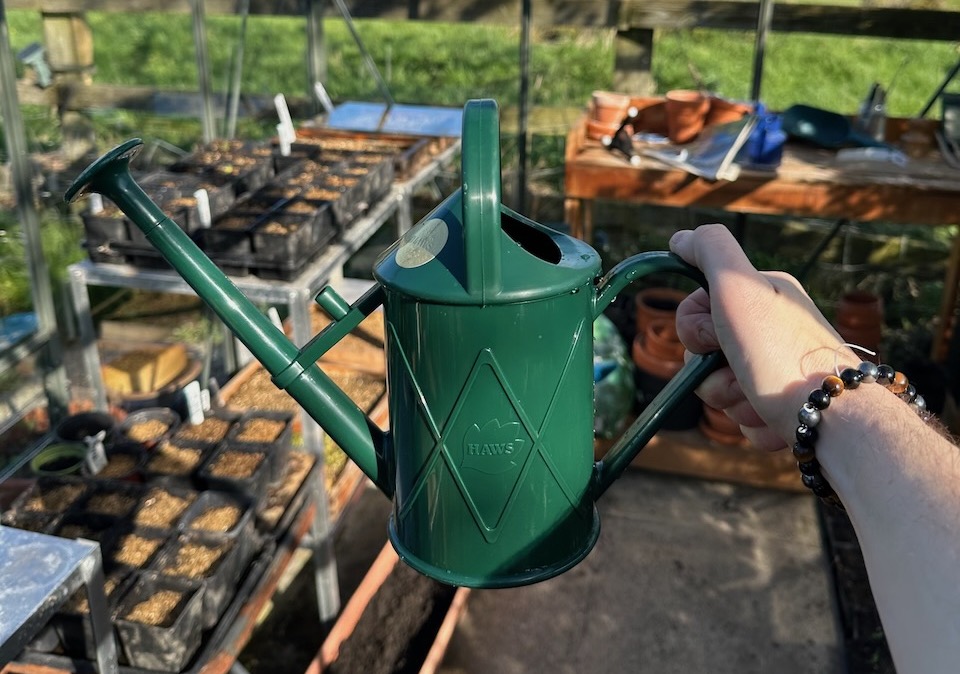
Summer is where most of the damage I hear about actually originates, so this is the season to be strictest about checking. In a warm spell, a container this size can need watering every two to three days rather than weekly, and it is worth building a genuine habit around it, a reminder on your phone or tying it to something else you already do regularly, since a tree that survived several summers perfectly well can still be lost to a single particularly hot, dry fortnight if nobody is checking.
Winter, by contrast, is the season people worry about least and actually need to worry about least, since growth and water use both slow right down in the cold. The tree still needs occasional checking through winter, especially during any prolonged dry, cold snap, but the frequency drops considerably compared with summer.
A container-grown conifer relies entirely on you for nutrients in a way a tree in open ground does not, since it cannot send roots out beyond the pot to find more. Every time you water, a small amount of nutrients is washed out through the drainage holes along with any excess water, a process gardeners call leaching, which means the compost gradually becomes less fertile over the months even without the tree using anything up itself.
A slow-release, balanced or ericaceous feed applied once in spring, at the rate given on the product, is usually enough to see most potted conifers through the growing season without the boom-and-bust of a fast-acting liquid feed applied too often.
A slow release conifer or evergreen feed worked into the top few centimetres of compost in spring is the simplest way to keep a potted tree fed without having to remember a regular liquid feeding schedule through summer.
Yellowing needles, as opposed to browning ones, are usually the clearest sign that feeding rather than watering is the issue, particularly if the yellowing is even across the whole tree rather than concentrated in one spot. If you see this alongside otherwise healthy-looking growth and a watering routine you are confident about, a feed is worth trying before assuming the worst.
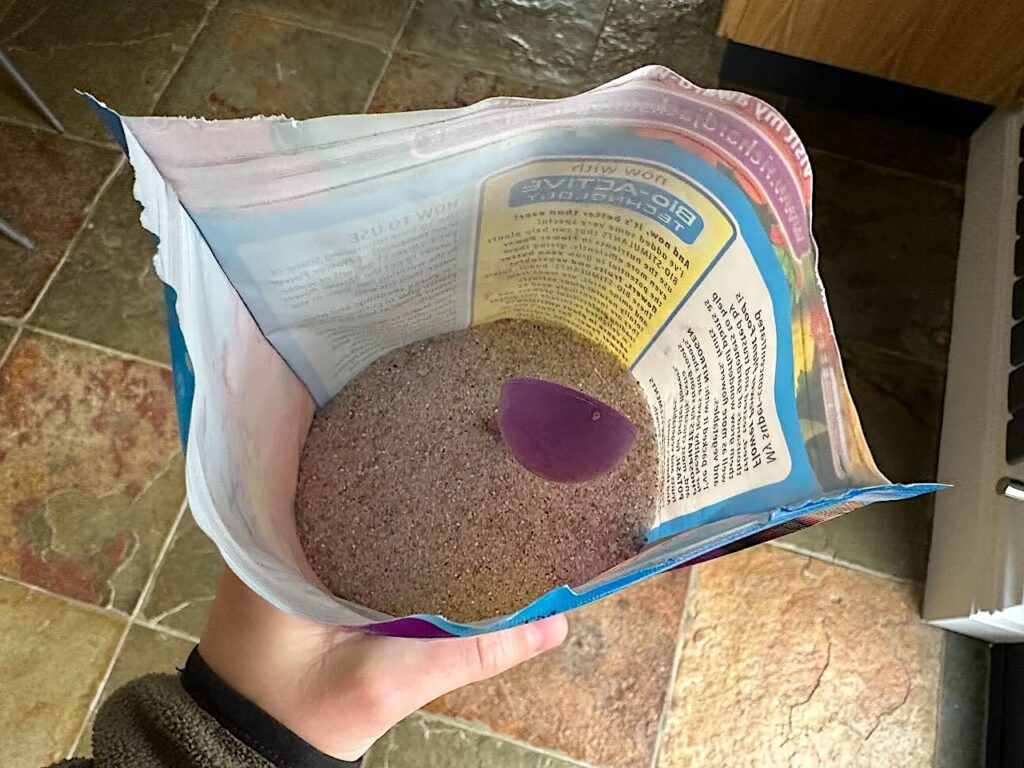
It is also worth avoiding feeding late in the year, from around August onward, since this can push soft new growth that has no time to harden off before the first frosts, leaving it more vulnerable to cold damage over winter than growth that stopped naturally in autumn.
🛒 Best Feeds for Conifers and Christmas Trees
Slow Release Conifer Feed
One application in spring, feeds all season
Liquid Plant Feed
Fast acting, ideal for a quick top-up
Organic Plant Feed
Gentler, slower feeding for sensitive roots
If the root check earlier in this guide showed a dense mat of circling roots with little compost left between them, repotting is the fix rather than anything you can achieve through watering or feeding alone. The best time to do this is late winter to early spring, once the risk of the hardest frosts has passed but before the tree puts on its main flush of new growth for the year, which gives the roots a chance to establish into the new compost while conditions are mild and growth demand is still relatively low.
Choose a new container roughly five to eight centimetres wider in diameter than the current one rather than jumping several sizes at once. A pot that is too large for the current root system holds far more compost than the roots can actually draw moisture from, which paradoxically increases the risk of the compost staying too wet and the roots rotting, rather than solving the drying out problem you are trying to fix.
Use a good-quality, peat-free multipurpose or tree and shrub compost, tease out any roots that have started to circle the outside of the old root ball before planting, and water in thoroughly once the tree is settled in its new pot.
A tree that has reached the largest container you are prepared to manage, rather than needing to go up another size, benefits instead from having the top layer of compost refreshed each spring. Scrape away the top five centimetres or so of old compost, taking care not to damage surface roots, and replace it with fresh compost mixed with a slow-release feed.
This gives the roots access to new nutrients and improved surface structure without the disruption of a full repot, and it is a good long-term routine once a tree has reached the pot size you intend to keep it in permanently.
Drainage is the part of this that gets overlooked most often, because a pot standing directly on a patio, decking or a hard surface can have its drainage holes partially blocked simply by sitting flush against that surface, especially once algae or moss builds up underneath over a wet winter. Waterlogged compost is just as damaging to a conifer as dry compost, since roots sitting permanently in water cannot access the oxygen they need and will start to rot, which then shows up above ground as the same kind of browning caused by drought, making the two problems easy to confuse without lifting the pot to check.
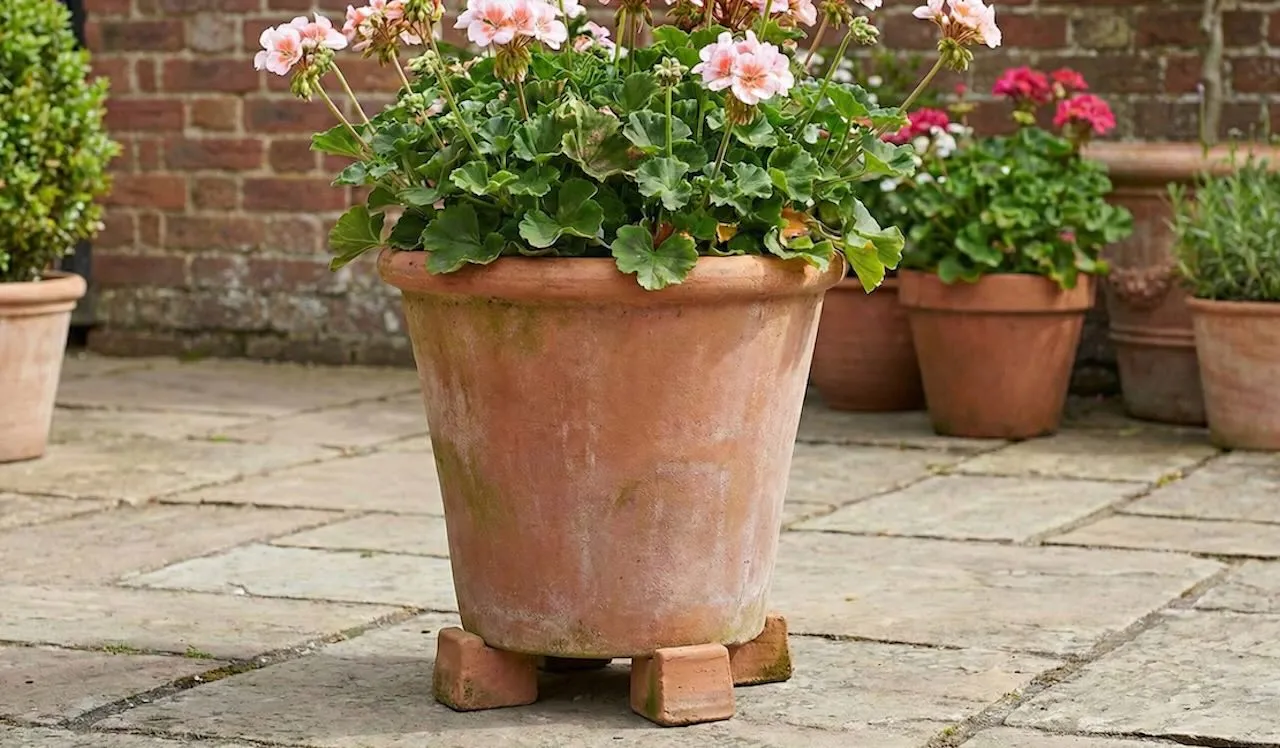
A set of terracotta pot feet raises the base of the container just enough for water to drain away freely and for air to circulate underneath, and is one of the cheapest and most effective changes you can make for a potted tree’s long-term health. It also stops pesky slugs from taking up residence under your pots, which can help reduce damage to your vegetable or kitchen gardens too!
Beyond pot feet, check that the container itself has enough drainage holes, since some decorative outer pots are designed purely as covers for a plastic grow pot and have no drainage of their own. If your tree is sitting in one of these, drill additional holes in the base if the material allows. Better still, keep the tree in its plain, well-drained grow pot and slot that inside the decorative pot only for display. Make sure you lift it out again before watering so that excess water does not sit in the base of the outer pot. If it sounds like a faff, simply get a decent terracotta pot with drainage holes!
Outside of its brief indoor visit at Christmas, a potted Christmas tree is happiest kept outdoors year-round rather than being brought back inside at any other time. A sheltered spot, such as a courtyard, a side return, or a north- or east-facing wall, protects it from the harshest summer sun and the worst of the drying wind, both of which increase how quickly the compost loses moisture.
Full, exposed midday sun at the height of summer is worth avoiding where you can, since it is one of the more common contributors to the compost drying out faster than expected, exactly when the tree is most likely to be forgotten about.
Group the pot with other containers if you can, since plants grouped together create a slightly more humid microclimate around each other and shade each other’s pots from direct sun, both of which reduce water loss compared with a single pot standing alone and fully exposed. Whatever spot you choose, make it somewhere you walk past reasonably often, ideally somewhere visible from a window you look through daily, since the trees I hear about going badly wrong are almost always the ones tucked away somewhere out of sight for most of the year, where a slowly drying pot goes unnoticed until the damage is already done.
There comes a point with any struggling potted conifer where the honest answer is that recovery is unlikely, and I would rather tell you that plainly than have you spend another year nursing a tree that has already gone. Run through this quick check before deciding either way.
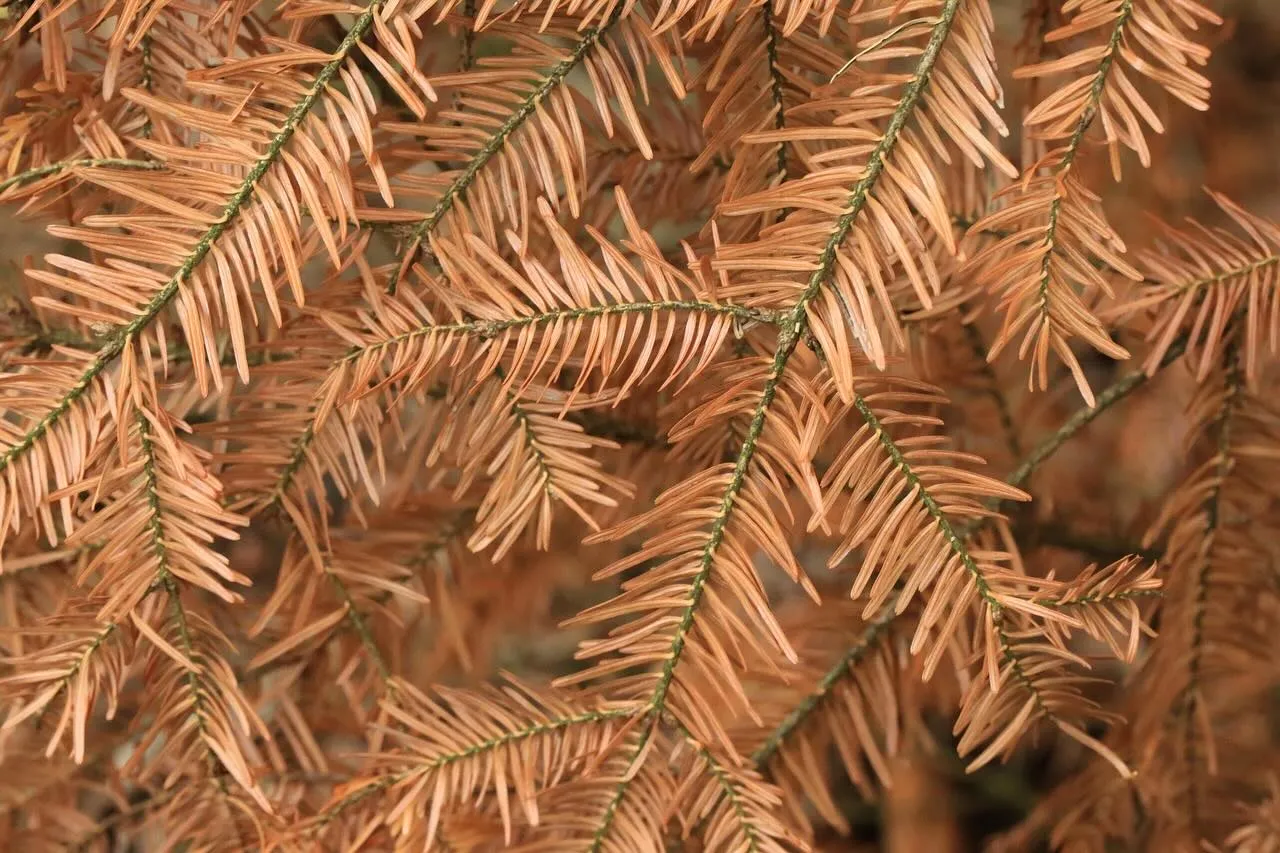
Bend a small section of a branch from an affected area. If it is still flexible and green underneath the bark when gently scratched with a fingernail, that part of the tree is alive and has a chance to recover once the underlying cause is fixed.
If the branch snaps cleanly and the wood underneath is dry and brown all the way through, that section is dead and will not regrow. Check several branches across different parts of the tree rather than just one, since a tree can be alive in some areas and dead in others.
As a rough guide, a tree with brown, dead growth on less than a third of the canopy, concentrated on one side or in the older inner growth, has a reasonable chance of recovering its overall shape over a couple of growing seasons once you fix the watering, drainage or root bound issue behind it, though the dead sections themselves will not turn green again and are best trimmed out for appearance. A tree with more than half of its canopy affected, especially if that includes newer outer growth and not just old inner needles, is generally not worth the effort of trying to nurse back to a good looking shape, and I would rather be upfront that replacing it will likely give you a better result for the coming years than continuing to work on one that has lost too much of its structure.
Whether this year’s tree recovers fully, partially, or needs replacing, the same handful of habits will protect whatever tree you have going into next Christmas. Water it as you would any other outdoor container plant throughout spring, summer, and autumn, checking it specifically during any warm, dry spell rather than assuming it can look after itself simply because it survived the previous summer. Keep it indoors at Christmas for no more than a fortnight, and position it away from direct heat.
Check the roots for signs of binding every couple of years, and repot before the tree becomes seriously root-bound, rather than after. Make sure the pot drains freely, on pot feet if it sits on a hard surface, and feed it once in spring with a slow-release feed so it is never relying entirely on whatever nutrients happened to be in the original compost from several years ago.
None of this is complicated on its own, and most of it takes only a few minutes here and there through the year. What catches people out is not knowing any of this; it is the tree quietly sitting somewhere out of the way for eleven months while attention goes elsewhere, which is really a reminder to place it somewhere you will actually notice it rather than a reflection on how demanding the tree itself is to keep.
Yes, and more often than people expect. Check the compost or the tree stand’s reservoir every one to two days while the tree is indoors, since central heating dries it out considerably faster than the same tree sitting outdoors in winter.
Needle drop alongside browning almost always points to the same underlying cause as the browning itself, most often drying out or, less commonly, waterlogged roots from poor drainage. A small amount of needle drop from the oldest, innermost growth is also completely normal seasonal shedding and not a cause for concern on its own.
Yes, and for a tree that has struggled repeatedly in a container, planting it in open ground is often the better long term option, provided you have space for it to reach its full eventual size. Most Christmas tree species, particularly Norway spruce and Nordmann fir, will grow considerably larger and faster once their roots are no longer restricted, so this is worth thinking through before committing.
It can be, though it is less common than drying out. Cypress aphid causes a similar rusty brown discolouration but typically starts as a fine mottling before turning fully brown, and close inspection may reveal tiny green aphids or their pale cast skins on the affected growth. If watering and drainage both check out as fine, this is worth ruling out next.
With consistent watering, an appropriate pot size and a sensible limit on time spent indoors each year, a well looked after potted Christmas tree can realistically be reused for six to ten years or more before it either needs planting out in open ground or becomes too large to manage comfortably in a container.

Join over 100,000 gardeners on YouTube
Free gardening videos from the Garden Ninja, with 8 million views and counting.
Subscribe on YouTube, it’s freeA struggling potted tree is very rarely a one-off problem; it is usually a sign that the wider approach to container growing needs a proper foundation. If you want to go beyond what one guide can cover, my courses walk you through exactly the kind of planning, planting, and seasonal care decisions I make on every client project, condensed into something you can work through at your own pace.
Courses start from just £29, giving you access to the same design and horticultural thinking I use professionally, without needing to book a full consultation.
For the garden you’ve already got, not the one you’re starting from scratch. Seven checklists and video lessons from BBC Garden Rescue’s Lee Burkhill, built to help you work out what’s worth keeping before you spend a penny.
Garden Design Examples for Small Gardens: 30 Design Templates & Planting Plans: In this online gardening course, I’ll walk you through 30 fantastic garden designs, explaining the logic behind the layout, the plant choices, and take-home tips for applying them in your own garden.
Learn how to transform and design your own garden with Lee Burkhills crash course in garden design. Over 5 hours Lee will teach you how to design your own dream garden. Featuring practical design examples, planting ideas and video guides. Learn how to design your garden in one weekend!
Garden Design for Beginners Online Course: If you want to make the career jump to becoming a garden designer or to learn how to design your own garden, this is the beginner course for you. Join me, Lee Burkhill, an award-winning garden designer, as I train you in the art of beautiful garden design.
Most potted Christmas trees that turn brown have simply dried out at some point, either forgotten over a hot summer or kept too long in a warm, dry room over the festive period, and once needles have died they will not turn green again no matter how carefully you nurse them afterwards.
The fix going forward is straightforward, even if it takes a little discipline: check the tree regularly through the growing season rather than assuming it can fend for itself, limit its time indoors each Christmas, make sure the pot drains properly, and repot before the roots become seriously bound. Get those basics right and a potted Christmas tree can serve you well for the best part of a decade rather than becoming an annual replacement.
If watering, drainage and root bound problems have all checked out and the browning still does not add up, it is worth reading my guide to why conifers die and turn brown, which covers the wider range of causes affecting garden grown conifer hedges and specimens, several of which can also apply to a potted tree in the right circumstances.
Whatever you decide with this year’s tree, whether it is heading back outside for a well-earned rest, into the ground for good, or off to the tip after one Christmas too many indoors, I hope this has given you a clearer picture of what actually went wrong and what to do differently going forward. Happy gardening.


Lee Burkhill, known as the Garden Ninja, is an award-winning garden designer and horticulturist with over 30 years of gardening experience and 15 years as a professional garden designer. A qualified RHS (Royal Horticultural Society) professional, Lee specialises in sustainable garden design and practical horticultural advice. He designs and presents on BBC1’s Garden Rescue and in leading gardening publications. Lee combines three decades of hands-on gardening knowledge with professional design qualifications to help gardeners create beautiful, functional outdoor spaces.
View all posts by Lee Burkhill