For the garden you’ve already got, not the one you’re starting from scratch. Seven checklists and video lessons from BBC Garden Rescue’s Lee Burkhill, built to help you work out what’s worth keeping before you spend a penny.
69


Quick Answer
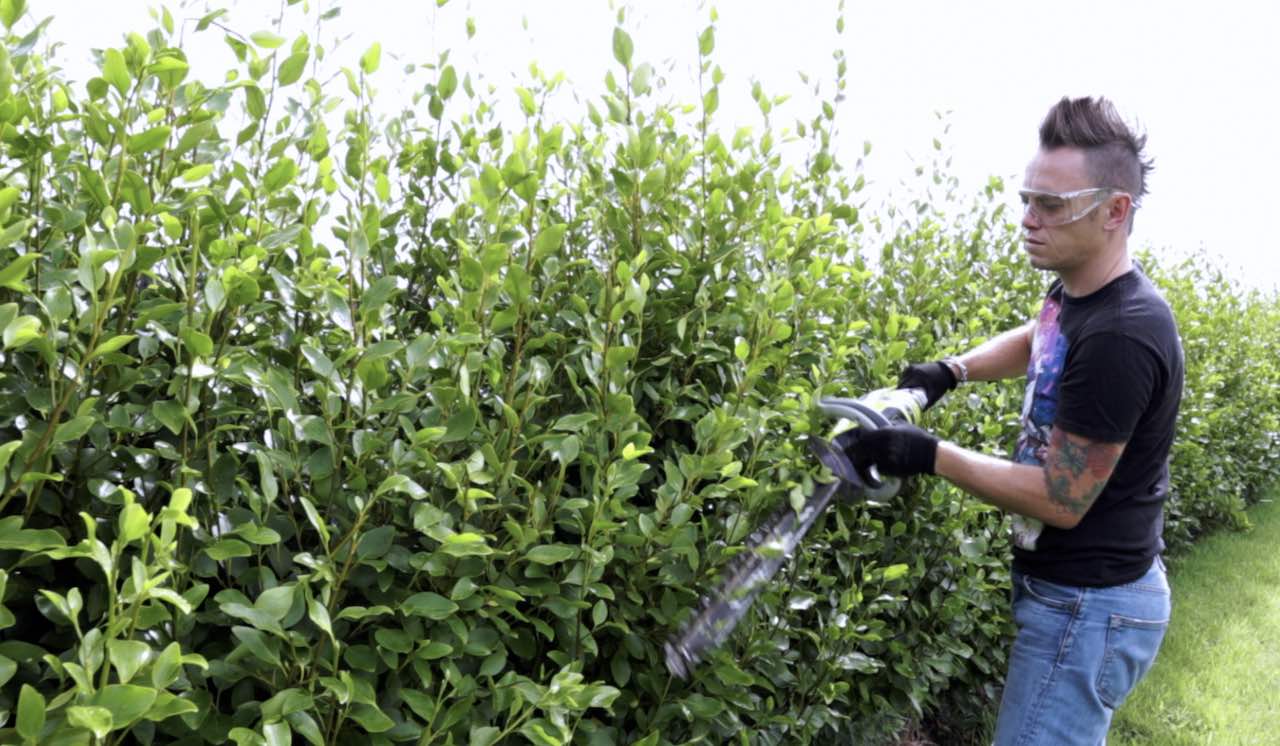
The best cordless hedge trimmer for most UK gardens is the Ryobi OHT1855R ONE+ for everyday domestic use, the Ryobi OHT1850X for hard-to-reach hedges and taller boundaries, and the STIHL HSA 56 if you want premium build quality and are prepared to pay for it. I have used Ryobi ONE+ tools extensively in my own garden and on client projects for years and the battery ecosystem is the main reason I keep coming back one battery system powering every tool in my garden!
Cutting hedges used to be one of those jobs I genuinely dreaded. Not because I do not enjoy the result, a freshly clipped hedge is one of the most satisfying things in any garden, but because the tools involved were either attached to a cable that got in the way at every turn or belching petrol fumes while I tried to work. I started switching my entire garden tool setup to cordless battery power about ten years ago and I have not looked back since. My current cordless toolkit includes two Ryobi trimmers, a leaf blower, a strimmer, a chainsaw, and a lawnmower, all running off the same ONE+ batteries. When something breaks or the battery needs replacing, one purchase covers everything.
Jump To
This page contains affiliate links for products I use and love. If you take action (e.g., subscribe or make a purchase) after clicking a link, I may earn a gardening commission, which helps me keep the Garden Ninja Blog free for all.
The cordless vs corded debate was still grinding on for five years in gardening circles. Battery technology at the consumer end of the market was not quite good enough to deliver the runtime and power that most gardeners needed for a full hedge-cutting session, and corded tools were more powerful for the money. That calculation has changed substantially. Modern 18V to 36V lithium-ion battery systems now deliver runtime that comfortably covers most domestic hedge cutting tasks on a single charge, and the practical advantages of working without a cable are enormous.
Think about the last time you cut a hedge with a corded trimmer. You spent the first ten minutes untangling the extension lead, the next hour trying to keep the cable behind you and out of the cutting zone, and at some point, you probably stood on it, dragged it through a border, or caught it on a fence post. With a cordless machine, all of that disappears. You pick it up, click the battery in, and go. For a professional working across multiple gardens in a day, the time saving is meaningful. For a domestic gardener cutting once or twice a year, it is just a considerably more pleasant experience.
Cordless tools are also significantly quieter than petrol equivalents, which matters in a residential setting, and they produce no fumes, which matters if you are working in an enclosed or sheltered space. The maintenance overhead is vastly lower: no carburettor to clean, no fuel to mix, no pull-cord to wrestle with on a cold morning.
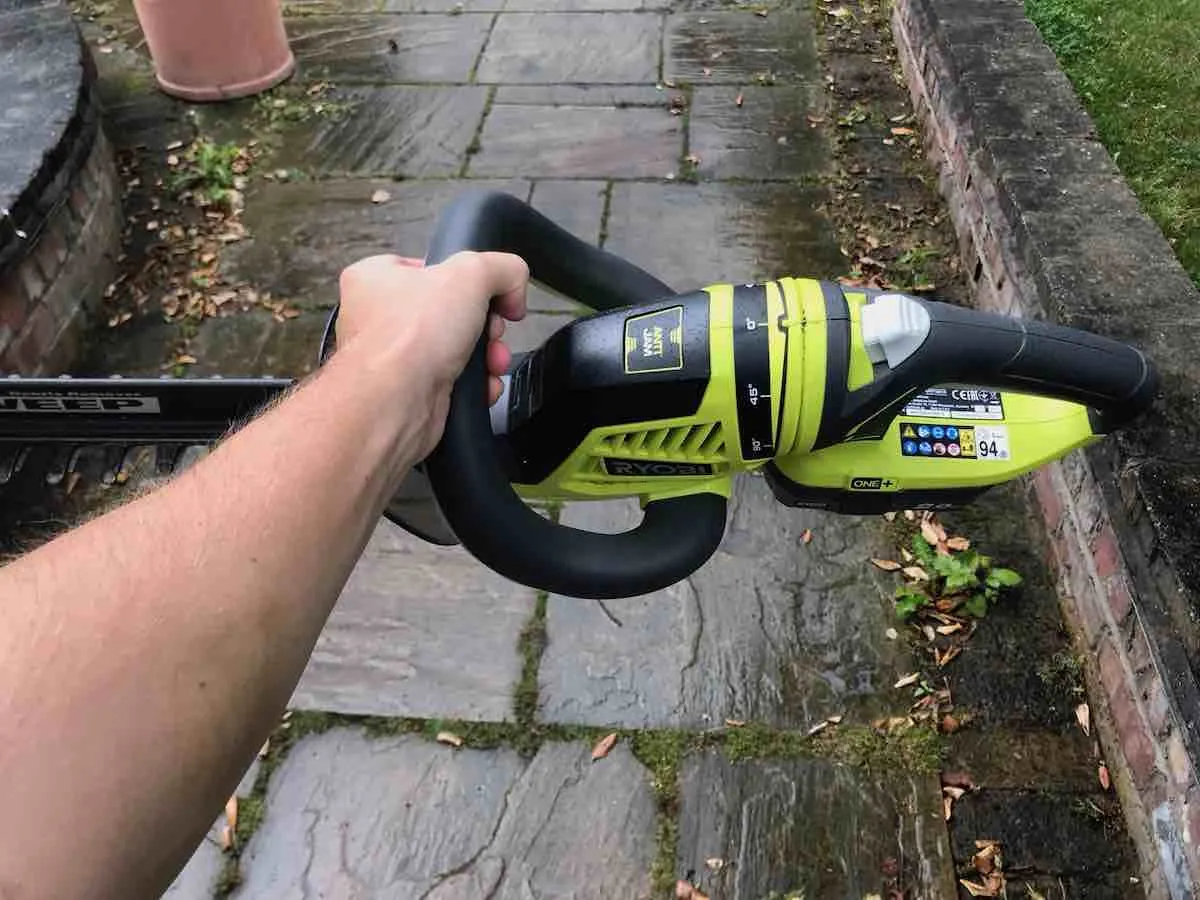
Before looking at specific models, understanding the key specifications will help you make a better decision and avoid buying something that is underpowered for your hedges or heavier than it needs to be for your garden. A hedge trimmer shapes soft new growth, but once a stem thickens into proper wood, a hedge trimmer will stall or shatter its blades. My guide to the best garden loppers covers the tool that picks up where a trimmer leaves off.
Blade length determines how quickly you can cover ground. A 45cm blade works well for small, formal hedges and topiary where precision matters more than speed. A 55cm to 65cm blade covers larger informal hedges and boundary plants significantly faster. I use a 55cm blade as my go-to length for most domestic hedges because it strikes the right balance between control and coverage.
Cutting capacity is the maximum branch diameter the trimmer can cut through cleanly. Most domestic cordless trimmers handle 16mm to 22mm branches comfortably. If you have established laurel, viburnum, or overgrown privet hedges with woody stems, look for a trimmer with at least 20mm cutting capacity and consider whether a brushless motor (which maintains power under load better than a brushed motor) is worth the additional cost.
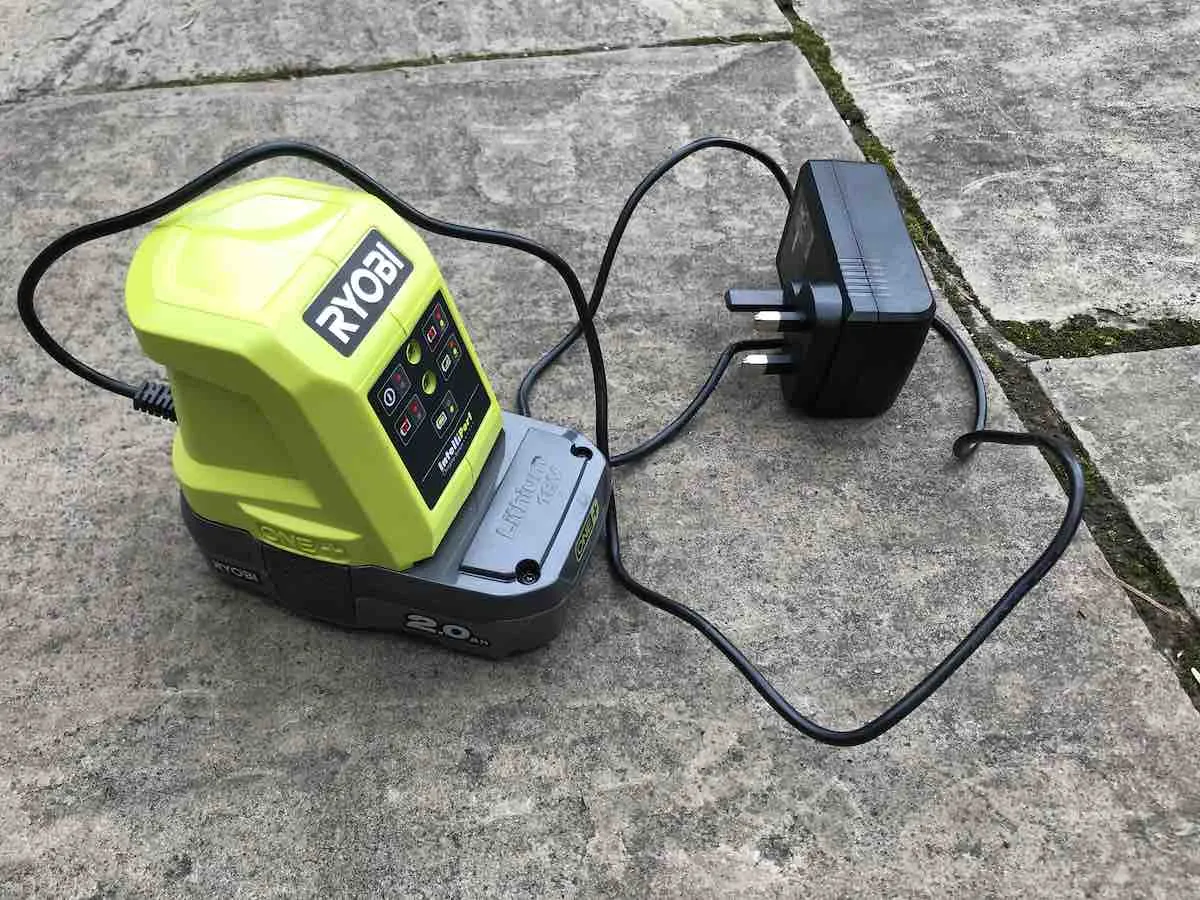
Battery voltage and capacity together determine power and runtime. Higher voltage (36V vs 18V) generally means more power for dense hedges. Higher capacity in amp-hours (Ah) means longer runtime per charge. A 2.0Ah battery on an 18V system will typically give you 25 to 35 minutes of cutting. A 4.0Ah or 5.0Ah battery on the same system will nearly double that. Buying larger capacity batteries is almost always worth doing if you have more than one or two hedges to cut.
Weight matters more than most guides acknowledge. A 3.5kg trimmer sounds reasonable on paper, but held at arm’s length to cut the top of a tall hedge for twenty minutes, it becomes significant. For anyone with shoulder problems, arthritis, or who will be cutting large volumes of hedge, weight is a primary consideration rather than a secondary one. Look for anything under 3kg for lighter domestic use; accept heavier machines only for larger tasks where the power is needed.
Dual-action vs single-action blades are worth understanding. All the machines in this guide use dual-action blades, where both the upper and lower blades move simultaneously. This produces a cleaner cut, less vibration, and faster results than single-action designs. Avoid any hedge trimmer with single-action blades unless you have no alternative.
This is the piece of advice I wish someone had given me when I bought my first cordless garden tool. The brand of battery system you choose is more important than the individual tool you buy today, because once you are invested in a battery platform, your future tool purchases are shaped by that decision. Ryobi ONE+ batteries fit over 150 tools, including hedge trimmers, strimmers, lawnmowers, leaf blowers, chainsaws, drills, and more. Makita’s 18V LXT system similarly covers a huge range. STIHL’s AK compact system is excellent, but it ties you into STIHL’s slightly narrower product range.
I chose Ryobi ONE+ about ten years ago and have never regretted it. I have replaced individual tools when they wore out, bought new batteries when I needed more capacity, and added tools to the collection over time, all on the same platform. The total cost of ownership over a decade is dramatically lower than it would be if I had bought a different brand for each tool. My current collection of Ryobi ONE+ tools in the #explodingatomgarden runs to eleven items. That is 11 tools, 1 battery standard, 4 batteries, and 1 charger. Try doing that with five different brands.
💡 Top Tip
Before you buy any cordless hedge trimmer, write down every other garden power tool you own or plan to buy in the next three years. If most of them are from one brand, buy that brand’s trimmer even if it is not the top-rated individual product in this category. The battery compatibility saving will outweigh a modest performance difference in the trimmer itself many times over.
I have been using the Ryobi OHT1855R in my own garden and on client projects for years. Ryobi originally sent me one to review and I have bought replacements since on my own account, which tells you everything you need to know about how I feel about it. This is the cordless hedge trimmer I recommend to the majority of gardeners asking me for advice, and the reasons are consistent whether you are a beginner with a small front garden or a more experienced gardener with established formal hedges.
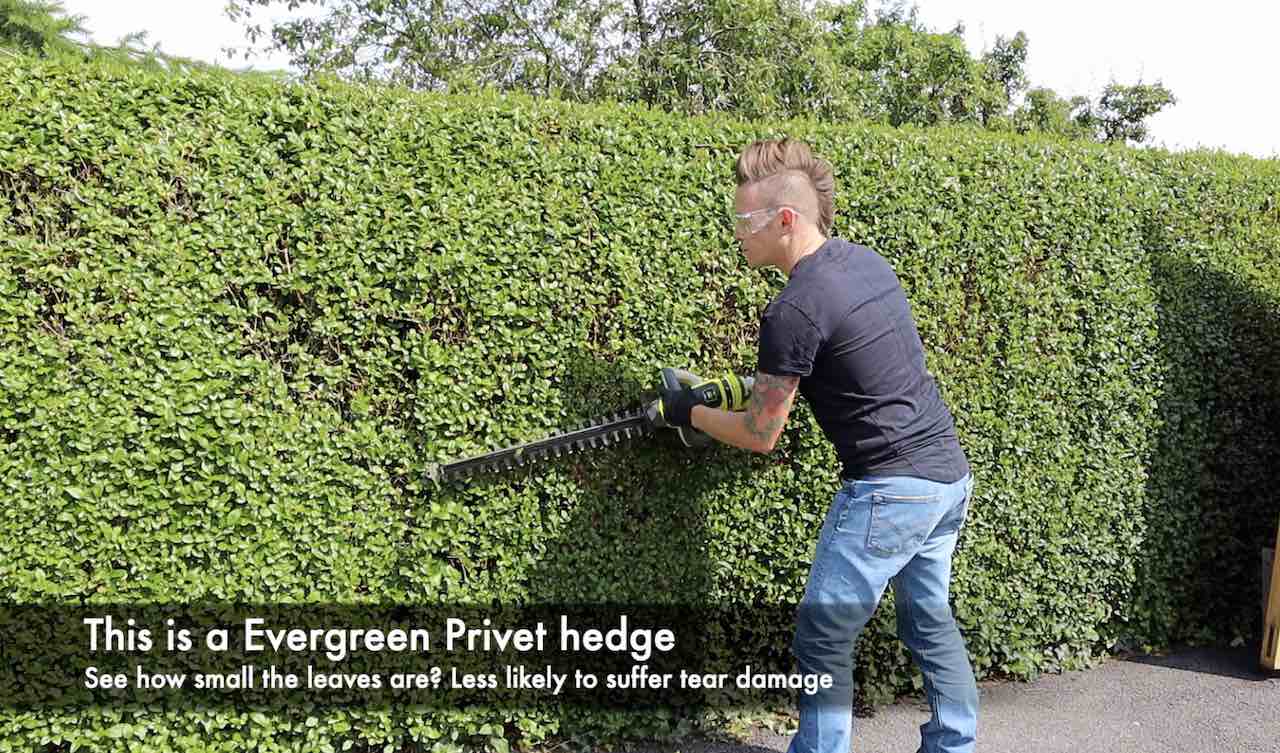
The 55cm laser-cut dual-action blade is the first thing you notice. It is longer than most comparable models at this price point, which means you cover more hedge with each pass and finish the job faster. The 22mm cutting capacity handles the vast majority of domestic hedge species, including privet, box, laurel, hornbeam, and berberis, without difficulty. Where I have found the occasional limit is on very woody, established laurel stems of 25mm or more, where a hesitation or a second pass is sometimes needed. On anything under that diameter it cuts cleanly and consistently.
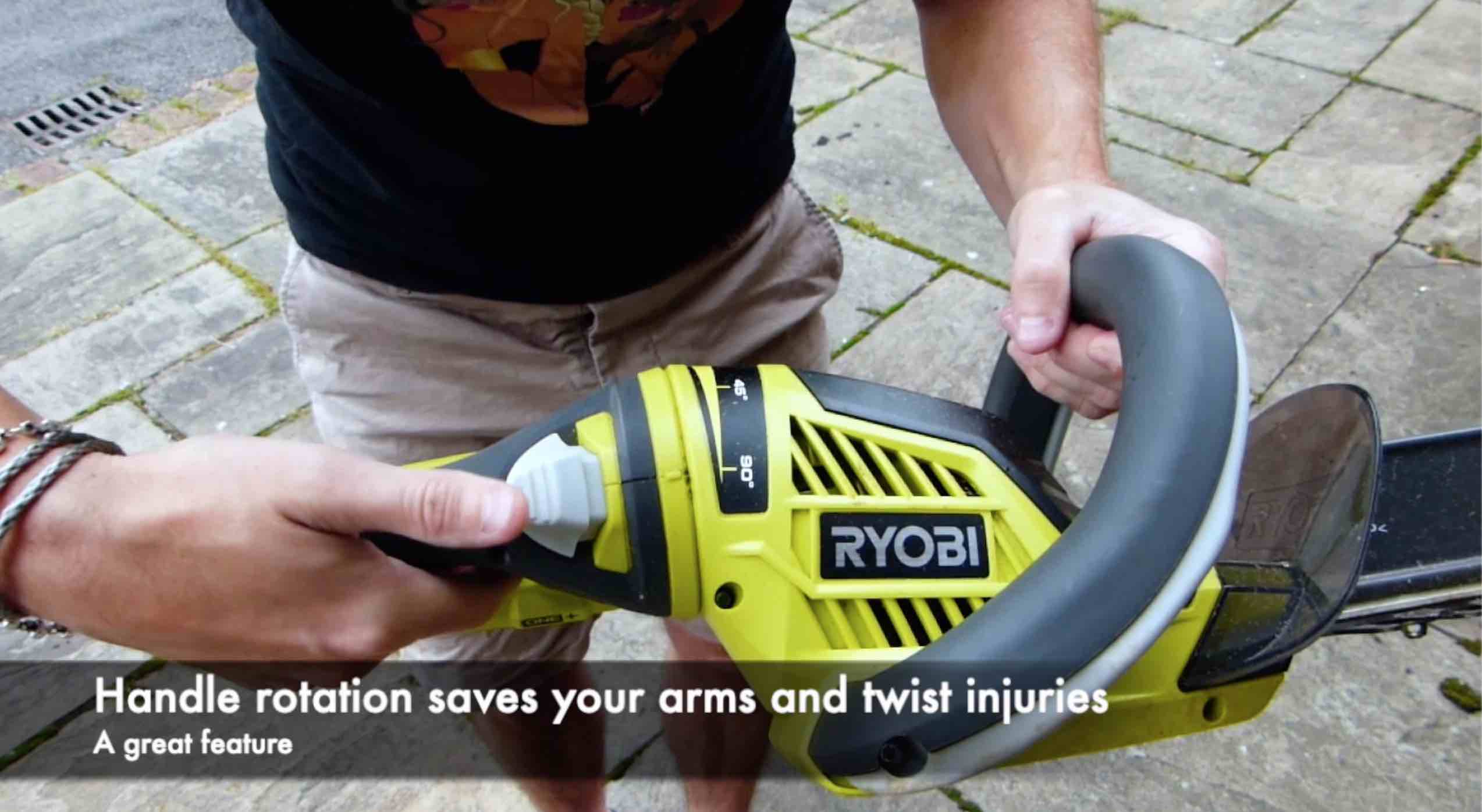
The rotating handle is the feature I value most on this machine. With the push of a button on the top of the trimmer, you can rotate the handle through 45 or 90 degrees. I used to dismiss this as a gimmick until I spent an afternoon cutting a long mixed hedge with a machine that did not have it and came home with a sore shoulder from twisting my torso at awkward angles for three hours. The rotating handle lets you keep your wrists and shoulders in a natural position, whether you are cutting the sides, the top, or working on shaped topiary. For a BBC Garden Rescue presenter who needs to be able to work all day across multiple gardens without injury, this is not a minor feature. It is the one I always mention first.
The HedgeSweep attachment, a debris deflector that pushes clippings away from the blade, is a small, practical addition that saves time on tidy-up. Instead of clippings falling back through the blade and having to be cut twice, they are swept aside as you work. It sounds trivial, but over a long session, it makes a noticeable difference to how clean the finished hedge looks.
The honest drawbacks: the OHT1855R is not a light machine at 2.8kg, including the battery. For anyone with shoulder problems or who will be cutting tall hedges for extended periods, that weight adds up. Battery life on the standard 2.0Ah battery is around 25 to 30 minutes of continuous cutting, which is enough for a typical small to medium garden, but may require a battery swap on larger properties. I always recommend buying a 4.0Ah or 5.0Ah battery alongside the trimmer if you have more than one substantial hedge to manage.
🛒 Buy the Ryobi OHT1855R on Amazon UK
The OHT1850X sits alongside the OHT1855R in my toolkit and handles a specific job that the standard trimmer cannot do as comfortably: tall hedges and the awkward top sections of wide boundary hedges, where reaching properly is a challenge. This is the machine that replaced my ladder for a significant proportion of hedge cutting tasks, and the reduction in risk that comes from keeping your feet on the ground is not a trivial benefit.
The four-position articulating head is the key feature here. You can angle the blade forward at four positions, from straight through to 90 degrees, which allows you to cut hedge tops from the ground without raising the machine above head height and losing control of the cut angle. Combined with the rotating rear handle and central trigger, positioned specifically for working with the machine in its more extended configuration, it is a machine designed with ergonomics in mind rather than just raw cutting performance.
The 50cm blade is slightly shorter than the OHT1855R and the cutting capacity of 16mm is a step down from the 22mm of its sibling. On the established, woody sections of tall boundary hedges that have not been cut regularly, I have occasionally found the OHT1850X less confident than I would like. For those situations, I revert to the OHT1855R or use hand secateurs to clear the thickest stems first. On recently maintained hedges, it handles everything cleanly.
The weight with the battery at 3.73kg is noticeably heavier than the standard trimmer, largely due to the extended-reach mechanism. For top-of-hedge work where you are holding the machine above shoulder height even briefly, that weight matters. Take breaks regularly and use both hands on the handles. This is not a machine for marathon sessions; it is a specialist tool for specific access challenges. I only use it for very specific small Box hedges and to nip the tops of some Yew hedging or Pleaches trees at height.
🛒 Buy the Ryobi OHT1850X on Amazon UK
💡 Top Tip
If you buy both Ryobi trimmers, which is what I would recommend for a garden with a mix of low formal hedges and taller boundary plants, you only need one set of batteries and one charger between them. That economy of scale is one of the biggest advantages of the ONE+ system over buying a specialist extended-reach tool from a brand that does not share batteries with your other tools.
I want to be honest about STIHL because I think they deserve more nuanced coverage than most buying guides give them. The HSA 56 is excellent. The build quality is exceptional, the cutting action is smooth and controlled in a way that feels different from consumer-grade machines, and the balance is noticeably better than most competitors at this weight class. If you pick up a STIHL trimmer and then pick up most alternatives, the quality difference is immediately apparent in your hands.
The 45cm blade is shorter than the Ryobi OHT1855R’s 55cm, which means more passes per hedge but more precise control on shaped or formal work. For box topiary, clipped yew, and other formal hedges where accuracy matters more than speed, the HSA 56’s shorter blade and excellent balance actually make it the better tool. I would not reach for a 55cm blade trimmer to cut a complex topiary shape. I would reach for something like the HSA 56.
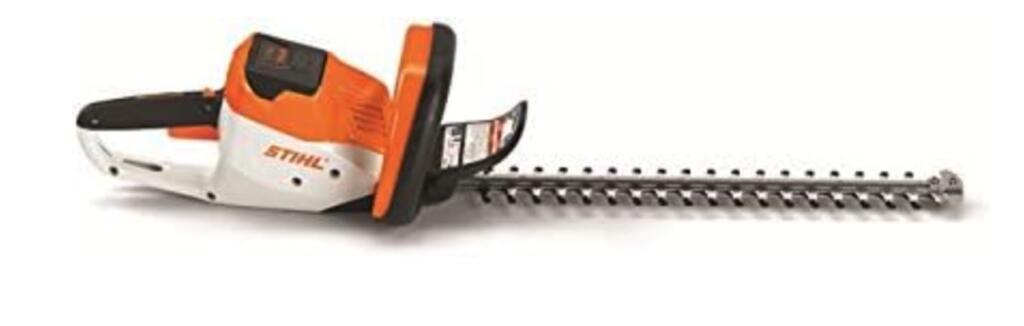
The STIHL AK compact battery system that powers the HSA 56 also powers the FSA 56 grass trimmer, BGA 56 leaf blower, and MSA 120 C-BQ chainsaw, which makes it a coherent if more limited ecosystem than Ryobi ONE+. The batteries are excellent quality and the charging speed is good. The honest limitation is that the AK system only covers four garden products currently, versus Ryobi’s 150+. If you are already committed to another brand for your other tools, the STIHL battery system creates a parallel platform rather than unifying your collection.
At around £209 including battery and charger, the HSA 56 is more expensive than the Ryobi OHT1855R in equivalent configuration. Whether that premium is worth it depends entirely on what your hedges demand and how much you value the build quality difference. For a garden with mainly soft, regularly maintained hedges and a user who values longevity over raw value, it is a justified investment. For a first cordless trimmer purchase or someone already invested in Ryobi ONE+, it is harder to recommend over the Ryobi on pure value grounds.
🛒 Buy the STIHL HSA 56 on Amazon UK
The Bosch AdvancedHedgeCut 36 is the machine I would recommend to a gardener who wants something reliable, well-made, and from a brand with an established service network, but who is not yet invested in any particular battery ecosystem. The 36V system provides noticeably more power than 18V tools for dense hedges, and the cutting performance on established growth is confident and consistent. Great for huge hedges or lots of trimming in your possible professional gardening practice if you’re a jobbing gardener.
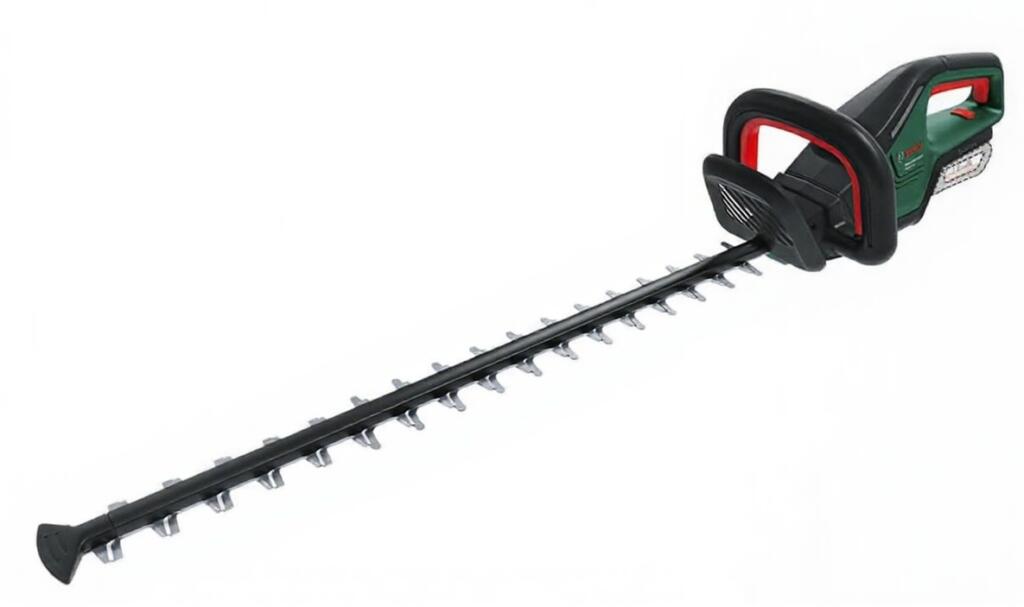
The 65cm blade on the larger version is impressive for quickly covering ground along long informal hedges. A single pass along a 2m-long boundary hedge section with a 65cm blade versus a 45cm blade yields far faster cutting. Bosch’s build quality at this price point is solid, and the tool feels well-balanced rather than front-heavy in use.
The limitation, as with the STIHL, is that the Bosch 36V system is a more limited ecosystem than the Ryobi ONE+. If you already have Bosch 18V tools in your shed, the AdvancedHedgeCut uses a different battery, and the two systems are not compatible. Check your existing Bosch battery type before purchasing. If you have no existing Bosch tools and are starting fresh, the ecosystem consideration is less critical.
🛒 Buy the Bosch AdvancedHedgeCut 36 on Amazon UK
The Makita DUH523Z earns its place in this guide for one straightforward reason: if you already own Makita 18V LXT tools, which is one of the most widely adopted professional tool systems in the UK. So if you’re already a DIY enthusiast or have a partner who loves building things, you’ve probably gotten used to the distinctive blue colour of all Makita tools! My husband has loads of them, but I’m more of a Ryobi fan 😉
This trimmer plugs straight into your existing battery collection. The LXT system covers an enormous range of products from drills to circular saws to outdoor power tools, and the battery compatibility is seamless.
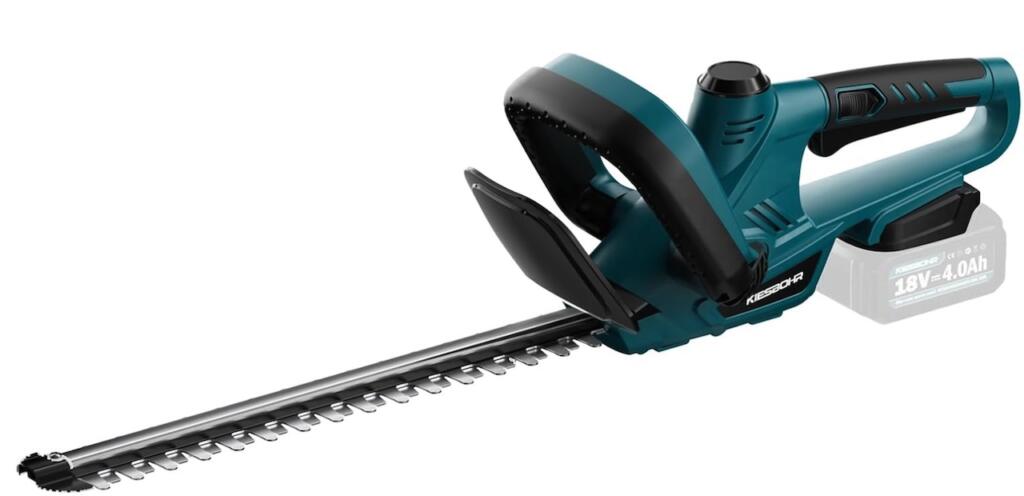
The DUH523Z itself is a solid performer with a 52cm blade, 15mm cutting capacity, and the brushless motor that Makita fits to its mid-range and above tools. Brushless motors deliver better performance under load, meaning the blade maintains speed more consistently when cutting dense or woody growth, and they have a longer service life than brushed equivalents. At around £130 to £160 for the body only, it is competitively priced given the build quality.
The cutting capacity of 15mm is the one area where it falls behind the Ryobi OHT1855R’s 22mm. For regularly maintained soft hedges, this is never an issue. For established or neglected woody hedges, the limitation becomes apparent on thicker stems.
🛒 Buy the Makita DUH523Z on Amazon UK
DeWalt’s DCM563PB deserves recognition for its cutting capacity of 22mm, which matches the Ryobi OHT1855R and is higher than most alternatives at this price point. If your garden contains mature laurel, established privet, or any hedging that has been left to grow woody over several seasons, the DeWalt’s ability to handle thicker stems without stalling or hesitating is a real practical advantage. Think of it as a step before the chainsaw is needed, especially for old abandoned hedges and mature out-of-control hedgerows that need hard pruning! Deciding whether an overgrown hedge is worth a hard cut or better replaced is really part of a bigger question about what else in the garden is worth keeping. I cover that whole process, hedges included, in my guide to gardening for beginners with an inherited garden.
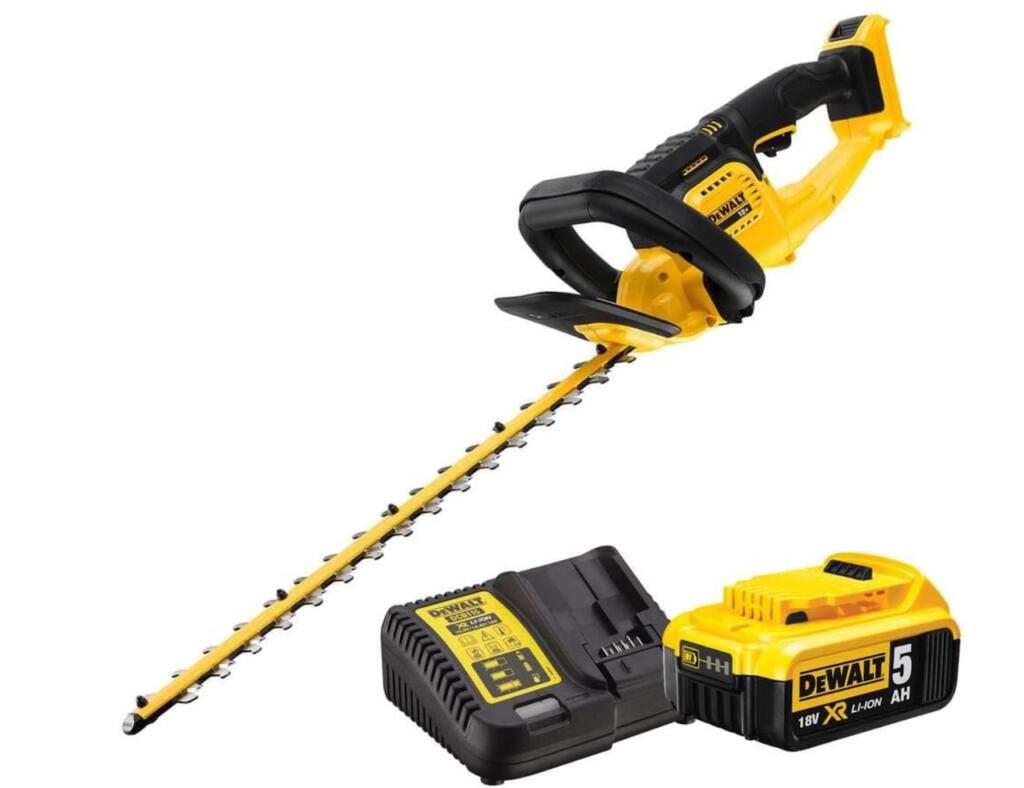
The brushless 18V motor maintains consistent blade speed under load, and the build quality reflects DeWalt’s professional tool heritage. It is heavier than the Ryobi alternatives at around 3.2kg with battery, which is a trade-off for the additional cutting capability. Like the Makita, this is a body-only purchase that requires you to already own DeWalt 18V XR batteries, which are widely available if you are invested in the DeWalt ecosystem.
🛒 Buy the DeWalt DCM563PB on Amazon UK

The single most common hedge trimmer mistake I see is buying a machine for a hedge it is not suited to. This guide would not be complete without a clear framework for matching the tool to the plant.
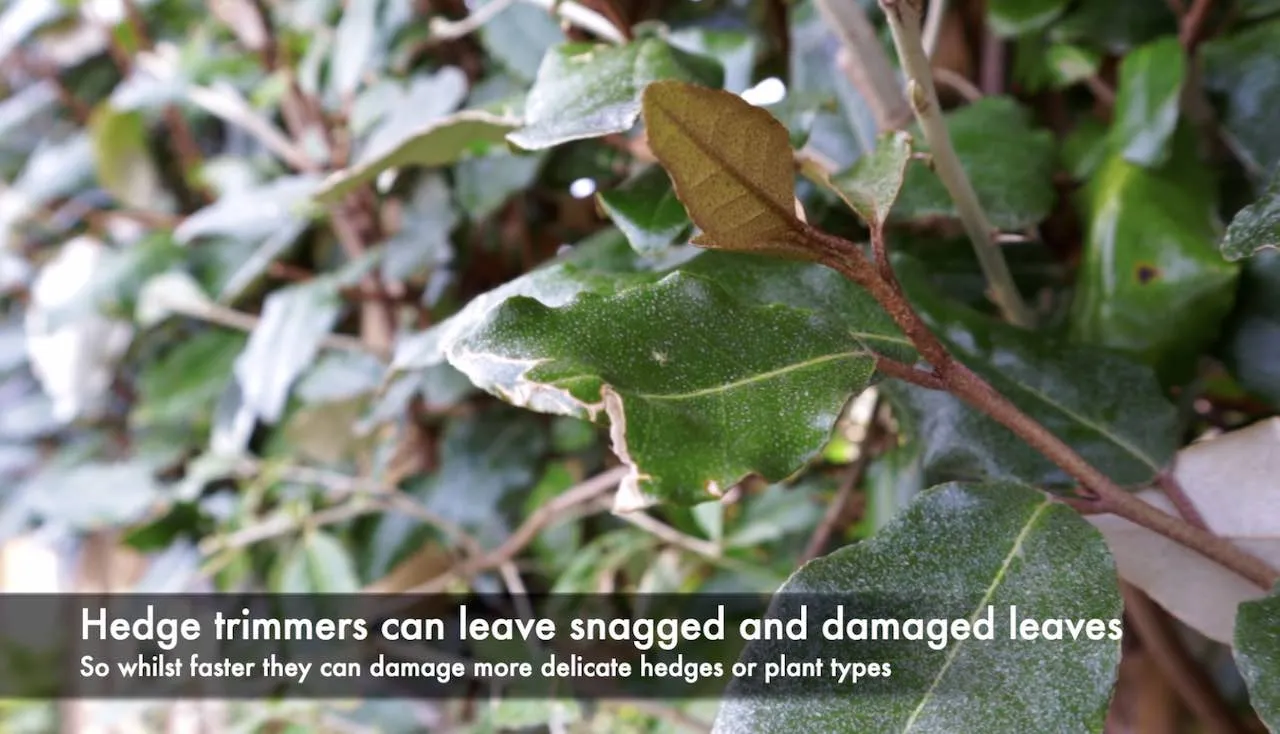
One practical note on laurel specifically: hedge trimmers do not cleanly cut large laurel leaves the way they cut fine-leaved hedging. The leaves get cut across their surface rather than through the stem, which leaves brown, ragged edges on every severed leaf. This is completely normal and unavoidable with a mechanical trimmer. The browning fades as new growth covers it within a few weeks. Finish laurel cuts with secateurs on any prominent branches where the appearance matters immediately, and accept that the machine trim is the foundation rather than the finished article.
The Ryobi ONE+ advantage becomes clearest in this table. If you already own any Ryobi ONE+ tools and batteries, the OHT1855R body-only purchase, priced at around £90 to £110, gives you a capable, full-featured trimmer with no additional battery investment. Every other brand in this table requires either a new investment in the battery ecosystem or ownership of existing tools. For first-time buyers with no existing cordless tools, buying a Ryobi kit that includes the 2.0Ah battery and charger, along with the trimmer, for £130 to £160 sets you up with a battery platform for future tools, not just one trimmer.
The safest window for most hedging is between August and February, outside the main bird nesting season, which runs from March to July. In practice, a light trim of formal hedges in early May, before nesting fully gets underway, is generally safe if done carefully, but a full renovation cut should wait until late summer. September and October are the ideal months for a thorough annual trim because growth has slowed, the hedge retains its shape well going into winter, and you are not disturbing nesting birds. Always check hedges thoroughly for active nests before cutting at any time of year. For a complete guide to hedge cutting timing and technique, see my complete guide to trimming hedges.
One thing worth flagging before you buy: check my nesting season guide for when it’s actually legal and safe to use one.
On a standard 2.0Ah 18V battery, most domestic cordless trimmers run for 25 to 35 minutes of continuous cutting. A 4.0 Ah battery roughly doubles that to 50-60 minutes. The actual runtime depends significantly on the density of the hedge being cut: fine, soft growth like regularly trimmed box drains the battery much more slowly than dense, established privet or woody laurel. I always recommend buying at least one 4.0Ah battery for serious hedge-cutting work, and keeping two batteries charged and ready if you have more than one substantial hedge to manage in a session.
Clean the blades after every use with a dry cloth or stiff-bristled brush to remove sap and debris, then apply a light coat of machine oil or WD-40 along the length of each blade. Sap in particular hardens and causes drag if left on the blade, which makes the motor work harder and produces ragged rather than clean cuts. Sharpen the blades once or twice a year using a flat file or diamond sharpening stone, working along the bevelled edge of each tooth at the original angle. Alternatively, most tool service centres will sharpen hedge trimmer blades for a modest charge. A sharp blade does noticeably better work and produces less brown, ragged damage on the cut surfaces.
For most domestic hedging tasks, yes. Modern 18V and 36V cordless systems now match or exceed the cutting performance of comparable corded 400W-500W models across most hedge types. The only scenario where corded retains an advantage is on very heavy, very established hedges that require prolonged continuous cutting at full power, where the unlimited runtime of a mains connection and the consistent power output of a corded motor give it an edge. For a typical UK domestic garden, cordless is the better practical choice without a meaningful performance compromise.
Privet can be cut in summer, typically in June, and again in late August or September, without harming the plant. Privet is one of the most tolerant and forgiving hedging species for timing of cutting. The main consideration in summer, as with all hedges, is bird nesting: check carefully before cutting during June and July. Privet also benefits from a third light trim in spring (April to early May) if you want to maintain a very tight formal shape, though for most domestic boundaries, two cuts a year is entirely sufficient.
Ready to transform your gardening skills beyond basic maintenance? Garden Ninja’s expertly crafted online courses will fast-track your development from keen amateur to skilled garden designer in months rather than years. Starting at just £29, you’ll gain access to professional garden design expertise from BBC Garden Rescue’s Lee Burkhill, delivered at a fraction of traditional horticultural education costs.
For the garden you’ve already got, not the one you’re starting from scratch. Seven checklists and video lessons from BBC Garden Rescue’s Lee Burkhill, built to help you work out what’s worth keeping before you spend a penny.
Garden Design Examples for Small Gardens: 30 Design Templates & Planting Plans: In this online gardening course, I’ll walk you through 30 fantastic garden designs, explaining the logic behind the layout, the plant choices, and take-home tips for applying them in your own garden.
Learn how to transform and design your own garden with Lee Burkhills crash course in garden design. Over 5 hours Lee will teach you how to design your own dream garden. Featuring practical design examples, planting ideas and video guides. Learn how to design your garden in one weekend!
Garden Design for Beginners Online Course: If you want to make the career jump to becoming a garden designer or to learn how to design your own garden, this is the beginner course for you. Join me, Lee Burkhill, an award-winning garden designer, as I train you in the art of beautiful garden design.
For most UK gardeners, the Ryobi OHT1855R ONE+ is the right choice: 55cm blade, 22mm cutting capacity, rotating handle, HedgeSweep, and access to a battery ecosystem covering over 150 tools. If you have tall or awkward hedges that need reach, add the Ryobi OHT1850X running off the same batteries. If you want the best build quality available and are prepared to pay for it, the STIHL HSA 56 is outstanding. If you are already invested in Makita LXT or DeWalt XR, those ecosystems have solid options too.
The battery ecosystem decision is more important than the individual trimmer specification. Choose the platform that works with your other tools, and you will thank yourself every time you need to replace a battery or add a new piece of equipment to your toolkit.
For more on hedge care and the tools that make it easier, these related guides cover everything from technique to timing:
👉 How to Trim and Clip Hedges: The Complete UK Guide
👉 Best Cordless Garden Tools UK 2026: A Garden Designer’s Complete Guide
👉 Best Secateurs UK 2026: A Garden Designer’s Honest Guide
👉 Hedge Pruning: When to Cut and How to Get a Clean Finish
Happy Gardening!

Lee Burkhill, known as the Garden Ninja, is an award-winning garden designer and horticulturist with over 30 years of gardening experience and 15 years as a professional garden designer. A qualified RHS (Royal Horticultural Society) professional, Lee specialises in sustainable garden design and practical horticultural advice. He designs and presents on BBC1’s Garden Rescue and in leading gardening publications.
View all posts by Lee Burkhill









JOIN THE NINJAS

Be the first in line for new Guides, Discount codes and Offers