Small Garden Makeover: Real Project Costs, Design Decisions & Mistakes to Avoid
Lee Burkhill: Award Winning Designer & BBC 1's Garden Rescue Presenters Official Blog
Quick Answer
A successful small garden makeover starts with a clear brief, an accurate site survey, and a design that uses every metre intelligently. The key principles are breaking the line of view to create depth, positioning the seating area where the sun falls (not nearest the house), choosing a restrained colour palette, and selecting plants that earn their place year-round. Budget small garden makeovers typically run from £3,000 to £8,000 depending on materials and landscaping scope.
Small garden design is where every decision matters, and there’s nowhere to hide a mistake. I’ve been designing gardens professionally for over 20 years, and in that time, the projects that have taught me the most have consistently been the small ones. A large garden forgives errors of proportion or planting. A 9 x 6 metre back garden does not.
This guide uses a real small garden makeover project I completed as its spine way back over 12 years ago, but the principles here apply to any compact outdoor space. Whether you’re planning to hire a designer, take on the work yourself, or just want to understand what a professional design process looks like before commissioning one, you’ll find everything you need to make genuinely good decisions about your small garden.
There’s a common assumption that a small garden should be simpler and cheaper to design than a large one. In my experience, the opposite is usually true. In a small space, every element is in constant visual relationship with every other element. A proportion that’s slightly off in a large garden disappears into the surrounding space. In a small garden, it’s immediately apparent, and it affects how the whole space feels.
Small gardens also carry a heavier functional load relative to their size. The same space needs to accommodate outdoor dining, a seating area, some planting, storage, possibly a lawn or a hard surface for children, and, ideally, a sense of privacy. Achieving all of that in under 60 square metres requires genuine design thinking rather than just shopping for plants and hoping it comes together.
The good news is that the principles that make small gardens work are learnable and consistent. Once you understand them, you can apply them to any compact space, and the results are often more satisfying than in a larger garden that has simply been filled.
The Project: A 9 x 6 Metre Back Garden Transformation
This particular small garden makeover was a typical rectangular back garden measuring 9 x 6 metres, a size that is common among UK terraced and semi-detached properties. The brief was clear: a contemporary layout with clean lines, raised beds for growing, a functional seating area, some privacy from the neighbouring property, and low-maintenance planting that would look good whether attended to weekly or every couple of months.
Budget: £3,500 for everything, including design, landscaping, materials, and planting.
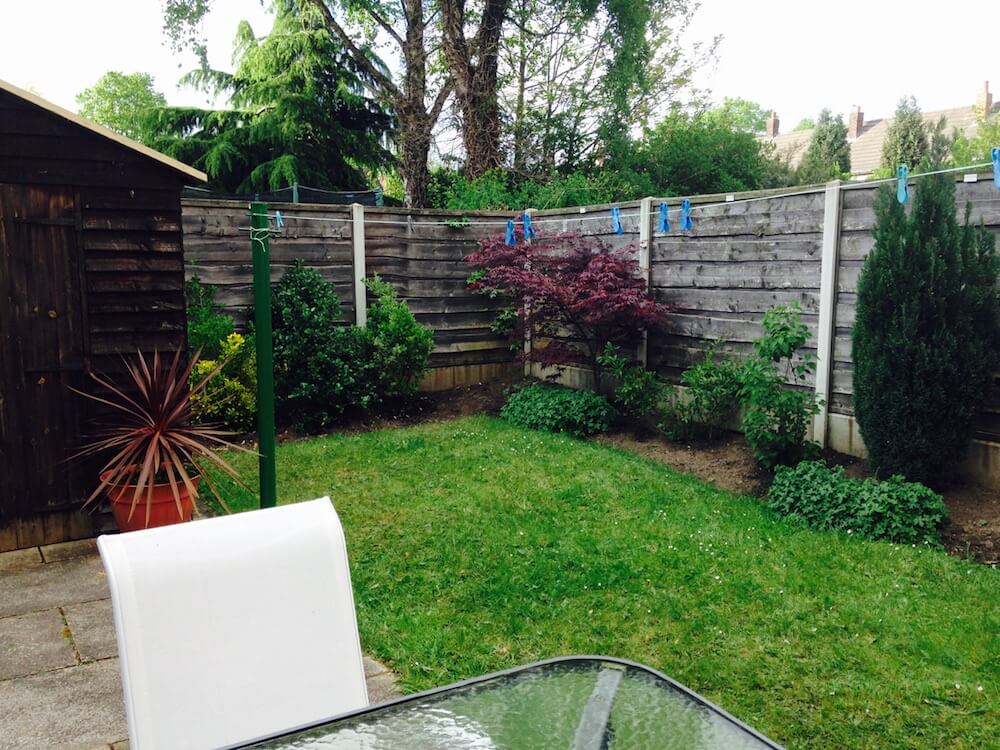
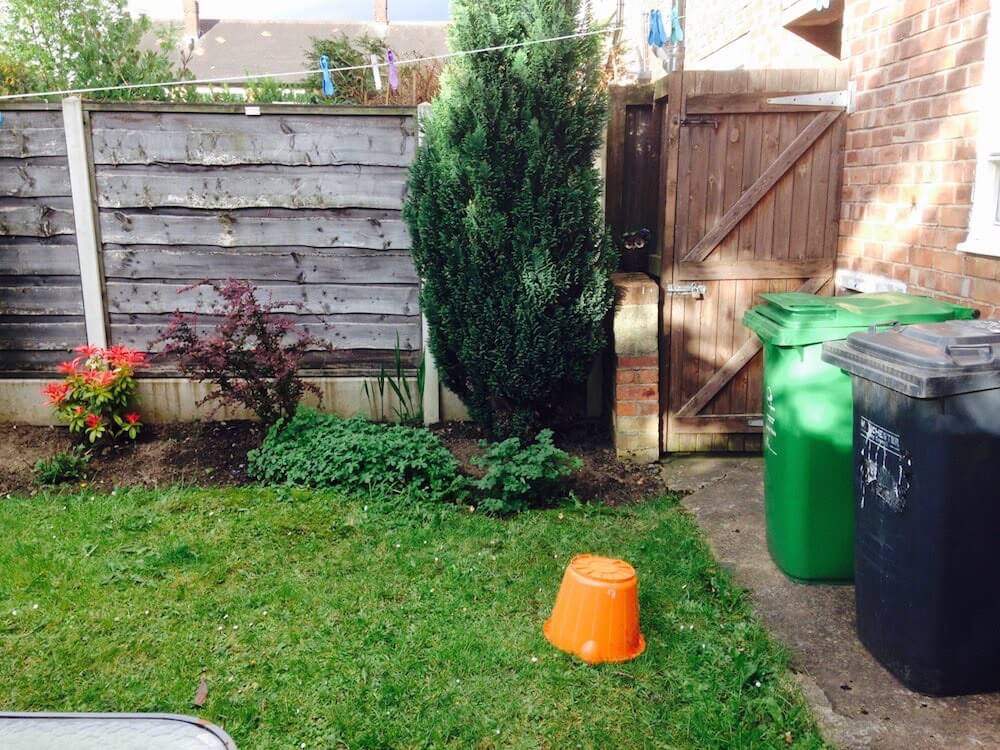
The garden before work began. Unloved turf, a mossy, slippery terrace, and a shed that was screening nothing useful. There’s potential here, but it needs a clear design strategy.
The garden had three problems that are extremely common in small rectangular plots. The terrace was in the wrong place (closest to the house rather than where the sun fell). The shed was acting as a visual obstacle rather than a design feature. And the planting had no structure or colour palette, making the space feel both cluttered and empty.
The brief required low-maintenance planting, somewhere to sit in the sun, raised beds for growing, and privacy from the neighbouring property on a strict £3,500 budget.
The Design Process: From Brief to Build
Before a single plant is chosen or a paving slab is ordered, a professional small garden design starts with two things: a proper client brief and an accurate site survey. The brief establishes what the garden needs to do, how it needs to feel, what the client’s lifestyle requires, and what their honest maintenance appetite is. The site survey provides measurements, the aspect (the direction the garden faces), soil conditions, and access constraints.
Both are vital. Skipping the survey leads to costly ordering errors and proportional mistakes. Skipping the brief leads to a beautiful garden that doesn’t suit the person living in it.
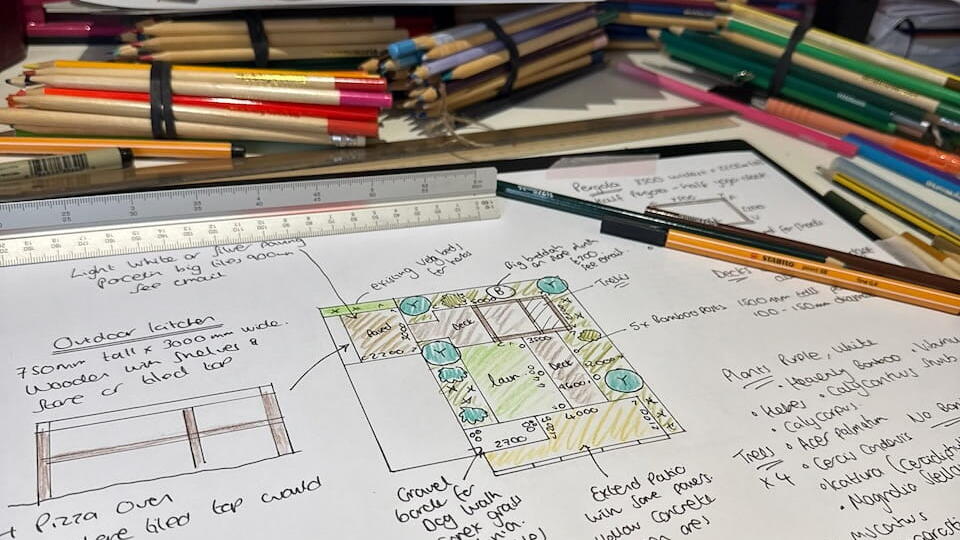
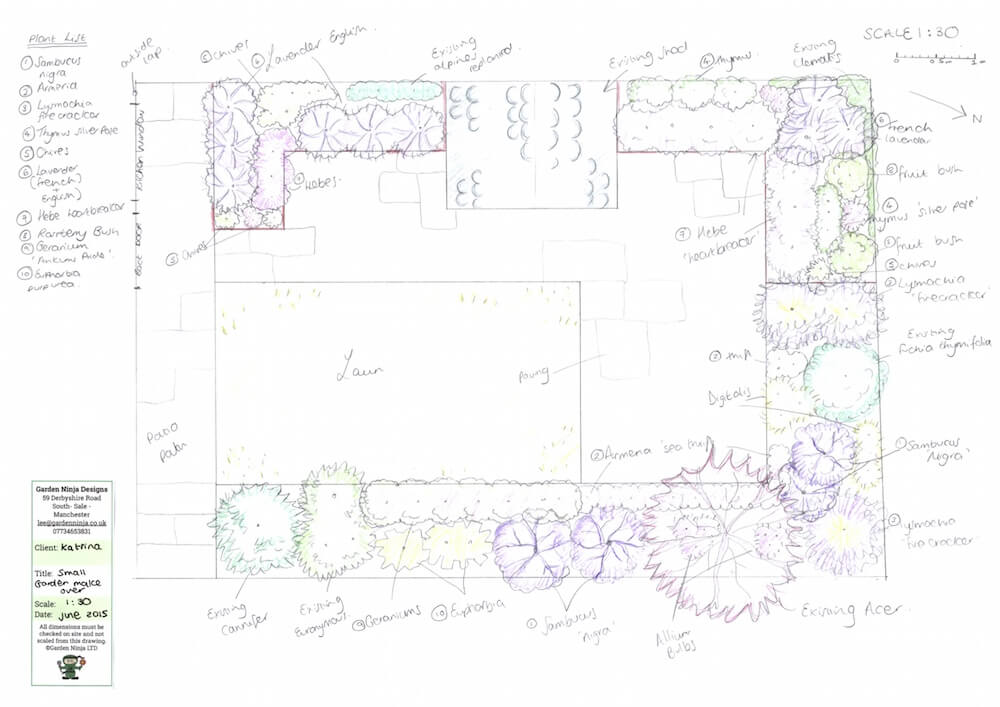
The initial hand-drawn concept plan. Getting ideas on paper before committing to materials is where the real thinking happens in small garden design.
Once the survey and brief were complete, I developed a mood board to align the visual direction with the client’s preferences before sketching the design. The client loved purples and pinks but disliked yellows. Here, I had a small design challenge because yellow is the natural complementary contrast to purple and would have given the planting depth and vibrancy. I took her through some examples of how purple and yellow work together in planting, using Lysimachia Firecracker as a demonstration, and asked for a small leap of faith. She agreed, and the planting came together far more dynamically as a result.
The developed CAD plan shows the repositioned shed, extended terrace, raised beds, and new lawn area. The design uses the full 9 x 6 metres without a wasted corner.
A large part of the early physical work was clearing the site of existing shrubs and some very thuggish ivy that had damaged fence panels. This is the unglamorous reality of most garden makeovers: before you can build something new, you spend a full day or more removing what’s already there. In this case, it was entirely worth it. The cleared space immediately showed the potential that had been buried.
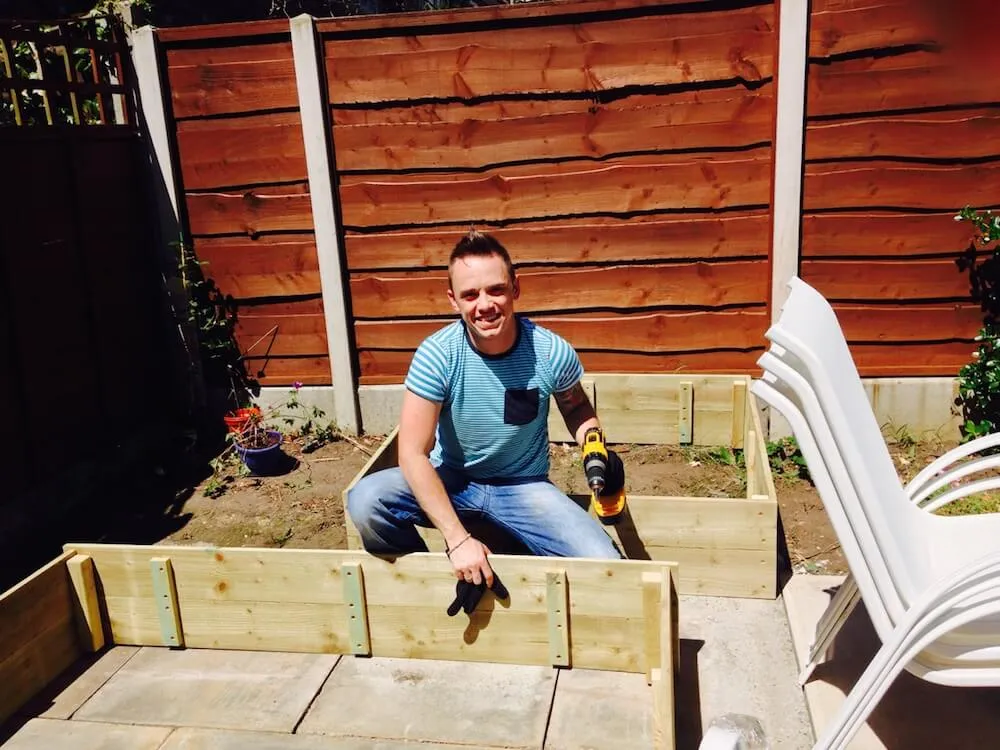
Hands-on during the build. Good garden design doesn’t stop at the drawing board.
Small Garden Design Principles That Make the Biggest Difference
These are the principles I apply to every small garden I design. They’re transferable to any compact space regardless of shape, aspect, or budget.
Break the Line of View
The single most effective thing you can do in a small garden is prevent the eye from seeing the entire space at once. When you can see everything from the back door, the garden registers as the sum of its dimensions. When something interrupts that view and draws you in, the brain reads the space as larger and more interesting than it actually is.
In this project, the shed provided that interruption. Rather than trying to hide it, I moved it 180 degrees and used it as a deliberate screen, creating a secondary area behind it that you discover rather than see immediately. This sense of discovery is what separates a garden that feels like an outdoor room from one that feels like a rectangle of grass.
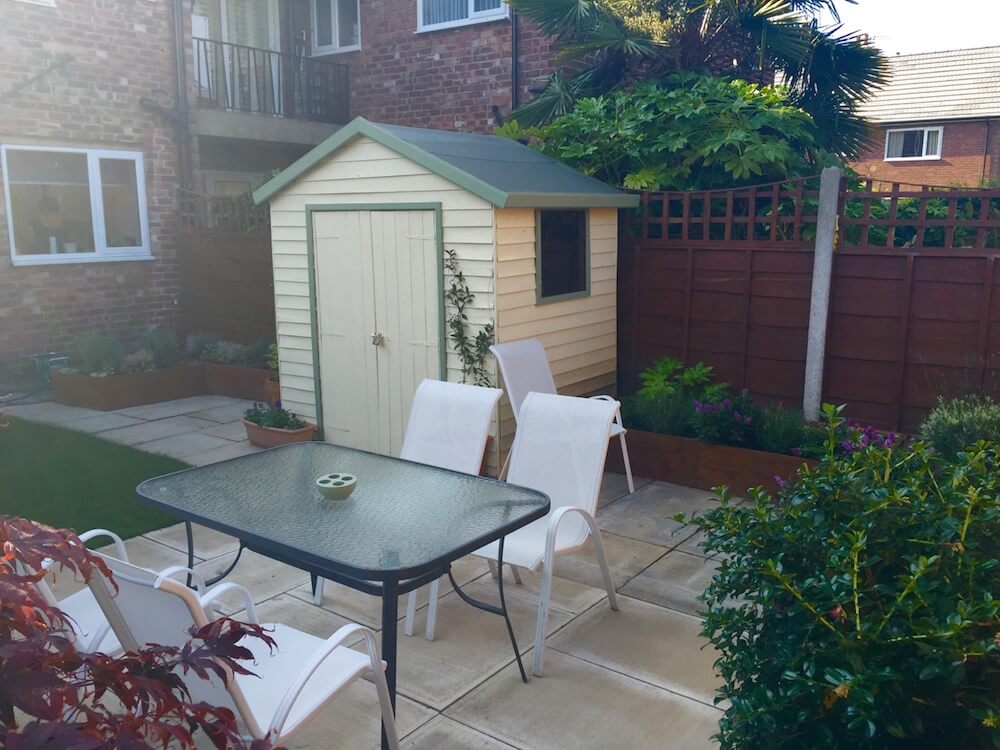
The repositioned and repainted shed became the focal point rather than the eyesore. The painted finish, window surrounds, and fascia boards transformed a liability into a feature.
Restrict Your Colour Palette
Small gardens tolerate very little visual noise. Using too many colours, materials, or styles fragments the space, makings it feel smaller and more chaotic. The most successful small garden designs I’ve created use a maximum of two or three main colours throughout, carrying them consistently through hard landscaping materials, painted surfaces, and planting. In this project, the palette was cream, dusky purple, and deep red, carried through the shed paint, the Sambucus nigra foliage, the lavender, and the Armeria edging. It reads as intentional rather than accidental.
Use Structural Plants That Earn Their Keep Year-Round
In a small garden, a plant that looks good for six weeks and indifferent for the rest of the year is a significant problem. Every plant should be earning its space for as much of the year as possible. This means prioritising evergreens for structure, plants with multiple seasons of interest (foliage, flowers, and seedheads), and avoiding single-season annuals as the backbone of a planting scheme.
Hebes, lavenders, and grasses all tick multiple boxes for small spaces. They’re compact, evergreen or semi-evergreen, low maintenance, and provide year-round structural interest even when not in flower.
Hard Landscaping Before Soft
Always finalise and install hard landscaping before deciding on planting. The structure of a small garden comes from its hard elements: paving, raised beds, paths, fences, and lawn edges. Planting into an unresolved structure is what makes small gardens look unfinished, even when full of plants. Get the bones right first, then plant around them.
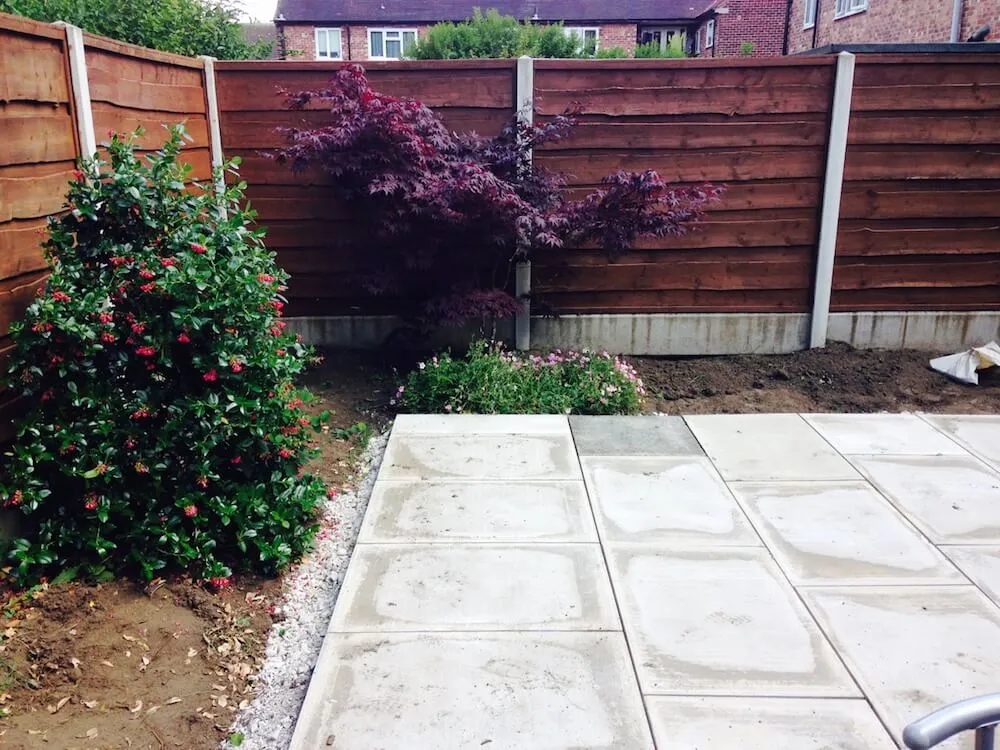
New paving was laid as part of the extended terrace. The hard landscaping was completed before any planting began.
Seating Areas and Flow in Small Gardens
One of the most common mistakes in small garden design is placing the seating area immediately outside the back door because it’s the most obvious and convenient location. In many UK gardens, the back of the property faces north or east, which means the area nearest the house is in shade for most of the day. Putting a seating area in permanent shade is a wasted investment.
Always investigate the aspect before finalising where the seating goes. Spend time in the garden at different times of day, noting where the sun falls. In this project,t the sunniest spot was at the far end, behind where the shed originally stood. Moving the seating there completely transformed the space’s liveability. The client went from a terrace she rarely used because it was cold and shady to a sun trap she sat in every evening from May to September.
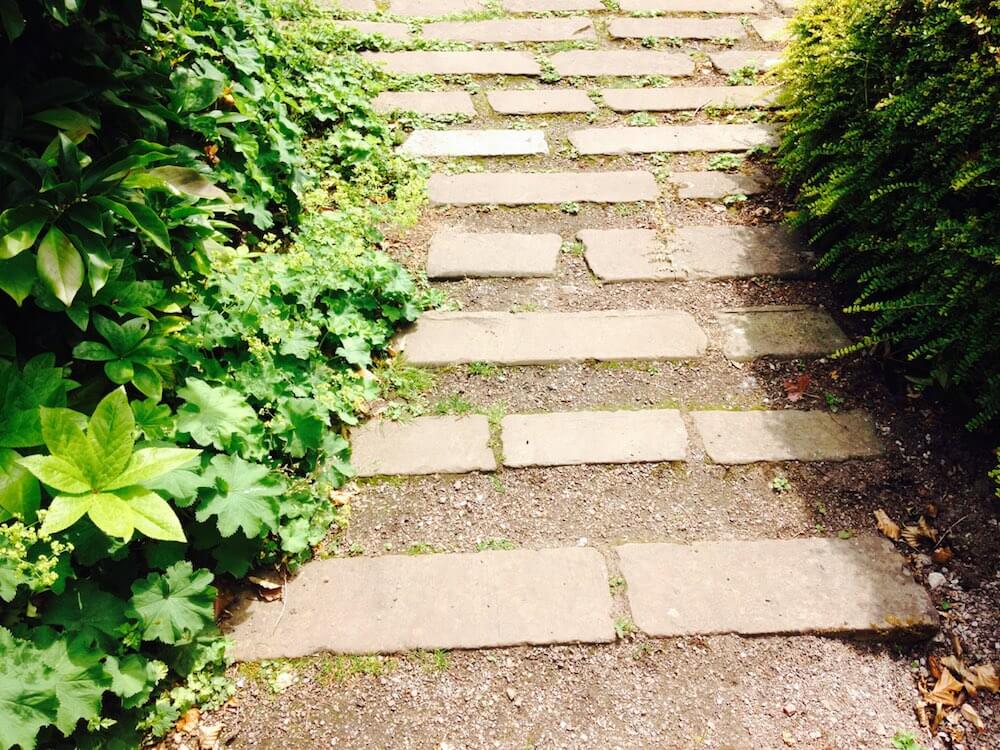
For flow, even a small garden benefits from a clear route that takes you on a visual journey rather than just delivering you from door to fence. A path that curves slightly, a stepping stone route through a planted area, or simply the positioning of a chair that draws your eye to the far corner, all create movement and interest in a confined space.
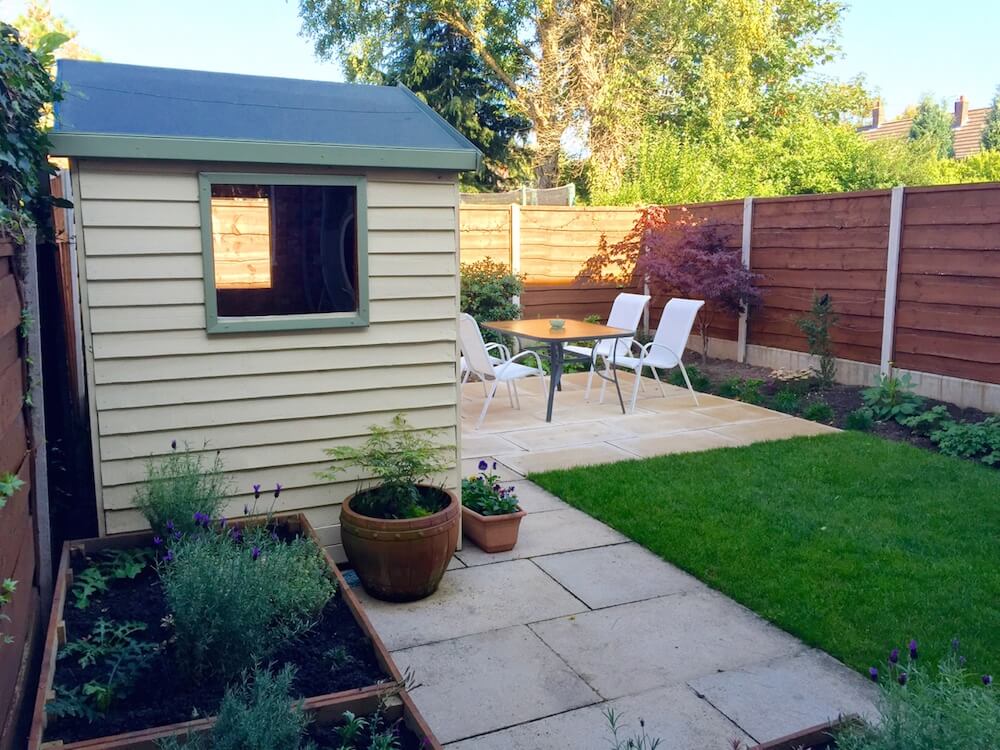
The finished garden with the seating area positioned in the suntrap at the far end. The shed, now painted and surrounded by planting, acts as a backdrop rather than an obstacle.
Raised Beds in Small Gardens: Practical and Beautiful
Raised beds are one of the most versatile elements you can add to a small garden. They solve several problems simultaneously: they define space without enclosing it, they give planting an immediate structural quality, they improve drainage in heavy clay soils, and they make gardening physically easier by raising the soil level.
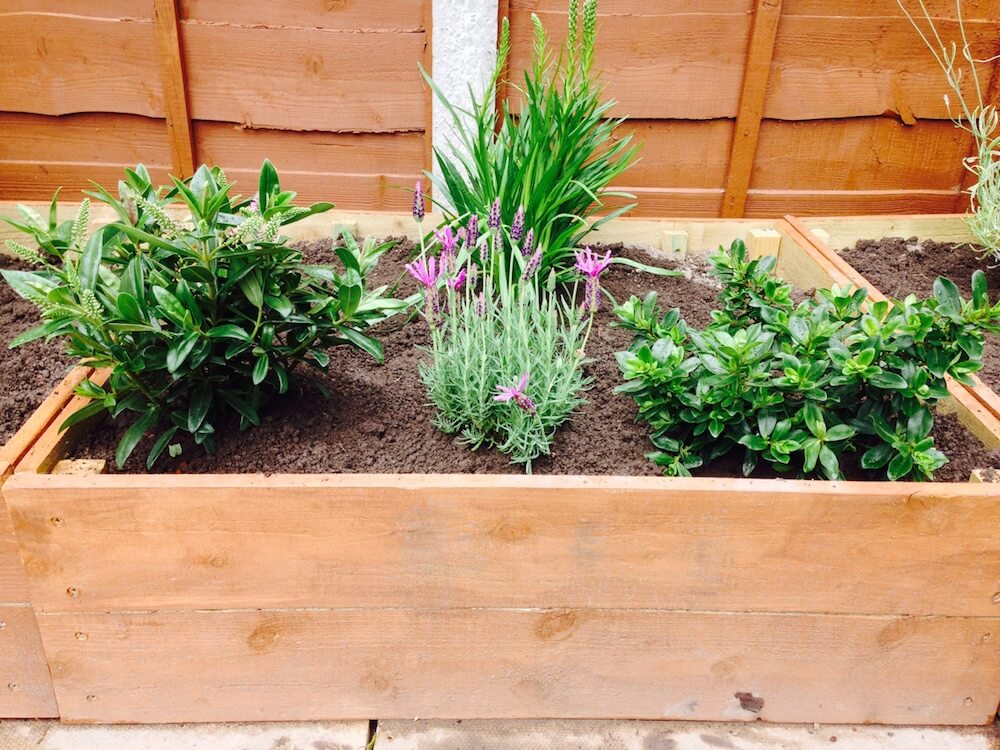
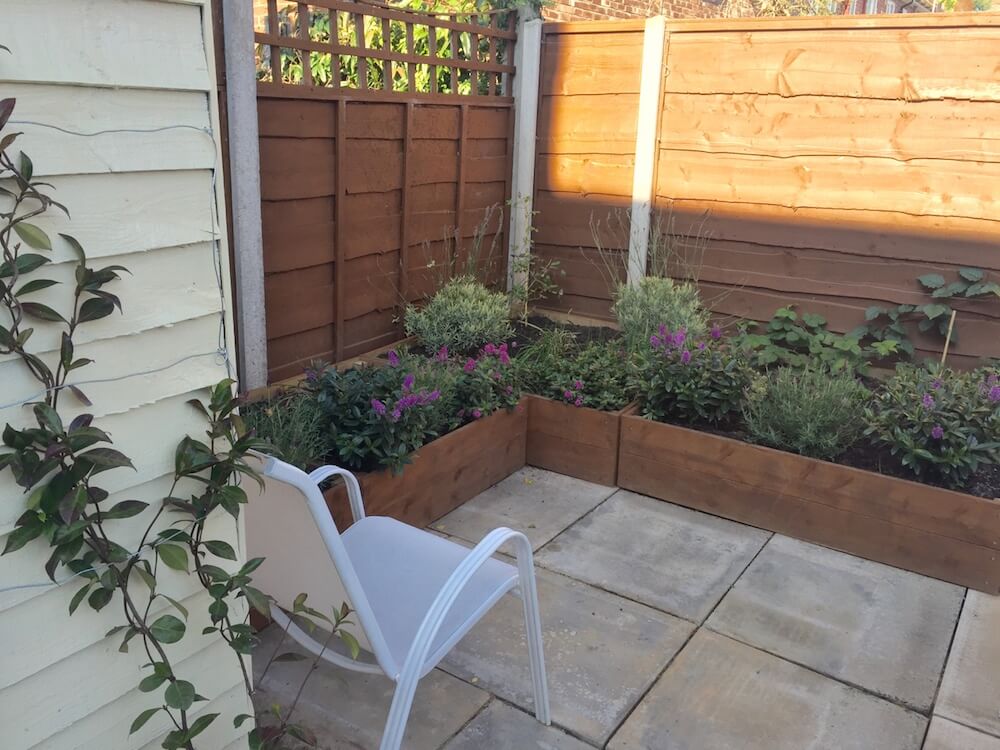
In this project, the raised beds were handcrafted from timber, stained to complement the cream shed, and planted with low-maintenance herbs, including lavender and hebes. The brief asked for somewhere to grow vegetables or plants, and raised beds fulfilled this perfectly without taking over the garden or requiring a significant maintenance commitment from a busy owner.
The bespoke timber raised beds are planted up with lavender and herbs. The raised height makes maintenance easier and gives the planting an immediate presence in the garden.
The proportions of raised beds in a small garden matter considerably. Beds that are too tall relative to the space feel oppressive. Beds that are too low look like afterthoughts. As a rule, 30 to 45cm is the right range for most small gardens: tall enough to be functional and visually present, low enough not to dominate. Width is more important than most people realise. A bed that’s too wide to reach the centre from either side is a bed you’ll avoid tending. Keep the maximum width at 1.2 metres for beds accessible from both sides, or 60cm for beds against a fence.
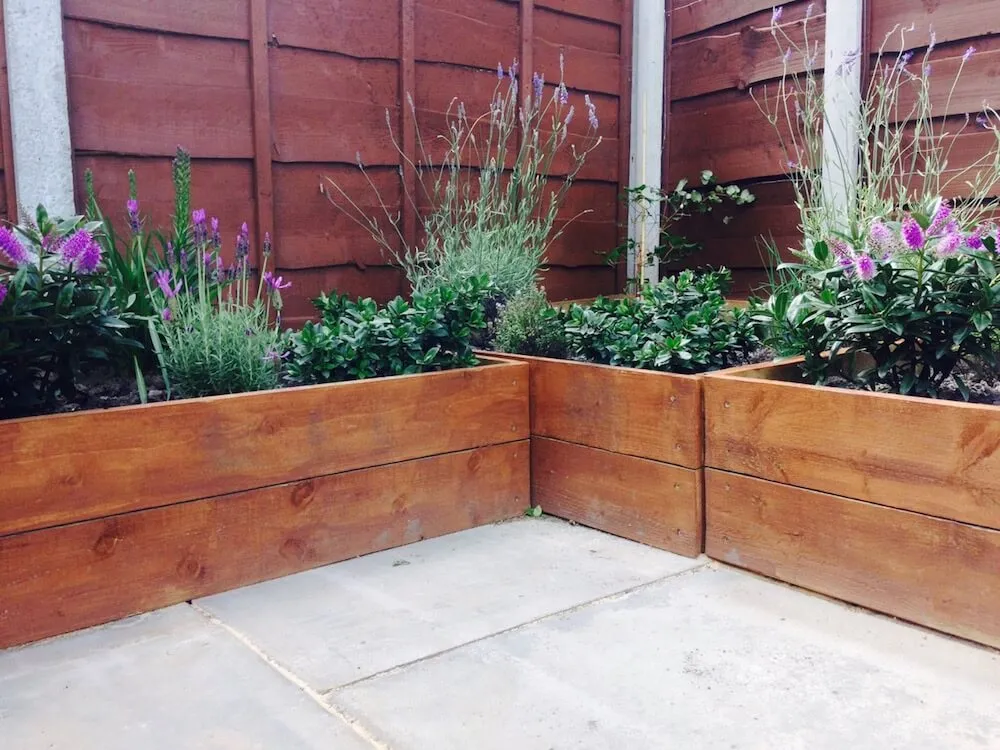
Another raised bed garden from the portfolio. The consistent height and material create a designed, intentional feel even in a compact space.
Planting for Small Spaces: How to Choose Well
Planting a small garden is a discipline in restraint. The temptation when visiting a garden centre is to buy something of everything that looks beautiful. In a small space, this produces a chaotic, unfocused result in which individual plants are lost in a jumble rather than contributing to a coherent whole.
The approach I use in small garden projects is to start by choosing the structural backbone: three to five key plants that will provide year-round presence and define the space’s character. Everything else is then chosen to complement or contrast with those key plants rather than competing with them independently.
In terms of colour, I used the existing Acer as the starting point and built outward from its foliage tones. The Sambucus nigra provided the bulk of the purple and deep red, creating height and drama at the back. The lavender and hebes carried the purple through the raised beds at a lower level. The Armeria edging brought the colour down to ground level and defined the terrace edge. The Lysimachia introduced the yellow contrast that lifted the entire scheme.
The planting scheme reads as intentional from every angle because the colour palette was established before a single plant was chosen.
Overlooking neighbours is one of the most commonly cited problems in small urban gardens, and the most commonly suggested solution (a tall fence or trellis all along the boundary) is often the worst one. A solid high boundary reduces light, makes the garden feel enclosed and oppressive, and doesn’t necessarily screen you at the point where you actually sit.
Targeted screening is far more effective. The question isn’t “how do I stop neighbours seeing into my garden” but “where do I sit, and what can they see from there?” In this project, the repositioned shed served as the primary screen for the seating area, entirely blocking the view from the adjacent property when you’re seated. A small amount of strategic planting completed the screen without reducing light levels elsewhere in the garden.
💡 Top Tip
Sit in your garden in the chair position where you want your seating area to be, then look up and around. Work out exactly what neighbours can see from their windows or upper floors. You may find that a single well-placed taller plant or simple pergola sail shade resolves 90% of the overlooking problem without affecting light levels anywhere else in the garden.
For more substantial privacy planting, columnar or fastigiate trees are far more space-efficient than spreading ones. Prunus amanogawa, the upright Japanese cherry, reaches 5 to 8 metres but stays within a 1 metre spread, giving you genuine height screening without taking over a small garden. Bamboos in large containers are another option, though they need a genuinely frost-proof container large enough to prevent them from drying out in summer.
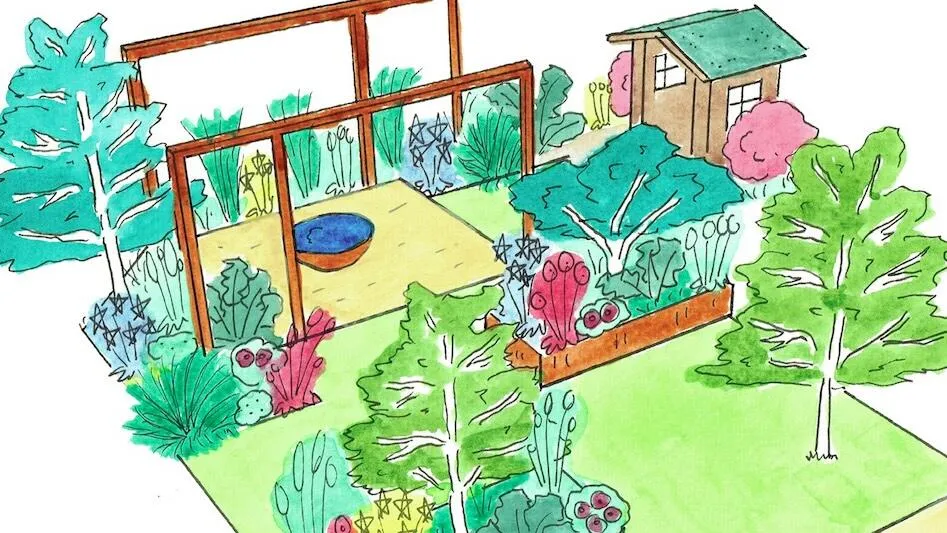
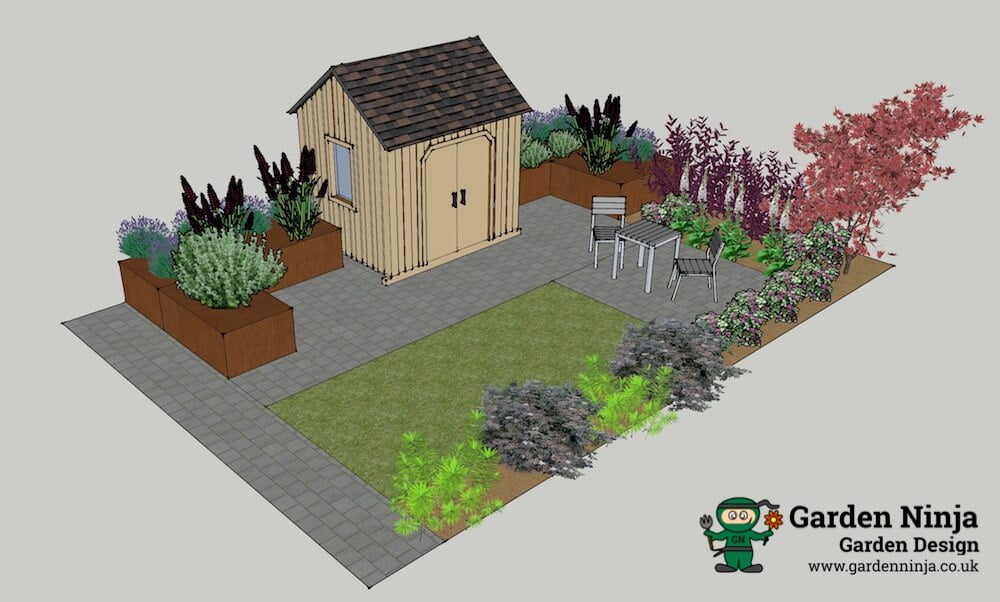
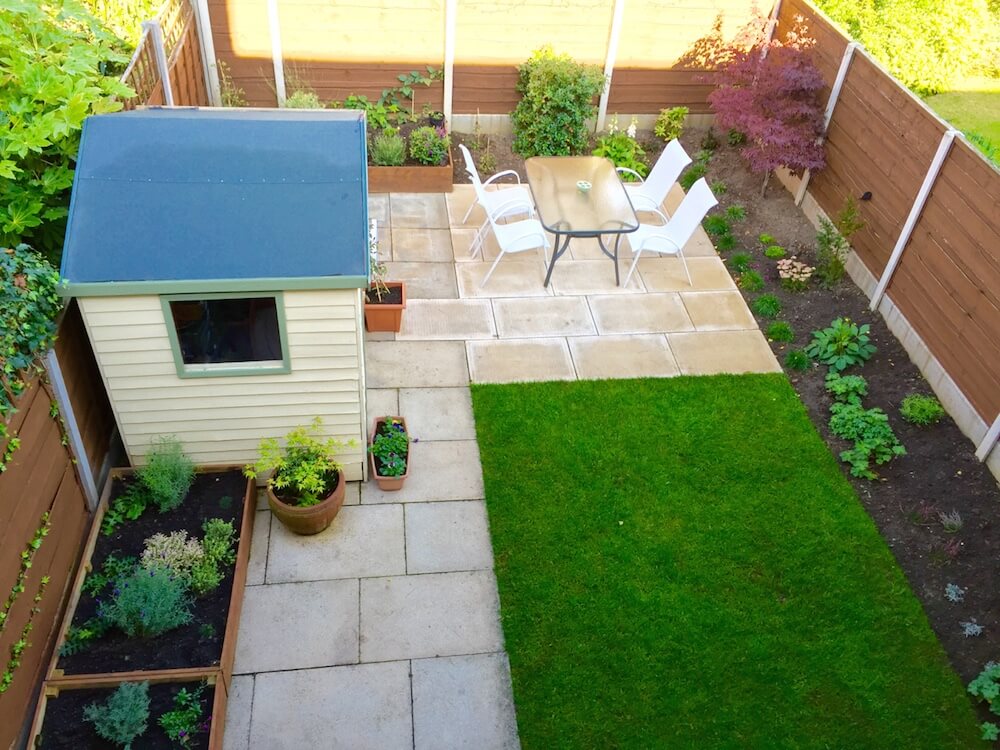
The aerial view clearly shows how the shed, raised beds, and planting create a layered garden that offers privacy in the seating area without closing in the whole space.
Small Garden Makeover Costs: What to Expect in 2026
Cost is the question I get asked most on the forum and in consultations, and I’ll give an honest answer rather than a vague range. This project cost £3,500 all in, which at the time of the original build (2015) was representative of a well-scoped, competitively priced small garden makeover with a professional designer involved throughout. In 2026, the same scope would cost considerably more due to inflation in labour and materials.
💷 Small Garden Makeover Cost Guide (2026)
Element
Typical Cost Range
Notes
Garden design and plans
£500 to £1,500
Varies by designer level and plan detail
Hard landscaping (paving, terrace)
£1,500 to £4,000
Depends on material choice and area
Raised beds (timber, bespoke)
£400 to £1,200
Per bed or set; materials and labour
Lawn (turf)
£15 to £25 per m2
Plus preparation and topsoil
Fencing or boundary work
£100 to £200 per panel
Installed; varies by panel type
Planting (structural plants)
£500 to £1,500
Depends on maturity and quantity
Clearance and preparation
£200 to £600
Often underestimated; allow a full day
Total typical range
£4,500 to £9,000
For a 50 to 80m2 garden, professionally designed and installed
The biggest variables are material choices (natural stone paving costs three to four times as much as concrete alternatives) and whether you use mature planting or smaller plug plants that will establish over two to three seasons. Using smaller plants and doing some of the labour yourself are the two areas where the budget can be managed most effectively without compromising the design.
DIY or Hire a Garden Designer?
This is a genuinely useful question, and the honest answer is: it depends on what you mean by DIY. Hiring a designer for the plans and then project-managing the installation yourself is often the best-value combination. You get professional design thinking applied to your specific space, plus a set of plans you can take to contractors for quotes, while saving the project management fee that comes with a full design-and-build service.
Doing the entire thing yourself, design included, can produce excellent results if you’re willing to learn the principles properly before starting. The common failure mode in complete DIY small gardens is not a lack of effort but a lack of a design framework that makes all the individual decisions coherent. Buying plants you love without a plan for how they relate to each other is how gardens end up looking busy and unresolved despite significant investment.
💡 Top Tip
Before commissioning a full design-and-build service, spend a few hours drawing your garden to scale on graph paper and placing the key elements you know you want. You will immediately discover the proportional constraints you’re working within and arrive at any designer consultation with a much better understanding of what you actually need.
Common Small Garden Mistakes to Avoid
Having designed and remodelled dozens of small gardens over more than 20 years, I find the same mistakes recur. These are the ones worth knowing about before you start spending money.
Putting the Seating by the Back Door
As covered above, this is almost always the wrong place. It makes it easy to ignore the garden and, therefore, not engage with it. One tip I use is to follow the sun, not the convenience of the door. You’ve got a better chance of being engaged and immersed in the beautiful garden itself!
Choosing Too Many Materials
Using three different paving materials, two different timber finishes, and a mix of painted and unpainted surfaces creates visual chaos in a small space. Restrict hard materials to two as a maximum of two. One paving material and one timber finish is often enough.
Buying Plants Too Small and Expecting Instant Results
Small plug plants are excellent value, but they need two to three seasons to establish. If you want impact in year one, budget for slightly more mature specimens for the key structural positions. Let the infill planting start small.
Ignoring the Shed
Most small gardens contain a shed that is treated as an embarrassing necessity. In reality, a shed is one of the most valuable design elements you have: it provides vertical interest, a potential backdrop for planting, a surface for paint colour, and a structure that can anchor a seating area. Paint it, position it deliberately, and frame it with plantin,g, and it becomes a feature rather than an eyesore.
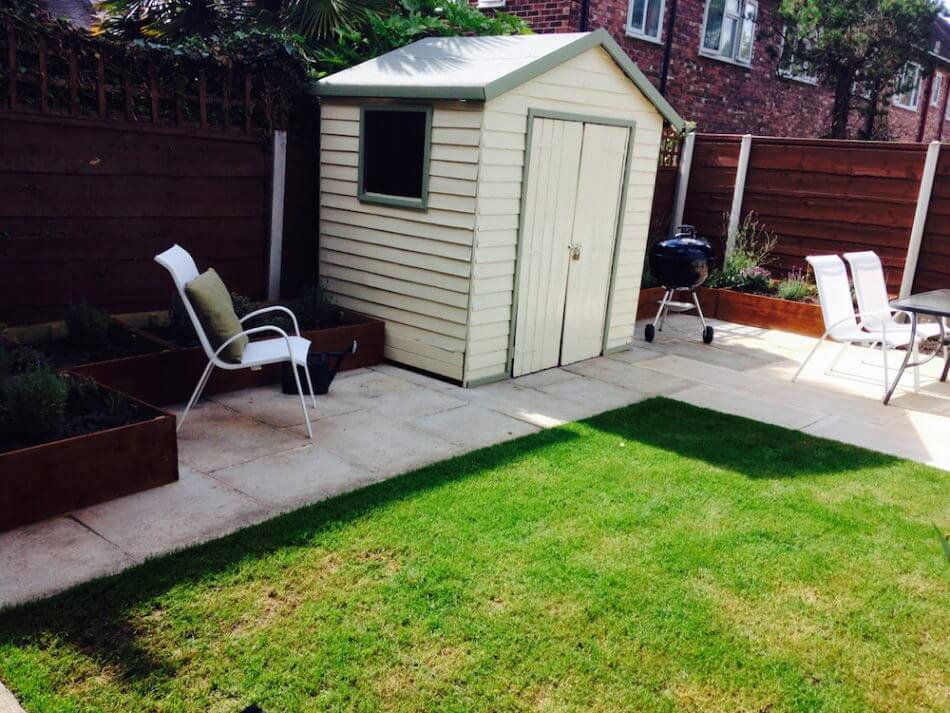
The shed after repainting and adding handcrafted window surrounds and fascia. The transformation cost less than a day’s labour and changed the entire character of the garden.
Overlooking Aspect
A north-facing garden has fundamentally different planting and layout requirements from a south-facing one. Understanding which direction your garden faces before you design or plant it is not optional: it determines what will grow well, where the sun falls, and therefore where seating and growing areas should be. My garden aspects guide covers this in full.
Using Vertical Space: Think Up, Not Out
The floor area of a small garden is fixed. The vertical space above it is not. This is one of the most underused assets in compact garden design, and exploiting it properly can transform both the visual richness and the planting capacity of a small plot without taking up a single extra centimetre of ground.
Boundaries are the obvious starting point. A bare fence panel offers nothing. The same fence panel with a climbing Rose, clematis, or star Jasmine trained across it becomes a full planting layer that adds colour, scent, and wildlife value while using almost no ground space. Evergreen climbers like Clematis armandii or Trachelospermum jasminoides (star Jasmine) are particularly valuable because they provide year-round coverage. Deciduous climbers like wisteria or climbing roses give spectacular seasonal impact, then allow light through in winter when it matters most.
Beyond climbers, consider height within the planting scheme itself. Tall, slim plants like Verbena bonariensis, alliums, or ornamental grasses add height without spread, creating that sense of layering that makes a small garden feel considered rather than flat. A six-foot Verbena bonariensis takes up almost no ground space, but its presence changes the feel of the entire planting around it.
Wall-mounted planters and vertical pocket systems are worth considering for genuinely tiny spaces, such as balconies or courtyard walls with no planting beds at all. They work best with herbs, small ferns, succulents, and trailing plants rather than structural shrubs, but for a kitchen herb garden on a south-facing wall,l they’re an excellent solution.
Wisteria trained over a pergola creates an extraordinary overhead canopy in late spring. In a small garden, en a pergola over the seating area also adds enclosure and intimacy to what might otherwise feel exposed.
A pergola or overhead structure above a seating area is the most dramatic vertical element available to a small garden. It adds enclosure and intimacy, provides a framework for climbers to create a living canopy, and visually defines the seating zone as a distinct room within the garden. Even a simple sail shade or timber beam structure over a small terrace fundamentally changes how that space feels to sit in.
💡 Top Tip
When training climbers on a fence, fix horizontal wires or a trellis panel first rather than attaching the plant directly to the fence boards. The gap between trellis and fence creates airflow that keeps the fence in better condition and gives the plant’s roots somewhere to run without the boards trapping moisture.
Garden Lighting: Extending Your Garden Into the Evening
Lighting is the element that most small garden makeovers forget until the end, and then underinvest in. This is a mistake, particularly in the UK where we’re effectively limited to a seven-month outdoor season. Good lighting extends that season by making the garden genuinely usable and inviting on cool evenings in spring and Autumn. It transforms the visual quality of a small space after dark in a way that daytime planting alone cannot achieve.
The principle to work from is layers of light rather than a single source. A single bright overhead light floods a small garden, creating a flat, clinical feel. Instead, combine three types: uplighting for trees or structural plants, ambient lighting for the seating area, and path or step lighting for safety and definition. Together, they create depth and atmosphere that a single floodlight never can.
Solar-powered spotlights have improved enormously in recent years and are now a credible option for garden lighting without mains installation. They work particularly well for uplighting individual plants or illuminating a path. The limitation is consistency: solar lights depend on charge, which varies by season and location. For a seating area where you need reliable light every evening, low-voltage mains-connected LED lighting is worth the installation investment.
💡 Top Tip
Always choose warm white (2700K to 3000K colour temperature) rather than cool white or daylight for garden lighting. Warm white creates atmosphere and is significantly less disruptive to nocturnal wildlife including bats, moths, and hedgehogs. Cool white or blue-toned lighting in gardens has a measurable negative impact on these species.
String lights or festoon lights threaded through a pergola, along a fence line, or above a seating area are the single cheapest and most impactful lighting addition for most small gardens. A set of warm white festoon lights costs very little, installs in an afternoon, and immediately creates an inviting evening atmosphere. They’ve become ubiquitous precisely because they work.
For hard landscaping, consider recessed deck or step lights at the planning stage if you’re installing decking or steps as part of the makeover. Retrofitting these later requires lifting boards and is considerably more expensive and disruptive. If in doubt, run conduit while the ground is open,n even if you don’t install the lights immediately.
The default assumption in most UK back gardens is that you need a lawn. In a small garden, en this assumption is worth challenging directly. The RHS is explicit on this point: for a small garden without children, ditching the lawn in favour of borders with paving, gravel, or decking is often less work overall, and frees up shed space previously allocated to a lawnmower. A small area of grass that takes ten minutes to mow but requires edging, feeding, scarifying, aerating, and overseeding to look presentable may not be earning its keep.
The alternatives worth considering for a small garden makeover are:
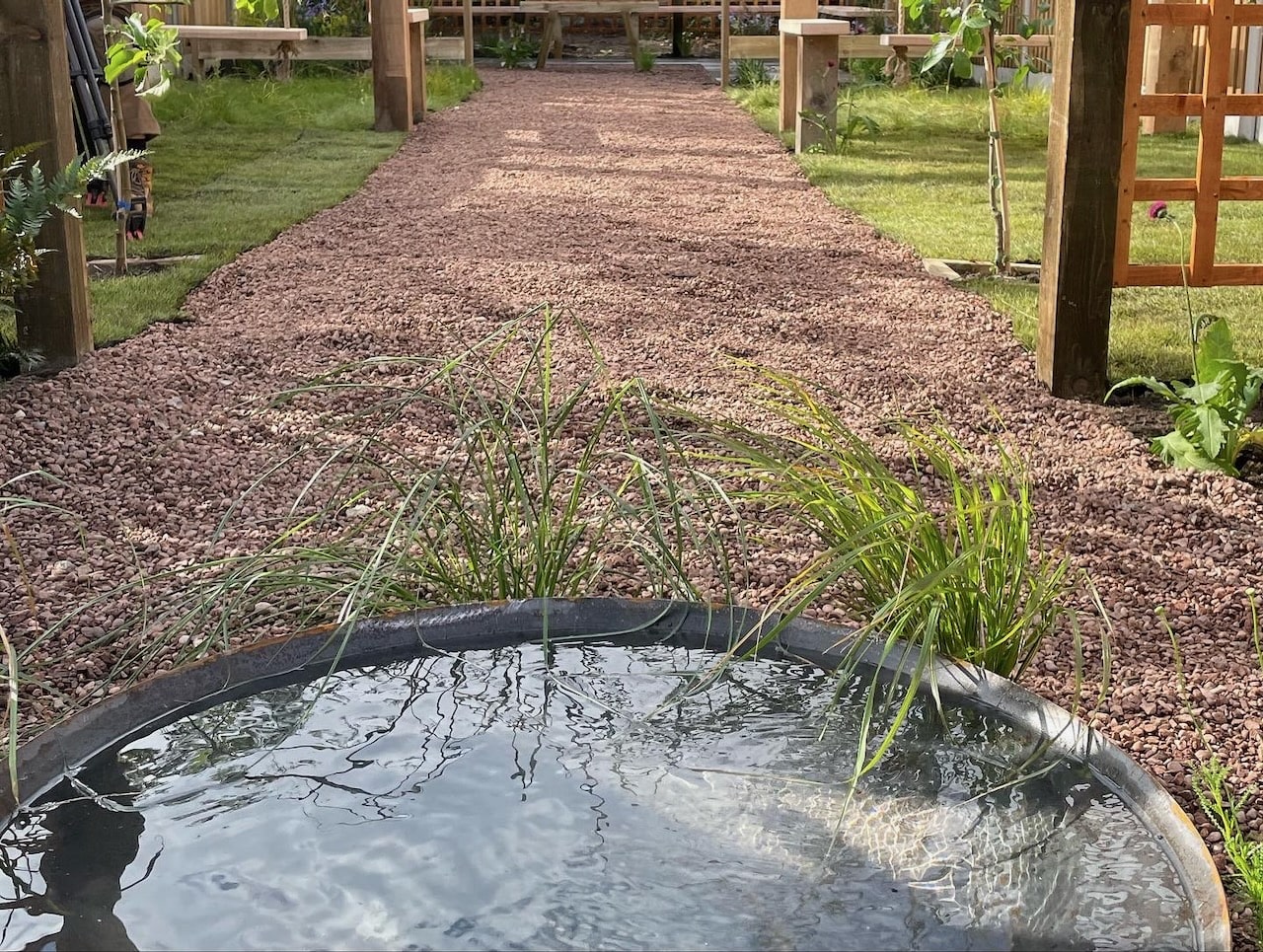
Gravel: The most versatile lawn alternative for small gardens. Laid on a geotextile membrane over compacted hardcore, it suppresses weeds effectively, drains well (important for the UK climate), and provides a neutral backdrop that makes container plants and border planting stand out. Pea gravel in a warm buff or pale grey reads as natural and clean. Avoid very pale white chippings, which can look harsh and glare in the summer sun. The drawback is that cats find it attractive as a toilet, which is worth factoring in if this is a concern in your area.
Gravel is a ground treatment in a small garden. Laid on a geotextile membrane, it suppresses weeds, drains freely, and creates an excellent backdrop for container planting.
Paving: More expensive than gravel but permanent, clean underfoot, and very low maintenance once laid. Natural stone paving ages beautifully and suits period properties. Porcelain paving is hharder-wearing easier to keep clean, and comes in a wide range of finishes. Large-format slabs (600 x 600mm or larger) make a small space feel larger because they reduce the number of joints the eye has to process.
Decking: Works particularly well in gardens that are viewed from an elevated position, such as a kitchen extension or raised ground floor. Composite decking has improved significantly in quality and durability, and requires far less maintenance than softwood decking. Avoid dark-stained softwood decking in shaded or north-facing gardens where it will stay damp and become slippery.
Mixed approach: In most small gardens I design, the answer is a combination rather than a single material. A paved terrace for the seating area, a small lawn if children need it, and gravel or planting for the remaining ground cover usually produce the best balance of functionality and visual interest. The key is making deliberate choices rather than defaulting to an all-lawn solution simply because it’s conventional.
Garden Zoning: Creating Rooms Within a Small Space
One of the most consistent findings in garden design is that a small garden feels larger when it is divided into distinct zones rather than left as a single undifferentiated space. This seems counterintuitive, but the psychology is straightforward: a single open area reads as its full dimensions immediately. Zones create a sense of movement between spaces, making the garden feel more complex and generous than its measurements suggest.
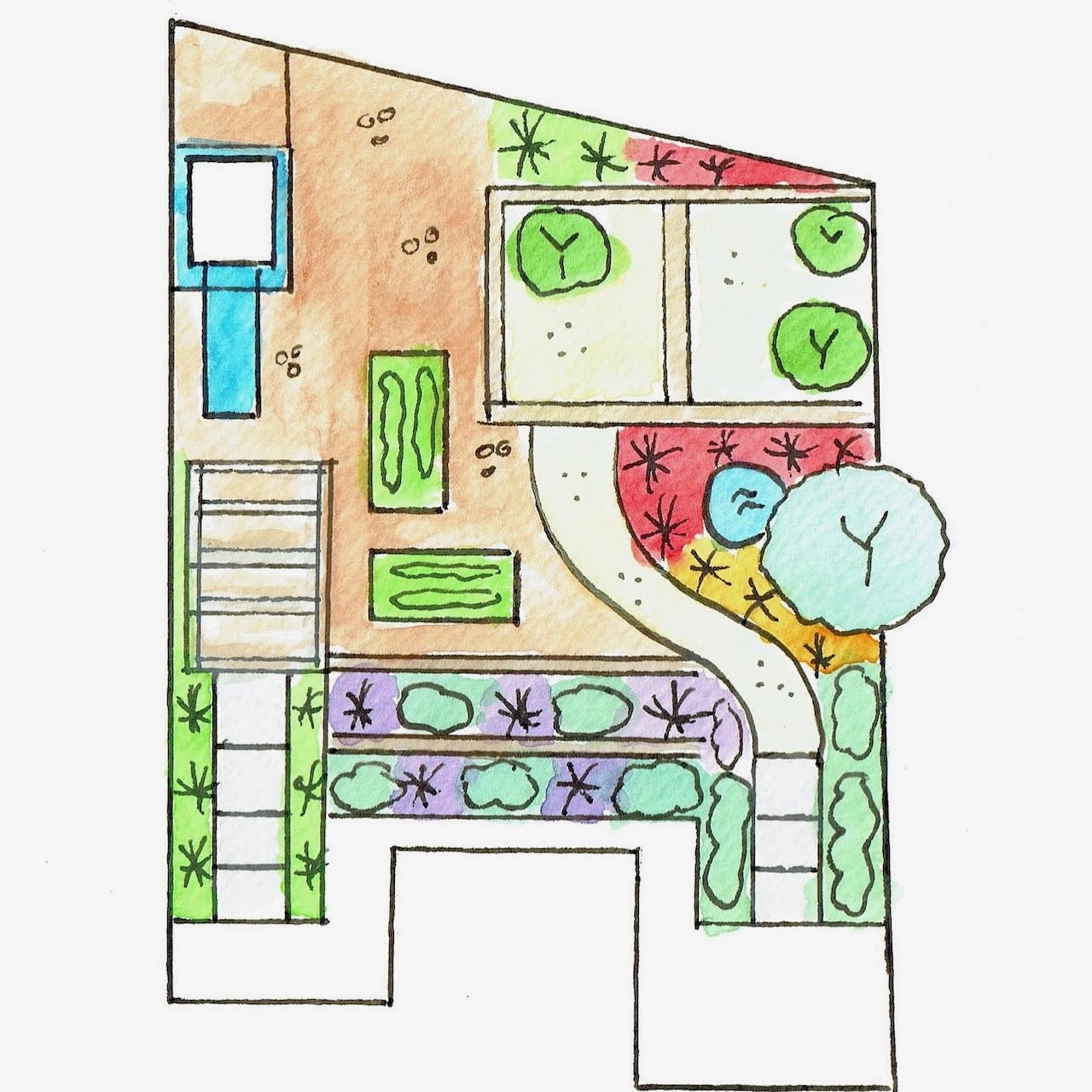
A zoned garden design plan. Even a small garden benefits from distinct areas: the dining zone, the growing zone, and the relaxation zone. You don’t need much space to create each one.
In a 9 x 6-metre garden, the zones don’t need to be large to work. The project in this guide effectively created three: a lawn and circulation zone near the house, a growing zone in the raised beds along the side, and a seating and relaxation zone in the suntrap at the far end behind the shed. Each has a distinct function, a distinct material character, and a slightly different planting personality. Moving between them feels like a journey rather than a walk to the end of a rectangle.
Zone boundaries don’t need to be hard physical divisions. A change in ground material from paving to gravel, a low, planted edge, a single specimen plant placed at a transition point, or simply a shift in level is enough to signal to the brain that it has moved from one space to another. The subtler these transitions are, the more sophisticated the result tends to be.
For a garden used by adults primarily, the classic three zones are dining (a hard surface with enough space for a table and chairs for the maximum number of people you’d realistically entertain), relaxation (a more informal seating spot, perhaps a single chair or a bench in a sunny corner), and growing or planting (raised beds, borders, or containers where the garden’s horticultural life is concentrated). These three cover most functional needs without requiring more space than the typical small UK garden provides.
💡 Top Tip
Draw your garden to scale on paper and sketch out your proposed zones before committing to anything physical. You will almost always discover that your initial instinct has the dining zone too large and the relaxation zone too small, or vice versa. Paper planning is free and catches these errors before they become expensive.
Frequently Asked Questions
How much does a small garden makeover cost in the UK?
In 2026, a professionally designed and installed small garden makeover for a garden of 50 to 80 square metres typically costs between £4,500 and £9,000. The main variables are material choices, whether mature or young planting is used, and how much of the labour you take on yourself. Design fees typically range from £500 to £1,500, depending on the level of detail and the designer’s experience.
How do I make my small garden look bigger?
The most effective techniques are breaking the line of view so you can’t see the entire space at once, using a restricted colour palette of two or three tones consistently throughout, placing the seating area at the far end rather than nearest the house, using vertical elements like tall narrow plants or trellis to draw the eye upward, and avoiding cluttering the space with too many different materials or plant species. Mirrors on walls or fences can create apparent depth, though they work best in partially shaded spots where direct sunlight won’t cause glare.
What should I put in a small back garden?
Prioritise in this order: a seating area in the sunniest spot, a defined hard surface or lawn that suits your lifestyle, structural planting that provides year-round interest, and any specifics like a shed, raised beds, or a water feature. The mistake most people make is starting with the specifics before the fundamentals are resolved.
What are the best low-maintenance plants for a small garden?
Hebes, lavender, ornamental grasses, hardy geraniums, evergreen ferns, Sarcococca (sweet box), and Pittosporum are all excellent choices for small gardens that need to look good without intensive maintenance. All are evergreen or semi-evergreen, provide multiple seasons of interest, and tolerate a range of UK conditions without constant attention.
Is it worth getting a garden designer for a small garden?
Yes, particularly for a small garden where mistakes are proportionally more costly and visible. A good designer will resolve the layout, proportion, and planting in a single coherent plan that saves you money on materials and plants in the long run. The most cost-effective approach is to commission design plans and then manage installation elements yourself or through separate contractors.
How long does a small garden makeover take?
The design and planning phase typically takes two to four weeks from initial consultation to approved plans. The physical installation for a garden of this size is usually a week to ten days for a professional team. A DIY installation spread over weekends might take a full season, depending on the scope. Allow extra time for the planting to establish: most schemes look their best in the second growing season rather than immediately after installation.
The design principles in this guide are exactly what I teach in my online garden design courses. Whether you want to design your own small garden from scratch, understand what a professional brief should include, or simply get more confident about making decisions in your outdoor space, my courses walk you through the whole process in a practical, jargon-free way.
From the Weekend Garden Design Crash Course, which covers the fundamentals in a single weekend, to the full four-week Garden Design for Beginners programme that takes you from bare plot to planting plan, the courses are designed for exactly the kind of gardener who reads a guide like this one and wants to take the next step.
Thousands of gardeners across the UK have used my courses to design gardens they’re genuinely proud of. Explore the courses here and give your small garden the design it deserves.
29
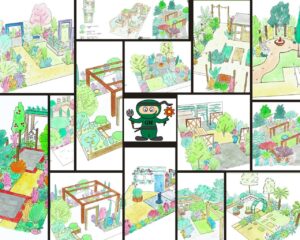
Garden Design Examples for Small Gardens: 30 Design Templates & Planting Plans
Garden Design Examples for Small Gardens: 30 Design Templates & Planting Plans: In this online gardening course, I’ll walk you through 30 fantastic garden designs, explaining the logic behind the layout, the plant choices, and take-home tips for applying them in your own garden.
Weekend Garden Makeover: A Crash Course in Design for Beginners
Learn how to transform and design your own garden with Lee Burkhills crash course in garden design. Over 5 hours Lee will teach you how to design your own dream garden. Featuring practical design examples, planting ideas and video guides. Learn how to design your garden in one weekend!
Garden Design for Beginners: Create Your Dream Garden in Just 4 Weeks
Garden Design for Beginners Online Course: If you want to make the career jump to becoming a garden designer or to learn how to design your own garden, this is the beginner course for you. Join me, Lee Burkhill, an award-winning garden designer, as I train you in the art of beautiful garden design.
Small gardens reward careful thinking more than large budgets. Position the seating where the sun falls, not where the door is. Break the line of view to create depth. Restrict your colour palette to two or three tones and carry them consistently through hard materials and planting. Choose structural plants that earn their place year-round. Get the hard landscaping right before you plant.
And don’t ignore the shed. It might be the most valuable design tool you already own.
Your subscription could not be saved. Please try again.
Your subscription has been successful.
Lee Burkhill
Lee Burkhill, known as the Garden Ninja, is an award-winning garden designer and horticulturist with over 30 years of gardening experience and 15 years as a professional garden designer. A qualified RHS (Royal Horticultural Society) professional, Lee specialises in sustainable garden design and practical horticultural advice. He designs and presents on BBC1’s Garden Rescue and in leading gardening publications. Lee combines three decades of hands-on gardening knowledge with professional design qualifications to help gardeners create beautiful, functional outdoor spaces.