Japanese Garden Design Guide: Create the perfect Zen garden
Lee Burkhill: Award Winning Designer & BBC 1's Garden Rescue Presenters Official Blog
Expert level
Japanese gardens are a really popular choice of theme for gardens. They work well on small scales which suits a number of gardeners, especially in the city where garden spaces may be tightly packed. They can invoke that feeling of calm, zen and being at one with nature. Japanese garden design can be exotic and bold; a far cry from lawns and square borders.
Japanese garden design is one of the most studied, imitated, and misunderstood garden styles in the world. I have been fascinated by it for years, both as a garden designer and as someone who has travelled to Japan specifically to walk through the gardens that inspired the whole tradition.
Quick Answer
A successful Japanese garden design combines three principles: every element must represent nature or carry symbolic meaning, the garden should flow with organic curves rather than rigid geometry, and restraint is essential. Key plants include Japanese maples, bamboo, moss, wisteria, and camellia. Use rocks in odd-numbered groupings, introduce water or gravel to symbolise its flow, and keep colour subtle so the composition breathes.
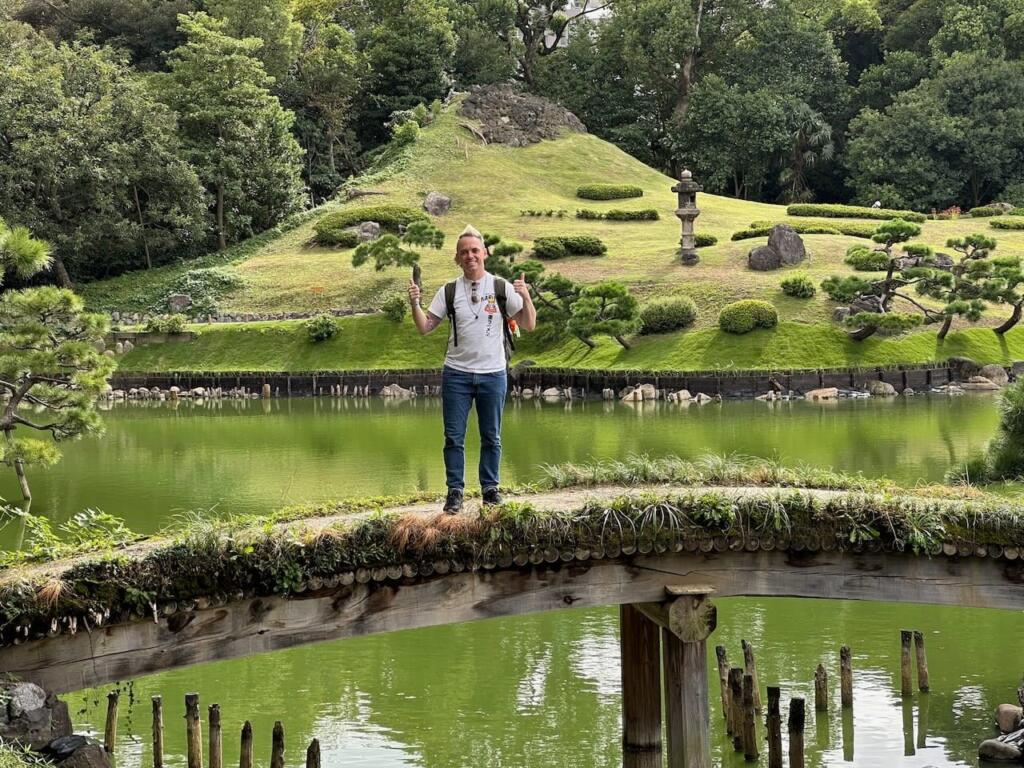
Visiting Kyoto’s moss gardens at Tofukuji in the early morning light, standing in the raked gravel courts of the great temple gardens of Osaka, and experiencing the breathtaking mountain landscapes of Hakone all gave me a completely different understanding of what Japanese design is actually trying to achieve. It is not about cherry blossom prints and bamboo fences. It is about distilling nature to its absolute essence.
In my work on BBC’s Garden Rescue, I have designed numerous Japanese-influenced gardens across the UK, and the principle I return to every time is the same one the great Japanese garden masters have always used: everything present must earn its place. A Japanese garden is an act of curation, not accumulation. That single rule will do more for your design than any amount of period-correct accessories.
1. Background and influences
Japan has a rich and complex garden history stretching back over a thousand years. Rather than attempt to cover all of it, it is worth understanding the two main threads that have shaped the tradition we draw from today, because they explain why Japanese gardens feel so different from Western garden design, and why so many DIY attempts fall short.
Visiting Japan’s great gardens in person transforms your understanding of what Japanese garden design is really trying to achieve
Buddhist origins
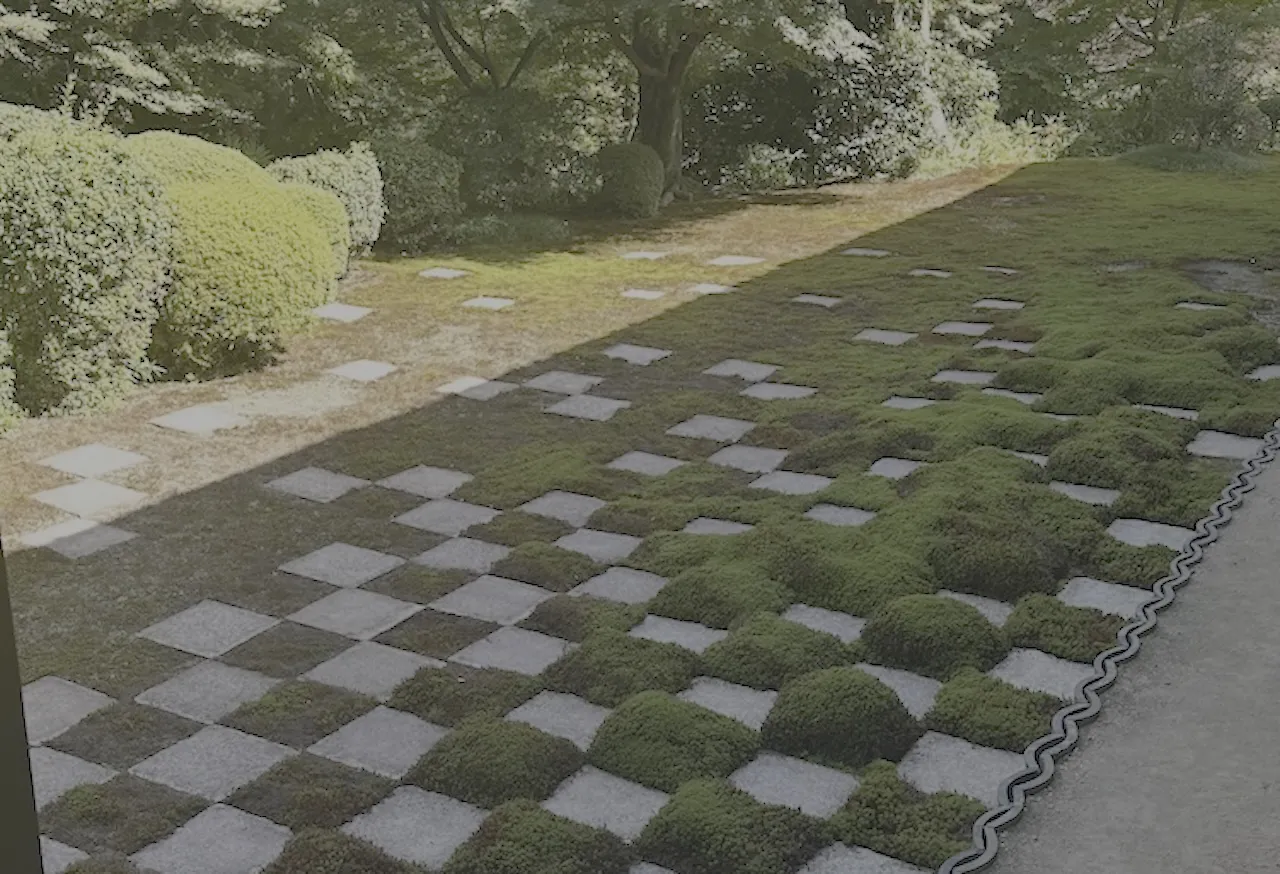
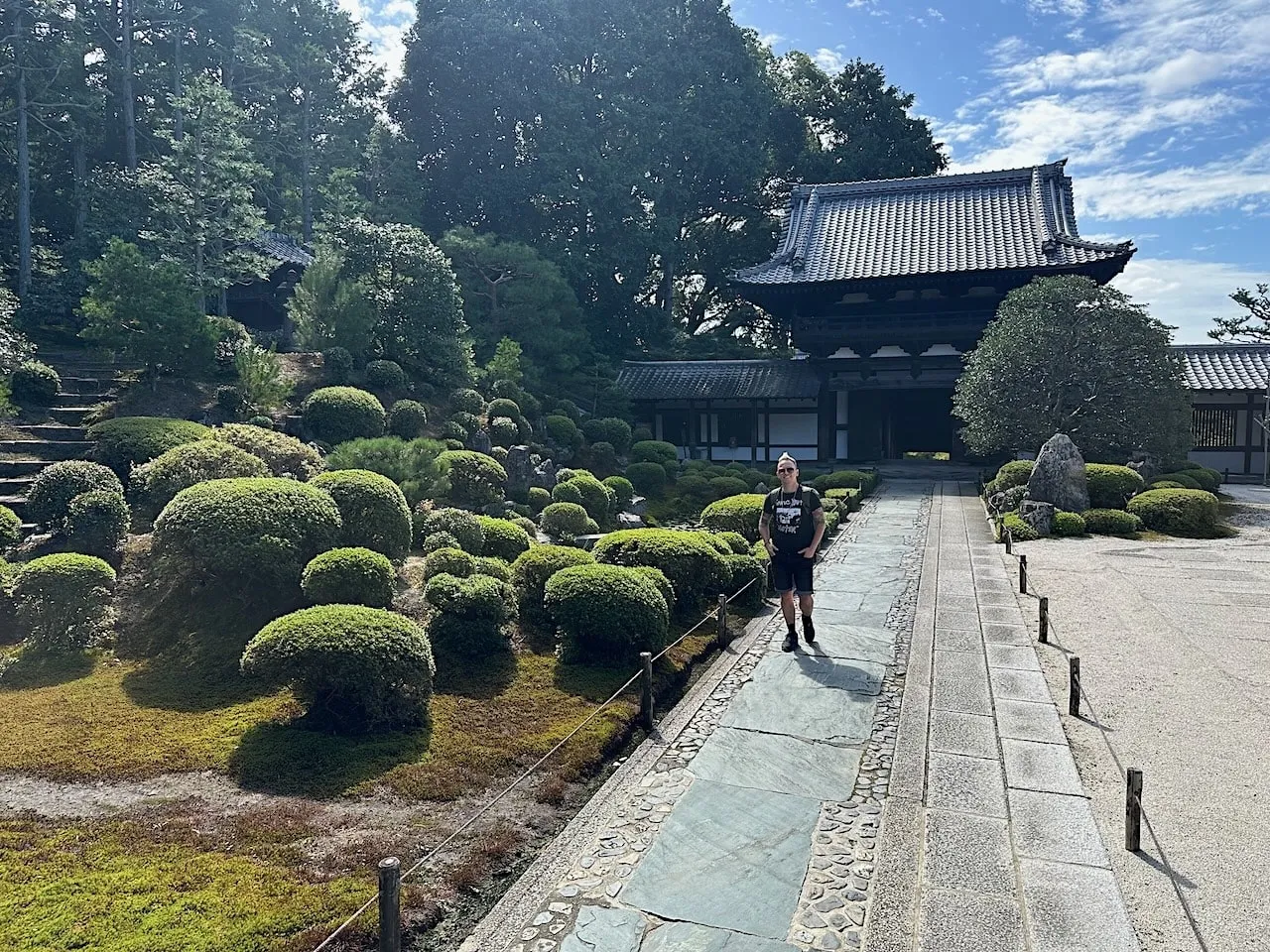
Japanese gardens first emerged as places of peace, meditation, and contemplation within Buddhist temple complexes. Walking through the great gardens of Kyoto, including Ryoanji, Daisen-in, and Tofukuji, you feel this immediately. These are not gardens designed for display or entertainment. They are environments carefully constructed to quiet the mind and invite inward reflection. Every element is chosen to minimise distraction and maximise the sense of effortless, timeless nature. When I visited the extraordinary moss gardens at Tofukuji during my trip to Japan, the silence was part of the design. The absence of colour, clutter, and complexity was as deliberate as any planting choice.
The moss gardens at Tofukuji in Kyoto demonstrate how Japanese garden design achieves maximum impact through restraint rather than abundance
Gardens as expressions of power and culture
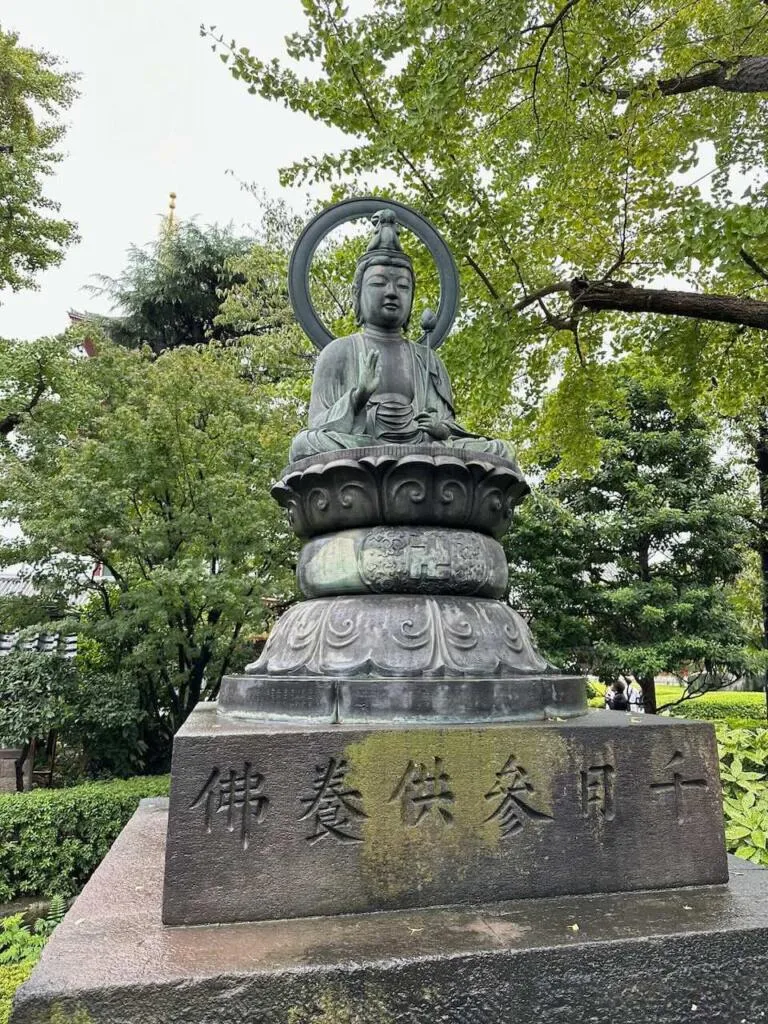
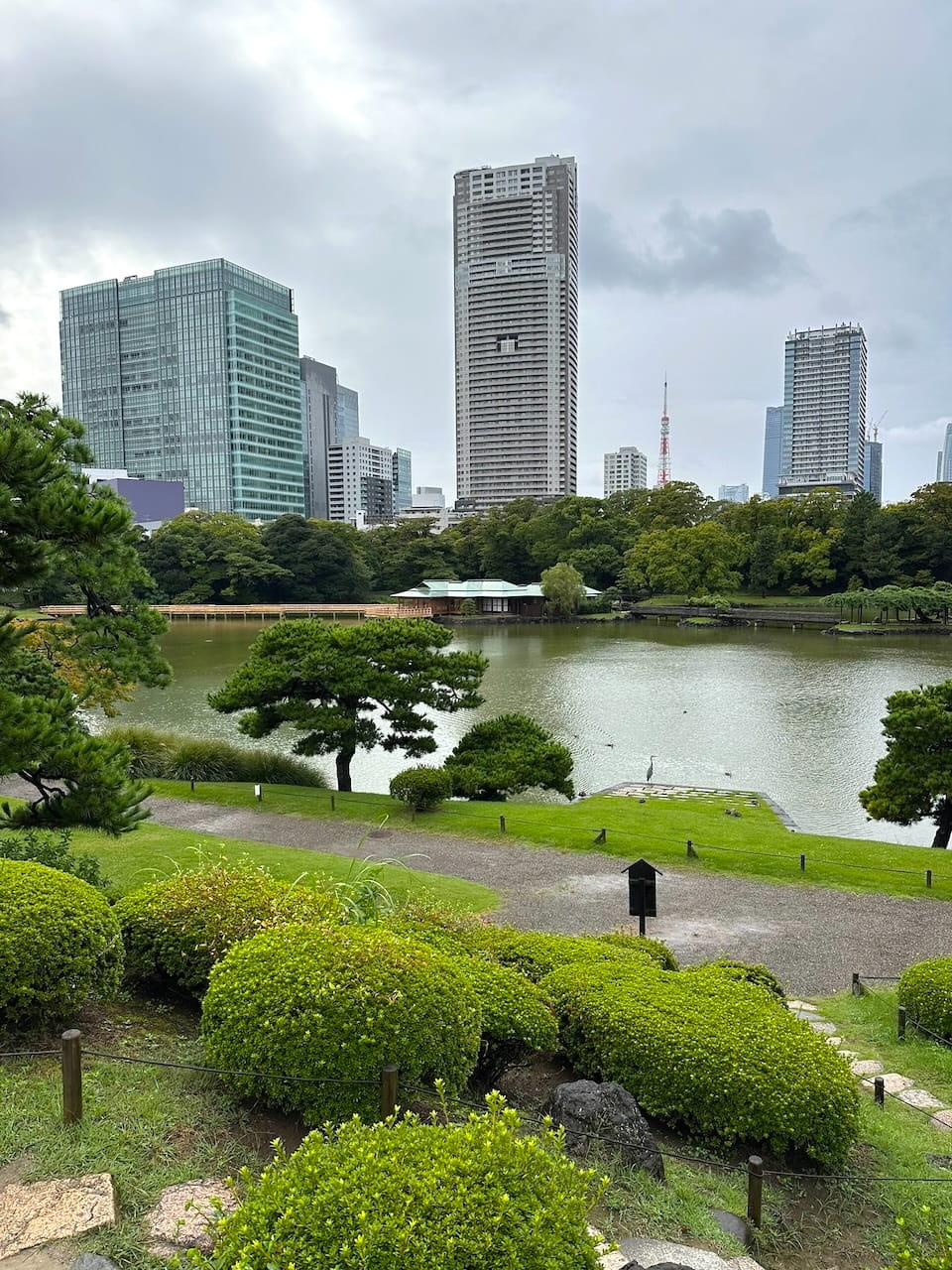
The second great influence is the aristocratic and imperial garden tradition, where powerful ruling families used elaborate landscape gardens as demonstrations of wealth, cultivation, and control over nature. These gardens often feature stylised versions of Japan’s dramatic geography, including miniature waterfalls and carefully placed rocks representing mountain ranges, and meandering streams symbolising great rivers. The gardens I explored in Tokyo and around Hakone carry this character: they are grand compositions that bring the landscape of all Japan into a single enclosed space. Creating nature at this level of precision was, and remains, the ultimate expression of mastery over one’s environment.
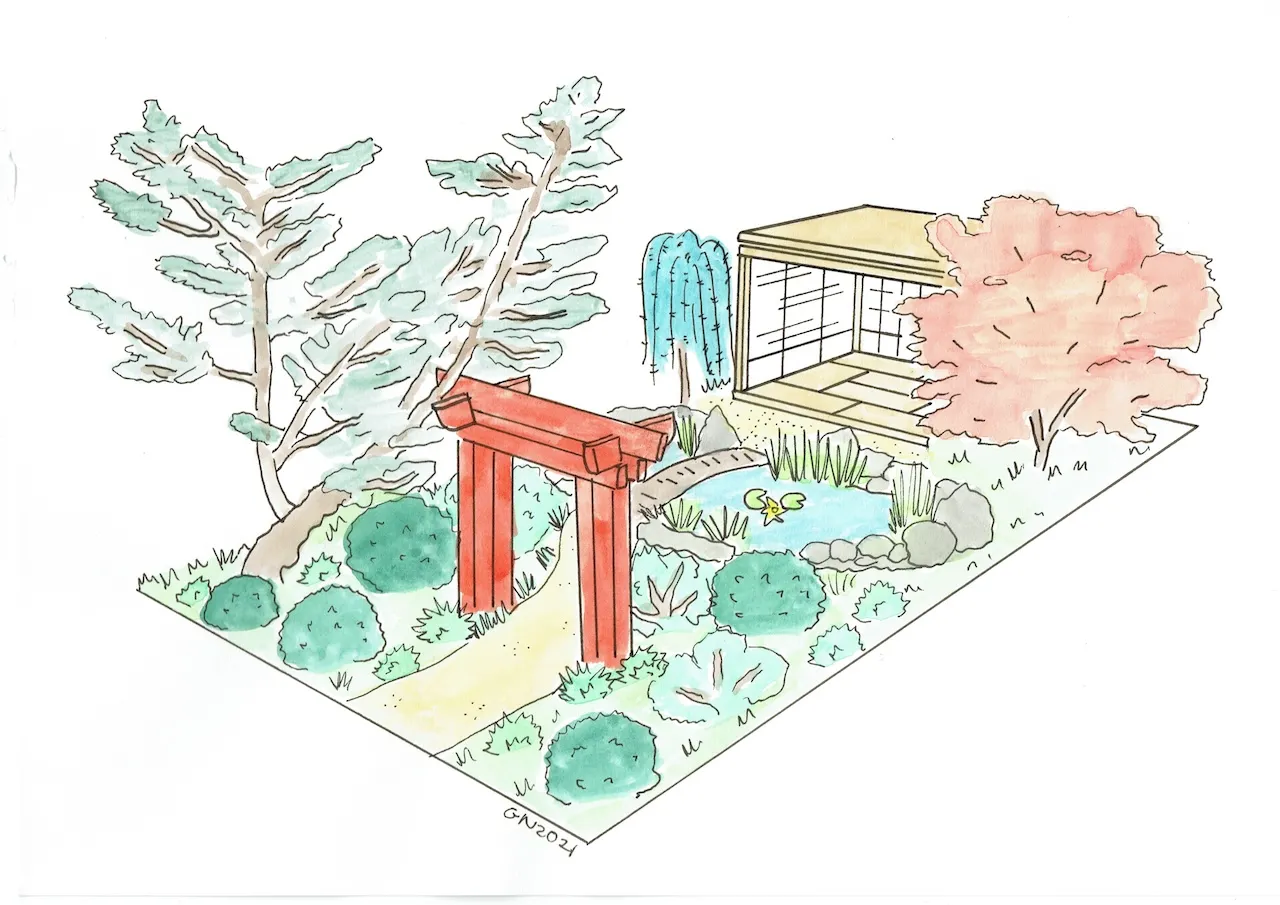
Japanese garden design I developed drawing on years of study and direct experience of Japan’s great historic gardens
2. Creating a zen garden
Zen, in its simplest useful sense for garden design, is a state of effortless calm, a space that allows the mind to settle rather than stimulate. The best Japanese gardens I visited in Osaka and Kyoto achieved this not through any single dramatic feature but through the accumulation of small, considered decisions: the texture of the gravel, the height relationship between rocks, the way a single acer branch falls across a mossy stone.
For a UK garden, you do not need to replicate a Kyoto temple complex. What you are aiming for is a space that feels coherent, intentional, and quietly purposeful. A place where someone can sit and think rather than be dazzled and distracted. Careful planning of every single element, from the largest tree down to the smallest piece of gravel, is what creates this feeling. Nothing in a Japanese garden should be there by default or convention. Everything should be chosen.
3. Which type of Japanese garden suits yours?
One of the most common mistakes I see in DIY Japanese garden attempts is treating “Japanese garden” as a single fixed style. In reality, there are five distinct classical traditions, each with a different purpose, aesthetic, and practical footprint. Understanding which one you are actually trying to create makes every subsequent decision, from plant choice to materials to budget, considerably clearer.
Quick Answer
The five classical types are: karesansui (dry rock garden), tsukiyama (hill and pond garden), chaniwa (tea garden), kaiyushiki (stroll garden), and tsubo niwa (courtyard garden). For most UK gardens, karesansui or tsubo niwa work best in smaller spaces, while tsukiyama suits larger plots where you can create changes in level.
Karesansui: the dry rock garden
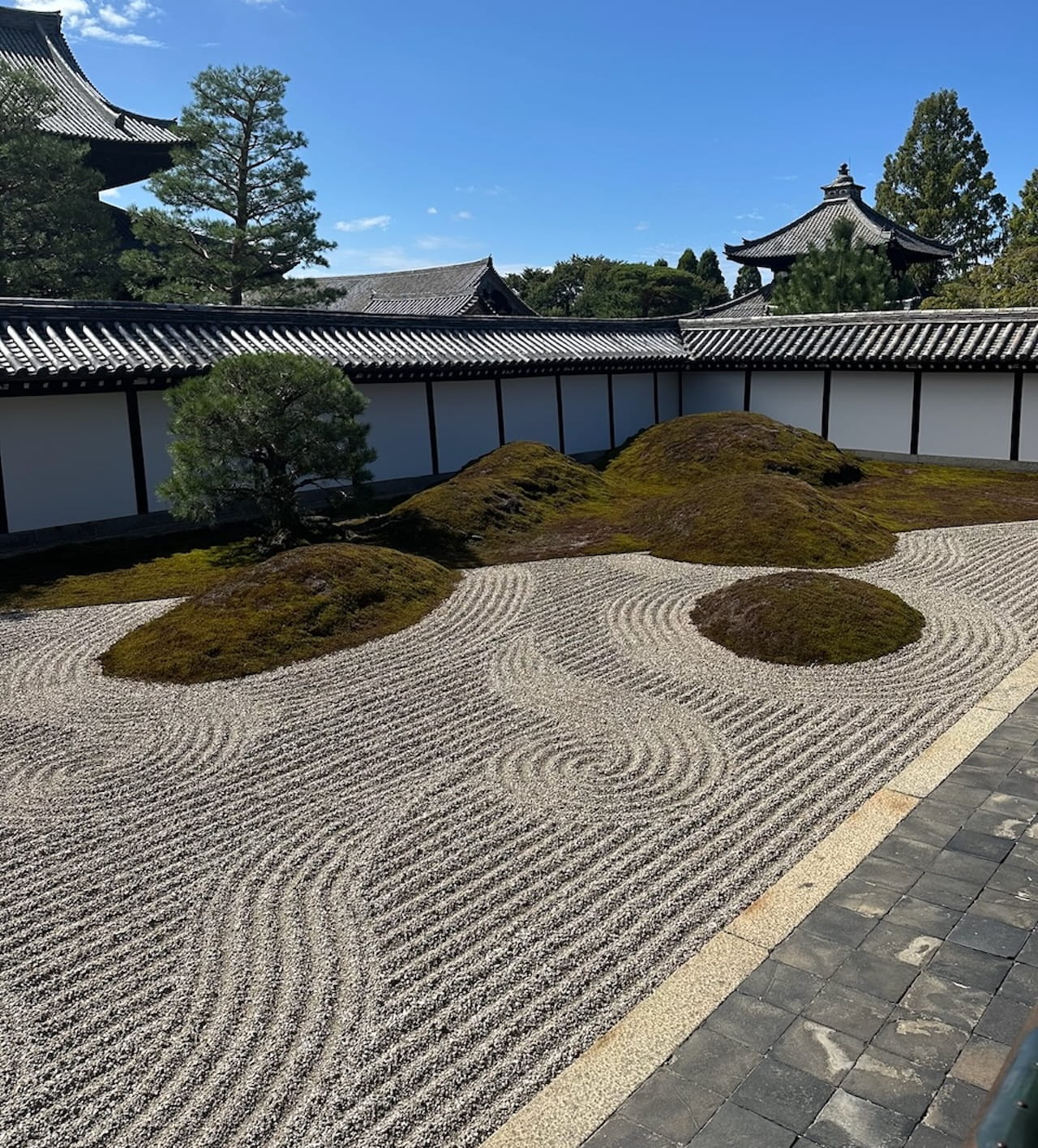
Karesansui is probably the style most people picture when they think of a Japanese garden: raked gravel or sand representing the movement of water, rocks placed with absolute precision to represent mountains or islands, and an almost complete absence of planting. The great karesansui gardens of Kyoto, including Ryoanji with its fifteen stones arranged so that at least one is always hidden from any given viewpoint, are among the most studied garden compositions in the world.
For UK gardeners, karesansui is genuinely practical because it requires no water feature, minimal planting, and relatively little ongoing maintenance beyond raking and weeding. It is the right choice for a small courtyard, a side passage, or any garden where you want maximum calm with minimum upkeep. The discipline lies not in the absence of elements but in making every element count absolutely. A poorly chosen or randomly placed rock in a karesansui garden is far more obvious than in any other style.
💡 Top Tip
Karesansui suits gardens from as small as 3 x 3 metres. Source local stone rather than imported rock where possible. The character and weathering of native sandstone or millstone grit can work beautifully in the UK climate and ages far more naturally than smooth imported pebbles.
Tsukiyama: the hill and pond garden
Tsukiyama translates roughly as “constructed mountain” and refers to gardens where man-made hills, ponds, streams, and winding paths recreate an idealised natural landscape in miniature. This is the grandest and most ambitious of the five styles, and the one that most closely resembles what UK gardeners might think of as a landscape garden. The aristocratic gardens of Japan’s imperial and feudal periods were largely tsukiyama, designed to represent famous landscapes or the scenery of all Japan compressed into a single enclosed space.
Tsukiyama is the right ambition if you have a garden of quarter of an acre or more and want to create genuine changes in level, a water feature of real scale, and a planting scheme diverse enough to carry seasonal interest through the year. It is also significantly more expensive and more demanding to maintain than any other Japanese style. I have worked on tsukiyama-influenced designs for BBC’s Garden Rescue and the amount of ground preparation and drainage work required before a single plant goes in is always more than clients anticipate.
Chaniwa: the tea garden
The chaniwa, or tea garden, is one of my personal favourites for UK adaptation because it works beautifully at a domestic scale and carries enormous atmosphere with relatively modest means. Its purpose is to prepare the visitor for the tea ceremony: the path, the stepping stones, the stone water basin, and the gate all function as a sequence of transitions that slow the mind and shift attention from the busy world outside to the quiet ritual within.
In practical terms for a UK garden, a chaniwa-influenced space might consist of an irregular stepping-stone path through moss or low ground cover, a stone water basin near a seating area, bamboo fencing or screening, and restrained planting of ferns, mosses, and shade-tolerant shrubs. It does not require a tea house, though even a simple garden room or a well-placed bench with a bamboo screen behind it can suggest the destination the path is leading to.
Kaiyushiki: the stroll garden
Stroll gardens are designed to be experienced by moving through them along a prescribed path, with each turn revealing a new composition or a carefully framed view. The experience is fundamentally narrative: the garden tells a story as you walk through it. Large examples might include miniature representations of famous landscapes, literary references, or a succession of distinct “rooms”, each with a different mood and character.
A kaiyushiki-influenced approach is practical even in a modest UK garden of, say, fifteen metres in length. The principle of revealing views progressively, hiding parts of the garden from the entrance so that the full space is only understood by moving through it, is one of the most effective garden design techniques I use regardless of the overall style. Curved paths, strategically placed screening plants, and a clear destination at the end of the route are the three ingredients that create this effect.
Tsubo niwa: the courtyard garden
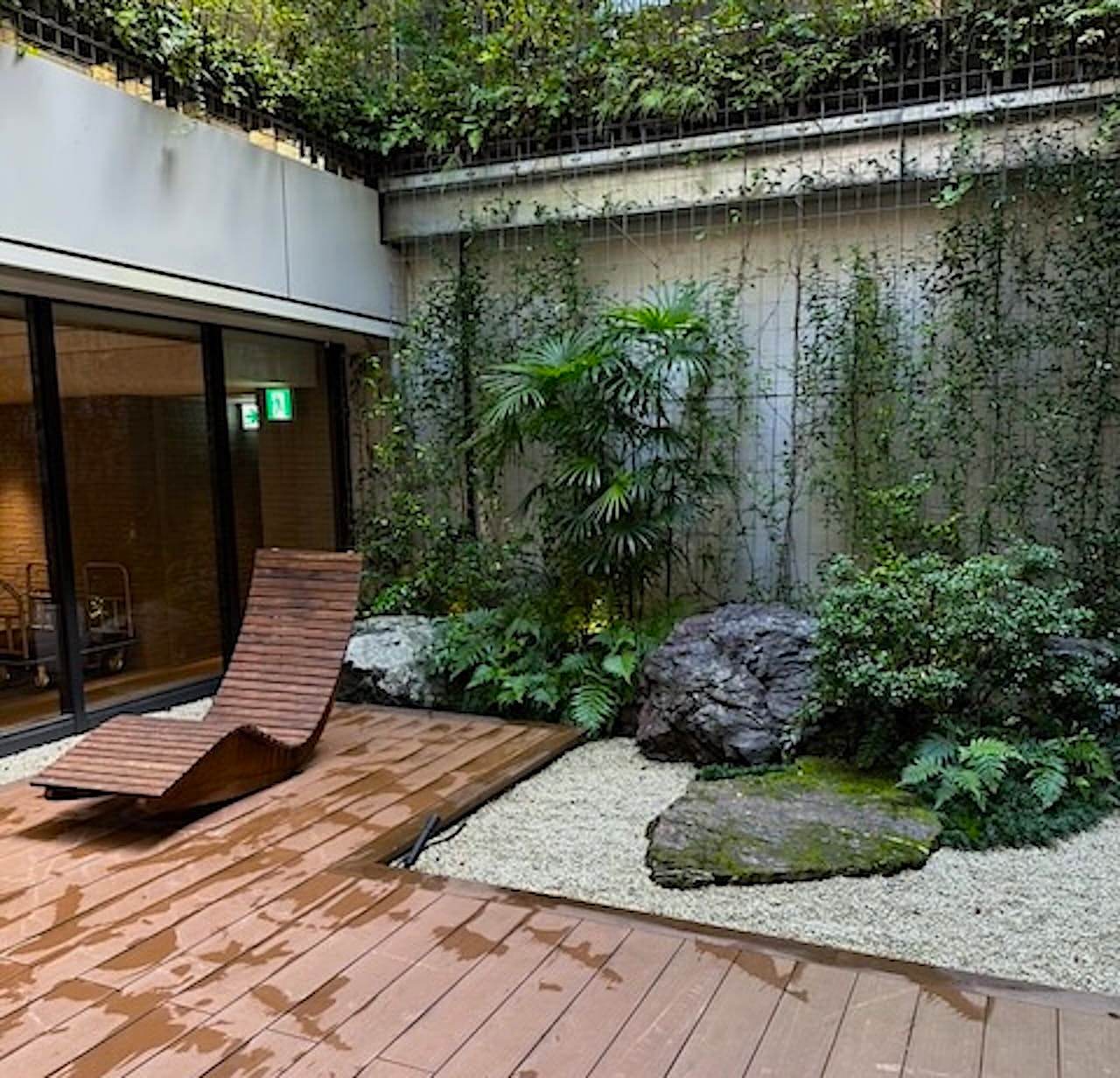
The tsubo niwa is a small enclosed garden, traditionally the size of two tatami mats, designed to be viewed from inside a building rather than walked through. It developed as a response to dense urban building in Japan’s cities, where interior courtyards between rooms or between buildings needed to bring light, nature, and the suggestion of a larger world into confined spaces.
For UK gardeners with a small side return, an internal courtyard, or a garden that is primarily viewed from a window, the tsubo niwa is the most useful classical model available. Everything is composed as a picture to be seen rather than a space to be entered. A single specimen acer, a moss-covered rock, a small stone lantern, and a carefully raked gravel bed can create a complete and satisfying tsubo niwa in a space no larger than a dining table.
Constructed hills, pond, streams, diverse planting
Large gardens, significant budget
3. Core design principles
There are a handful of principles that I apply to every Japanese-influenced design I create, whether it is a small town garden in Manchester or a larger landscape project. These come from years of study, from my time designing for BBC’s Garden Rescue, and from direct observation during my travels in Japan.
Nature rules the composition
Everything in a Japanese garden should either represent or echo nature. This does not mean it needs to look wild or unmanaged. Quite the opposite is true. The most authentic Japanese gardens are extraordinarily controlled and precisely maintained. What it means is that the language of the garden is drawn from the natural world: organic curves rather than straight edges, asymmetrical compositions rather than formal symmetry, textures drawn from stone, water, moss, and bark rather than manufactured materials.
Every element of a well-designed Japanese garden references the natural world in some way, even when the planting is carefully controlled
Rectangular beds, square ponds, and ruler-straight paths are all antithetical to the Japanese garden ethos. Curves and a sense of flow are essential. Some straight lines can appear as accents, but the overriding feel should be one of an evolved, organic landscape rather than an imposed geometric structure.
Everything must serve a purpose
This is the principle I emphasise most when designing Japanese-influenced gardens on BBC’s Garden Rescue. Every element should carry meaning or function. Water represents the ebb and flow of life. Rocks symbolise mountains or spiritual landmarks. Moss evokes ancient, unhurried time. Gravel suggests the surface of water or the texture of a mountain path. A bamboo water feature creates sound that transports the mind. If you cannot articulate why something is in the garden, it almost certainly should not be there.
This principle immediately eliminates the LED rock lights, solar-powered gnomes, and miscellaneous ornaments that so frequently derail well-intentioned Japanese garden attempts. It is not that such things are offensive. They lack meaning within the composition and therefore break the spell the garden is trying to cast.
Winding paths
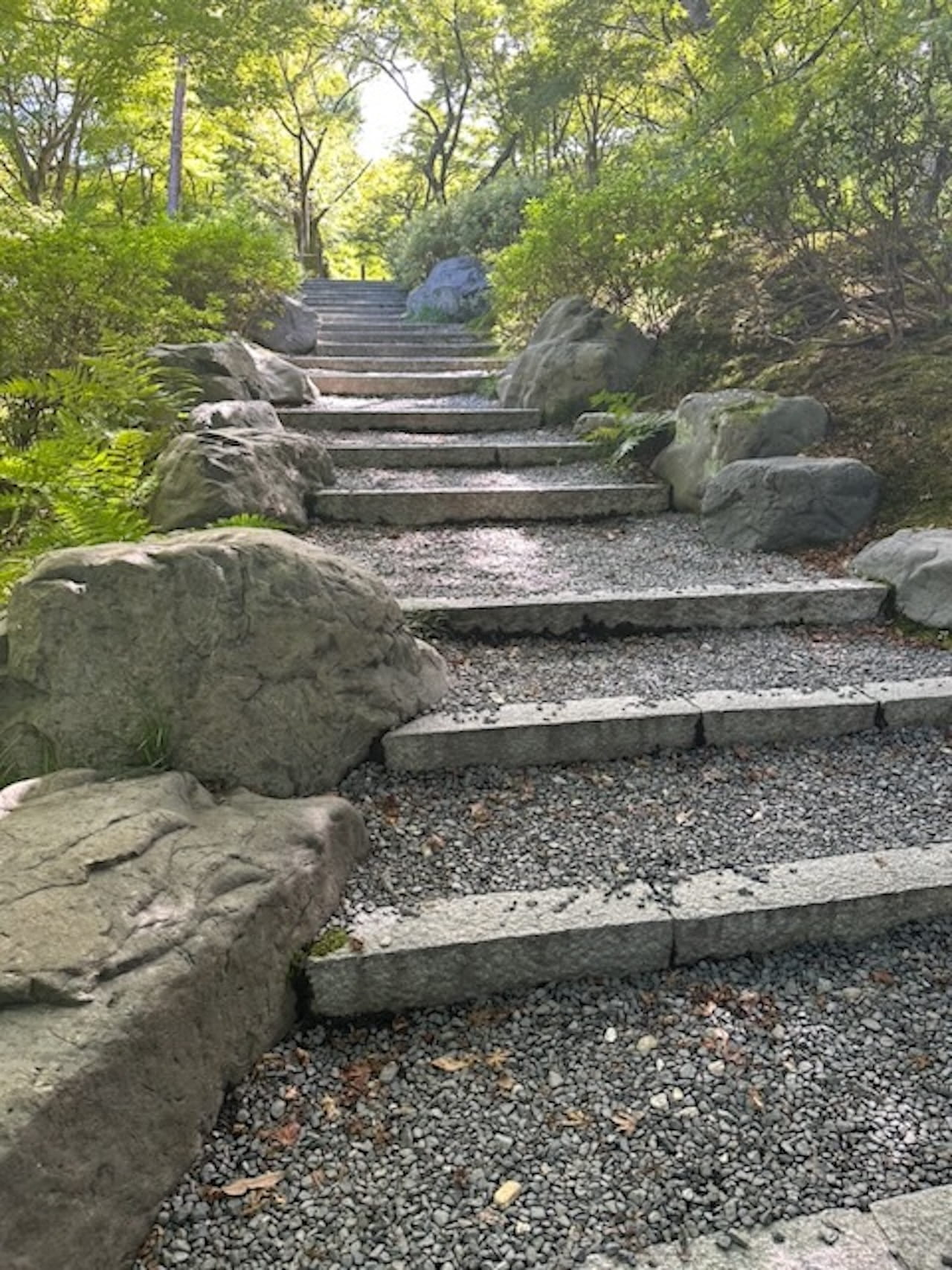
In every Japanese garden I visited, from the garden districts of Kyoto to the landscape parks of Tokyo, paths played a central role. They serve two purposes simultaneously: they guide the visitor through the garden, and they symbolise life’s journey. The experience of moving through a Japanese garden should feel like a narrative, with each turn of a path revealing a new composition or perspective.
Experiencing Japanese garden pathways in person reveals how carefully the views and reveals are choreographed as you walk through the space
Materials matter significantly here. I cover this in depth in my garden design guide. Stepping stones of natural granite, fine gravel, water-worn pebbles, and occasionally weathered timber all work well. The texture underfoot is part of the sensory composition. Avoid uniform machine-cut paving slabs, which read as too contemporary and too precise for the organic character of a Japanese garden.
Shakkei: the borrowed landscape
Shakkei, which translates as “borrowed landscape” or “captured alive”, is one of the most sophisticated principles in Japanese garden design and one that UK gardeners can apply directly and to considerable effect. The idea is simple: rather than treating your garden as a self-contained enclosure, you deliberately incorporate what lies beyond your boundary into the composition. A distant tree, a church spire, a hillside, a neighbouring garden’s mature canopy: anything that adds depth, scale, or interest to the view from your garden becomes part of your design without costing you a penny or requiring a single planting decision.
In Japan’s great historic gardens, shakkei was used at a grand scale: entire mountain ranges were incorporated into garden views by careful framing, with gateway structures, clipped hedges, and tree canopies all positioned to direct the eye toward the borrowed element at the right moment along the path. The garden designer Ogawa Jihei used shakkei brilliantly in Kyoto’s Murin-an garden, where Mount Higashiyama is drawn into the composition so seamlessly that it reads as a continuation of the garden itself.
In a typical UK garden, shakkei works at a more modest scale but the principle is identical. When I am designing a garden, one of the first things I do is stand at the main viewing point and identify what lies beyond the boundary that could be framed rather than hidden. Many gardeners instinctively screen everything out, reaching immediately for tall bamboo or leylandii along every fence line. The shakkei approach asks the opposite question: what is worth keeping in view, and how do I frame it to make it feel like part of my composition?
In practice this might mean leaving a gap in boundary planting to frame the canopy of a mature tree in a neighbouring garden. It might mean positioning a garden seat so that a view of open countryside or a distant roofline is visible over a low hedge rather than blocked by a tall one. It might mean choosing fence or gate height deliberately so that a borrowed element sits at exactly the right position in the frame when viewed from the main seating area.
💡 Top Tip
Shakkei works in reverse too. If what lies beyond your boundary is genuinely ugly and a warehouse wall, a telegraph pole, an unattractive roofline and use framing to direct attention deliberately away from it. A strategically placed tree, a tall bamboo screen at just the right position, or a focal point that pulls the eye in a more rewarding direction are all active uses of the same borrowed landscape principle.
Flowers are not dominant
This is the principle that surprises UK gardeners most. In the Buddhist garden tradition, flowers were actively removed as distractions. Even in more ornamental Japanese garden styles, flowers play a supporting rather than starring role. The primary palette is green, in every shade and texture, from the bright acid green of fresh fern fronds to the dark bottle green of clipped pine, the silver-green of bamboo, and the velvet olive of moss.
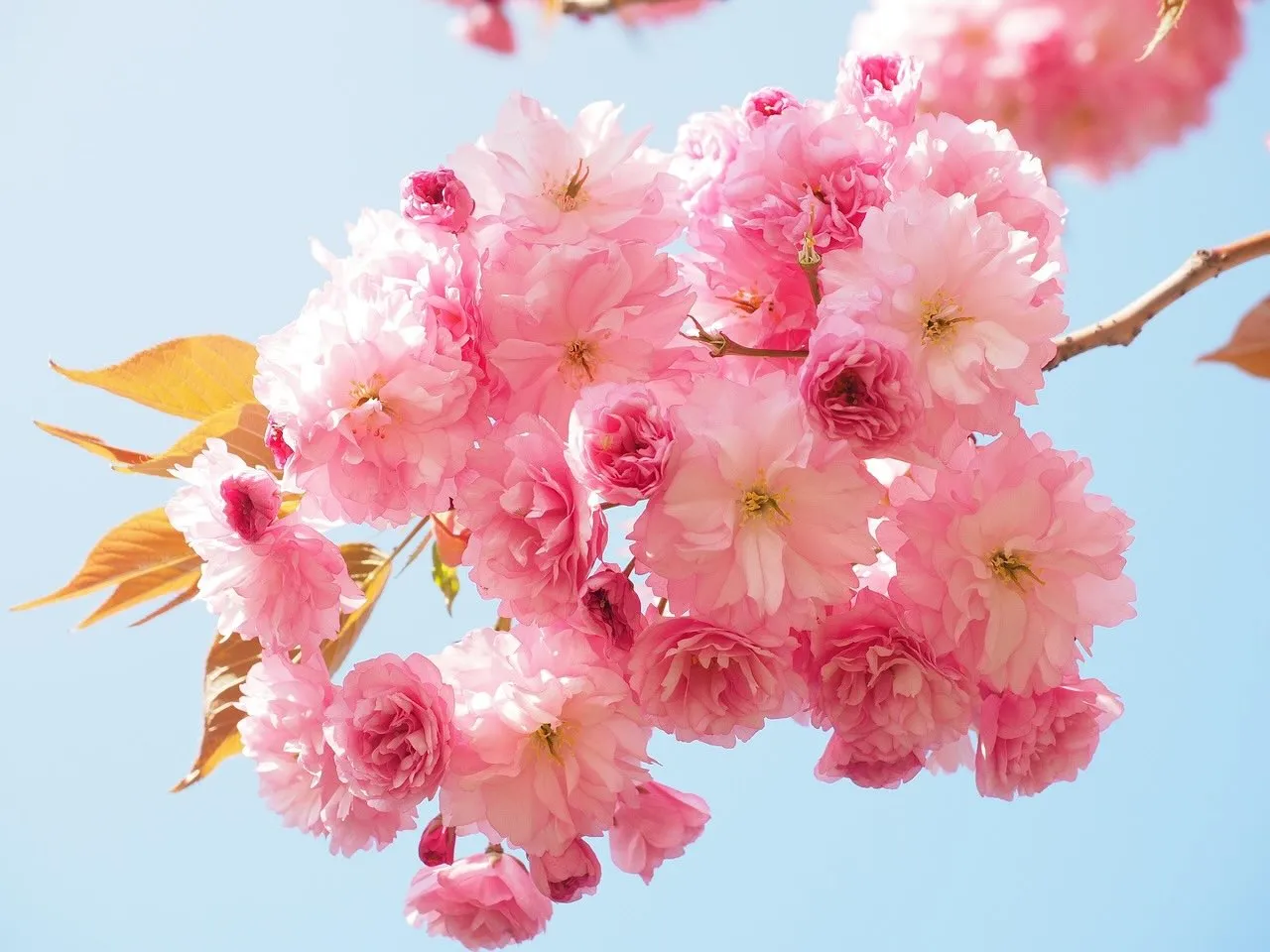
Where flowers do appear, they should be restrained in colour and used as seasonal punctuation rather than as the main event. Cherry blossom is the classic example: a single Prunus in full flower against a backdrop of dark evergreens and raked gravel is extraordinary precisely because the flower is so brief and so unexpected against the otherwise muted palette. If you want colour, keep it to white, pale pink, and soft mauve. Moss can be used brilliantly to suggest either a dried watercourse or the ancient, weathered quality that all good Japanese gardens possess.
Choosing the right plants is where many Japanese garden attempts in UK gardens either succeed or fall apart. Below are the plants I reach for most often when designing Japanese-influenced spaces, whether for private clients or for television. All of these perform well in UK conditions and carry the right aesthetic character for the style.
The right plant palette makes or breaks a Japanese garden design. Restraint and authenticity of character matter far more than volume.
1. Japanese maple (Acer palmatum)
The acer is the signature plant of Japanese garden design and with good reason. Its delicate, deeply cut foliage, spectacular autumn colour, and naturally elegant branching structure perfectly embody the Japanese aesthetic. I have used acers in dozens of garden designs over the years, from small courtyard gardens where a single specimen in a glazed pot becomes the entire focal point, to larger landscapes where a grove of acers creates a woodland understorey of extraordinary beauty.
Acer palmatum ‘Bloodgood’ is one of the finest selections for Japanese garden design, with rich purple foliage turning crimson in autumn
🌿 At A Glance: Japanese Maple
Botanical Name
Acer palmatum
Plant Type
Deciduous tree or large shrub
UK Hardiness
H5 (hardy to -15°C with shelter)
Height / Spread
2–8m / 2–6m depending on variety
Best Conditions
Dappled shade, moist well-drained soil, shelter from cold winds
Bamboo is essential to the Japanese garden but it requires careful selection. The running bamboos such as Phyllostachys are magnificent but will colonise your garden and your neighbours’ if not contained with a root barrier. For most UK gardens I recommend the clump-forming Fargesia species, which are non-invasive and produce graceful, arching canes that work beautifully as screening or as a structural vertical element. Bamboo also provides year-round movement and sound in the wind, which is a genuinely important sensory dimension of the Japanese garden experience.
Fargesia nitida ‘Pillar’ is a non-invasive bamboo that creates beautiful vertical structure without the spreading habit of running bamboos
Year-round movement and sound; excellent screening
⚠ Important: Running Bamboo Warning
If you choose a running bamboo such as Phyllostachys, install a solid bamboo root barrier to a depth of at least 60cm before planting. Running bamboo can travel many metres underground and is extremely difficult to remove once established.
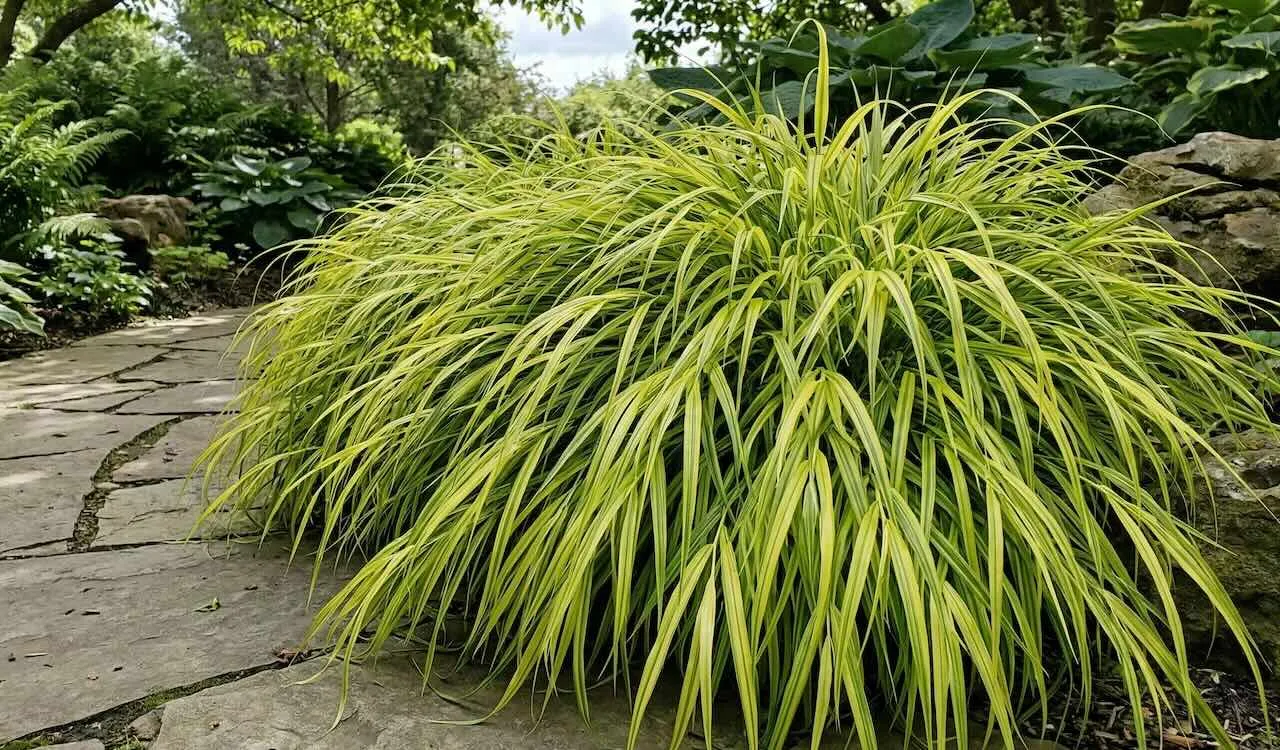
Hakonechloa is one of the most beautiful and underused grasses for UK gardens. Its soft, arching habit cascades like a waterfall of fine foliage, with ‘Aureola’ offering luminous gold and green variegation that brings extraordinary light to shady spots. It is native to the mountain slopes of Japan, where it grows naturally along stream banks, which makes it an authentically Japanese choice rather than a stylistic imposition. I have used it extensively in my designs as edging for stone paths, as a ground-level contrast against dark bamboo, and as a cascading element over the lip of a raised planting bed.
Japanese forest grass cascades beautifully along path edges and makes an excellent contrast to stone and dark bamboo foliage
🌿 At A Glance: Japanese Forest Grass
Botanical Name
Hakonechloa macra
Plant Type
Deciduous ornamental grass
UK Hardiness
H5 (hardy)
Height / Spread
30–45cm / 45cm
Best Conditions
Partial shade, moist well-drained soil
Key Feature
Cascading habit; glowing gold-green variegation in shade
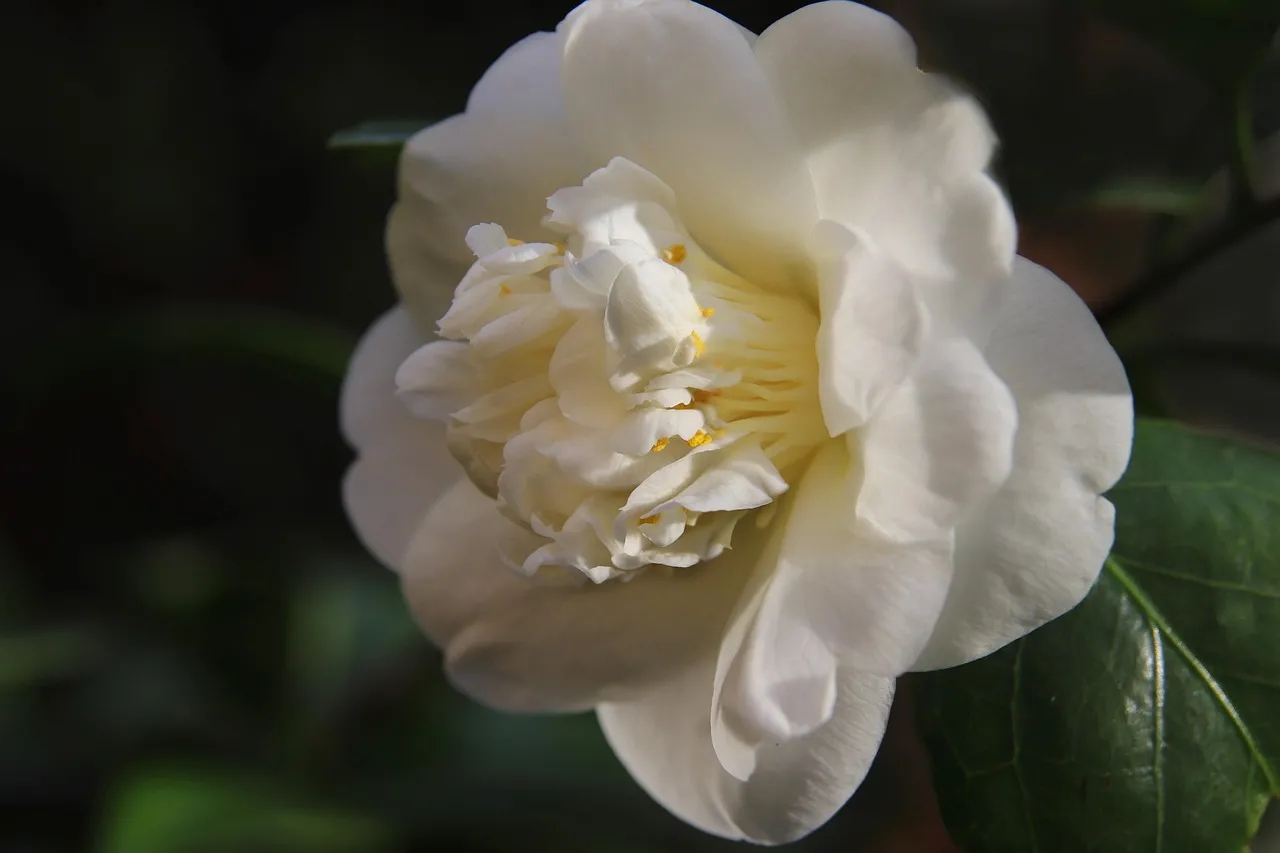
Camellia is the quintessential Japanese flowering shrub, with cultivated forms having been developed in Japan for centuries before European gardeners ever encountered them. The dark, glossy evergreen foliage is as valuable as the flowers, providing year-round structure and a luxurious deep green backdrop for other planting. The late winter and spring flowers in white, pink, and red emerge when little else is flowering, making them a genuinely useful seasonal accent in the restrained Japanese palette.
White-flowered camellias are the most authentically Japanese choice, keeping colour restrained against the rich green evergreen foliage
🌿 At A Glance: Camellia
Botanical Name
Camellia japonica
Plant Type
Evergreen shrub
UK Hardiness
H4 (hardy with some shelter)
Height / Spread
2–6m / 2–4m
Best Conditions
Acid soil, partial shade, shelter from morning frost
Key Feature
Rich evergreen structure; late winter to spring flowers
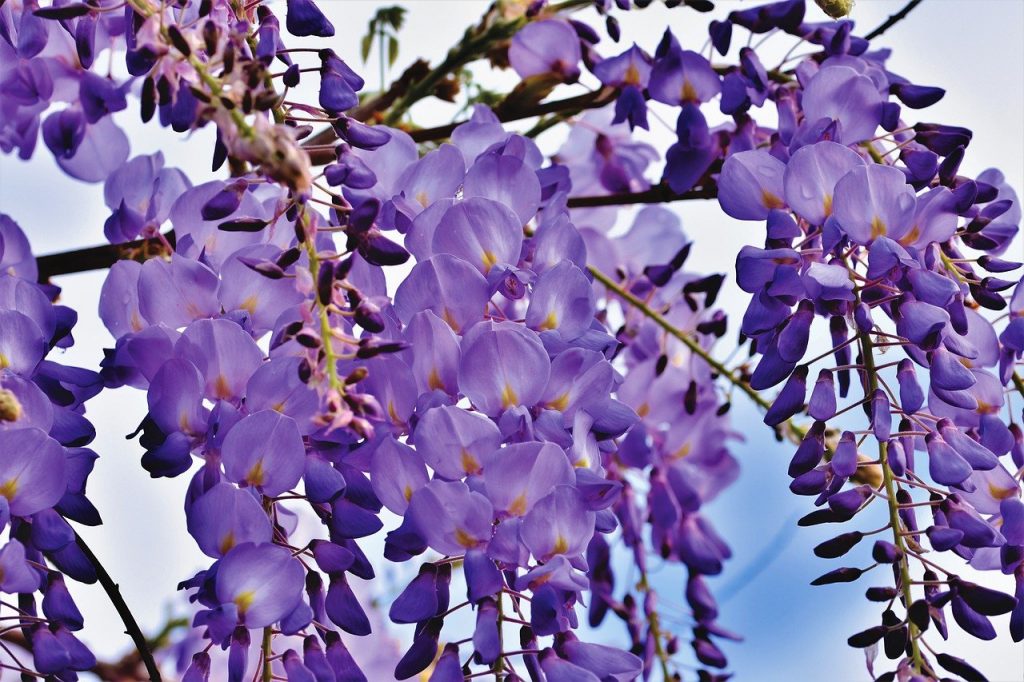
Japanese wisteria is a plant I have encountered all over Japan, trained over pergolas, bridges, and temple walls in cascades of extraordinary purple and white. Wisteria floribunda, the Japanese species, produces longer racemes than its Chinese counterpart and is a magnificent choice for pergolas, walls, and arched structures in a Japanese garden. The key to using it well is to train it deliberately and prune it twice a year, in summer and winter, to keep it compact enough to be a feature rather than an engulfing menace.
🌿 At A Glance: Japanese Wisteria
Botanical Name
Wisteria floribunda
Plant Type
Deciduous climbing shrub
UK Hardiness
H6 (fully hardy)
Height / Spread
Up to 9m with support
Best Conditions
Full sun, well-drained soil, strong support
Key Feature
Spectacular May flowering with pendulous fragrant racemes
Fatsia is one of the most architectural evergreen shrubs available in UK gardens and it is genuinely Japanese in origin. Its enormous, deeply lobed leaves create a bold, tropical-feeling statement that works brilliantly in shaded corners where many other plants struggle. I have used fatsia repeatedly in Japanese-influenced designs to provide a strong structural anchor in areas that receive little direct sun. The white lollipop flower heads in autumn are a bonus.
Fatsia japonica provides bold, architectural evergreen structure in shaded spots where most other plants would struggle
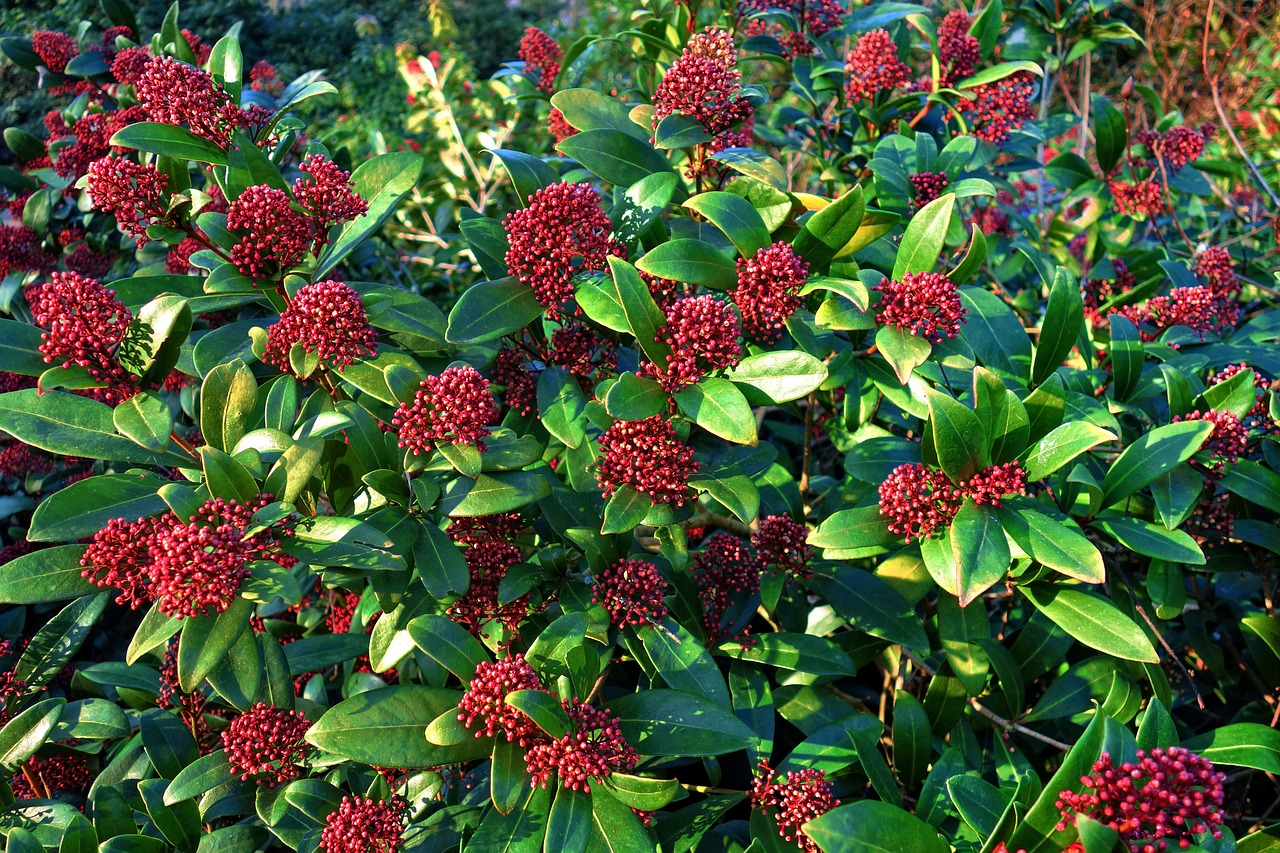
Skimmia is a compact, slow-growing evergreen shrub with deep green leaves, fragrant white flowers in spring, and bright red berries through autumn and winter. It is native to Japan and China and has exactly the kind of restrained, year-round presence that Japanese garden design demands. For the shadier areas of a Japanese garden, skimmia is one of my go-to choices. It pairs beautifully with ferns and moss and never becomes overwhelming.
Skimmia provides year-round interest in shade with fragrant spring flowers followed by jewel-like autumn berries
🌿 At A Glance: Skimmia
Botanical Name
Skimmia japonica
Plant Type
Evergreen shrub
UK Hardiness
H5 (hardy)
Height / Spread
60cm–1.5m / 60cm–1.5m
Best Conditions
Shade to partial shade, acid or neutral soil
Key Feature
Fragrant spring flowers; persistent red berries in winter
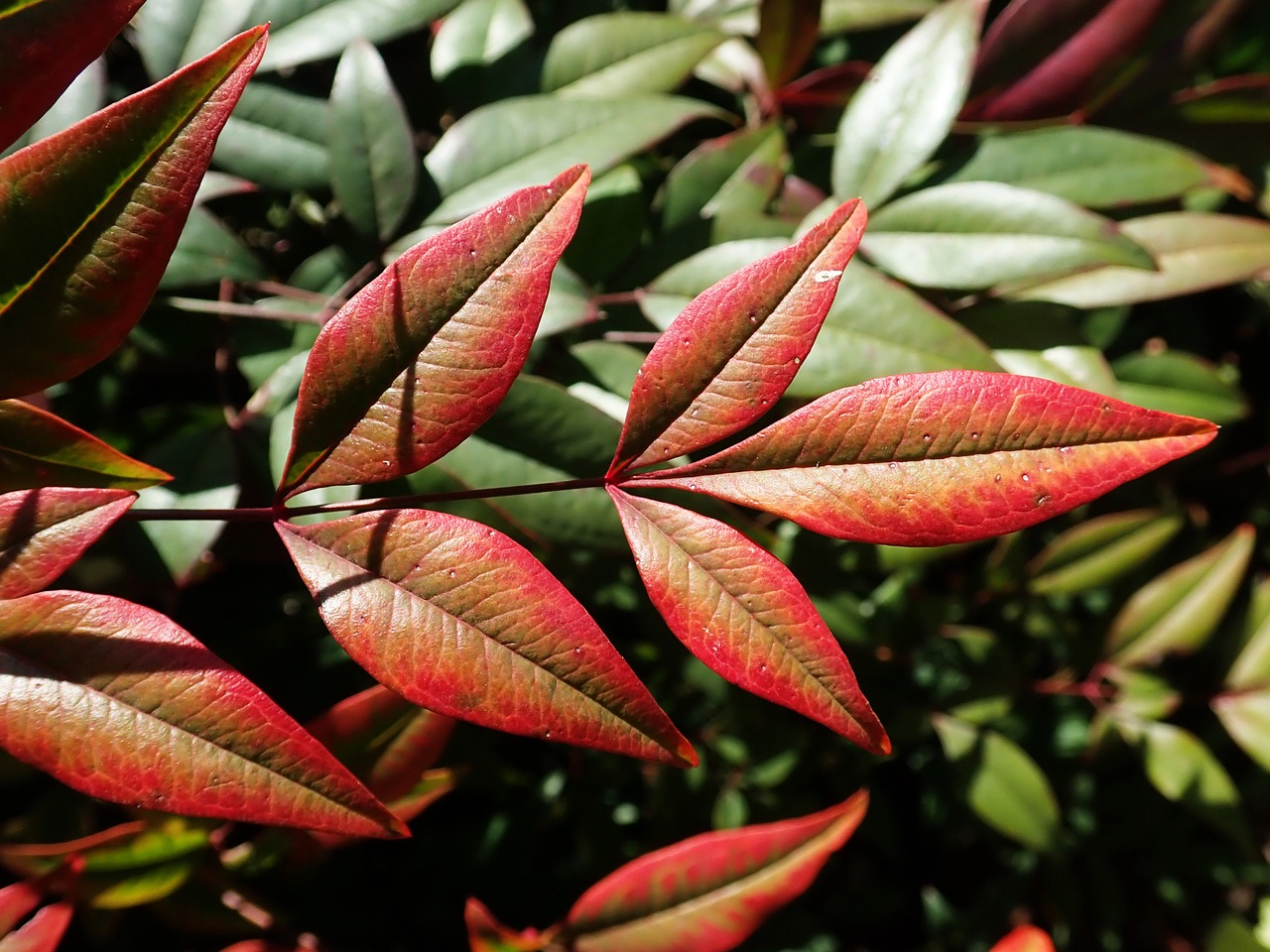
Nandina, known as heavenly bamboo, is not actually a bamboo at all but an architectural evergreen shrub native to Japan and China. Its elegant, pinnate leaves resemble bamboo in texture and movement but are far more manageable. The foliage flushes red in spring, matures to green through summer, and turns vivid crimson-orange in autumn and winter. White flowers in summer are followed by clusters of red berries. It is one of the most four-season useful plants in the Japanese palette.
Nandina domestica offers four seasons of interest with spring red foliage, summer flowers, autumn berries, and winter colour
🌿 At A Glance: Nandina
Botanical Name
Nandina domestica
Plant Type
Semi-evergreen shrub
UK Hardiness
H4 (hardy with some shelter)
Height / Spread
1–2m / 60cm–1m
Best Conditions
Sun or partial shade, well-drained soil
Key Feature
Four-season foliage colour; architectural structure without bulk
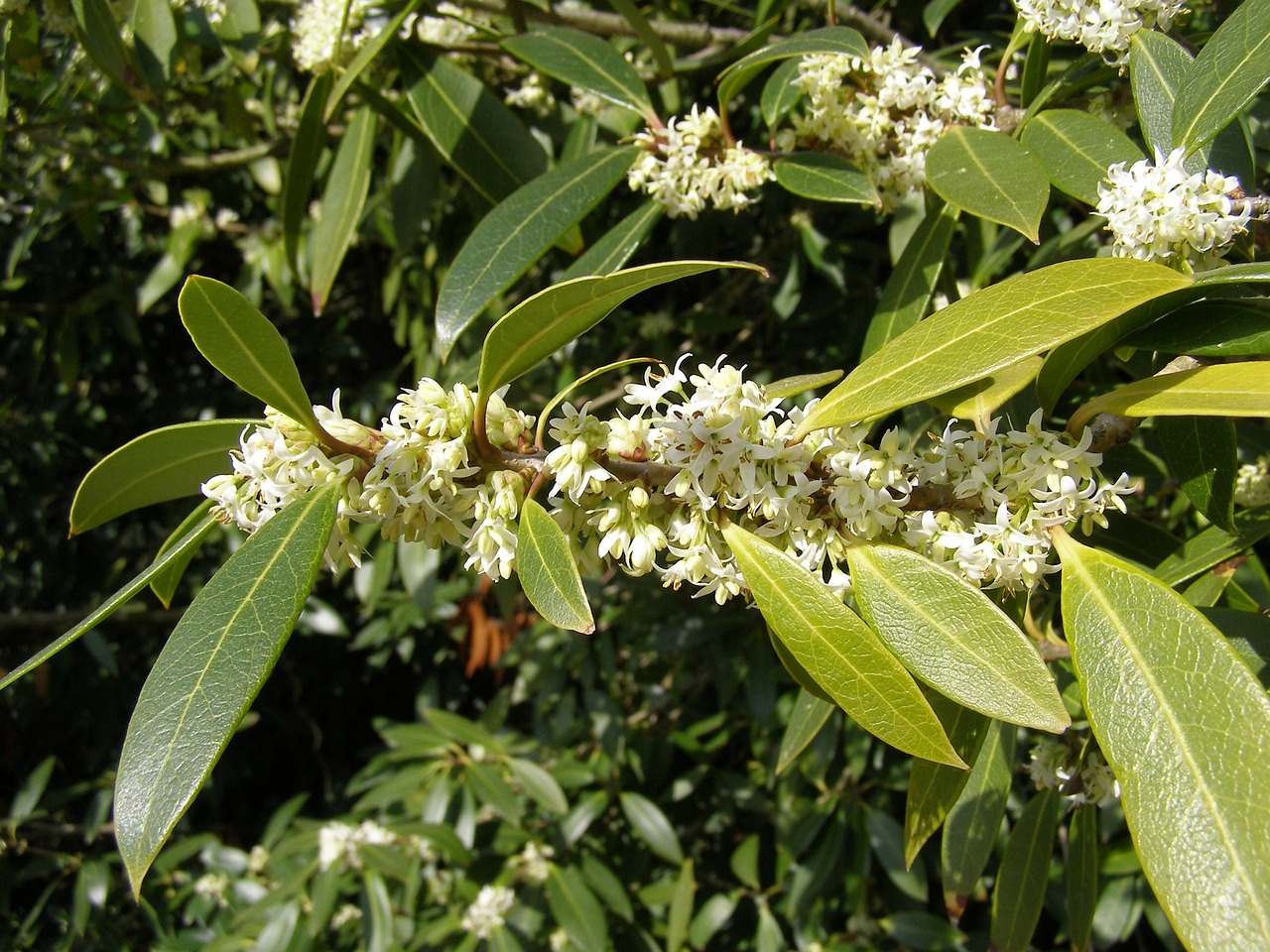
Osmanthus is one of those plants I come back to repeatedly in Japanese-influenced designs because it is so easy to use well. Dense, dark, glossy evergreen foliage that clips beautifully into cloud-pruned forms. Extraordinarily fragrant small white flowers in spring. Tolerance of shade and exposed positions. It is the perfect plant for creating the kind of clipped, cloud-topiary shapes that are so characteristic of the Japanese garden, where shrubs are pruned to suggest mountainous landscapes in miniature.
Osmanthus clips beautifully into cloud-pruned forms, one of the defining visual characteristics of authentic Japanese garden design
🌿 At A Glance: Osmanthus
Botanical Name
Osmanthus burkwoodii
Plant Type
Evergreen shrub
UK Hardiness
H5 (hardy)
Height / Spread
2–3m / 2–3m (clips to any size)
Best Conditions
Sun or shade, well-drained soil
Key Feature
Ideal for cloud pruning; intensely fragrant spring flowers
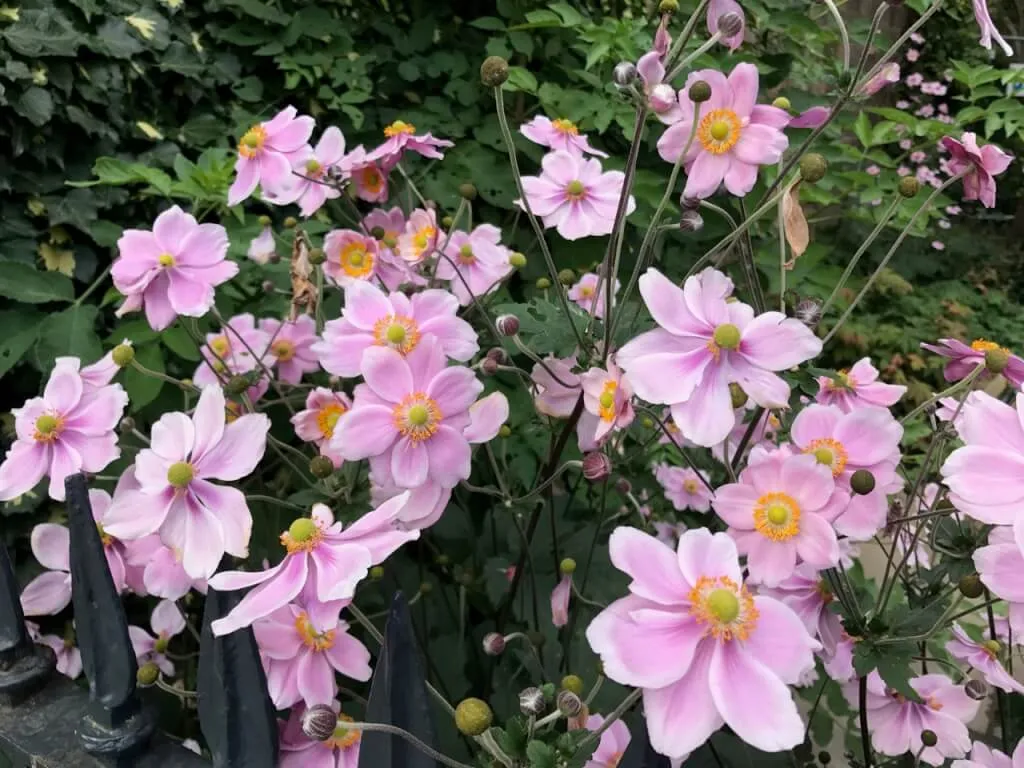
Japanese anemones bring a delicacy and grace to late summer and autumn that few other plants can match. Their single flowers of white or soft pink tremble on tall stems above a clump of deeply cut dark foliage, exactly the kind of restrained flowering that works well within a Japanese garden palette. They naturalise beautifully under the shade of trees and spread gently to create flowing drifts of late-season colour when most other plants are looking tired.
Japanese anemones bring late-season grace and movement exactly when it is most needed, with flowers that dance in the breeze
🌿 At A Glance: Japanese Anemone
Botanical Name
Anemone × hybrida
Plant Type
Hardy perennial
UK Hardiness
H5 (hardy)
Height / Spread
60–120cm / 60cm, spreading
Flowering Period
August to October
Key Feature
Late-season elegance; naturalises beautifully in shade
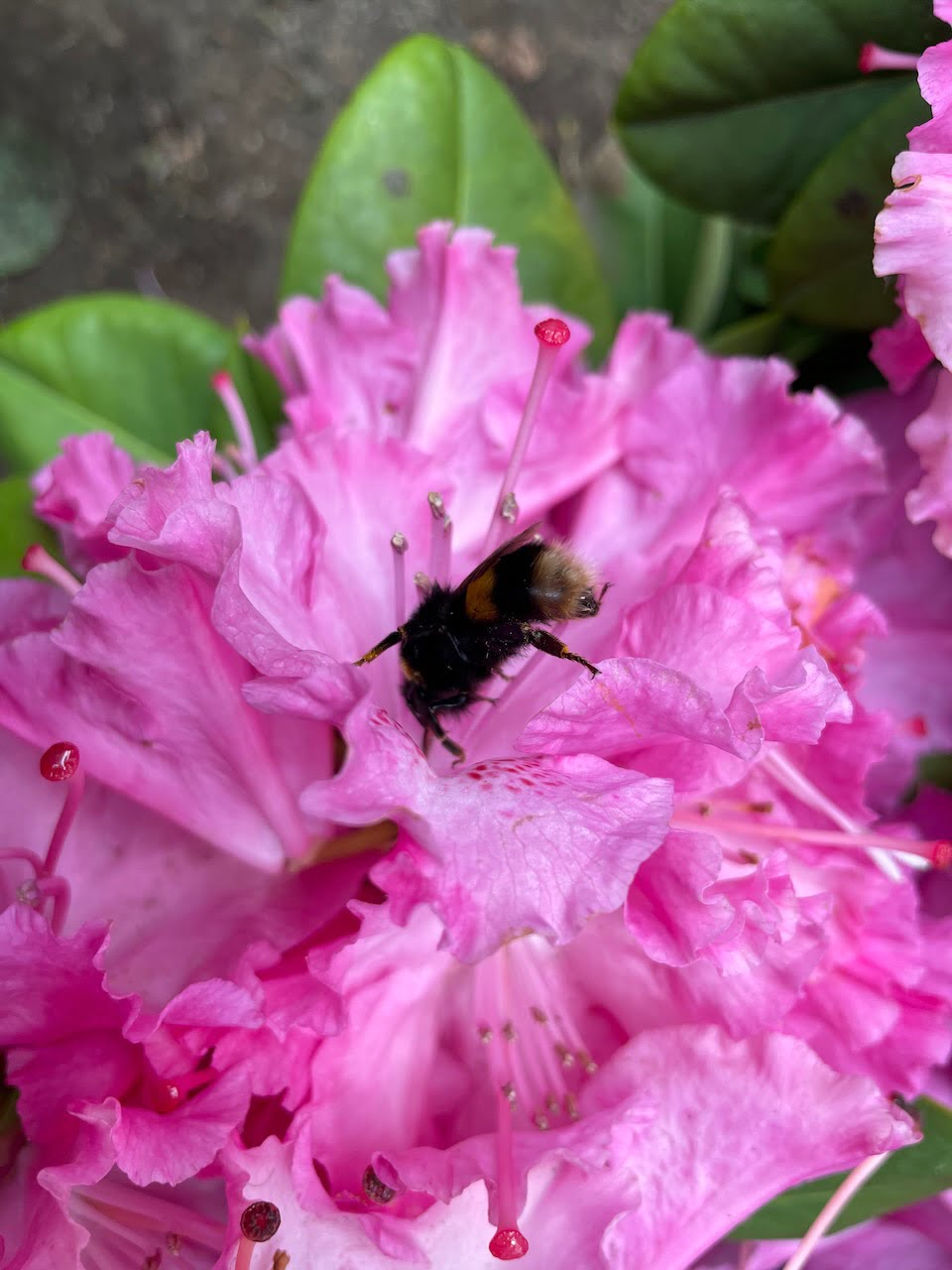
Azaleas are deeply embedded in Japanese garden tradition, where they are used as structural, clipped hedging elements as much as for their flowers. The Japanese practice of clipping azaleas into rounded cloud forms, called karikomi, creates beautifully abstract landscape compositions that suggest rolling hills or mountain ridges. As flowering plants, choose Japanese species such as Rhododendron kiusianum or any of the Kurume hybrid group for the most authentic feel. Acid soil is essential.
Azaleas in Japanese garden design are as valued for their clipping potential as for their spring flowers
🌿 At A Glance: Azalea
Botanical Name
Rhododendron spp. (Kurume group)
Plant Type
Evergreen or semi-evergreen shrub
UK Hardiness
H4–H5
Height / Spread
60cm–2m / 1–2m
Best Conditions
Acid soil essential, partial shade, shelter from frost
Key Feature
Excellent for cloud-clipping; vivid spring flowers
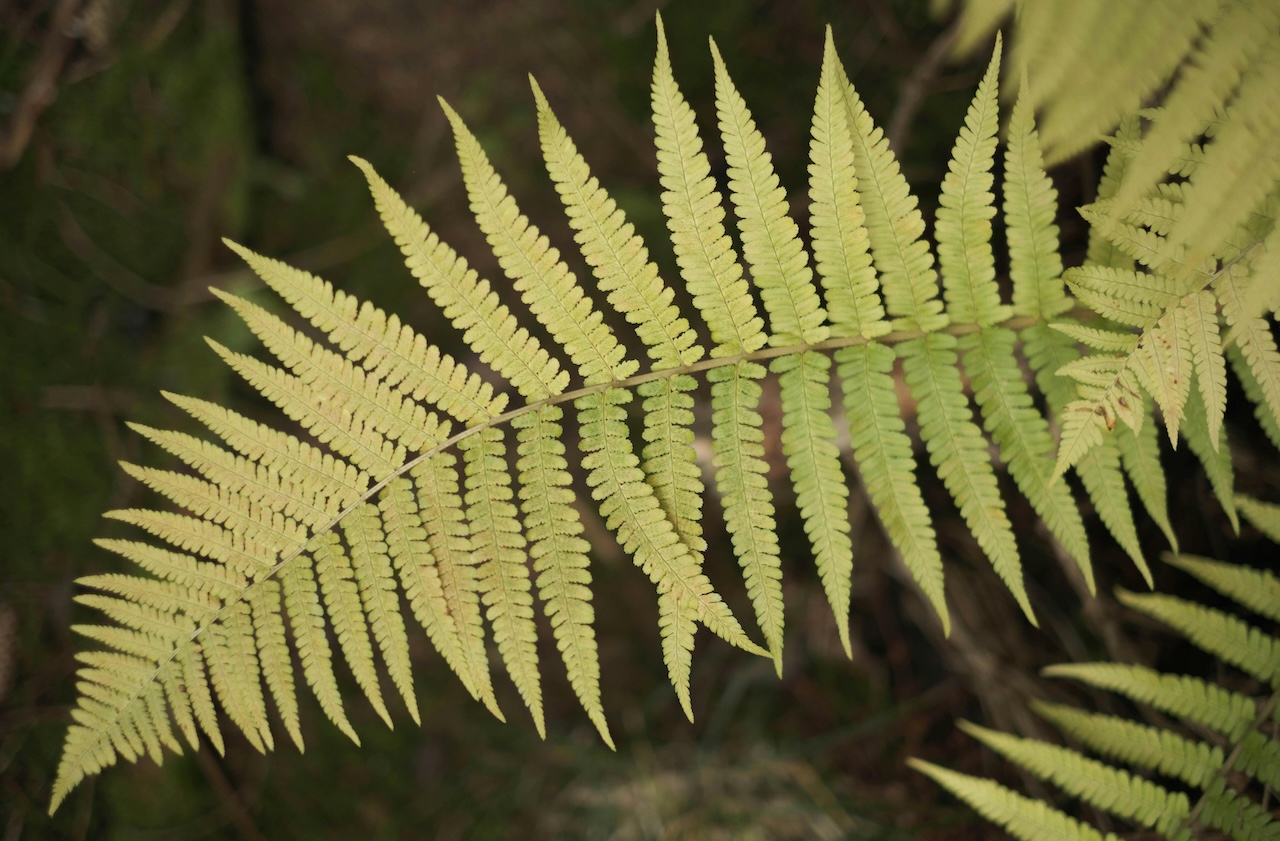
The Japanese painted fern is one of the most beautiful ferns available in UK gardens, with silver and burgundy-flushed fronds that bring a metallic shimmer to shaded corners. It grows naturally in Japan’s mountain forests and is perfectly suited to the kind of moist, shaded conditions that often exist beneath a canopy of acers and bamboo. Planting it in drifts under trees creates a ground-level tapestry of extraordinary delicacy.
The Japanese painted fern brings a metallic shimmer to shaded spots beneath trees, creating an authentic forest-floor feel
🌿 At A Glance: Japanese Painted Fern
Botanical Name
Athyrium niponicum var. pictum
Plant Type
Deciduous fern
UK Hardiness
H5 (hardy)
Height / Spread
30–45cm / 45–60cm
Best Conditions
Deep shade, moist humus-rich soil
Key Feature
Stunning silver and burgundy fronds; authentic forest-floor planting
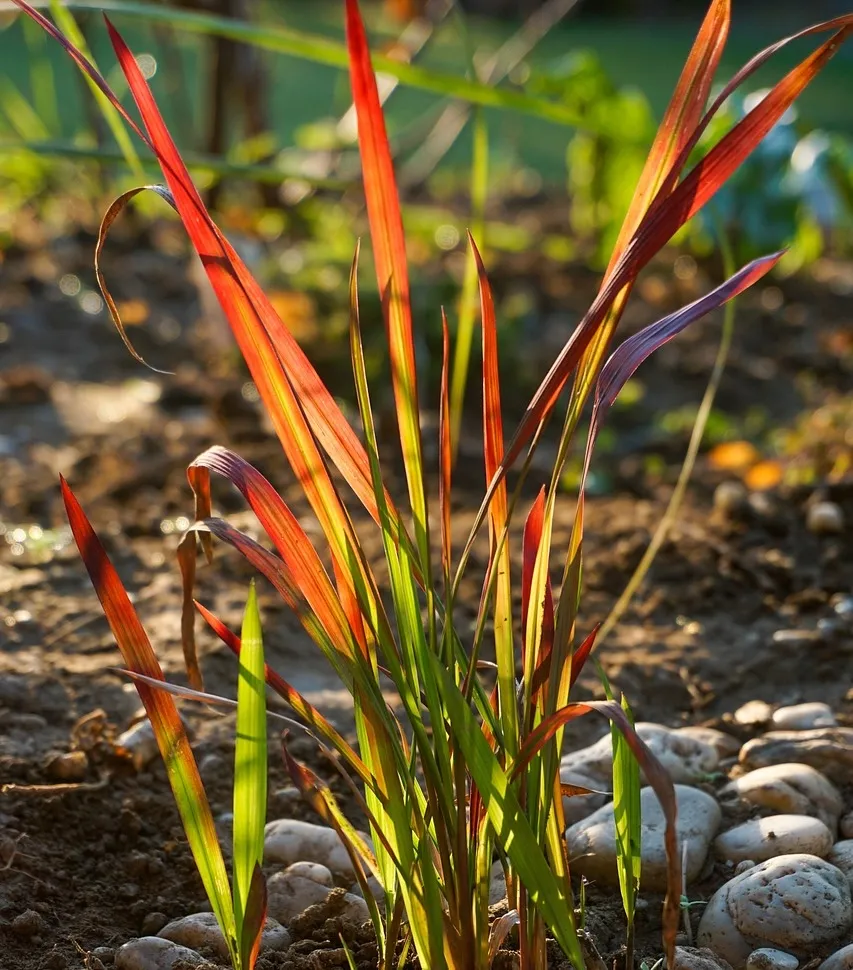
13. Japanese blood grass (Imperata cylindrica ‘Red Baron’)
Japanese blood grass is one of the most visually striking plants available for UK gardens, with upright blades that are green at the base and intensely blood-red at the tips, the whole plant becoming almost translucent when backlit by low autumn sun. It is a slow grower and non-invasive in UK conditions, making it safe to use without root barriers. I use it as a punctuation plant. A single clump placed where it catches the light makes a breathtaking focal point.
Japanese blood grass becomes almost luminous when backlit by autumn sun, making it one of the most dramatic focal plants available
🌿 At A Glance: Japanese Blood Grass
Botanical Name
Imperata cylindrica ‘Red Baron’
Plant Type
Deciduous ornamental grass
UK Hardiness
H4 (protect in hard winters)
Height / Spread
30–45cm / 30cm
Best Conditions
Full sun, moist well-drained soil
Key Feature
Intensely red blade tips; spectacular when backlit
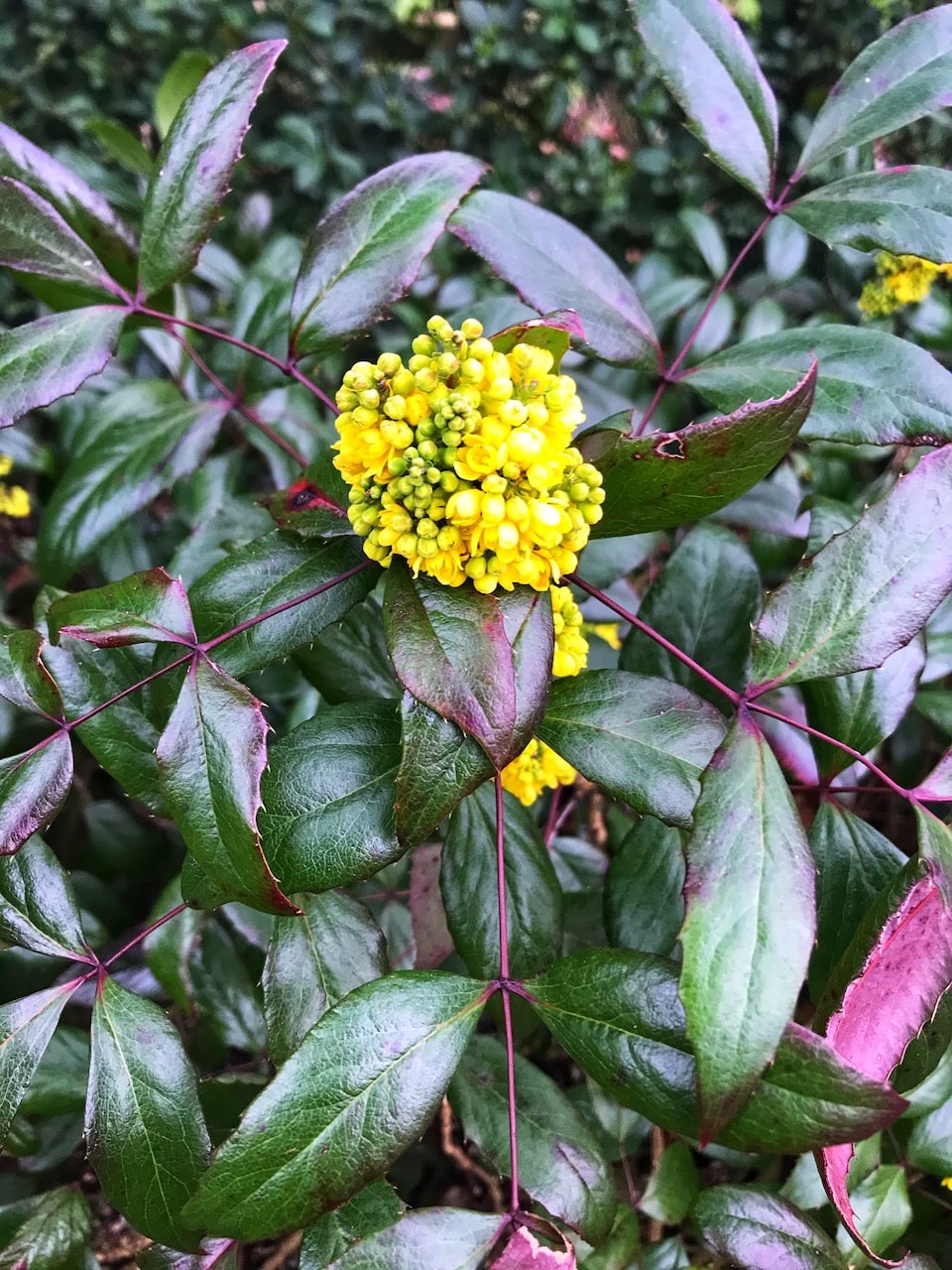
Mahonia japonica is one of the most underrated architectural shrubs available to UK gardeners. Its bold, pinnate leaves are genuinely structural throughout the year, its intensely fragrant yellow flowers appear from November through March when almost nothing else is flowering, and the whole plant tolerates deep shade with ease. Walking through Japanese gardens in winter reinforced for me how valuable plants with strong architectural presence are during the lean months.
Mahonia provides intensely fragrant yellow flowers through the darkest winter months when almost nothing else is performing
🌿 At A Glance: Mahonia
Botanical Name
Mahonia japonica
Plant Type
Evergreen shrub
UK Hardiness
H5 (hardy)
Height / Spread
1.5–3m / 2–3m
Best Conditions
Shade to partial shade, any soil
Key Feature
Winter flowers of exceptional fragrance; bold year-round structure
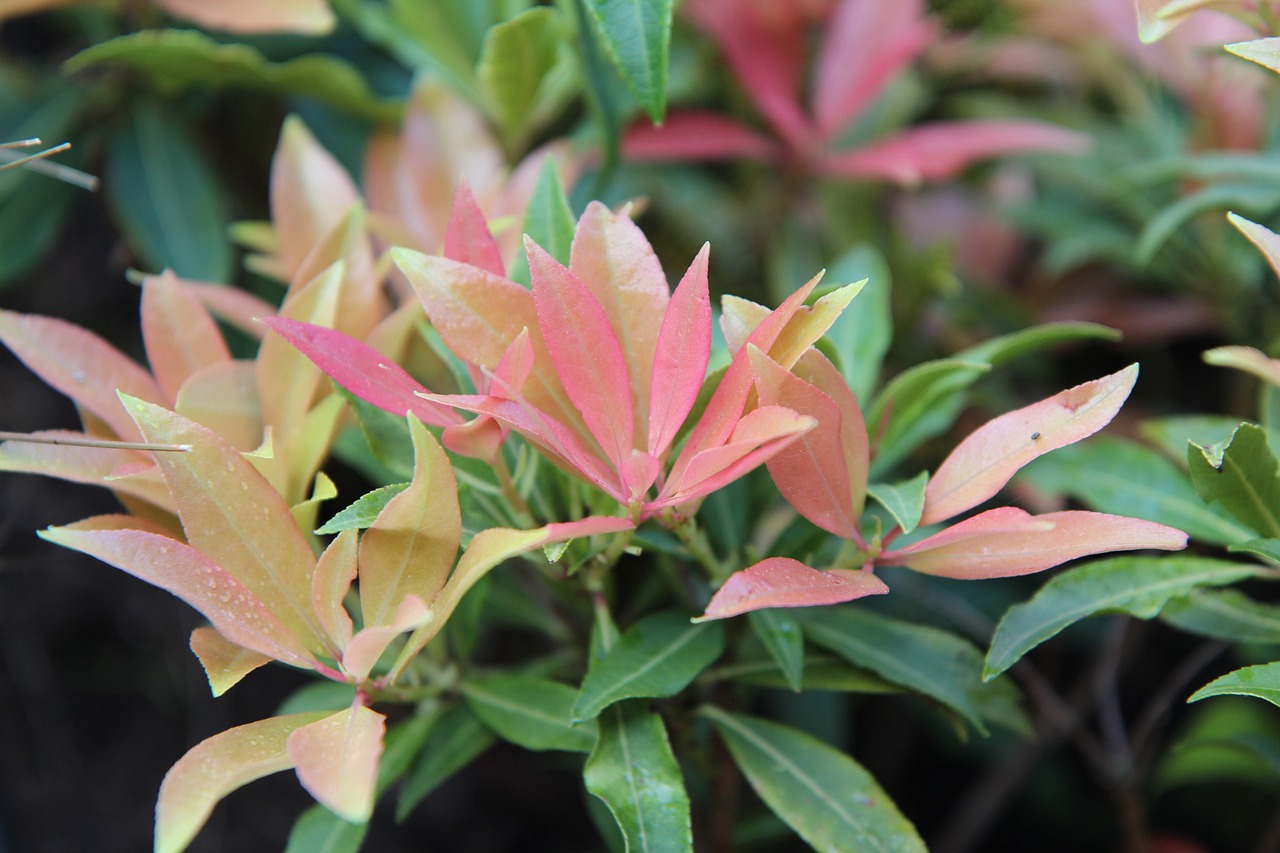
Pieris is a slow-growing, compact evergreen shrub with the most spectacular spring display of cascading white flowers combined with vivid red-flushed new growth that can look almost as striking as any flower. Native to Japan, it is an acid-loving plant that partners beautifully with camellias, skimmia, and Japanese acers. Its combination of reliable evergreen structure and exceptional seasonal interest makes it one of my most used plants in Japanese-themed designs.
Pieris japonica’s vivid red spring growth combined with cascading white flowers is one of the finest displays of any acid-loving shrub
🌿 At A Glance: Pieris
Botanical Name
Pieris japonica
Plant Type
Evergreen shrub
UK Hardiness
H5 (hardy)
Height / Spread
1–3m / 1–3m
Best Conditions
Acid soil, partial shade, shelter from frost
Key Feature
Vivid red new growth in spring; cascading white flowers
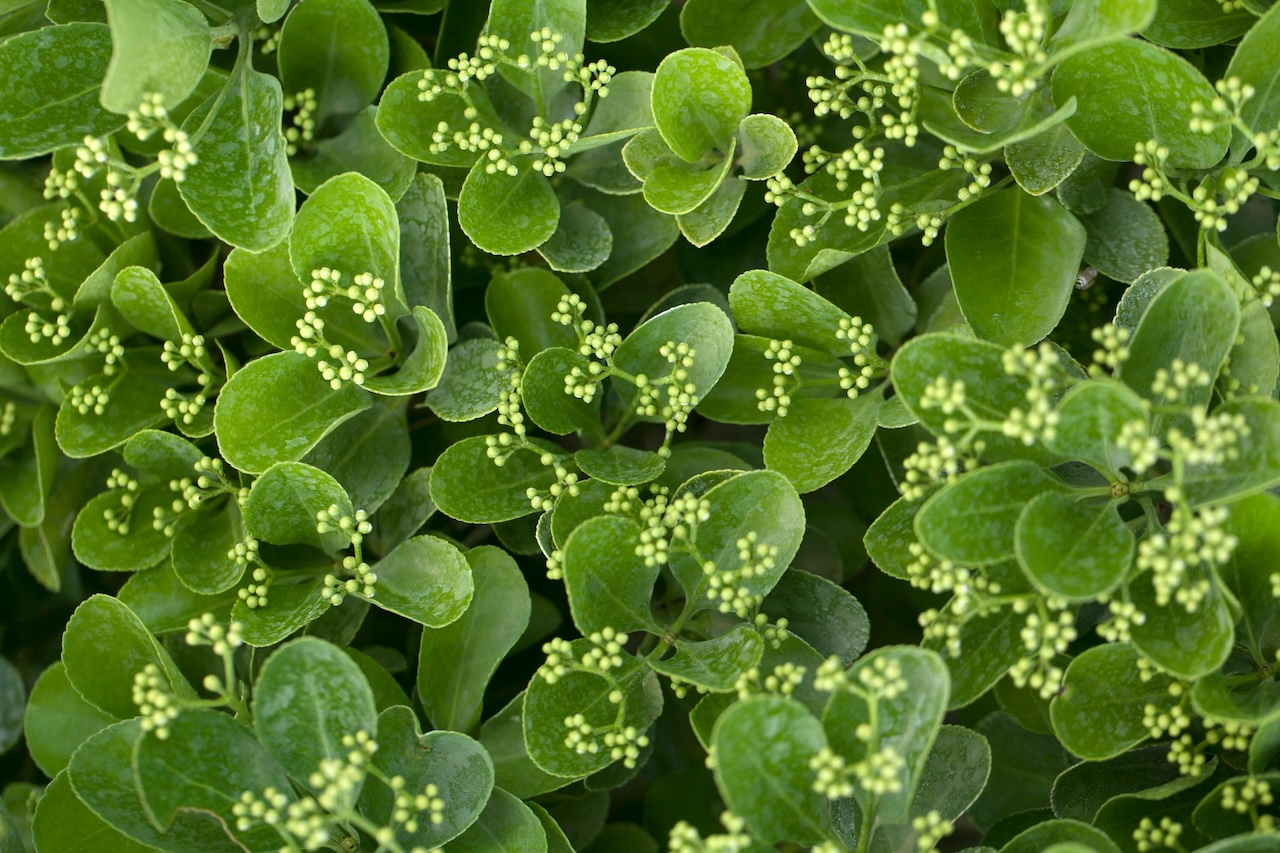
Japanese spindle is one of the toughest and most versatile evergreen shrubs available, with clean, glossy foliage that ranges from solid dark green to boldly variegated green and gold. It tolerates coastal exposure, pollution, shade, and clipping into formal shapes with remarkable equanimity. In Japanese garden design it works as a structural hedge element or as a clipped specimen, providing the kind of solid, reliable evergreen backbone that allows more delicate planting to shine around it.
Japanese spindle clips beautifully and tolerates difficult conditions, making it an invaluable structural element in Japanese garden design
🌿 At A Glance: Japanese Spindle
Botanical Name
Euonymus japonicus
Plant Type
Evergreen shrub
UK Hardiness
H5 (hardy)
Height / Spread
2–4m / 1–2m
Best Conditions
Sun or shade, any well-drained soil, coastal tolerant
Key Feature
Extremely tough evergreen structure; excellent for clipping
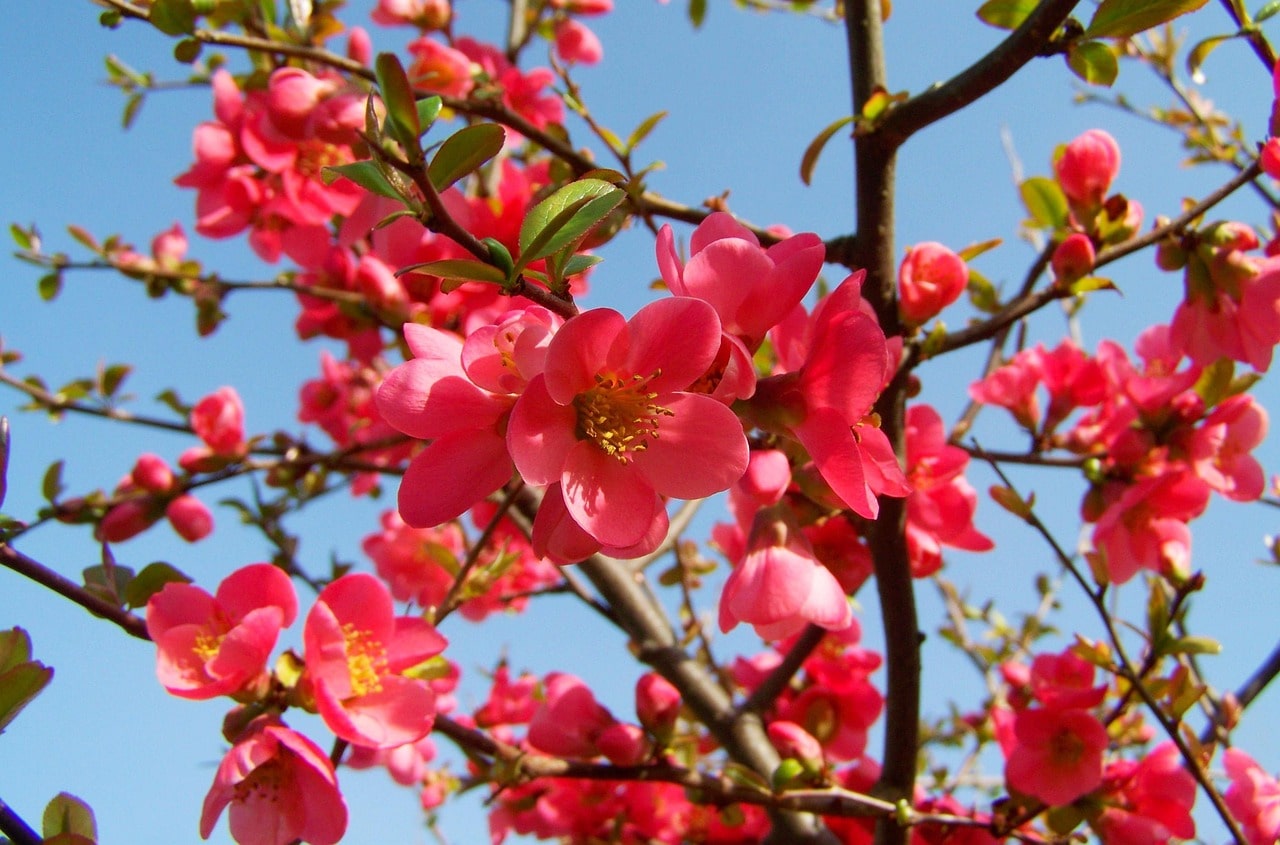
Japanese quince is a tough, deciduous shrub that produces its vivid red, orange, or white flowers in late winter and early spring, often on bare branches before the leaves emerge. This habit of flowering on bare wood is strikingly beautiful against stone, gravel, or a clipped evergreen backdrop and is entirely in keeping with the Japanese aesthetic of seasonal celebration. The edible yellow fruits that follow in autumn are a bonus.
Japanese quince flowers on bare winter stems, creating one of the most striking early-season displays available
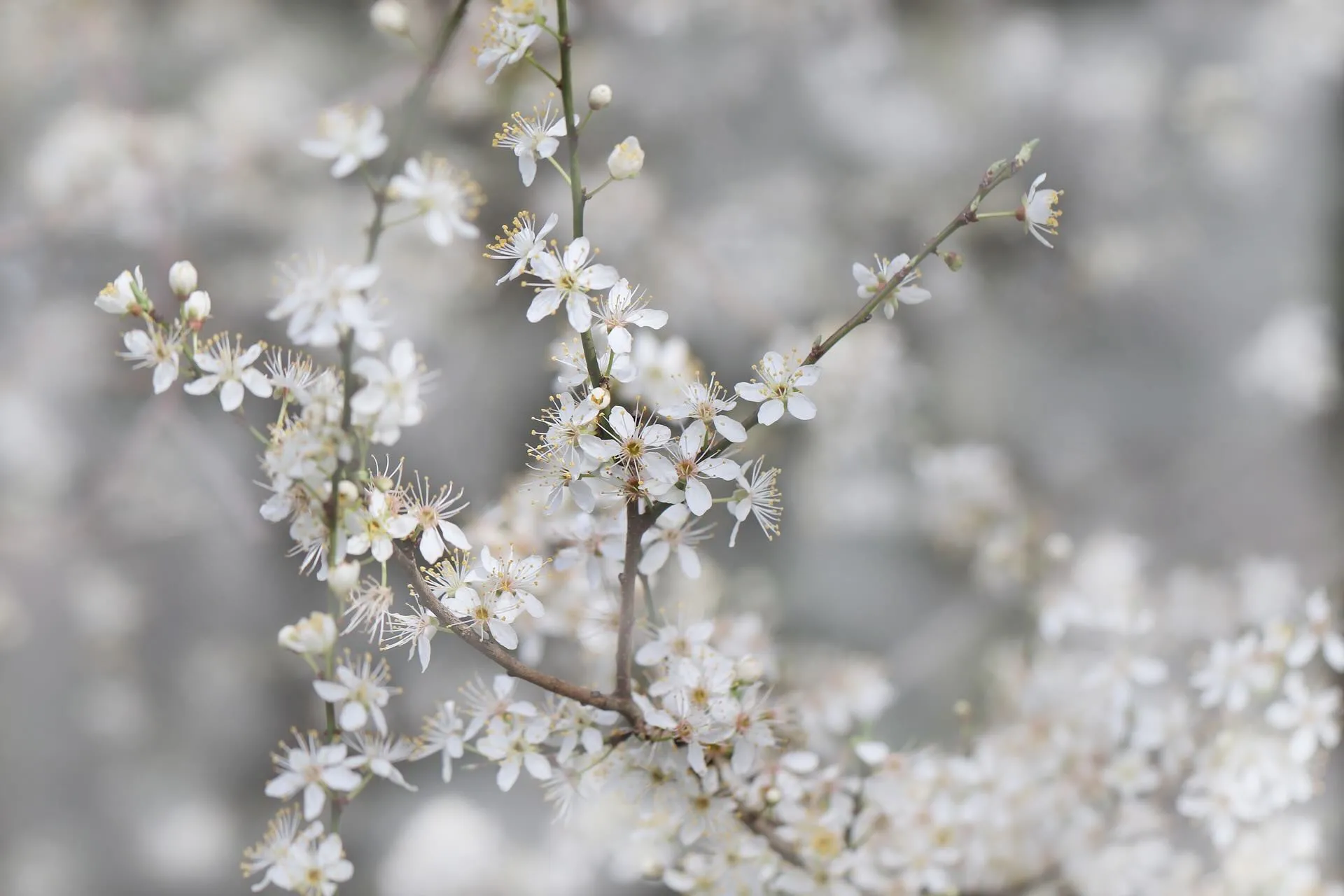
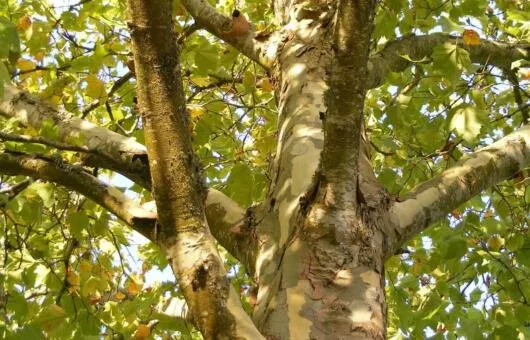
Cherry blossom is the symbol of Japanese culture and one of the most powerful seasonal expressions in any garden. The Japanese concept of mono no aware, the bittersweet awareness of impermanence, is embodied in the cherry blossom’s brief, spectacular flowering. For UK gardens, I recommend Prunus ‘Tai-Haku’ (the great white cherry) for large spaces, Prunus × subhirtella ‘Autumnalis’ for small gardens where a delicate, winter-flowering tree would earn enormous impact, or Prunus serrula where the polished mahogany bark is as valuable as the flowers.
Prunus ‘Tai-Haku’, the great white cherry, produces extraordinary blossom and is one of the finest Japanese-origin trees for UK gardens
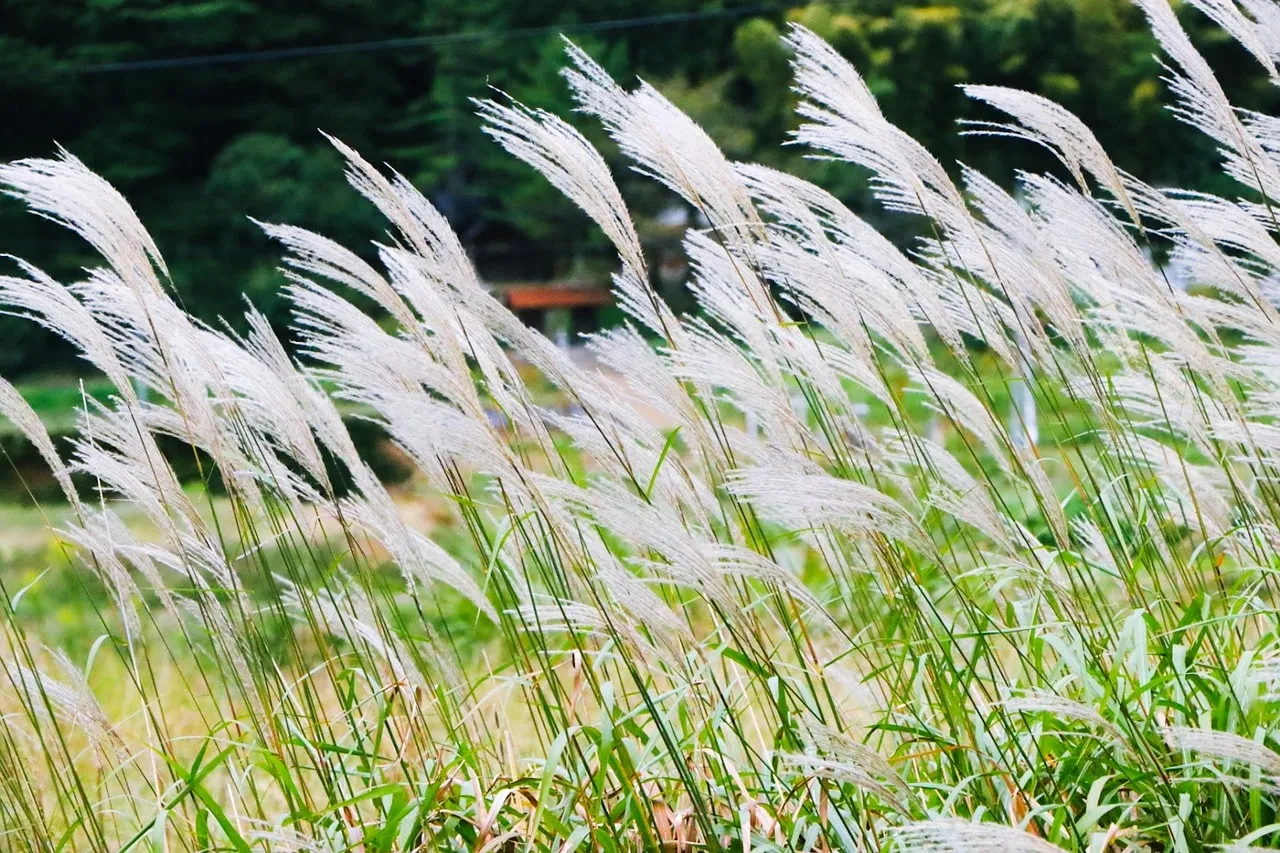
Miscanthus is native to East Asia including Japan, where it grows naturally on open hillsides and along riverbanks. Its tall, graceful flowering plumes and the gentle movement of its foliage in the wind make it one of the most useful grasses in a Japanese-influenced planting scheme. In autumn the foliage turns warm shades of gold and amber before the whole plant becomes a skeletal, frosted structure through winter. I leave it standing through winter in every design I use it in, and the effect is spectacular.
Miscanthus grasses left standing through winter create exceptional structure and movement long after other plants have retreated
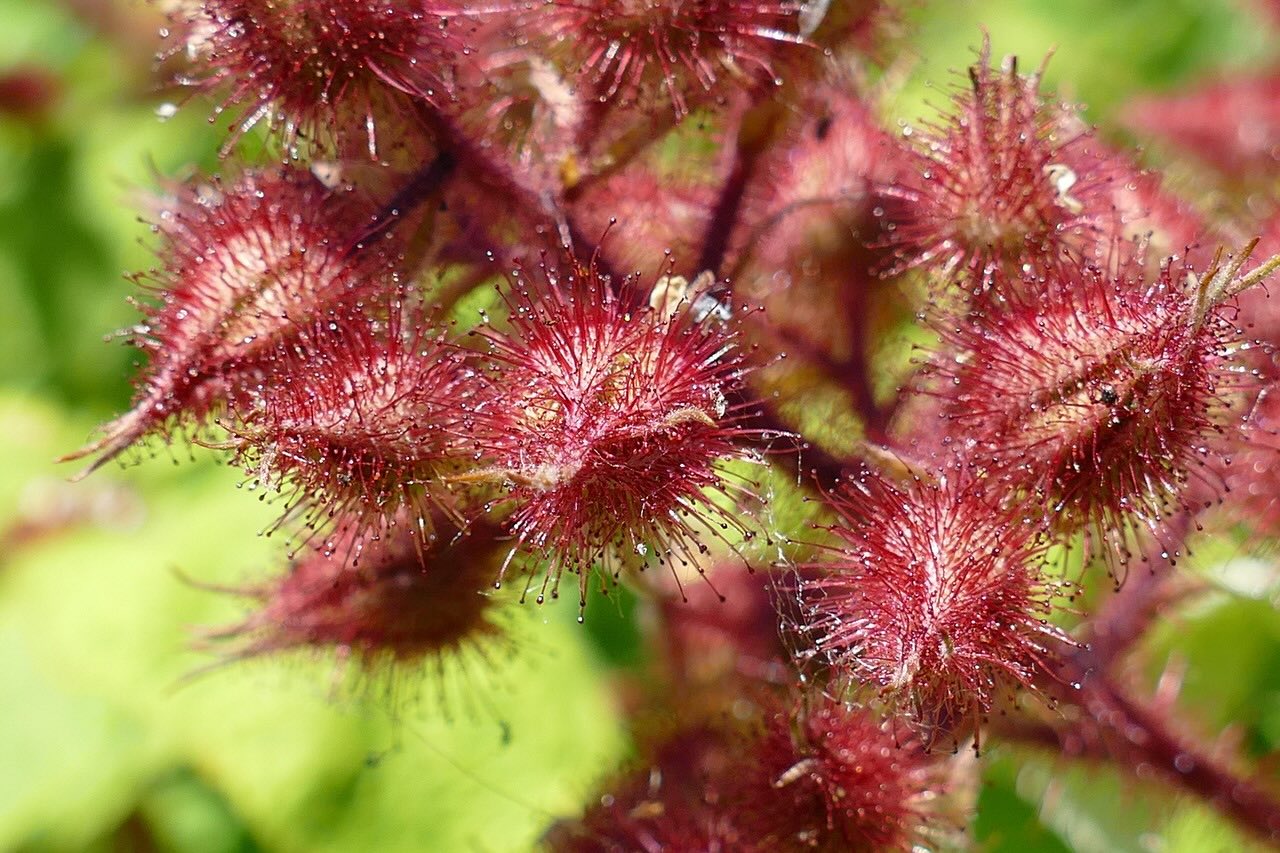
Japanese wineberry is a beautiful ornamental fruiting cane with distinctive bristly red stems that glow in low winter light and delicious amber-red berries in late summer. It is vigorous but manageable, and its combination of visual interest across multiple seasons with edible productivity makes it an excellent choice for a Japanese garden that also produces something to eat. Train it against a wall or fence for the most dramatic display of the vivid stems through winter.
Japanese wineberry offers ornamental red stems through winter, followed by sweet amber-red berries in summer
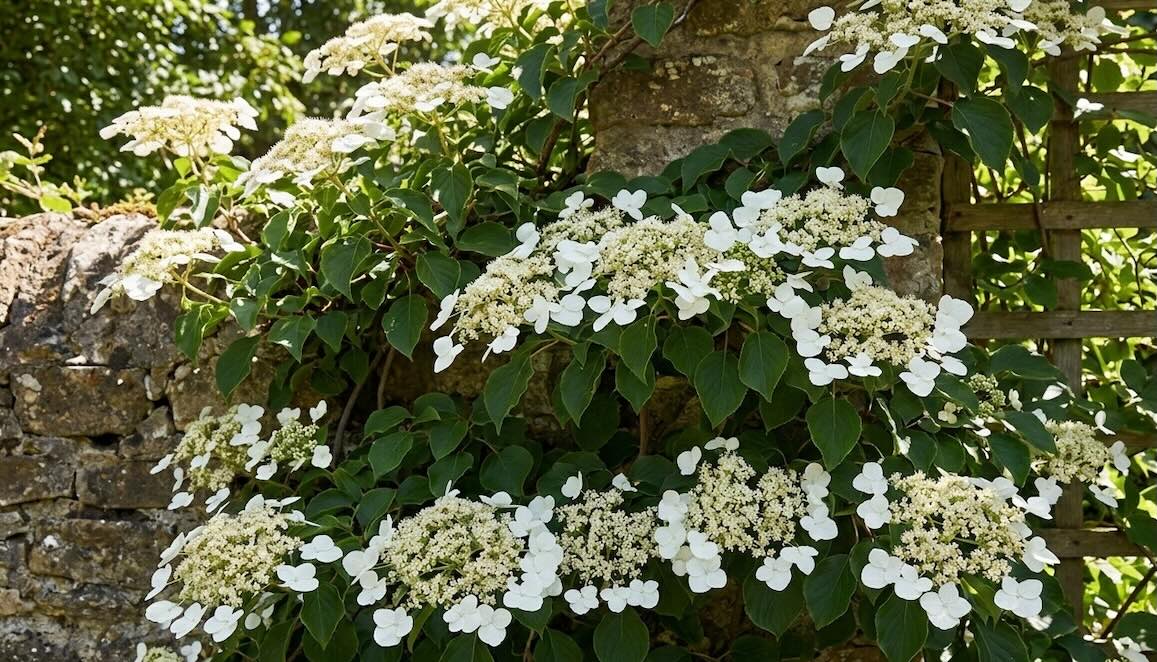
21. Japanese hydrangea vine (Schizophragma hydrangeoides)
This climbing plant from Japan is closely related to the climbing hydrangea and produces large, elegant flowerheads in summer, each one surrounded by broad white bracts that tremble beautifully in the breeze. It is exceptionally well suited to shaded north or east-facing walls where little else would flower so generously, and its peeling cinnamon-coloured bark provides winter interest. A single established plant trained across a wall or fence can become a genuinely extraordinary feature.
Schizophragma is one of the finest climbing plants for shaded walls, producing extraordinarily elegant flowers in summer
Water is perhaps the single most powerful element in Japanese garden design. In the great gardens I visited across Japan, from the mirror-still pools of Kyoto’s Kinkakuji to the tumbling mountain streams of Hakone, water brought a quality of life and movement that no other element could replicate. It represents the flow of time and life itself, and in combination with rock it creates the fundamental yin and yang of the Japanese garden: the yielding and the immovable, the soft and the hard.
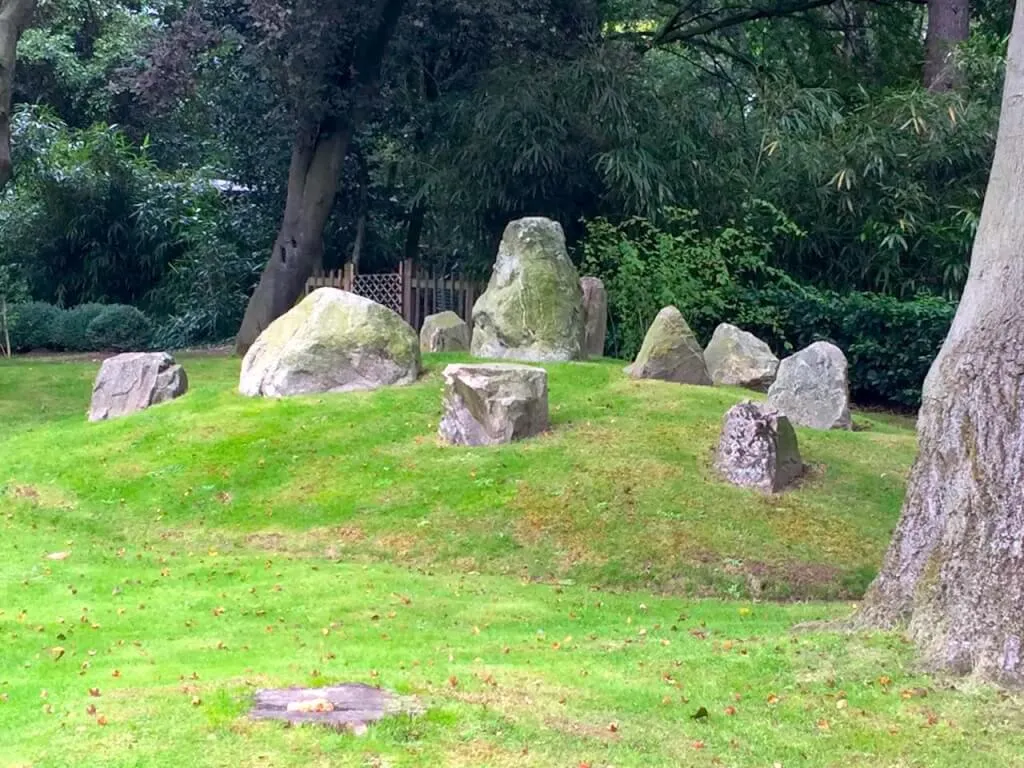
Rocks should be arranged in odd numbers, typically three, five, or seven, with clear height relationships between them. The tallest stone traditionally represents heaven, the shortest represents earth, and the intermediate stones bridge the two. Position rocks so they appear to have been there for centuries rather than recently placed. Partially burying the base of each stone and planting moss around it helps enormously. Avoid lining rocks up in a row, which reads as a garden centre display rather than a considered composition.
Rock groupings in Japanese garden design should suggest landscape rather than decoration. Odd numbers, varied heights, and partial burial all help.
You can also symbolise water without having any physically present. A carefully raked gravel bed creates the impression of water in movement or at rest, and in a dry garden (karesansui) this illusion is the entire point. The raking patterns themselves carry meaning: concentric circles suggest water disturbed by a stone; parallel curves represent flowing water or ocean waves. Gravel is also supremely low maintenance and works beautifully in UK gardens where a pond might not be practical.
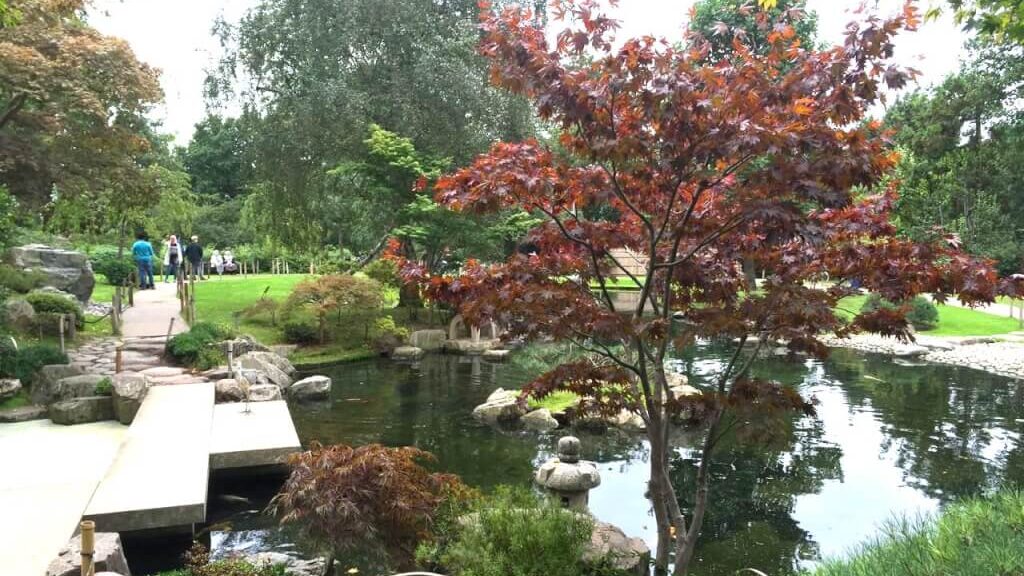
The Kyoto Garden in Holland Park is one of the finest Japanese garden examples in the UK and an excellent reference point for design decisions
The shishi-odoshi: bamboo deer scarer
The shishi-odoshi is one of the most recognised Japanese garden features, yet most people who have seen one do not know its name or purpose. The name translates as “deer scarer” and that is precisely what it was originally: a practical device used in Japanese gardens and farms to startle deer and wild boar away from cultivated plants. A hollow bamboo tube fills slowly from a stream or pipe, tips when full, empties with a satisfying clack against a stone beneath, and returns to its upright position to fill again.
A shishi-odoshi photographed in Kyoto. The rhythmic clack of bamboo on stone is as much a part of the Japanese garden experience as the visual composition.
In a contemporary Japanese garden, the shishi-odoshi serves a different purpose entirely. The sound is the point. That periodic, irregular clack of bamboo on stone interrupts silence without breaking it, drawing attention to the present moment in a way that continuous background noise never could. I have used shishi-odoshi features in several Japanese-influenced garden designs and the response from clients is always the same: they stop, they listen, and they settle.
A shishi-odoshi requires a water supply, either mains-fed through a small pump and reservoir or fed from a gravity source if you have one. The bamboo itself needs replacing every few years as it weathers and splits. The stone it strikes should be a piece of character; a flat, water-worn piece of granite or slate that rings clearly when struck rather than thudding dully. The sound quality matters as much as the visual quality in this feature.
💡 Top Tip
Position your shishi-odoshi so it can be heard from a seating area but is not in direct eyeline. Discovering the source of the sound by following it through the garden is part of the experience. Hide it partially behind bamboo or fern planting so it is glimpsed rather than immediately obvious.
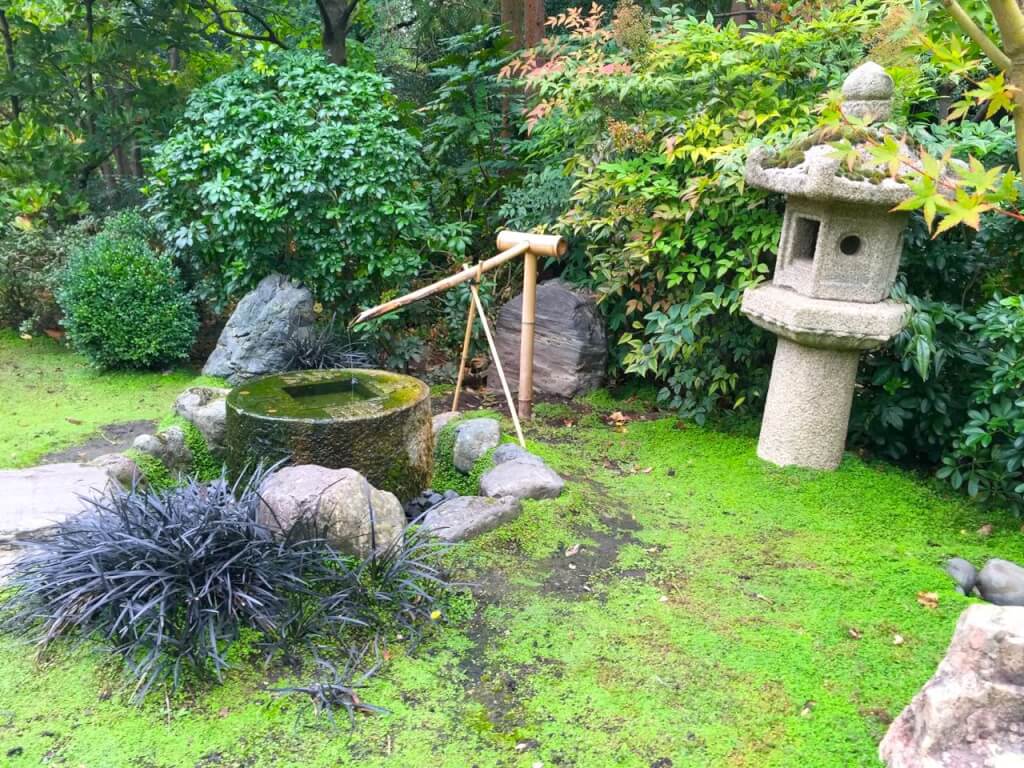
The tsukubai is a stone water basin set low to the ground, traditionally placed at the entrance to a tea garden to allow guests to wash their hands before entering. The word means “to crouch” in Japanese, because the basin is deliberately positioned so that a visitor must bend low to use it. This is not an oversight of ergonomics. It is a designed act of humility: the physical posture of bowing before entering a sacred or contemplative space. Even stripped of its ceremonial context, a tsukubai carries this quality. It asks you to slow down and pay attention.
In a UK garden a tsukubai works as both a focal point and a water feature, typically fed by a small submersible pump that keeps water moving through the basin and out through a bamboo pipe or over the stone edge. Surrounding the basin with cobbles or smooth pebbles allows the water to drain discreetly and prevents the muddy splash that kills the effect of a well-chosen stone. Moss encouraged to grow on the basin surface is a mark of quality in Japanese garden design. A moss-covered tsukubai suggests age, care, and deep time in a way that a pristine stone never can.
💡 Top Tip
To encourage moss on a new stone tsukubai, paint the surface with a thin slurry of natural yoghurt mixed with a small amount of soil. Keep the stone in shade and misted regularly, and moss will establish over several months. Avoid this technique with limestone, as the surface needs to be slightly acidic for moss to colonise it successfully.
One of the principles that separates a truly authentic Japanese garden from a surface-level imitation is the intention behind seasonal change. Western garden design tends to chase constant colour and permanent abundance. Japanese garden philosophy treats each season as a distinct mood to be lived in rather than compensated for. The garden should look different in every month of the year, and every version of it should be intentional and complete in its own way.
When I travelled through Japan’s historic gardens across different seasons, what struck me most was how the same spaces felt entirely different at each visit. The Kyoto gardens I saw in early spring, with bare branches against raked gravel and the first suggestion of moss thickening after winter rain, were completely distinct from the same gardens in late autumn, when the acers were burning crimson and the gravel had a different quality of light in the lower sun. Planning a Japanese garden well means planning for all four seasons simultaneously, not just the moment when it photographs best.
Spring
Spring in a Japanese garden arrives first in the structure. Before any plant breaks into leaf, the relationship between rocks, raked gravel, and the skeletal forms of deciduous shrubs and trees is at its most legible. This is the season to appreciate your design decisions most honestly, because there is nothing soft to hide behind. A well-chosen rock, a correctly positioned specimen acer, and a path of clean stepping stones look extraordinary in early March light.
Cherry blossom is the iconic Japanese spring moment, but it is brief by design. A single Prunus ‘Kojo-no-mai’ or a weeping Prunus subhirtella against a backdrop of dark bamboo or clipped evergreens gives you ten days of extraordinary drama that is all the more powerful for its brevity. Camellia, which begins flowering in late winter and carries into spring, provides a longer season of restrained colour. Mosses thicken and green up vigorously after spring rain, which in the UK means spring is often the season when a Japanese garden looks most lush and alive.
Cherry blossom is the defining Japanese spring moment: brief, spectacular, and all the more precious for its transience.
Summer
Summer is the season when a Japanese garden’s green palette is at its richest. Bamboo is lush and full, ferns have unfurled completely, hostas create pools of cool textured foliage, and the acers are in full leaf. This is not the season for flower colour. It is the season for shade, for the sound of water, and for the textures of different greens held in composition against each other.
Wisteria is the one exception to the Japanese garden’s rule of floral restraint in summer: trained over a pergola or a simple timber beam, it produces a curtain of pale mauve or white that is entirely appropriate in character. It should be grown with discipline, trained precisely, and pruned twice a year to keep it from becoming the sprawling tangle that defeats so many UK gardeners. I have a full guide to wisteria pruning on the site if you need it.
In a UK summer, the lawn equivalent in a Japanese garden is moss, and moss requires moisture to look its best. If you have a hot, dry spell, your moss may brown and look stressed. Gentle watering in the early morning rather than the heat of the day will help it recover, and it will green back up quickly once the weather cools.
Autumn
Autumn is the season Japanese gardens were arguably designed for. The colour change in acers, from green through yellow, orange, and crimson to the final deep burgundy before leaf fall, is the most celebrated event in the Japanese garden calendar. The combination of autumn acer colour against the permanent green of bamboo, the grey of rocks, and the pale gold of raked gravel creates compositions of extraordinary richness.
Fallen leaves on raked gravel are not a maintenance problem in a Japanese garden. They are part of the composition, and there is a specific Japanese concept, wabi-sabi, that values this kind of impermanent beauty. A few perfect leaves on freshly raked gravel is a moment to enjoy rather than immediately sweep away. The formal clearing of autumn leaves is done at the end of the season, not daily during it. Allow the garden to pass through this transition with some dignity.
💡 Top Tip
For maximum autumn impact, position your acer so the low autumn sun catches it from behind in the afternoon. Back-lit autumn foliage is luminous in a way that front-lit foliage never quite is. East or south-east aspects work well for this effect in a UK garden.
Winter
Winter is when a Japanese garden reveals whether it was designed with real intention or assembled from decorative parts. A garden that depends entirely on foliage and flowers has nothing to say in January. A Japanese garden that was designed properly has everything: the architecture of bare branches against sky, the permanence of rocks under frost, the pale gold of gravel raked clean, the dark vertical lines of bamboo canes, the bronze tones of dried ornamental grass held upright against cold air.
Stone lanterns earn their place most fully in winter. Lit in the early evening on a short winter day, a traditional stone lantern in a Japanese garden transforms the whole space into something quietly extraordinary. The quality of light from a low source against dark bamboo and pale gravel is as considered as any other element of the design. If you are going to invest in one feature that will make you feel the rightness of the whole composition, a stone lantern placed with care is the one I would recommend above all others.
Evergreen structure also matters greatly in winter: clipped box, pine, and bamboo provide the bones that hold the composition together when deciduous plants are dormant. Plan for at least one third of your Japanese garden’s plant palette to be evergreen if you want it to hold its character through the darkest months.
6. Trees and shrubs: the art of cloud pruning
Cloud pruning, or niwaki, is where the magic of Japanese garden design really becomes evident. It is the art of pruning trees and shrubs into naturalistic, cloud-like forms that simultaneously suggest both wild nature and meticulous human control. Having studied and practised this technique over many years, and having seen it executed at the highest level in the great garden collections of Japan, I can tell you that it transforms an ordinary garden into something that reads as genuinely extraordinary.
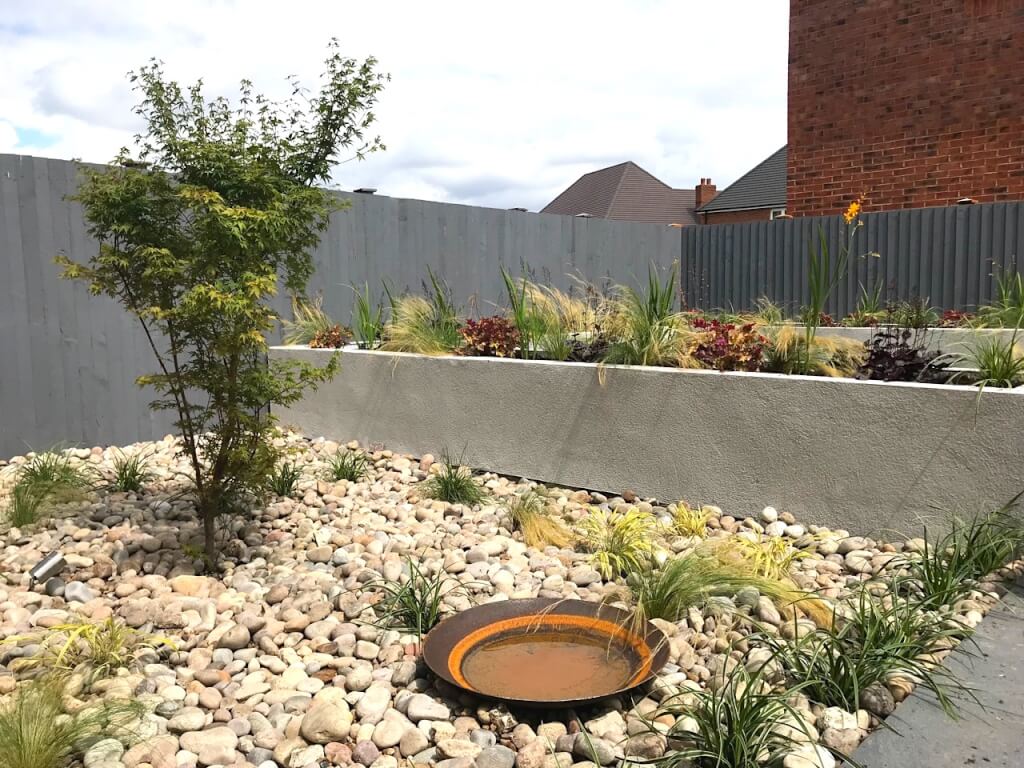
A Japanese maple trained in a gravel garden. The combination of sculpted tree form, gravel, and simple planting creates authentic Japanese atmosphere
Acers are the most commonly cloud-pruned tree in Japanese design, but osmanthus, box, pine, and yew all take to the technique beautifully. The principle is to remove internal growth to expose the branch structure, then clip the outer growth into rounded cloud-like pads. It is slow work requiring patience and sharp tools, but the results age magnificently and give even young plants the air of ancient specimens.
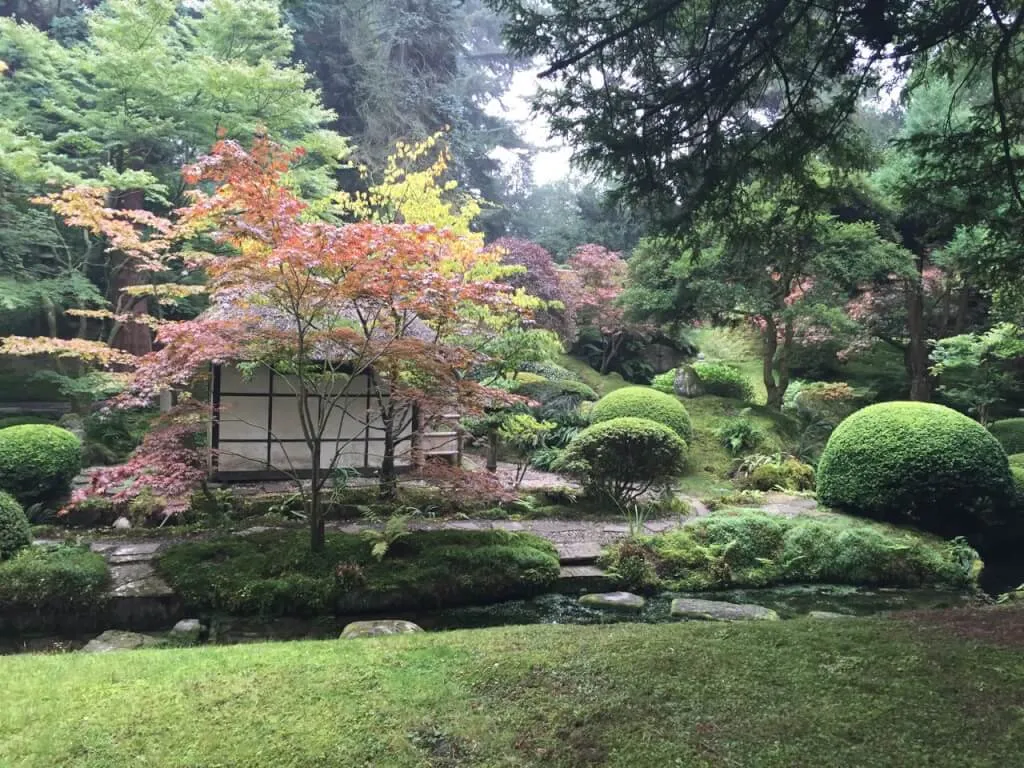
The Tatton Park Japanese garden in Cheshire, which I have visited many times and which informed several of my own BBC Garden Rescue designs, demonstrates cloud-pruned azaleas used as landscape elements at their finest. Rows of clipped azalea mounds suggest a mountain range in miniature, an effect that is simultaneously abstract and deeply natural.
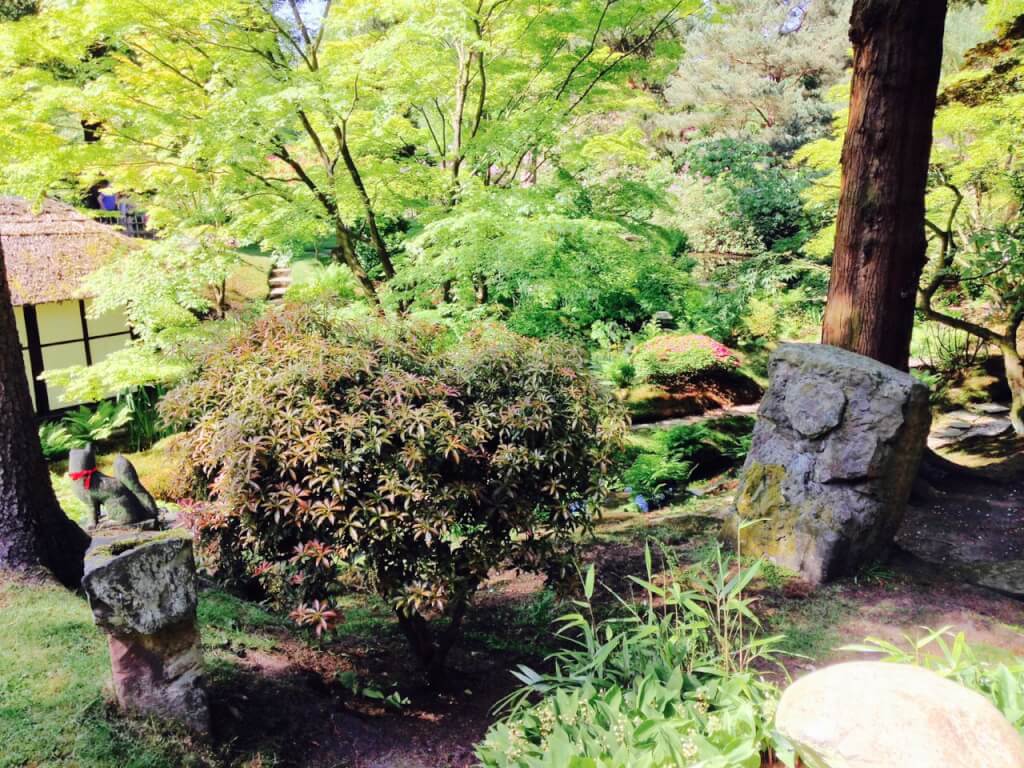
The Japanese garden at Tatton Park in Cheshire is one of the UK’s finest examples and a regular reference point for my own design work
7. Japanese garden tools
Japan has a centuries-old tradition of tool-making that is intimately linked to its gardening culture, and Japanese tools consistently outperform their Western counterparts for certain tasks. After years of using them professionally, both in my garden design work and in the plant care demonstrations on BBC’s Garden Rescue, I have strong opinions on which ones belong in every serious gardener’s kit.
Japanese tools form the backbone of my professional tool kit, and they are among the finest cutting tools available for garden use
The hori hori
The hori hori is a Japanese digging knife that has become one of the most essential tools in my entire professional kit. The name literally means “dig dig” in Japanese, which tells you everything about its purpose. It is a heavy, double-edged blade, usually around 17–20cm long, with a serrated edge on one side and a smooth edge on the other, set into a sturdy handle. It is the most versatile single gardening tool I have ever used.
The concave, double-edged blade of a hori hori is unlike any Western garden tool. It is a precision instrument as much as a digging implement
In the course of a single hour I might use my hori hori to plant bulbs (the blade cuts through soil cleanly and the depth markings on the blade eliminate guesswork), divide herbaceous perennials, remove deep-rooted weeds like dock and dandelion, slice through the roots of invasive plants, and trim small shrub roots during planting. It genuinely replaces four or five separate tools, which is why I have carried one in my professional kit for over a decade. The Niwaki hori hori is my personal recommendation. The steel quality and balance are exceptional.
The Niwaki hori hori is my personal recommendation. The steel quality, balance and edge retention are exceptional for professional use
Okatsune is a Japanese tool manufacturer based in Okayama with over sixty years of production history. Their secateurs are used by professional horticulturalists across Japan and increasingly across the UK, and they deserve every bit of the reputation they have built. The steel is harder than most European secateurs, which means they hold a sharper edge for longer, and the blade geometry is optimised for a clean, precise cut rather than a crushing one. A clean cut heals faster and carries less disease risk than the bruised cuts produced by cheaper tools, which is why professional standards of pruning genuinely matter for the health of your plants.
Japanese secateurs produce a far cleaner cut than most European equivalents, which matters for plant health as much as for aesthetics
🛠 Japanese Secateurs At A Glance
Brand
Okatsune (Japan)
Steel Type
High-carbon Japanese steel; holds edge longer than most European alternatives
Best For
All pruning work; particularly fine for cloud-pruning and detailed niwaki work
Lee’s Verdict
Among the finest bypass secateurs available for professional use
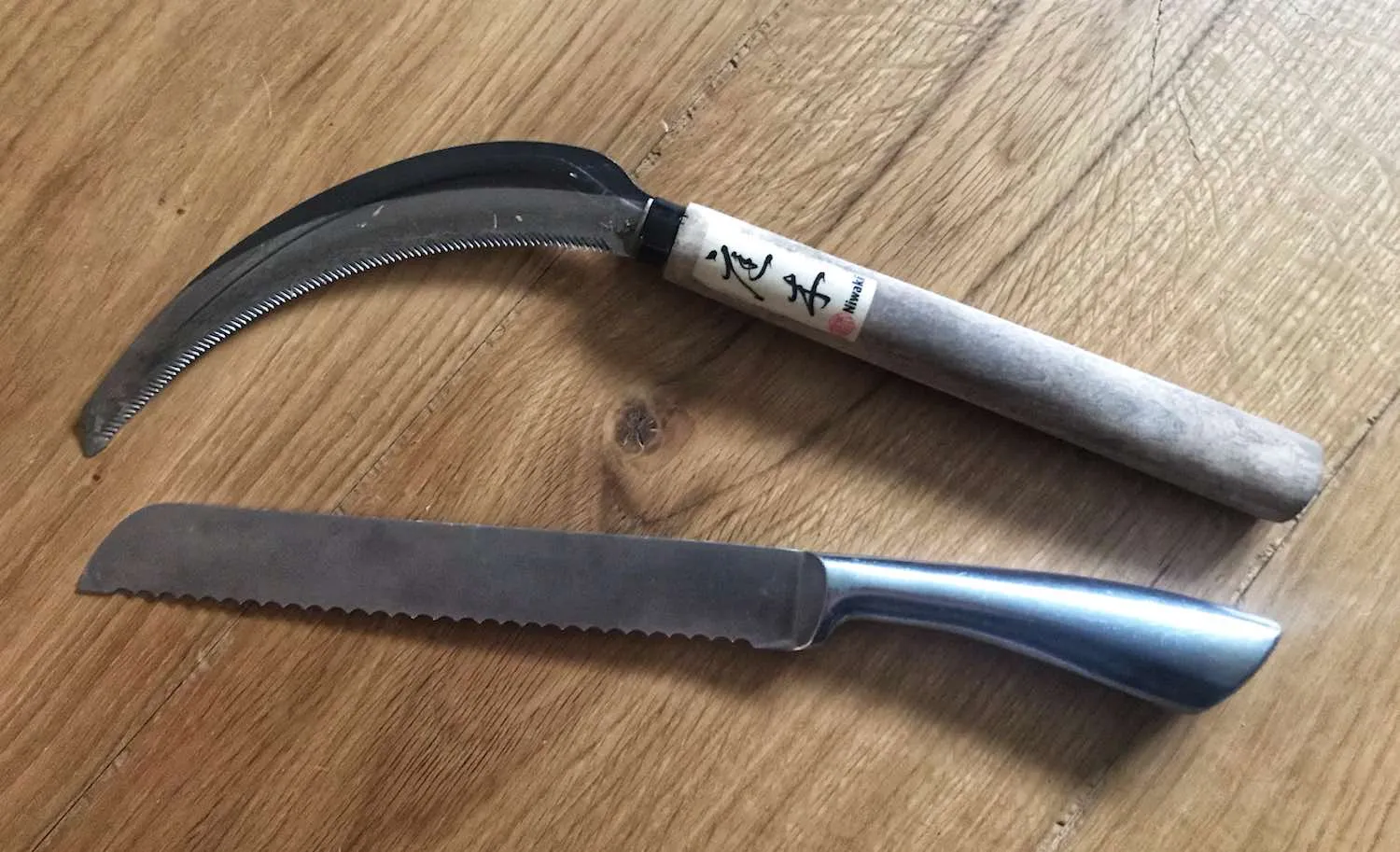
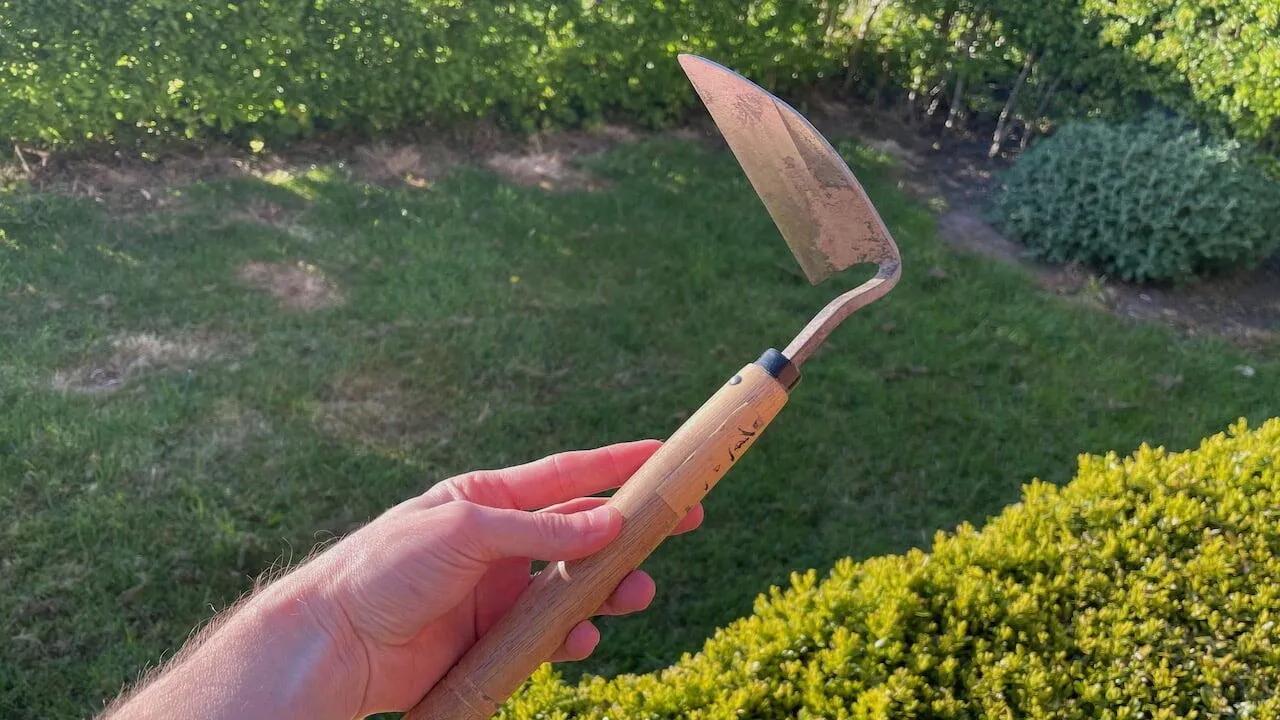
The Japanese garden scythe, or kama, is a small, lightweight sickle with a curved blade that is perfect for trimming grass, cutting back ground cover, harvesting bamboo shoots, and edging. It works completely differently from any Western equivalent. The motion is a drawing cut rather than a pushing one, and once you develop the muscle memory it is extraordinarily efficient. I have used one for edging and grass management on Japanese garden projects where a strimmer would have been both noisy and imprecise.
The Japanese kama scythe is a remarkably efficient hand tool for grass cutting, edging, and bamboo management once you develop the technique
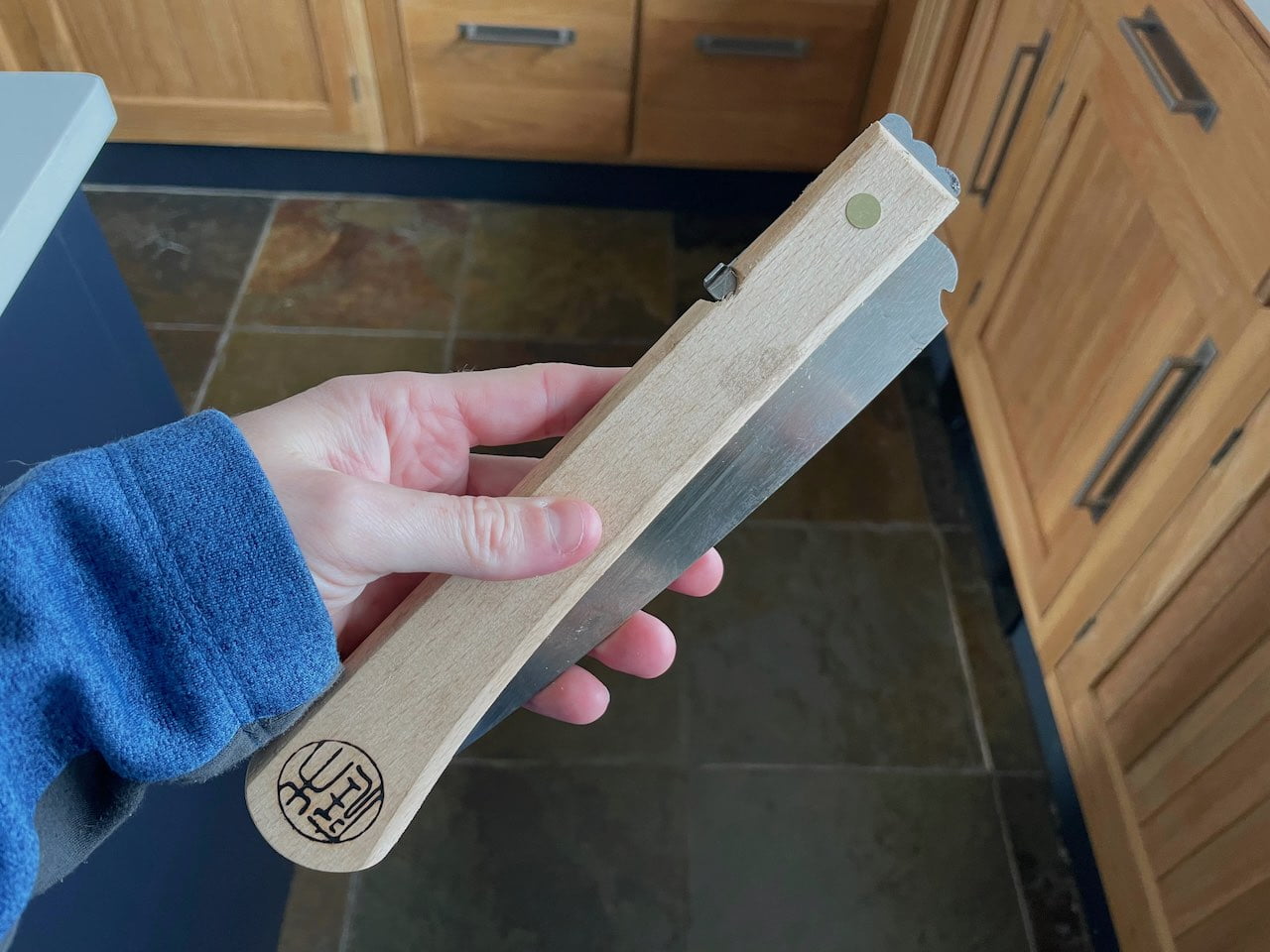
The Japanese folding pruning saw is another tool I have used professionally for years and would not be without. Unlike Western pruning saws that cut on the push stroke, Japanese saws cut on the pull stroke, which means the blade is under tension when cutting rather than compression. This allows for much thinner, more flexible blades that produce extraordinarily clean cuts in confined spaces where a standard pruning saw would either bind or produce a ragged finish. For cloud pruning and niwaki work specifically, where you are often making cuts inside a dense canopy, a Japanese folding saw is invaluable.
A Japanese folding pruning saw cuts on the pull stroke, allowing a thinner blade and cleaner cut than any push-cut Western equivalent
The Japanese hand weeder is a small, lightweight tool with an L-shaped blade designed specifically for extracting taprooted weeds such as dandelions and docks without disturbing the surrounding soil. The thin blade slides down alongside the root, levering it upward cleanly and extracting it with minimal soil disturbance, which matters particularly in a Japanese garden where the gravel, moss, and soil texture are part of the composition and should not be unnecessarily disrupted.
The Japanese hand weeder extracts taprooted weeds cleanly and precisely, causing minimal disturbance to the surrounding soil and planting
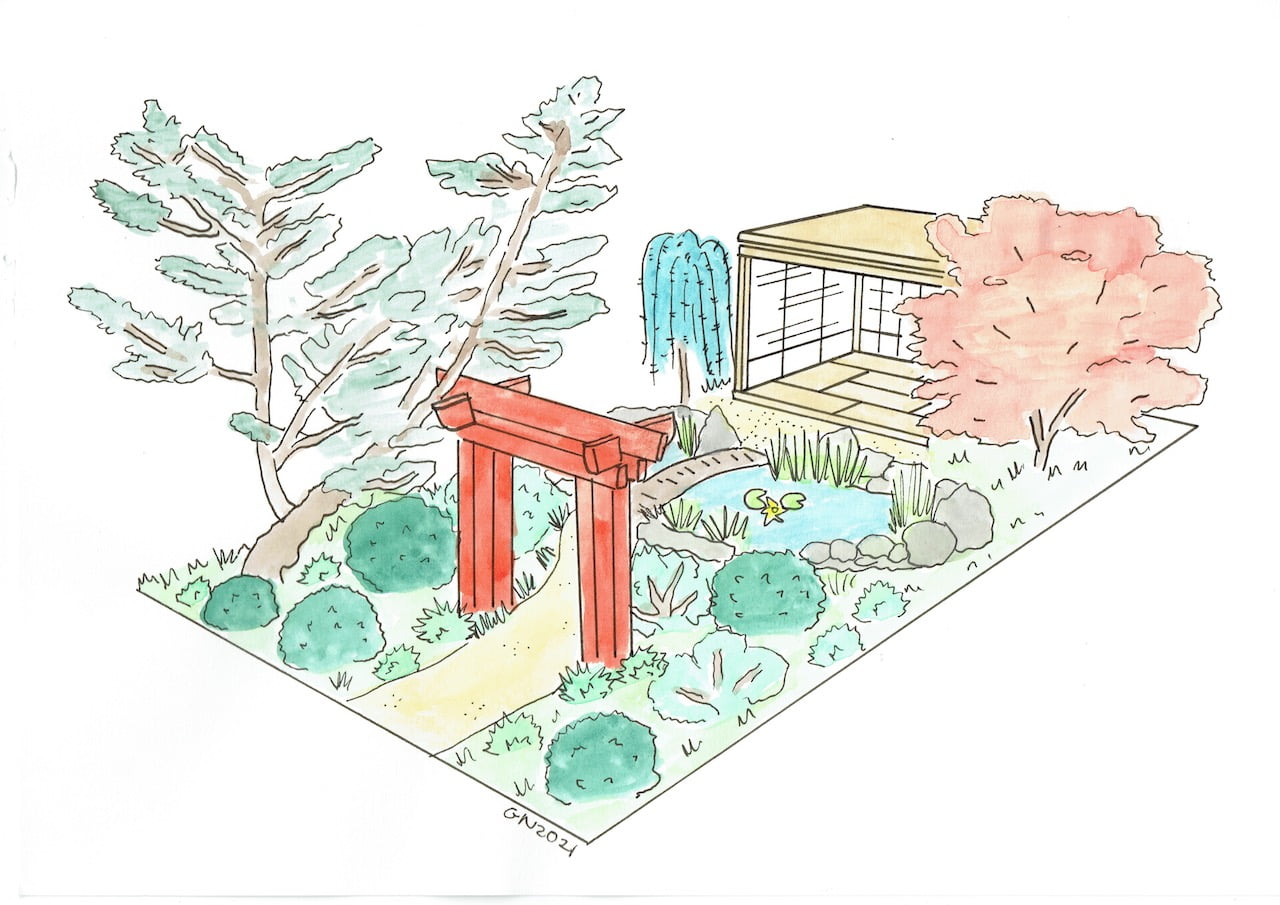
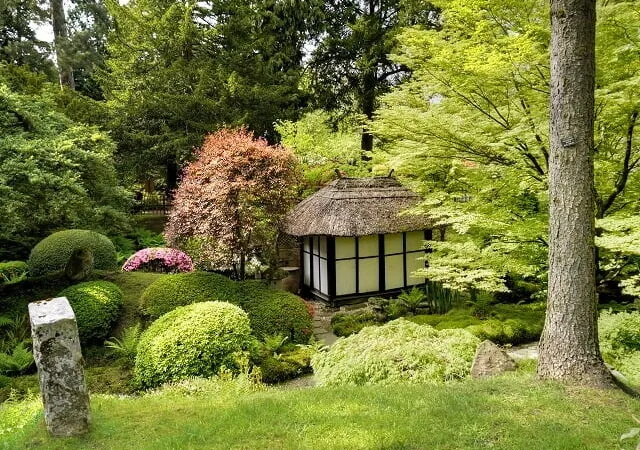
Structures in a Japanese garden occupy a fascinating design position. They are the one element that is deliberately not natural, yet they do not fight the garden. They accentuate it. The tension between a precisely crafted timber structure and the organic, flowing planting around it is part of what gives Japanese gardens their visual dynamism.
The tea room is the traditional destination garden structure in Japanese design. The path leads you through the garden, the composition unfolds as you walk, and the tea room is where the journey ends and the contemplation begins. In a UK garden, a simple timber pavilion, a covered seating area, or even a single bench positioned at the end of a winding path performs the same function. What matters is that the structure gives the garden a destination and a purpose rather than just a pleasant view to look at.
Scale is the critical decision with structures. A pergola or pavilion that dominates the garden eliminates the sense of journey and compression that makes Japanese garden design so powerful. In a very small space, a single stone lantern (toro), a tsukubai (low stone water basin), or a carefully chosen rock formation will do everything a large structure does, with none of the visual weight problems.
Japanese gardens to visit in the UK
Nothing replaces seeing a well-executed Japanese garden in person. Books and photographs communicate the visual composition but not the scale, the sound, the smell of damp moss and bamboo, or the way the proportions of rocks and paths feel when you are moving through them. I would strongly encourage any gardener planning a Japanese-influenced design to spend a day at one of the UK’s established Japanese gardens before they commit to a single stone purchase. The clarity it brings to your own decisions is worth the journey.
Tatton Park, Cheshire
Tatton Park’s Japanese Garden is my local reference point and, I would argue, one of the finest Japanese gardens in the country. Created in 1910 and inspired by the Japan-British Exhibition of that year, it has now matured over more than a century into a genuinely atmospheric Meiji period tea garden. The combination of moss, ferns, azaleas, maples, and pines is managed in a traditional Japanese style, and the enclosed quality of the space, separated from the rest of Tatton’s extensive grounds, gives it an intimacy and calm that is genuinely transportive.
If you are in the North West of England it is an easy day trip. Go in late October for the best acer colour, or in late April when the azaleas are beginning to open. Both visits will give you a completely different but equally rewarding experience of the same space.
Kyoto Garden, Holland Park, London
The Kyoto Garden in Holland Park is a gift from the city of Kyoto to London and it punches well above its weight for what is essentially a public park feature. The waterfall, the koi pond, the stone lanterns, and the well-chosen acer and maple planting give it a genuine sense of Japanese character. It is particularly useful as a reference point for anyone designing a smaller urban garden because the space is not large and yet it feels complete and convincing. Free to enter and open year round.
Compton Acres, Dorset
Compton Acres near Bournemouth contains one of the most complete Japanese gardens in private ownership in the UK, with a tea house, authentic bronze figures imported from Japan in the 1920s, stone lanterns, a pond with koi, and planting that has had a century to mature into something of real authority. It is more theatrical than Tatton and more overtly decorative, but as a study in how individual Japanese garden elements combine into a coherent whole it is extremely instructive.
RHS Chelsea Flower Show
Chelsea regularly features outstanding Japanese garden design, and in 2025 Kazuyuki Ishihara’s tea garden won Best in Show. Ishihara has designed at Chelsea for nearly two decades and his gardens are consistently the finest contemporary Japanese work being shown anywhere in the world outside Japan itself. If you want to see the absolute current state of the art in Japanese garden design, Chelsea in May is the place to see it. I cover the show in detail on this site each year, including the Japanese gardens when they feature.
💡 Top Tip
When visiting any Japanese garden, take photographs of details rather than wide shots. A single rock placement, the junction of a stepping stone path with gravel, the way bamboo is used as screening, the height relationship between a stone lantern and surrounding planting. These close studies are far more useful reference material than the wide-angle compositions that look spectacular on Instagram but are harder to learn from.
How much does a Japanese garden cost?
Japanese garden design has a reputation for being expensive, and at the high end that reputation is justified. A fully executed tsukiyama garden with mature specimen trees, a recirculating pond, imported stone lanterns, and a professional installation will cost tens of thousands of pounds. But this is not the only version of a Japanese garden available to you, and it is important to understand where the money actually goes in this style of design so you can make intelligent decisions about where to invest and where to save.
The good news is that the most powerful Japanese garden style for small UK gardens, karesansui, is also the most achievable on a limited budget. The materials are inexpensive: a tonne of decorative gravel costs between £50 and £150 depending on type, three well-chosen rocks from a local stone merchant might cost £100 to £300, a Fargesia bamboo is around £30 to £50, and a raking tool is £20 to £40. A complete small courtyard karesansui garden, perhaps 4 x 4 metres, is achievable for £400 to £800 in materials if you do the work yourself.
Earthworks, pond lining, mature trees, professional labour
The single biggest cost driver in any Japanese garden is mature planting. A 40-litre specimen acer in a striking form might cost £150 to £300, and you will almost certainly want at least one if not two. A large established Fargesia bamboo for immediate screening can cost £80 to £150. Stone lanterns range from £80 for a simple cast resin version to several hundred pounds for a genuine carved granite piece. The quality difference between a resin lantern and a stone one is immediately obvious, and in a style that prizes authenticity above all else, the stone version will always look more appropriate.
My honest advice is to invest in one excellent specimen plant and one high-quality stone feature before spending money on anything else. A single outstanding acer in a glazed pot, a well-chosen rock, and carefully raked gravel already constitute a Japanese garden. Everything else is refinement. The Japanese garden principle of restraint is not just an aesthetic philosophy. It is also a very practical approach to budget management.
💡 Top Tip
Buy stone lanterns from a stone merchant or specialist Japanese garden supplier rather than a general garden centre. The difference in material quality and proportion is significant. A badly proportioned lantern is worse than no lantern at all in a Japanese garden, because it draws the eye to an error rather than a carefully considered composition.
If you would like professional guidance on designing your own Japanese garden, I offer online garden design consultations where we can work through your specific space, budget, and ambitions. You can find full details on my garden design services page, and my garden design courses cover the principles of spatial design that underpin Japanese garden composition alongside other styles.
After years of designing Japanese-influenced gardens, visiting the great originals in Japan, and reviewing countless DIY attempts through my work on BBC’s Garden Rescue, the same mistakes come up time and again.
⚠ Mistake 1: Too many focal points
A stone lantern, a Buddha head, a water feature, a bonsai display, and a pergola in a small garden create chaos rather than calm. Choose one focal point and let the planting and structure support it. Everything else should recede.
⚠ Mistake 2: Running bamboo without root barriers
Running bamboo planted without a physical barrier will colonise your garden and your neighbours’ within three to five years. Once established, it is extremely difficult to remove. Always install a solid root barrier to 60cm depth before planting any Phyllostachys species.
⚠ Mistake 3: Bright, clashing colours
A Japanese garden in which every border is planted with red, orange, and yellow bedding plants is a contradiction. The colour palette should be restrained: green in all its variations as the primary note, with white, pale pink, and soft mauve as seasonal accents only.
⚠ Mistake 4: Straight lines and rectangular forms
Square raised beds, rectangular ponds, and straight path edges all read as Western design conventions transplanted into the wrong context. Japanese gardens use curves, asymmetry, and organic forms throughout. If you have existing straight borders, consider edging them with curved stone to soften the geometry.
⚠ Mistake 5: Neglecting maintenance
A Japanese garden requires more maintenance than almost any other style, not less. Cloud-pruned specimens need twice-yearly clipping. Raked gravel needs re-raking after rain and wind. Moss needs moisture management. The minimalist appearance is achieved through constant, precise attention. Budget time for this before committing to the style.
Your subscription could not be saved. Please try again.
Your subscription has been successful.
10. Frequently asked questions
What is the best size garden for a Japanese design?
Japanese design scales beautifully to any size. Some of the most powerful Japanese gardens in existence are tiny. A single raked gravel courtyard with two or three rocks and a clipped pine is a complete composition. Larger gardens allow more complexity and a longer journey through the space, but they require correspondingly more plant material and more maintenance. The principles apply equally whether you have two square metres or two hundred.
Do I need a pond for a Japanese garden?
Not at all. Water can be symbolised very effectively with raked gravel or carefully placed pebbles. Many of the most celebrated Japanese gardens in Kyoto, including the famous garden at Ryoanji, have no water whatsoever. A dry garden (karesansui) that uses gravel and rock to represent water can be more powerful and is considerably less maintenance than a pond. If you do want water, a small bamboo deer scarer or a simple stone basin is more in keeping with the style than a large formal pond.
Can I grow a Japanese garden on clay soil?
Yes, with some amendment. Many Japanese garden plants including acers, bamboo, fatsia, and miscanthus grow well on clay. For acid-loving plants like camellias, pieris, and azaleas, raised beds with ericaceous compost give better results on clay. The biggest risk on clay is waterlogging, which acers particularly dislike, so improving drainage with grit and organic matter before planting pays dividends.
How do I achieve the cloud-pruning look without professional help?
Start with a plant that has good natural branch structure, including osmanthus, box, and yew are all forgiving subjects for beginners. Remove all internal growth to expose the main branch framework, then clip the outer growth into rounded, hemisphere shapes. Work slowly and step back regularly to assess the overall form. The aim is a loose, naturalistic dome rather than a geometric sphere. Do this twice yearly and the forms will improve with each clipping as the plant fills out more densely.
Why not start shaping a garden that truly works for you? Level up your skills with one of my online gardening courses!
My Garden Design for Beginners course is the perfect next step. Whether you’re completely new to garden design or just need a more structured approach, this affordable online course guides you through the full process from blank canvas to brilliant layout.
I’m Lee Burkhill, award-winning garden designer and presenter on BBC1’s Garden Rescue, and I’ve packed this course with practical advice, insider tips, and easy-to-follow steps to help you design a garden that works in harmony with nature, and keeps ground elder firmly in its place!
Enrol now for just £199 and start your journey toward garden design mastery!
29
Garden Design Examples for Small Gardens: 30 Design Templates & Planting Plans
Garden Design Examples for Small Gardens: 30 Design Templates & Planting Plans: In this online gardening course, I’ll walk you through 30 fantastic garden designs, explaining the logic behind the layout, the plant choices, and take-home tips for applying them in your own garden.
Weekend Garden Makeover: A Crash Course in Design for Beginners
Learn how to transform and design your own garden with Lee Burkhills crash course in garden design. Over 5 hours Lee will teach you how to design your own dream garden. Featuring practical design examples, planting ideas and video guides. Learn how to design your garden in one weekend!
Garden Design for Beginners: Create Your Dream Garden in Just 4 Weeks
Garden Design for Beginners Online Course: If you want to make the career jump to becoming a garden designer or to learn how to design your own garden, this is the beginner course for you. Join me, Lee Burkhill, an award-winning garden designer, as I train you in the art of beautiful garden design.
A successful Japanese garden comes down to three principles applied consistently: every element must earn its place through meaning or function, the palette should be built on green with restrained seasonal colour accents, and maintenance must match ambition. Start with the right structural plants, including an acer, clipped osmanthus or azalea, some bamboo, and Japanese forest grass, and build from there. Japanese tools, particularly the hori hori, okatsune secateurs, and folding pruning saw, will make the ongoing maintenance both more effective and more enjoyable.
Your subscription could not be saved. Please try again.
Your subscription has been successful.
Lee Burkhill
Lee Burkhill, known as the Garden Ninja, is an award-winning garden designer and horticulturist with over 20 years of professional garden design experience. A qualified RHS professional, Lee has designed numerous Japanese-inspired gardens and has travelled extensively in Japan studying the great garden traditions of Kyoto, Osaka, Tokyo, and Hakone. He designs and presents on BBC1’s Garden Rescue and in leading gardening publications.
Wow what an amazing share! I was searching the internet for Japanese Garden ideas in the early hours of the morning and stumbled upon your post. Absolutely love the water feature and tea room. I will definitely take those elements with me.

























Wow what an amazing share! I was searching the internet for Japanese Garden ideas in the early hours of the morning and stumbled upon your post. Absolutely love the water feature and tea room. I will definitely take those elements with me.