For the garden you’ve already got, not the one you’re starting from scratch. Seven checklists and video lessons from BBC Garden Rescue’s Lee Burkhill, built to help you work out what’s worth keeping before you spend a penny.
69


Quick Answer
Himalayan balsam grows 1.5 to 2.5 metres tall with hollow, reddish, translucent looking stems and distinctive pink to purple, helmet shaped flowers from June to October. It is not illegal to have it on your land, but it is an offence to let it spread into the wild, and its seed pods explode on contact, flinging seeds several metres and making early removal, before the pods form, the most pressing task. Unlike Japanese knotweed, it is an annual with shallow roots, so hand pulling is properly effective if you catch it in time.
This is the last of the four problem plants in this series, and in some ways the gentlest of the bunch. Himalayan balsam will not burn you the way giant hogweed can, and it will not threaten your mortgage the way Japanese knotweed might. But it spreads faster than almost anything else on this list, and it has a properly interesting complication that the other three do not: it is also one of the best late-season food sources honeybees get all year.

I want to deal with both sides of that honestly in this guide: the ecological problem it causes and the real benefit it offers pollinators, rather than pretending it is simply good or simply bad. Yes, this is a very problematic plant, especially if you find it in your garden and then let it prolifically self-seed into neighbours’ gardens, but unlike other weeds, it offers wildlife some fabulous late-season forage!
Jump To
Himalayan balsam, Impatiens glandulifera, is a member of the touch-me-not family, Balsaminaceae, native to the western Himalayas. It arrived in Britain in 1839 as an ornamental garden plant, valued at the time for its tall, exotic-looking flowers, a way for ordinary Victorian gardeners to grow something with a whiff of the exotic orchid houses only the wealthy could otherwise afford. Just like Japanese Knotweed, the Victorians loved their plants but often didn’t consider the invasive nature of their imported finds!
It escaped cultivation soon after and has been spreading along British rivers and waterways ever since, helped enormously by how efficiently it disperses its own seed; hence the Latin impatiens, which means ‘impatient ‘, and thats key to the seed dispersal!

Unlike Japanese knotweed or giant hogweed, this is an annual plant. It germinates from seed each spring, grows fast through the summer, flowers, sets seed, and is killed off completely by the first proper frost, leaving no perennial root system behind to regrow from the following year. Which means tackling it is about stopping it self-seeding if you find it growing in your garden, which I will come back to in the removal section.
The touch me not family name itself is worth a mention, since it comes from the same explosive seed dispersal mechanism described above, a characteristic shared across the wider Impatiens genus, which also includes the common bedding busy lizzie sold in every garden centre. Busy lizzie shares the family trait of a ripe seed pod that pops at the slightest touch, just at a much smaller, entirely harmless domestic scale, so if you have ever grown one and been surprised by seeds scattering across a windowsill, you have already met a tame, well-behaved relative of the plant this guide is about.
The stems are hollow, smooth, and have a distinctive reddish or pinkish tinge, often described as almost translucent or succulent looking, quite different from the tough, woody stem of most garden weeds. They are brittle and snap easily, and can reach 1.5 to 2.5 metres in good conditions, occasionally taller still along a particularly fertile riverbank.

The leaves are lance shaped with distinctly serrated, toothed edges, arranged in whorls of three or in opposite pairs up the stem, and have a slightly glossy, dark green appearance.
The flowers are the real giveaway, and once you have seen one you will not mistake this plant for anything else growing wild in Britain. They are distinctly helmet or slipper shaped, pink to purple, occasionally paler or almost white, and hang in loose clusters from the upper stem from June right through to the first frosts in October. This shape is exactly where two of the plant’s older common names come from, policeman’s helmet and poor man’s orchid, both a fair description of what you are looking at.
The seed pods are worth knowing specifically, since they explain most of the plant’s reputation. Once fertilised, each flower produces a swollen, torpedo shaped seed pod that becomes tightly sprung under tension as it ripens. The lightest touch, a hand, a passing animal, even a strong breath of wind, triggers the pod to burst open explosively, flinging up to several hundred seeds as far as seven metres away. A single plant can produce up to 800 seeds this way, which is the entire reason timing matters so much if you are removing it, more on that below.

Once flowering, Himalayan balsam is hard to mistake for anything else growing wild in Britain; no other common riverside plant has that same distinctive helmet-shaped flower. Earlier in the year, before flowers appear, young plants are sometimes confused with rosebay willowherb, which also grows tall and favours similar waste ground and riverside habitats, but willowherb has narrow, willow like leaves and produces upright spikes of simple, four petalled pink flowers rather than balsam’s hanging, helmet shaped ones, and its stems are solid rather than balsam’s hollow, brittle, reddish ones.
The ecological case against Himalayan balsam is straightforward. It grows fast and tall enough to shade out native riverbank plants entirely, forming dense, single species stands that crowd out everything from wildflowers to tree seedlings along a watercourse. Because it is an annual that dies back completely over winter, it leaves riverbanks bare and unprotected through the wet winter months, right when erosion risk is highest, in a way a permanent native plant community would not. I think of it as a thug who does the dirty on you then leaves in the middle of the night.
Its seed dispersal method makes it particularly hard to contain once established. Those exploding pods send seed several metres in every direction on their own, and because the plant thrives beside water, any seed that lands in the river itself can be carried far further downstream, establishing entirely new colonies well beyond where the original stand was ever noticed.
This is why balsam control tends to work best as a coordinated, catchment-wide effort; upstream landowners clearing it does little good if nobody downstream is doing the same. It makes me shiver when I see kids popping the seed pods when I walk my dogs, knowing that they and others are inadvertently spreading this plant!

The erosion point is worth unpacking a little further, since it is easy to underestimate. A healthy native riverbank is usually held together by a mix of perennial grasses, sedges and shrubs whose root systems persist through the winter, physically binding the soil together even when nothing is actively growing above ground.
Himalayan balsam offers none of that once it dies back, leaving loose, bare soil exposed through exactly the months when rainfall and river levels are at their highest. Over several years, a balsam-dominated stretch of bank can visibly slump and erode faster than a comparable stretch with intact native vegetation, which is part of why river trusts treat it as more than a simple aesthetic nuisance.
I am a garden designer rather than a solicitor, so treat this as a general explanation of the legal position rather than advice on your specific situation.
Simply having Himalayan balsam growing on your land is not, on its own, a criminal offence. It is listed on Schedule 9 of the Wildlife and Countryside Act 1981, and the actual offence under Section 14 of that Act is planting it or otherwise causing it to grow in the wild. It is also banned from sale in the UK, so you will not find it offered by a legitimate nursery or garden centre.
What you do carry is a responsibility to prevent it spreading from your land into the wild or onto a neighbour’s property, which given how the seed pods work is worth taking seriously rather than treating as a formality. In practice this means removing flowering plants before the pods form, or at minimum before they ripen and start bursting, rather than leaving it to do as it pleases. Councils and rivers trusts do organise and encourage reporting and community removal, and RHS and Wildlife Trust advice both consistently recommend control even though it is not strictly compulsory on private land the way it can become with giant hogweed under a formal notice.
Here is where I want to put my own beekeeping hat on rather than just my garden designer one, because this is a properly fascinating bit of natural history that most people writing about this plant never mention.
Every late summer, I get honeybees returning to my own hives looking like they have been rolled in flour, a distinct, chalky white dusting across the back and thorax that is completely different from the normal yellow, orange or grey pollen they usually bring home. This is such a well-known, distinctive sight among beekeepers that it has its own name, ghost bees, and if you keep bees anywhere near a river or canal in August or September, you will almost certainly see it too.
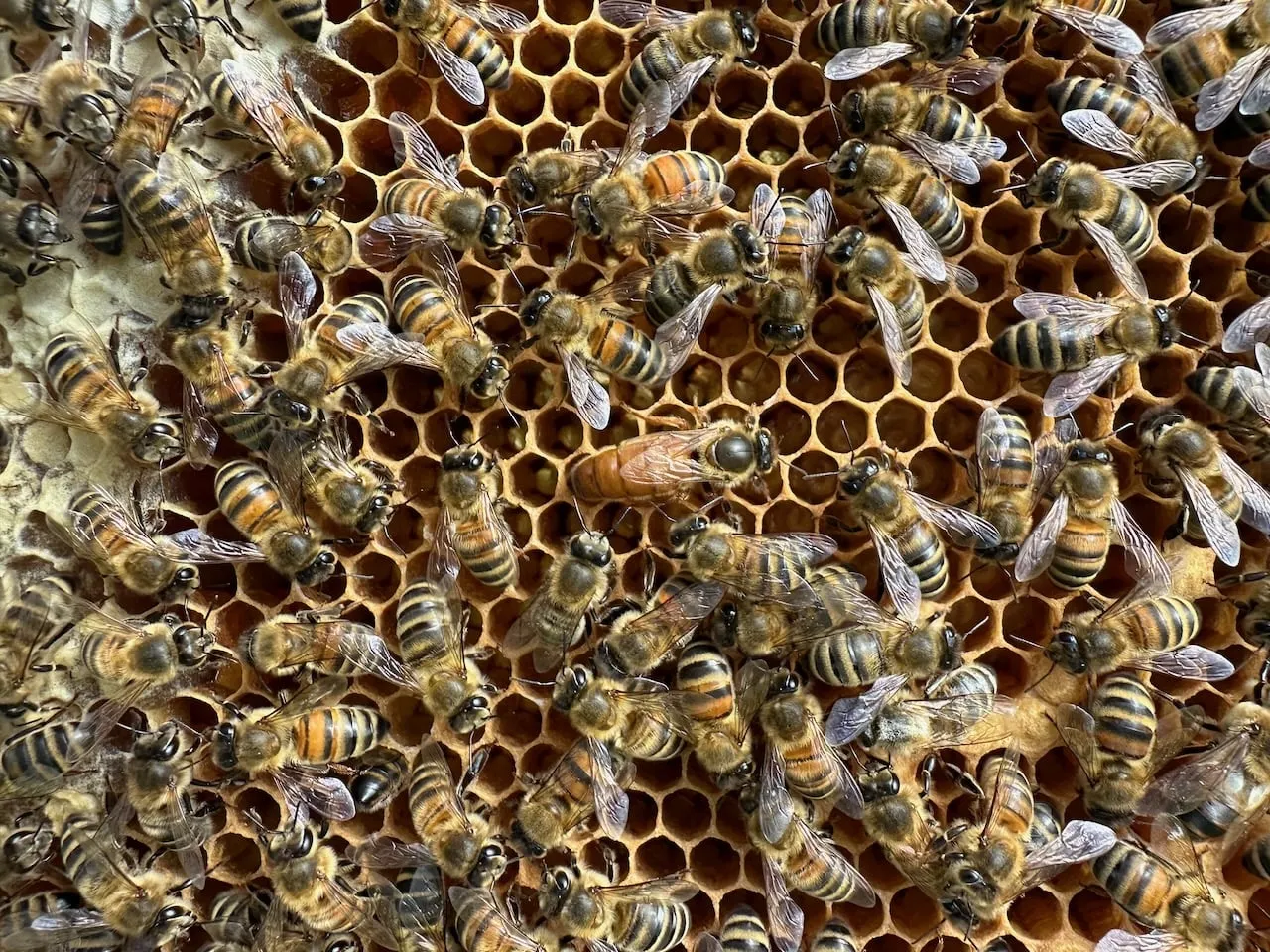
The cause is Himalayan balsam. Its flowers are large enough that a honeybee disappears almost entirely inside one to reach the nectar at the back, and in doing so gets thoroughly dusted in the plant’s pale, near white pollen from the anthers positioned right in the flower’s roof. Bees can groom most parts of their body clean, but the one spot they truly cannot reach themselves is the top of the thorax, right behind the head, so that patch stays coated white long after everywhere else has been cleaned off, and that is the tell tale mark you spot on a returning forager.
What makes this more than a curiosity is the timing. Himalayan balsam flowers from June through to the first frosts, but its real value to bees comes late in the season, August and September, exactly the point in the year when most other nectar sources have already finished and when a colony most needs to be building up stores for winter.

Research from the National Botanic Garden of Wales, using honey samples to track changes in the UK’s floral landscape, found balsam pollen in a meaningful share of samples despite most sampling happening earlier in summer before balsam has properly got going, which strongly suggests its real contribution to UK honey production is even larger than the numbers alone capture. Some beekeepers even sell a single origin Himalayan balsam honey, pale, sweet and fragrant, when they have hives positioned near a large enough stand, a properly lovely product to come from a plant with such a troubled ecological reputation.
⚠ This Is Not an Argument for Planting It
I want to be completely clear about this, given everything above. You should never plant Himalayan balsam, in a garden, a pond margin, or anywhere else, and doing so is exactly the offence the law described earlier exists to prevent. The pollinator value does not cancel out the ecological harm it causes to native riverbank plant communities, and the two facts sit alongside each other rather than resolving into a simple verdict either way.
Where I land on this, for what it is worth, is common sense rather than a hard rule. If Himalayan balsam is already established along a river or canal near you, land you do not own or control, and realistically is not going anywhere in the short term regardless of what any individual gardener does, there is no need to feel conflicted about your own bees making good use of it while it is there. That is simply bees doing what bees do with whatever late-season forage exists in the landscape around them, not an endorsement of the plant’s presence.
What actually matters is that you are never the reason it exists somewhere it did not before, never planting it, never moving cut material carelessly, never letting a patch on your own land go to seed unchecked. If you are curious about keeping bees yourself and want to understand more about what they forage on through the year, my beginner’s guide to keeping bees is a good place to start, and I have also written about how fruit trees can help support bees in a garden setting if you want a properly plantable alternative that helps pollinators without any of the legal or ecological complications this one carries.
The good news, relative to the other three plants in this series, is that Himalayan balsam is properly the easiest to control if you catch it at the right time, precisely because it is a shallow-rooted annual rather than something with an established perennial rhizome to exhaust.
Hand pulling is the standard approach and works well, since the whole plant, roots and all, tends to come free easily from damp riverside soil. The critical detail is timing: pull after the plant has flowered but before the seed pods have formed and ripened, broadly late June to mid July, though this shifts a little depending on the season and your local climate.
Pull too early and you will spend the whole summer chasing regrowth from seed already in the soil bank; pull too late, once the pods are set and springy to the touch, and the act of pulling itself can trigger them to burst and scatter seed exactly where you are standing. If you find yourself outside that window with a stand already in seed, the safer move is often to leave it and plan properly for next year rather than risk spreading it further through a rushed removal.
Strimming or cutting works as an alternative to hand pulling on larger stands, timed the same way, before seed set, and is sometimes more practical across a large riverbank area than pulling everything by hand.
Because it does not persist as a perennial root system, consistent removal before seeding for a few consecutive years can achieve genuine, complete eradication from a site, which is a meaningfully better outcome than you can promise with either knotweed or hogweed. The seed bank in the soil is the only thing you are working against at that point, and balsam seed does not remain viable anywhere near as long as knotweed rhizome does, so a few disciplined seasons of catching it before it flowers can finish the job properly.
This is also the invasive species most commonly tackled through organised community “balsam bashing” events, run by rivers trusts, wildlife trusts and local conservation groups, since a large stand along a shared stretch of riverbank is truly a job better done as a coordinated group than by one landowner working alone. Worth checking whether your local rivers trust or wildlife trust runs one if you have a significant stand nearby rather than only ever tackling your own small patch in isolation, and a good way to meet other people just as fed up with the same stretch of riverbank as you are.
Himalayan balsam is classed as controlled waste in the same way Japanese knotweed and giant hogweed are, so the same restrictions apply. Pulled or cut material should not go in your council green waste bin, general household waste, or home compost heap, and should not be taken to a standard household recycling centre.
In practice, for a small domestic amount, the most common approach is to leave pulled plants on site in a pile well away from water, on ground where they cannot re-root, since balsam is fairly quick to dry out and break down once removed from damp soil and does not resprout from a cut stem the way some perennial weeds can. For anything larger, or anywhere near a watercourse where dumped material could wash back in, arranging collection by a licensed waste carrier is the properly compliant route, and this is usually included as standard if you are working with a professional invasive species contractor or a coordinated community removal event.
If you spot a stand of Himalayan balsam somewhere that is not your own garden, a riverbank, canal towpath or public park, it is worth reporting rather than assuming someone else already has. Most councils have an online form for exactly this through their environmental services pages, and the Invasive Non-Native Species (INNS) Mapper, run in partnership with wildlife trusts across the country, is a properly useful tool for logging a sighting properly so it feeds into the wider picture of where control efforts are most needed. If the stand is on private land belonging to someone else, letting the landowner know directly is the more appropriate first step, since responsibility for action sits with them rather than the council.
No, simply having it on your land is not an offence. It is listed on Schedule 9 of the Wildlife and Countryside Act 1981, and the offence is planting it or causing it to spread into the wild. It is also banned from sale in the UK.
The pods build up tension as they ripen, and the lightest touch triggers them to burst open, flinging up to several hundred seeds as far as seven metres. This is the plant’s natural dispersal method and the main reason it spreads so aggressively along riverbanks.
Both are true at once. It is a properly valuable late season nectar source for honeybees when little else is flowering, but it is also ecologically damaging to native riverbank plant communities. The pollinator benefit is not a reason to plant it, only a reason not to feel conflicted about bees using it where it is already established.
This is almost certainly Himalayan balsam pollen, known among beekeepers as ghost bees. It collects on the back of the thorax, the one spot a bee cannot groom itself, and is a common late summer sight anywhere near a river or canal where balsam grows.
No, no no! It is classed as controlled waste and cannot go in a home compost heap, council green waste, or general household bin. Small amounts can be left to dry out on site away from water, but anything larger needs disposal through a licensed waste carrier.
Yes, more reliably than either Japanese knotweed or giant hogweed, because it has no persistent perennial root system to work against. A few consecutive years of removing every plant before it sets seed will exhaust the seed bank in the soil and can achieve genuine, complete eradication from a defined site.
Yes, it has a distinctive sweet, slightly musky scent that many people notice before they spot the plant itself, particularly on a warm day near a dense stand. It is not unpleasant, and is part of what makes the nectar so attractive to bees and other pollinators.

Join over 100,000 gardeners on YouTube
Free gardening videos from the Garden Ninja, with 8 million views and counting.
Subscribe on YouTube, it’s freeOne of the best ways to improve your gardening skills as a beginner is to take a garden design or gardening course. You can take many weekend or distance courses from the RHS, local gardening groups, or horticultural colleges to help improve your skills, all of which will help take your gardening to the next level. But what if you do not have the time to attend an in-person course or the funds to commit to gardening?
That is where online gardening courses come in. Online garden courses cost a fraction of the price, can be completed at home in your own time, and often provide far greater value for money when training as a gardener.
I offer a number of gardening and garden design courses to help take your skills to the next level so you can become a fully fledged Garden Ninja.
For the garden you’ve already got, not the one you’re starting from scratch. Seven checklists and video lessons from BBC Garden Rescue’s Lee Burkhill, built to help you work out what’s worth keeping before you spend a penny.
Garden Design Examples for Small Gardens: 30 Design Templates & Planting Plans: In this online gardening course, I’ll walk you through 30 fantastic garden designs, explaining the logic behind the layout, the plant choices, and take-home tips for applying them in your own garden.
Learn how to transform and design your own garden with Lee Burkhills crash course in garden design. Over 5 hours Lee will teach you how to design your own dream garden. Featuring practical design examples, planting ideas and video guides. Learn how to design your garden in one weekend!
Garden Design for Beginners Online Course: If you want to make the career jump to becoming a garden designer or to learn how to design your own garden, this is the beginner course for you. Join me, Lee Burkhill, an award-winning garden designer, as I train you in the art of beautiful garden design.
Himalayan balsam is easy to identify once flowering, with tall, hollow reddish stems and unmistakable pink helmet-shaped flowers, and it is the most manageable of the four plants in this series, since it is a shallow-rooted annual rather than a persistent perennial.
Never plant it, and always remove flowering stands on your own land before the seed pods form. But if you keep bees, or simply enjoy watching them, an established stand nearby in late summer is one of the more interesting quirks of the UK’s invasive plant problem rather than something to feel guilty about, a reminder that even a genuine problem plant can sit in the landscape with more nuance than a simple good or bad label ever quite captures.
If you spot your own bees coming home looking like ghosts this September, now you will know exactly why.
Happy Gardening!


Lee Burkhill, known as the Garden Ninja, is an award winning garden designer and horticulturist with over 30 years of gardening experience and 15 years as a professional garden designer. A qualified RHS professional, Lee specialises in sustainable garden design and practical horticultural advice. He designs and presents on BBC1’s Garden Rescue and in leading gardening publications. Lee combines three decades of hands on gardening knowledge with professional design qualifications to help gardeners create beautiful, functional outdoor spaces.
View all posts by Lee Burkhill



JOIN THE NINJAS

Be the first in line for new Guides, Discount codes and Offers