For the garden you’ve already got, not the one you’re starting from scratch. Seven checklists and video lessons from BBC Garden Rescue’s Lee Burkhill, designed to help you decide what’s worth keeping before you spend a penny.
69


Quick Answer
Ragwort is a UK native wildflower with clusters of small daisy like yellow flowers on stems 30 to 100cm tall. It is not illegal to have it in a garden, but it is listed as an injurious weed under the Weeds Act 1959 because it is toxic to horses and livestock if eaten. In an ordinary garden with no grazing animals nearby, the RHS itself says it is perfectly acceptable, and actively beneficial for wildlife, to leave it be.
Ragwort is one of those plants I get asked about constantly, usually by someone who has just been told by a well-meaning neighbour that it is illegal and has to come out immediately. That is not quite right, and the real picture is more interesting and more reasonable than the panic suggests.

Ragwort is not a dangerous plant to have in an ordinary garden. It is a genuine UK native wildflower, and one of the most valuable single plants you can have for pollinators and moths. The danger it poses is real but specific: it is toxic to horses and grazing livestock, which is exactly why the law treats it differently depending on where it grows rather than banning it outright.
Jump To
Common ragwort, Jacobaea vulgaris (you will also see it under its older name Senecio jacobaea), is a member of the daisy family, Asteraceae, the same broad family as sunflowers, dahlias and marguerites. Unlike Japanese knotweed, this is a genuine British native, found naturally on grassland, sand dunes, verges and wasteland right across the country, and it has been part of the UK flora for a very long time rather than being an introduced problem species.
It follows a biennial life cycle, which is worth knowing since it changes what you are looking at depending on the time of year. In its first year, it forms a low rosette of feathery, deeply cut, dark green leaves close to the ground and does nothing more dramatic than that. In its second year, that rosette sends up a tall flowering stem, and this is the stage almost everyone actually notices, usually from July onward when the flat-topped clusters of small yellow flowers open.
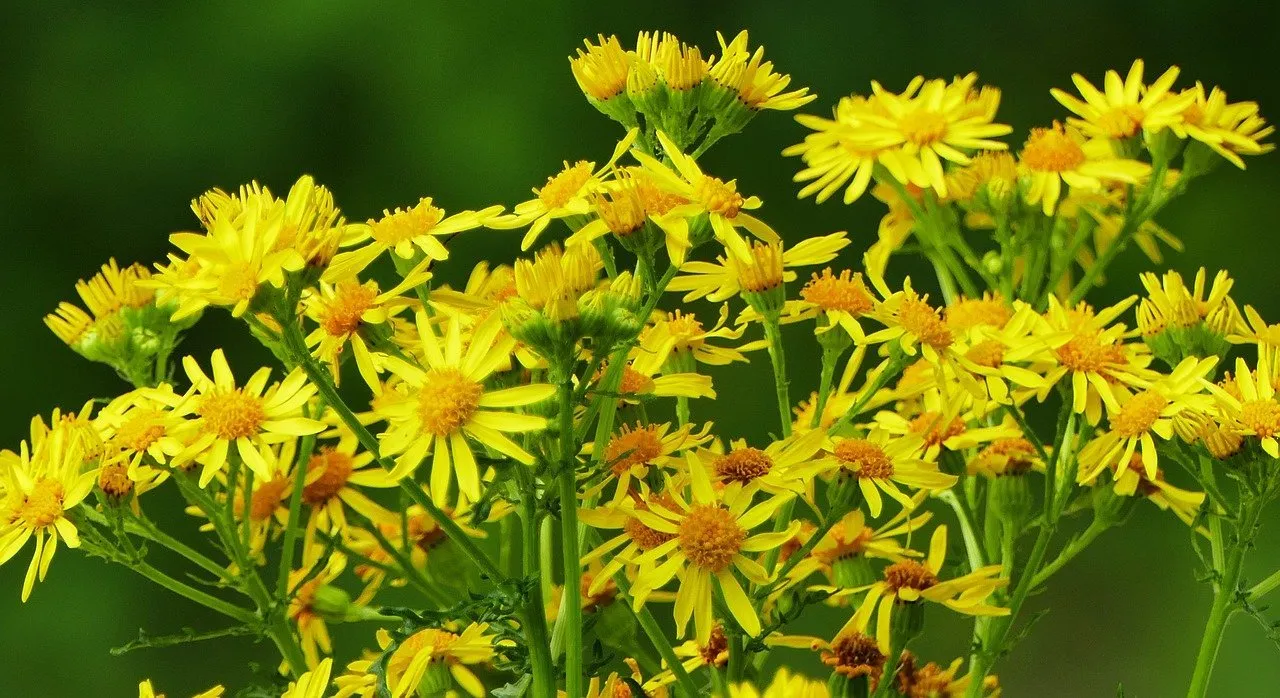
Ragwort is one of the more straightforward UK weeds to identify confidently once you know what to look for at each stage, since it does not have the long list of genuine lookalikes that something like Japanese knotweed carries.
The flowering stem, which is the stage most people ask about, stands between 30cm and a metre tall, upright and often slightly branched toward the top. The leaves along the stem are deeply lobed and ragged-looking, almost torn in appearance, dark green on top and noticeably paler and slightly hairy underneath. This ragged leaf edge is actually where the older country name “stinking willie” and the more polite “ragwort” both come from.
The flowers are the easiest confirmation. They are small, daisy-like, bright yellow, and produced in flat-topped clusters at the top of the stem, typically from July through to October. Each individual flower has a ring of petals, usually thirteen, around a darker yellow centre, giving the whole cluster a cheerful, slightly untidy look rather than the neater symmetry of something like a marigold.

The first year rosette is the stage most people never notice, sitting flat and low to the ground with the same deeply lobed, feathery leaf shape, dark green and slightly glossy. If you are trying to get ahead of ragwort before it flowers, learning to spot this rosette stage is the way to do it, though I would say for most domestic gardens there is little urgency to do so.
Ragwort belongs to a loose group gardeners half-jokingly call the DYCs, the damn yellow composites, a whole tribe of daisy-family wildflowers that all produce small yellow flowers and cause exactly this kind of identification headache. A few are worth knowing apart from ragwort specifically.
Groundsel (Senecio vulgaris) was once lumped together with ragwort under the same genus, but ragwort has since been moved into its own genus, Jacobaea, so the two are best described as relatives within the wider Senecioneae tribe rather than each other’s closest kin. Groundsel still shares the same toxic alkaloids as ragwort, so confusing the two remains something to watch for in practical terms, though groundsel is smaller, rarely past 30cm, with much less showy, almost petal less yellow flower heads that never produce ragwort’s proper daisy display.
Tansy (Tanacetum vulgare) produces flat clusters of small, button like yellow flowers without the surrounding petals ragwort has, and its leaves are finely feathery along the whole stem rather than the more ragged, deeply cut leaf shape of ragwort.
St John’s wort (Hypericum perforatum) has a similar cheerful yellow colouring but the flower shape is entirely different, five separate rounded petals rather than ragwort’s dense daisy head, and the leaves are small, oval and smooth edged rather than lobed.
None of these carry ragwort’s specific legal profile, so the main practical reason to tell them apart is simply satisfying your own curiosity, or reassuring a worried neighbour, rather than any pressing safety concern.
The entire reason ragwort has legislation of its own comes down to one specific fact. Every part of the plant, fresh or dried, contains pyrrolizidine alkaloids, compounds that cause cumulative, irreversible liver damage in horses, cattle and other grazing livestock if eaten in enough quantity over time. There is no effective treatment once poisoning has progressed, which is precisely why prevention through good pasture management is treated so seriously in farming and equestrian circles.
A detail that catches a lot of people out is that ragwort actually becomes more dangerous once it is dead and dried, not less. Growing ragwort tastes bitter, and most animals will naturally avoid it in a field with adequate other grazing available. But once it has been cut, dried, and ended up baled into hay, that bitterness disappears while the toxins remain, so an animal can end up eating a lethal amount without the natural aversion that would normally protect it. This is why cut ragwort near a paddock or a hay meadow is treated as a far more urgent problem than the same plant growing quietly in a border with no animals anywhere near it.

For people rather than animals, ragwort is not something to be alarmed about. It is not the skin hazard that giant hogweed is, and casual contact while gardening poses no meaningful risk. Sensible precautions, gloves when hand-pulling any quantity of it and washing your hands afterwards, are just good general weed handling practice rather than a specific response to any particular danger ragwort poses to a person.
The symptoms of ragwort poisoning in horses build slowly and are easy to miss until the damage is well advanced, since liver function has considerable spare capacity before problems become visible. Early signs include weight loss despite normal appetite, lethargy, and mild jaundice showing as a yellowish tinge to the gums, progressing in advanced cases to photosensitivity, disorientation, and liver failure. Because the damage accumulates from repeated small doses over months or years rather than a single dramatic event, by the time visible symptoms appear the underlying liver damage is usually already severe and irreversible, which is precisely why prevention through good pasture management matters so much more than treatment after the fact.
I am a garden designer rather than a solicitor, so treat the following as a clear general explanation rather than advice on your specific situation, particularly if you are already in a dispute with a neighbour over it.
Simply having ragwort growing in your garden is not illegal. This is where the neighbourly panic usually starts and it is worth being able to say with confidence that it is not accurate. Ragwort is listed under the Weeds Act 1959 as one of five “injurious weeds”, a category that exists to protect agricultural land and grazing animals, not to ban a native wildflower from every garden in the country.
The Ragwort Control Act 2003 built on this by introducing a DEFRA Code of Practice, which sets out when action is actually expected. In practice this comes down to risk and proximity: if ragwort on your land is spreading toward, or already growing on, grazing pasture or land used to produce hay or forage, and it presents a genuine risk to horses or livestock, a landowner can be required to control it, and in the most persistent cases a formal notice can be served under the Weeds Act. If your garden has no such land anywhere near it, this entire enforcement mechanism simply does not apply to you in any practical sense.
The RHS puts this plainly in their own advice, stating that in most ordinary gardens, where there is no risk of it poisoning livestock, leaving ragwort to grow is not just acceptable but actively beneficial for wildlife. That is a properly useful sentence to have to hand the next time someone tells you it has to come out immediately on pain of prosecution.
I will put my own approach on the table here rather than just giving you the general rule, because I think it actually illustrates the decision better than a paragraph of caveats. I leave ragwort standing in my own garden, and I do it deliberately rather than through neglect.
The reasoning is straightforward common sense once you strip away the anxiety the plant tends to generate. As a member of the Asteraceae family, ragwort is an outstanding late season nectar source, flowering at a point in summer when a lot of earlier perennials have already gone over, and I regularly see it covered in hoverflies, bees and a wide range of other pollinators making the most of it. Beyond the general pollinator value, it is the single food plant of the cinnabar moth caterpillar, the striking black and orange striped caterpillars you will spot stripping a ragwort plant back in July and August. Cinnabar moths are entirely reliant on ragwort specifically, not able to simply switch to something else if it disappears, which makes every patch left standing a small, direct contribution to a species that has nowhere else to go.
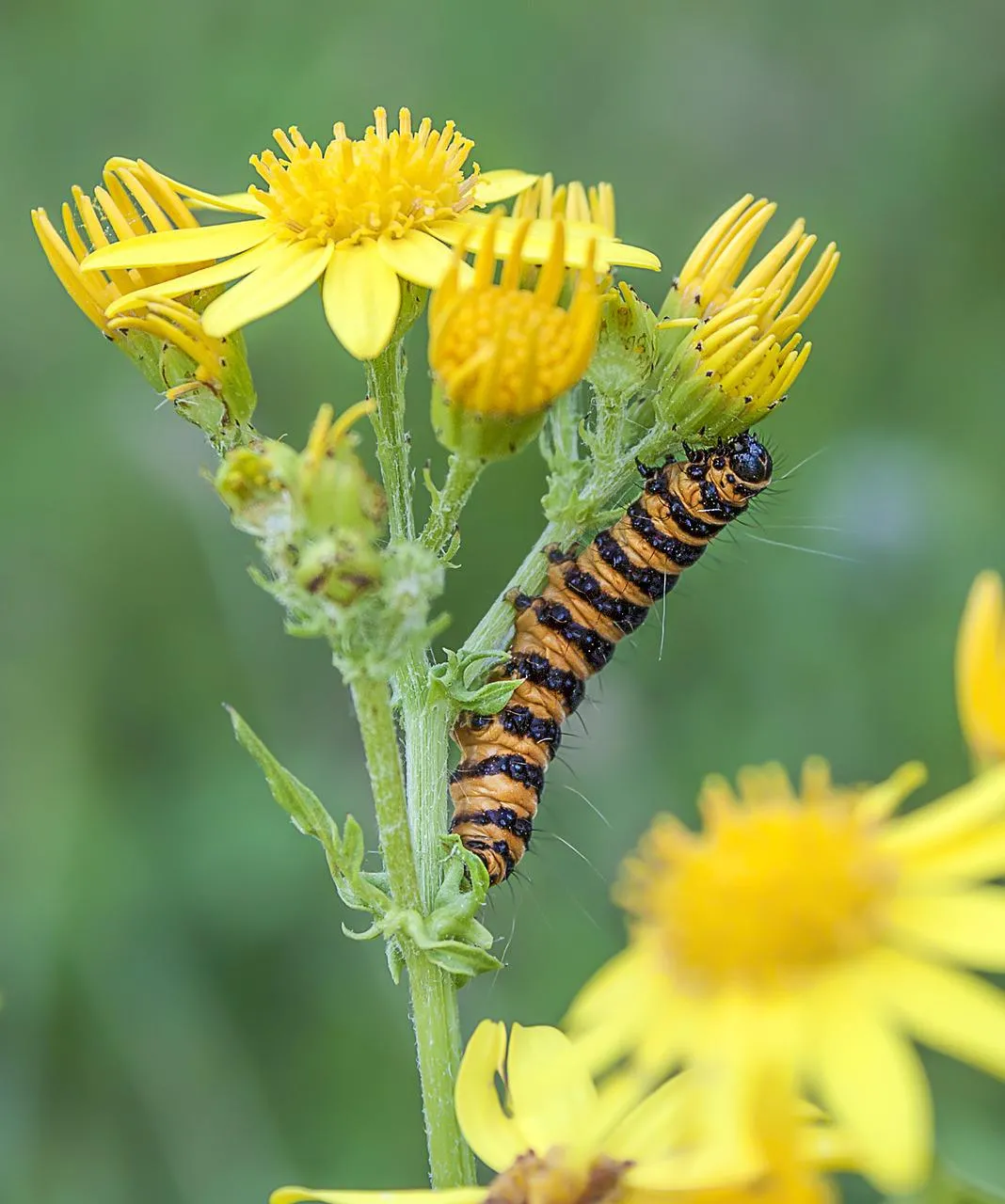
The part of the equation that actually makes this an easy decision rather than a difficult trade off is that I have no horses or grazing livestock anywhere near my garden, and no neighbouring paddock, hay meadow or forage land it could ever spread toward. That single fact is the whole basis of the legal position covered above, and it applies just as directly to the practical, common sense version of the decision. The danger ragwort poses is entirely conditional on proximity to grazing animals, and where that condition truly does not exist, keeping it is not a risk being taken, it is simply a wildflower being allowed to do what it does best.
I would make a different call in a heartbeat if my garden bordered a paddock, and I would encourage anyone in that position to read the section below on managing it near grazing land rather than following my example blindly. But for the ordinary suburban or urban garden with no animals anywhere near it, I think ragwort gets a rougher reputation than it deserves, and I would rather make the case for leaving it than simply repeat the received wisdom that it always has to go.
Worth a mention from the design side of what I do, since it is relevant to more than just the accidental patch of ragwort that turns up uninvited. When I am putting together a wildflower meadow or a naturalistic pollinator planting scheme for a client, and the site truly has no grazing animals anywhere near it, ragwort is sometimes a plant I am happy to let establish itself as part of the wider mix rather than something to weed out on sight.

It earns its place through exactly the qualities covered above, a long, useful flowering season running well into autumn when many other meadow plants have finished, real nectar value for a wide range of pollinating insects, and its role as the sole food source for the cinnabar moth. A meadow with a scattering of ragwort through it tends to show noticeably more insect activity than one without, which for a client specifically asking for a wildlife-friendly scheme is exactly the outcome we are aiming for.
The professional judgement call is always the same one covered throughout this guide: site context first. On a client project bordering agricultural land, equestrian facilities, or anywhere hay is cut and stored, I take a completely different position and manage it entirely outside the scheme. Good planting design is never a fixed rulebook applied identically everywhere; it is a set of principles applied properly to the actual site in front of you, and ragwort is as good an example of that as any plant I work with.
If you have decided removal is the right call for your situation, whether that is proximity to grazing land, a family member with an allergy concern, or simply personal preference, here is how to do it properly.
Hand pulling is the most common approach for a manageable number of plants and works best when the soil is damp, since the whole taproot needs to come out rather than snapping off at the base, or it will simply regrow. Wear gloves as standard good practice, and pull before the flowers set seed wherever possible, ideally at the rosette or early flowering stage rather than once it has gone to seed and started spreading itself further.
Digging with a fork to loosen the taproot before pulling is more reliable than pulling alone on established plants, particularly in heavier clay soils where the root can snap.
Herbicide treatment using a standard glyphosate based product is effective on larger infestations where hand pulling is impractical, best applied while the plant is actively growing in the rosette stage rather than once it has bolted up to flower.
Whichever method you use, timing before seed set is the detail that actually matters most for keeping on top of it long term, since a single mature plant can produce a surprisingly large number of wind dispersed seeds if left to flower and set seed fully.
Topping or mowing repeatedly through the season is a lower effort option worth knowing about for larger areas where hand pulling every plant is impractical, cutting the flowering stems back before they open stops seed production even if it does not kill the plant outright. It needs repeating as regrowth appears, and it will not eradicate an established infestation on its own, but as a holding measure to prevent spread while you plan a more thorough approach, it is properly useful on rough grazing margins or larger wildflower areas that need managing rather than fully cleared.
Ragwort is not classed as controlled waste the way Japanese knotweed is, so the disposal rules are considerably more relaxed. Pulled ragwort can go into your council green waste collection or a well managed hot compost heap in an ordinary garden setting.
💡 Top Tip
The one rule that actually matters is never leaving pulled or cut ragwort anywhere it could end up accessible to grazing animals or mixed into hay or forage, since dried ragwort is more dangerous to livestock than the growing plant. If you are anywhere near a paddock or grazing field, bag it and remove it from site entirely rather than leaving it in a pile to dry out nearby.
This is the situation where I would actively encourage control rather than the live and let live approach I take in my own garden. If your boundary sits next to a horse paddock, a livestock field, or land used to cut hay, ragwort growing near that boundary is a genuine risk to someone else’s animals, not a neutral wildlife choice.
The sensible approach is to control any ragwort within a reasonable distance of the shared boundary, remove flowering plants before they can set seed and drift onto the neighbouring land, and have a conversation with whoever manages that grazing land if you are unsure how much of a buffer they would like to see maintained. Most horse owners and farmers will be properly grateful for a neighbour who takes this seriously without needing to be asked twice, and it heads off exactly the kind of dispute that occasionally ends up in the local paper.
No. Simply having ragwort growing on your land is not illegal. It is listed as an injurious weed under the Weeds Act 1959, and control can be required if it presents a genuine risk to grazing animals or forage land nearby, but an ordinary garden with no such land near it carries no legal obligation to remove it.
Casual contact while gardening poses no meaningful risk to people. The danger is from ingestion, specifically by horses and livestock, not from skin contact during normal handling. Gloves are sensible good practice rather than a response to a genuine skin hazard.
Fresh, growing ragwort tastes bitter, and most animals naturally avoid it if other grazing is available. Once cut and dried, that bitterness disappears while the toxic alkaloids remain, so an animal can eat a dangerous amount, particularly if it ends up baled into hay, without the natural aversion that would normally protect it.
Not necessarily. The RHS itself advises that in gardens with no risk of it poisoning livestock, leaving ragwort to grow is acceptable and beneficial for pollinators and the cinnabar moth specifically. It is a personal choice at that point rather than a legal or safety requirement.
The cinnabar moth caterpillar, black and orange striped and highly visible from July to August, feeds exclusively on ragwort and relies on it as its only food plant. The flowers themselves are also a valuable late season nectar source for bees, hoverflies and a wide range of other pollinators.
Yes, primarily by wind dispersed seed once flowers have gone over, which is why timing removal before seed set matters if you are anywhere near grazing or forage land. This is also the specific scenario the Weeds Act 1959 enforcement mechanism exists to address.
Cutting alone will not spread it the way disturbing Japanese knotweed rhizome does, since ragwort does not regenerate from stem fragments in the same way. However, cut material left lying near grazing animals becomes more dangerous once dried, so cutting without proper removal of the material afterwards can create a worse hazard than leaving the plant standing.
In Summary
Ragwort is a UK native wildflower, not an illegal or invasive plant, and the risk it carries is specific to horses and grazing livestock rather than gardeners or bystanders. If your garden has no grazing land anywhere near it, leaving it be actively helps pollinators and gives the cinnabar moth somewhere to live. If you do border a paddock or hay meadow, control it properly, before it seeds, and dispose of it well away from anywhere it could end up in feed.

Join over 100,000 gardeners on YouTube
Free gardening videos from the Garden Ninja, with 8 million views and counting.
Subscribe on YouTube, it’s freeOne of the best ways to improve your gardening skills as a beginner is to take a garden design or gardening course. You can take many weekend or distance courses from the RHS, local gardening groups, or horticultural colleges to help improve your skills, all of which will help take your gardening to the next level. But what if you do not have the time to attend an in-person course or the funds to commit to gardening?
That is where online gardening courses come in. Online garden courses cost a fraction of the price, can be completed at home in your own time, and often provide far greater value for money when training as a gardener.
I offer a number of gardening and garden design courses to help take your skills to the next level so you can become a fully fledged Garden Ninja.
For the garden you’ve already got, not the one you’re starting from scratch. Seven checklists and video lessons from BBC Garden Rescue’s Lee Burkhill, designed to help you decide what’s worth keeping before you spend a penny.
Garden Design Examples for Small Gardens: 30 Design Templates & Planting Plans: In this online gardening course, I’ll walk you through 30 fantastic garden designs, explaining the logic behind the layout and plant choices, plus take-home tips for applying them in your own garden.
Learn how to transform and design your garden with Lee Burkhill’s crash course in garden design. In over 5 hours, Lee will teach you how to design your dream garden. Featuring practical design examples, planting ideas and video guides. Learn how to design your garden in one weekend!
Garden Design for Beginners Online Course: Want to become a garden designer or design your own garden? This beginner course is for you. Join me, Lee Burkhill, an award-winning garden designer, as I train you in the art of beautiful garden design. Enjoy 20 hours of online study and video lessons, along with quizzes and a completion certificate.
Ragwort is a UK native wildflower, not an illegal or invasive plant, and the risk it carries is specific to horses and grazing livestock rather than gardeners or bystanders. If your garden has no grazing land anywhere near it, leaving it be actively helps pollinators and gives the cinnabar moth somewhere to live. If you do border a paddock or hay meadow, control it properly, before it seeds, and dispose of it well away from anywhere it could end up in feed.
Happy gardening, and if ragwort has turned up in your own garden, I hope this has replaced a bit of the panic with an actual, sensible decision you can feel confident about either way.


Lee Burkhill, known as the Garden Ninja, is an award winning garden designer and horticulturist with over 30 years of gardening experience and 15 years as a professional garden designer. A qualified RHS professional, Lee specialises in sustainable garden design and practical horticultural advice. He designs and presents on BBC1’s Garden Rescue and in leading gardening publications. Lee combines three decades of hands on gardening knowledge with professional design qualifications to help gardeners create beautiful, functional outdoor spaces.
View all posts by Lee Burkhill






JOIN THE NINJAS
Be the first in line for new Guides, Discount codes and Offers