How to Grow Star Jasmine UK: Planting, Care and the Best Varieties
Lee Burkhill: Award Winning Designer & BBC 1's Garden Rescue Presenters Official Blog
Beginner level
Star Jasmine is one of the most popular evergreen climbers here in the UK. Its exotic appearance when in flower and long leather-like evergreen leaves bring a touch of the Mediterranean or even Asian inspired garden styles to our less tropical UK climate. This guide shows you how to grow star jasmine here in the UK and what to watch out for, so it flowers and stays healthy!
Quick Answer
Star jasmine (Trachelospermum jasminoides) thrives in a warm, sheltered position with full sun or light shade and fertile, free-draining soil. Plant against a south or west-facing wall with a trellis or wires for support. Water regularly and feed monthly through summer. Prune after flowering in August to September. Hardy throughout most of the UK once established, though it benefits from protection in colder northern gardens.
Climbing plants like Star Jasmine enable us gardeners to lift our planting out of the flower beds and start to grow vertically, making the best use of our spaces and increasing the amount of greenery in our gardens, no matter how small. Star Jasmine is a very popular and easy-to-grow evergreen climber, meaning fence panels, ugly walls, or the side of that lacklustre garden shed can all be disguised year-round with something green, beautiful, and highly scented when its small white flowers emerge in summer.
I’ve been using this plant for decades and want to share my experience of how best to get it to grow here in the UK and position it to get the most flowers to boot! So come on, Ninjas, let’s talk about how to grow Star Jasmine!
This page contains affiliate links for products I use and love. If you take action (i.e. subscribe, make a purchase) after clicking a link, I may earn some gardening commission which helps me keep the Garden Ninja Blog free for all.
1. What is star Jasmine?
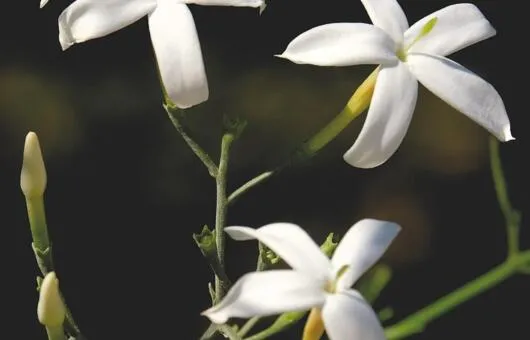
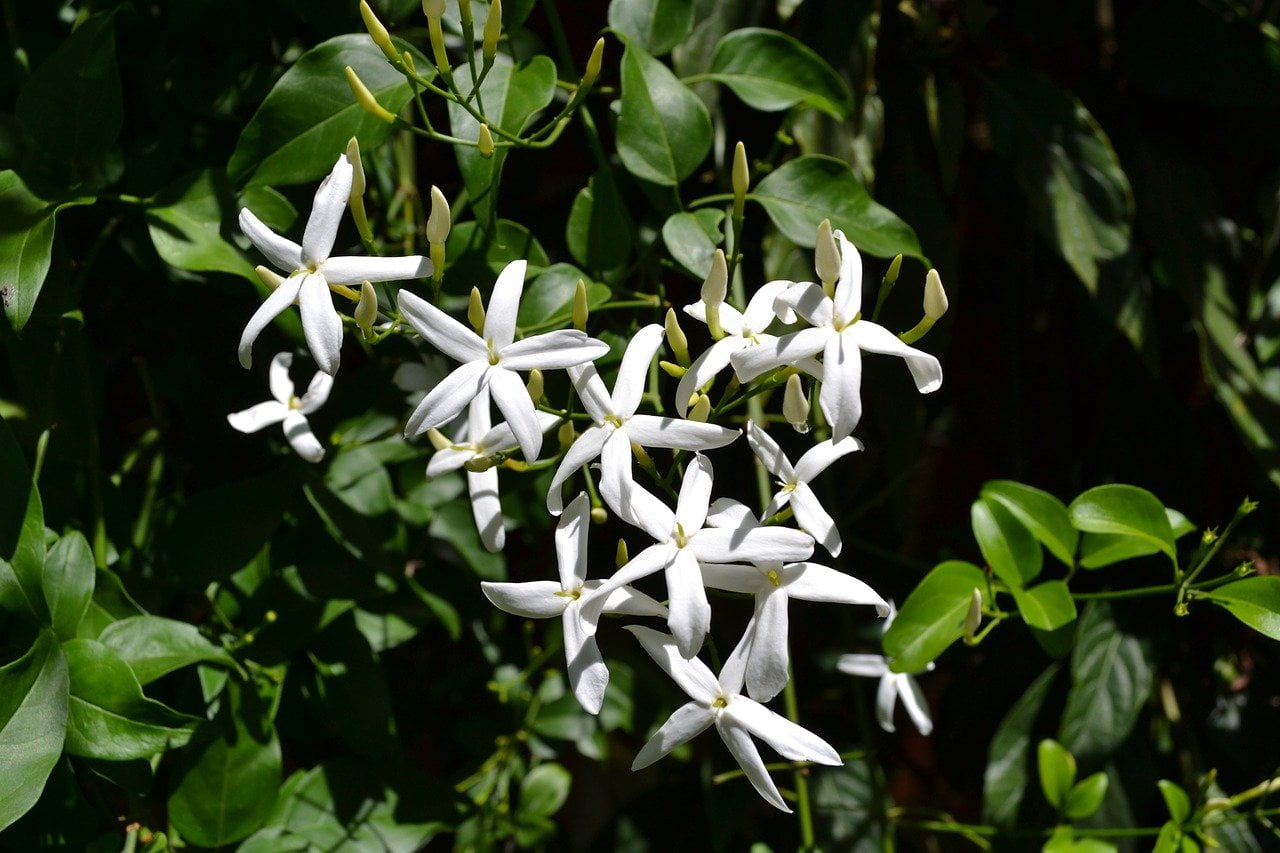
Star Jasmine, botanically known as Trachelospermum jasminoides, is a self-twining evergreen climbing shrub native to China and Japan. Despite its common name and the jasmine-like fragrance of its flowers, it is not a true Jasmine at all. It belongs to the family Apocynaceae rather than the Oleaceae family of true jasmines, which makes it a distant relative of vinca and oleander rather than a close relation of Jasminum officinale. That said, the confusion is entirely understandable: the small white starry flowers, the twining habit, and especially the fragrance make it seem like a Jasmine in every meaningful sense.
What has made star Jasmine so widely planted in UK gardens over the past two decades is its combination of qualities that is genuinely rare in a single plant: year-round evergreen foliage that stays a deep, glossy green through most winters, an extraordinary scent from the summer flowers that carries across a garden on warm evenings, a reasonably manageable habit once the framework is established, and solid UK hardiness once established. I specify it regularly in professional garden designs, particularly on south- and west-facing boundary walls, where I want a year-round structure combined with a summer fragrance. It is one of those plants that earns its place in every month of the year.
2. Star Jasmine at a glance
🌿 At A Glance: Trachelospermum jasminoides
Botanical Name
Trachelospermum jasminoides
Common Names
Star jasmine, Confederate jasmine, Chinese jasmine
Full sun or light shade, warm sheltered wall, free-draining fertile soil
Key Feature
Year-round evergreen foliage with exceptional summer fragrance
3. Best star Jasmine varieties for UK gardens
The species Trachelospermum jasminoides is by far the most widely grown and the one you will find in virtually every UK garden centre. But there are a handful of named cultivars worth knowing about, particularly if you want something with a different foliage effect or that suits a specific garden style.
Trachelospermum jasminoides (the classic)
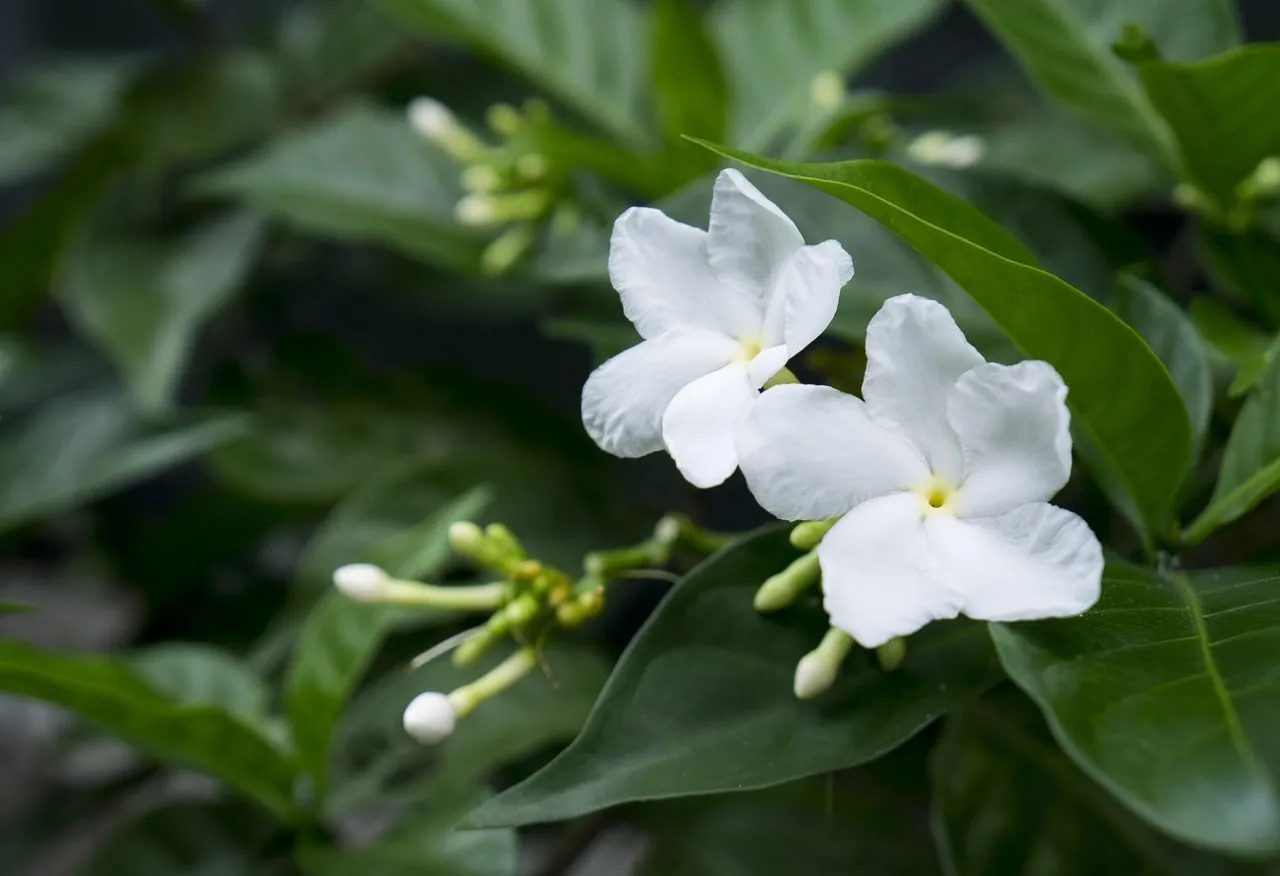
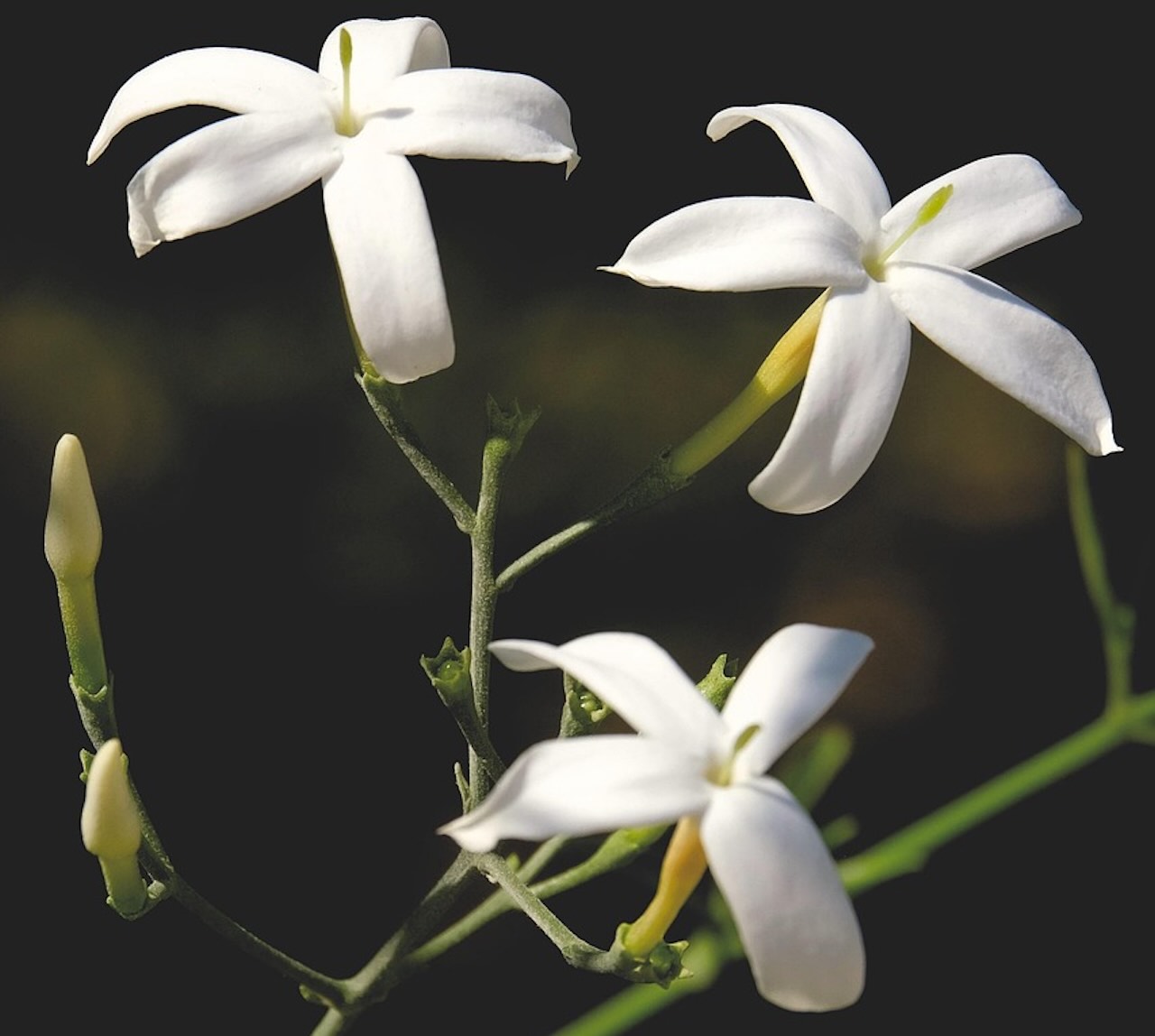
The species itself is hard to improve upon for most UK garden situations. Deep, glossy dark green leaves that take on a bronzed or reddish tint in cold winters, clusters of small white pinwheel-shaped flowers with an exceptional fragrance from July through August, and a self-twining habit that requires only a wire or trellis framework rather than constant tying in. It holds the RHS Award of Garden Merit and is my default recommendation for any warm, sheltered boundary wall.
‘Variegatum’
A variegated form with cream and green foliage that takes on pink and red tints in cold weather, making it a genuinely four-season foliage plant. The flowers are identical to the species. It is slightly less vigorous than the plain species and benefits from a warmer, more sheltered position. I use this in contemporary designs where a lighter, more textural wall covering is needed, and the species’ plain green would feel too heavy.
‘Wilsonii’
A species variant with slightly smaller leaves and particularly pronounced winter bronze colouring. Less commonly available than the main species but worth seeking out if strong winter foliage colour is a priority. The flowers and fragrance are equivalent to the species.
Trachelospermum asiaticum (Asian star jasmine)
A related species with smaller, narrower leaves and cream to pale yellow flowers. Slightly hardier than jasminoides in some exposures and often used as a ground cover in mild UK gardens. The flowers have a similar but slightly different fragrance to jasminoides. Worth considering for gardens where the standard species has struggled in cold winters, though asiaticum is less commonly available.
Getting the position right is more important with star Jasmine than with most climbers, because this plant is genuinely responsive to microclimate. A star Jasmine on a south-facing sheltered house wall in Manchester will thrive and flower abundantly. The same plant on a north-facing exposed fence in the same garden will struggle, flower poorly, and suffer foliage damage in a hard winter. The difference is not marginal.
Aspect and sun
A south- or west-facing wall or fence is ideal throughout the UK. Star Jasmine will tolerate light or partial shade and still produce a respectable display, but the fragrance and flower count are noticeably reduced below around four to five hours of direct sun per day. East-facing walls are acceptable in the south of England. North-facing positions should be avoided unless you are in a very mild coastal garden in the far south west.
The warmth a masonry wall retains through the night is genuinely significant for this plant. A brick or stone wall facing south or west acts as a thermal store, releasing heat absorbed during the day back into the adjacent planting throughout the evening and night. This microclimate effect can raise the effective temperature around a wall-trained star Jasmine by two to three degrees compared with open ground, which makes a real difference to both flowering and winter survival in northern UK gardens.
Shelter from wind
Cold, drying winds cause more winter damage to star Jasmine than cold temperatures alone. The combination of freezing air and wind desiccates the evergreen leaves, causing them to go brown and drop. Shelter from a wall, fence, hedge or neighbouring building significantly reduces this risk. In exposed coastal positions or hilltop gardens, I would prioritise protection from wind over even the aspect when choosing where to plant.
Soil requirements
Star Jasmine grows in a wide range of soils as long as drainage is reasonable. It performs best in fertile, well-drained soil with a roughly neutral pH. It will not tolerate permanently waterlogged conditions, which can cause Phytophthora root rot. On heavy clay soils, improving drainage before planting with horticultural grit and raised planting is important. On chalk or sandy soils, it will thrive with minimal intervention beyond reasonable feeding.
5. How to plant star Jasmine
Spring planting from April onwards is ideal, giving the plant the full growing season to establish before its first UK winter. Container-grown star Jasmine can technically be planted at any time of year. Still, Autumn planting should be avoided in colder or exposed gardens as the plant has no time to establish before winter arrives. Summer planting requires consistent watering through the first season.
Plant star Jasmine at least 20 to 30 centimetres away from the base of the wall or fence, rather than hard against it. The soil immediately at the base of a wall is often poor, dry, and nutrient-deficient because the wall sheds rainwater away from the nearby ground. The plant can easily reach the wall with its twining stems, but benefits from being in better soil farther out.
Dig a hole roughly twice the width of the root ball and to the same depth. Work a generous amount of well-rotted compost or garden compost into the base and sides of the hole to improve both nutrition and moisture retention. Plant at the same depth as the pot, firm in well, and water thoroughly. Apply a five-centimetre mulch of bark or compost around the base, keeping it clear of the main stem, to retain moisture during the establishment period.
💡 Top Tip
Soak the root ball in a bucket of water for thirty minutes before planting. Container-grown star jasmine is often sold in peat-based compost that can become hydrophobic when dry, repelling water rather than absorbing it. A good pre-planting soak ensures the roots are fully hydrated from the moment they go into the ground and significantly improves establishment.
6. Support structures for star Jasmine
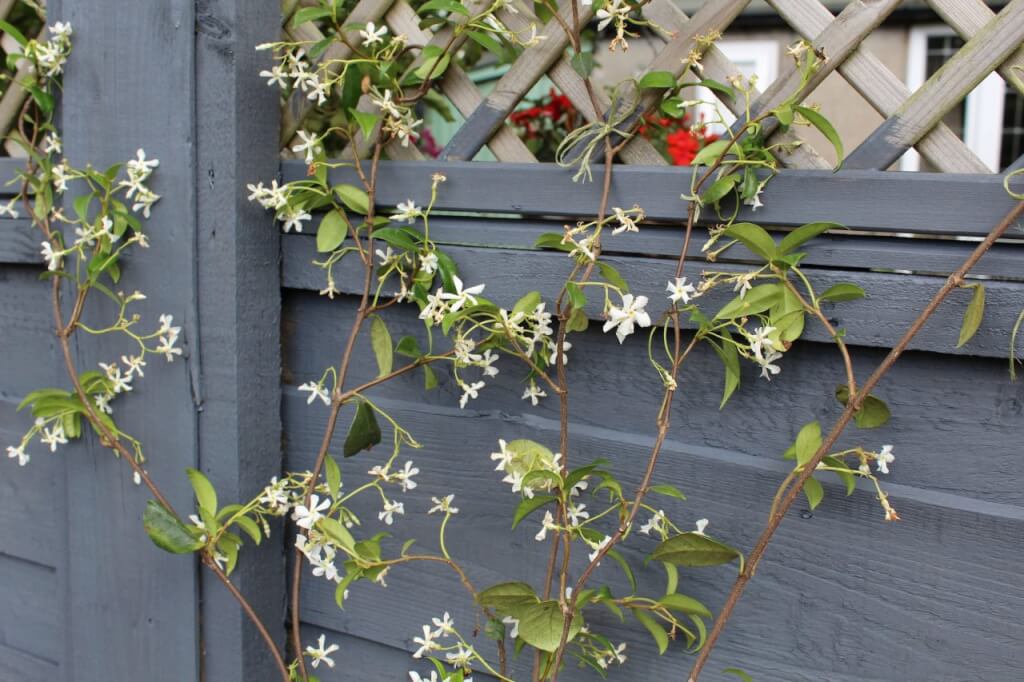
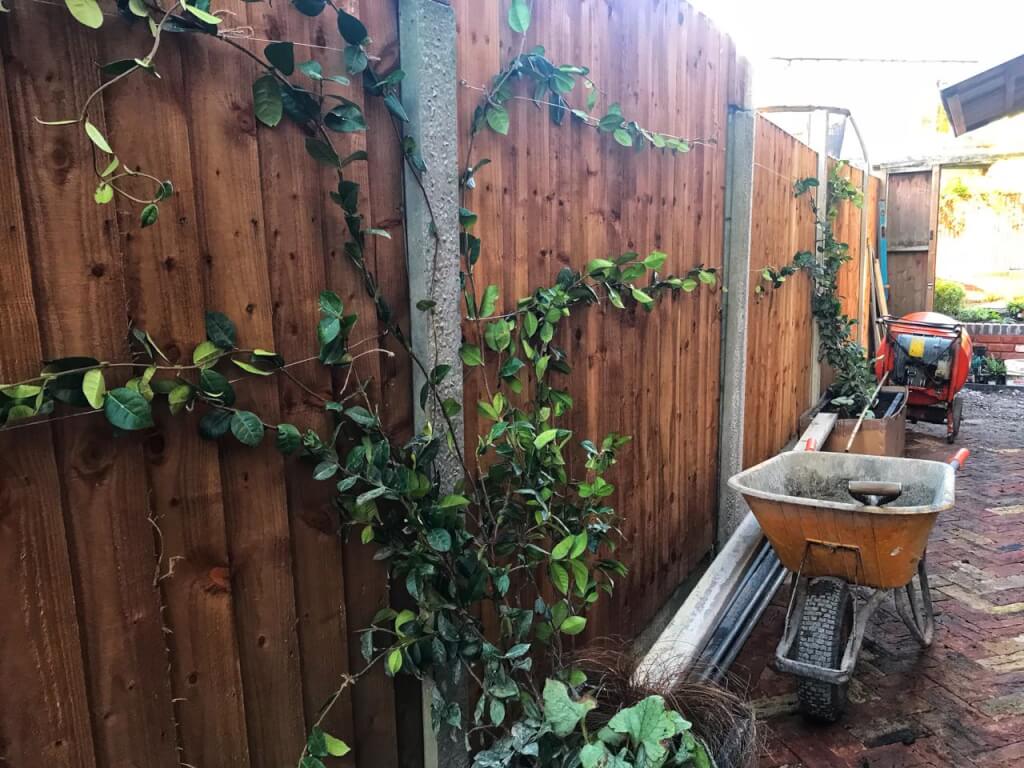
Star Jasmine is described as self-clinging, but this requires some clarification. It is self-twining, meaning its stems twine around any available support, but it does not produce the adhesive root pads of ivy or the suction pads of Virginia creeper. It cannot grip a flat wall surface without something to wrap around. Trellis panels or horizontal wires are essential, not optional.
For wall training, horizontal wires fixed with vine eyes spaced 30 to 45 centimetres apart vertically provide an excellent framework. Use galvanised wire of at least 2mm diameter, tensioned firmly between the vine eyes, with the wire held two to three centimetres from the wall surface to allow air circulation. This system is more durable than trellis panels, more flexible in training direction, and will last the lifetime of the plant.
Trellis panels are perfectly adequate for the first several years, but will eventually need to be replaced as the plant matures and the weight of growth increases. If you install trellis, choose a heavy-duty pressure-treated timber design and ensure it is fixed to the wall with substantial fixings rather than lightweight screws into mortar. A mature star Jasmine in full leaf carries considerable weight, particularly after rain.
Water star Jasmine regularly through the first growing season after planting, particularly during dry spells, to help the root system establish. A deep soaking every seven to ten days in dry weather is more effective than light daily watering that only wets the surface. Once established after its first or second season, star Jasmine is reasonably drought-tolerant in the open ground. However, it benefits from watering during prolonged dry periods in summer when flowering is at its peak. Container-grown plants need more frequent attention, particularly in July and August, when they are working hard to produce flowers.
Feeding
Apply a balanced liquid fertiliser monthly through the growing season from April to August. A general-purpose liquid feed is appropriate for this plant as it benefits from a balanced nutrient profile rather than the high-potassium feeds suited to flowering perennials. Apply a slow-release granular fertiliser in spring as an alternative approach, which reduces the need for regular liquid feeding but may produce slightly less vigorous growth in the first part of the season.
Pruning is the aspect of star Jasmine care that causes the most confusion, and getting the timing wrong is the single most common reason the plant fails to flower well. The key principle is that star Jasmine flowers on wood produced the previous year. Pruning in spring removes the stems that were going to flower that summer, and the result is a healthy, vigorous, leafy plant with no flowers.
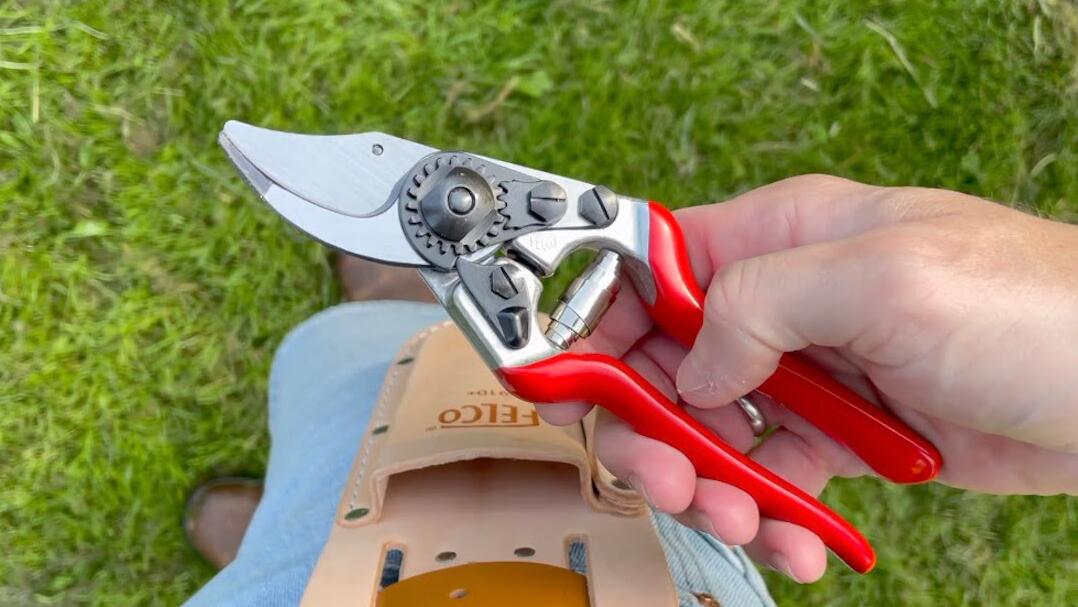
The correct time to prune is immediately after flowering, in August or September. At this point, the plant has finished its display, and there is still enough of the growing season left for the new growth produced after pruning to ripen and harden before winter. Cut back overgrown or flowered stems to strong new sideshoots lower down, and remove any dead or congested growth entirely. For an established, well-maintained plant, this is a relatively straightforward annual tidy that takes an hour or so. For an overgrown plant, the process is more involved and is covered in full in the dedicated pruning guide.
For everything you need to know about pruning star jasmine, including how to tackle a severely overgrown plant, two-year renovation pruning, training against walls and fences, and what to do when yours has not flowered despite healthy growth, see the dedicated star jasmine pruning guide.
9. Winter hardiness and protection by UK region
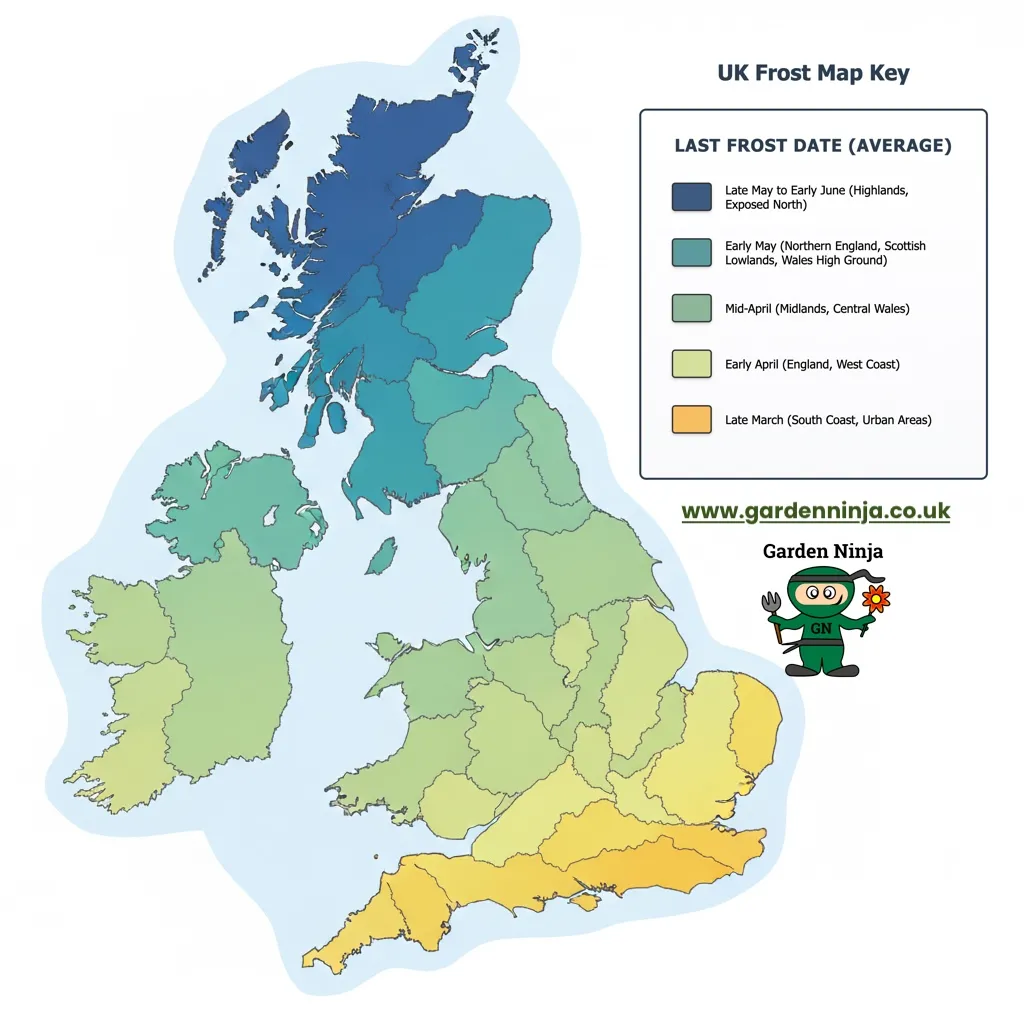
The RHS rates Trachelospermum jasminoides as H4, meaning it is generally hardy down to around minus five to minus ten degrees Celsius. In practice, this means it survives most UK winters without any protection when planted in a sheltered position. Still, it does sit right at the boundary of reliable hardiness in northern England and Scotland, and a particularly hard winter or an exposed position can cause significant damage or loss.
Southern England, London and the Midlands
In these regions, star Jasmine is generally reliable outdoors against a sheltered wall without any winter protection once established. The foliage may bronze or develop reddish tints in cold spells, which is normal and not a sign of distress. In a particularly cold winter, some outer leaves may drop, but the plant recovers in spring. There is nothing to din thegh winter except leave it alone.
Northern England
In northern England, including the North West, Yorkshire, and the North East, star Jasmine can be grown successfully against a warm, sheltered south or west-facing wall but benefits from some winter protection in its first two or three years while it establishes. A loose draping of horticultural fleece during periods of hard frost below minus five degrees Celsius provides meaningful protection without creating the damp conditions that cause fungal problems. Once the root system is established, most plants survive without intervention.
Scotland and exposed northern gardens
In Scotland and other cold, exposed positions, star Jasmine is a more calculated risk. It can be grown successfully in sheltered urban gardens in Edinburgh or Glasgow, particularly against a heated house wall. Still, it is not something I would plant in an exposed rural or hilltop position. In these situations, Trachelospermum asiaticum is sometimes cited as slightly hardier and worth considering as an alternative. Container growing and overwintering in a cold greenhouse is the most reliable approach for gardeners in the coldest regions who want to grow star Jasmine.
Coastal gardens
Coastal gardens in the south west, Wales and western Scotland often provide excellent conditions for star Jasmine despite their latitude, because the moderating effect of the sea keeps winter temperatures above the critical threshold. The main challenge on exposed coasts is wind rather than cold, and shelter from prevailing winds is the priority in these situations.
10. Growing star Jasmine in containers
Container growing is an excellent option for star Jasmine in colder gardens, for smaller spaces such as balconies and patios, or for gardeners who want to move the plant to a more sheltered position in winter. The restricted root zone keeps the plant more compact and manageable than open-ground specimens, and the mobility means you have full control over its winter environment.
Use a loam-based compost such as John Innes No. 3 for the best results in containers. Peat-free multipurpose compost can be used, but it breaks down more quickly, and the drainage deteriorates over time. Add about 20 per cent horticultural grit to improve drainage, especially if the container lacks generous drainage holes. Choose a pot at least 35 to 45 centimetres in diameter to give the root system room to develop, and repot every two to three years into fresh compost as the mix breaks down.
Container-grown star Jasmine needs more regular watering and feeding than open-ground specimens because nutrients leach from the compost with each watering,g and the restricted root zone cannot access moisture from surrounding soil. Feed fortnightly with a balanced liquid feed through the growing season and check soil moisture every two to three days in warm weather. In winter, move containers under cover before the first hard frost and reduce watering significantly, checking once every two to three weeks to prevent the compost from drying out completely.
11. How to propagate star Jasmine
Semi-ripe cuttings can propagate star Jasmine in summer or by layering in spring. Both methods are straightforward and allow you to increase your stock or produce new plants at no cost.
Semi-ripe cuttings (July to September)
Take cuttings of around 10 to 12 centimetres from the current season’s growth, choosing stems that are firm at the base but still flexible at the tip. Remove the lower leaves, leaving two or three pairs at the top. Dip the cut end in hormone rooting powder or gel, then insert it into a small pot of free-draining cutting compost mixed with perlite. Cover with a clear plastic bag or a propagator lid to maintain humidity and place in a warm position out of direct sunlight. Roots usually develop within six to eight weeks. Once rooted, pot on into John Innes No. 2 and grow on in a protected position through the first winter before planting out the following spring.
Layering (spring)
Star Jasmine layers naturally where stems touch soil, which is one reason overgrown plants spread so readily. You can use this tendency deliberately by selecting a long, flexible stem in spring and pegging a section of it into a pot of compost placed alongside the parent plant. Wound the stem slightly where it contacts the compost. A shallow nick with a sharp knife just below a leaf node works well. Cover the wounded section with a couple of centimetres of compost. Keep the pot moist, and the layer will root within a growing season. Once rooted, sever the connection to the parent plant and grow the new plant on in its pot for several weeks before transplanting.
12. Common star Jasmine problems and how to solve them
Leaves turning yellow
Yellowing leaves on star Jasmine most commonly indicate a nutrient deficiency, usually nitrogen, or, in container plants, the compost being exhausted after several years without repotting. Apply a balanced liquid feed and assess whether the plant needs repotting. Some older leaves yellowing and dropping in late Autumn is entirely normal as the plant renews its foliage, and should not cause concern if the new growth is healthy.
Leaves turning brown in winter
Winter browning of the foliage is the most common complaint about star Jasmine, particularly after a sharp frost or during periods of cold, drying wind. It is not necessarily a sign that the plant is dying. Remove the brown leaves in spring and check whether the stems beneath are still green and flexible. If they are, the plant is alive and will produce new growth. Prune back any stems that are genuinely dead to healthy wood. Position the plant away from cold wind as a long-term prevention measure, and consider a loose horticultural fleece wrap during the coldest spells in exposed gardens.
No flowers despite healthy growth
A star Jasmine that produces abundant healthy growth but no flowers is almost certainly being pruned at the wrong time of year, typically in spring rather than after flowering in late summer. Pruning in spring removes exactly the stems that were going to flower that season. Stop spring pruning and switch to post-flowering pruning in August and September. The plant will return to flowering the following year once the new growth produced this season has matured over the winter. Over-feeding with a nitrogen-rich fertiliser can also push the plant toward vegetative growth at the expense of flowers, so switch to a more balanced feed if this may be the cause.
Scale insects
Scale insects occasionally colonise star Jasmine, appearing as small brown or grey oval bumps on the stems and undersides of leaves. They suck sap and, in large numbers, can weaken the plant and produce honeydew that encourages sooty mould on the foliage. Light infestations can be removed manually with a soft brush or cloth dipped in soapy water. Heavier infestations may require treatment with a horticultural oil or an insecticidal soap spray, applied at dusk to avoid harming pollinators.
13. Using star Jasmine in garden design
Star Jasmine is one of my most consistently used climbers in professional design work, and the reason is straightforward: it solves one of the most common problems in UK gardens: the need for a year-round, low-maintenance, evergreen covering for a boundary wall, while adding a genuine summer fragrance event that nothing else quite matches. Here are the ways I use it most often.
Near seating areas for evening scent
The fragrance of star Jasmine is strongest on warm evenings and wafts considerable distances. Positioning it on a wall or fence adjacent to or behind a seating area is one of the simplest and most effective scent design decisions available. The plant needs nothing from you except its annual prune, and in return, it fills the seating area with fragrance on every warm evening through July and August. It is the kind of detail that transforms how a garden feels to be in rather than just how it looks.
Boundary wall and fence cover.ing
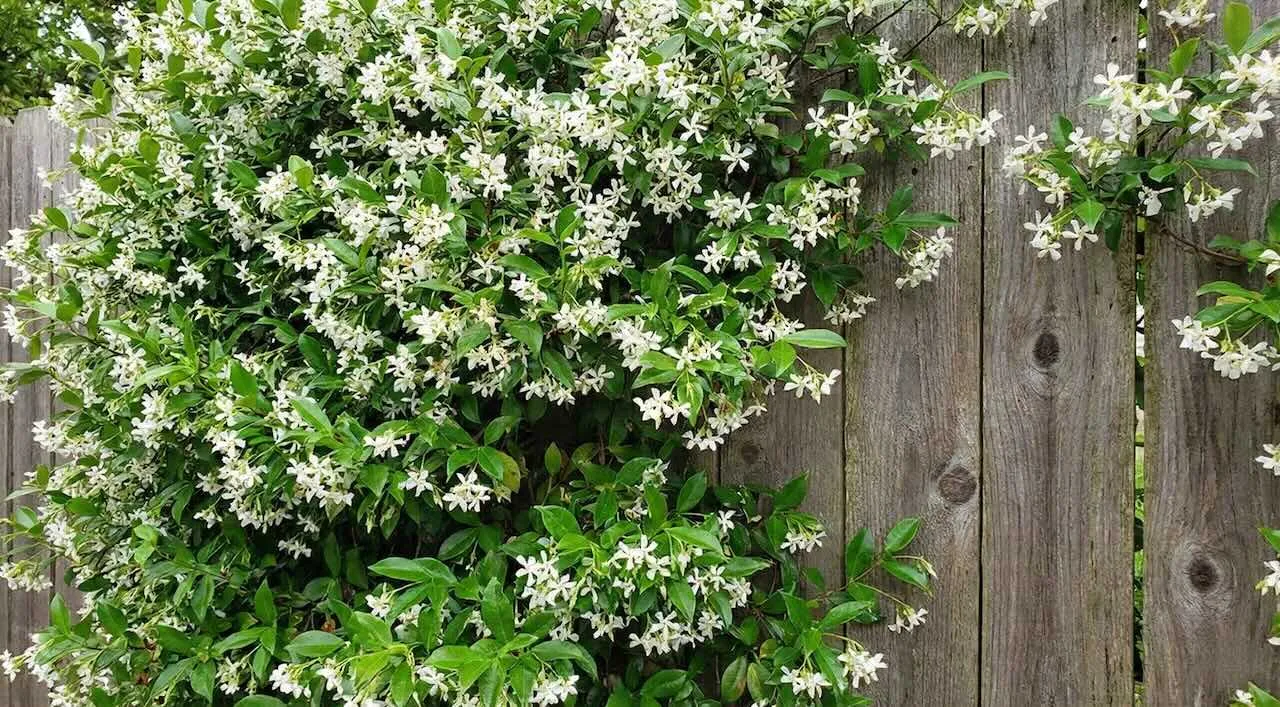
For south and west-facing boundaries, star Jasmine provides a year-round evergreen covering that looks clean and structured in every season. The winter bronze colouring of the foliage adds a warm quality to walls and fences that plain green evergreens lack. Against a light-coloured rendered wall or a painted fence, the glossy dark green or bronzed winter leaves look particularly effective. I use it regularly on new build garden projects where the brief includes greening up boundary walls without the maintenance burden of a climber that needs constant tying in.
Archways and pergolas in warm gardens
In sheltered gardens in the south of England and coastal locations, star Jasmine trained over an archway or pergola creates one of the finest summer experiences available. Walking beneath a well-established star Jasmine arch in full flower in July is extraordinary. The scent is intense, the flowers frame the view through the arch beautifully, and the year-round evergreen foliage means the structure never looks bare. The key requirement is a substantial, well-built arch or pergola, as the weight of a mature plant is considerable and lightweight structures will not survive in the long term.
Ground cover in mild gardens
In mild coastal gardens or as a ground cover beneath a warm south-facing boundary, star Jasmine can be used as a spreading ground cover plant rather than a climber. The self-layering habit that makes it difficult to manage as a climber becomes an asset in this role, as it fills space rapidly and roots as it spreads, forming a weed-suppressing mat. This use is most successful in the southwest of England and coastal Wales, where winters are mild enough to avoid repeated foliage damage.
14. Frequently asked questions about growing star Jasmine
Is star Jasmine hardy in the UK?
Generally, yes, in most of the UK when given a sheltered south or west-facing position. It is rated H4 by the RHS, tolerating temperatures to around minus five to minus ten degrees Celsius. Northern England and Scotland may require protection with horticultural fleece in their first few winters while establishing.
When does the star Jasmine flower?
Mid to late summer, typically July through August, with flowering lasting around four to six weeks. The fragrance is strongest on warm evenings.
Why is my star Jasmine not flowering?
Almost certainly because it is being pruned in spring rather than after flowering in August and September, Star Jasmine flowers on wood produced the previous year, so spring pruning removes the flowering stems for that season. Switch to post-flowering pruning, and it will flower again the following year.
Does star Jasmine need a trellis?
Yes, it cannot cling to flat wall surfaces. Horizontal wires fixed with vine eyes or a trellis panel are essential for it to climb. Without support,t it piles on itself rather than spreading across the wall.
Is star Jasmine the same as common Jasmine?
No. They are different plants. Star Jasmine (Trachelospermum jasminoides) is evergreen and slightly less hardy. Common Jasmine (Jasminum officinale) is deciduous and fully hardy throughout the UK. Both are excellent fragrant climbers, but require different care and have different pruning times.
Ready to stop guessing and start designing with confidence? My Garden Design for Beginners online course takes you from blank canvas to brilliant layout, step by step.
I’m Lee Burkhill, award-winning garden designer and BBC1’s Garden Rescue presenter, and I’ve built this course around the same principles I use for every client garden — practical, honest, and designed to actually work in the real world.
In 20 hours of flexible online study, you’ll cover:
Design principles that make any garden work
How to select and arrange plants like a professional
Styles and layouts to suit every size and shape of space
Video lessons, real-world case studies, quizzes, and a certificate on completion — all for just £199.
Enrol today and start designing your dream garden.
29
Garden Design Examples for Small Gardens: 30 Design Templates & Planting Plans
Garden Design Examples for Small Gardens: 30 Design Templates & Planting Plans: In this online gardening course, I’ll walk you through 30 fantastic garden designs, explaining the logic behind the layout, the plant choices, and take-home tips for applying them in your own garden.
Weekend Garden Makeover: A Crash Course in Design for Beginners
Learn how to transform and design your own garden with Lee Burkhills crash course in garden design. Over 5 hours Lee will teach you how to design your own dream garden. Featuring practical design examples, planting ideas and video guides. Learn how to design your garden in one weekend!
Garden Design for Beginners: Create Your Dream Garden in Just 4 Weeks
Garden Design for Beginners Online Course: If you want to make the career jump to becoming a garden designer or to learn how to design your own garden, this is the beginner course for you. Join me, Lee Burkhill, an award-winning garden designer, as I train you in the art of beautiful garden design.
Star jasmine is one of the finest climbers available for UK gardens with a sheltered, sunny position. Give it a good wall, decent support, consistent water and feeding through summer, and the correctly timed post-flowering prune each August to September. In return it will provide year-round evergreen structure, extraordinary summer fragrance, and a winter foliage display that improves with age. Few climbers offer this combination of practicality and genuine beauty in every month of the year.
Your subscription could not be saved. Please try again.
Your subscription has been successful.
Lee Burkhill
Lee Burkhill, known as the Garden Ninja, is an award-winning garden designer and horticulturist with over 30 years of gardening experience and 15 years as a professional garden designer. A qualified RHS (Royal Horticultural Society) professional, Lee specialises in sustainable garden design and practical horticultural advice. He designs and presents on BBC1’s Garden Rescue and in leading gardening publications. Lee combines three decades of hands-on gardening knowledge with professional design qualifications to help gardeners create beautiful, functional outdoor spaces.