How to Design a Small Square Garden: Transform Your Box into a Brilliant Outdoor Space
Lee Burkhill: Award Winning Designer & BBC 1's Garden Rescue Presenters Official Blog
Beginner level
Square gardens aren't design disasters, they're opportunities disguised as limitations. That perfect geometry which feels restrictive is actually your greatest asset once you understand how to manipulate it properly. The trick isn't fighting the square, it's working with the shape whilst cleverly disguising its boxiness through strategic design decisions.
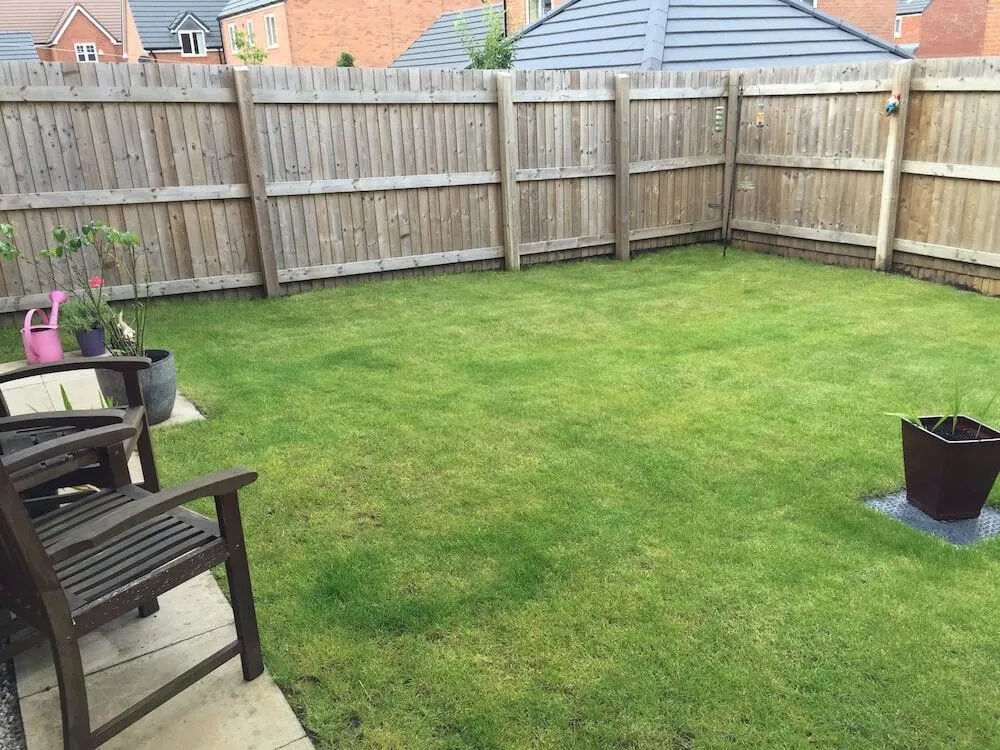
Staring out at your perfectly square garden through those patio doors, you might be feeling distinctly uninspired. That predictable rectangle of lumpy turf bordered by fence panels on all sides probably looks less like a garden and more like a green prison yard, especially if it’s one of those typical new build plots where developers have maximised house size and minimised garden space.
Square gardens are everywhere in urban and suburban Britain, and whilst they’re absolutely functional shapes, they’re about as exciting as a beige carpet if you simply leave them as nature and property developers intended.
I’ve been designing gardens professionally for over 15 years, presented over 50 episodes of BBC Garden Rescue, and transformed dozens of square plots from uninspiring boxes into genuinely stunning outdoor spaces that homeowners actually want to use.
This comprehensive guide will walk you through exactly how to transform your small square garden using the same design principles I teach in my Garden Design for Beginners course and apply to Garden Rescue transformations. Whether your square measures five metres or fifteen metres per side, you’ll discover practical solutions that work in real British gardens with real budget constraints and real maintenance limitations.
Why Square Gardens Feel So Boring
Before diving into solutions, let’s address why square plots feel so utterly uninspiring in their natural state. Understanding what makes them feel bland is crucial to knowing how to fix them properly, rather than just chucking a few curved borders in and hoping for the best.
The fundamental problem with square gardens is their predictability. When you can take in the entire space in one glance from your back door, there’s no mystery, no discovery, and frankly, no reason to actually walk into the garden.
Your brain processes the whole layout instantly and dismisses it as uninteresting. The symmetry compounds this. Those four equal sides and four identical corners create such a perfect balance that the space feels static rather than dynamic. There’s nowhere for your eye to travel, no natural flow, and no hierarchy of features competing for attention.
The second major issue is thatsquare gardens often end up being treated as squares. Rectangular patios immediately outside the back door, square lawns in the middle, border strips running along each fence line, then maybe a shed plonked in one corner.
It’s a garden design by default rather than intention, and the results are exactly as boring as you’d expect. As I discuss in my guide on where to start with garden design, this approach of just filling space without proper planning is where most amateur designers fall down completely.
The third challenge specific to small square gardens is proportion. In a limited space, every design decision has an outsized impact. Get your patio slightly too large, and suddenly there’s no room for meaningful planting. Make your borders too narrow,w and they become mere afterthoughts rather than proper garden features. This is why proper planning and understanding of design principles matter so much more in small squares than in larger, more forgiving spaces.
The Golden Rules for Small Square Garden Design
After designing countless square plots across different budgets, locations, and client requirements, I’ve distilled the approach into four fundamental principles that apply whether you’re working with twenty square metres or eighty.
Rule One: Break the Visual Box
The biggest mistake with square gardens is leaving them visually intact as squares. When your lawn is square, your patio is rectangular, and your borders run in straight lines parallel to the fences, you’ve essentially created a diagram of a square rather than an actual garden. Instead, you must break up that geometry using curves, diagonals, or strong focal points that pull attention away from the corners and boundaries.
The most effective method I’ve found is either introducing circular elements that contrast completely with the straight boundaries or using diagonals or asymmetry.
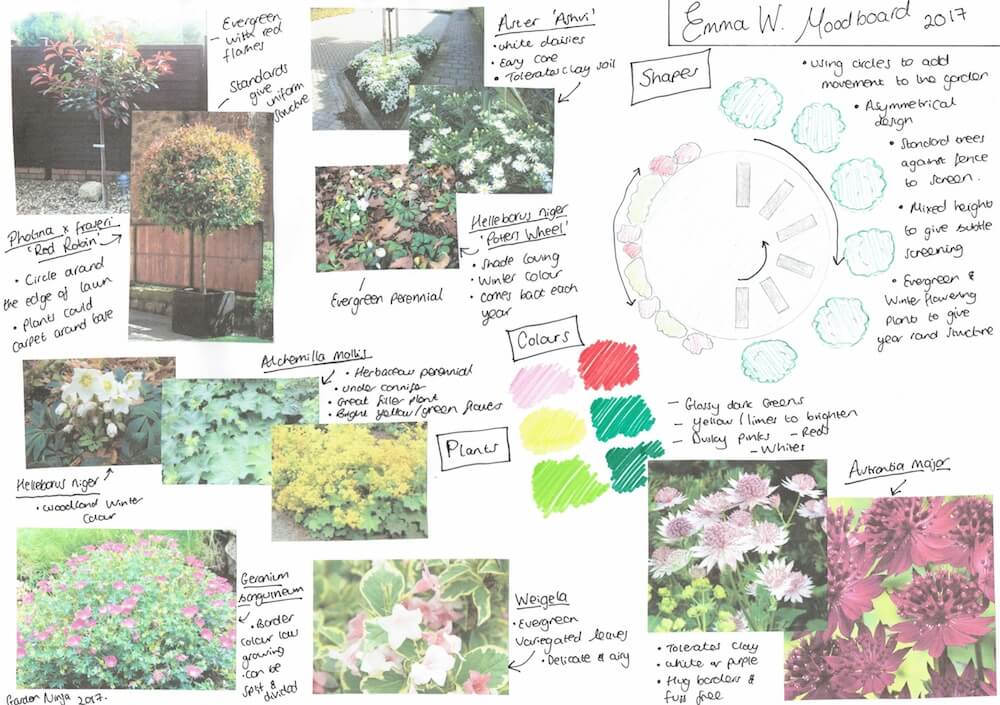
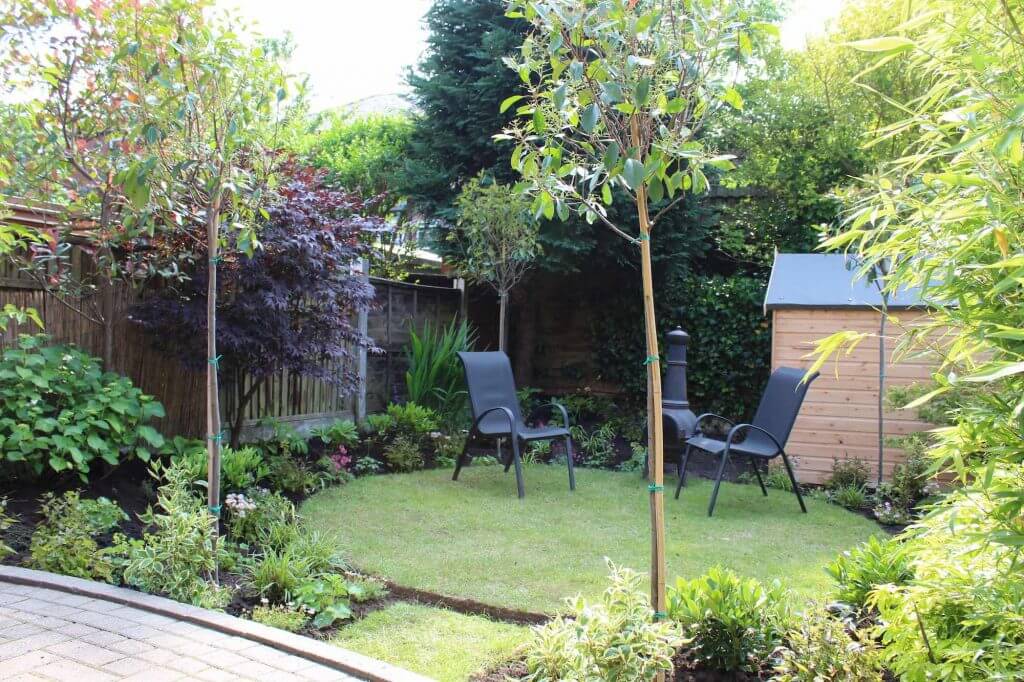
A circular lawn in the centre of a square garden immediately transforms the entire character of the space. Your eye follows the curve rather than tracking along those predictable fence lines, and suddenly the garden feels organic rather than geometric. This is the exact technique I used in my overlooked back garden design, where a circular lawn surrounded by standard trees created intimacy without feeling boxed in.
Diagonal layouts work brilliantly as well, particularly in very small squares where circles might feel cramped. By rotating your main patio area45e degreesaway fromf the house, you immediately create interesting triangular planting pockets in the corners and establish diagonal sight lines that make the space feel considerably larger. As I explain in my comprehensive guide to garden design, working with diagonals rather than straight lines parallel to boundaries is one of the most powerful tricks in small space design.
Rule Two: Create Zones with Purpose
Small square gardens demand functional zoning. Trying to use the entire space for one purpose simply emphasises the square shape and wastes the opportunity to create different experiences within your limited area. Instead, divide your square into two or three distinct zones, each with a clear purpose and character.
Think about how you actually want to use the garden.
Most people need a proper entertaining or dining zone near the house where you can comfortably fit furniture and move around without feeling cramped. This typically requires minimum dimensions of about three metres by three metres, which in a small square might consume a quarter of your total space. That’s fine. Better to have one properly sized functional area than to try to squeeze multiple inadequate zones that don’t really work for anything.
The remaining space can then be divided among relaxation areas, planting zones, or practical elements, such as vegetable beds or storage areas. The key is to ensure these zones feel intentionally distinct rather than being arbitrary divisions of the square. Use changes in level, different materials, screening plants, or even just distinct colour palettes to make each zone read as its own space whilst still connecting to the overall design.
Rule Three: Control What You See and When
In my family-friendly garden design guide, I emphasise the importance of creating discovery in gardens. This principle matters even more in small squares where the temptation is to leave everything open because you’re worried about making the space feel smaller through screening. Actually, the opposite is true. Gardens that reveal themselves gradually feel larger and more interesting than those you can comprehend at a glance.
Strategic screening using taller perennials, small trees, or even carefully positioned large planters means you can’t see your entire garden from the back door. This forces movement through the space and creates that crucial element of surprise. You might screen the far corner with tall grasses and architectural perennials, then place a seating area or water feature behind them that’s only discovered when you walk into the garden properly. Suddenly, your predictable square has become a journey rather than a static picture.
Rule Four: Embrace Asymmetry
Squares are inherently symmetrical shapes, which means the absolute worst thing you can do is design them symmetrically. Symmetrical layouts in symmetrical spaces create mind-numbing predictability. Instead, embrace asymmetric balance using the rule of thirds, which I cover extensively in my online courses.
Imagine dividing your square garden into a three-by-three grid of nine smaller squares. The most interesting design compositions typically place key features at the intersections of these grid lines rather than at the dead centre or in perfect symmetry. Your main patio might occupy roughly one-third of the space rather than being centred.
Your focal point, whether a tree or sculpture, might sit at the two-thirds position rather than directly in the middle. This creates visual tension in a good way, making the design feel considered and sophisticated rather than obvious and boring.
Practical Design Solutions for Different Square Sizes
Small square gardens come in various actual dimensions, and whilst the fundamental principles remain consistent, the specific solutions vary considerably depending on whether you’re working with a tiny urban courtyard or a more generous suburban plot.
Very Small Squares (Under 25 Square Metres)
If your square measures roughly five metres per side or smaller, you’re working with genuinely limited space where every design decision has a massive impact. These tiny squares are common in new build developments, terraced properties, and urban conversions where outside space is essentially an afterthought.
For very small squares, resist the temptation to cram in multiple zones. You simply don’t have the space to do several things adequately, so choose what matters most and do that brilliantly. In most cases, this means creating a properly sized patio for sitting out with a coffee or having a meal, then using the remaining space for lush planting that creates atmosphere without demanding room you don’t have.
Vertical gardening becomes crucial in tiny spaces. Climbers on all four boundary walls, wall-mounted planters, and even living wall panels can add significant greenery without consuming precious ground space. I cover this approach extensively in my new build gardens guide, where maximising vertical space is often the difference between a garden that feels green and alive and a paved yard with a few plants dotted around.
For tiny squares, consider going fully contemporary with larger format paving covering most of the ground plane, then using oversized planters as your main planting method.
This gives you flexibility to rearrange the space seasonally and ensures your planting makes a proper visual impact rather than being apologetic strips along the edges. Three or four substantial planters with bold architectural plants like phormiums, grasses, or even small Japanese maples will create far more drama than trying to squeeze narrow borders around the perimeter.
Medium Squares (25 to 50 Square Metres)
Medium-sized squares measuring roughly five to seven metres per side offer considerably more design flexibility whilst still feeling intimate and manageable. These are probably the most common square gardens in British suburbs, and they’re genuinely workable spaces if designed thoughtfully.
For medium squares, proper zoning becomes viable. You can realistically create a paved entertaining area near the house, then transition to either a small lawn area or generous planted borders, with perhaps a tucked-away corner for composting or storage. The key is to ensure each zone feels properly proportioned, rather than being stingy slivers of space.
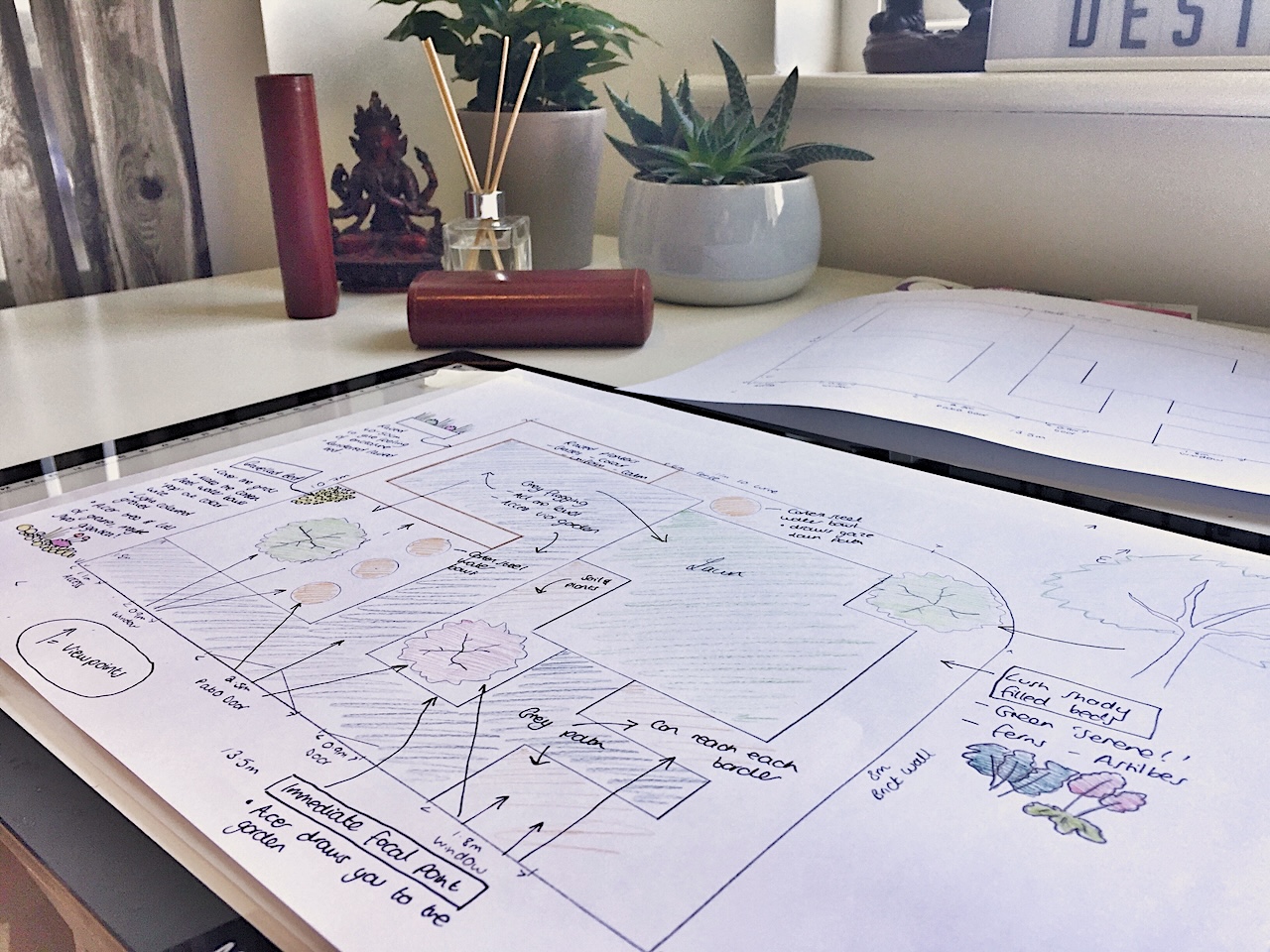
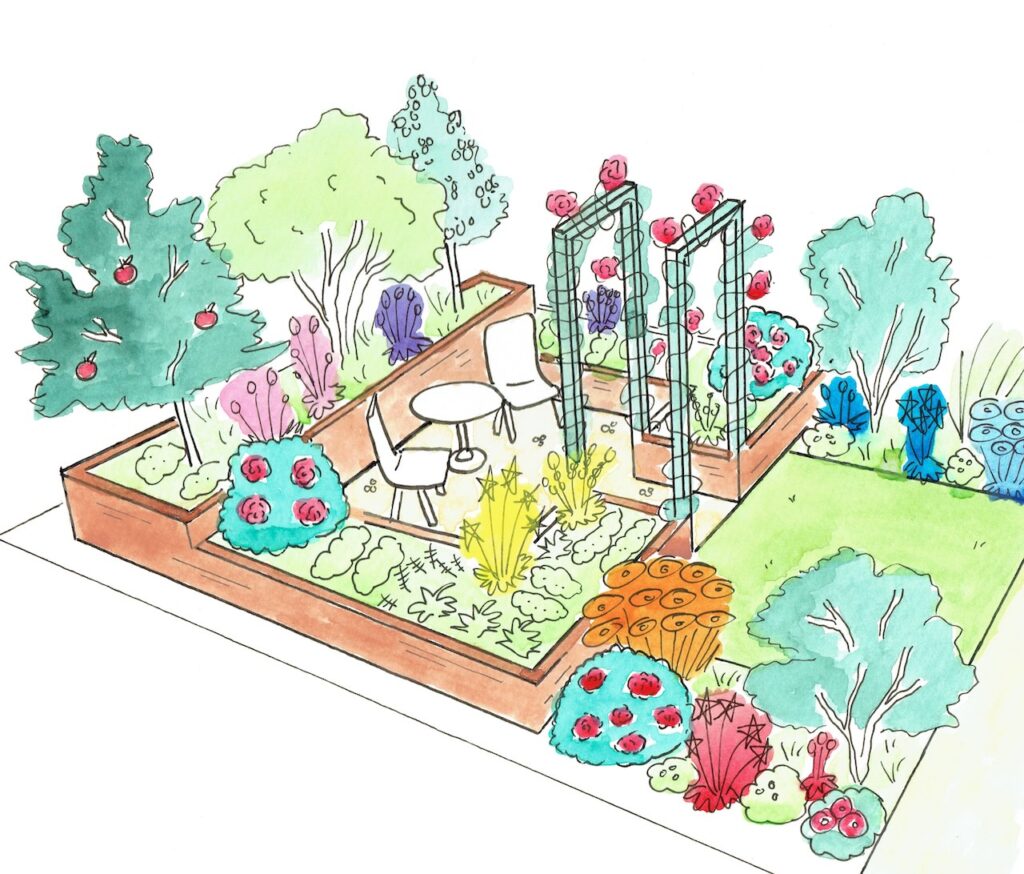
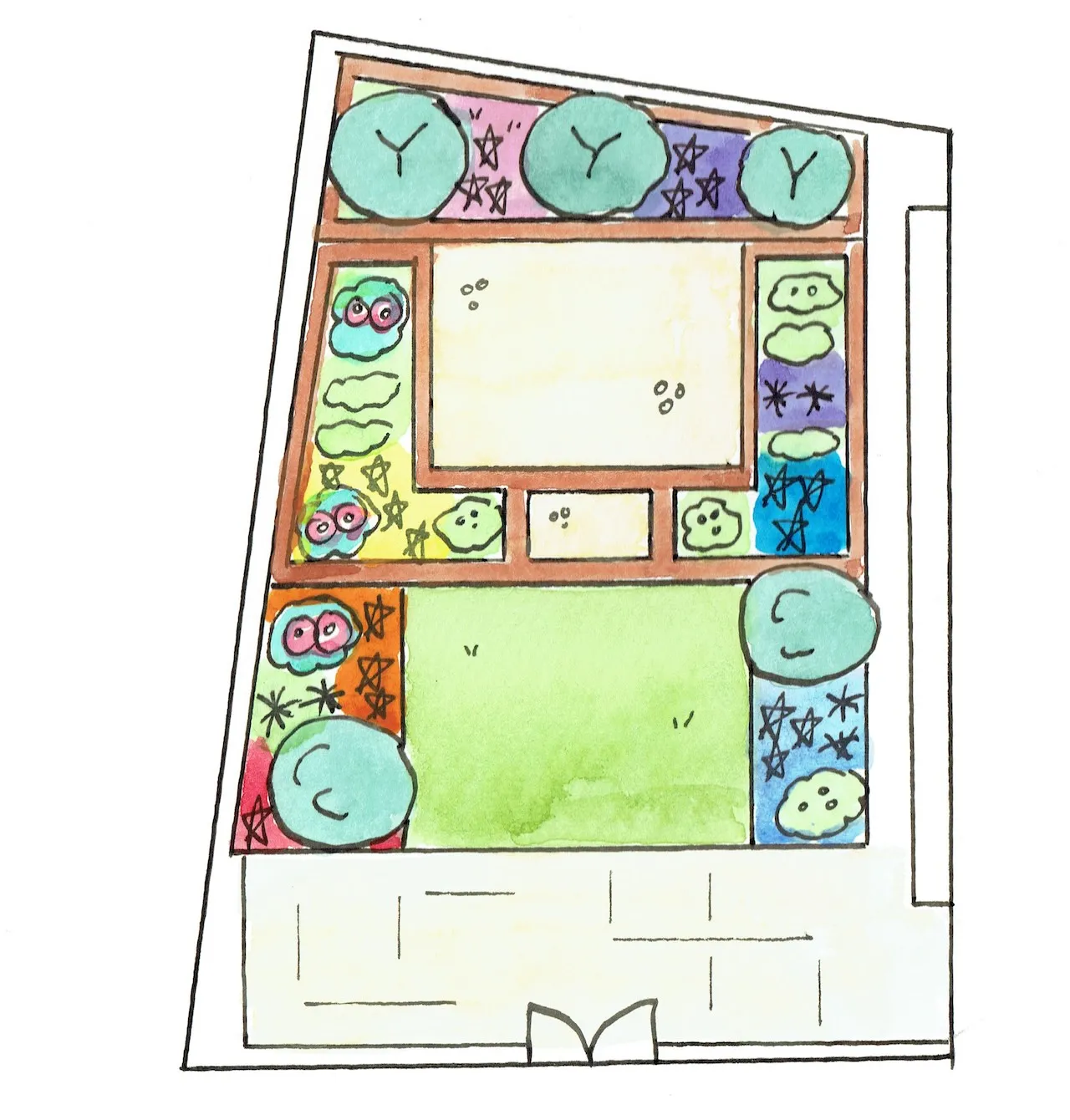
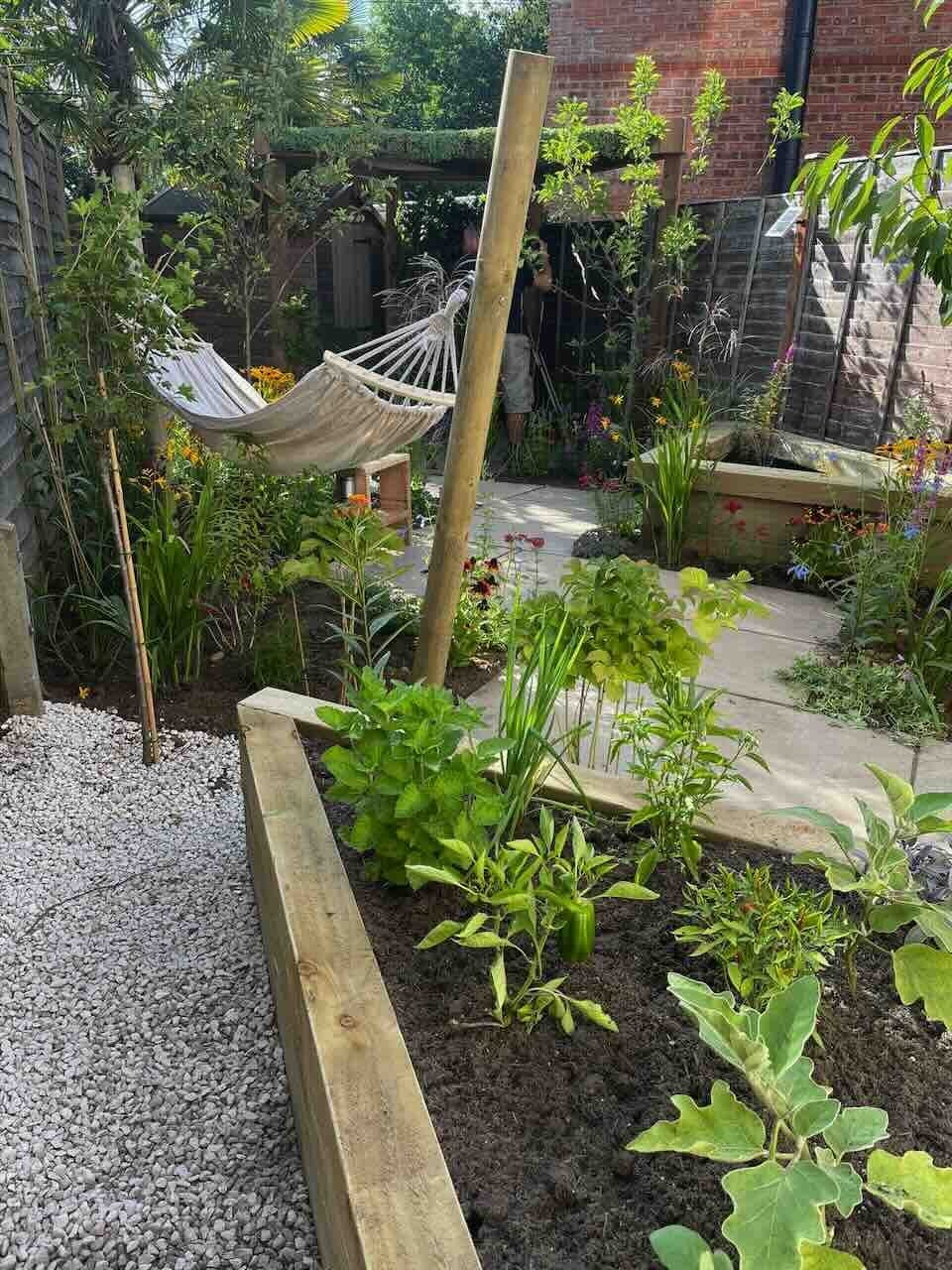
The design image below illustrates how three zones in a medium-sized square garden add depth and interest with deep, raised beds around the perimeter.
This size is also wherecircular lawn designs work particularly well. A circular lawn roughly three to four metres in diameter in the centre of a medium square creates beautiful curved borders all around the perimeter that can be deeply planted without feeling overwhelming. Those curved borders also brilliantly disguise the square boundaries, especially if you layer the planting with taller specimens towards the back that partially obscure the fence lines.
Alternatively, consider the diagonal patio approach. Position your main paving area at forty five degrees to the house, creating interesting triangular planted areas in the two corners furthest from the house. This diagonal orientation makes the space feel considerably larger because you’re emphasising the longer diagonal sight lines rather than the shorter straight measurements. It’s a trick I use constantly in small space design because the visual impact is remarkable for such a simple geometric shift.
Larger Squares (Over 50 Square Metres)
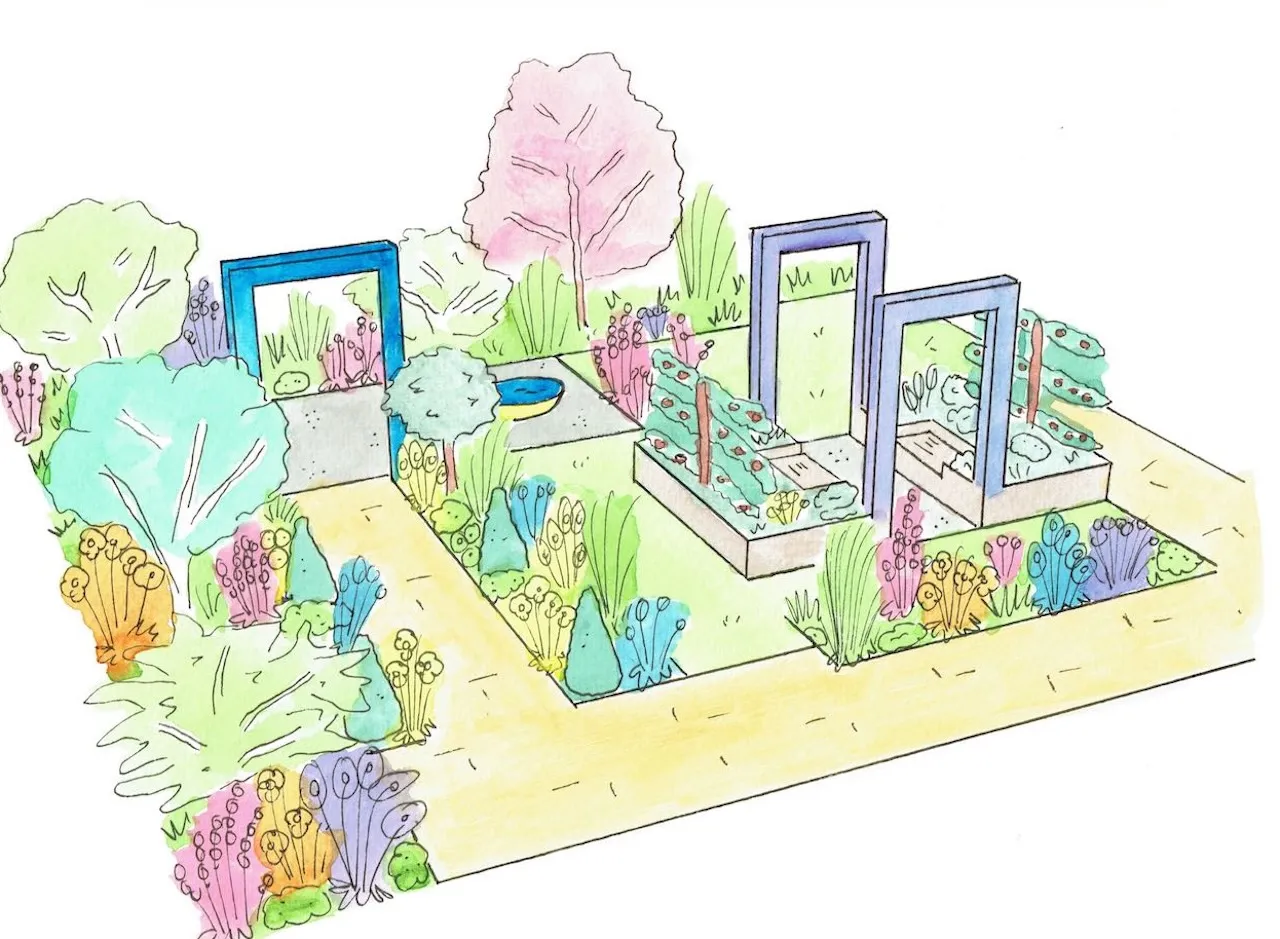
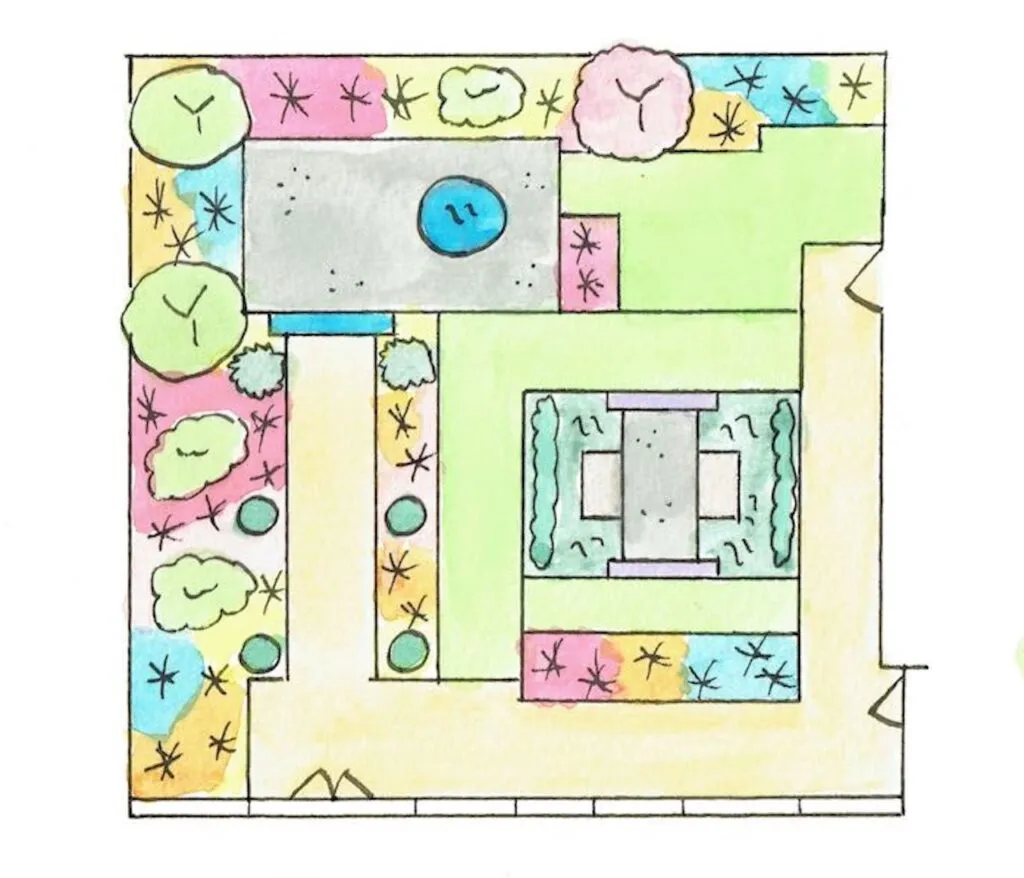
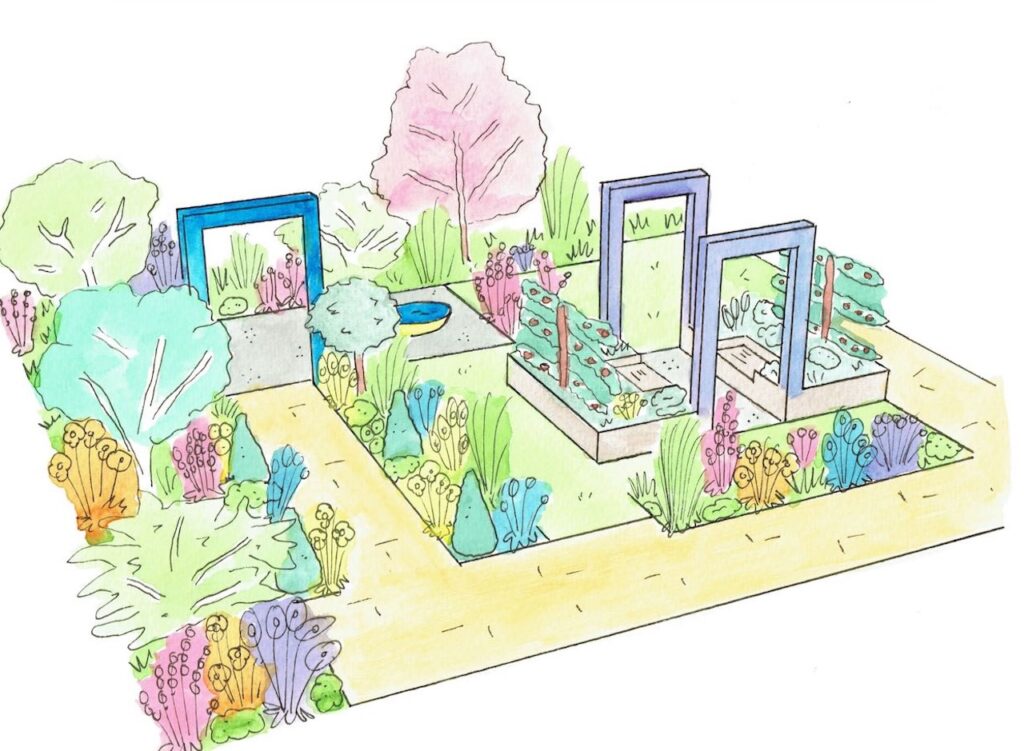
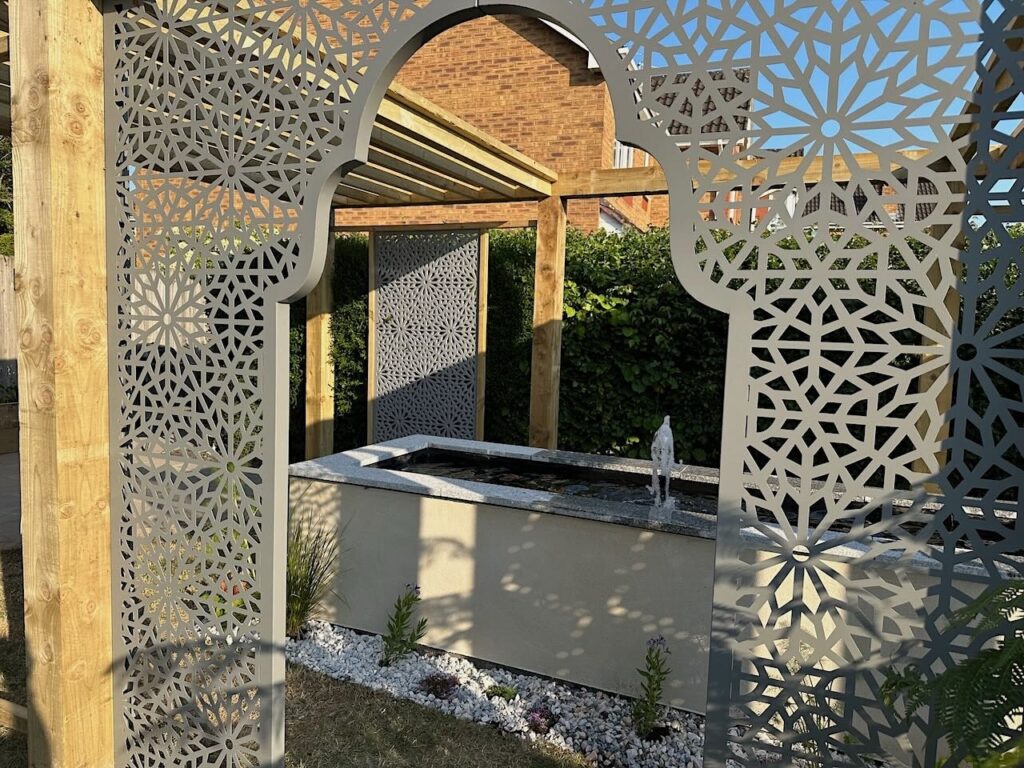
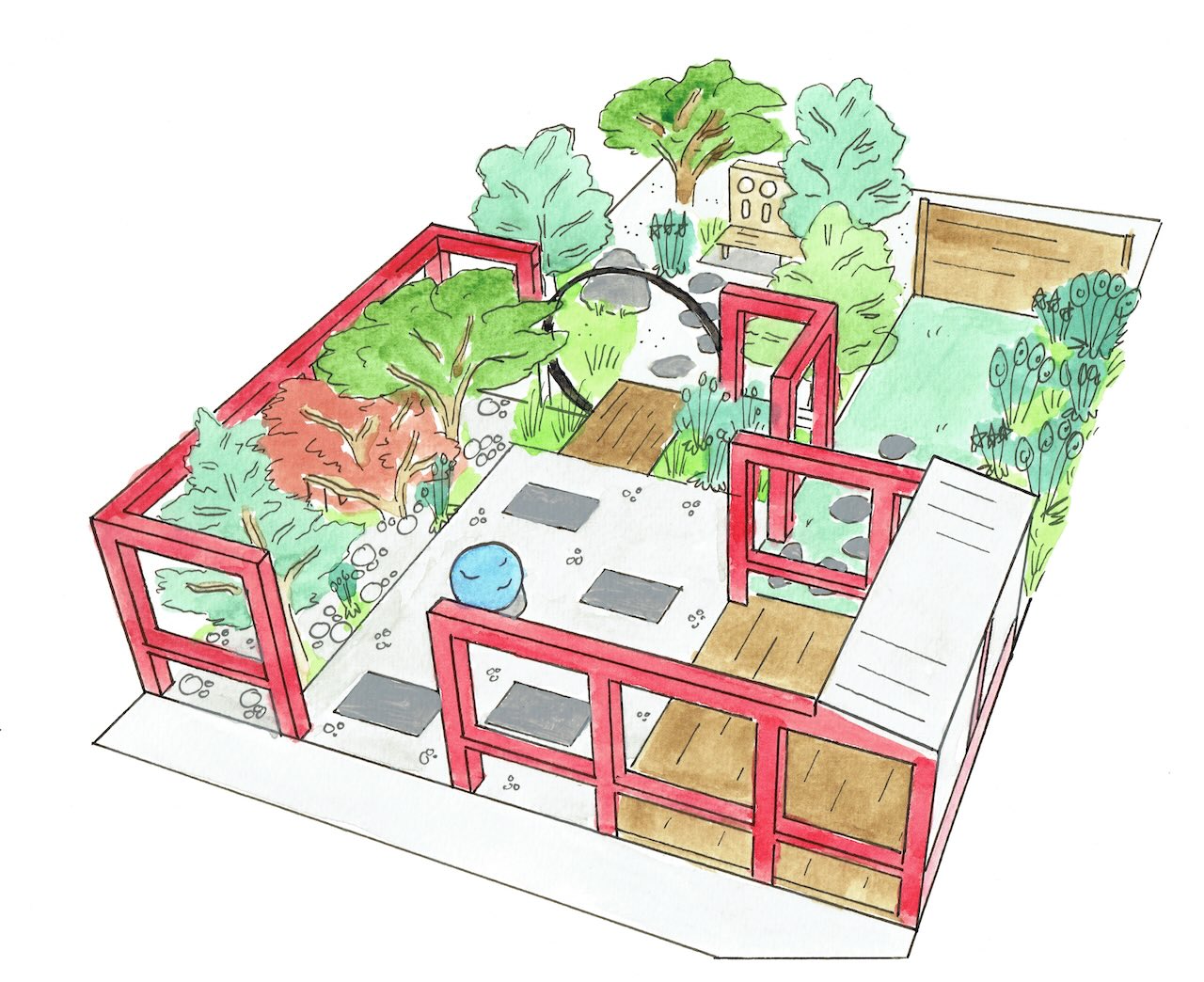
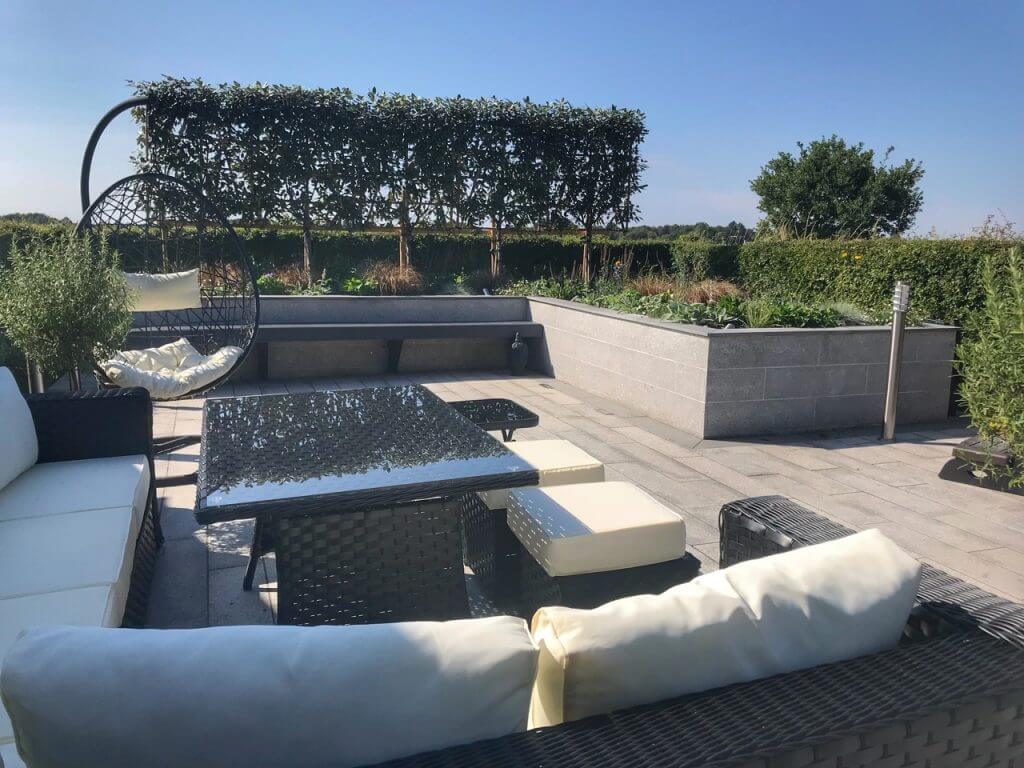
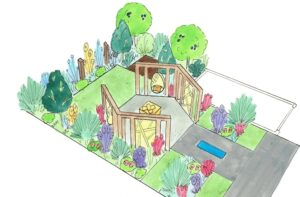
If you’re fortunate enough to have a square garden measuring eight metres per side or larger, you’re working with genuine room to create multiple zones and more ambitious features whilst still maintaining cohesion. These larger squares often occur in older properties or more generous suburban developments where garden space wasn’t quite so ruthlessly minimised. See the modern twist on a Chinese garden design below, and how ambitious yet effective the use of height, screening and zones is?
Larger squares can accommodate focal features that would overwhelm smaller spaces. A small tree positioned off-centre becomes a genuine design anchor, visually dividing the space while adding crucial vertical structure. Water features, substantial pergolas, or even compact summerhouses become viable options, creating destination points within the garden.
For larger squares, consider creating a central seating area and then subdividing the surrounding planted area into distinct character zones. Perhaps Mediterranean-style drought-tolerant planting in the sunniest corner, shade-loving ferns and hostas in the area cast into shadow by neighbouring buildings, and a productive vegetable section where light and soil conditions suit. This variety prevents the larger square from feeling monotonous whilst still maintaining overall cohesion through the central circular focal point.
Your subscription could not be saved. Please try again.
Your subscription has been successful.
Design Layouts That Actually Work in Square Gardens
Theory is all well and good, but what actually works on the ground? Here are three proven layouts I’ve used successfully in square gardens of various sizes, each addressing the fundamental challenge of making squares feel less square whilst remaining practical and beautiful.
The Circular Lawn Layout
This is probably my most used solution for square gardens because it’s elegant, effective, and genuinely transforms how the space feels. The central circular lawn, typically occupying roughly forty to fifty per cent of the total ground area, creates instant contrast with the square boundaries. Surrounding curved borders can then be generously planted with layered perennials, shrubs, and perhaps standard trees that provide vertical interest without overwhelming the space.
The patio area near the house either blends into these curved borders or can be a separate rectangular or curved zone. Pathways around the lawn perimeter give access to all areas whilst creating that crucial visual journey through the garden. This layout works particularly well in overlooked gardens because the circular form draws your eye inward and downward rather than outward towards neighbouring properties.
The Diagonal Drama Layout
For a more contemporary aesthetic or tiny squares where circles might feel cramped, rotating the main design elements 45 degrees creates a remarkable spatial illusion. Your patio sits at an angle to the house, creating interesting triangular planting pockets in the corners. Pathways run diagonally across the space rather than straight back from the door.
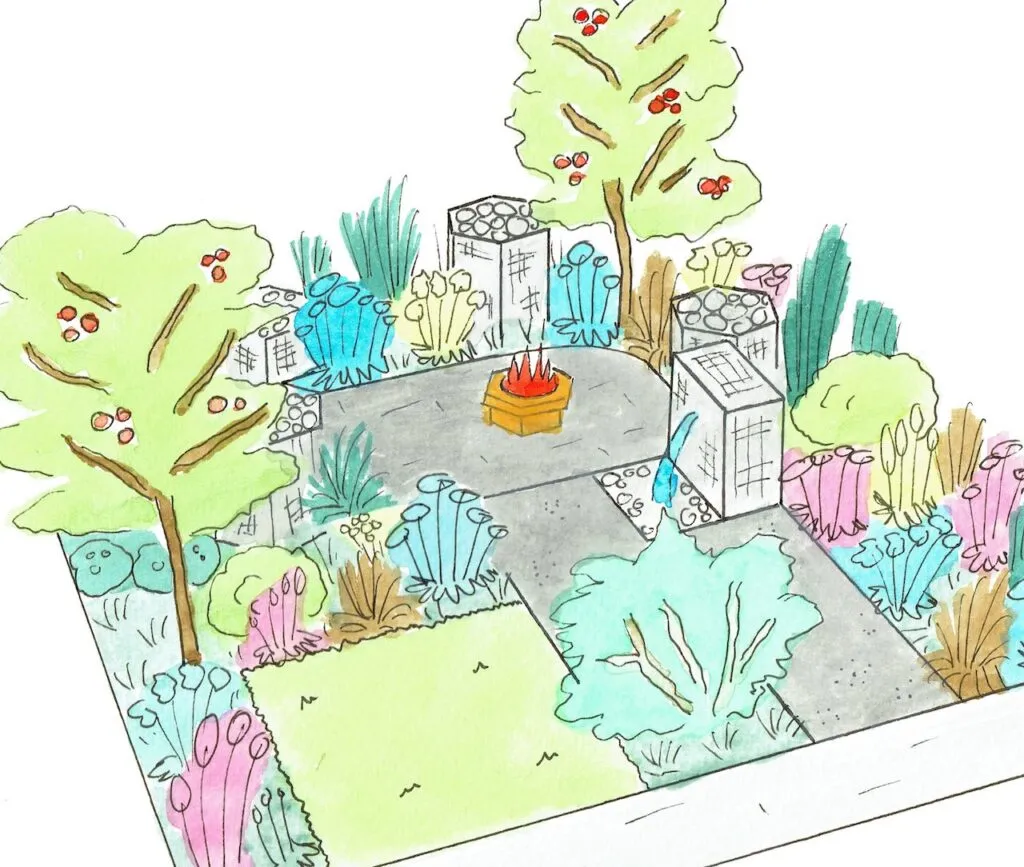
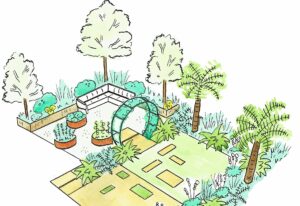
Below is a diagonal path in a tiny garden, illustrating how it alters the journey and the illusion of depth.
This diagonal approach emphasises the longest sight lines in your square, which are corner to corner rather than side to side. Psychologically, this makes the garden feel considerably more spacious. The triangular planting areas in the opposite corners can be planted deeply with tall grasses, architectural perennials, or specimen shrubs that partially screen the boundaries and create layered depth.
The Divided Square Layout
For larger squares or gardens needing distinct functional zones, dividing the square into clearly defined sections using screening, level changes, or material transitions works brilliantly. Imagine splitting your square into two roughly equal rectangles, with the entertaining zone near the house and a more naturalistic or productive zone towards the far end.
The division might be achieved with a low hedge, a pergola with climbers, or even just a change from paving to gravel to grass that signals the transition. This approach prevents the dreaded ‘all visible at once’ problem while creating spaces with different characters and purposes.
I successfully applied this technique in several Garden Rescue transformations where families required distinct areas for dining, children’s play, and adult relaxation within relatively compact spaces.
Planting Strategies for Square Gardens
Getting the planting right in square gardens requires particular attention to scale, layering, and creating sufficient visual interest without veering into chaotic clutter. The planting needs to work hard because you simply don’t have the space for passengers.
Start with structural evergreens that provide year-round presence. In square gardens, I typically position these strategically to break up sight lines and disguise corners rather than dotting them randomly around borders.
A pair of box balls or clipped Photinias on either side of a pathway entrance creates rhythm. A Pittosporum or Viburnum tinus in a corner draws the eye up and softens that ninety-degree angle. These structural plants form the bones of your design that everything else builds upon.
For the borders themselves, layered planting works far better than the old-fashioned approach of tall at the back, short at the front, like a school photo. Instead, create rhythm and movement by allowing some taller plants to come forward whilst pulling lower-growing species back towards the fence.
This creates depth and prevents your borders from reading as flat bands of colour. I go into considerable detail on this layering technique in my Garden Design Examples for Small Gardens course, where thirty complete planting plans demonstrate exactly how to achieve professional-looking combinations.
Resist the urge to use too many different species. In small, square gardens, repetition creates cohesion far more effectively than diversity does, creating interest.
Choose perhaps five to seven reliable perennials suited to your soil type and aspect, then plant them in substantial groups of three, five, or seven specimens. Repeat these groups around the garden in different positions. This repetition unifies the design while preventing the chaotic jumble effect you see in gardens where someone has bought one of everything from the garden centre.
For very small squares, consider a simplified colour palette that creates impact through repetition rather than variety. White and green gardens evoke a sense of spaciousness and sophistication. Purple and silver combinations create drama without chaos. Hot colours like reds, oranges, and yellows energise small spaces but require careful handling to avoid overwhelming them. Whatever palette you choose, commit to it properly rather than hedging your bets with a bit of everything.
Common Square Garden Mistakes to Avoid
I’ve seen the same errors crop up repeatedly in square gardens, and learning from other people’s mistakes is considerably cheaper than making them yourself.
Mistake One: Timid Border Widths
Narrow strip borders running around the edge of your square garden are utterly pointless. They’re too shallow to plant meaningfully, they emphasise rather than disguise the square shape, and they make maintenance awkward.
If you’re going to have borders, make them the proper depth, with a minimum of one metre and ideally more. Bold, generous borders create impact and actually make the remaining central space feel more intentional rather than less.
Mistake Two: Central Lawn Syndrome
Plonking a square lawn in the middle of your square garden and calling it designed is peak laziness. It emphasises the square shape, provides no visual interest, and wastes the opportunity to create something genuinely special. If you want a lawn, make it circular, oval, or interestingly shaped. If you want to stick with a square lawn, at least rotate it forty-five degrees so it’s on the diagonal rather than parallel to the boundaries.
Mistake Three: Furniture That Doesn’t Fit
I cannot tell you how many small square gardens I’ve visited where the patio is too small to comfortably accommodate the furniture the owners actually want to uuse Before you design anything, determine what you want to fit into the space, then ensure your patio or entertaining area is actually large enough.
A dining table and six chairs require a minimum space of roughly three metres by three metres. A sofa set needs a similar dimension. Skimping on these dimensions means your garden doesn’t actually function as intended, regardless of how lovely the planting might be.
Mistake Four: DIY Without Design Knowledge
The biggest mistake is diving straight into implementation without understanding fundamental design principles. I see this constantly with new build gardens, where enthusiastic homeowners start paving and planting before they’ve actually worked out a coherent plan.
The results are gardens that feel disjointed, poorly proportioned, and ultimately unsatisfying to use. This is precisely why I created my comprehensive Garden Design for Beginners course for £199, because proper design training prevents these expensive mistakes and gives you the confidence to create gardens that actually work rather than just hoping for the best.
Making Your Square Garden Work for Your Budget
Small square gardens shouldn’t require unlimited budgets to succeed, despite what glossy magazines might suggest. Some of my most successful transformations have been achieved through clever phasing and strategic investment, rather than throwing money at every aspect at once.
Start with getting the hard landscaping right in your primary entertaining zone. Quality paving or decking, properly installed, will serve you for decades and forms the foundation upon which everything else is built. You can absolutely phase the rest of the garden, installing temporary solutions like bark mulch pathways or leaving areas as lawn until budget allows for upgrading. But skimping on your main patio usually means redoing it within a few years, which ends up costing more in the long run.
For planting, buying small specimens and growing them on is perfectly viable if you’re patient. A three-litre shrub might cost £12 compared to £40 for the same plant in a fifteen-litre pot, and given a couple of seasons, you’ll barely notice the difference.
Perennials are even more forgiving, with small plugs or divided plants establishing quickly in properly prepared soil. I cover budget planting strategies extensively in my online courses because creating beautiful gardens shouldn’t be limited to those with deep pockets.
Learn With Me
If professional design feels financially out of reach, that’s exactly why I developed my online learning platform. My Garden Design for Beginners course at £199 provides comprehensive training on design principles, layout planning, and planting strategies specifically for small spaces, including squares.
You’ll learn the same principles I use professionally, adapted for self-builders working within realistic budgets. Alternatively, my 30 Garden Design Templates course includes multiple square garden designs with complete planting plans you can adapt to your specific plot, taking the guesswork out of creating professional-looking results.
29
Garden Design Examples for Small Gardens: 30 Design Templates & Planting Plans
Garden Design Examples for Small Gardens: 30 Design Templates & Planting Plans: In this online gardening course, I’ll walk you through 30 fantastic garden designs, explaining the logic behind the layout, the plant choices, and take-home tips for applying them in your own garden.
Weekend Garden Makeover: A Crash Course in Design for Beginners
Learn how to transform and design your own garden with Lee Burkhills crash course in garden design. Over 5 hours Lee will teach you how to design your own dream garden. Featuring practical design examples, planting ideas and video guides. Learn how to design your garden in one weekend!
Garden Design for Beginners: Create Your Dream Garden in Just 4 Weeks
Garden Design for Beginners Online Course: If you want to make the career jump to becoming a garden designer or to learn how to design your own garden, this is the beginner course for you. Join me, Lee Burkhill, an award-winning garden designer, as I train you in the art of beautiful garden design.
For those who prefer personalised guidance without the full design service costs, my online garden design consultations, starting at £250, provide expert advice on layout, zoning, and plant selection tailored specifically to your square garden. Sometimes, an hour with an experienced designer at the planning stage can save thousands in implementation mistakes.
Transform Your Square Garden with Confidence
Square gardens might feel like design challenges, but they’re actually opportunities to create something genuinely special that stands out from the predictable patterns most people settle for. Every boring boundary line represents a chance for creative problem solving, and the finished results can be remarkably distinctive and personal in ways that more irregular shapes sometimes struggle to achieve.
The key to success isn’t fighting the square shape; it’s understanding how to work with the geometry while cleverly disguising its boxiness through curves, diagonals, layered planting, and strategic screening. Proper zoning ensures functionality, whilst asymmetric layouts create visual interest that symmetrical arrangements never achieve. These aren’t complex concepts, but they do require an understanding of fundamental design principles, rather than simply copying layouts from Instagram or guessing what might work.
Your square garden is waiting to be transformed. Let’s make it happen!
Your subscription could not be saved. Please try again.
Your subscription has been successful.
Lee Burkhill
Lee Burkhill, known as the Garden Ninja, is an award-winning garden designer and horticulturist with over 30 years of gardening experience and 15 years as a professional garden designer. A qualified RHS (Royal Horticultural Society) professional, Lee specialises in sustainable garden design and practical horticultural advice. He designs and presents on BBC1’s Garden Rescue and in leading gardening publications. Lee combines three decades of hands-on gardening knowledge with professional design qualifications to help gardeners create beautiful, functional outdoor spaces.