Fragrant Flowers for Evening Gardens: 35 Blooms That Release Scent at Dusk
Lee Burkhill: Award Winning Designer & BBC 1's Garden Rescue Presenters Official Blog
Beginner level
Creating an evening garden with night blooming flowers that release perfume at dusk transforms your outdoor space into a sensory sanctuary. This guide covers 35 fragrant plants for UK and US gardens, from moonflower and honeysuckle to evening primrose, chosen for their intoxicating twilight scent and strategic placement near seating areas.
There’s something utterly transformative about a garden at dusk. As the day’s heat subsides and shadows lengthen across borders and pathways, an entirely different sensory experience emerges in our gardens. In my years designing gardens across Britain and consulting internationally, I’ve witnessed countless clients discover the magic of evening fragrance for the first time, and it never fails to enchant!
These aren’t merely plants that happen to smell pleasant; they’re sophisticated species that have evolved to release their perfume specifically as darkness falls, courting night-flying pollinators with invisible tendrils of scent that hang heavy in the cooling air, which means more moths, bats and wildlife for our gardens. Ninjas!
The chemistry behind evening fragrance is rather fascinating. Many of these plants intensify their scent production as temperatures drop and humidity rises, conditions that allow volatile compounds to linger rather than dissipate rapidly in daytime heat.
For gardeners who work during the day and return home as evening approaches, or for those who prefer dining al fresco under the stars, positioning these plants near seating areas, along pathways, or beside bedroom windows creates an immersive experience that daytime bloomers cannot match.
This isn’t about filling every corner with fragrance; instead, it’s about strategic placement that rewards you precisely when you’re most likely to appreciate it.
This page contains affiliate links for products I use and love. If you take action (i.e. subscribe, make a purchase) after clicking a link, I may earn some gardening commission which helps me keep the Garden Ninja Blog free for all.
Why Evening Fragrance Matters in Garden Design
Evening fragrant plants also serve a practical purpose beyond their purely aesthetic value. In smaller urban gardens where space is at a premium, selecting plants that offer dual value through both visual appeal and nocturnal scent maximises every square metre. Moreover, pale-flowered evening bloomers create luminous focal points that seem to glow against darkening foliage, providing structure and interest even when colour perception fades.
The multisensory aspect cannot be overstated; whilst we rely heavily on vision during daylight, scent becomes the dominant sense after dark, creating memories and emotional responses that purely visual plantings rarely achieve. So let me show you my favourite plants that have heavy nocturnal scent for night owl gardeners!
Classic Evening Blooming Plants
1. Night Scented Stock (Matthiola longipetala bicornis)
This remains one of my most frequently specified plants despite its relatively modest daytime appearance. The single flowers close during daylight, looking frankly disappointing, but as dusk arrives, they open to release an extraordinarily powerful clove-like fragrance that carries across entire gardens. This annual self-seeds reliably if you’re patient, returning year after year once established. As someone who has specified hundreds of planting schemes on Garden Rescue and in private commissions, I can tell you that no single plant delivers more evening impact for less outlay than this unassuming annual. Sow it generously and it will reward you beyond all expectation.
🌿 Lee’s Expert Tip
On Garden Rescue I always recommend sowing night scented stock directly where it is to grow, in drifts along pathway edges or immediately beneath open windows. The flowers look quite bedraggled by day, so I pair them with day-flowering companions such as California poppy or cornflower, giving the border continuous colour whilst the stock quietly waits for its evening performance. Once established in a favoured spot it will self-seed reliably, so your original few pence worth of seeds becomes a permanent planting.
Growing Tips: Sow in drifts near doorways or beneath windows where its scent can waft indoors on warm summer evenings. Prefers full sun with well-drained soil. Tolerates poor soil conditions remarkably well. Direct sow in spring after the last frost or autumn for earlier flowering.
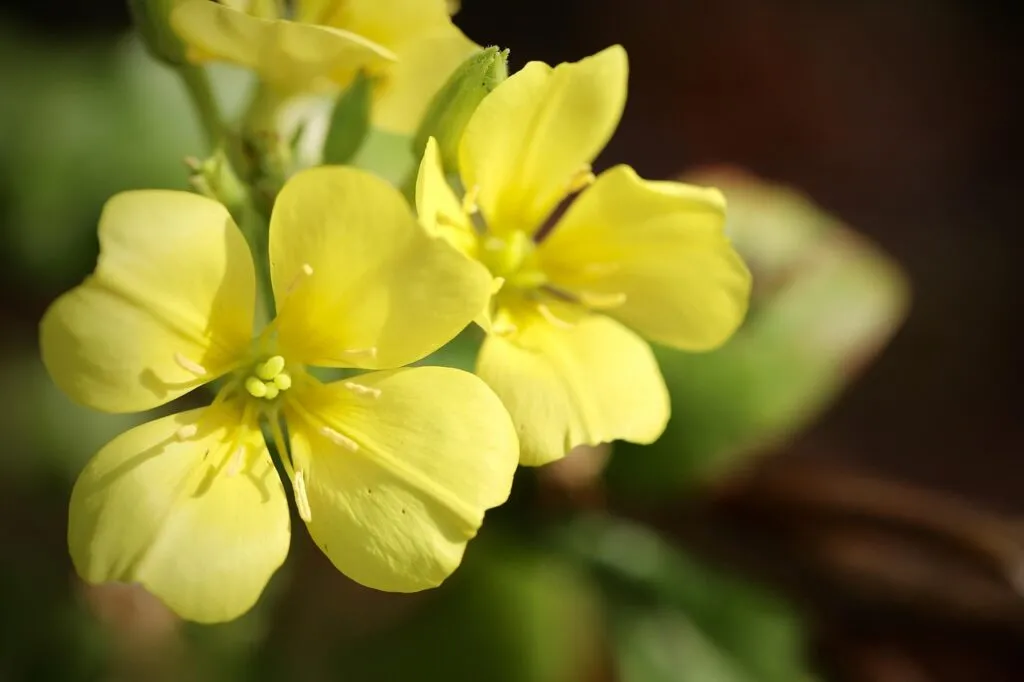
2. Evening Primrose (Oenothera biennis)
🌙 Evening Primrose at a Glance
Ultimate Height
120cm
Spread
45cm
Flowering Period
June to September
RHS Hardiness
H6 (hardy across UK including most of Scotland)
Position
Full sun, poor to average well-drained soil
Wildlife Value
Outstanding for hawkmoths; nectar-rich for bees
This biennial offers both visual drama and fragrance as its luminous yellow flowers unfurl rapidly at dusk, sometimes visibly opening before your eyes. The sweet, lemony scent attracts hawkmoths, and watching these extraordinary pollinators hover and feed adds another dimension to the evening garden experience. It naturalises beautifully in gravel gardens and prairie-style plantings. The flowers produced each evening last only until the following morning, but each stem carries numerous buds that open in succession over many weeks, giving you a surprisingly long display from a single plant.
🌿 Lee’s Expert Tip
The key with evening primrose is to plant it where its rather coarse first-year rosette is hidden by neighbouring plants. Position it at the back of a gravel border behind lower-growing perennials, where it will rocket up through them in its second year to produce that spectacular flowering column. If you’re creating a wildlife garden, this is arguably the single most valuable plant you can introduce for moths alone.
Growing Tips: Prefers full sun and tolerates poor, dry soils admirably, making it ideal for challenging sites where more demanding plants struggle. Allow to self-seed freely, but remove unwanted seedlings promptly as it can become invasive in ideal conditions. This night-scented specimen flowers in its second year from seed.
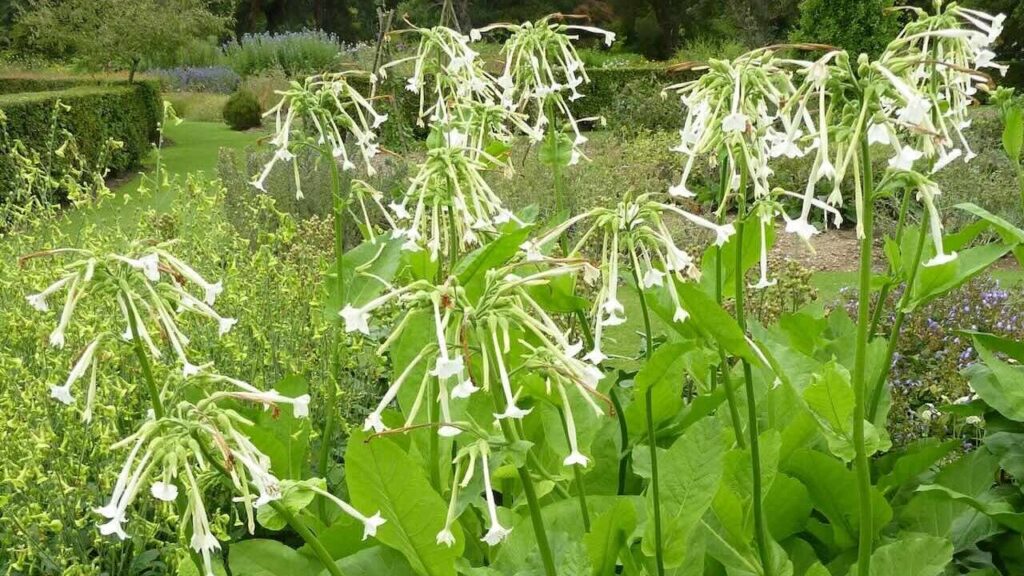
This architectural giant produces magnificent drooping white trumpet flowers that release their intoxicating fragrance as evening approaches. The sheer scale of this plant makes it a stunning focal point, creating presence in borders or large containers. Each flower emits a sweet perfume that carries remarkably well across the garden. I’ve used Nicotiana sylvestris on numerous Garden Rescue projects where clients wanted a dramatic, instantly recognisable presence in a new planting scheme, particularly against dark-painted fences or walls where those white trumpets absolutely gleam in low evening light.
🌿 Lee’s Expert Tip
Nicotiana sylvestris is one of those plants that genuinely stops visitors in their tracks when they encounter it for the first time at dusk. Use it as a bold architectural statement in large pots flanking a seating area or dining space, or planted in groups of three towards the back of a border. The key is positioning it where you’ll actually be sitting or passing during the evening hours, as the fragrance is so good that wasting it on an unvisited corner of the garden feels like a genuine missed opportunity.
Growing Tips: Position where fragrance can be appreciated up close, perhaps in large containers flanking seating areas or doorways. Prefers partial shade to full sun and consistently moist, fertile soil. Deadhead regularly to prolong flowering. Readily self-seeds in favourable conditions.
4. Flowering Tobacco (Nicotiana alata)
🌙 Nicotiana alata at a Glance
Ultimate Height
60 to 90cm
Spread
30cm
Flowering Period
June to October
RHS Hardiness
H2 (grow as annual in UK)
Position
Full sun to partial shade, moist fertile soil
Wildlife Value
Good for moths and hummingbird hawkmoths
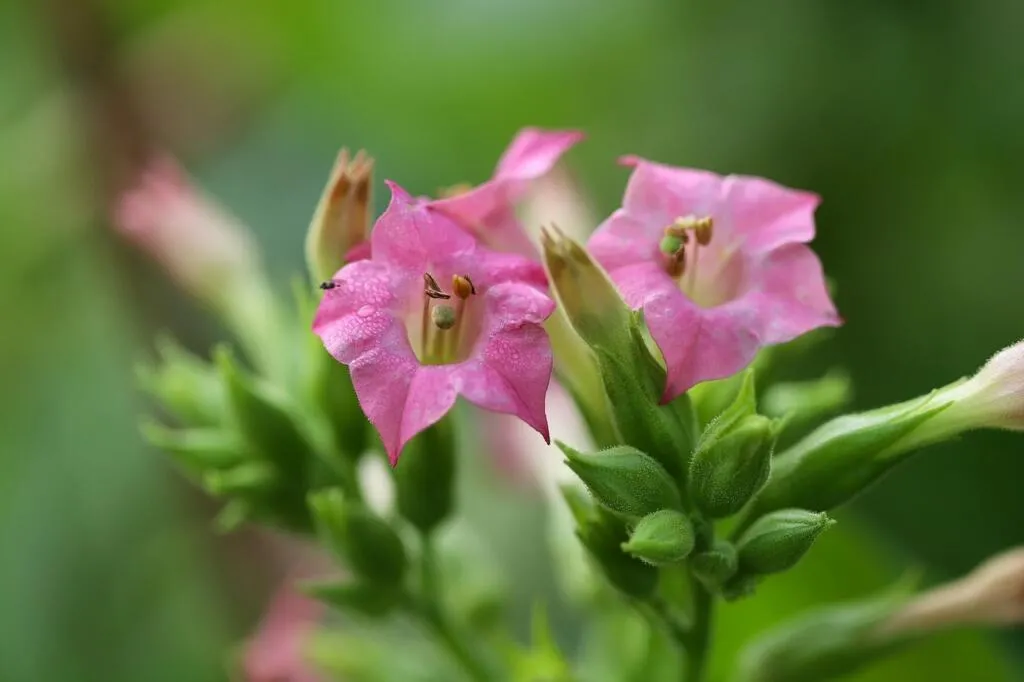
This more compact species offers a broader colour range than its taller cousin, with varieties in white, pink, lime green, and burgundy. The tubular flowers open fully as evening approaches, releasing their sweet fragrance most powerfully after dusk. Modern hybrids bred for day-opening flowers often sacrifice fragrance, so seek out older varieties or those specifically described as fragrant. The original species form, with its blowsy white flowers, remains the most powerfully scented and is infinitely preferable for an evening garden.
🌿 Lee’s Expert Tip
A word of caution for Ninjas wanting Nicotiana alata: always read the description carefully before purchasing. Many modern seed catalogues now sell compact, day-opening varieties that have been bred for bedding displays but have entirely lost their evening fragrance in the process. Look specifically for the species form or for varieties described as “fragrant” or “evening-scented” and you won’t be disappointed.
Growing Tips: Thrives in partial shade as well as full sun, making it versatile for various garden situations. Keep consistently moist and feed regularly for prolonged flowering from June through October. Excellent in containers that allow for easy movement, enabling experimentation with fragrance placement.
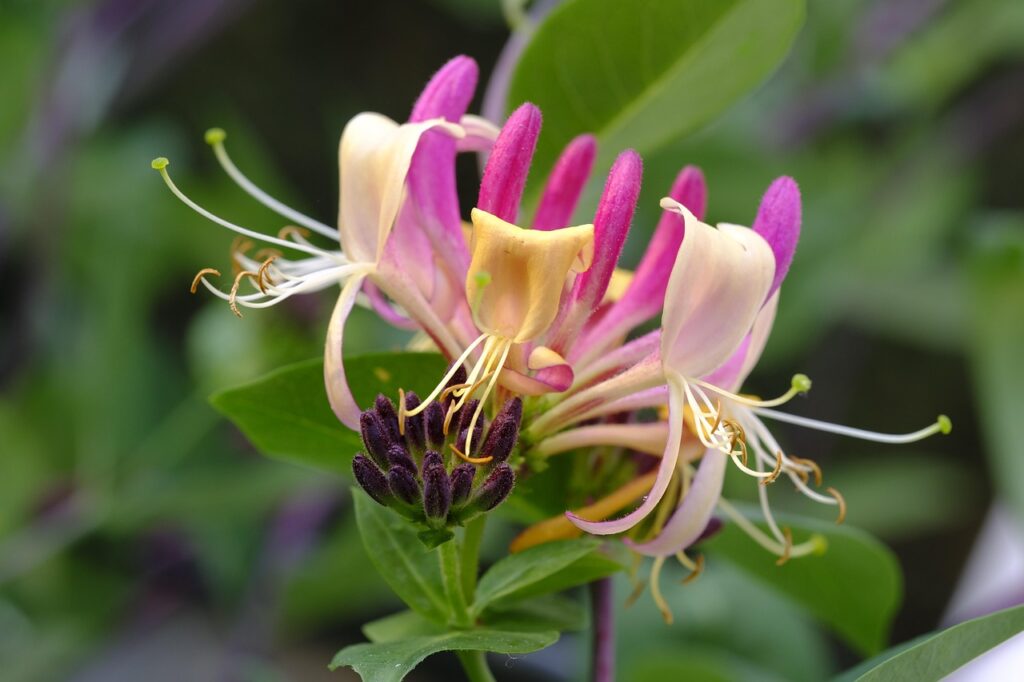
Britain’s most beloved evening-scented climber produces creamy yellow and pink tubular flowers whose fragrance intensifies dramatically as light fades. Our native woodbine thrives in partial shade, making it perfect for north-facing walls and fences where few other fragrant climbers prosper. I often specify late Dutch honeysuckle (variety ‘Serotina’) for its exceptionally long flowering period, which extends from June through October. Honeysuckle holds a special place in the British garden design tradition, and rightly so; no other climber delivers such generosity of scent for such modest demands in return.
🌿 Lee’s Expert Tip
The classic mistake with honeysuckle is planting it in full sun with the roots baking dry. Think of where you find it in the wild, scrambling up through hedgerows with its feet in cool shade and its flowering tops in sunlight. Replicate this by planting a low-growing perennial at the base to shade the root zone, and your honeysuckle will reward you with dramatically improved vigour, flowering and fragrance. Mulching roots generously each spring also makes a significant difference.
Growing Tips: Plant with roots in shade and growth in sun for best performance. Requires initial support but becomes self-supporting on textured surfaces. Mulch roots well to keep cool. Prune after flowering to control size, cutting back flowered shoots to strong buds.
6. Common Jasmine (Jasminum officinale)
🌙 Common Jasmine at a Glance
Ultimate Height
12m
Spread
3m
Flowering Period
June to September
RHS Hardiness
H4 (hardy in most UK, protect in colder regions)
Position
Full sun, well-drained soil, sheltered aspect
Wildlife Value
Good for moths, bees and butterflies
This semi-evergreen climber produces clusters of starry white flowers whose almost overwhelming sweetness epitomises summer evenings. The fragrance carries remarkably well, and a single established plant can perfume an entire small garden. In colder regions, growing jasmine in a large container that can be moved to a sheltered position during winter significantly extends its range. Given an established south or west-facing wall in a sheltered garden, jasmine will grow with extraordinary vigour and become one of the most rewarding plants you’ll ever grow.
🌿 Lee’s Expert Tip
Jasmine grown on a warm south-facing wall will absolutely romp away once established, so provide a robust framework of horizontal wires at 30cm spacing from the outset. I’ve seen mature plants pull down poorly fixed trellis panels under their own weight, creating considerable damage to both plant and fence. Invest in proper eye bolts and tensioned wire from the beginning and you’ll have a plant that gives you decades of pleasure.
Growing Tips: Requires full sun and well-drained soil, performing best when its roots are shaded but its upper growth receives maximum light. Provide sturdy support as mature plants become heavy. Prune after flowering to maintain shape. Protect roots with winter mulch in borderline areas.
7. Moonflower (Ipomoea alba)
🌙 Moonflower at a Glance
Ultimate Height
4.5m
Spread
1.5m
Flowering Period
July to October (in UK)
RHS Hardiness
H1C (tender annual, grow under glass initially)
Position
Full sun, rich well-drained soil, sheltered spot
Wildlife Value
Exceptional for hawkmoths, especially convolvulus hawk-moth
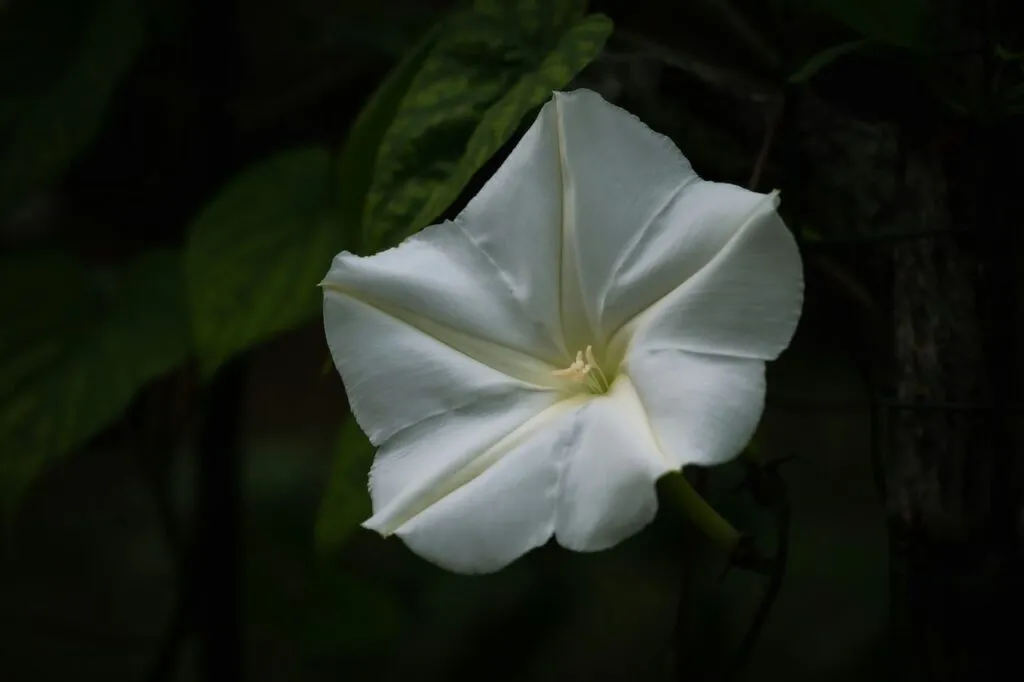
This offers one of the most spectacular evening garden performances I know. The enormous white trumpet flowers, reaching 15 centimetres across, unfurl as darkness falls, their opening almost audible in the stillness. The heavy, sweet fragrance attracts hawkmoths, and the pure white blooms seem to glow luminously against dark foliage. Moonflower requires more effort than many plants on this list, but when you witness those enormous blooms opening one by one as you sit outside on a warm summer evening, you’ll understand entirely why the effort is worthwhile.
🌿 Lee’s Expert Tip
The hard seed coat of moonflower genuinely needs help. Soak seeds in tepid water for 24 hours before sowing, or gently nick the seed coat with a nail file on the opposite side from the eye. Start seeds indoors in late April in a heated propagator at 20°C minimum, and don’t plant out until the soil has genuinely warmed in early June. Moonflower resents cold soil far more than cold air, so this timing makes a significant difference to performance.
Growing Tips: Demands full sun, rich soil, and consistent moisture. Grows rapidly in warm weather, so provide strong support from the outset. Soak seeds overnight before sowing or nick the hard seed coat. Excellent grown up obelisks or tripods near seating areas for maximum impact.
Partial shade, neutral to alkaline well-drained soil
Wildlife Value
Good for early bees and butterflies
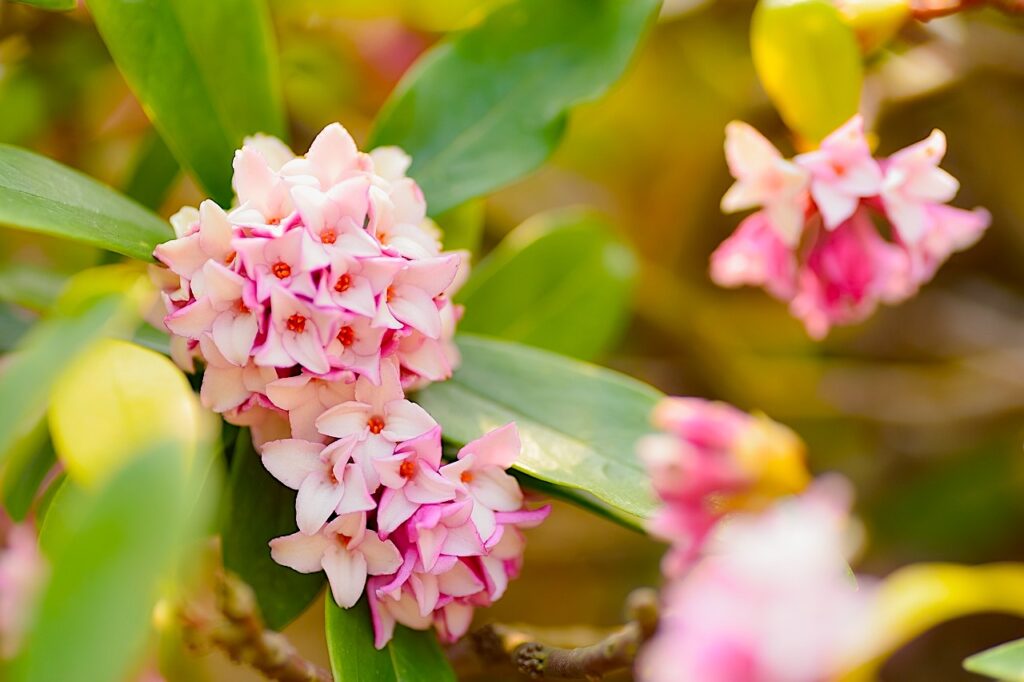
This semi-evergreen shrub delivers intense fragrance from surprisingly diminutive flowers in late spring and often again in autumn. The scent becomes particularly pronounced on still evenings, carrying across considerable distances despite the small size of the flowers. Pink-tinged white flowers appear in clusters, followed by toxic red berries if consumed. What makes Daphne so special in design terms is that unlike many fragrant shrubs, it remains a compact, well-behaved shape that fits comfortably into even the smallest garden without ever demanding the attention that its fragrance power alone would seem to require.
🌿 Lee’s Expert Tip
Daphne is a plant that absolutely resents being moved. Choose its position with care before planting, incorporating plenty of grit into heavy soils, and then leave it entirely alone. I have seen many a client kill an established Daphne by trying to transplant it when it had grown slightly larger than anticipated. Treat it like a permanent resident from day one, give it excellent drainage and neutral to alkaline soil, and it will reward you with fragrance that few other shrubs can match.
⚠️ Toxicity Warning
All parts of Daphne are highly toxic if ingested, including the berries which can be attractive to children. Position with care in gardens where young children play unsupervised, and wash hands after handling the plant. This applies to all Daphne species.
Growing Tips: Demands excellent drainage and resents root disturbance, so position carefully from the outset. Place plants near paths or doorways where their fragrance rewards daily passage. Prefers partial shade and neutral to alkaline soil. Add grit to heavy soils and never cultivate around the roots.
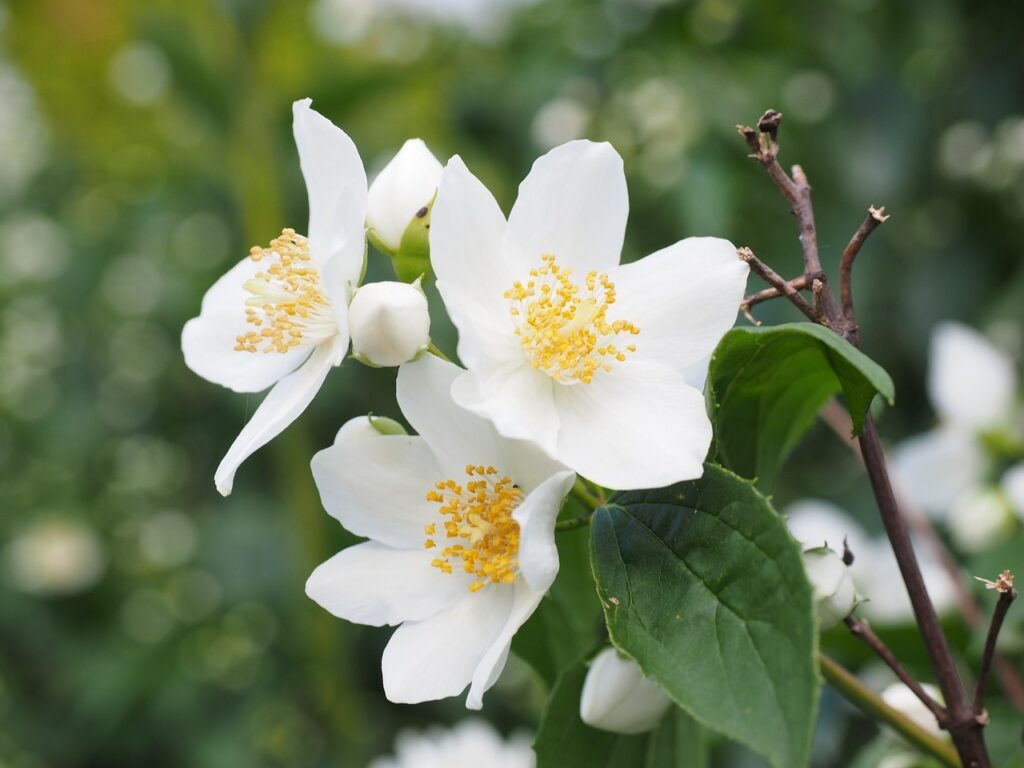
This compact variety produces creamy white flowers with subtle maroon centres whose orange blossom fragrance intensifies as evening approaches. These deciduous shrubs flower prolifically in June, creating clouds of fragrance that define early summer evenings. The arching branches create an elegant framework even when not in flower. Belle Étoile’ is my preferred Philadelphus cultivar for smaller gardens, combining a manageable mature size with scent that rivals any of the larger, more vigorous forms.
🌿 Lee’s Expert Tip
Mock orange suffers considerably from poor pruning technique, and the results set clients back several years of flowering. Prune immediately after flowering by removing up to one-third of the oldest stems down to ground level. Do not cut all the stems back by a third, which is a common mistake; instead, selectively remove entire old stems to encourage fresh young growth. Pruning at the wrong time, meaning in spring or late summer, removes the flower buds entirely and you’ll be waiting another year.
Growing Tips: Tolerates a wide range of soil conditions and garden aspects, though flowering proves most prolific in full sun. After flowering, the rather plain foliage benefits from being surrounded by later-blooming perennials. Prune immediately after flowering, removing the oldest stems to ground level to encourage vigorous new growth.
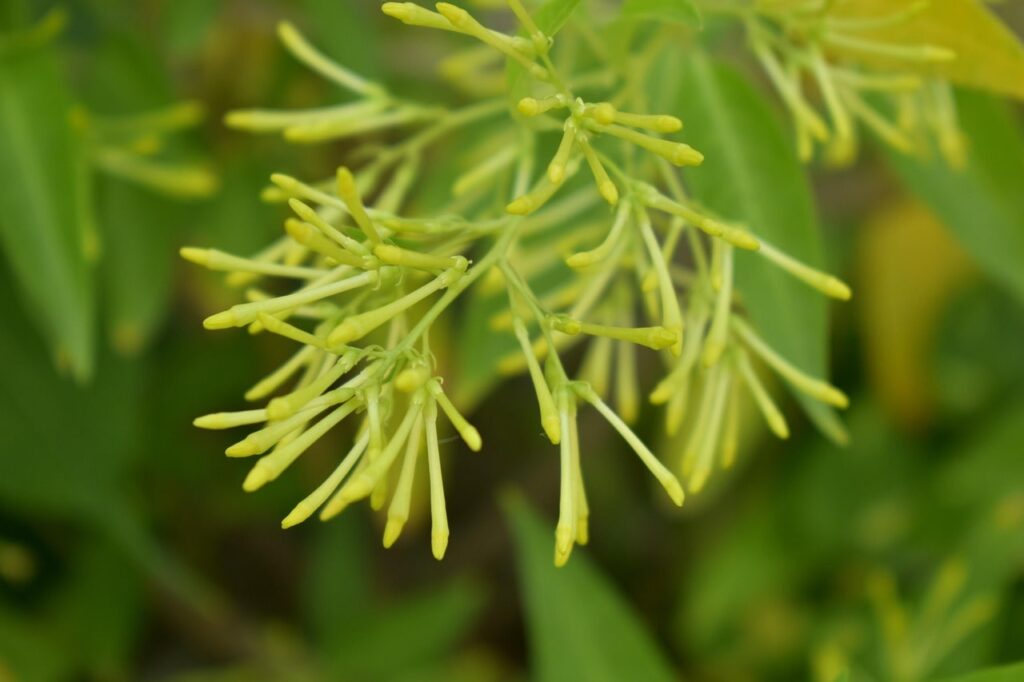
10. Night Blooming Jasmine (Cestrum nocturnum)
🌙 Night Blooming Jasmine at a Glance
Ultimate Height
3m
Spread
2m
Flowering Period
Summer and autumn (repeatedly)
RHS Hardiness
H1C (frost-free protection required in UK)
Position
Full sun to light shade, rich well-drained soil
Wildlife Value
Good for night-flying moths in warm climates
This tender shrub produces inconspicuous, greenish-white, tubular flowers that belie their potent fragrance. Native to the West Indies, the scent, often described as overwhelmingly sweet, polarises opinion; some find it intoxicating, whilst others consider it cloying. It flowers repeatedly throughout summer and autumn in warm climates. In my experience designing conservatories and garden rooms, Cestrum nocturnum is the plant that consistently generates the most comment from guests, for both good reasons and the occasional complaint about its intensity.
🌿 Lee’s Expert Tip
Cestrum nocturnum works beautifully as a conservatory or garden room plant in the UK, where it can be kept just frost-free over winter and moved outside to a sheltered patio in a large container from late May. The fragrance within an enclosed space can be extraordinary on a warm evening. My advice is always to position it where you can close a door or window if the scent becomes too intense, as a little goes a very long way.
Growing Tips: Requires greenhouse or conservatory protection in cooler climates. Position them at a distance from seating areas initially, allowing you to adjust your location based on personal preference. Prefers rich, well-drained soil in full sun to light shade. Prune in spring to maintain a compact shape and encourage flowering.
Border Perennials and Bulbs
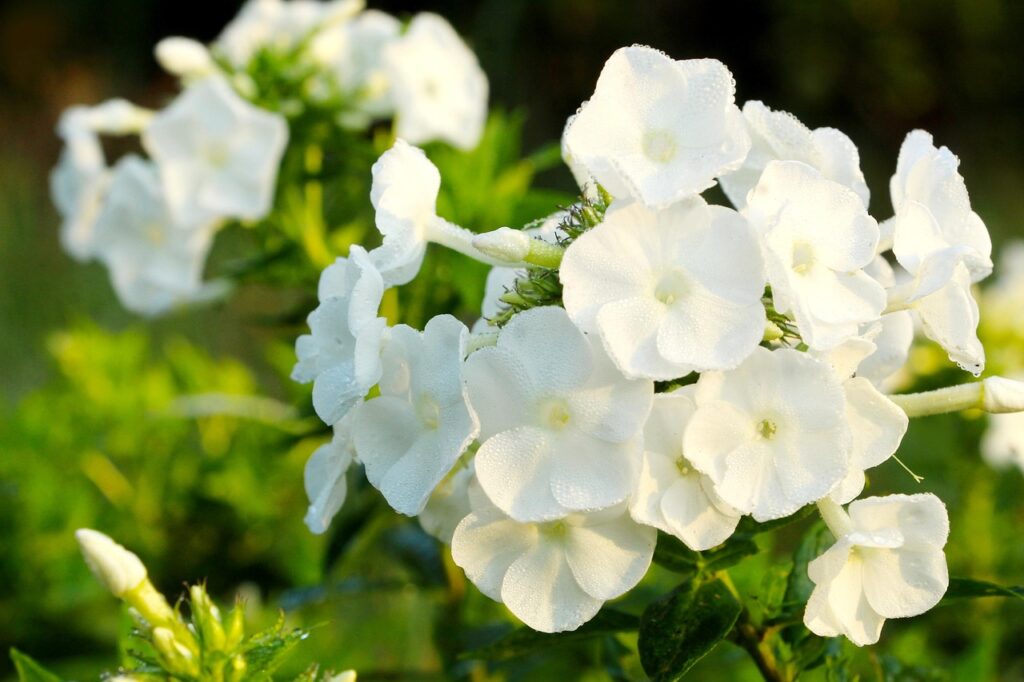
11. Garden Phlox (Phlox paniculata ‘David’)
🌙 Garden Phlox at a Glance
Ultimate Height
90 to 120cm
Spread
60cm
Flowering Period
July to September
RHS Hardiness
H6 (very hardy throughout UK)
Position
Full sun to partial shade, moist fertile soil
Wildlife Value
Excellent for butterflies and night-flying moths
This classic border perennial boasts impressive, pure white flower heads and a sweet, honey-like fragrance that intensifies as evening approaches. ‘David’ combines excellent mildew resistance with reliable fragrance and vigorous growth. The flower heads attract butterflies by day and release their scent most powerfully during evening hours. I specify ‘David’ over all other white Phlox because its mildew resistance means it looks genuinely good from July through to September, rather than developing that characteristic chalky white coating on the foliage that ruins the appearance of less-resistant forms.
🌿 Lee’s Expert Tip
Phlox paniculata in general is a moisture-hungry plant, and the biggest mistake I see is planting it in dry, impoverished soil and then wondering why it struggles. Incorporate generous quantities of well-rotted organic matter before planting, mulch heavily each spring, and water during dry spells. Division every three to four years in autumn or early spring is also essential to maintain flowering vigour; old, congested crowns produce fewer, smaller flower heads.
Growing Tips: Demands consistently moist, fertile soil and benefits from division every three to four years. Position in middle of borders where height provides structure and fragrance can waft across lower plantings. Deadhead regularly to prolong flowering. Mulch well to retain moisture and feed monthly during growing season.
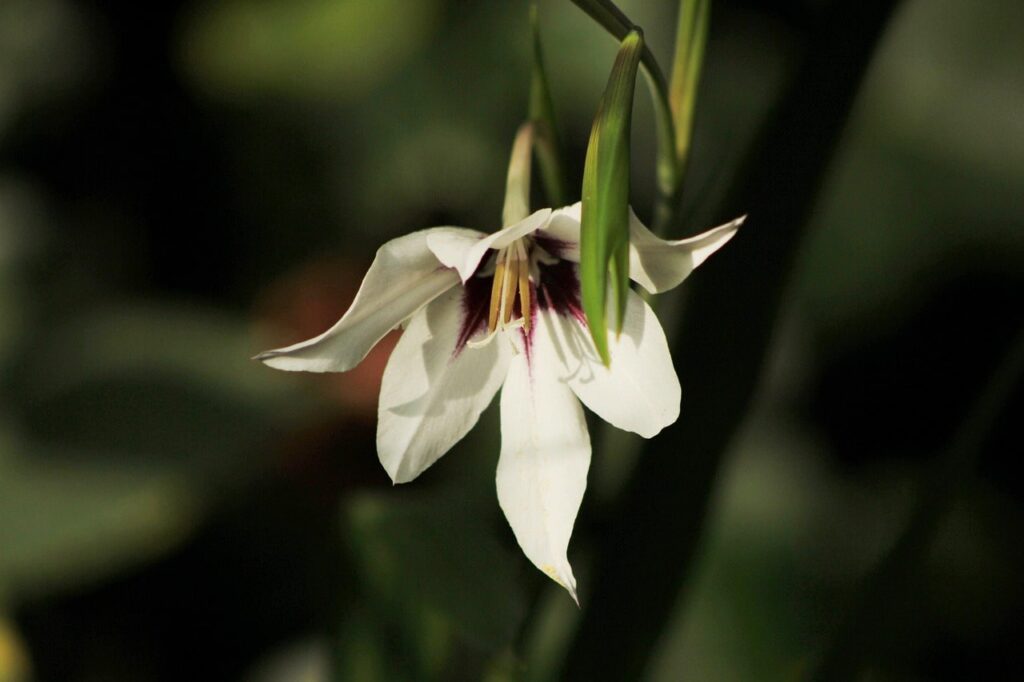
12. Peacock Orchid (Gladiolus callianthus)
🌙 Peacock Orchid at a Glance
Ultimate Height
60 to 90cm
Spread
15cm
Flowering Period
August to October
RHS Hardiness
H3 (lift and store over winter in most UK regions)
Position
Full sun, well-drained soil
Wildlife Value
Good for late-season moths and bees
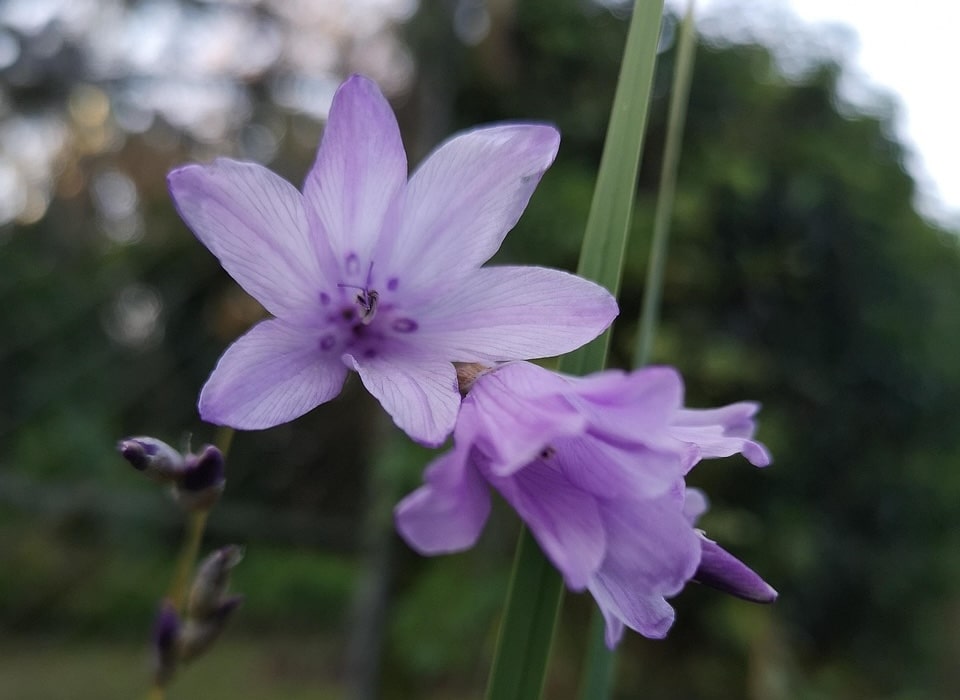
This elegant plant offers white flowers with dramatic purple centres and a sweet fragrance that releases primarily during evening hours, distinguishing it from most gladiolus species. The gracefully arching stems bear multiple flowers that open in succession, extending the display over several weeks. Formerly classified as Acidanthera, these distinctive blooms add exotic elegance to late summer borders. The peacock orchid brings something genuinely different to the evening garden: a refined, almost orchid-like quality that sits beautifully alongside other late-season performers such as Hedychium and Agapanthus.
🌿 Lee’s Expert Tip
Plant corms in a group of at least twelve for proper visual impact, not the small clusters of three or five that look lost in a border. The relatively slender stems mean the foliage is not particularly ornamental, so position peacock orchids where neighbouring late-summer perennials can mask the lower growth whilst allowing the flower spikes to emerge above them. In most UK regions, lift corms after the first frost, dry thoroughly, and store in paper bags in a frost-free shed for replanting the following May.
Growing Tips: Plant corms in groups of at least a dozen for visual impact. Position where fragrance can be appreciated but rather untidy foliage can be concealed by neighbouring plants. Requires lifting and winter storage in colder regions. Plant 10cm deep in spring once soil has warmed.
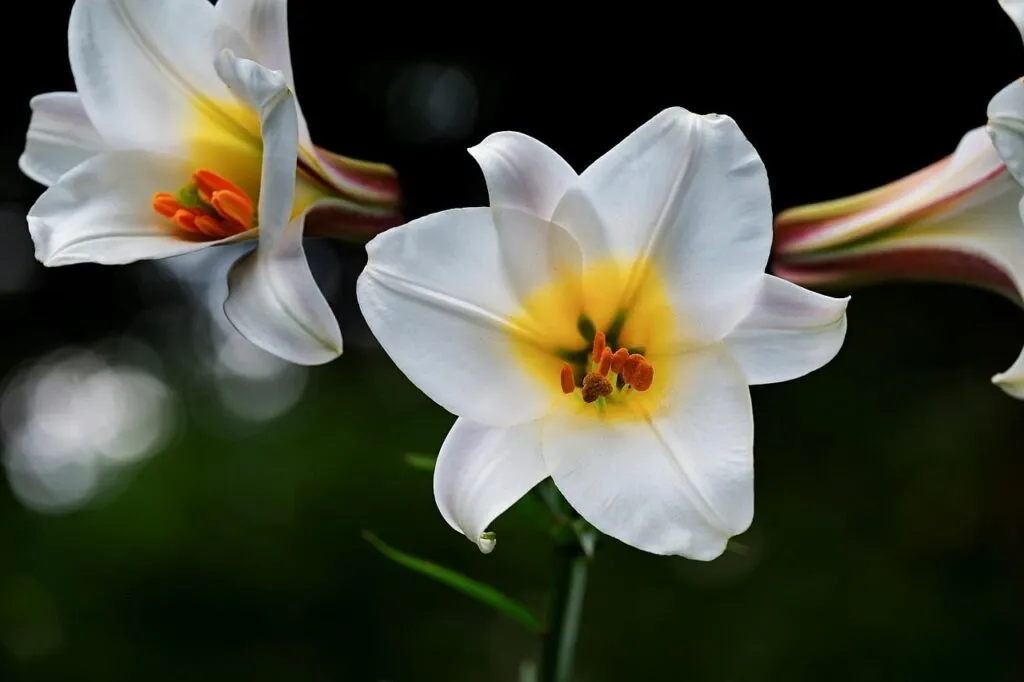
13. Regal Lily (Lilium regale)
🌙 Regal Lily at a Glance
Ultimate Height
90 to 150cm
Spread
30cm
Flowering Period
July
RHS Hardiness
H6 (very hardy throughout UK)
Position
Full sun to light shade, well-drained enriched soil
Wildlife Value
Excellent for hawkmoths and bumblebees
This trumpet lily offers a sweeter, more refined fragrance than oriental hybrids and greater hardiness. The large white trumpets with golden yellow centres and purple-pink exteriors create stunning focal points whilst releasing their powerful perfume most intensely as temperatures cool. Each stem carries multiple flowers that open in succession. Lilium regale is one of the great classic garden plants of the twentieth century, and its combination of extraordinary hardiness, reliable performance and jaw-dropping fragrance makes it, in my view, the single most essential lily for UK gardens. Plant it in generous groups for maximum impact.
🌿 Lee’s Expert Tip
The cardinal rule with all lilies, and Lilium regale especially, is to plant them deeply: 15cm of soil above the top of the bulb is the minimum. Deep planting protects against both frost and the virus that devastates shallow-planted lily collections, whilst also allowing the stem roots that form above the bulb to draw additional nutrients. Plant bulbs of five or seven together for a genuinely impressive display, positioning them upwind of where you’ll be sitting on summer evenings.
Growing Tips: Plant in groups of three to five bulbs for maximum fragrance impact, positioning upwind of seating areas. Demands well-drained soil enriched with organic matter. Plant bulbs 15cm deep among low-growing perennials that shade the roots while allowing the stems to grow through. Stake tall varieties before they need it.
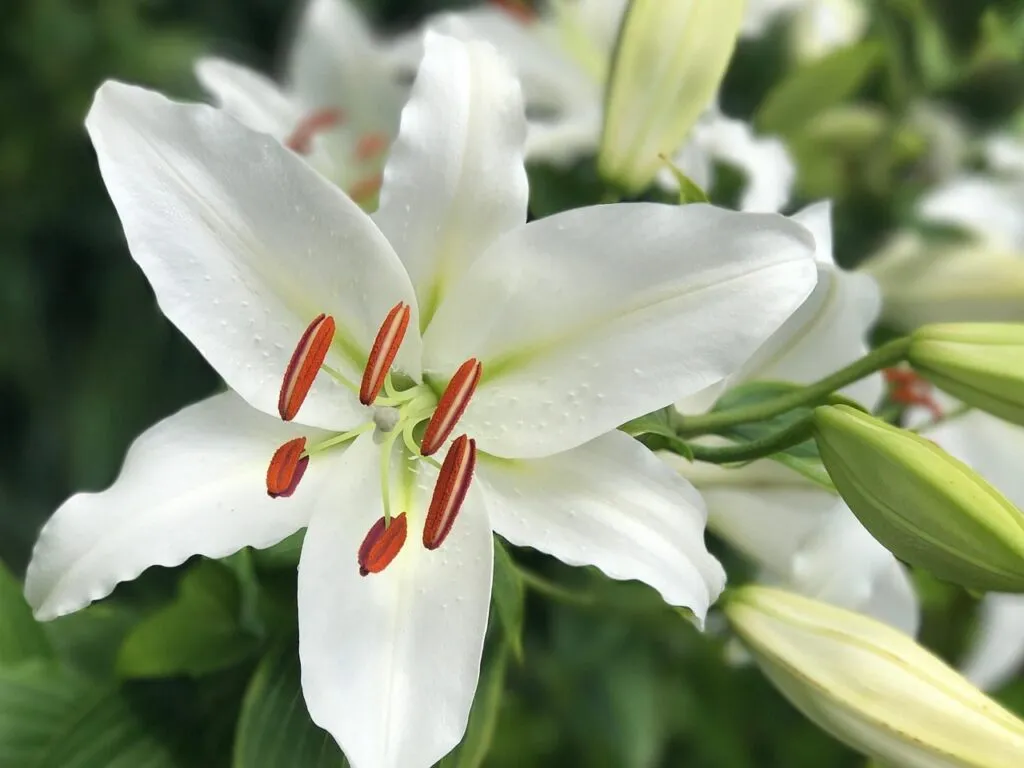
These enormous pure white flowers release their heavy, exotic perfume most intensely as temperatures cool. The fragrance is more opulent and complex than trumpet lilies, with a heady sweetness that some find overwhelming. Each flower reaches 20 centimetres across, creating spectacular focal points in borders or containers. ‘Casa Blanca’ represents the pinnacle of the white oriental lily, combining the largest flower size with a perfume so potent that a single container planted with three bulbs, positioned near a garden dining table, will fragrance your entire evening meal.
🌿 Lee’s Expert Tip
Oriental lilies are significantly more demanding than trumpet lilies, and they absolutely detest lime. If your soil is alkaline, grow them exclusively in containers using an ericaceous compost mixed with sharp grit at a ratio of three to one. Feed with a high-potash tomato fertiliser once flower buds appear, switching to a balanced liquid feed once flowering is over to help build the bulb for the following year. Red lily beetle is your primary pest concern; check plants weekly from April onwards and remove adults and larvae by hand.
Growing Tips: Requires a sheltered position and well-drained, slightly acidic soil enriched with leafmould. Plant 20cm deep and mulch well. Deadhead spent flowers, but allow foliage to die back naturally. In containers, use loam-based compost with added grit. Feed with high-potash fertiliser once flower buds appear.
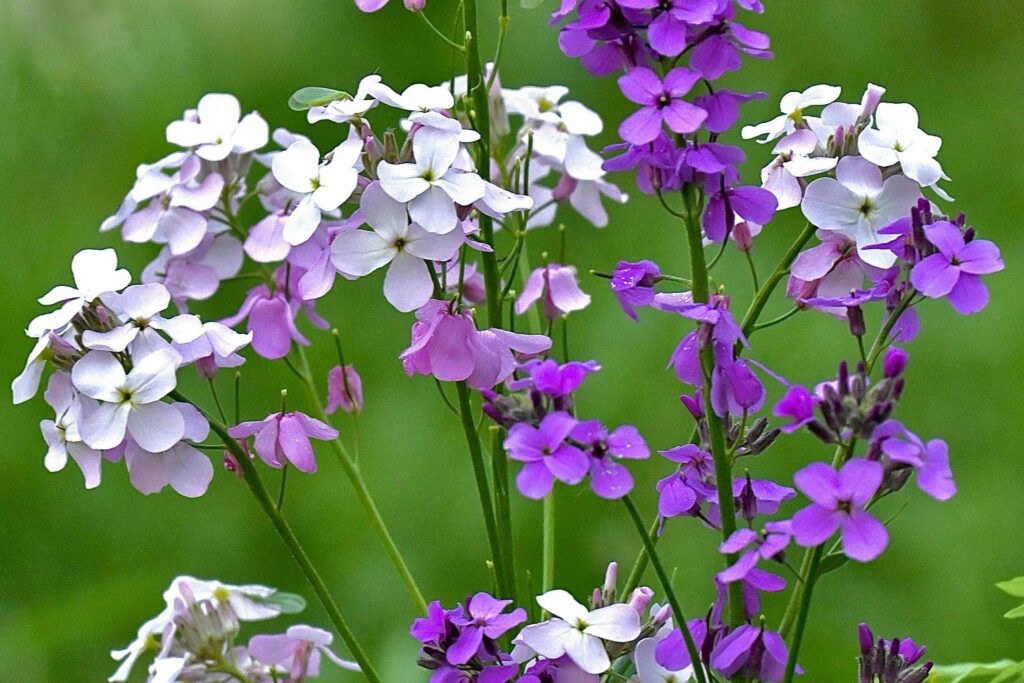
15. Sweet Rocket (Hesperis matronalis)
🌙 Sweet Rocket at a Glance
Ultimate Height
90cm
Spread
45cm
Flowering Period
May to July
RHS Hardiness
H7 (fully hardy throughout UK and Ireland)
Position
Full sun to partial shade, reasonable drainage
Wildlife Value
Excellent for orange-tip butterflies, moths, bees
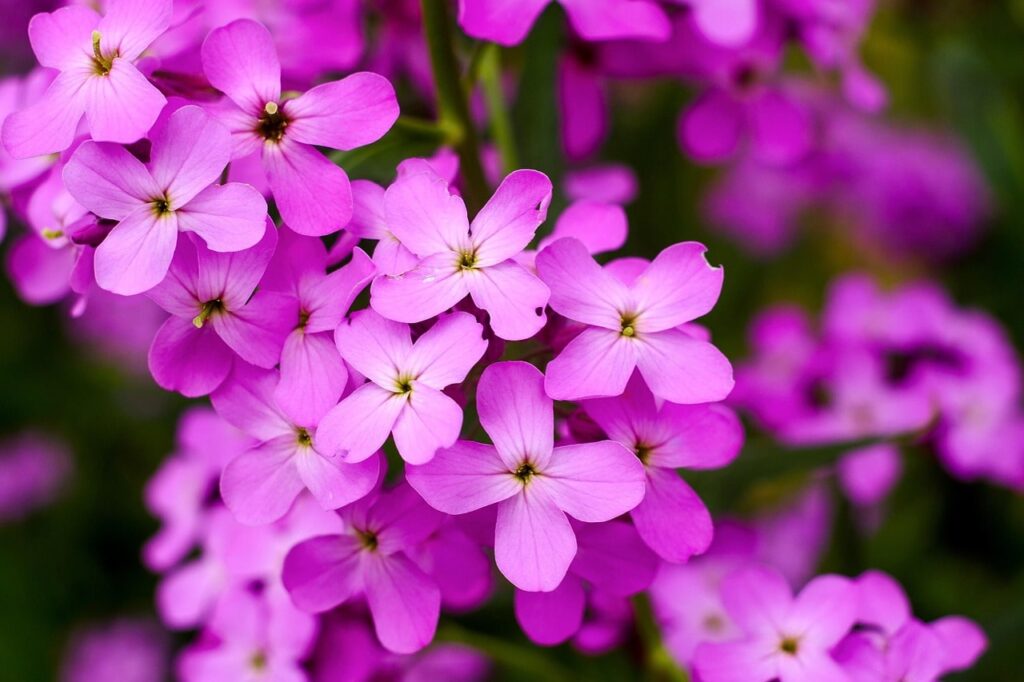
This short-lived perennial or biennial produces spires of purple, pink, or white flowers whose clove-like scent intensifies dramatically at dusk. The fragrance carries well, and established colonies create waves of perfume on evening breezes. It naturalises beautifully in cottage garden settings, woodland edges, and wildflower meadows. Sweet rocket is also the larval food plant for the orange-tip butterfly, making it an invaluable addition to any wildlife-focused planting scheme, so there is a strong conservation argument for growing it beyond its undeniable evening fragrance qualities.
🌿 Lee’s Expert Tip
Sweet rocket is one of those plants that genuinely performs better when left to its own devices. Rather than replacing plants every two or three years, simply allow generous self-seeding and edit out the resulting seedlings to maintain the colours you prefer. The white form is particularly luminous in low evening light and looks wonderful drifting through the lower storeys of a mixed border alongside late-flowering tulips.
Growing Tips: Remarkably unfussy about soil conditions, provided drainage is adequate. Allow to self-seed freely, editing resulting seedlings to maintain colour preferences. Flowers in late spring to early summer. Deadhead to prevent excessive seeding if desired, though self-sown plants often perform better than deliberately planted ones.
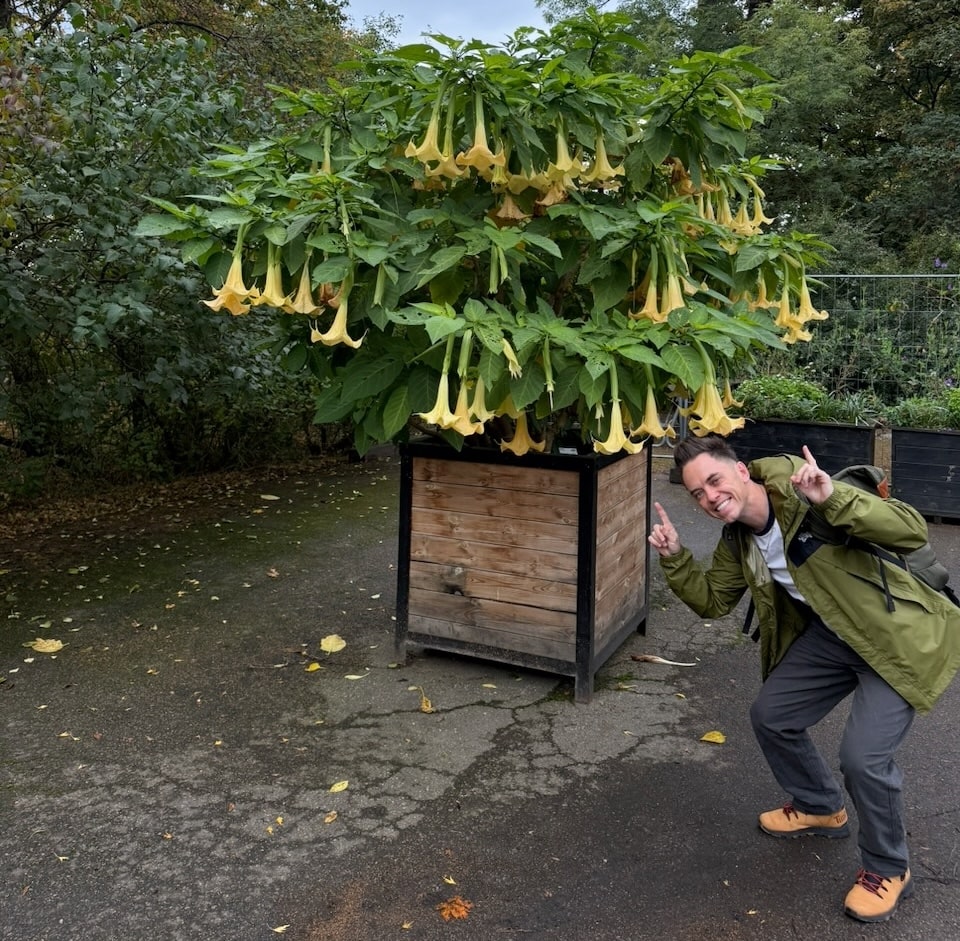
This variety produces enormous, pendant, golden-yellow flowers that reach 30 centimetres in length, releasing their intoxicating fragrance most powerfully after dark. The pale forms generally offer the strongest fragrance. Despite requiring frost-free winter protection, their spectacular performance justifies the effort required. All parts are highly toxic if consumed. Brugmansia is the plant that generates more questions from Garden Rescue viewers than almost any other, and the answer is always the same: yes, the effort of overwintering it is entirely worth it for those extraordinary, pendulous trumpet flowers that fill the entire garden with scent on a still summer evening.
🌿 Lee’s Expert Tip
Overwintering Brugmansia is easier than its exotic reputation suggests. In October, before the first frost, cut the plant back by about half, bring it indoors to a frost-free but cool greenhouse, garage or shed, and reduce watering to almost nothing. The plant will drop its leaves and sit dormant through winter. Begin watering again in March and move back outside once all frost risk has passed. Feed generously with a high-nitrogen fertiliser through the growing season to fuel that remarkable growth rate.
⚠️ Important Toxicity Warning
All parts of Brugmansia are highly toxic if ingested, including the seeds, leaves and flowers. This plant should not be grown in gardens where young children or pets have unsupervised access. Handle with gloves and wash hands thoroughly after contact.
Growing Tips: Demands rich, moist soil, regular feeding, and full sun to perform optimally. Grow in large containers that can be moved to a frost-free greenhouse over winter. It can also be cut back hard and overwintered dormant in a dark cellar. Feed weekly during the growing season and water generously.
17. Kahili Ginger (Hedychium gardnerianum)
🌙 Kahili Ginger at a Glance
Ultimate Height
180cm
Spread
90cm
Flowering Period
August to October
RHS Hardiness
H3 (protect rhizomes from hard frost)
Position
Full sun to light shade, rich moist soil
Wildlife Value
Good for late-season bees and hoverflies
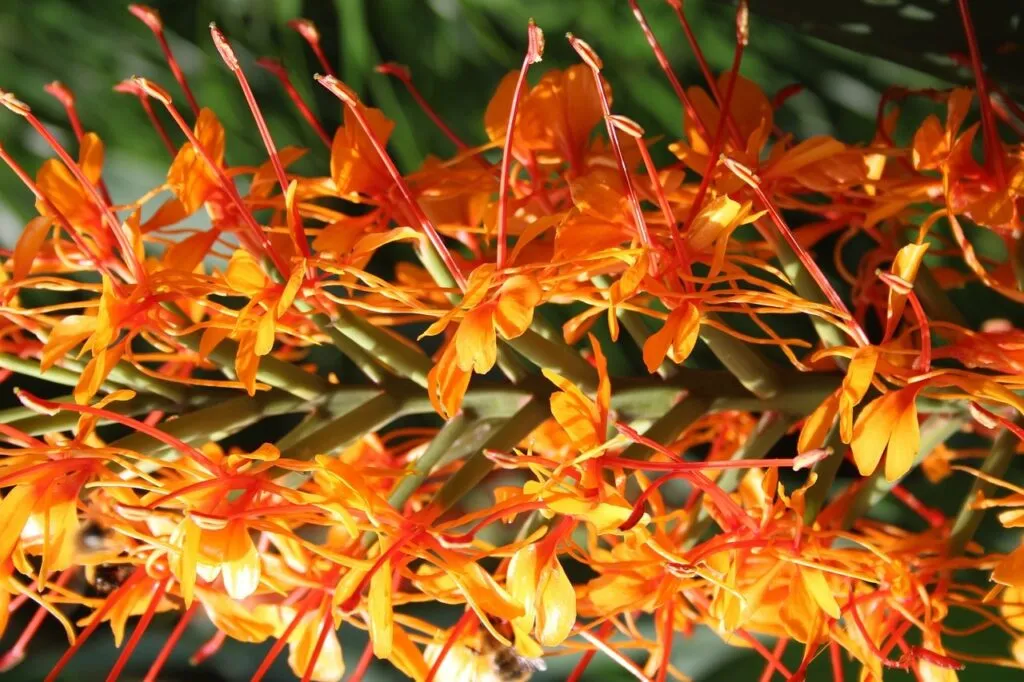
This is the hardiest ginger lily, producing exotic flower spikes whose fragrance ranges from sweet and honeyed to richly spicy. The lush, tropical-looking foliage provides architectural presence even before the spectacular yellow and orange flower spikes appear in late summer. The fragrance intensifies during warm evenings. Kahili ginger has become one of my most frequently used statement plants in contemporary garden designs, where its bold, paddle-shaped foliage and exotic flower spikes provide exactly the kind of dramatic architectural presence that modern garden design demands.
🌿 Lee’s Expert Tip
In sheltered UK gardens in the south and west, Kahili ginger can overwinter in the ground with a deep mulch of bark chippings or straw over the rhizomes, applied once the foliage has been cut back by autumn frosts. In colder or more exposed gardens, lift rhizomes after the first frost, pot into dry compost and store frost-free until late spring. Hedychium dislikes cold and wet simultaneously, so the combination of good drainage and mulching is the key to keeping it thriving year on year.
Growing Tips: Prefers rich, consistently moist soil and full sun to light shade. Mulch heavily with organic matter in autumn to protect rhizomes. In colder regions, grow in containers for easy winter protection. Cut back frosted foliage in spring. Divide congested clumps in late spring once growth resumes.
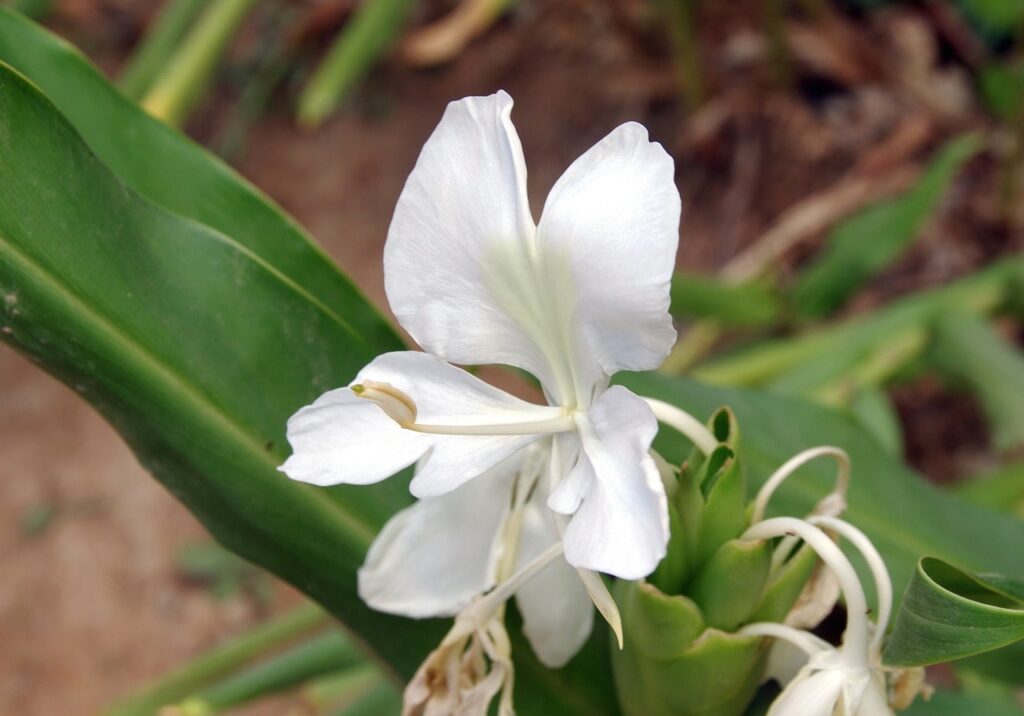
This proves more tender than Hedychium gardnerianum but offers arguably the finest fragrance, reminiscent of gardenia. The large, white, butterfly-like flowers with prominent stamens release their perfume powerfully during the evening hours. The exotic appearance and intoxicating scent make this worth the extra effort required. Hedychium coronarium is the national flower of Cuba, which tells you something about just how remarkable its fragrance is; it has been celebrated for centuries across tropical cultures precisely because no other plant produces quite that combination of pure white flowers and complex, gardenia-like evening scent.
🌿 Lee’s Expert Tip
Hedychium coronarium is best treated as a container plant in most of the UK, grown in large pots of moisture-retentive loam-based compost and moved into a heated greenhouse or conservatory for winter. Unlike Kahili ginger, this species genuinely needs warmth to thrive and will not perform well if kept in a cold, barely frost-free environment. Treat it more like a canna in terms of overwintering requirements, and it will reward you with that extraordinary gardenia-like fragrance from late summer well into autumn.
Growing Tips: Demands consistent moisture and rich, humus-rich soil in light shade. Grow in containers in colder regions, then move them to frost-free protection over winter. Can be cut back and stored like cannas. Benefits from regular feeding during the growing season. Maintain high humidity where possible.
19. Tuberose (Polianthes tuberosa)
🌙 Tuberose at a Glance
Ultimate Height
90cm
Spread
20cm
Flowering Period
August to October (in UK)
RHS Hardiness
H2 (requires frost-free conditions in UK)
Position
Full sun, rich well-drained soil, warm sheltered spot
Wildlife Value
Good for hawkmoths and night-flying moths
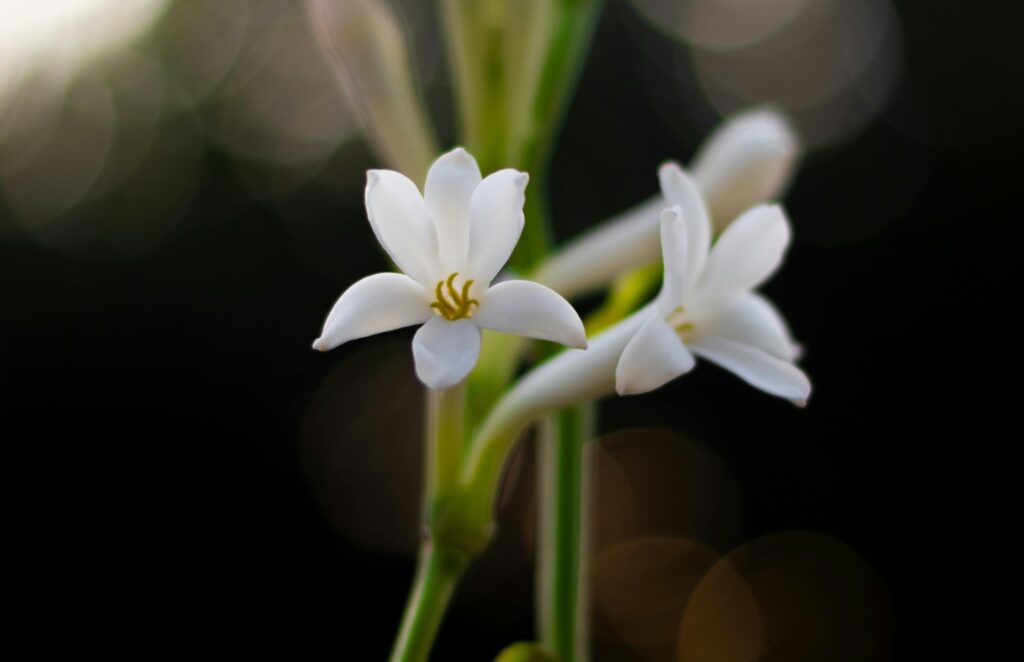
This produces waxy white flowers on elegant spikes, releasing one of the most intoxicating fragrances in the plant kingdom. The scent, often described as a complex blend of jasmine, orange blossom, and hyacinth, intensifies dramatically as evening approaches. A single flower spike can perfume an entire terrace. Tuberose has been used in high-end perfumery for centuries, and Chanel No. 5 includes tuberose as one of its key notes; growing it in your garden gives you access to what is essentially a luxury perfume ingredient at the cost of a packet of bulbs.
🌿 Lee’s Expert Tip
Tuberose requires more warmth to flower in the UK than many bulb suppliers acknowledge. Do not plant out until late May at the earliest, into well-warmed soil or a pre-warmed pot. A warm south-facing wall makes a considerable difference to flowering success. The single-flowered form (as opposed to the double ‘The Pearl’) is considered to have the superior fragrance, and is certainly more attractive to night-flying pollinators. Allow 12 to 16 weeks from planting to flowering, so plant at the right time to have blooms at their peak for late summer evenings.
Growing Tips: Plant bulbs in late spring once the soil has warmed thoroughly to at least 20°C. Requires full sun and rich, well-drained soil. Often grown in pots positioned near doors or windows where fragrance can be fully appreciated. Requires lifting and winter storage in most climates. Takes 3 to 4 months from planting to flowering.
Annuals for Instant Evening Impact
20. Four O’Clocks (Mirabilis jalapa)
🌙 Four O’Clocks at a Glance
Ultimate Height
60 to 90cm
Spread
45cm
Flowering Period
July to October
RHS Hardiness
H2 (grow as annual or lift tubers for winter)
Position
Full sun, moderately fertile soil
Wildlife Value
Good for moths and long-tongued bees
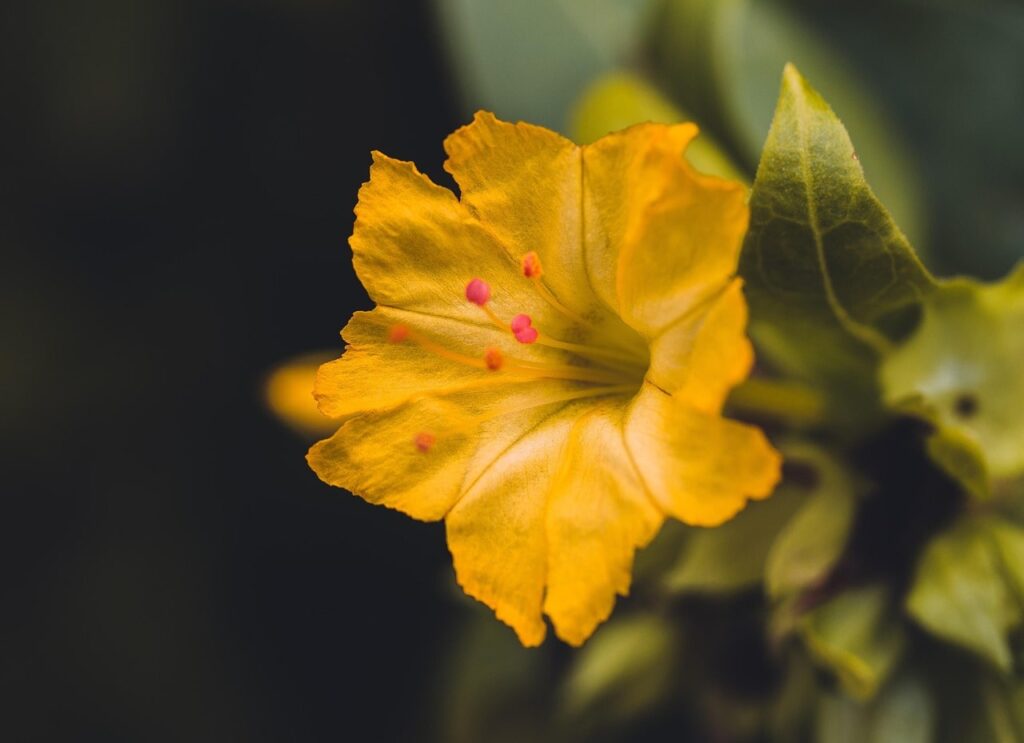
These open their trumpet-shaped flowers late afternoon, typically around 4 PM, hence the common name. The flowers remain open through the evening, releasing a sweet, orange blossom-like fragrance. Available in vibrant colours, including pink, yellow, red, and white, often with striking bicolour patterns. The tuberous roots can be lifted and stored like dahlias, which are not hardy. One of the delightful quirks of Mirabilis jalapa is that a single plant can simultaneously produce flowers in two or three different colours, occasionally even on a single stem, making each one a unique individual.
🌿 Lee’s Expert Tip
Mirabilis jalapa is an excellent choice for hot, dry spots where other evening-scented plants struggle, and it tolerates the reflected heat from south-facing walls and paved surfaces far better than most. Start seeds indoors in April for earlier flowering, or sow direct in May where it is to flower. The tubers do increase in size over successive years if you lift them, so a small initial investment in seeds or tubers can eventually produce quite a substantial colony.
Growing Tips: Tolerates heat and drought admirably once established, preferring full sun and moderately fertile soil. Self-seeds reliably in favourable conditions. Deadhead regularly to prolong flowering or allow seed development if you want self-sown plants. Water during establishment, then reduce once growing strongly.
21. Mignonette (Reseda odorata)
🌙 Mignonette at a Glance
Ultimate Height
30cm
Spread
25cm
Flowering Period
June to September
RHS Hardiness
H5 (hardy annual in UK)
Position
Full sun to light shade, poor to average soil
Wildlife Value
Very good for bees and hoverflies
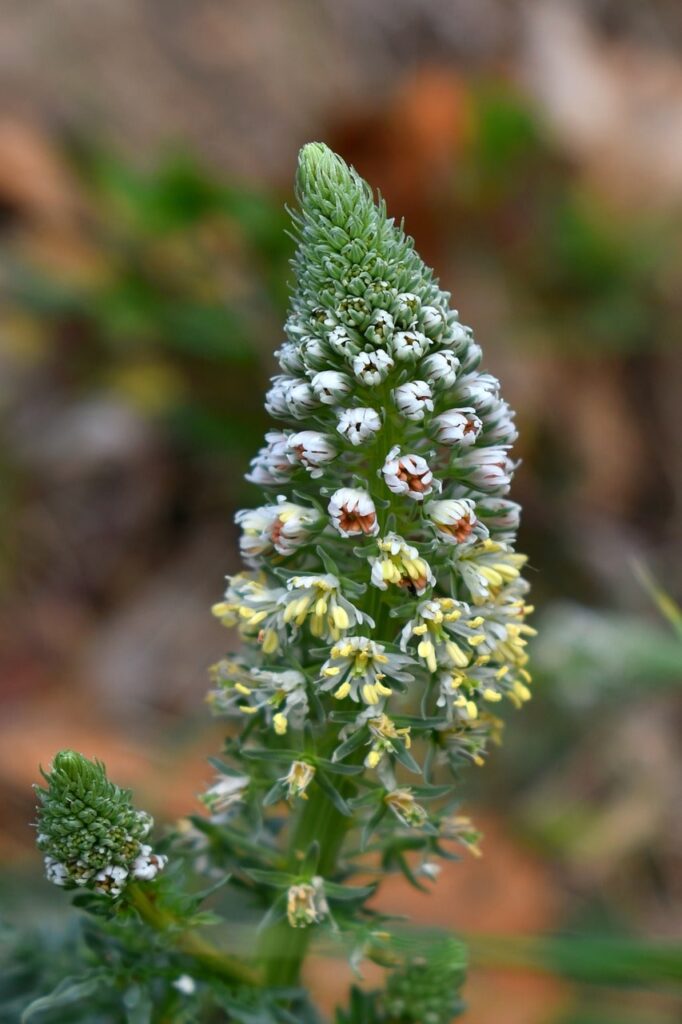
This cottage garden annual offers modest visual appeal but extraordinary fragrance, often described as raspberry-like or reminiscent of fresh-cut hay. The small greenish flowers on short spikes release their scent most powerfully during evening hours. Victorian gardeners cultivated it extensively for cutting, bringing its fragrance indoors. Mignonette enjoyed a period of extraordinary popularity in nineteenth-century Britain, when Parisian flower sellers used to cry “Little one, do not despise me” in reference to its unassuming appearance and disproportionate fragrance; a phrase that perfectly captures its enduring charm.
🌿 Lee’s Expert Tip
Mignonette is one of those plants that deserves far more attention than it currently receives. Sow it in the gaps between paving slabs on a sunny terrace, where passing brushes its foliage and releases additional scent, and in drifts at path edges where it can be appreciated at close range. Make two or three successive sowings from April through to June to ensure continuous fragrance from early summer right through to autumn, as individual plants tend to become less vigorous as summer progresses.
Growing Tips: Self-seeds reliably, appearing year after year without intervention. Sow in gaps between paving stones or along path edges where passing brushes against foliage releases additional scent. Prefers full sun to light shade and tolerates poor soil. Make successive sowings from spring through summer for continuous flowering.
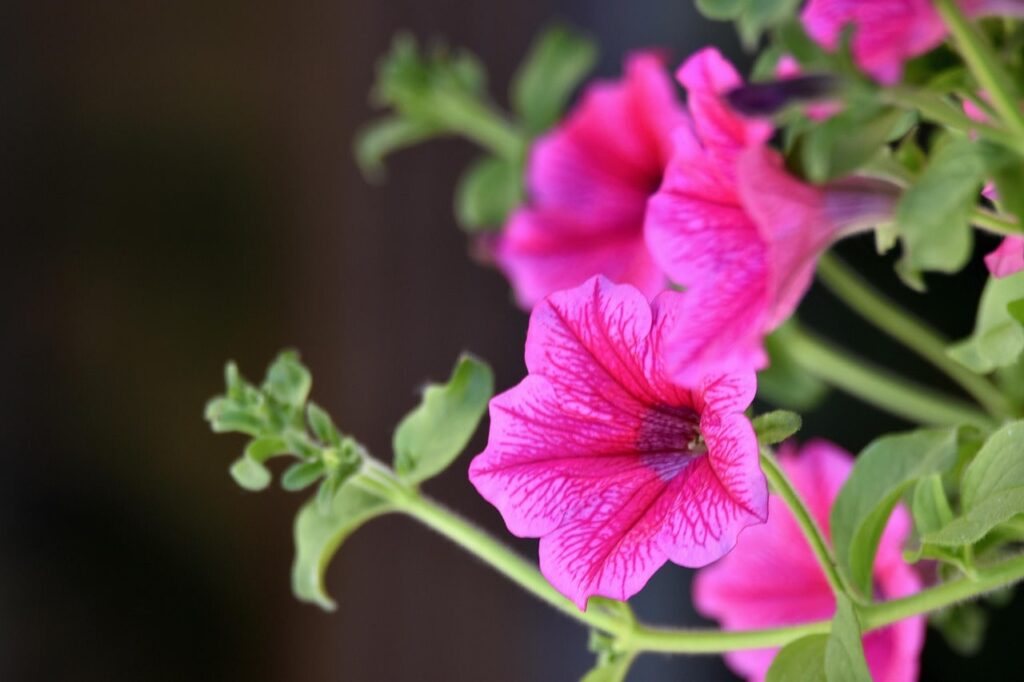
22. Fragrant Petunia (Petunia integrifolia)
🌙 Fragrant Petunia at a Glance
Ultimate Height
30 to 40cm
Spread
45cm
Flowering Period
June to October
RHS Hardiness
H1C (grow as annual in UK)
Position
Full sun, well-drained soil or containers
Wildlife Value
Good for moths and hoverflies
This species-type petunia produces smaller flowers than modern cultivars but compensates with a sweet fragrance that intensifies at dusk. The purple-pink flowers appear continuously throughout summer and autumn. Unlike modern hybrids bred for size and colour, these retain the powerful evening scent that made petunias popular in Victorian gardens. If you have previously grown the large-flowered modern petunia cultivars and found them disappointingly scentless, Petunia integrifolia will be a revelation; the original species is everything its showier descendants are not, putting fragrance ahead of flower size at every turn.
🌿 Lee’s Expert Tip
Position Petunia integrifolia in hanging baskets and containers at or above nose height where the fragrance rises naturally towards you. Deadheading is important but easily overlooked when flowers are small; running your fingers through the plant every few days and removing spent blooms takes only moments and dramatically extends the flowering season. Feed with a high-potash fertiliser every two weeks from June onwards to maintain that remarkable continuous flower production.
Growing Tips: Trails beautifully from containers and hanging baskets, performing best in full sun with regular deadheading and feeding. Position where fragrance can rise upward from containers to nose height. Water regularly and feed weekly with high-potash fertiliser. Pinch out growing tips to encourage bushiness.
Trees for Overhead Fragrance
23. Small Leaved Lime (Tilia cordata ‘Greenspire’)
🌙 Small Leaved Lime at a Glance
Ultimate Height
15m
Spread
8m
Flowering Period
July (flowers brief but intensely fragrant)
RHS Hardiness
H7 (fully hardy throughout UK)
Position
Full sun, adaptable to most soils
Wildlife Value
Outstanding for bees; important native tree species
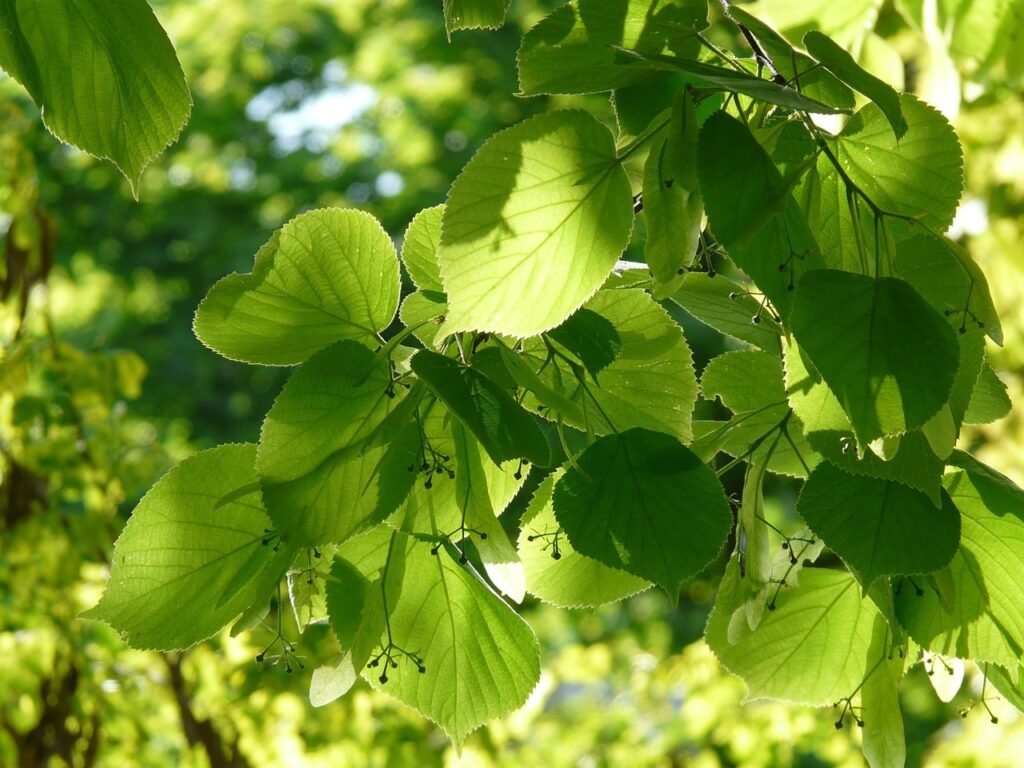
This reaches a more manageable size than common lime, while offering an equally powerful fragrance. The inconspicuous flowers belie their extraordinary honey-sweet scent, particularly pronounced on warm summer evenings. The neat pyramidal form suits formal situations and street planting. Walking beneath a lime tree in full flower on a July evening is one of the great sensory experiences in the British gardening calendar, and the combination of that enveloping honeyed sweetness with the low hum of hundreds of bees working the flowers above you is something that no smaller garden plant can replicate.
🌿 Lee’s Expert Tip
Position a lime tree where you will regularly pass beneath its canopy on warm July evenings, such as alongside a main garden path or near a seating area with overhead clearance. The aphid honeydew issue, which causes sticky drips from the canopy, means it is worth avoiding positioning directly over garden furniture, cars or light-coloured paving. Site it to one side of a seating area so the fragrance drifts across but the drips fall elsewhere.
Growing Tips: Tolerates a wide range of soil conditions and urban pollution. Plant where shade is desired, but be aware they attract aphids whose honeydew can drip on surfaces beneath. Minimal pruning required beyond removing crossing branches. Establish with regular watering during the first two summers.
Sheltered warm wall or full sun, well-drained humus-rich soil
Wildlife Value
Good for beetles, bees and pollinators
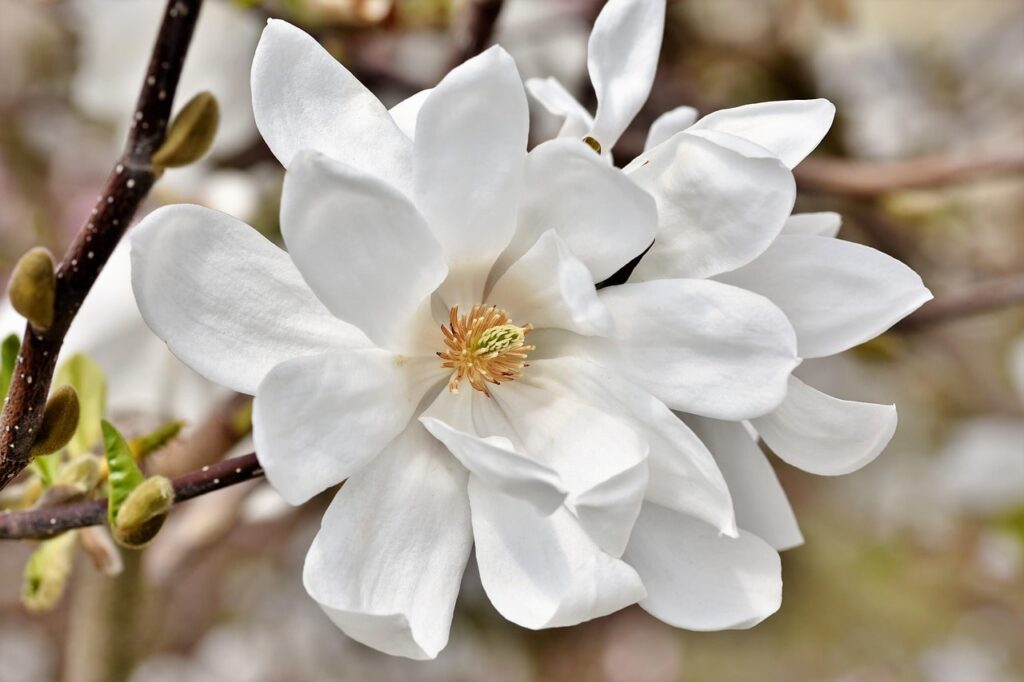
This magnificent evergreen produces enormous creamy white flowers whose lemony fragrance intensifies during evening hours. Grows slowly and can be trained as a wall shrub in smaller gardens. The glossy evergreen foliage provides year-round structure whilst summer flowers appear sporadically over several months. Each flower lasts only a few days, but its size and fragrance more than compensate. Wall-training Magnolia grandiflora is one of the most rewarding long-term garden design choices you can make; within ten to fifteen years, a well-established wall specimen becomes one of the most spectacular and talked-about features any garden can possess.
🌿 Lee’s Expert Tip
The variety ‘Exmouth’ is generally considered the best for UK gardens, combining reasonable hardiness with reliable flowering from a younger age than many other forms. For wall training, fix horizontal wires at 30cm intervals from 30cm above ground level upwards, and tie in young growth carefully each autumn. This is a generational plant: it may take five to seven years to begin flowering freely, but the subsequent decades of performance make it one of the best long-term investments in any garden.
Growing Tips: Demands shelter from cold winds and well-drained, humus-rich soil. Wall training provides extra protection in borderline areas, requiring minimal pruning. Mulch generously and water during dry periods until the plants are well-established. Choose variety ‘Exmouth’ for improved hardiness or ‘Goliath’ for the largest flowers.
Mediterranean Evening Aromatics
25. Angel’s Fishing Rod (Dierama pulcherrimum)
🌙 Angel’s Fishing Rod at a Glance
Ultimate Height
150cm
Spread
60cm
Flowering Period
July to August
RHS Hardiness
H4 (hardy in most UK, mulch in cold areas)
Position
Full sun, excellent drainage, sheltered
Wildlife Value
Good for bees and hoverflies
This produces arching stems of pendant bell flowers whose subtle fragrance becomes more noticeable during still evenings. These graceful perennials create fountains of movement as flowers dance in the slightest breeze. The fragrance, although not overpowering, adds a delicate dimension when planted in groups, allowing you to pause during evening garden tours. Dierama is a plant that genuinely creates wonder: the extraordinary way those wiry stems arc outward, laden with pendant bells that tremble in the faintest air movement, creates a quality of animated elegance that no other garden plant quite matches.
🌿 Lee’s Expert Tip
Dierama absolutely hates being divided or transplanted, so resist the temptation to move it once planted. Choose its final position with care, ensuring exceptional drainage and a sunny spot, then leave it completely undisturbed. It can take two or three years after planting to settle in and flower freely, but once established it is one of the most permanent and low-maintenance plants in the garden. At the poolside or beside a rill where the arching stems hang over water, it creates a simply breathtaking effect.
Growing Tips: Demands exceptionally well-drained soil and full sun, thriving in gravel gardens and coastal conditions. Resents root disturbance, so plant carefully and leave undisturbed. Divide only when absolutely necessary, in spring. Mulch lightly in winter in colder areas, but ensure crown drainage remains excellent.
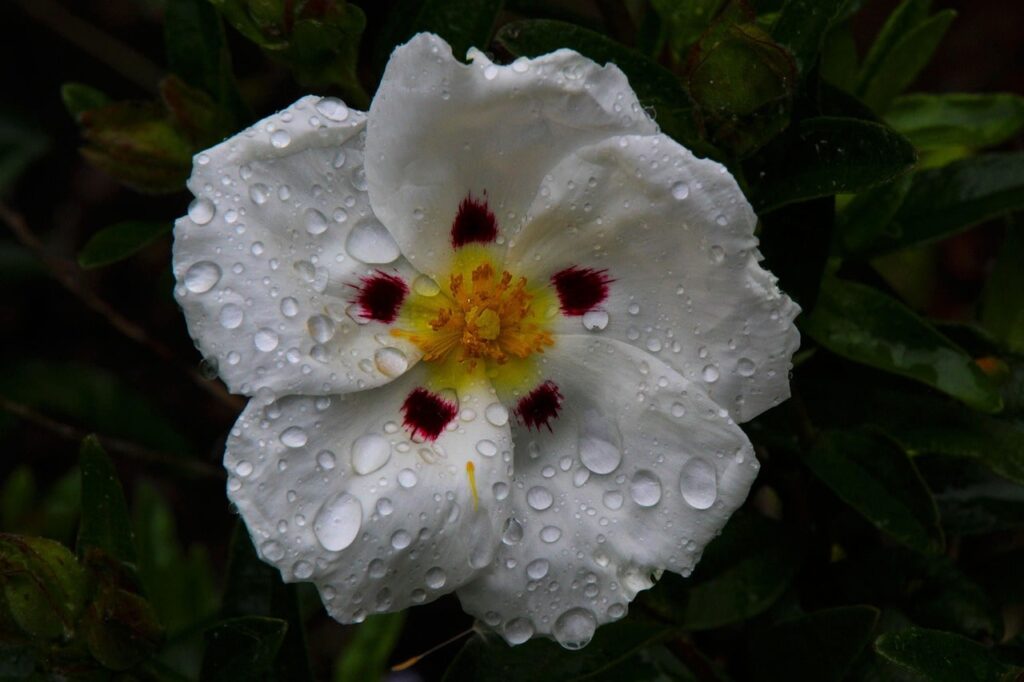
26. Sunset Rock Rose (Cistus × purpureus)
🌙 Rock Rose at a Glance
Ultimate Height
100cm
Spread
100cm
Flowering Period
June to July
RHS Hardiness
H4 (hardy in most UK, protect from cold wet winters)
Position
Full sun, poor dry well-drained soil
Wildlife Value
Good for solitary bees and hoverflies
This evergreen shrub releases resinous fragrance from both flowers and foliage, particularly noticeable on warm evenings. The magenta flowers with maroon blotches appear prolifically in early summer. The foliage’s aromatic oils intensify in heat, creating a complex scented atmosphere that defines warm summer evenings. Cistus has become an increasingly valuable plant in UK gardens as summers grow hotter and drier, combining the drought tolerance we now need with that wonderful warm Mediterranean resinous scent that transports you instantly to sunbaked hillsides.
🌿 Lee’s Expert Tip
Cistus is one of the few shrubs that actively performs better in poorer, drier soil. Adding fertiliser or growing in rich soil encourages lush, sappy growth that is far more vulnerable to cold and wind damage than the naturally compact, resinous growth produced in lean conditions. The worst thing you can do for any cistus is feed it. Trust the plant, give it the driest sunniest spot you have, and it will reward you enormously.
Growing Tips: Requires full sun and well-drained soil, making it ideal for Mediterranean-style gardens and dry, sunny banks. Never plant in heavy clay or apply fertiliser. Prune lightly after flowering to maintain shape, but never cut into old wood. Drought-tolerant once established, but dislikes winter wet.
27. Gum Cistus (Cistus ladanifer)
🌙 Gum Cistus at a Glance
Ultimate Height
150cm
Spread
150cm
Flowering Period
June (individual flowers last one day)
RHS Hardiness
H4 (protect from cold wet winters)
Position
Full sun, poor well-drained soil, sheltered
Wildlife Value
Good for solitary bees and pollen collectors
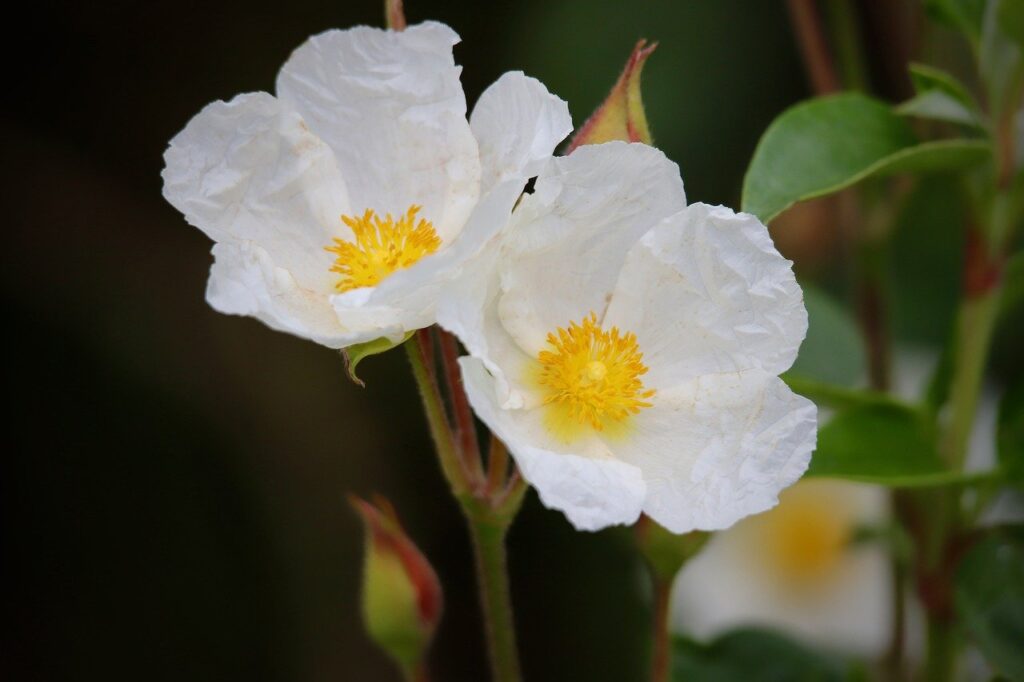
This offers large white blooms with chocolate centres and perhaps the most resinous fragrance of any cistus. The sticky aromatic foliage releases its scent particularly powerfully on hot evenings. Individual flowers last only a day but appear in succession over several weeks in early summer. The labdanum resin collected from Cistus ladanifer has been used in perfumery since ancient Egyptian times, and the complex, warm, slightly smoky quality of the scent is one of the most distinctive in the plant kingdom.
🌿 Lee’s Expert Tip
Cistus ladanifer is one of the more borderline-hardy plants on this list, but in sheltered gardens in the south of England and Wales it performs remarkably well given the right conditions. The key is excellent drainage: this plant will tolerate quite cold temperatures if its roots are not sitting in wet soil through winter. Planting on a slight slope or in a raised bed with generous grit incorporation makes a significant difference to its winter survival rate.
Growing Tips: Requires excellent drainage and full sun in moderately fertile to poor soil. Short-lived but fast-growing, typically lasting 5 to 8 years. Avoid pruning hard; instead, remove spent flower stems and very lightly shape after flowering. Replace rather than attempt renovation of old specimens.
Unexpected Evening Scents
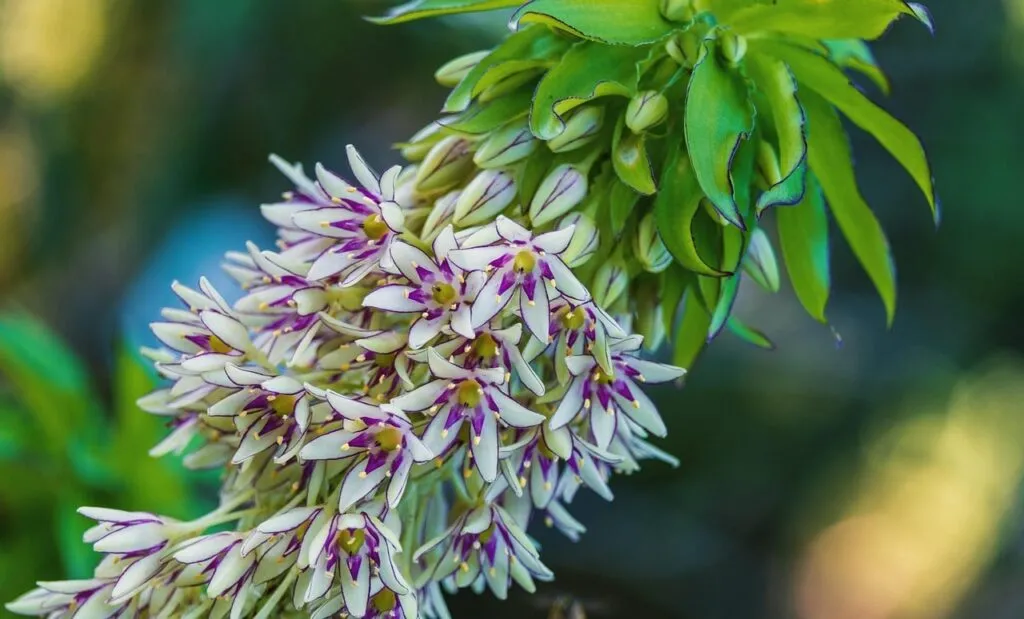
28. Giant Pineapple Lily (Eucomis comosa)
🌙 Pineapple Lily at a Glance
Ultimate Height
60cm
Spread
30cm
Flowering Period
July to September
RHS Hardiness
H4 (hardy in most UK, deep mulch in cold areas)
Position
Full sun, fertile well-drained soil
Wildlife Value
Good for bees and hoverflies
This produces architectural spikes of starry flowers topped with pineapple-like tufts of bracts. The subtle fragrance, more noticeable during evening hours, carries hints of honey and tropical fruit. The exotic appearance and evening fragrance make them valuable additions to container displays and gravel gardens, whilst the seed heads provide architectural winter interest. The purple-leaved cultivar ‘Sparkling Burgundy’ has become one of the most talked-about container plants of recent years, combining dramatic chocolate-purple foliage with those distinctive flower spikes and a subtle but genuine evening fragrance.
🌿 Lee’s Expert Tip
Eucomis is one of the most effective container plants for late summer interest. Plant three to five bulbs in a large, deep pot of well-drained loam-based compost in April, and by midsummer you’ll have an architectural statement that requires almost no maintenance. The bulbs increase year on year, so after three or four seasons you’ll have a congested pot worth dividing to produce additional plants. In the ground, deep mulching with bark or straw in November is sufficient winter protection in most of southern England.
Growing Tips: Prefers full sun and fertile, well-drained soil. Plant bulbs 15cm deep in spring. Mulch heavily in winter in colder areas. Excellent in containers using loam-based compost with added grit. Leave foliage to die back naturally. Divide congested clumps in spring every four to five years.
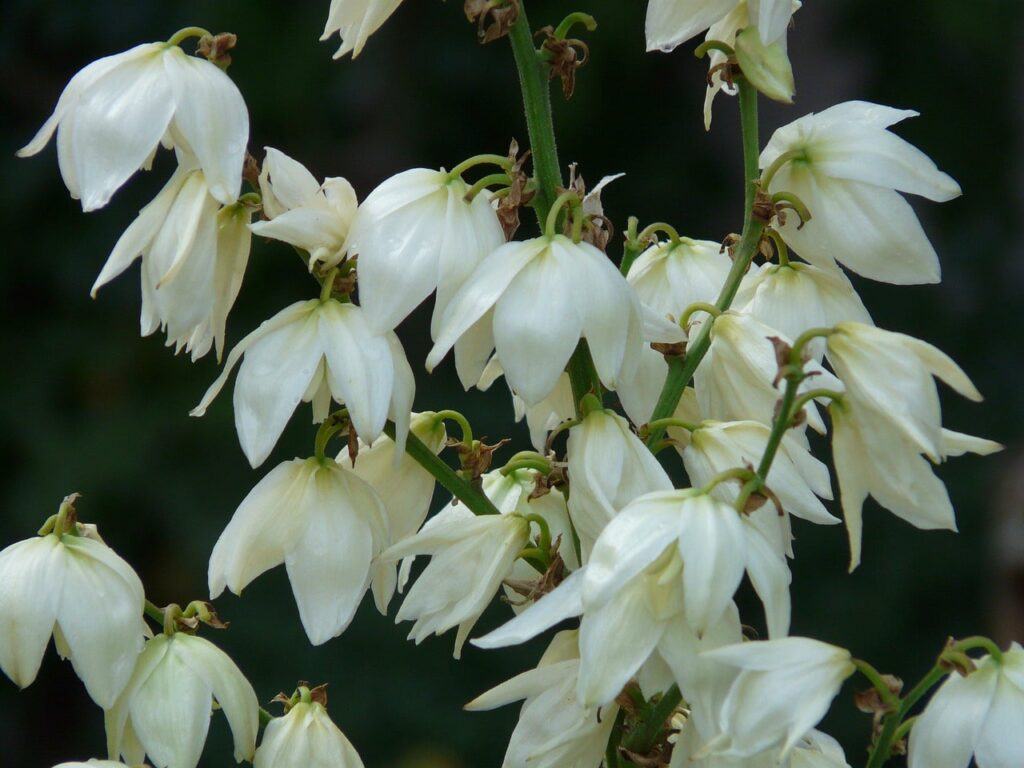
29. Adam’s Needle (Yucca filamentosa)
🌙 Adam’s Needle at a Glance
Ultimate Height
180cm (in flower)
Spread
90cm
Flowering Period
July to August
RHS Hardiness
H5 (hardy in most of UK)
Position
Full sun, excellent drainage, any reasonable soil
Wildlife Value
Good for night-flying moths; structural value for birds
This architectural evergreen produces towering flower spikes whose creamy white bells release a sweet fragrance during evening hours. The sword-like foliage provides dramatic year-round structure. The flower spikes reach impressive heights, appearing in mid to late summer and creating spectacular focal points. Yucca filamentosa is one of those plants that justifies its space in a garden entirely on year-round structural grounds, with the evening fragrance of its flower spikes representing a substantial bonus that most gardeners discover with some surprise the first time they plant it.
🌿 Lee’s Expert Tip
Yucca filamentosa is one of the toughest plants you can grow, thriving with complete neglect in poor dry soil that would defeat almost anything else. Use it as a bold structural anchor in gravel gardens or contemporary planting schemes, or in coastal gardens where salt spray defeats most competition. The thread-like filaments that peel from the leaf margins, which give the species its name, are an attractive characteristic that distinguishes it clearly from the coarser-looking Yucca gloriosa.
Growing Tips: Demands full sun and excellent drainage, thriving in gravel gardens, coastal situations, and contemporary schemes. Remove spent flower spikes after blooming and dead leaves as they accumulate. Protect from winter wet rather than cold. Divide offsets in spring to propagate or maintain compact clumps.
30. Spanish Dagger (Yucca gloriosa)
🌙 Spanish Dagger at a Glance
Ultimate Height
200cm (in flower)
Spread
150cm
Flowering Period
August to October
RHS Hardiness
H6 (very hardy throughout UK)
Position
Full sun, any well-drained soil, coastal exposure
Wildlife Value
Good for moths; provides bird roosting habitat
This proves hardier and more substantial than Yucca filamentosa, developing a trunk with age. The enormous flower spikes carry hundreds of creamy white bells that release their fragrance powerfully on warm evenings. The architectural presence makes this a stunning focal point in contemporary or Mediterranean-style gardens. Mature specimens of Yucca gloriosa that have developed a proper trunk become genuinely monumental in appearance, capable of stopping garden visitors in their tracks and prompting the universal question: how on earth do you grow that?
🌿 Lee’s Expert Tip
Position Yucca gloriosa with absolute care for human safety, as those leaf tips are genuinely sharp enough to cause a serious eye injury. Keep it well away from pathways, play areas, and any space where people might fall or brush against it. At the back of a border, or as a bold isolated specimen in a gravel garden with clear space around it, it is entirely safe and magnificent. Flowering occurs every two to three years on mature plants rather than annually, so the appearance of a flower spike is a genuine garden event.
Growing Tips: Tolerates coastal exposure, salt spray, and neglect admirably. Remove lower leaves as the trunk develops for a cleaner appearance. Flowering occurs every 2 to 3 years on mature plants. Sharp foliage requires careful positioning away from pathways. Drought-tolerant once established.
Additional Evening Treasures
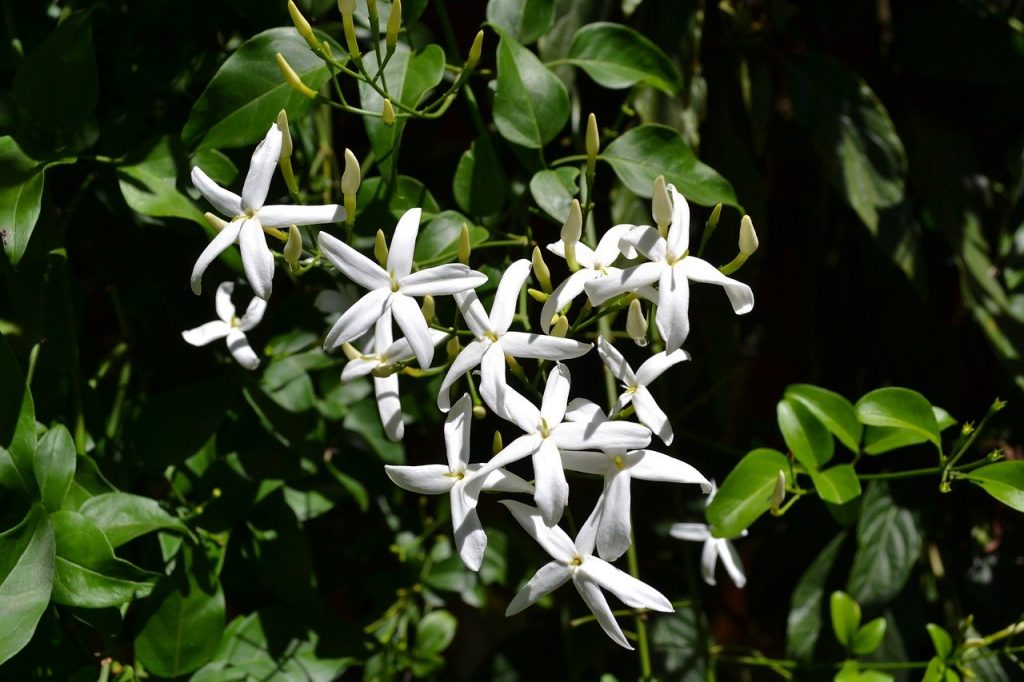
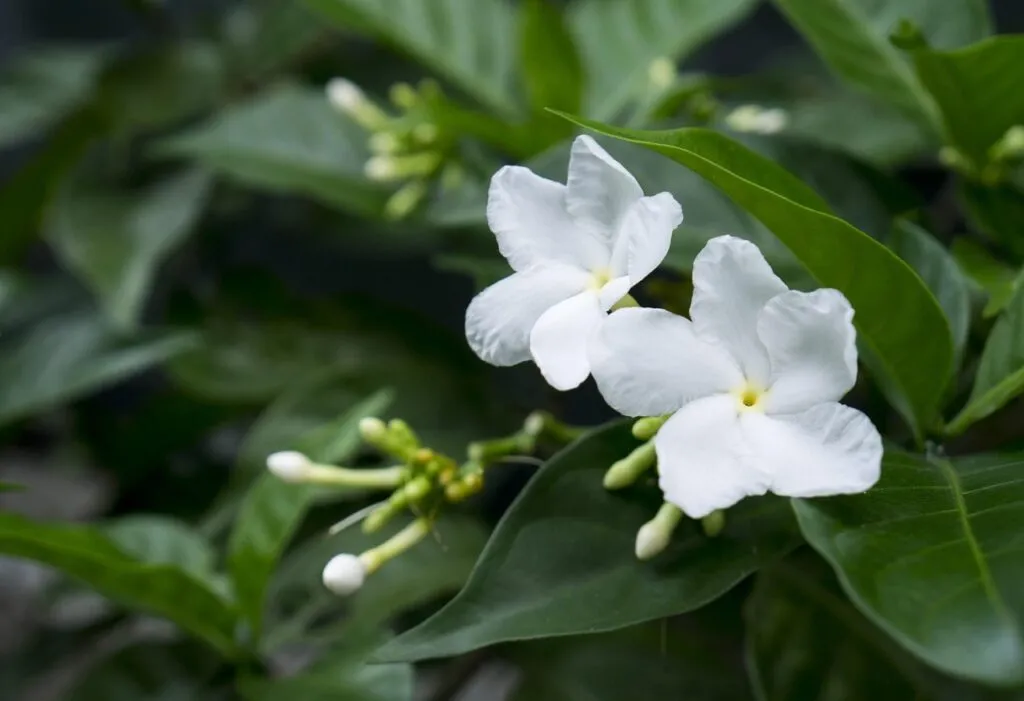
31. Star Jasmine (Trachelospermum jasminoides)
🌙 Star Jasmine at a Glance
Ultimate Height
9m
Spread
3m
Flowering Period
June to September
RHS Hardiness
H4 (hardy in most UK, shelter from north and east winds)
Position
Full sun to partial shade, any well-drained soil
Wildlife Value
Very good for moths, bees and hoverflies
This evergreen climber produces masses of starry, white flowers, whose sweet fragrance intensifies dramatically during the evening hours. The glossy dark green foliage provides year-round interest, turning bronze-purple in winter. Once established, plants flower so profusely that the foliage almost disappears beneath the blooms. Star jasmine has become one of the most fashionable and widely planted climbers in British gardens over the past decade, and with very good reason; it combines remarkable reliability, year-round evergreen foliage, and an extraordinary summer fragrance in a package that suits almost any wall, fence or pergola.
🌿 Lee’s Expert Tip
Star jasmine is remarkably slow in its first two or three years, which can be frustrating, but I always tell clients to trust the process. Once its root system is established, it accelerates dramatically and eventually covers significant wall space with dense, weed-suppressing, fragrant foliage. The common phrase in horticulture applies perfectly here: the first year it sleeps, the second year it creeps, and the third year it leaps. Water and feed regularly in that critical establishment phase, mulch the roots to conserve moisture, and your patience will be amply rewarded.
Growing Tips: Thrives in full sun to partial shade on any well-drained soil. Grows slowly initially but accelerates once established. Requires support and tying initially. Prune after flowering to control size. Tolerates coastal conditions well. Mulch roots in cold areas and provide wall protection.
32. Dame’s Violet (Hesperis matronalis var. albiflora)
🌙 Dame’s Violet at a Glance
Ultimate Height
90cm
Spread
45cm
Flowering Period
May to July
RHS Hardiness
H7 (fully hardy throughout UK)
Position
Full sun to partial shade, any reasonable soil
Wildlife Value
Excellent for orange-tip butterflies, moths, bees
The white-flowered form of sweet rocket offers even more luminosity in the evening garden than its purple counterpart. The clove-scented flowers glow softly as darkness falls, creating ethereal drifts in cottage gardens and woodland edges. Short-lived but self-seeds reliably to maintain the display. In low evening light, the white form of Dame’s violet has a genuine luminosity that photographs cannot quite capture; the flowers seem almost to emit light themselves against the darkening foliage behind them, an effect that garden designers have exploited for centuries in the creation of moon gardens and white borders.
🌿 Lee’s Expert Tip
The white form of Hesperis combines superbly with late-flowering tulips in spring and early summer, and I often design mixed planting schemes that use both together at the front of borders. The tall, upright flowering habit of white Dame’s violet contrasts beautifully with the rounded heads of white tulips such as ‘White Triumphator’, creating a succession of white flowering that is both visually spectacular and provides continuous evening fragrance from April right through to July.
Growing Tips: Even more willing to self-seed than purple forms. Thrives in light shade as well as sun, making it versatile for woodland edges. Cut back after flowering to encourage basal growth and potential autumn rebloom. Tolerates damp conditions better than many evening-scented plants.
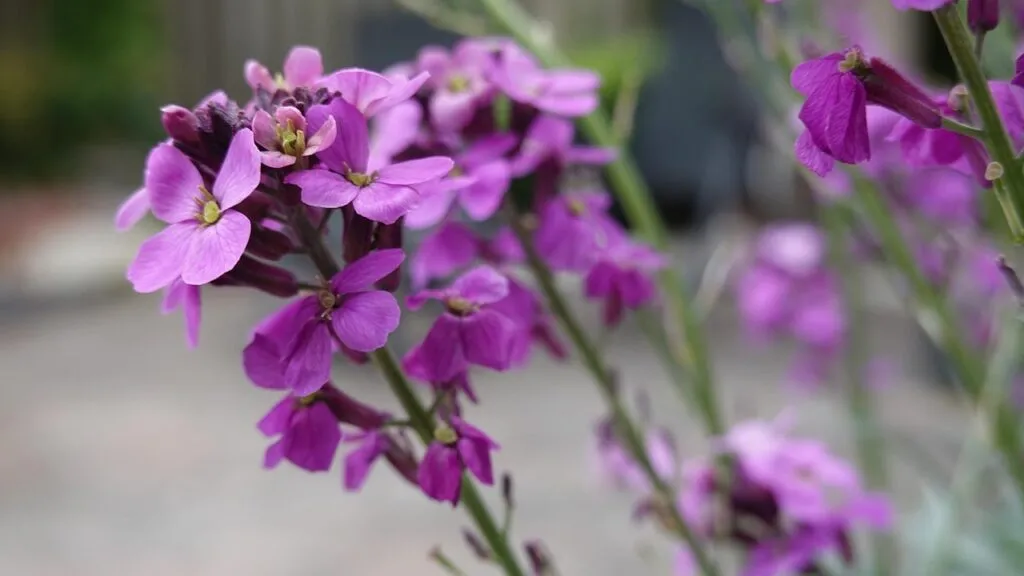
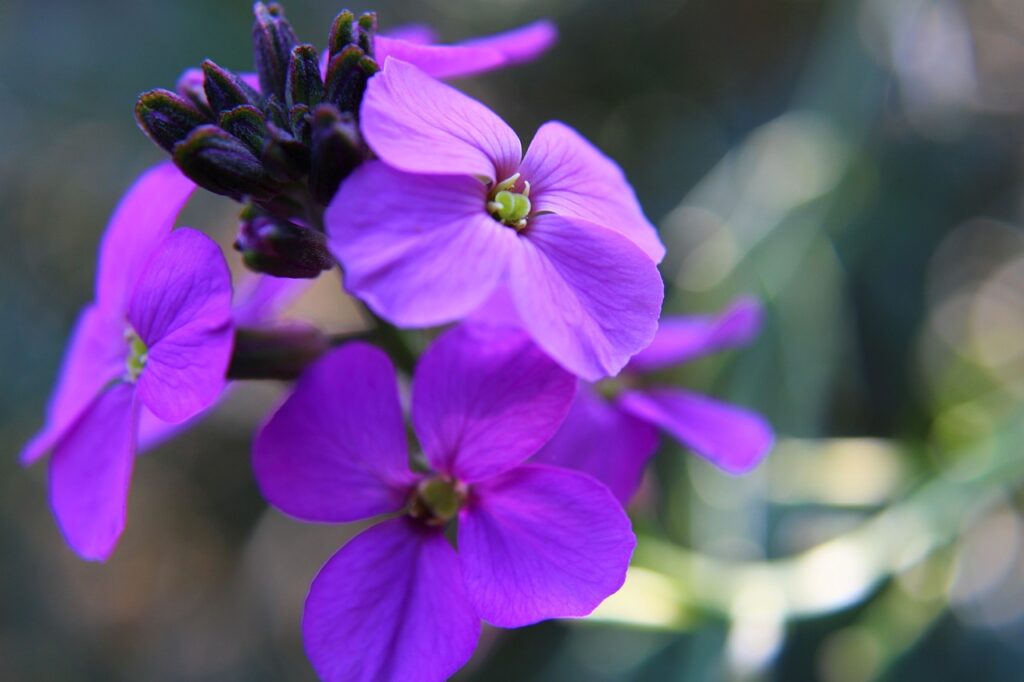
These cottage garden favourites release their warm, spicy fragrance most powerfully during evening hours, particularly the darker red and purple varieties. The rich colours and intense scent make them invaluable for spring evening gardens. Short-lived perennials are usually grown as biennials. The wallflower’s spring evening fragrance, at its best in April and May when warm days give way to still evenings, is one of the defining scents of the British gardening year; a warm, complex blend of vanilla and spice that has been celebrated in English gardens since the sixteenth century.
🌿 Lee’s Expert Tip
The key to outstanding wallflower performance is planting bare-root plants in autumn at exactly the right time, which means late September to early November into well-firmed alkaline or neutral soil. Many gardeners make the mistake of planting pot-grown wallflowers in spring and wondering why the performance is comparatively poor. The autumn-planted bare-root plants establish a much more extensive root system over winter, producing a dramatically superior flowering performance the following spring. The dark reds, burgundies and purples also have noticeably more fragrance than the lighter-coloured forms.
Growing Tips: Sow in early summer for flowering the following spring. Prefer alkaline, well-drained soil in full sun. Deadhead regularly to prolong flowering. Replace plants annually or biennially as they become woody and flower poorly in subsequent years. Self-seeds readily.
This slightly hardier alternative to star jasmine produces equally fragrant, creamy yellow flowers. The compact growth habit suits smaller gardens where Trachelospermum jasminoides might prove too vigorous. The evergreen foliage remains attractive year-round, turning bronze in cold weather. Confederate jasmine is particularly well-suited to growing along low walls, fences or as a ground-covering climber, where its more restrained growth habit is an advantage rather than a limitation compared to the more vigorous star jasmine.
🌿 Lee’s Expert Tip
Trachelospermum asiaticum is one of the few fragrant climbers that genuinely tolerates significant shade, making it an invaluable choice for north-facing walls and fences where alternatives are limited. The fragrance is slightly less intense than its white-flowered relative, but on a still June evening it is more than sufficient to make its presence known. Like T. jasminoides, be patient through the first two establishment years and then expect it to accelerate considerably.
Growing Tips: More tolerant of shade than star jasmine. Grows more slowly and remains more compact. Excellent for covering low walls and fences or growing in large containers. Prune after flowering to maintain the desired size. Benefits from shelter from cold winds in borderline areas.
35. Abyssinian Gladiolus (Gladiolus murielae)
🌙 Abyssinian Gladiolus at a Glance
Ultimate Height
90cm
Spread
15cm
Flowering Period
August to October
RHS Hardiness
H3 (lift and store over winter in UK)
Position
Full sun, well-drained soil
Wildlife Value
Good for late-season moths and bees
This elegant species produces arching stems of white flowers with dramatic purple centres, releasing their sweet fragrance during evening hours. The graceful habit and refined appearance distinguish it from typical gladiolus cultivars. Each corm produces multiple flower spikes over an extended period. The Abyssinian gladiolus offers something genuinely different from the bold, upright stance of typical gladiolus hybrids, its arching stems and pendant-nodding flowers creating a quality of elegance that associates it more with Dierama than with the bedding gladiolus of the traditional herbaceous border.
🌿 Lee’s Expert Tip
Gladiolus murielae makes an outstanding cut flower, combining those elegant white and purple blooms with a genuine fragrance that carries indoors; relatively rare among gladiolus. Plant successive batches of corms two weeks apart from mid-April through to early June for a continuous display from August right through to the first frosts. In most of the UK, lift corms after the first frost, dry them thoroughly, and store in a paper bag in a frost-free location. Replant each May and they will flower reliably year after year.
Growing Tips: Plant corms 10cm deep in groups for the best effect. Requires full sun and well-drained soil. Lift and store in frost-free conditions over winter in colder areas. Plant successively from mid-spring for extended flowering. Stake individually in exposed positions as stems can be top-heavy when laden with flowers.
Troubleshooting Your Evening Fragrance Garden
Even the most carefully planned evening garden can throw up challenges. After thirty years of working with fragrant plants in every kind of UK garden, from tiny urban courtyards to rambling country estates, these are the problems I encounter most frequently and the solutions that actually work.
My fragrant plants have stopped smelling as strongly as they used to
This is one of the most common complaints I hear, and there are several possible causes. The most frequent culprit is over-feeding: many fragrant plants, including cistus, lavender, wallflowers, and Nicotiana, actually produce more volatile fragrance compounds when grown in leaner conditions. High-nitrogen fertilisers produce lush, sappy growth that appears healthy but has diluted fragrance. Reduce feeding, or stop entirely for naturally lean-soil plants, and fragrance often improves markedly within a single growing season.
Age is another factor. Many annual and biennial fragrant plants, including night-scented stock, sweet rocket, and wallflower, decline significantly in fragrance as they age and begin setting seed. Deadheading promptly redirects energy from seed production back into flower and fragrance production, and replacing plants every two to three years keeps fragrance at its peak. Established clumps of Phlox paniculata that have not been divided for many years also decline in both flower quality and fragrance; divide in spring or autumn and replant the young outer sections for renewed vigour.
My evening garden has no fragrance before 9pm in summer
This is entirely normal for many of the most powerfully scented plants on this list. True nocturnal bloomers such as night-scented stock, moonflower, and Nicotiana sylvestris genuinely hold their fragrance until temperatures drop in the early evening, and in a British midsummer, that may not occur until well after 8pm. The chemistry of their scent production is temperature-responsive rather than light-responsive: it is the cooling of the air, rather than the fading of daylight, that triggers full fragrance release.
If you want fragrance available from the moment you step outside after work, add early-evening performers such as Mock Orange, Common Jasmine, and Trachelospermum to your planting, which begin releasing fragrance while it is still relatively warm, then layer in the true nocturnal performers for later enjoyment. Combining plants from different fragrance-release profiles across the evening gives you a sequence that begins at dusk and deepens as the night progresses.
My tender fragrant plants keep dying over winter despite protection
The commonest mistake is protecting against cold rather than against cold combined with wet, which is almost always the lethal combination for tender Mediterranean and sub-tropical plants in UK winters. Brugmansia, Cestrum, Hedychium, and Tuberose all require removal from wet soil conditions before or immediately after the first frost rather than attempting to protect them in situ. For container-grown plants, moving to a frost-free but cool, dry environment is far more effective than wrapping with fleece whilst leaving them standing in wet compost outside.
For plants grown in the ground, the combination of deep mulching and improving drainage around the planting site before winter is the most reliable strategy. Incorporating sharp grit or gravel into the planting hole at planting time permanently improves drainage and significantly increases overwinter survival rates for borderline-hardy fragrant plants. If a plant fails repeatedly despite protection, the garden is clearly telling you it is not suited to your particular microclimate, and there is wisdom in replacing it with a hardier alternative rather than continuing the annual battle.
The fragrance from my garden feels overwhelming rather than pleasant
This is a genuine design problem I encounter occasionally, particularly in small, enclosed gardens where fragrant plants are positioned in concentrated groups around a seating area. The solution is rarely to remove plants, but rather to spread the fragrant planting across a wider area of the garden, using only one or two powerfully scented species immediately adjacent to the seating zone and placing others further away, where their scent reaches you in a diluted, more pleasant form carried on the prevailing breeze.
The most commonly problematic combinations are Cestrum nocturnum with tuberose, or large-flowered oriental lilies positioned within two metres of an enclosed seating area. Both are plants whose fragrance in enclosed spaces can become genuinely unpleasant in heavy concentrations. Moving them to the borders upwind of the seating area, at a distance of five metres or more, usually transforms the experience from overwhelming to perfect. The aim is always to create a fragrance that arrives rather than smothers.
Your subscription could not be saved. Please try again.
Your subscription has been successful.
Frequently Asked Questions About Night Scented Plants
What plants smell strongest at night in a UK garden?
The most powerfully scented plants for UK evening gardens are tuberose (Polianthes tuberosa), which is often described as having one of the most intense fragrances in the plant kingdom; night-scented stock (Matthiola longipetala), whose clove-like scent carries across an entire garden from a single packet of seeds; common jasmine (Jasminum officinale), which can perfume a whole small garden from one established plant; and Nicotiana sylvestris, whose sweet tobacco fragrance on a still summer evening is truly extraordinary. For climbers, star jasmine (Trachelospermum jasminoides) and native honeysuckle (Lonicera periclymenum) are both outstanding. The intensity of scent varies considerably with temperature and air movement: still, warm evenings always produce the most concentrated fragrance experience.
What is the difference between evening-scented and night-scented plants?
Evening-scented plants begin releasing fragrance as temperatures drop in the late afternoon and early evening, roughly from 5pm onwards in summer, and include species such as Mock Orange (Philadelphus), Common Jasmine, and star jasmine. True night-scented plants hold their fragrance almost completely until full darkness or near-darkness, with fragrance triggered primarily by temperature drop rather than by fading light. Night-scented stock, moonflower, Nicotiana sylvestris, and tuberose fall into this second category. In practical garden design terms, combining both types gives you fragrance that begins at dusk and intensifies through the evening, creating the most rewarding sequence of scented experience.
Which night-scented plants are best for a small urban garden?
For small urban gardens, I consistently recommend night-scented stock (Matthiola longipetala) as the first choice: it costs almost nothing, requires no space, and produces extraordinary fragrance from a narrow sowing along any path edge or beneath a window. Star jasmine (Trachelospermum jasminoides) is my second recommendation, particularly for a sheltered wall where its evergreen foliage earns its space year-round and its June to September fragrance is transformative. Phlox paniculata ‘David’ performs beautifully in a narrow border, and a single container of regal lily (Lilium regale) positioned near a dining table or seating area will produce more fragrance per pound spent than almost anything else you can grow. In small enclosed gardens, avoid the most powerfully scented plants such as tuberose and oriental lilies at very close range, as the concentration can become overwhelming.
Why do plants smell more at night?
The chemistry behind nocturnal fragrance is genuinely fascinating. Many plants have evolved to release their volatile scent compounds specifically during cooler evening and night-time temperatures, as part of a co-evolutionary relationship with night-flying pollinators such as moths and hawkmoths. The lower temperatures of evening allow these volatile molecules to linger in the air rather than dissipating rapidly as they do in daytime heat. Higher evening humidity also plays a role, helping fragrance molecules carry further. Additionally, the absence of competing daytime fragrances and sounds makes us more perceptive of scent during evening hours. For plants such as night-scented stock and moonflower, the flowers actually remain physically closed during the heat of the day and open only as temperatures drop, a dramatic strategy that concentrates their entire reproductive effort on nocturnal pollinators.
Can I create an evening scented garden in pots and containers?
Absolutely, and containers offer some distinct advantages for evening fragrance gardening. They allow you to move plants to precisely where you want the fragrance at any given time, positioning the most spectacular performers immediately adjacent to wherever you are sitting or dining. An excellent evening container combination might include a large pot of regal lilies, a hanging basket of Petunia integrifolia at nose height, a pot of night-scented stock along the path edge, and a container-grown Nicotiana sylvestris for architectural presence. For tender plants such as Brugmansia, tuberose, and Hedychium coronarium, containers are practically essential in UK conditions as they allow easy winter protection. Use good-quality loam-based compost rather than peat-free alternatives for most bulbs and woody plants, incorporating generous amounts of horticultural grit for drainage.
Which night-scented plants attract moths?
The best night-scented plants for attracting moths to UK gardens include evening primrose (Oenothera biennis), which is particularly associated with the elephant hawkmoth and the broad-bordered bee hawkmoth; native honeysuckle (Lonicera periclymenum), the primary food plant and nectar source for the white admiral butterfly and the white-lined sphinx moth; night-scented stock (Matthiola longipetala), which attracts a wide range of nocturnal moths to its clove-scented flowers; sweet rocket (Hesperis matronalis), important for orange-tip butterflies and various moth species; and moonflower (Ipomoea alba), which in warmer southern gardens can attract the convolvulus hawkmoth. Generally, pale or white flowers with strong sweet fragrances are the most attractive to moths, as these pollinators locate flowers primarily by scent rather than colour in the darkness.
When is the best time to enjoy a fragrant evening garden in the UK?
In terms of seasonal timing, the peak evening fragrance season in UK gardens runs from late May through to late September, with July and August typically offering the most concentrated combination of night-scented performers. The best conditions for experiencing evening garden fragrance are warm, still evenings following a warm sunny day, as daytime warmth promotes the production of volatile scent compounds that are then released as temperatures drop in the evening. Light rainfall earlier in the day can also enhance fragrance by cleaning the air of other particles. In terms of time of evening, the most dramatic fragrance usually occurs between roughly 8pm and midnight on midsummer evenings, when temperatures are at their lowest and dew points are rising. Windy conditions disperse fragrance rapidly, so the most memorable evening garden experiences almost always occur on perfectly still nights.
Are any plants on this list toxic to dogs, cats or children?
Several plants on this list require careful positioning in gardens used by children or pets. Brugmansia (Angel’s Trumpets) is highly toxic in all parts and should not be grown where children or animals have unsupervised access. Daphne burkwoodii is also highly toxic, with its berries particularly dangerous to children. Nicotiana species contain nicotine alkaloids and are toxic if consumed in quantity. The berries of Cestrum nocturnum are toxic. Moonflower (Ipomoea alba) seeds are toxic if consumed. Lilies in general, and particularly oriental and asiatic species, are extremely toxic to cats and can cause acute kidney failure even in very small quantities, so cat owners should avoid planting any lily species. If in doubt about specific plant toxicity for your circumstances, the RHS maintains an excellent online toxicity database and the ASPCA provides a comprehensive list of plants toxic to dogs and cats. When designing gardens with children or pets, always position potentially toxic plants in areas that are inaccessible to those most at risk.
Designing Your Evening Fragrance Garden
Creating an effective evening garden requires more strategic thinking than simply purchasing fragrant plants and hoping for the best. Consider the prevailing wind direction and position the most powerfully scented plants upwind of seating areas, allowing breezes to carry perfume toward you rather than away. Conversely, plants with particularly heavy or potentially overwhelming fragrances benefit from placement at a slight distance, their scent reaching you in pleasantly diluted form.
Layering fragrance through the seasons extends the evening garden’s appeal beyond the traditional summer months. Early spring brings Daphne and scented Narcissus, early summer sees Philadelphus and Lilium regale, high summer offers Nicotiana and Brugmansia, whilst autumn delivers Hedychium and late-flowering Cestrum.
This succession ensures something fragrant greets you most evenings throughout the growing season, preventing the disappointment of a brief peak followed by months of scentless evenings. The most sophisticated evening gardens have been designed with this seasonal succession in mind from the outset, and the result is a garden that reveals a different fragrant character with each month that passes.
The magic of an evening garden lies not in overwhelming the senses but in creating subtle layers of experience that reveal themselves gradually as you settle into the space. A well-designed evening garden should surprise and delight, offering new discoveries each time you venture outside as light fades and the day’s final act unfolds. This is gardening at its most sophisticated, engaging senses beyond the visual and creating memories that linger long after the last flower has faded!
Want to learn more about garden design?
My Garden Design for Beginners Course is here to help take your garden from average to extraordinary with an affordable online course, no matter how little your experience with plants.
This course offers step-by-step guidance from me, Lee Burkhill, award-winning garden designer and presenter on BBC1’s Garden Rescue. In this course, you’ll go from a garden design novice to a confident designer equipped to tackle any green space.
Planting Techniques – Select and arrange plants like a pro.
Design Styles & Layout Options – Explore different styles to suit every garden.
Course Features:
20 Hours of Study Time
Flexible Online Learning
Engaging Video Lessons & Quizzes
Real-World Case Studies
Certification upon Completion
Taught by Award-Winning Designer Lee Burkhill
Enrol now for just £199 and start your journey toward garden design mastery!
29
Garden Design Examples for Small Gardens: 30 Design Templates & Planting Plans
Garden Design Examples for Small Gardens: 30 Design Templates & Planting Plans: In this online gardening course, I’ll walk you through 30 fantastic garden designs, explaining the logic behind the layout, the plant choices, and take-home tips for applying them in your own garden.
Weekend Garden Makeover: A Crash Course in Design for Beginners
Learn how to transform and design your own garden with Lee Burkhills crash course in garden design. Over 5 hours Lee will teach you how to design your own dream garden. Featuring practical design examples, planting ideas and video guides. Learn how to design your garden in one weekend!
Garden Design for Beginners: Create Your Dream Garden in Just 4 Weeks
Garden Design for Beginners Online Course: If you want to make the career jump to becoming a garden designer or to learn how to design your own garden, this is the beginner course for you. Join me, Lee Burkhill, an award-winning garden designer, as I train you in the art of beautiful garden design.
Layering fragrance through the seasons extends the evening garden’s appeal beyond the traditional summer months. Early spring brings Daphne and scented Narcissus, early summer sees Philadelphus and Lilium regale, high summer offers Nicotiana and Brugmansia, whilst autumn delivers Hedychium and late-flowering Cestrum. This succession ensures something fragrant greets you most evenings throughout the growing season, preventing the disappointment of a brief peak followed by months of scentless evenings.
The magic of an evening garden lies not in overwhelming the senses but in creating subtle layers of experience that reveal themselves gradually as you settle into the space. A well-designed evening garden should surprise and delight, offering new discoveries each time you venture outside as light fades and the day’s final act unfolds. This is gardening at its most sophisticated, engaging senses beyond the visual and creating memories that linger long after the last flower has faded!
Your subscription could not be saved. Please try again.
Your subscription has been successful.
Lee Burkhill
Lee Burkhill, known as the Garden Ninja, is an award-winning garden designer and horticulturist with over 30 years of gardening experience and 15 years as a professional garden designer. A qualified RHS (Royal Horticultural Society) professional, Lee specialises in sustainable garden design and practical horticultural advice. He designs and presents on BBC1’s Garden Rescue and in leading gardening publications. Lee combines three decades of hands-on gardening knowledge with professional design qualifications to help gardeners create beautiful, functional outdoor spaces.