Hi @zsuzsanna
Thank you for posting, and I'm so sorry to hear about your mum.
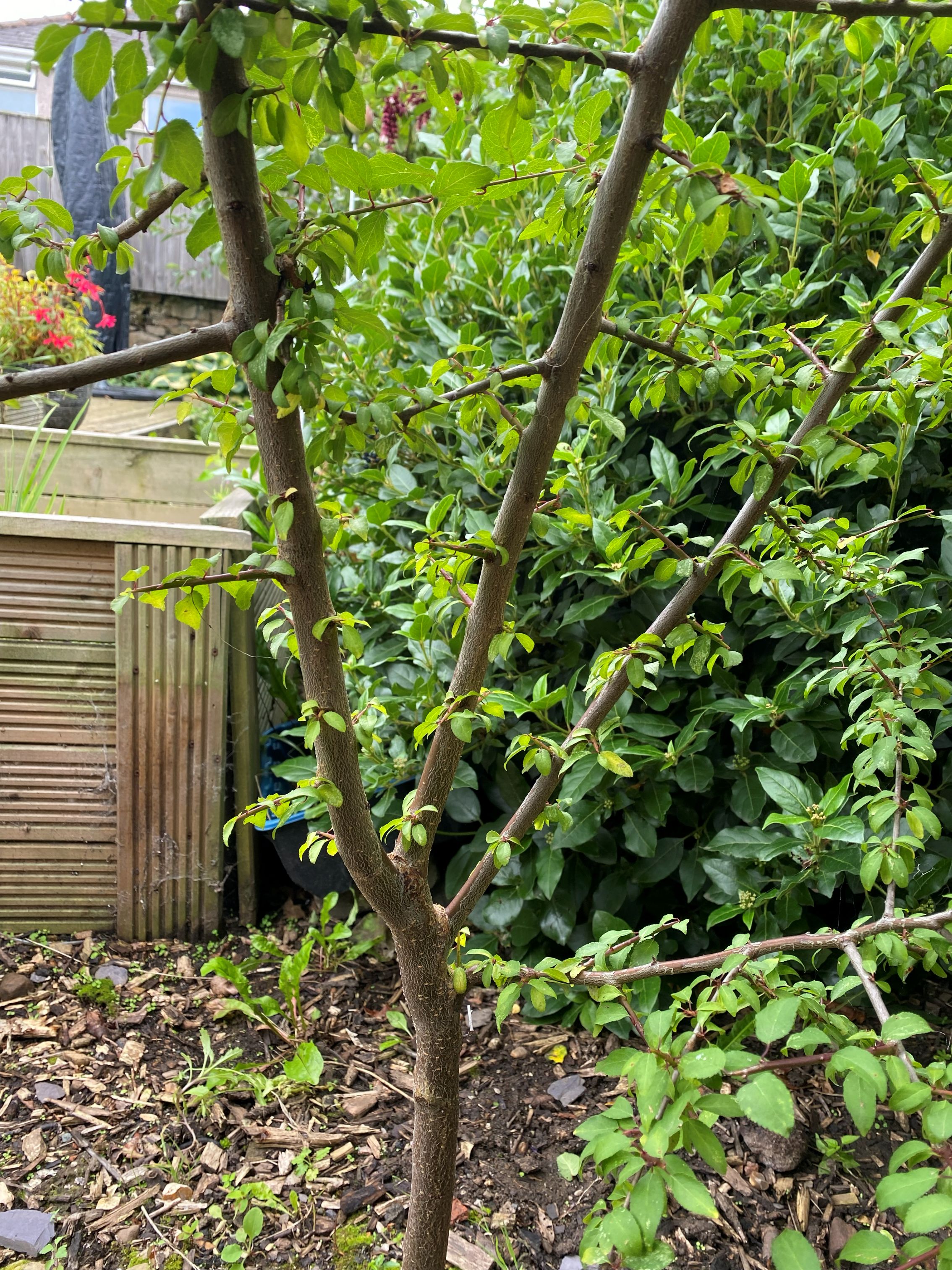
A memory tree is a lovely thing to have in the garden and the good news from your photo is that it has settled in beautifully. A plum sits in the same family as cherries, the Prunus family, so everything in my How to Prune Cherry Trees: Beginner Guide applies to your tree exactly as written. Have a read of that first for the tool prep, the clean cut technique and the goblet shape, then come back here for the bits specific to your two leaders.
Please don't cut anything just yet
Late September is the wrong moment. All stone fruit gets pruned in active growth, never in autumn or winter, because that is when silver leaf spores are flying about and looking for a fresh wound to colonise. If you want the detail on why we are so strict about this, I've covered it in my silver leaf disease guide.
For a young tree that you are still shaping, the window you want is late March into April as the buds begin to swell and break. That is slightly earlier than the midsummer window I'd give you for an established, fruiting plum, which is covered in my summer fruit tree pruning guide. Formative cuts made at bud burst heal fast because the tree is pouring energy into new growth, and you get the whole season of regrowth to see the results.
https://youtu.be/EWPEuJ48kmU
Which lead to keep
Keep the left one. It was the original lead, it has the strongest connection back down through the graft union, and that slight lean is not a problem at all on a tree this young. Trees straighten themselves up towards the light far more than gardeners expect, and a bit of character in a trunk is no bad thing. Do check your stake and tie while you are there, because a tie that has been on since planting will be starting to bite into the bark by now and wants loosening or replacing.
What you do want to deal with is the competition. Two leads of roughly equal vigour eventually form what we call a co-dominant stem, and the fork between them traps a layer of dead bark rather than knitting together properly. Plum wood is brittle and heavy when fruiting, so those forks are the ones that split out in a gale ten years down the line. Dealing with it now, while the wound is the width of a pencil, is far kinder than dealing with it later.
The cut on the right hand lead
Take the right hand lead back by half, cutting to an outward facing bud so the regrowth heads away from the centre of the tree rather than back into it. Make the cut about 5mm above that bud, angled gently away from it so rain runs off rather than sitting on the bud.
I'd reduce it rather than remove it completely, and that is deliberate. Cutting it out flush in one go takes a big chunk of leaf area off a young tree and leaves a wound at the most sensitive point on the whole trunk. By shortening it instead, you hand dominance to the left lead while keeping the leaves that are still feeding the roots. Next spring you can take it back further, or convert it into a permanent scaffold branch if it has settled into a nice wide angle.
What to do with the laterals
Yes, prune them, but lightly. Take roughly a third off each of the remaining side branches, again cutting to an outward facing bud each time. That third is enough to make each one branch out and thicken rather than continuing as a single whippy stem, which is how you start building the open goblet or vase shape described in the main guide.
Resist stripping the lower laterals off entirely. Those low leaves are doing valuable work thickening the trunk in the early years, and you can always remove them cleanly in a year or two once the tree has the girth to carry itself. What you are working towards eventually is three to five evenly spaced scaffold branches with the lowest sitting around 60 to 75cm above ground, all radiating outwards with a hollow middle.
A few things the main guide doesn't cover
Watch for suckers appearing from below the graft union, which is that knuckle low down on the trunk. Plum rootstocks such as St Julien A and Pixy sucker readily, and anything growing from below that union is rootstock rather than your tree, so pull it off at the base rather than cutting it. Worth knowing too that the rootstock is what determines the final size of your tree more than anything you do with the secateurs, and I've explained how that works in my rootstock sizes guide.
Two other habits worth building in from the start. First, never paint or seal a pruning cut, as the old wound paints trap moisture and do more harm than good. Second, keep an eye out for amber blobs of resin oozing from the bark, known as gumming, which on a Lancashire plum usually points towards bacterial canker rather than anything you have done wrong. An open, airy shape is your best protection against both that and brown rot, which is the real reason we bother with the goblet rather than it being about looks.
Between now and next March
Give it a mulch this autumn once the soil is damp, keeping a 5cm gap around the trunk itself so the bark can breathe. My mulching guide has the how and why. Keep a circle of bare soil or mulch about a metre across free of grass, because turf competes hard for water and is the most common reason young fruit trees sulk in their first few years.
Then sharpen and disinfect your secateurs before you touch the tree in spring. Blunt blades crush rather than cut, and a crushed cut on a plum is an open invitation to exactly the diseases we are trying to avoid. Here's how to sharpen secateurs if yours need attention over winter.
One last thought, and you can take it or leave it. Given what this tree means to you, it is worth knowing that plums can be propagated by grafting, so a piece of your mum's tree could be carried on elsewhere one day if you ever wanted that insurance. I've written up the basics in my fruit tree grafting guide.
Happy gardening,
Lee Garden Ninja
Hi @zsuzsanna
Thank you for posting, and I'm so sorry to hear about your mum.
A memory tree is a lovely thing to have in the garden and the good news from your photo is that it has settled in beautifully. A plum sits in the same family as cherries, the Prunus family, so everything in my How to Prune Cherry Trees: Beginner Guide applies to your tree exactly as written. Have a read of that first for the tool prep, the clean cut technique and the goblet shape, then come back here for the bits specific to your two leaders.
Please don't cut anything just yet
Late September is the wrong moment. All stone fruit gets pruned in active growth, never in autumn or winter, because that is when silver leaf spores are flying about and looking for a fresh wound to colonise. If you want the detail on why we are so strict about this, I've covered it in my silver leaf disease guide.
For a young tree that you are still shaping, the window you want is late March into April as the buds begin to swell and break. That is slightly earlier than the midsummer window I'd give you for an established, fruiting plum, which is covered in my summer fruit tree pruning guide. Formative cuts made at bud burst heal fast because the tree is pouring energy into new growth, and you get the whole season of regrowth to see the results.
Which lead to keep
Keep the left one. It was the original lead, it has the strongest connection back down through the graft union, and that slight lean is not a problem at all on a tree this young. Trees straighten themselves up towards the light far more than gardeners expect, and a bit of character in a trunk is no bad thing. Do check your stake and tie while you are there, because a tie that has been on since planting will be starting to bite into the bark by now and wants loosening or replacing.
What you do want to deal with is the competition. Two leads of roughly equal vigour eventually form what we call a co-dominant stem, and the fork between them traps a layer of dead bark rather than knitting together properly. Plum wood is brittle and heavy when fruiting, so those forks are the ones that split out in a gale ten years down the line. Dealing with it now, while the wound is the width of a pencil, is far kinder than dealing with it later.
The cut on the right hand lead
Take the right hand lead back by half, cutting to an outward facing bud so the regrowth heads away from the centre of the tree rather than back into it. Make the cut about 5mm above that bud, angled gently away from it so rain runs off rather than sitting on the bud.
I'd reduce it rather than remove it completely, and that is deliberate. Cutting it out flush in one go takes a big chunk of leaf area off a young tree and leaves a wound at the most sensitive point on the whole trunk. By shortening it instead, you hand dominance to the left lead while keeping the leaves that are still feeding the roots. Next spring you can take it back further, or convert it into a permanent scaffold branch if it has settled into a nice wide angle.
What to do with the laterals
Yes, prune them, but lightly. Take roughly a third off each of the remaining side branches, again cutting to an outward facing bud each time. That third is enough to make each one branch out and thicken rather than continuing as a single whippy stem, which is how you start building the open goblet or vase shape described in the main guide.
Resist stripping the lower laterals off entirely. Those low leaves are doing valuable work thickening the trunk in the early years, and you can always remove them cleanly in a year or two once the tree has the girth to carry itself. What you are working towards eventually is three to five evenly spaced scaffold branches with the lowest sitting around 60 to 75cm above ground, all radiating outwards with a hollow middle.
A few things the main guide doesn't cover
Watch for suckers appearing from below the graft union, which is that knuckle low down on the trunk. Plum rootstocks such as St Julien A and Pixy sucker readily, and anything growing from below that union is rootstock rather than your tree, so pull it off at the base rather than cutting it. Worth knowing too that the rootstock is what determines the final size of your tree more than anything you do with the secateurs, and I've explained how that works in my rootstock sizes guide.
Two other habits worth building in from the start. First, never paint or seal a pruning cut, as the old wound paints trap moisture and do more harm than good. Second, keep an eye out for amber blobs of resin oozing from the bark, known as gumming, which on a Lancashire plum usually points towards bacterial canker rather than anything you have done wrong. An open, airy shape is your best protection against both that and brown rot, which is the real reason we bother with the goblet rather than it being about looks.
Between now and next March
Give it a mulch this autumn once the soil is damp, keeping a 5cm gap around the trunk itself so the bark can breathe. My mulching guide has the how and why. Keep a circle of bare soil or mulch about a metre across free of grass, because turf competes hard for water and is the most common reason young fruit trees sulk in their first few years.
Then sharpen and disinfect your secateurs before you touch the tree in spring. Blunt blades crush rather than cut, and a crushed cut on a plum is an open invitation to exactly the diseases we are trying to avoid. Here's how to sharpen secateurs if yours need attention over winter.
One last thought, and you can take it or leave it. Given what this tree means to you, it is worth knowing that plums can be propagated by grafting, so a piece of your mum's tree could be carried on elsewhere one day if you ever wanted that insurance. I've written up the basics in my fruit tree grafting guide.
Happy gardening,
Lee Garden Ninja
 Lee Burkhill: Award Winning Designer & BBC 1's Garden Rescue Presenters Official Blog