Hi @dcswindells
Thanks for reaching out about your cherry tree, and I can see from your photos exactly what's happened here. The good news is that you can definitely improve the shape and structure, but the first thing I need to tell you is don't prune it right now. Cherry trees must be pruned in June or July when they're in full leaf, never during the dormant winter months. Pruning cherries in winter leaves them vulnerable to silver leaf disease and bacterial canker, both of which can kill the tree.
I know it's tempting to get out there with the secateurs when you're looking at a badly shaped tree, but trust me on this: wait until midsummer when the sap is flowing strongly and the tree can seal its wounds effectively. Mark this in your calendar for June, and in the meantime, let's talk about what you're actually going to do when the time comes.
Understanding Your Tree's Current Shape
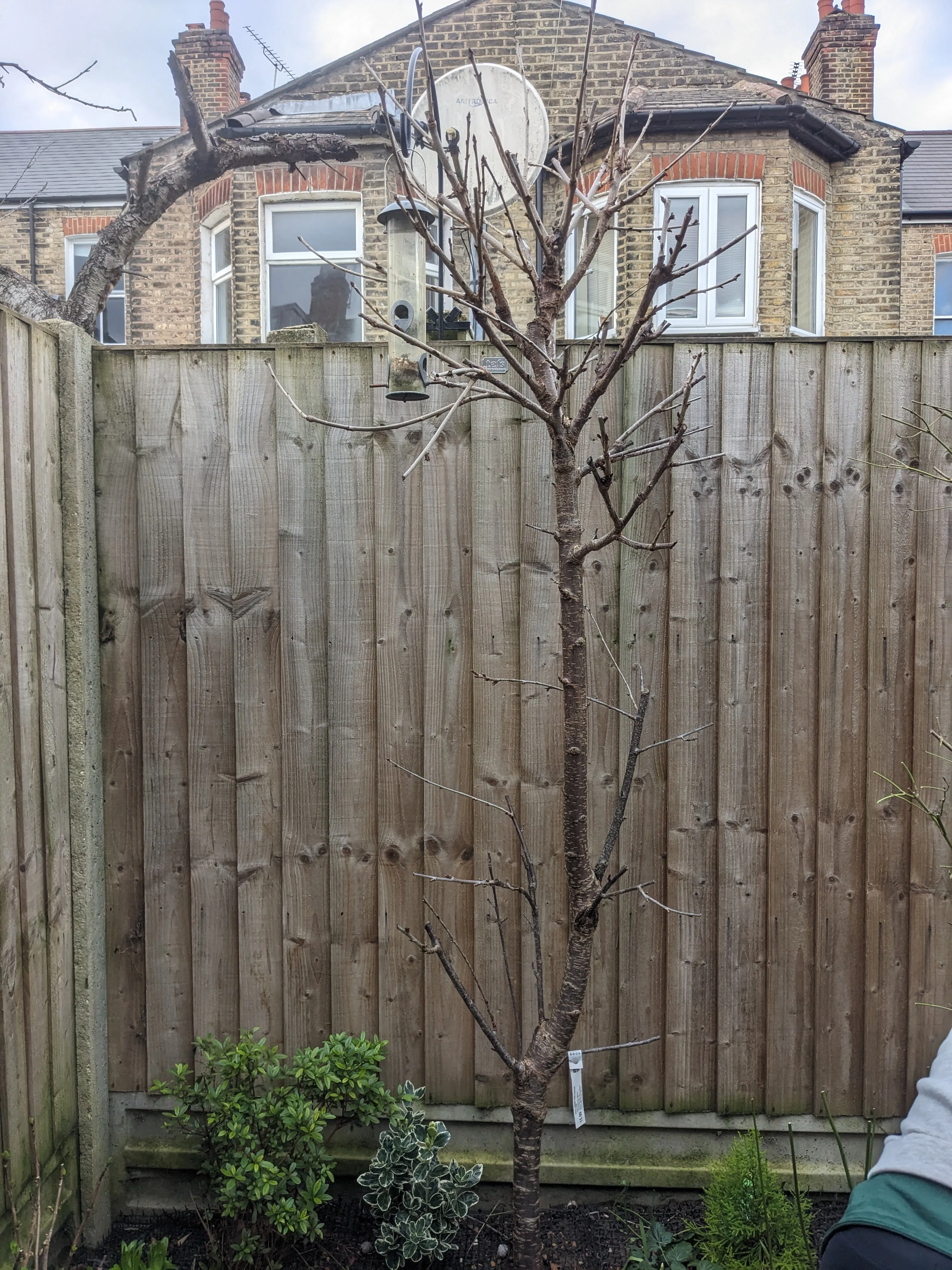
What you've got is a common problem with young cherry trees that haven't been properly trained in their early years. Those low level branches competing with the main trunk, combined with the bare section and then regrowth higher up, suggests the tree either wasn't pruned at all in its first few years or was pruned inconsistently. The result is exactly what you're seeing: a confused structure that doesn't know whether it's trying to be a bush or a tree.
The lower branches growing from near ground level need to come off completely, cut back flush to the main trunk. These are never going to develop into a useful framework and they're just stealing energy from the upper canopy. When you remove them in June or July, make clean cuts right back to the trunk collar (that slight swelling where the branch meets the trunk) without leaving stubs.
https://youtu.be/EWPEuJ48kmU
Why Reducing Height Isn't the Answer Here
Here's where I'm going to give you advice that probably contradicts what you were hoping to hear, but it's important you understand why. You shouldn't try to reduce the overall height of this tree. Looking at your photos, the tree is already quite badly shaped, and chopping the top off will only make it worse by encouraging a mass of weak, vigorous regrowth exactly where you've cut. You'll end up with a bushy mop head of tangled branches rather than the elegant canopy you're hoping for.
Instead, what you need to do is remove about one third of the upper branches, keeping only the strongest and best positioned ones to create an open, goblet shaped canopy. This means selecting three to five well spaced branches that radiate outward from the central area, ideally positioned roughly evenly around the tree. Everything else in that upper section should be removed completely, cut back to where they join a main branch or the trunk. This will give you structure and light penetration without triggering that vigorous regrowth response.
The bare trunk section in the middle is actually fine and will become part of the tree's character as it matures. What you're creating is a small ornamental tree with a clear trunk and an open, airy canopy above, not a compact bush shape. Focus on reducing the lateral branches (the side shoots) rather than the height, which will give you a much more manageable and attractive tree in the long run.
Height in the Garden is Actually Your Friend
I completely understand the instinct to want everything below fence level, especially in a small London garden where space feels precious. But here's something that might change your perspective: height and vertical structure are absolutely essential in garden design, particularly in urban spaces. A well shaped tree with an open canopy above the fence line actually creates more depth, privacy, and interest than trying to keep everything squat and compact.
That open goblet shape I mentioned will give you a canopy that filters light rather than blocking it, meaning you get dappled shade beneath the tree rather than dense gloom. The clear trunk allows you to see through and beyond the tree, making the garden feel larger, not smaller. An open canopy above the fence line creates privacy by breaking up sight lines from neighbouring properties without making your garden feel enclosed or claustrophobic, which is exactly what happens when you try to create privacy with solid, low level screening.
Think of it this way: when you walk through a woodland, you don't feel hemmed in even though you're surrounded by trees, because the canopy is above you and the trunks create vertical lines that draw your eye upward and outward. The same principle applies in gardens. A small tree with a clear trunk and airy canopy feels spacious and elegant, whereas a pruned down, heavily branched shrub feels cluttered and takes up valuable ground level space.
Your Pruning Plan for June or July
When you come to prune in midsummer, here's your step by step approach. First, remove all those low level branches flush to the trunk, making clean cuts at the branch collar. Don't leave stubs, as these will die back and create entry points for disease. These cuts might seem drastic, but they're necessary to establish a proper tree form.
Second, assess the upper canopy and identify the three to five strongest, best positioned branches that will form your framework. You're looking for branches that radiate outward fairly evenly around the tree, creating that open goblet or vase shape. Everything else in the upper section gets removed, cut back to where they join one of your keeper branches or the main trunk.
Third, step back frequently and assess the shape as you're working. It's much easier to take more off than to stick branches back on. The goal is an open structure where light can penetrate through the canopy and air can circulate freely. You should be able to see sky through the branches when you stand underneath and look up.
Essential Reading on Cherry Tree Pruning
Rather than trying to explain every nuance of cherry pruning in this reply, I've written a comprehensive guide that'll walk you through the entire process with photos and clear instructions. My How to Prune Cherry Trees: Beginner Guide covers everything from the best time to prune through to the specific cuts you need to make for different shapes and sizes.
You'll also find helpful discussions in other forum threads where people have tackled similar cherry tree challenges. There are dozens of posts from gardeners dealing with overgrown, misshapen, or neglected cherry trees, and reading through their experiences and the advice they received will give you confidence that this is a common problem with straightforward solutions.
The key message across all of these resources is the same: prune in summer, not winter, and focus on creating an open structure rather than reducing height. Get those fundamentals right and your cherry tree will reward you with healthy growth, better disease resistance, and a far more attractive shape.
Living With a Small Garden Tree
One final thought that might help you make peace with having height in your garden: small ornamental trees like cherries are absolute assets in urban spaces. They give you seasonal interest with spring blossom, summer foliage, autumn colour, and attractive winter bark. They provide habitat for birds and beneficial insects. They create vertical structure that makes small gardens feel more designed and intentional rather than just being flat rectangles of planting.
Your instinct to reduce everything to below fence level is completely understandable, but it's actually working against what makes small gardens feel larger and more interesting. Embrace the height, create that open canopy, and you'll find your garden feels more spacious, more private, and infinitely more characterful than if you'd hacked everything down to a uniform low level.
Wait until June or July, follow the pruning guidance in my detailed guide, and be brave with removing those lower branches and thinning the upper canopy. Your cherry tree will thank you for it, and in a couple of years you'll have a beautifully shaped small tree that's the envy of your neighbours rather than a confused tangle of badly placed branches.
Keep us posted on how you get on!
Lee Garden Ninja
Hi @dcswindells
Thanks for reaching out about your cherry tree, and I can see from your photos exactly what's happened here. The good news is that you can definitely improve the shape and structure, but the first thing I need to tell you is don't prune it right now. Cherry trees must be pruned in June or July when they're in full leaf, never during the dormant winter months. Pruning cherries in winter leaves them vulnerable to silver leaf disease and bacterial canker, both of which can kill the tree.
I know it's tempting to get out there with the secateurs when you're looking at a badly shaped tree, but trust me on this: wait until midsummer when the sap is flowing strongly and the tree can seal its wounds effectively. Mark this in your calendar for June, and in the meantime, let's talk about what you're actually going to do when the time comes.
Understanding Your Tree's Current Shape
What you've got is a common problem with young cherry trees that haven't been properly trained in their early years. Those low level branches competing with the main trunk, combined with the bare section and then regrowth higher up, suggests the tree either wasn't pruned at all in its first few years or was pruned inconsistently. The result is exactly what you're seeing: a confused structure that doesn't know whether it's trying to be a bush or a tree.
The lower branches growing from near ground level need to come off completely, cut back flush to the main trunk. These are never going to develop into a useful framework and they're just stealing energy from the upper canopy. When you remove them in June or July, make clean cuts right back to the trunk collar (that slight swelling where the branch meets the trunk) without leaving stubs.
Why Reducing Height Isn't the Answer Here
Here's where I'm going to give you advice that probably contradicts what you were hoping to hear, but it's important you understand why. You shouldn't try to reduce the overall height of this tree. Looking at your photos, the tree is already quite badly shaped, and chopping the top off will only make it worse by encouraging a mass of weak, vigorous regrowth exactly where you've cut. You'll end up with a bushy mop head of tangled branches rather than the elegant canopy you're hoping for.
Instead, what you need to do is remove about one third of the upper branches, keeping only the strongest and best positioned ones to create an open, goblet shaped canopy. This means selecting three to five well spaced branches that radiate outward from the central area, ideally positioned roughly evenly around the tree. Everything else in that upper section should be removed completely, cut back to where they join a main branch or the trunk. This will give you structure and light penetration without triggering that vigorous regrowth response.
The bare trunk section in the middle is actually fine and will become part of the tree's character as it matures. What you're creating is a small ornamental tree with a clear trunk and an open, airy canopy above, not a compact bush shape. Focus on reducing the lateral branches (the side shoots) rather than the height, which will give you a much more manageable and attractive tree in the long run.
Height in the Garden is Actually Your Friend
I completely understand the instinct to want everything below fence level, especially in a small London garden where space feels precious. But here's something that might change your perspective: height and vertical structure are absolutely essential in garden design, particularly in urban spaces. A well shaped tree with an open canopy above the fence line actually creates more depth, privacy, and interest than trying to keep everything squat and compact.
That open goblet shape I mentioned will give you a canopy that filters light rather than blocking it, meaning you get dappled shade beneath the tree rather than dense gloom. The clear trunk allows you to see through and beyond the tree, making the garden feel larger, not smaller. An open canopy above the fence line creates privacy by breaking up sight lines from neighbouring properties without making your garden feel enclosed or claustrophobic, which is exactly what happens when you try to create privacy with solid, low level screening.
Think of it this way: when you walk through a woodland, you don't feel hemmed in even though you're surrounded by trees, because the canopy is above you and the trunks create vertical lines that draw your eye upward and outward. The same principle applies in gardens. A small tree with a clear trunk and airy canopy feels spacious and elegant, whereas a pruned down, heavily branched shrub feels cluttered and takes up valuable ground level space.
Your Pruning Plan for June or July
When you come to prune in midsummer, here's your step by step approach. First, remove all those low level branches flush to the trunk, making clean cuts at the branch collar. Don't leave stubs, as these will die back and create entry points for disease. These cuts might seem drastic, but they're necessary to establish a proper tree form.
Second, assess the upper canopy and identify the three to five strongest, best positioned branches that will form your framework. You're looking for branches that radiate outward fairly evenly around the tree, creating that open goblet or vase shape. Everything else in the upper section gets removed, cut back to where they join one of your keeper branches or the main trunk.
Third, step back frequently and assess the shape as you're working. It's much easier to take more off than to stick branches back on. The goal is an open structure where light can penetrate through the canopy and air can circulate freely. You should be able to see sky through the branches when you stand underneath and look up.
Essential Reading on Cherry Tree Pruning
Rather than trying to explain every nuance of cherry pruning in this reply, I've written a comprehensive guide that'll walk you through the entire process with photos and clear instructions. My How to Prune Cherry Trees: Beginner Guide covers everything from the best time to prune through to the specific cuts you need to make for different shapes and sizes.
You'll also find helpful discussions in other forum threads where people have tackled similar cherry tree challenges. There are dozens of posts from gardeners dealing with overgrown, misshapen, or neglected cherry trees, and reading through their experiences and the advice they received will give you confidence that this is a common problem with straightforward solutions.
The key message across all of these resources is the same: prune in summer, not winter, and focus on creating an open structure rather than reducing height. Get those fundamentals right and your cherry tree will reward you with healthy growth, better disease resistance, and a far more attractive shape.
Living With a Small Garden Tree
One final thought that might help you make peace with having height in your garden: small ornamental trees like cherries are absolute assets in urban spaces. They give you seasonal interest with spring blossom, summer foliage, autumn colour, and attractive winter bark. They provide habitat for birds and beneficial insects. They create vertical structure that makes small gardens feel more designed and intentional rather than just being flat rectangles of planting.
Your instinct to reduce everything to below fence level is completely understandable, but it's actually working against what makes small gardens feel larger and more interesting. Embrace the height, create that open canopy, and you'll find your garden feels more spacious, more private, and infinitely more characterful than if you'd hacked everything down to a uniform low level.
Wait until June or July, follow the pruning guidance in my detailed guide, and be brave with removing those lower branches and thinning the upper canopy. Your cherry tree will thank you for it, and in a couple of years you'll have a beautifully shaped small tree that's the envy of your neighbours rather than a confused tangle of badly placed branches.
Keep us posted on how you get on!
Lee Garden Ninja
 Lee Burkhill: Award Winning Designer & BBC 1's Garden Rescue Presenters Official Blog