For the garden you’ve already got, not the one you’re starting from scratch. Seven checklists and video lessons from BBC Garden Rescue’s Lee Burkhill, built to help you work out what’s worth keeping before you spend a penny.
69
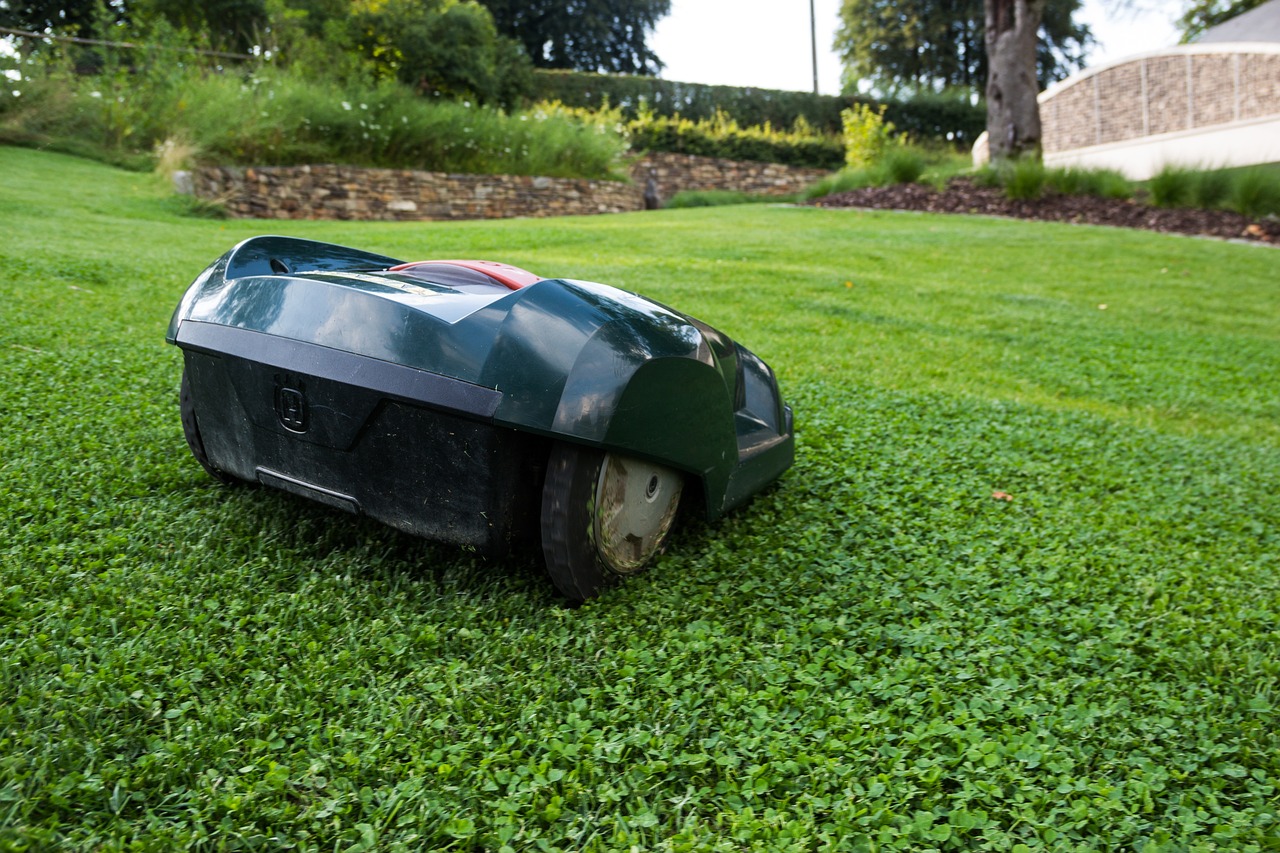

Quick answer: For a typical UK back garden under 300 square metres on a tight budget, the WORX Landroid Vision Cloud WR303E at around £630 is the robot mower I would fit, because it needs no wire and no antenna. Larger gardens up to 800 square metres do better with the LiDAR-guided Segway Navimow i208, and steep or sprawling plots need the all-wheel drive Mammotion Luba 3 AWD instead.

This guide is the version I wish someone had handed me at the start of my journey into trialling robotic lawn mowers. It covers what has actually changed in the last three years, mostly the death of the boundary wire, and is honest about what robot mowers still cannot do. It also covers the wildlife question properly, because the research on hedgehogs and robot mowers is now solid enough that no UK buying guide should be ignoring it, and almost all of them still do.
Every price below is the UK price at the time of writing. Robot mower pricing moves around a lot, particularly in autumn when retailers clear stock, so always check before you commit.
Jump to
(If you want the short version and a typical UK back garden under 300 square metres, the WORX Landroid Vision Cloud WR303E is available on Amazon here, and it is the machine I recommend most often.)
This page contains affiliate links for products I use and recommend. If you take action after clicking a link, such as subscribing or making a purchase, I may earn a small gardening commission, which helps keep the Garden Ninja blog free for everyone.
For the right garden, yes. Robot mowers can save you precious time, especially if you are working full time and do not fancy pushing an electric lawn mower around every Saturday. For the wrong garden, they are an expensive ornament. The deciding factor is not budget; it is the shape, steepness and size of your lawn.
A robot mower earns its money on a lawn that is broadly open, reasonably flat, and cut often. Because it trims a few millimetres every day or two rather than taking a third off the sward once a fortnight, the grass never goes through the shock of a hard cut. The clippings are tiny and mulch right back down, feeding the lawn and meaning you never fill a single brown bin.
On the design jobs where I have specified one for a client with a simple rectangular back lawn, the finish after a month is better than anything they were achieving with a rotary mower at the weekend.
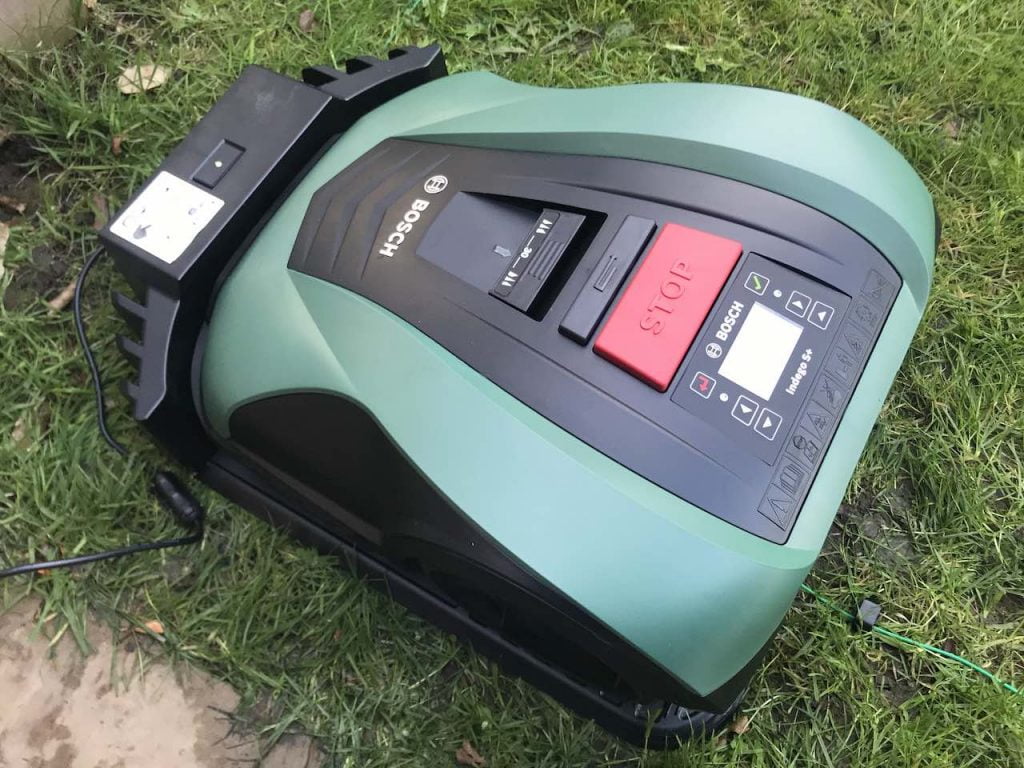
Where they fall down is complexity. Narrow throats between lawn areas, sunken trampolines, raised tree roots, gravel paths that spill onto the grass, steps, and steeply banked sections all cause trouble. Every one of those can be worked around, but each workaround costs you either money or tolerance. If your lawn is made up of several small, awkward pieces rather than one or two clean shapes, think it through before spending £700 or more on a robot mower.
The other thing worth saying plainly is that a robot mower does not eliminate lawn work. You still need to strim edges it cannot reach, and you still need to scarify, aerate and feed. If anything a robot mower makes the rest of your lawn care more visible, because the cutting is handled and everything else stands out. My month-by-month lawn care planner covers the jobs that remain.
This is the single biggest decision, and it has changed completely in the last three years, so any advice from before 2024 is out of date. In fact, when I first reviewed Robo mowers 8 years ago, they were all wired, and back then, corrosion of the buried wires was a big issue, leading to intermittent breakdowns and the need for fixes. Hardly a maintenance and time saver!
A boundary wire system works by pegging or burying a perimeter cable around the edge of the lawn and around every obstacle. The mower senses the field from that wire and stays inside it.
Installation on a medium-sized garden takes most of a day, and if you later change a border shape, you have to dig up the wire again, probably severing it in a few places during the process and getting frustrated. What you get in return is absolute reliability. The wire does not care about tree canopy, cloud cover, shadow, or a patchy Wi-Fi signal at the bottom of the garden.
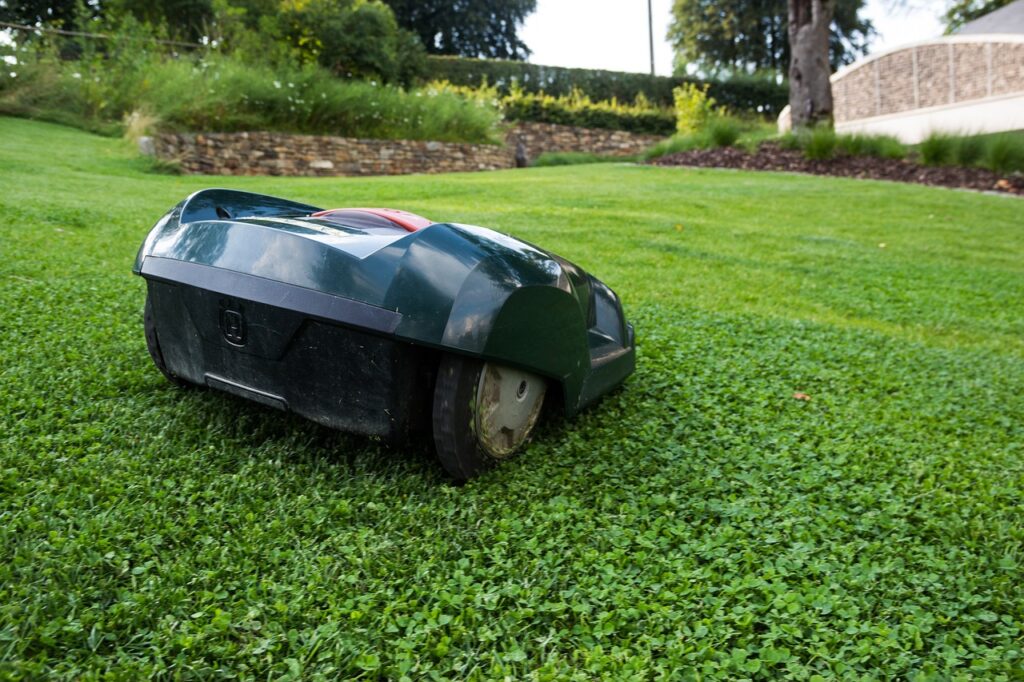
Wire-free machines navigate using satellite positioning, solid-state LiDAR, onboard vision, or some fusion of the three, increasingly correcting position data over the cloud rather than needing a physical base station in the garden at all. You walk the perimeter once with the app, or in some cases let the mower map itself, and you are done in under an hour. Changing a zone later is a two-minute job on your phone.
The catch with satellite systems used to be signal. Under a mature tree canopy or tight against a two storey house, the fix can drop out. The newer machines handle this far better than the first generation did, because they fall back on camera vision, LiDAR, or dead reckoning when the satellite signal weakens rather than simply stopping and sulking.
Some wire-free mowers now also need a stable Wi-Fi signal across the entire lawn rather than a satellite fix, which is its own kind of coverage problem in a garden with a summerhouse or a garage at the far end. On a garden with heavy overhanging trees or patchy Wi-Fi, a wire system is still the safer bet, and that is the main reason Husqvarna’s wired Automowers are still worth buying in 2026, even now that the brand also sells wire-free models.
Five machines, running from a genuine budget option through to the machine I would specify for a large, steeply sloping garden. I have kept this list deliberately short rather than padding it out with every model on the market, because most of the differences between mid-range robot mowers are marketing rather than engineering.
Under each machine, you will find a pros-and-cons table compiled from what owners report on Amazon and Trustpilot, alongside independent test sites, rather than from the brochure. I have weighted the complaints that come up again and again more heavily than the one-off horror stories, because a fault reported by hundreds of owners tells you something about the machine, whereas a single furious review usually does not.
| Model | UK price | Max lawn | Navigation | Max slope | Cut height |
|---|---|---|---|---|---|
| Einhell FREELEXO 500 | £375 to £400 | 500m² | Boundary wire, app and keypad control | 35% (19°) | 30 to 60mm |
| WORX Landroid Vision Cloud WR303E | £630 | 300m² | Wire-free, RTK Cloud and Vision AI | 30% (17°) | 30 to 60mm |
| Husqvarna Automower Aspire R6V | £999 | 600m² | Wire-free, satellite and AI vision (needs Wi-Fi across the lawn) | 40% inside, 15% at boundary | 20 to 50mm |
| Segway Navimow i208 LiDAR | £1,099 | 800m² | Wire-free, solid-state LiDAR and vision, no antenna | 45% (24°) | App-adjustable |
| Mammotion Luba 3 AWD 1500 | From around £2,000 | 1,500m² | Wire-free, Tri-Fusion: 360° LiDAR, NetRTK and AI vision | 80% (38.6°) | App-adjustable |
If £630 upwards is more than you want to spend, this is where I point people instead. The FREELEXO 500 is a boundary wire machine rather than wire-free, which in this guide is normally the thing I am steering people away from, but at this price it is a sensible trade. You get a proper robot mower, from an established brand, for under £400.
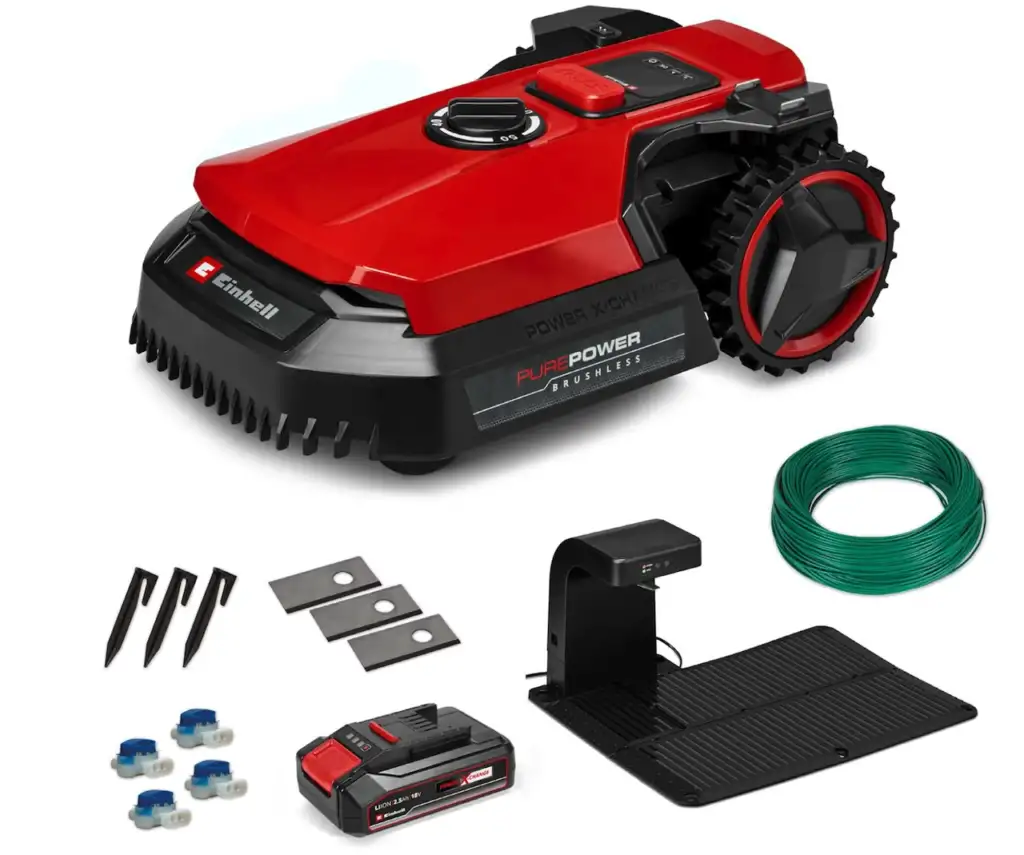
It covers up to 500 square metres, cuts an 18cm width at 30 to 60mm across four settings, and handles a 35 per cent slope, which is better than either of the wire-free machines further down this list. Installation is the trade-off. You are pegging or burying 130 metres of boundary wire around the lawn edge, and every obstacle before it will cut a single blade, which is most of a weekend’s work on an average garden rather than the approx. 1 hour a wire-free machine takes.
Shock, tilt and lift sensors, a rain sensor, and PIN code theft protection are all included as standard, and the whole thing runs from Einhell’s Power X-Change battery platform, so the battery is interchangeable if you already own other Einhell tools.
This is not the machine for a garden with lots of narrow, awkward sections, since moving the wire later means digging it up and re-pegging it. For a simple, open lawn under 500 square metres where budget matters more than convenience, it does the job properly.
Einhell FREELEXO 500 pros and cons at a glance
| Pros | Cons |
|---|---|
| Cheapest sensible way into robot mowing, with the wire, pegs, battery and charging station all in the box | Around 130 metres of boundary wire to peg or bury before it cuts a blade |
| Power X-Change battery is shared with the rest of Einhell’s cordless range | Cuts in a random pattern rather than systematic lines, so it needs longer on the lawn to cover it |
| Three year warranty once the machine is registered, and Einhell spares are easy to get hold of | Owners report it gets fussy on bumpy ground and around clusters of obstacles |
| App runs over Bluetooth in the garden or remotely over Wi-Fi, with firmware updates arriving overnight | The 35 per cent slope figure looks optimistic on damp grass, judging by owner reports |
| The wire keeps working under dense tree canopy and in the far corners where Wi-Fi gives up | Reshaping a border later means lifting and re-pegging the wire rather than editing a map |
🛒 Check the current price of the Einhell FREELEXO 500 on Amazon.
This is the one I fit most often with clients, because it lands on the right side of every compromise for a normal British garden. At £630 for 300 square metres of coverage, it costs less than a boundary wire kit and a weekend of your time to install, with no wire to bury and no antenna to mount.
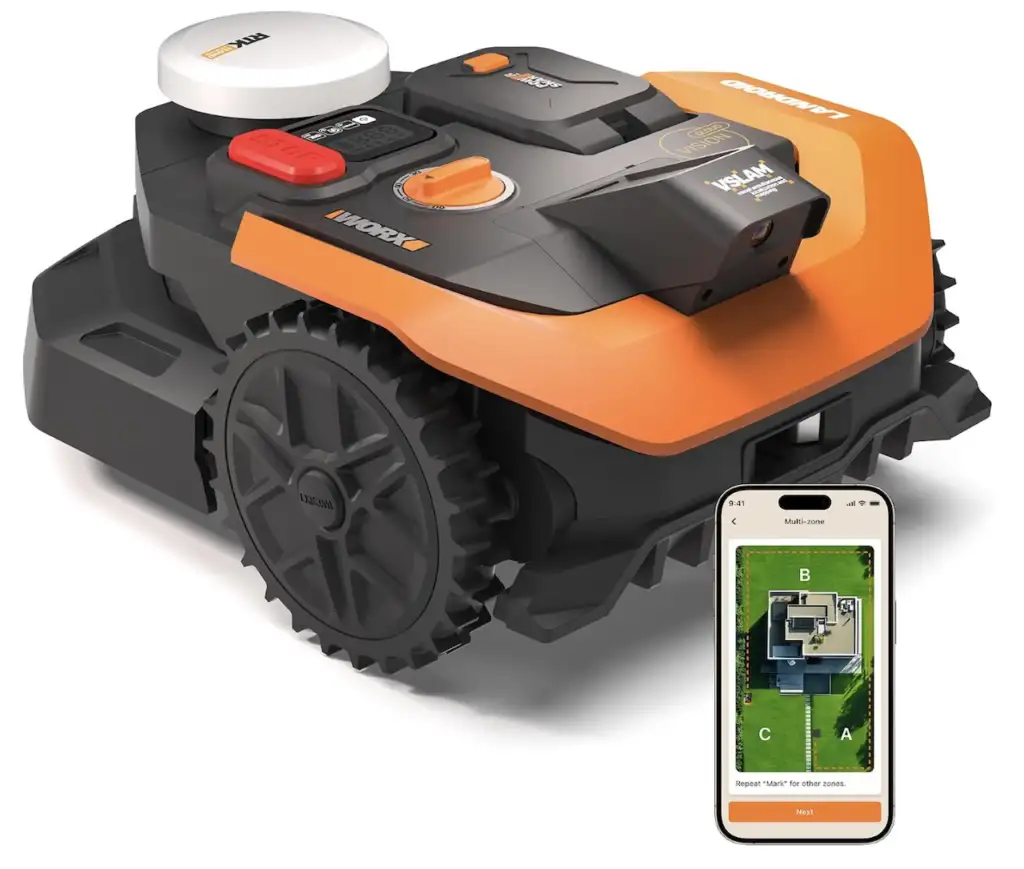
Setup is app-led and takes under an hour on a straightforward plot. Positioning comes from WORX’s RTK Cloud service, which corrects the mower’s location in the cloud rather than from a base station in your garden, and is backed up by Vision AI and V-SLAM when it loses satellite view under trees or in shade.
It cuts an 18cm width across four cutting heights from 30 to 60mm, runs on a 20V PowerShare battery that is interchangeable with other WORX garden tools, and handles a 30 per cent slope. The three pivoting blades are also the safer design for wildlife, which I come back to later.
Two things to know before you buy. Cutting height on this smaller model is adjusted by hand rather than through the app, and a true zero-edge cut needs an optional module, so expect to trim a narrow strip by hand in places without it. For a flat or gently sloping garden inside 300 square metres, which covers most British back lawns, it is hard to beat at the money.
WORX Landroid Vision Cloud WR303E pros and cons at a glance
| Pros | Cons |
|---|---|
| No wire and no antenna, with the RTK correction arriving from the cloud and no subscription attached to it | A true zero-edge cut needs the optional module, so corners and hard edges leave a trim strip |
| App-led setup that testers are finishing inside an hour, with auto-mapping that copes with multiple zones | Cutting height is set by hand on the machine rather than through the app as it is on the bigger models |
| Obstacle recognition handles toys, pets and narrow gaps between lawn areas well in independent testing | The 30 per cent slope rating rules out anything with a proper bank in it |
| PowerShare battery swaps into other WORX garden tools, and there is a three-year warranty if you register within 30 days | WORX after-sales takes steady criticism on Trustpilot over response times and parts availability |
| Three pivoting blades, which is the safer arrangement for wildlife as covered further down | The Vision Cloud range is new, so long-term owner reports are thin, and the older camera-only Vision models share almost the same name |
🛒 Check the current price of the WORX Landroid Vision Cloud WR303E on Amazon.
Husqvarna have been building these longer than anyone, and the Aspire R6V is the model that finally brings that reputation to a wire-free machine at an accessible price. At £999 it covers up to 600 square metres using satellite positioning and a built-in AI Vision camera rather than a buried perimeter cable, which is a real shift for a brand that built its name on the wire.
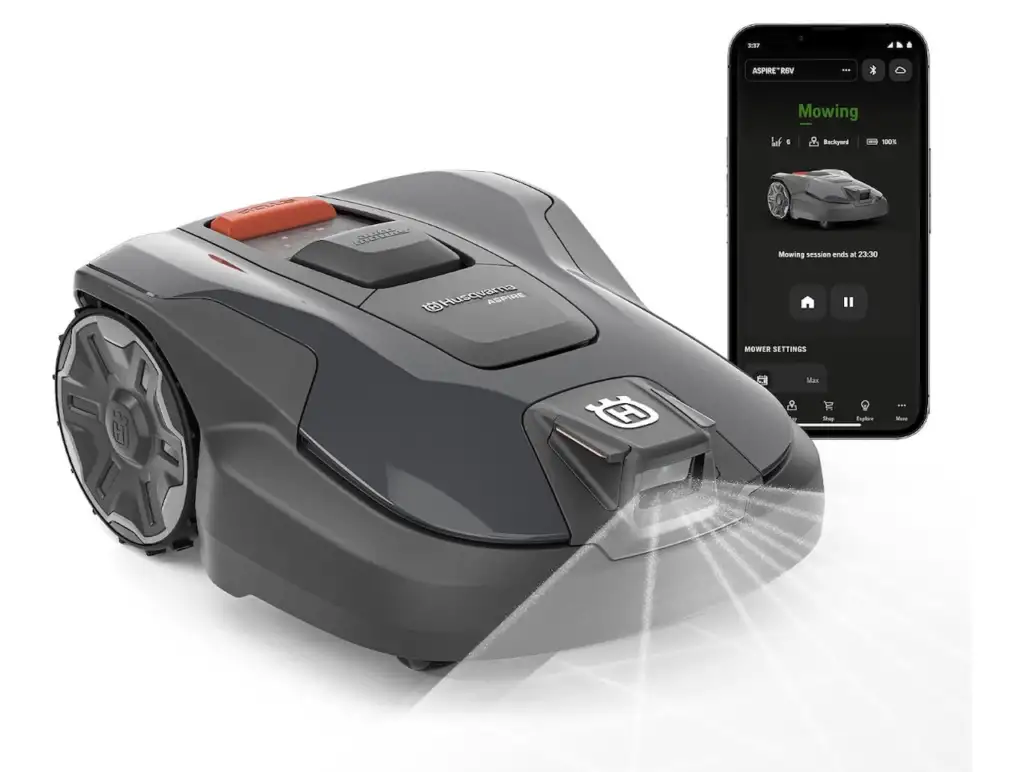
It cuts a 22cm width at 20 to 50mm with three pivoting razor blades and a skid plate, both features that matter for the wildlife section below, and handles a 40 per cent slope inside the lawn, dropping to 15 per cent right at the boundary itself, which is worth checking if you have a bank running up to the edge. The catch, and it is a real one, is that wire-free installation needs Wi-Fi coverage across the entire lawn, not just near the house.
If your garden has a summerhouse, a garage, or simply a dead spot at the far end, check your phone signal out there before you buy, not after. Security includes PIN code, geofence, and alarm as standard, though unlike some rivals, GPS theft tracking is not built in.
This is also where I would point you back towards Husqvarna’s older, wired Automower range, such as the 405X, if your garden works against a wire-free machine. Heavy tree canopy, a large detached outbuilding, or simply patchy Wi-Fi at the bottom of the garden are all situations where a physical boundary wire, immune to signal and satellite dropout entirely, is still the more reliable choice. Husqvarna sell both approaches side by side for exactly this reason, and matching the technology to your actual garden matters more than chasing the newest navigation method.
Husqvarna Automower Aspire R6V pros and cons at a glance
| Pros | Cons |
|---|---|
| Setup is a case of dropping waypoints round the lawn in the app, and the boundaries are easy to nudge afterwards | Wire-free running needs Wi-Fi across the whole lawn, which is what catches most buyers out |
| The AI Vision camera steers around obstacles rather than bumping into them first | The 600 square metre figure drops to nearer 400 once the layout gets complicated |
| Systematic cutting pattern, pivoting razor blades and a skid plate under the deck | Slope tolerance falls to 15 per cent right at the boundary, so a bank running up to the edge is a problem |
| A proper UK dealer network for installation, servicing and spares, which none of the direct sellers here match | GPS theft tracking is not built into this model, unlike the older wired Automowers |
| Quiet in use, built in Europe, with a long history of parts availability behind the brand | Husqvarna’s own after-sales scores badly on Trustpilot, with long waits for warranty parts a recurring theme |
🛒 Check the current price of the Husqvarna Automower Aspire R6V on Amazon.
This is the machine I move people up to once a garden goes past what the WORX or Husqvarna can comfortably manage. At £1,099 it covers up to 800 square metres and drops satellite dependence entirely in favour of solid-state LiDAR paired with an onboard camera, so it maps and navigates without a wire, without an antenna, and without needing a clear view of the sky.
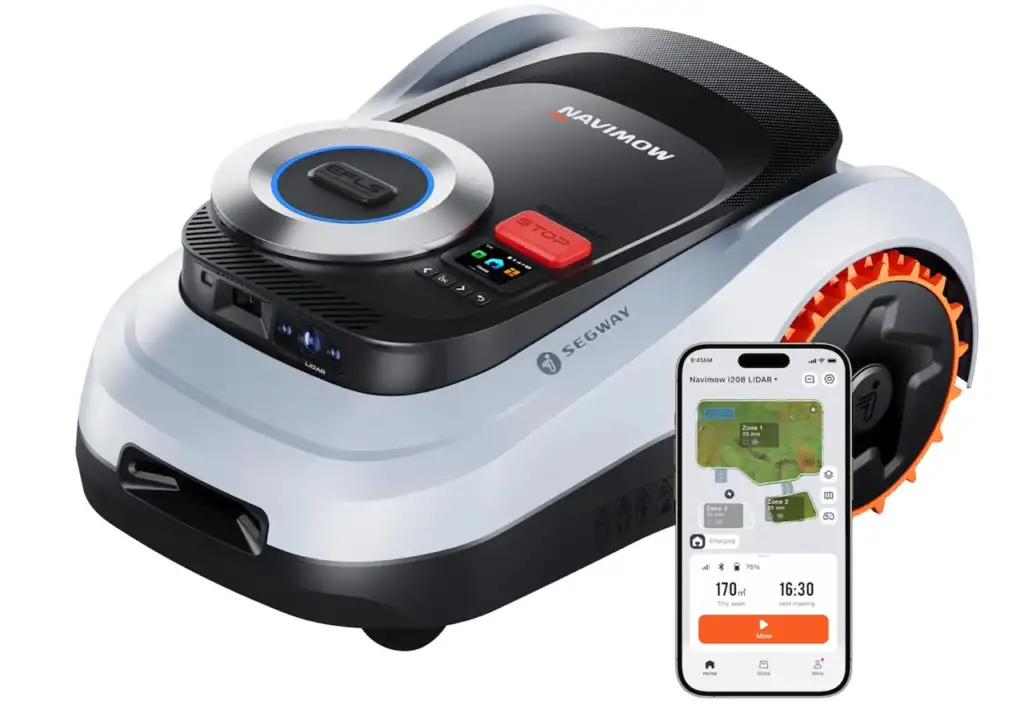
That LiDAR and vision combination is the real selling point. It keeps working reliably under mature tree cover and in low light, exactly where satellite-based machines struggle, and the auto-mapping is a single tap in the app rather than a walked perimeter.
It handles a 45 per cent slope, which is steeper than anything else on this list bar the Mammotion, runs a six-blade cutting disc from a 100W motor, and operates at 59dB(A), quiet enough to run during the day without anyone noticing. Security comes built in rather than as an add-on this time round, with GPS tracking, geofence alerts, lift detection and Apple Find My support all included through the mower’s built-in 4G connection.
The trade-off is straightforward. This is a step up in price for a step up in coverage and shade tolerance, and it is more mower than most typical back gardens need. For anything approaching 500 to 800 square metres, particularly under trees, it earns that price.
Segway Navimow i208 LiDAR pros and cons at a glance
| Pros | Cons |
|---|---|
| LiDAR and camera navigation keeps working under canopy, in shade and after dark, with no antenna and no need for a view of the sky | The initial mapping takes more fiddling than the drop-and-mow marketing suggests |
| Quiet enough at 59dB to run through the afternoon without annoying anyone | Edges still need a strimmer, as they do on everything else in this guide |
| GPS tracking, geofence alerts, lift detection and Apple Find My all included through the built-in 4G | Comfortably more mower than a standard British back garden needs |
| Build quality rates well with testers, and long-term owners report the software improving season on season | Owners of earlier Navimow models report clipping thin trunks, shrubs and low branches, scuffing the casing |
| Regularly discounted below the £1,099 list price, often with the weatherproof garage included | Support is hit-and-miss, with slow responses reported alongside plenty of good experiences |
🛒 Check the current price of the Segway Navimow i208 LiDAR on Amazon.
This is the machine for the gardens that defeat everything else on this list. All-wheel drive, an 80 per cent slope rating which is just under 39 degrees, and Mammotion’s Tri-Fusion navigation, which combines 360 degree LiDAR, cloud-based RTK and dual camera AI vision into one system that switches between them depending on what the garden throws at it. I have watched one walk up a bank that I would think twice about pushing a rotary mower across. This is the real terminator of robo mowers, Ninjas!
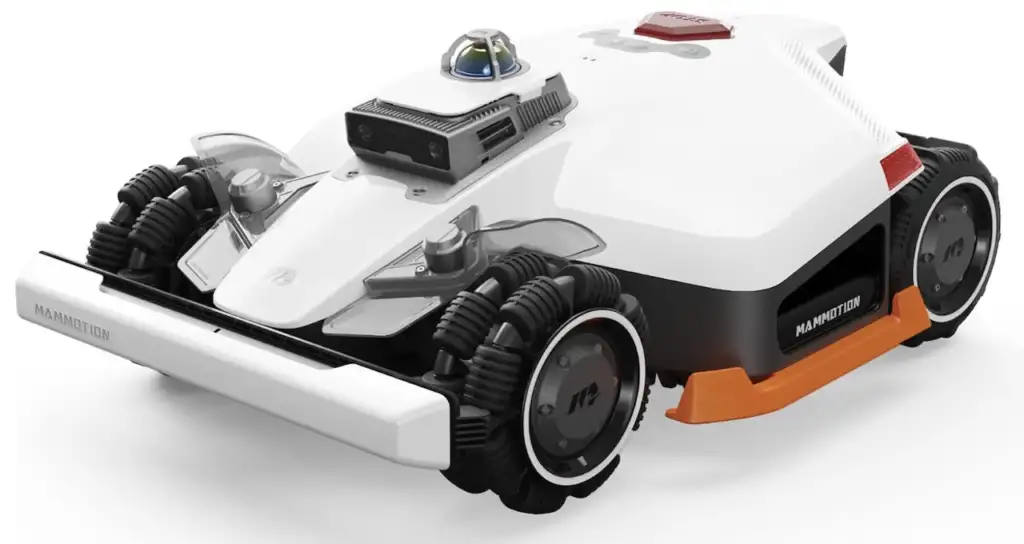
The 1500 model covers up to 1,500 square metres, with larger 3,000 and 5,000 square metre versions available above it for anyone with serious acreage. It maps automatically rather than needing you to walk the perimeter, identifies over 300 obstacle types, and the 360 degree LiDAR keeps working reliably in the dark and under dense shade where a satellite only system would lose its fix. Prices for the range start from around £2,000 and move around, so check the current figure before you commit.
For a normal suburban back garden this is comprehensively too much mower. For a large country garden, or anything with serious banking or heavy shade that has previously ruled robot mowers out altogether, it is the one on this list built to actually do the job.
Mammotion Luba 3 AWD 1500 pros and cons at a glance
| Pros | Cons |
|---|---|
| All-wheel drive and independent suspension deal with wet, rough and steeply banked ground that stops everything else | The built-in 4G is free for three years, then runs at roughly £50 a year |
| Tri-Fusion navigation holds its position under trees where satellite only machines drift | The app works but is less polished than Segway’s, and multi-zone setup takes more steps than it should |
| A 40cm deck that lays down parallel stripes, with cutting height set in the app from 25 to 70mm | The front tyres can mark soft or shaded turf, which shows up over a wet autumn |
| Automatic mapping, over 300 obstacle types recognised, and firmware that has measurably improved the platform since launch | Obstacle detection sometimes reads long grass as an obstacle, leaving tufts around trees and at the edge of rougher areas |
| Covers ground fast enough to keep on top of a large country garden without running all day | Mammotion after-sales draws repeated complaints about returns, replacements and slow replies |
🛒 Check the current price of the Mammotion Luba 3 AWD on Amazon.
Manufacturers quote a maximum working area and almost everyone buys too close to it. The quoted figure assumes an open rectangle, a mower running most of the day, and no obstacles. Real gardens have trees, beds, washing lines and a trampoline.
My rule is to buy for about 70 per cent of the quoted maximum. A 500 square metre machine is comfortable on a 350 square metre lawn and will struggle to keep on top of a genuine 500. Buying up a size costs less than living with a mower that never quite finishes.
To measure your lawn, pace the length and width of each section in metres and multiply. Most British back lawns come out somewhere between 80 and 250 square metres, which is well inside every machine listed here. If you are not sure, the satellite view in any mapping app will let you trace the area and read off a figure that is close enough.
Slope ratings are given as a percentage, which confuses everyone, so here is the translation. A 30 per cent slope rises 30cm over a metre travelled, which is roughly 17 degrees and steeper than it sounds. A 40 per cent slope is about 22 degrees, and the 45 per cent figure on the Segway Navimow i208 works out at roughly 24 degrees. The 80 per cent figure on the Mammotion Luba 3 AWD is nearly 39 degrees, which is a bank you would struggle to stand comfortably on.
Measure the steepest part of your lawn rather than the average. A mower rated to 30 per cent will manage a garden that averages 15 per cent with one short 35 per cent bank right up until the grass is wet, at which point it will spin, scar the turf and throw an error.
Edges are the other honest limitation. No robot mower cuts a true zero-edge without either a specific edge cutting function or a hard mowing strip for the wheels to run along. If you are laying a new lawn or resetting borders, a 30cm brick or paver mowing strip flush with the turf is the single best thing you can do to make a robot mower work well. My guide to laying turf covers getting levels right at the same time.
Nobody tells you this part, and it is where most of the disappointment comes from. A robot mower does not look impressive for the first two weeks. It looks like a small appliance wandering about achieving very little.
Start by cutting the lawn conventionally, down to roughly the height you want the robot to maintain. If you set a machine loose on grass that is 80mm long and ask it to hold 30mm, it will labour, leave clumps and probably throw a motor overload error on the first afternoon. Bring the lawn down over two conventional cuts a week apart, then hand over.
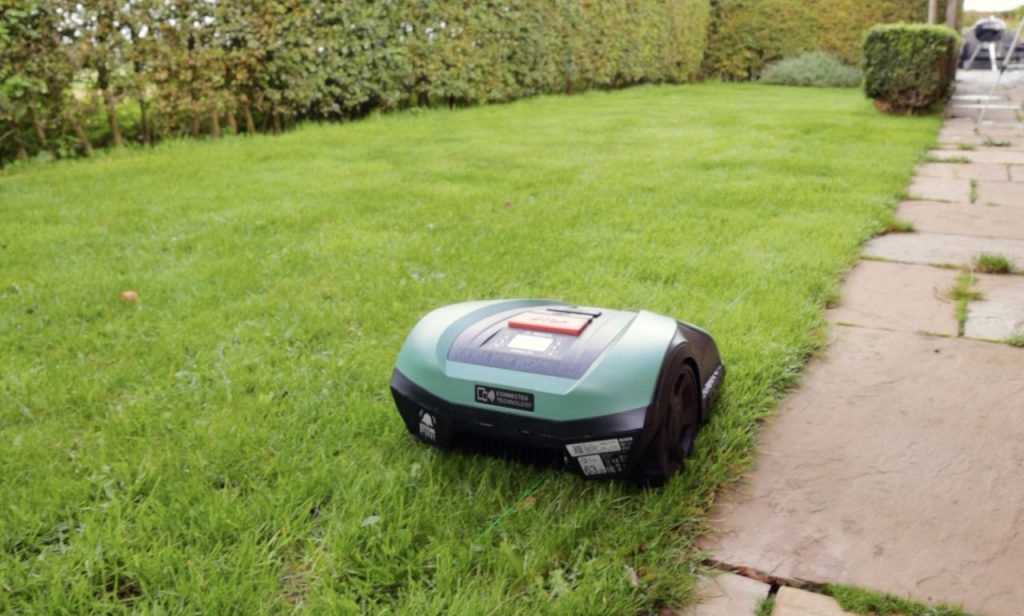
Set the cutting height high for the first fortnight, around 50mm on most machines, then drop it 5mm a week until you reach your target. This gives the sward time to thicken in response to frequent cutting rather than being scalped into stress. The lawn will look patchy for ten days or so while this happens, and then it will start to look noticeably better than it did before, because frequent light cutting encourages the grass to tiller and spread sideways.
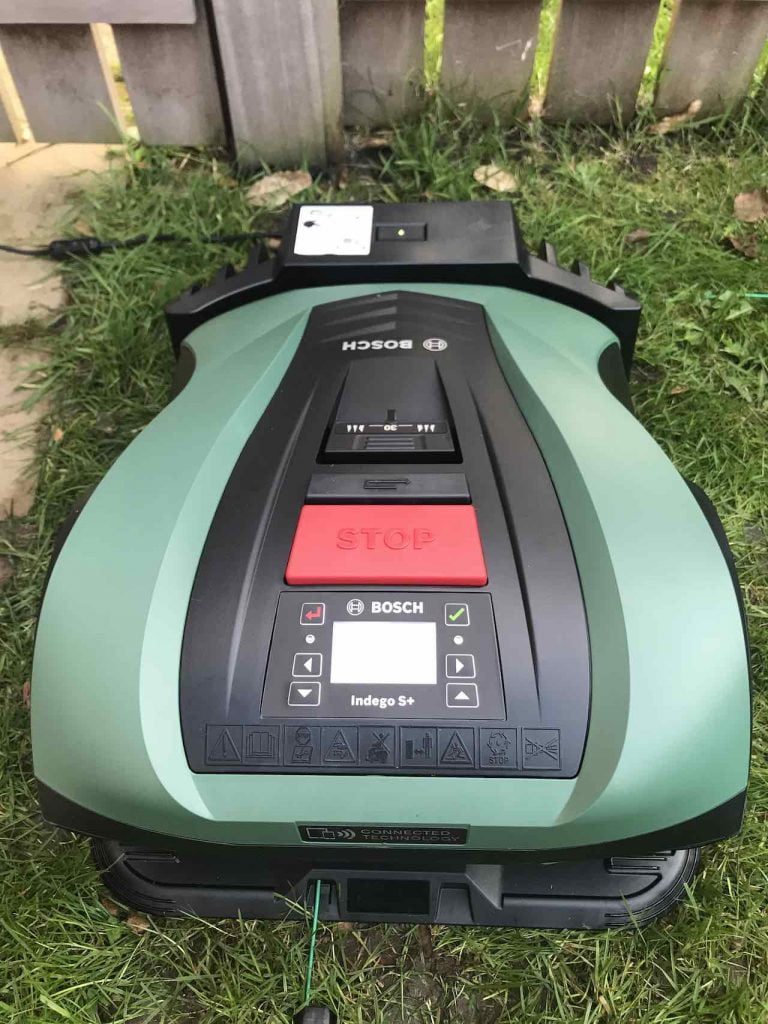
Expect to intervene. In the first week you will find the mower stuck somewhere, and the place it gets stuck tells you what to fix. A slight dip by the patio, a tree root that has lifted, a spot where the turf meets gravel. Each one is a five minute job with a spade or a paving slab, and after a fortnight of small corrections the machine will run for weeks without needing you.
Run the first few cuts while you are at home and can watch. This is the single most useful thing you can do, because you will see the machine approach a problem area before it gets trapped there, and you will learn which parts of your garden it treats with suspicion.
On schedule, less is usually more. Manufacturers default to aggressive timetables that have the mower out most of the day. On a lawn well inside the machine’s rated capacity you can often halve that and get the same finish with less wear, less noise and a much smaller window in which wildlife can come to harm. Start conservative and increase only if the lawn starts outgrowing the cut.
This is the section almost every robot mower guide leaves out, and it is the one I care most about. The research here is solid and it should change how you set your machine up.
A study led by Dr Sophie Lund Rasmussen of Aalborg University and Oxford University’s WildCRU, funded by the British Hedgehog Preservation Society and published in the journal Animals in April 2021, put 18 robotic mower models through collision testing using deceased hedgehogs across four weight classes, each tested twelve times in three positions.

Two findings matter for anyone buying one. Every single model tested required physical contact before it detected a hedgehog at all, and none of them detected juveniles weighing under 200 grams. The sensors on these machines are designed to spot a garden bench, not a small mammal that has curled up rather than run away, which is exactly what a hedgehog does when threatened.
The good news is that the damage varied enormously between models. Some caused extensive injuries, others left the test animals essentially unharmed. The design features that made the difference were pivoting blades rather than fixed ones, skid plates under the deck, and front-wheel drive. Oxford researchers went on to develop a standardised hedgehog safety test in 2024, with the aim of producing a labelling system so buyers can see which machines are wildlife-friendly before they part with their money.
Until that labelling exists, here is what I do on every installation.
None of the machines in this guide are marketed as specifically hedgehog-aware, and I would treat any claim along those lines with some scepticism until Oxford’s labelling scheme actually exists. Scheduling for daylight only is the one change that actually moves the needle, on any model, and it costs nothing but a few taps in the app.
A robot mower sits unattended in an open garden for hours at a time and is worth anywhere from £400 to over £2,000. Treat security as part of the purchase rather than an afterthought, and check exactly what is included in the price rather than assuming.
This has shifted around between models recently, which is worth knowing before you buy on reputation alone. The Segway Navimow i208 now includes GPS tracking, geofence alerts, lift detection and Apple Find My support as standard through its built-in 4G connection, no separate module required.
The Husqvarna Automower Aspire R6V, by contrast, ships with geofence alerts, a PIN lock and an alarm, but GPS theft tracking is not built in on this particular model, which is a change from Husqvarna’s older wired range where it commonly was. The Einhell FREELEXO 500 relies on its PIN code and the simple fact that lifting it off the lawn does not free it from the buried wire it is paired to. Always check the specific model’s spec sheet rather than assuming the brand’s flagship features carry down to every price point.
Beyond the machine’s own features, position the charging station where it is not visible from the road or a rear alley, and check whether your home insurance covers garden equipment left outside. Many policies cap outdoor cover well below the price of a mid-range robot mower.
Electricity is the least of it. A robot mower on a typical UK lawn uses somewhere around £15 to £25 of electricity across a full season, which is less than a single tank of petrol for a rotary mower.
Blades are the real consumable. Most machines use small razor-style blades that need swapping every six to ten weeks in the growing season, and a set costs a few pounds. Budget around £20 to £30 a year. Batteries last three to five seasons before capacity drops noticeably, and a replacement is typically £100 to £200 depending on the model.
Over winter, bring the mower indoors once growth stops, usually late October or November in most of the UK. Charge the battery to roughly half, clean the deck and underside properly, and store it somewhere frost-free. Leaving a lithium battery flat in an unheated shed through a British winter is the fastest way to kill it. Boundary wire can stay in the ground, but bring the charging station in if it is the type that unclips.
Worth being straight about, because the marketing is not.
They cannot cut long grass. Come back from a fortnight’s holiday to a lawn at 15cm and the mower will bog down, not power through. If you have been away, cut it conventionally first and let the robot take over again from there.
They cannot collect clippings. Everything is mulched back into the sward, which is good for the lawn and a problem if you were counting on the clippings for a compost heap.
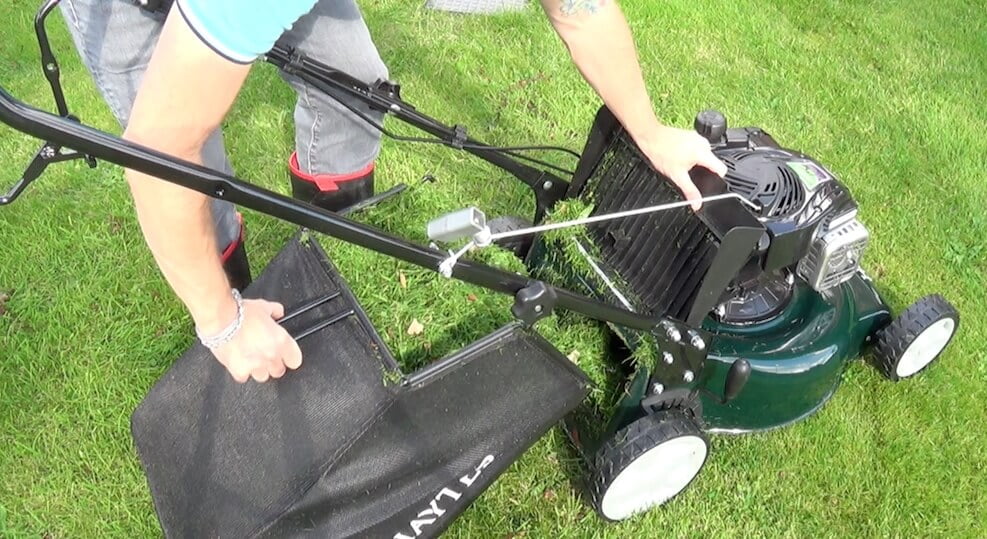
They cannot deal with leaf fall. A heavy autumn drop will either be shredded into the lawn, which is not always what you want, or will stop the machine entirely. A leaf blower or garden vacuum is still a separate job.
They cannot give you stripes. If you want a striped lawn you need a roller, and no domestic robot mower has one. The finish is even and dense rather than banded.
And they cannot replace the rest of lawn care. Scarifying, aerating, feeding and overseeding all still need doing, and a robot mower arguably makes them more important because the lawn is being cut so frequently. My guides on scarifying and feeding a lawn cover both.
For an open, broadly flat lawn that you want cut often, yes. A robot mower cuts a few millimetres every day or two rather than taking a third off the sward once a fortnight, so the grass never gets the shock of a hard cut and the clippings mulch straight back down. For a lawn made up of several small awkward sections with steps, gravel spill and steep banks, the workarounds cost more than the time you save.
They cannot cut long grass, so a fortnight away means cutting conventionally before the robot takes over again. They cannot collect clippings. They struggle with heavy autumn leaf fall. They cannot cut a true zero-edge without a mowing strip or a specific edge function, and they cannot give you stripes. They also pose a risk to hedgehogs unless you restrict them to daylight hours.
Not usually. Satellite-guided and LiDAR-guided machines, often backed up by cameras, map a lawn in under an hour from an app with no wire at all. A boundary wire is still the more reliable choice on a lawn under heavy tree canopy or with patchy Wi-Fi coverage, since some wire-free systems now need a stable internet signal across the whole lawn to work.
Not inherently. Research funded by the British Hedgehog Preservation Society tested 18 models and found every one required physical contact before detecting a hedgehog, and none detected juveniles under 200 grams. Restricting the mower to daylight hours removes most of the risk, since hedgehogs are nocturnal. Models with pivoting blades, skid plates and front-wheel drive caused less damage in testing.
Slope ratings are quoted as a percentage. Thirty per cent is about 17 degrees and covers most gently sloping gardens. Forty per cent is around 22 degrees. The all-wheel drive Mammotion Luba 3 AWD is rated to 80 per cent, which is nearly 39 degrees. Measure the steepest part of your lawn rather than the average, because a wet bank is where a mower will spin and scar the turf.
Electricity runs at roughly £15 to £25 across a full UK season. Blades need replacing every six to ten weeks in the growing season at a few pounds a set, so budget £20 to £30 a year. Batteries last three to five seasons and cost £100 to £200 to replace depending on the model.
It can, which is why PIN locking, GPS tracking, geofence alerts and alarms are worth checking model by model rather than assuming they are all included. The Segway Navimow i208 includes GPS tracking as standard through its built-in 4G connection. The Husqvarna Automower Aspire R6V includes geofence, PIN and alarm protection, but not GPS tracking on this particular model. Position the charging station out of sight from the road, and check whether your home insurance covers garden equipment left outside.
Buy for about 70 per cent of the quoted maximum working area. Manufacturers quote figures based on an open rectangle with no obstacles, so a machine rated for 500 square metres is comfortable on a 350 square metre lawn. Most British back lawns fall between 80 and 250 square metres.

Join over 100,000 gardeners on YouTube
Free gardening videos from the Garden Ninja, with 8 million views and counting.
Subscribe on YouTube, it’s freeGetting the mowing automated is the easy part. Knowing how a lawn should sit within the wider design, where the levels want to be and how the borders should meet the turf, is what turns a tidy garden into one that works all year.
My online courses start at £29 and take you from the basics through to planning and planting a garden with confidence, using the same approach I use on client work.
For the garden you’ve already got, not the one you’re starting from scratch. Seven checklists and video lessons from BBC Garden Rescue’s Lee Burkhill, built to help you work out what’s worth keeping before you spend a penny.
Garden Design Examples for Small Gardens: 30 Design Templates & Planting Plans: In this online gardening course, I’ll walk you through 30 fantastic garden designs, explaining the logic behind the layout, the plant choices, and take-home tips for applying them in your own garden.
Learn how to transform and design your own garden with Lee Burkhills crash course in garden design. Over 5 hours Lee will teach you how to design your own dream garden. Featuring practical design examples, planting ideas and video guides. Learn how to design your garden in one weekend!
Garden Design for Beginners Online Course: If you want to make the career jump to becoming a garden designer or to learn how to design your own garden, this is the beginner course for you. Join me, Lee Burkhill, an award-winning garden designer, as I train you in the art of beautiful garden design.
A robot mower suits an open, broadly flat lawn that you want cut frequently, and struggles with fragmented gardens full of steps, gravel and steep banks. The boundary wire is no longer necessary for most people, though it remains the more reliable option under heavy tree canopy or in areas with patchy Wi-Fi coverage.
Buy for around 70 per cent of the quoted maximum area, measure the steepest part of your lawn rather than the average, and set the schedule to daylight hours so you are not putting hedgehogs at risk. Get those three things right, and a robot mower will give you back an hour a week for years.
Happy gardening, and if you have questions about fitting a robot mower to your own lawn, come and ask on the Garden Ninja forum where I answer them personally.


Lee Burkhill, known as the Garden Ninja, is an award-winning garden designer and horticulturist with over 30 years of gardening experience and 15 years as a professional garden designer. A qualified RHS (Royal Horticultural Society) professional, Lee specialises in sustainable garden design and practical horticultural advice. He designs and presents on BBC1’s Garden Rescue and in leading gardening publications. Lee combines three decades of hands-on gardening knowledge with professional design qualifications to help gardeners create beautiful, functional outdoor spaces.
View all posts by Lee Burkhill









JOIN THE NINJAS

Be the first in line for new Guides, Discount codes and Offers