Hi @tankboy74
Great to hear from you again! Is your name anything to do with Tank Girl the comic by any chance?If so ten extra ninja points!!
You've made a solid start with the preparation for this pear tree. Well-rotted manure worked into clay soil with a mulch on top is textbook establishment practice, and you should feel confident that you have done the groundwork properly. Let me work through what I think is happening here.
Heat Wave Woes
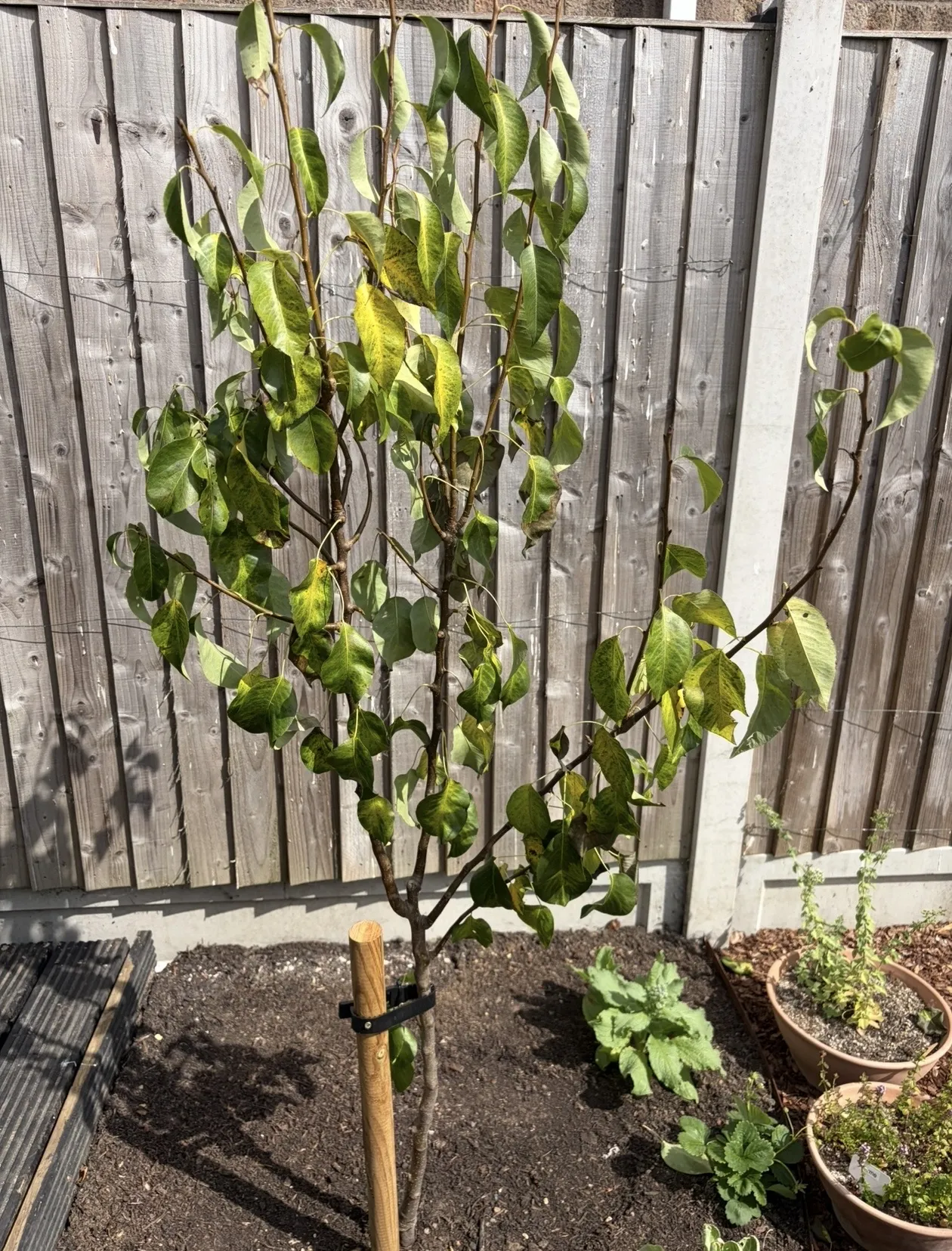
We have had two significant heatwaves in the UK this summer, and that context is central to understanding what your Conference Pear is doing right now. A tree planted only a month ago has a relatively small, shallow root system that is still in the process of making contact with the surrounding soil. In normal summer conditions, that is manageable. In the kind of sustained heat we have been experiencing, a newly planted tree with a limited root system is under considerable stress regardless of how well you have watered it, because the rate of moisture loss through the leaves can outpace the rate of water uptake through those young roots no matter what you do.
What I Think This Is
My strong suspicion is that this is heat stress rather than a watering problem in either direction. The leaf drop you are seeing is the tree's natural response to extreme conditions. When a tree cannot maintain sufficient water pressure through its leaves during a heatwave it sheds them, not because it is dying, but because dropping leaves reduces the surface area losing moisture and allows the tree to concentrate its limited resources on keeping the core of the plant alive. It is a survival mechanism rather than a death spiral.
The fact that other plants nearby are not suffering is actually consistent with this diagnosis rather than contradicting it. Established plants with deep, extensive root systems can access moisture from a much larger volume of soil and are far better buffered against short periods of extreme heat than a tree planted four weeks ago whose roots have barely extended beyond the original rootball.
Think of it as the tree having a bit of a sulk in response to some genuinely extreme weather. That is not a clinical term but it is an accurate one.
The Finger Test
Rather than trying to diagnose from visual symptoms alone, push your finger or a thin cane about ten centimetres into the soil at the base of the tree. What you find there tells you far more than what the leaves are doing above ground.
If the soil feels wet or cold at that depth, ease off watering and allow it to dry back to simply moist before watering again. If it feels barely damp or dry at that depth, give it a thorough, slow, deep watering at the base rather than a light sprinkle, and do this in the early morning rather than during the heat of the day. You are aiming for consistently moist but never waterlogged, which on clay soil in a heatwave requires more attention than it would in normal conditions because clay swings between wet and baked hard more dramatically than other soil types.
On the Clay Soil Point
Clay is both an asset and a challenge here. In sustained heat it can bake and crack on the surface while remaining quite cold and wet just a few centimetres down, which makes surface assessment unreliable. The finger test cuts through that guesswork. The mulch you have applied is doing important work in moderating those temperature extremes and retaining moisture, so keep it in place and top it up if it has thinned out at all, keeping it clear of the trunk itself to avoid rot at the base.
Here is the reassurance I want to give you alongside the practical advice. You will not know with any certainty whether this tree has come through well until next spring. That sounds alarming, but it is simply the reality of planting a tree in its first summer through exceptional weather. A tree can lose a significant proportion of its leaves, look thoroughly sorry for itself through August and September, and then push out strong healthy growth the following April once the root system has had a full winter to settle and extend into the surrounding soil. The leaf drop you are seeing now does not mean the tree is lost.
Do the scratch test on a small section of bark on one of the main branches. If the tissue beneath is green and slightly moist, the tree is alive and managing. If it is brown and dry all the way through, that branch is in trouble. A tree that passes the scratch test on its main scaffold branches in August, even with significant leaf drop, is very likely to make it through to spring.
Keep the watering consistent using the finger test as your guide; resist the urge to feed it this season, as feeding pushes growth a stressed tree cannot support, and let it rest through autumn and winter.
Come back and let us know how it looks in April.
Lee Garden Ninja
Hi @tankboy74
Great to hear from you again! Is your name anything to do with Tank Girl the comic by any chance?If so ten extra ninja points!!
You've made a solid start with the preparation for this pear tree. Well-rotted manure worked into clay soil with a mulch on top is textbook establishment practice, and you should feel confident that you have done the groundwork properly. Let me work through what I think is happening here.
Heat Wave Woes
We have had two significant heatwaves in the UK this summer, and that context is central to understanding what your Conference Pear is doing right now. A tree planted only a month ago has a relatively small, shallow root system that is still in the process of making contact with the surrounding soil. In normal summer conditions, that is manageable. In the kind of sustained heat we have been experiencing, a newly planted tree with a limited root system is under considerable stress regardless of how well you have watered it, because the rate of moisture loss through the leaves can outpace the rate of water uptake through those young roots no matter what you do.
What I Think This Is
My strong suspicion is that this is heat stress rather than a watering problem in either direction. The leaf drop you are seeing is the tree's natural response to extreme conditions. When a tree cannot maintain sufficient water pressure through its leaves during a heatwave it sheds them, not because it is dying, but because dropping leaves reduces the surface area losing moisture and allows the tree to concentrate its limited resources on keeping the core of the plant alive. It is a survival mechanism rather than a death spiral.
The fact that other plants nearby are not suffering is actually consistent with this diagnosis rather than contradicting it. Established plants with deep, extensive root systems can access moisture from a much larger volume of soil and are far better buffered against short periods of extreme heat than a tree planted four weeks ago whose roots have barely extended beyond the original rootball.
Think of it as the tree having a bit of a sulk in response to some genuinely extreme weather. That is not a clinical term but it is an accurate one.
The Finger Test
Rather than trying to diagnose from visual symptoms alone, push your finger or a thin cane about ten centimetres into the soil at the base of the tree. What you find there tells you far more than what the leaves are doing above ground.
If the soil feels wet or cold at that depth, ease off watering and allow it to dry back to simply moist before watering again. If it feels barely damp or dry at that depth, give it a thorough, slow, deep watering at the base rather than a light sprinkle, and do this in the early morning rather than during the heat of the day. You are aiming for consistently moist but never waterlogged, which on clay soil in a heatwave requires more attention than it would in normal conditions because clay swings between wet and baked hard more dramatically than other soil types.
On the Clay Soil Point
Clay is both an asset and a challenge here. In sustained heat it can bake and crack on the surface while remaining quite cold and wet just a few centimetres down, which makes surface assessment unreliable. The finger test cuts through that guesswork. The mulch you have applied is doing important work in moderating those temperature extremes and retaining moisture, so keep it in place and top it up if it has thinned out at all, keeping it clear of the trunk itself to avoid rot at the base.
Here is the reassurance I want to give you alongside the practical advice. You will not know with any certainty whether this tree has come through well until next spring. That sounds alarming, but it is simply the reality of planting a tree in its first summer through exceptional weather. A tree can lose a significant proportion of its leaves, look thoroughly sorry for itself through August and September, and then push out strong healthy growth the following April once the root system has had a full winter to settle and extend into the surrounding soil. The leaf drop you are seeing now does not mean the tree is lost.
Do the scratch test on a small section of bark on one of the main branches. If the tissue beneath is green and slightly moist, the tree is alive and managing. If it is brown and dry all the way through, that branch is in trouble. A tree that passes the scratch test on its main scaffold branches in August, even with significant leaf drop, is very likely to make it through to spring.
Keep the watering consistent using the finger test as your guide; resist the urge to feed it this season, as feeding pushes growth a stressed tree cannot support, and let it rest through autumn and winter.
Come back and let us know how it looks in April.
Lee Garden Ninja
 Lee Burkhill: Award Winning Designer & BBC 1's Garden Rescue Presenters Official Blog