Hi @gardenaculou
Portuguese Laurel (Prunus lusitanica) is generally one of the toughest and most reliable hedging plants you can choose, so let's work out what's going on and get your hedge back on track.
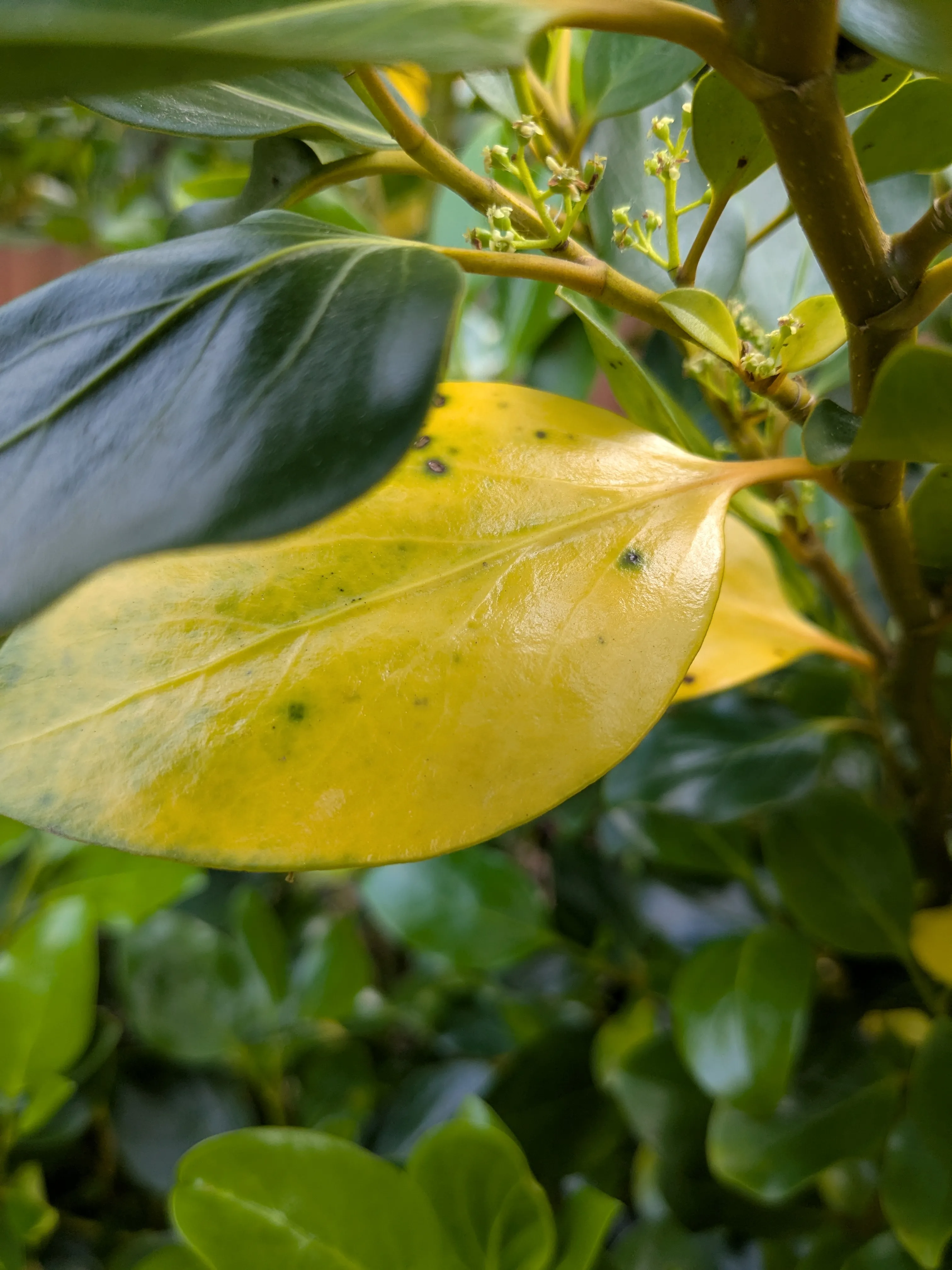
Looking at the yellowing leaves and brown spotting in your photos, this is a combination of symptoms that points to two likely culprits working together rather than a single cause. The good news is that neither is a death sentence for your hedge, and the fact that you planted on a slight ridge shows really sensible thinking.
Waterlogging and Root Stress in Clay Soil
A wet spring on clay soil is the most likely primary cause of the yellowing you're seeing. Even with reasonable drainage and a planted ridge, clay soils in a persistently wet spring can become saturated for long enough to restrict oxygen around the root zone.
Portuguese Laurel is relatively tolerant of clay but it does not appreciate sitting in waterlogged conditions for extended periods, particularly in its first year or two while the root system is still establishing and relatively shallow. When roots are deprived of oxygen they begin to struggle with nutrient uptake, and one of the first visible signs of this is yellowing leaves, often starting with the older lower foliage and working upwards.
The plants being in part shade compounds this slightly because reduced light means slower growth and less vigorous recovery from stress. It is not a problem in itself but it does mean the plants have less capacity to push through a difficult period than they would in full sun.
The Brown Spotting
The brown spots on the leaves are most likely shot hole disease (Stigmina carpophila), a fungal condition that is extremely common on all members of the Prunus family including Portuguese Laurel, particularly after a wet spring exactly like the one you're describing. The fungus spreads readily in cool, damp conditions and causes small brown spots that often drop out of the leaf centre over time, leaving a characteristic hole that gives the disease its name. It looks alarming but it is rarely fatal to an otherwise healthy plant and tends to resolve as conditions dry out and improve through summer.
Bacterial leaf scorch is another possibility for the spotting, again triggered by wet and humid conditions, and it presents in a very similar way so the two are often difficult to tell apart without laboratory analysis. The treatment approach is broadly the same either way.
What to Do Right Now
The most important immediate step is to improve drainage and airflow around the plants as much as you practically can. If you haven't already, add a generous mulch of bark chipping around the base of each plant, keeping it clear of the stems themselves, which will help regulate soil moisture and temperature as conditions improve through summer. Avoid any mulch that sits against the trunk as this can encourage further fungal issues at the base.
Remove any heavily affected leaves by hand and dispose of them in your general waste rather than composting them, as the fungal spores can survive in leaf litter and reinfect the plants next season. This won't cure the problem on its own but it reduces the spore load around the plants and gives you a cleaner starting point.
Check that the planting ridge hasn't settled or compacted over the winter, and if any of the plants look like they're sitting in a slight hollow where water is pooling, build the ridge back up gently around them with some gritty compost or sharp sand worked into the existing soil.
Should You Feed Them?
A slow release balanced granular fertiliser applied around the base of each plant now will help support recovery and push on new healthy growth through the summer. Plants under stress benefit from nutritional support but avoid anything high in nitrogen alone as this pushes soft leafy growth that is more susceptible to further fungal attack. A balanced feed with roughly equal proportions of nitrogen, phosphorus, and potassium is what you're after.
The Bigger Picture
First year establishment on clay in a wet spring is genuinely one of the harder starts a hedge can have, and the fact that most of your plants are showing only limited symptoms so far suggests they are coping reasonably well. Portuguese Laurel is a robust plant with a good track record in exactly these conditions once established. Keep a close eye on things through early summer, and if the spotting spreads significantly or any individual plant starts to look really poorly, rather than just stressed, do post updated photos, and we can reassess.
My laurel hedge dying guide covers the full range of causes in much more detail and is well worth working through alongside this advice.
Hang in there. With a bit of patience and the drier weather that summer should bring, these plants will very likely push through and reward you with exactly the privacy hedge you're hoping for.
Lee Garden Ninja
Hi @gardenaculou
Portuguese Laurel (Prunus lusitanica) is generally one of the toughest and most reliable hedging plants you can choose, so let's work out what's going on and get your hedge back on track.
Looking at the yellowing leaves and brown spotting in your photos, this is a combination of symptoms that points to two likely culprits working together rather than a single cause. The good news is that neither is a death sentence for your hedge, and the fact that you planted on a slight ridge shows really sensible thinking.
Waterlogging and Root Stress in Clay Soil
A wet spring on clay soil is the most likely primary cause of the yellowing you're seeing. Even with reasonable drainage and a planted ridge, clay soils in a persistently wet spring can become saturated for long enough to restrict oxygen around the root zone.
Portuguese Laurel is relatively tolerant of clay but it does not appreciate sitting in waterlogged conditions for extended periods, particularly in its first year or two while the root system is still establishing and relatively shallow. When roots are deprived of oxygen they begin to struggle with nutrient uptake, and one of the first visible signs of this is yellowing leaves, often starting with the older lower foliage and working upwards.
The plants being in part shade compounds this slightly because reduced light means slower growth and less vigorous recovery from stress. It is not a problem in itself but it does mean the plants have less capacity to push through a difficult period than they would in full sun.
The Brown Spotting
The brown spots on the leaves are most likely shot hole disease (Stigmina carpophila), a fungal condition that is extremely common on all members of the Prunus family including Portuguese Laurel, particularly after a wet spring exactly like the one you're describing. The fungus spreads readily in cool, damp conditions and causes small brown spots that often drop out of the leaf centre over time, leaving a characteristic hole that gives the disease its name. It looks alarming but it is rarely fatal to an otherwise healthy plant and tends to resolve as conditions dry out and improve through summer.
Bacterial leaf scorch is another possibility for the spotting, again triggered by wet and humid conditions, and it presents in a very similar way so the two are often difficult to tell apart without laboratory analysis. The treatment approach is broadly the same either way.
What to Do Right Now
The most important immediate step is to improve drainage and airflow around the plants as much as you practically can. If you haven't already, add a generous mulch of bark chipping around the base of each plant, keeping it clear of the stems themselves, which will help regulate soil moisture and temperature as conditions improve through summer. Avoid any mulch that sits against the trunk as this can encourage further fungal issues at the base.
Remove any heavily affected leaves by hand and dispose of them in your general waste rather than composting them, as the fungal spores can survive in leaf litter and reinfect the plants next season. This won't cure the problem on its own but it reduces the spore load around the plants and gives you a cleaner starting point.
Check that the planting ridge hasn't settled or compacted over the winter, and if any of the plants look like they're sitting in a slight hollow where water is pooling, build the ridge back up gently around them with some gritty compost or sharp sand worked into the existing soil.
Should You Feed Them?
A slow release balanced granular fertiliser applied around the base of each plant now will help support recovery and push on new healthy growth through the summer. Plants under stress benefit from nutritional support but avoid anything high in nitrogen alone as this pushes soft leafy growth that is more susceptible to further fungal attack. A balanced feed with roughly equal proportions of nitrogen, phosphorus, and potassium is what you're after.
The Bigger Picture
First year establishment on clay in a wet spring is genuinely one of the harder starts a hedge can have, and the fact that most of your plants are showing only limited symptoms so far suggests they are coping reasonably well. Portuguese Laurel is a robust plant with a good track record in exactly these conditions once established. Keep a close eye on things through early summer, and if the spotting spreads significantly or any individual plant starts to look really poorly, rather than just stressed, do post updated photos, and we can reassess.
My laurel hedge dying guide covers the full range of causes in much more detail and is well worth working through alongside this advice.
Hang in there. With a bit of patience and the drier weather that summer should bring, these plants will very likely push through and reward you with exactly the privacy hedge you're hoping for.
Lee Garden Ninja
 Lee Burkhill: Award Winning Designer & BBC 1's Garden Rescue Presenters Official Blog