Hi Rosemary,
What a fab opportunity you have here Ninja. Living by the sea in Scotland with 25 years of knowing exactly how your garden behaves gives you a real advantage when it comes to making the right choice, and the fact that you've already thinned the hedge means you have a head start rather than a setback. If you've followed me on social media, you will know I am obsessed with travelling all around Scotland in my motorhome and visiting gardens wherever I can!
The first thing I'd say is that your instinct about replacing rather than restoring is a sound one. Most hedges, with the notable exception of conifers, will regenerate well from a hard prune. If your existing hedge is deciduous or mixed, cutting it back hard to around 60cm now, just before spring growth kicks in, will trigger strong regrowth from the base. Within a couple of seasons you'd have a rejuvenated structure to work with. So that option is very much still on the table if you want a safety net while you plan.
That said, if this is truly your moment to make a change, I'd strongly encourage you to take it. Coastal gardens in Scotland are a specific and quite demanding environment, and the plants you choose need to be genuinely tough rather than just attractive in a catalogue photo.
My first recommendation would be Rosa rugosa.
This is the plant I'd reach for first in your situation. You'll see it growing wild along coastal roads and in the dunes of almost every Scottish seaside town, which tells you everything you need to know about its resilience. It handles salt-laden winds, poor sandy soils, and exposed positions with remarkable ease. It gives you fragrant flowers in pink or white through summer, striking orange-red hips well into autumn and winter, and the foliage has a lovely textured, wrinkled quality that looks quite different from a typical formal hedge. It's also brilliant for wildlife, with bees loving the open flowers and birds feeding on the hips.
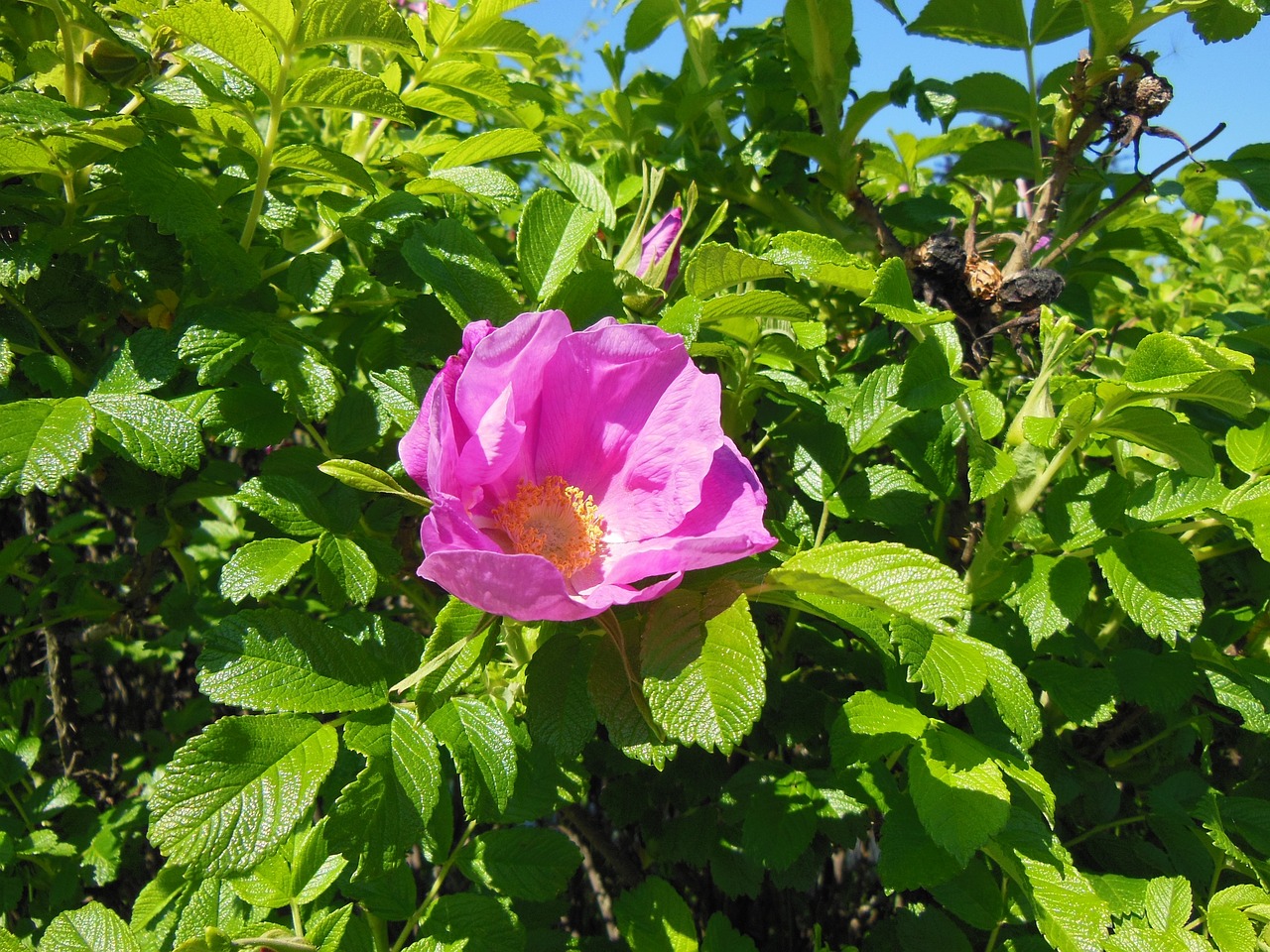
As an informal boundary, it provides excellent shelter without needing constant trimming, which sounds like exactly what you're after.
A mixed informal hedge is another approach well worth considering. Rather than a single species planted in a row, a mixture of coastal-tolerant shrubs planted in a loose, relaxed arrangement gives you year-round interest, varied wildlife value, and a far more natural look that suits a seaside setting.
Alongside Rosa rugosa you might include Escallonia, which is a superb coastal performer and carries pink or red flowers across summer. Pittosporum tenuifolium is another strong option for your part of Scotland, particularly the hardier varieties, and gives you year-round evergreen structure with that lovely silvery-green foliage. Elaeagnus x ebbingei is tough as old boots in coastal conditions and provides dense evergreen shelter with a subtle fragrance in autumn.
One thing I'd caution against quite firmly: avoid Cherry Laurel and anything with very large, dense evergreen foliage that's going to form a solid wall. You mention catching the evening sun in that area, and if you have any view of the sea, even a partial one, a solid evergreen screen will quickly steal that from you.
The beauty of an informal mixed planting is that you can keep it to a height that shelters without blocking, and the open structure of something like Rosa rugosa lets light and glimpses of sky and sea through rather than creating a green wall.
In terms of timing, planting now or over the next few weeks as we move into spring is ideal for bare-root or container-grown shrubs. They'll establish through the growing season and be putting on proper growth by summer. If you do decide to hard prune what's there as a temporary measure, you can plant the new shrubs alongside or in front of the existing structure and let both establish together.
It sounds like a genuinely exciting moment for that part of your garden, Rosemary. The fact that you know your site so well after 25 years means you'll make the right call.
You might find these guides useful as you plan:
How to Prune Hedges | Coastal Garden Plants | Garden Design for Shelter and Privacy
Do let us know what you decide. I'd love to see how it transforms.
Lee Garden Ninja — Garden Ninja
Hi Rosemary,
What a fab opportunity you have here Ninja. Living by the sea in Scotland with 25 years of knowing exactly how your garden behaves gives you a real advantage when it comes to making the right choice, and the fact that you've already thinned the hedge means you have a head start rather than a setback. If you've followed me on social media, you will know I am obsessed with travelling all around Scotland in my motorhome and visiting gardens wherever I can!
The first thing I'd say is that your instinct about replacing rather than restoring is a sound one. Most hedges, with the notable exception of conifers, will regenerate well from a hard prune. If your existing hedge is deciduous or mixed, cutting it back hard to around 60cm now, just before spring growth kicks in, will trigger strong regrowth from the base. Within a couple of seasons you'd have a rejuvenated structure to work with. So that option is very much still on the table if you want a safety net while you plan.
That said, if this is truly your moment to make a change, I'd strongly encourage you to take it. Coastal gardens in Scotland are a specific and quite demanding environment, and the plants you choose need to be genuinely tough rather than just attractive in a catalogue photo.
My first recommendation would be Rosa rugosa.
This is the plant I'd reach for first in your situation. You'll see it growing wild along coastal roads and in the dunes of almost every Scottish seaside town, which tells you everything you need to know about its resilience. It handles salt-laden winds, poor sandy soils, and exposed positions with remarkable ease. It gives you fragrant flowers in pink or white through summer, striking orange-red hips well into autumn and winter, and the foliage has a lovely textured, wrinkled quality that looks quite different from a typical formal hedge. It's also brilliant for wildlife, with bees loving the open flowers and birds feeding on the hips.
As an informal boundary, it provides excellent shelter without needing constant trimming, which sounds like exactly what you're after.
A mixed informal hedge is another approach well worth considering. Rather than a single species planted in a row, a mixture of coastal-tolerant shrubs planted in a loose, relaxed arrangement gives you year-round interest, varied wildlife value, and a far more natural look that suits a seaside setting.
Alongside Rosa rugosa you might include Escallonia, which is a superb coastal performer and carries pink or red flowers across summer. Pittosporum tenuifolium is another strong option for your part of Scotland, particularly the hardier varieties, and gives you year-round evergreen structure with that lovely silvery-green foliage. Elaeagnus x ebbingei is tough as old boots in coastal conditions and provides dense evergreen shelter with a subtle fragrance in autumn.
One thing I'd caution against quite firmly: avoid Cherry Laurel and anything with very large, dense evergreen foliage that's going to form a solid wall. You mention catching the evening sun in that area, and if you have any view of the sea, even a partial one, a solid evergreen screen will quickly steal that from you.
The beauty of an informal mixed planting is that you can keep it to a height that shelters without blocking, and the open structure of something like Rosa rugosa lets light and glimpses of sky and sea through rather than creating a green wall.
In terms of timing, planting now or over the next few weeks as we move into spring is ideal for bare-root or container-grown shrubs. They'll establish through the growing season and be putting on proper growth by summer. If you do decide to hard prune what's there as a temporary measure, you can plant the new shrubs alongside or in front of the existing structure and let both establish together.
It sounds like a genuinely exciting moment for that part of your garden, Rosemary. The fact that you know your site so well after 25 years means you'll make the right call.
You might find these guides useful as you plan:
How to Prune Hedges | Coastal Garden Plants | Garden Design for Shelter and Privacy
Do let us know what you decide. I'd love to see how it transforms.
Lee Garden Ninja — Garden Ninja

 Lee Burkhill: Award Winning Designer & BBC 1's Garden Rescue Presenters Official Blog