Hi @vjames
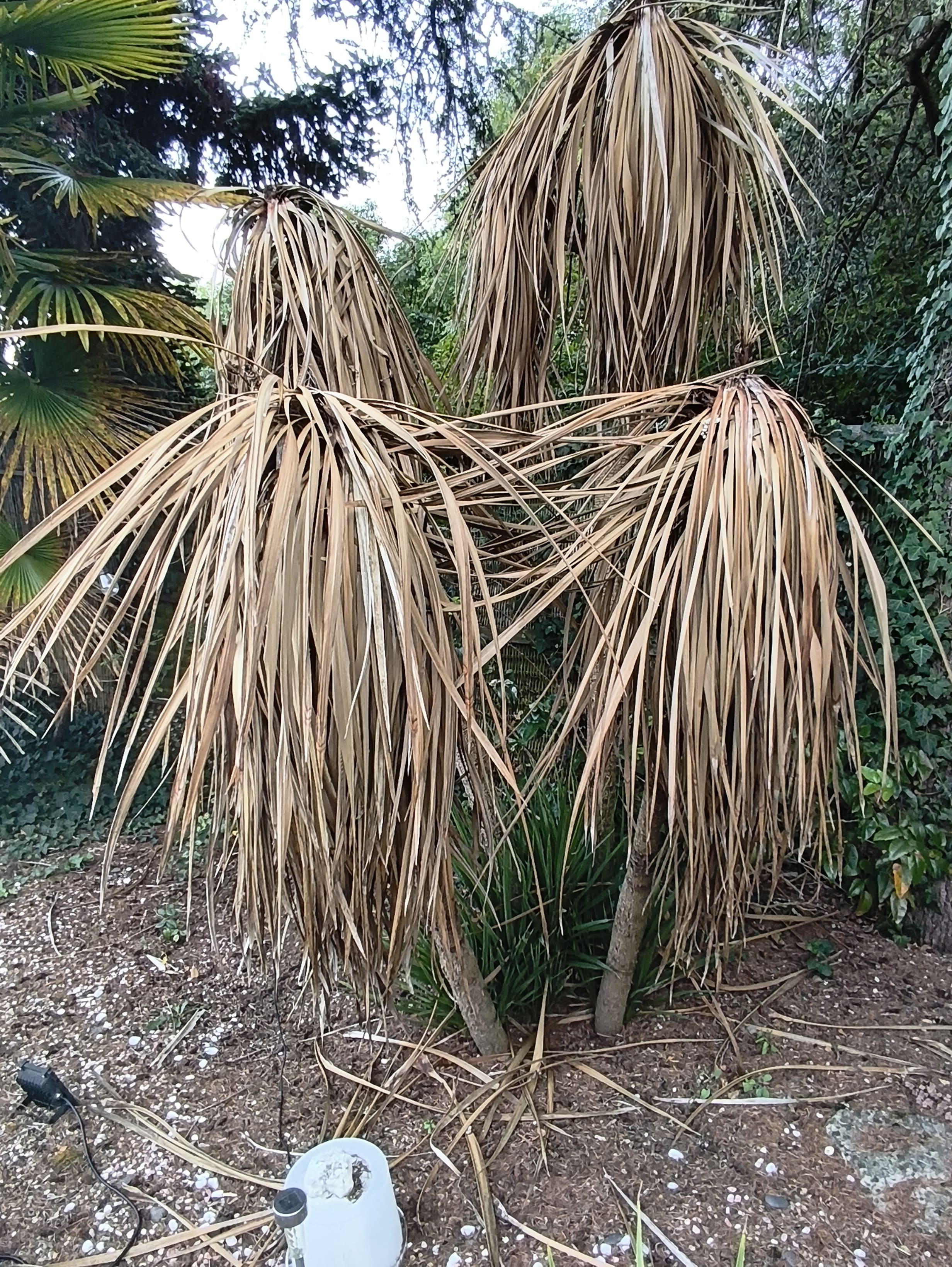
Thanks so much for the photo, it's really helpful for assessing what's going on here. Looking at your dragon tree, it's clear the 40+ degree heat has taken a serious toll, and I want to give you an honest assessment of where things stand rather than just tell you what you want to hear.
What the Photo is Telling Us
Before we even get to the pruning question, something in that image needs addressing urgently. Look at the soil around your dragon tree. It's bone dry, pale, compacted, and showing all the signs of prolonged moisture deprivation. This matters enormously because of a misconception that catches a lot of gardeners out.
Dragon trees, like many plants we associate with hot or tropical climates, are often assumed to be immune to drought. They're not. In their natural habitat on the Canary Islands, Dracaena draco benefits from coastal moisture, morning mist, and seasonal rainfall. They're adapted to periods of dryness, yes, but they are not adapted to the kind of sustained, extreme heat and soil desiccation you're describing at 40+ degrees with what looks like no meaningful moisture reaching those roots. The same principle applies to desert plants like cacti and succulents. Even the most drought-adapted plants have a threshold beyond which they cannot function, and prolonged extreme heat with zero soil moisture will push any plant past that point regardless of its origins.
The first thing to do before any pruning whatsoever is to water these trees deeply and thoroughly, and keep doing so over the coming days. Slow, deep watering that penetrates right down to the root zone, rather than a quick splash on the surface, gives the root system the best chance of beginning to function again before you add the additional stress of pruning cuts. My heatwave watering guide covers exactly how to do this effectively, and my finger test method will help you judge when the soil has recovered enough moisture before you consider any intervention. My top 10 watering tips are also worth bookmarking for future reference.
Those New Shoots at the Base
The new shoots emerging at the base of your dragon trees are the single most encouraging thing in your photo and your message. This tells you the root system is alive and the plant has not given up. When a plant pushes new growth from the base after severe stress, it's essentially making a survival decision to start fresh from the ground up, redirecting whatever resources it has left into new viable growth. That's a really important signal that there is life in these trees worth saving.
The Hard Pruning Question
This is where I want to be straightforward with you. Hard pruning a severely stressed dragon tree carries real risk, and I wouldn't recommend going in hard on the trunks right now. Pruning is more successful when the plant has steady light exposure to fuel recovery, and cutting back during periods of drought stress compounds the problem rather than solving it. Your trees are currently in exactly that situation, and adding the trauma of significant pruning cuts whilst the root system is already struggling to supply moisture and nutrients is asking too much of a plant already on its knees.
Even if the top growth looks completely gone, the roots may well still have viable tissue, so don't remove the plants yet. The dead foliage looks alarming, but the trunks and roots underneath may tell a very different story. My beginner's pruning guide covers the general principles of when to prune and when to hold back, which is just as important as knowing how to make the cuts themselves.
What to Do Right Now
Start by removing the dead leaves carefully, working from the bottom of each rosette upwards. This tidies the plant considerably, reduces the weight on the trunks, and lets you assess the condition of the stems underneath more clearly. Dead leaves on a dragon tree peel away relatively easily and their removal won't stress the plant further.
Once you've removed the dead foliage and established a thorough, consistent watering routine over several weeks, scratch the bark on each trunk very gently with your thumbnail. Green or cream-coloured moist tissue underneath means that trunk is alive. Dry, papery, brown tissue all the way through suggests it's beyond recovery. Do this test on several points along each trunk before making any decisions about cutting them back.
If the trunks do test as alive after a few weeks of good watering, dragon trees can be cut back to almost any height and will push new growth from below the cut point, often producing two or more new heads of foliage where there was one before. But that conversation is for later, once the plant has had a chance to stabilise with consistent moisture and the stress of the heatwave has passed.
The Honest Prognosis
The basal shoots give me real hope for these trees. Even if the main trunks don't recover, those new shoots from the base can develop into new trunks over time, effectively renewing the plant from the ground up. That's not the immediate result you're hoping for, but it's far better than losing the plants entirely.
Focus on water, patience, and gentle leaf removal for now. The pruning question will become much clearer once the trees have had several weeks of proper care and you can assess which parts of the trunk structure are still viable.
Happy gardening Veronica, and please do post an update in a few weeks once you've had a chance to get some moisture back into that soil!
Hi @vjames
Thanks so much for the photo, it's really helpful for assessing what's going on here. Looking at your dragon tree, it's clear the 40+ degree heat has taken a serious toll, and I want to give you an honest assessment of where things stand rather than just tell you what you want to hear.
What the Photo is Telling Us
Before we even get to the pruning question, something in that image needs addressing urgently. Look at the soil around your dragon tree. It's bone dry, pale, compacted, and showing all the signs of prolonged moisture deprivation. This matters enormously because of a misconception that catches a lot of gardeners out.
Dragon trees, like many plants we associate with hot or tropical climates, are often assumed to be immune to drought. They're not. In their natural habitat on the Canary Islands, Dracaena draco benefits from coastal moisture, morning mist, and seasonal rainfall. They're adapted to periods of dryness, yes, but they are not adapted to the kind of sustained, extreme heat and soil desiccation you're describing at 40+ degrees with what looks like no meaningful moisture reaching those roots. The same principle applies to desert plants like cacti and succulents. Even the most drought-adapted plants have a threshold beyond which they cannot function, and prolonged extreme heat with zero soil moisture will push any plant past that point regardless of its origins.
The first thing to do before any pruning whatsoever is to water these trees deeply and thoroughly, and keep doing so over the coming days. Slow, deep watering that penetrates right down to the root zone, rather than a quick splash on the surface, gives the root system the best chance of beginning to function again before you add the additional stress of pruning cuts. My heatwave watering guide covers exactly how to do this effectively, and my finger test method will help you judge when the soil has recovered enough moisture before you consider any intervention. My top 10 watering tips are also worth bookmarking for future reference.
Those New Shoots at the Base
The new shoots emerging at the base of your dragon trees are the single most encouraging thing in your photo and your message. This tells you the root system is alive and the plant has not given up. When a plant pushes new growth from the base after severe stress, it's essentially making a survival decision to start fresh from the ground up, redirecting whatever resources it has left into new viable growth. That's a really important signal that there is life in these trees worth saving.
The Hard Pruning Question
This is where I want to be straightforward with you. Hard pruning a severely stressed dragon tree carries real risk, and I wouldn't recommend going in hard on the trunks right now. Pruning is more successful when the plant has steady light exposure to fuel recovery, and cutting back during periods of drought stress compounds the problem rather than solving it. Your trees are currently in exactly that situation, and adding the trauma of significant pruning cuts whilst the root system is already struggling to supply moisture and nutrients is asking too much of a plant already on its knees.
Even if the top growth looks completely gone, the roots may well still have viable tissue, so don't remove the plants yet. The dead foliage looks alarming, but the trunks and roots underneath may tell a very different story. My beginner's pruning guide covers the general principles of when to prune and when to hold back, which is just as important as knowing how to make the cuts themselves.
What to Do Right Now
Start by removing the dead leaves carefully, working from the bottom of each rosette upwards. This tidies the plant considerably, reduces the weight on the trunks, and lets you assess the condition of the stems underneath more clearly. Dead leaves on a dragon tree peel away relatively easily and their removal won't stress the plant further.
Once you've removed the dead foliage and established a thorough, consistent watering routine over several weeks, scratch the bark on each trunk very gently with your thumbnail. Green or cream-coloured moist tissue underneath means that trunk is alive. Dry, papery, brown tissue all the way through suggests it's beyond recovery. Do this test on several points along each trunk before making any decisions about cutting them back.
If the trunks do test as alive after a few weeks of good watering, dragon trees can be cut back to almost any height and will push new growth from below the cut point, often producing two or more new heads of foliage where there was one before. But that conversation is for later, once the plant has had a chance to stabilise with consistent moisture and the stress of the heatwave has passed.
The Honest Prognosis
The basal shoots give me real hope for these trees. Even if the main trunks don't recover, those new shoots from the base can develop into new trunks over time, effectively renewing the plant from the ground up. That's not the immediate result you're hoping for, but it's far better than losing the plants entirely.
Focus on water, patience, and gentle leaf removal for now. The pruning question will become much clearer once the trees have had several weeks of proper care and you can assess which parts of the trunk structure are still viable.
Happy gardening Veronica, and please do post an update in a few weeks once you've had a chance to get some moisture back into that soil!
 Lee Burkhill: Award Winning Designer & BBC 1's Garden Rescue Presenters Official Blog